Introduction
Japan has repeatedly suffered from natural disasters (Figure 1). A great earthquake with a magnitude of 7.2 (i.e., the Great Hanshin-Awaji Earthquake [GHAE]) struck Kobe City, which is 1 of the major port towns in Japan, and killed more than 6400 people on January 17, 1997. 1–3 The Great East Japan Earthquake (GEJE) with a magnitude of 9.0 and a subsequent huge tsunami, struck the northeastern region of Japan on March 11, 2011, and claimed more than 20000 lives. 4,5 On April 16, 2016, a great earthquake with a magnitude of 7.0 (i.e., the Kumamoto Earthquake [KE]), which followed a foreshock with a magnitude of 6.5, struck the Kumamoto and Oita Prefectures in Kyushu Island in southwestern Japan. Consequently, it killed 230 people and destroyed more than 200000 houses. 6
Recent great earthquakes in Japan Japan was struck by many great earthquakes including the Great Hanshin-Awaji Earthquake in 1995, the Great East Japan Earthquake in 2011, and the Kumamoto Earthquake in 2016.

In areas that are struck by major natural disasters such as the aforementioned earthquakes, a number of residents are forced to evacuate their homes and stay in local temporary evacuation shelters. For example, more than 200000 evacuees stayed in local evacuation shelters during the first month that followed the GHAE because they had lost their homes. Reference Nakamura7 The GEJE forced more than 470000 residents to stay in evacuation shelters. 8 Operational efficiency of temporary evacuation shelters had improved after the GHAE, but a number of problems and concerns were encountered in the temporary evacuation shelters that had been organized in response to the GEJE and KE. Most evacuation shelters were packed with evacuees and operated under unsanitary conditions. Reference Fuse, Igarashi and Tanaka9 The food that was provided to the evacuees was poor in terms of quantity and quality. 10 Although the nationwide implementation of disaster medical coordinators was undertaken after the GEJE, prefectural governments did not use such coordinators to manage evacuation shelters. Reference Egawa, Suda, Jones-Konneh, Murakami and Sasaki11 However, no systematic review has been published in the past to answer the research question “what are the medical problems and concerns encountered in evacuation shelters?”
The purpose of the present study was to review the literature on the medical problems and concerns that were encountered in evacuation shelters after the occurrence of the great earthquakes in Japan by focusing on sanitation, food and nutrition, and medication.
Methods
A systematic review of the existing literature on the medical problems and concerns that were encountered in temporary evacuation shelters after the occurrence of major earthquakes in Japan was conducted.
Search Strategy
The authors followed the Preferred Reporting Items for Systematic Review and Meta-Analysis Protocols (PRISMA–P; Moher, et al., 2015). Articles that were published between January, 1995 and August, 2019 were retrieved from 2 databases, namely, PubMed and Japan Medical Abstracts Society (JMAS). Combinations of controlled vocabulary (i.e., medical subject headings) and keywords (e.g., disaster, earthquake, evacuation, evacuation shelter, evacuee, Great Hanshin-Awaji Earthquake, Great East Japan Earthquake, Kumamoto Earthquake) were used for this purpose. Hand searching of official documents issued by the central and local governments and press releases were also completed using Google and Yahoo! Japan as needed.
Inclusion and Exclusion Criteria
Inclusion criteria for this review were as follows: (1) Published in English or Japanese between January, 1995 and August, 2019 that addressed conditions of evacuation shelter organized in response to the GHAE, GEJE, and KE. (2) Not only articles presenting Level I studies (i.e., systematic reviews, meta-analyses, and randomized controlled trials), Level II studies (2-group, non-randomized designs), and Level III studies (1-group, non-randomized designs) but also articles presenting Level IV (descriptive studies) and Level V (case reports and expert opinion) were included in the present review.
Exclusion criteria in this review included: (1) Articles that pertained to evacuation shelters that had been organized in response to the accident of the Fukushima Daiichi Nuclear Power Plant (FDNPP) were excluded because shelters after FDNPP accident might have different kinds of issues from those organized after other natural disasters e.g., evacuation extending over a number of years due to the radioactive contamination of residence areas.
Results
Figure 2 is a flowchart that provides details about the search results. Initially, 94 articles were retrieved from PubMed. These articles only provided Level IV and V evidence, and no article was retrieved with Level I, II, and III evidence. A review of those selected empirical literature revealed that the following 3 factors were repeatedly reported as factors that have an important influence on the health of evacuees: (1) unsanitary environment, (2) insufficient food supply, and (3) shortage of medication in evacuation shelters. The second-round database search on PubMed was conducted using the following sets of keywords, and it yielded 7, 5, and 3 papers, respectively: (1) unsanitary environment: hygiene OR management OR sanitary OR space OR latrine OR toilet; (2) insufficient food supply: dietary OR food OR nutrition; and (3) shortage of medication: drug OR medication. Additionally, 12 papers were retrieved from JMAS and through a search for administrative documents. Thus, a total of 26 articles were included in the present review (Table 1, the second and third columns). The U.S. Preventive Services Task Force (2013) definitions for level of certainty were used to classify the evidence as a whole as strong, moderate, or low. Strong evidence indicates 2 or more well-designed Level I studies. Moderate evidence indicates at least 1 high-quality Level I study or multiple moderate-quality studies. Low evidence indicates a small number of studies with inconsistent findings or flaws. Using these definitions, the certainty of this review would be moderate because the findings were consistent as a whole, although no Level I study was retrieved. Since all of the selected literatures were of empirical documentation, it was not possible to synthesize those data to perform a meta-analysis.
Flow chart of the literature search. Relevant papers searched from PubMed as well as from JMAS were included in the present study. Note that this chart corresponds to the second and third columns of Table 1.

Medical concerns, health consequences, and recommended countermeasures regarding evacuation shelters organized in response to great earthquakes

Unsanitary Environment
Limited Space Availability
After the GEJE had struck, community centers (36%), public schools (33%), and nursing homes (10%), Reference Tokuda, Kunishima and Gu12 were temporarily designated as evacuation shelters even though they had limited space availability. The average area per evacuee was only 1.8m2 in the shelters in Ishinomaki City that had been affected by the GEJE. Reference Tanno13 In 1 shelter, 50 evacuees were housed within a 60m2 area (i.e., 1.2m2 per evacuee). Reference Kanamori, Aso and Tadano14 It was also very difficult to maintain a minimal distance of 1m between evacuees within the evacuation shelters. Reference Tokuda, Kunishima and Gu12 In most evacuation shelters, the distance between different families was also less than 1m. This underscores the difficulties that are involved in implementing droplet precautions in such environments. Reference Kanamori, Kunishima, Tokuda and Kaku15 In addition, the GHAE and GEJE occurred in the months of January and March, respectively. Since these months are characterized by relatively cold weather, doors and windows were kept shut. As a result, these evacuation centers were poorly ventilated. Reference Kanamori, Kunishima, Tokuda and Kaku15,Reference Yanai16
Disrupted Lifelines (Infrastructure)
The unavailability or insufficient supply of running water was a hygienic problem. In most cases, there was no running water in evacuation shelters during the early phases of the disasters. Reference Tsuboyama-Kasaoka, Hoshi, Onodera, Mizuno and Sako17 It took approximately 3 months to completely restore water supply in Kobe City after the GHAE. 18 Gas and electricity supply were also significantly affected. Reference Tsuboyama-Kasaoka, Hoshi, Onodera, Mizuno and Sako17 In the case of the GEJE, it took 4 and 6 weeks for gas and electricity supply to be 90% restored, respectively. Reference Amagai, Ichimaru, Tai, Ejiri and Muto19
Latrines
In April, 2016, Japan established the national guidelines for the operation of evacuation shelters 20 in accordance with the international guidelines for humanitarian missions. 21,22 It protects the privacy of evacuees and offers due consideration to older adults, children, women, and individuals with disabilities. However, in the case of the KE, which struck in 2016, post- disaster operations largely failed to meet the requirements of these guidelines. Specifically, it was common for unsanitary and unsafe latrines to be situated outside evacuation shelters; this was inconvenient, especially to older adults and women. It was also unfortunate that the norovirus outbreak occurred at an evacuation shelter a week after the KE. Reference Izumikawa23
Concerns Related to Food and Nutrition
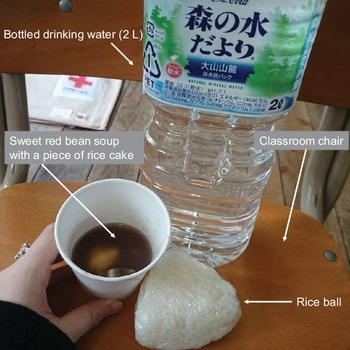
Inadequate efforts were taken to meet the dietary, and nutritional needs of the evacuees. Reference Yanagihara, Hatakeyama and Iwasaki24 The food that was offered in evacuation shelters was not always nutritionally balanced. Most foods that were offered during the early phases of rescue operations were carbohydrate-based items such as rice balls and bread (Figure 3), Reference Tsuboyama-Kasaoka, Hoshi, Onodera, Mizuno and Sako17,Reference Hirai, Okuda and Masuda25,26 possibly because they are easy to serve and are abundantly available in emergence food pantries. The amount of vitamins B and C and vegetable fibers that these foods contained were less than 50% of the required level. 27 For example, food offered in evacuation shelters in Miyagi Prefecture contained only 66%, 68%, and 32% of the recommended amount of vitamin B1, B2, and C, respectively. 27 It has been pointed out that living in environments that are grossly dissimilar to one’s home is associated with poor dietary intake. The likelihood for adequate consumption of food was significantly lower among those who were living in evacuation shelters and temporary housing facilities than among those who were living in their own homes or relatives’ homes. Reference Zhang, Ohira and Abe28 This underscores the need to provide evacuees who live in evacuation shelters and temporary housing facilities with balanced meals.
An example of a carbohydrate-based meal offered at an evacuation shelter in Kumamoto. A bottle of water (top), a rice ball (bottom right) and a cup of oshiruko (sweet red-bean soup with a piece of rice cake) were served as lunch to evacuees 3 days after the earthquake. Note that foods were placed on a classroom chair; evacuees ate them sitting on the flat and hard wooden floor.
Source: http://bylines.news.yahoo.co.jp/horijun/20160421-00056849/ courtesy of Mr. Jun Hori (8bitNews, Tokyo, Japan) with permission.

Another dietary problem was the excessive consumption of sodium by evacuees. Reference Amagai, Ichimaru, Tai, Ejiri and Muto19 For example, canned sardine, which is a protein-rich food item, is a preferred food aid among evacuees who are primarily provided with carbohydrate-rich foods. However, the amount of salt in such food items is more than double the daily requirement. Conversely, it contains less than 50% of the daily requirements for vitamins A, B6, and D. Reference Amagai, Ichimaru, Tai, Ejiri and Muto19
Imbalanced distribution of food across different evacuation shelters was another problem. For example, in 1 city that had been affected by the GEJE, out of a total of 67 evacuation centers (7423 evacuees), 53 (79%) shelters had experienced food shortages, whereas 24 (36%) of them had excess food. Reference Tsuboyama-Kasaoka, Hoshi, Onodera, Mizuno and Sako17
Delayed lifeline restoration is correlated with inadequate quantity and quality of food in evacuation shelters. Indeed, the frequency with which meals, grains, and vegetables were provided to evacuees was significantly higher in evacuation shelters that were equipped to cook food than in those that did not have the resources to do so. Reference Tsuboyama-Kasaoka, Hoshi, Onodera, Mizuno and Sako17
Shortage of Medication
Emergency medical teams carried pharmacy kits that were intended to be used throughout the acute phase of post-disaster rescue operations. 29–32 Thus, drugs for chronic diseases were limited both in terms of quantity and variety. Furthermore, a number of patients with chronic diseases feared that there may be a shortage of the medications that they require (e.g., antihypertensives and antidiabetics). As a result of the shortage of medication, the prescriptions that were provided to evacuees entailed a narrower range of drugs and shorter courses of treatment. Reference Yamaguchi33 In many cases, there was no choice except changing prescriptions because other identical drugs were not included in pharmacy kits. Reference Ooe34 Meanwhile, another article reported that only a third of the drugs that were included in emergent pharmacy kits had been used. Reference Handa, Kuroiwa and Ishii35
In the case of the GEJE, personal property was lost as a result of the subsequent tsunami, and many people were left without medication and/or their prescriptions. In many cases, there was no way to identify the drugs that the evacuees had been prescribed. A list of medications (not necessarily a formal prescription) efficiently helped emergency medical teams dispense the required drugs to evacuees. Reference Mitani, Kako and Mayner36 A pocket-sized personal prescription record, which was called the “Drug Notebook” (Japanese: Okusuri-Techo), has been distributed by the Japan Pharmaceutical Association in time of peace. 37 The Drug Notebook was immensely helpful in not only retrieving prescriptions but also collecting medical information from the evacuees who had been staying in the evacuation shelters. Reference Ooe34,37–Reference Tsuzuki39
Discussion
The preceding sections narratively reviewed the medical problems and concerns that were encountered in the evacuation shelters that were organized in response to the great earthquakes that struck Japan. No review has been published in the past on those as far as the present authors surveyed, which underscore the novelty of our study. Disaster is defined as a serious disruption of the functioning of a community that causes widespread human, material, economic, or environmental losses, which exceed the ability of the affected community to cope with these losses using its own resources. 40 Thus, the magnitude of the consequences of sudden natural hazards is a direct result of the manner in which individuals and communities respond to the threats that are posed by these hazards. Thus, the magnitude of the impact of a natural hazard is determined by human action or a lack thereof. 40 Those who experienced lower initial exposure (impact of a natural hazard) but then received less post-disaster help reported poorer quality of life (QOL). Thus, the role that post-disaster conditions in evacuation shelters play in post-disaster QOL may be as important as that of pre-disaster vulnerability and the disaster itself. Reference Wang, Gao, Zhang, Zhao, Shen and Shinfuku41
Guidelines that pertain to the provision of temporary humanitarian shelters for refugees, 21,22 recommend that evacuation shelters must have a minimum living space of 3.5m2 per person. Furthermore, evacuation shelters must have a minimum of 1 latrine per 20 persons. Latrines must be located within 50m of dwelling places to enhance accessibility and at least 6m away from dwelling places to ensure that the evacuees are not exposed to foul odors that may emanate from the latrines. Additionally, 75% of the latrines must be designated for women. The Japanese government has established guidelines for the operation of evacuation shelters 20 in accordance with those international guidelines. 21,22 However, as illustrated by the aforementioned examples, the rescue operations were not compliant with these guidelines. Such unsanitary conditions and concerns about the availability of food and medications can have substantial influences on the spread of infections and chronic diseases among evacuees (Table 1).
Increased Risk for Infectious Diseases
Increased risk for infectious diseases, especially acute respiratory infection, tuberculosis, and waterborne diarrheal diseases, Reference Yanai16,Reference Izumikawa23,Reference Watson, Gayer and Connolly42,Reference Kawano, Hasegawa, Watase, Morita and Yamamura43 among evacuees who stay in evacuation shelters is a major public health problem. As noted earlier, crowding in evacuation shelters is associated with an increased incidence of acute respiratory infection after a natural disaster. Reference Kawano, Tsugawa, Nishiyama, Morita, Yamamura and Hasegawa44 The number of patients with community-acquired pneumonia in Miyagi Prefecture was 2.2 times higher after the GEJE. Furthermore, in 50% of the cases, the condition had originated from evacuation shelters. Reference Ohkouchi, Shibuya, Yanai, Kikuchi, Ichinose and Nukiwa45 The Japanese government, 46 and related academic societies, 47 have published guidelines for infection control in evacuation shelters in accordance with the guideline of the Centers for Disease Control and Prevention. 48 However, the actual operation of evacuation shelters that were organized in response to the KE largely failed to meet these requirements. Consequently, there was a norovirus outbreak a week after the KE. Reference Izumikawa23
Japan is 1 of the middle-burden countries with regard to tuberculosis, and its prevalence rate was 14.4 cases per 100000 individuals in 2016. 49 Thus, precautions against tuberculosis infection must be included in the national response to a large-scale disaster. In the coastal region of Northern Miyagi Prefecture, which was struck by the tsunami that followed the GEJE, the number of patients with tuberculosis was almost twice as high during the post-disaster period than during the pre-disaster period (9.6 vs. 19.1 cases per 100000 individuals, P < 0.001). In addition, staying in evacuation shelters was a risk factor for the contraction of tuberculosis (odds ratio: 19.31, 95% CI: 1.11, 334.80). Reference Sakurai, Takahashi, Ohuchi, Terui, Kiryu and Shikano50 The prevalence of latent tuberculosis infection was reportedly as high as 20% among 50 evacuees who were staying in a 60m2 shelter. Reference Kanamori, Aso and Tadano14 Those who had been exposed to a patient with active tuberculosis for more than 25 days in an evacuation shelter (19%) were more likely to obtain positive results on the interferon-gamma release assay test than those who had not been exposed (3%) to such an individual (P = 0.008). Reference Kanamori51 Minimum ventilation (e.g., closed windows and doors) and limited space availability were also associated with positive results on the tuberculin sensitivity test. Reference Bailey, Gerald, Kimerling, Redden, Brook, Bruce, Tang, Duncan, Brooks and Dunlap52
In evacuation shelters, evacuees must share unsanitary latrines that have not been adequately cleaned and maintained. In addition, requirements for the hygienic handling of food were not adequately met. Reference Tokuda, Kunishima and Gu12 This was especially true of evacuation shelters in which water supply had not been restored. These conditions may have led to an increased risk of contracting waterborne diarrheal diseases. Reference Watson, Gayer and Connolly42
The coronavirus disease 2019 (COVID-19) pandemic has caused a significant burden on health care systems globally. COVID-19 is caused by the novel severe acute respiratory syndrome coronavirus 2 (SARS-CoV-2). Since it is estimated that 50% of transmission may occur via pre-symptomatic carriers, Reference Wiersinga, Rhodes, Cheng, Peacock and Prescott53 SARS-CoV-2 infection could be a pressing threat in evacuation shelters. After the first domestic detection of COVID-19 on January 17, 2020, 54 evacuation shelters were organized in response to a heavy rain in Kyushu Island (2020 Kyushu floods) and a Typhoon (Typhoon Haishen). 55,56 No outbreak was reported in those shelters up to the present. On January 7, 2021, the Japanese government declared a state of emergency in response to the recent increase in the number of COVID-19. Should a large disaster occur, risk of outbreak in evacuation shelters would not be low. It would also be difficult to reject evacuees with fever or respiratory symptoms from a humanitarian perspective. Operation of evacuation shelters would also be more complicated in such a scenario.
Exacerbation of Chronic Diseases
In the case of the GEJE, the disaster area had a large proportion of older adults who had chronic conditions and required medication to maintain their health. For example, in 2011, the percentage of the population that was 65 years of age or older was 27% in Iwate Prefecture and 21% in Tokyo (P < 0.001). 57 Poor living environments and nutritional intake among evacuees who stay in evacuation shelters have been found to be correlated with exacerbation of chronic diseases after disasters. For example, there was a high demand for drugs for chronic medical conditions among evacuees after the occurrence of Hurricane Katrina in 2005. Reference Jhung, Shehab and Rohr-Allegrini58
Many diabetic patients in evacuation shelters were unable to keep good control of their blood glucose level as a result of unfavorable living environments and inadequate nutritional intake. In addition, many patients with diabetes mellitus lost their oral antidiabetic agents and insulin. Reference Kishimoto and Noda59 Consequently, a significant increase in mean glycated hemoglobin (HbA1c) level was observed among diabetic patients after the GHAE. Reference Kirizuka, Nishizaki and Kohriyama60 Post-disaster glycemic control was particularly vulnerable to deterioration among diabetic patients with reduced capacity for endogenous insulin secretion. Reference Tanaka, Imai and Satoh61
Natural disasters have been linked to the exacerbation of hypertension among evacuees who stay in evacuation shelters. Reference Nishizawa, Hoshide, Shimpo and Kario62 High salt intake and increased salt sensitivity, which is caused by disrupted circadian rhythms, lead to neurohumoral activation under stressful conditions, and may consequently exacerbate post-disaster hypertension. Reference Nishizawa, Hoshide, Shimpo and Kario62,Reference Kario63 In addition, most of the evacuees who stayed in shelters sat on the floor (since there were no chairs) during the daytime and lay down on the floor at night. This may have resulted in an elevation in their blood pressures. Reference Nara, Ueda, Aoki, Tamada, Yamaguchi and Hongo64 The introduction of makeshift cardboard beds significantly reduced high blood pressure among evacuees. Reference Nara, Ueda, Aoki, Tamada, Yamaguchi and Hongo64
Deep vein thrombosis and pulmonary thromboembolism that had resulted from restricted space and unsanitary latrines were also of concern. Reference Hirose65–Reference Sato, Sakamoto, Hashimoto and Hanzawa69 The relationship between the restricted environments in shelters and deep vein thrombosis was first reported in London under an air raid during World War II. Reference Simpson70 In the case of GEJE, the prevalence of deep vein thrombosis was 2.2%, which is a figure that is 200 times higher than usual. Reference Ueda, Hanzawa, Shibata and Suzuki68 Further, among inpatients, the prevalence rate was as high as 34% in flooded evacuation centers and 19% in non-flooded evacuation centers (P < 0.001). Reference Ueda, Hanzawa and Shibata71 In another study that used mobile ultrasonography screening, 10.6% of the examinees (178 out of 1673) were found to have deep vein thrombosis a month after the KE. Reference Sato, Sakamoto, Hashimoto and Hanzawa69 Older age was a significant predictor of the presence of deep vein thrombosis. Reference Sato, Sakamoto, Hashimoto and Hanzawa69 It is noteworthy that many evacuees who were older adults refrained from drinking water because there was a shortage of latrines. This resulted in dehydration, which in turn may have increased the risk of developing deep vein thrombosis. Reference Yamaguchi33 The odds ratio was 3.4 (P < 0.001) among those who limited their use of the latrine. Reference Hanzawa72
Natural disasters have also been linked to the exacerbation of the following conditions: peptic ulcer, Reference Kanno, Iijima and Koike73 chronic obstructive pulmonary disease, Reference Kobayashi, Hanagama and Yamanda74 physical disability, Reference Tomata, Kakizaki, Suzuki, Hashimoto, Kawado and Tsuji75 sleep disturbances, Reference Kawano, Nishiyama, Morita, Yamamura, Hiraide and Hasegawa76 and cognitive dysfunction. Reference Ishiki, Okinaga and Tomita77 The Japan Geriatric Society distributed a guideline on the management of chronic illnesses to evacuees who were older adults to reduce the likelihood of morbidity and mortality that are associated with disaster-related illnesses. Reference Morimoto78 Many patients with chronic diseases lost their drugs after natural disasters, especially after tsunamis. The Drug Notebook was reportedly helpful in retrieving prescriptions. Reference Tsuzuki39 However, it should be pointed out that Drug Notebook could be lost along with drugs by tsunami, which might be a non-negligible risk.
Recommended Countermeasures
There was a severe shortage of healthcare professionals in evacuation shelters. There was also a significant difference in the prevalence of digestive symptoms among those who stayed in evacuation shelters with (0.3%) and without (2.1%) persons who were in charge of health-related matters (P < 0.001). Reference Tokuda, Kunishima and Gu12 Dietary support was successfully coordinated to avoid excesses and deficiencies in nutrition by nationally registered dieticians deployed to evacuation shelters. Reference Yanagihara, Hatakeyama and Iwasaki24 Based on an extrapolation of such observations, we recommend that a healthcare professional be dispatched per 50 evacuees. It is difficult to address limited space availability and promptly restore lifelines immediately after an earthquake. Thus, it might be a more practicable and effective approach to deploy such professionals to evacuation shelters. The importance of providing education about practicing hand hygiene throughout food preparation and after latrine use must be emphasized by healthcare personnel who have been deployed to evacuation shelters. Indeed, poor compliance with hand hygiene guidelines among evacuees can increase the risk of infections. Reference Kanamori, Kunishima, Tokuda and Kaku15
Limitations
In the present study, the systematically reviewed data on evacuation shelters were limited to those that have been documented in case reports or descriptive reports on rescue operations. The present authors found only a small number of original research articles, although the present study aimed to conduct a systematic literature review before the initial literature search was undertaken. Since there were no adequate literatures that could be meaningfully synthesized for a meta-analysis, only a narrative review has been presented in this article. A risk of publication bias also exists in the present study.
Conclusion
The authors narratively reviewed the major medical problems and concerns that were encountered in the temporary evacuation shelters organized in response to great earthquakes that struck Japan since the GHAE. Unsanitary and limited space availability was found to increase the risk of contracting infectious diseases such as tuberculosis. Poor nutrition and a shortage of medication exacerbated chronic diseases among evacuees who were older adults. In addition to addressing these environmental and operational problems, the authors of this article underscore the importance of promptly deploying healthcare professionals to evacuation shelters because they are equipped to make the best use of the available resources.
Acknowledgment
The authors express their sincere gratitude to Ms. Kazue Ogata (Faculty of Welfare and Health Sciences, Oita University) for her devoted assistance in preparing this manuscript. A part of this literature review was conducted as a research practicum for 3 medical students (SN, YM, and JK) at the School of Medicine, Oita University Faculty of Medicine. We would like to thank Editage for English language editing.
Funding
A part of this study was supported by the Fund for Strategic Research Project of Oita University (2016).
Author contributions
Osamu Tokumaru and Masanori Fujita contributed equally to the work.