I want to preface this brief piece by declaring from the outset that the title is not ironic and does not intend to sport with our or another's misfortune. In spite of its brutality, it has proved, in the end, a pleasant recession. By the time this article goes to press, we will be advertising two new faculty lines in the Ph.D. program at the University of Washington. When this edition of Theatre Survey comes out, we will be interviewing candidates. Two years after the budget crisis first hit and we lost half of our doctoral faculty in one month, we will have emerged stronger than ever, with a wider, deeper, more rigorous program with far more partners and opportunities than we ever could have imagined. By the time this issue arrives, the hard times will not likely have ended, but they most certainly will have improved us.
Hard Times, Hard Times
It happened everywhere (Albany, Cornell, Washington State, the UC system . . .) and is still happening everywhere, the troubles in higher education, but everyone knows their own sorrows best. At my university, the University of Washington, the budget cuts of 2009–10 were quick and deep and laid us open to the bone. They came unexpectedly, suddenly, massive waves with great ferocity and no break-wall, and left in their wake great devastation. The debt (hadn't we always lived with debt?) was urgently due, called in by a state that had was reeling from budget shortfalls. The university administration went into triage. Freezes were immediate. Searches were canceled. Staff hours were reduced. All available faculty lines were evaporated to pay down the budget shortfall. Retirements were not replaced, renewable appointments were no longer renewed, lectureships were discontinued, staff were sliced out of positions, programs were closed. . . . The casualties are by now familiar to us all.
In Washington, the state's flagship institution watched as its state support was halved. When the first round of crisis hit, the state's appropriation to the university was slashed by 25 percent: from $400 million to $300 million—$100 million out of the budget. The second round of cuts took an additional 25 percent. Freezes on salaries, elimination of positions, loss of programs, and staff reductions were followed with dizzying tuition hikes (28 percent, followed by an additional 16 percent). The university lost a thousand positions in the first round alone. It was, as we all know, brutal and more brutal. Artworks were auctioned off, rare books were sold, libraries were closed, galleries were shut down, departments were consolidated, and programs were threatened—particularly small humanities programs such as languages, fine arts, and theatre. The doctoral program in the School of Drama was among them. A storied and highly ranked program faced the same downsizing as others across campus. We were told to close the doctoral program. That was in fall of 2009.
It was terrible news, and there was no one to blame (or hit); like the loss of so many other storied programs, the loss would be irreparable. Generous colleagues from across the field wrote in support, and in the end, reasonable arguments, high rank, renowned reputations, and raw passion were of no avail. It was just the stuff the blues are made of, just hard times, like everyone else had. It was all a line from Stephen Foster that one intoned with a weary sigh: “Hard times, hard times, come again no more.”
But come again they did.
The present legislative session (2010–11) has served up more of the same. An additional 33 percent (another $100 million) will be cut from the university's budget, now half of its former amount, while tuition is expected to jump again, another 16 percent. Another round of staff cuts, job losses, closures. . . . Although the university still funds a vigorous assistance program to lower-income students, the new profile will be increasingly a two-class campus: those who can still afford education and those who have received assistance, with an absent layer where the middle class used to be—the bulk of the population of this state university.
This story is being replicated all across the nation. Everywhere, the state university system—what Frank Donoghue of Ohio State called “the backbone of American education”Footnote 1—is increasingly imperiled and impoverished. Tuition is up, state support is down, no funding, no resources, and a lot of good programs going, going, and gone.
Worse still is the effect on the morale of the workplace. Within the shrinking campus, a new and often insidious environment of competing for diminishing resources has left many in the humanities without products in a marketplace whose new directions begin to look more and more like a return to medieval scholasticism: training for the three professions.
The Currency of Recession
So we were told to close the program.
And we didn't. That was just not something that was even thinkable. Instead, we looked around for ways to engineer our own salvation. In flush times and foul, we have always soldiered on. Invention is the currency of recession. While we still had some agency, we looked at what other universities have done. We looked around at other small humanities programs within our own university, equally threatened, who shared an interest in performance culture, and we brought them all together for an initial exploratory meeting. We invited forty faculty from fourteen departments, and forty-four showed up. We began to discuss individual threats and collective strengths; we began to discuss what a consortium of programs might look like, what we might be able to do by sharing resources rather than competing for them. We talked of our fragilities, lack of faculty, lack of curriculum, lack of resources for support, guests, students. Out of this conversation was born the Center for Performance Studies (CPS). It was conceived as a sort of commons, in the medieval sense, a shared space. We would build curriculum with more porous borders, allow (and expect) graduate students from many disciplines to take advantage of courses that would be designed to accommodate many fields. We discovered, for example, that three departments were all teaching a graduate research methodology course. Could they be combined? And would that free up faculty to teach another graduate seminar? And could that be made interdisciplinary? Three taught pedagogy. Four of us taught in the baroque, five were early modernists, two taught the Spanish Golden Age (one in English, one in Spanish). How might our areas be shared and courses be created to combine the best of our disciplines and do more with less?
We began to border-cross, and the rewards were immediate. The curriculum got larger, deeper, as we pooled specializations. We secured a grant from the Simpson Center for the Humanities, which promotes interdisciplinarity in the humanities, to help create new curriculum: Center Seminars, based in team-taught, truly interdisciplinary courses themed around common fields of study. One was titled “Rebuilding Culture, Reclaiming Identity through Performance,” taught by faculty in dance, ethnomusicology, and social work. We built a website to become the front door for the Center for Performance Studies, with links to constituent faculty: a map of all the seminars offered for the year across campus relative to the study of performance culture in its broadest sense. Then we began to create better traffic patterns between courses, to allow the movement the CPS was encouraging. We begin to modify programs, requiring fewer credits in-house and more from a selection of Center Seminars We began to solicit and gather all the opportunities posted in individual departments: calls for papers, conferences, postdocs, and job postings as well as productions, performances, lecture series, and guests. Where few departments were able to afford guests in the new fiscal landscape, collectively we could pool smaller funds and bring in artists and scholars of interest across the Center.
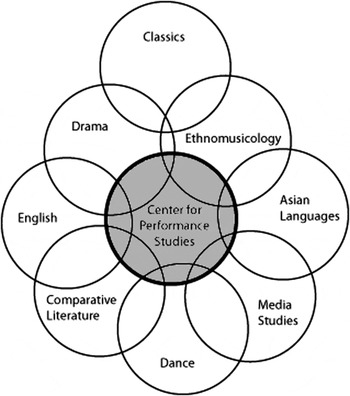
We created a crediting system that allowed faculty to teach part-time in team-taught seminars without volunteering or overloading. We called it credit banking. Essentially, anyone who teaches a Center Seminar gets credit for one-third of a course. After the faculty member teaches two Center courses, he or she collects on the third course for a full course credit. We were also, thanks to an internal grant, able to secure some honoraria to incentivize participation. Mostly, we have looked for the ways we can share the very best of what we all do without comprising the disciplinarity of our programs. The model we have developed essentially links the curricula from a dozen or more different departments and promotes components as available to other departments through the Center. This model proposes that two-thirds of each department's curriculum will still be rendered in-house and one-third through the Center, which represents part of another linking department's core curriculum. One could conceive it as a cluster of circles, each representing a discipline or department (Comparative Literature, Film and Cinema, Theatre, Spanish and Portuguese, French and Italian, etc.), with the area of intersection being the commons we call the Center (see Fig. 1).
Figure 1.

What has emerged through our new partnerships is a truly astonishing field of opportunities we never enjoyed as an in-house program. The range of courses widened, the opportunities of gaining the discipline of other disciplines deepened. (One of our great deficits, as a field, is that we borrow indiscriminately from other disciplines but seldom with their rigor.) How, for example, social work as a field developed protocols for interviewing live subjects is quite different from how we often practice in our field. We have much to learn from other disciplines, and sitting together in team-taught seminars is one way to begin. We have also become more entrepreneurial than we were ever obliged to be before, and consequently we have sought out and developed beautiful and fruitful alliances across and beyond campus. Ph.D. students are securing grants and teaching partnerships that provide them with priceless career opportunities to teach courses close to their own research interests. Let me speak of two courses in particular that came about because of these new partnerships.
Among the smaller losses of the first round of cuts was the surrendering of all funds that might allow guest artists and scholars. Where we formerly were able to bring in prominent scholars across the field and acquaint our students with their work, this was lost early and was not restored. So we began instead to look abroad and find figures who might appeal to several departments so we could cosponsor guests. A four-way partnership among Drama, Comparative Literature, the Center for Jewish Studies, and the Schusterman Foundation created the resources to bring in a prominent Israeli playwright, Joshua Sobol, who will be available to each contributing department. We then leveraged his presence to write a small grant that would allow a fifth-year doctoral student, Samer Al-Saber, whose area of research is Palestinian performance, to team-teach a class with Sobol on representations of the Middle East. “Crisis on Stage,” team-taught by an Israeli playwright and a Palestinian scholar, is a course we never could have offered without seeking these new alliances. A second opportunity came through the Center for Labor Studies. Again, a fifth-year doctoral student, Michelle Granshaw, wrote the grant that would allow her to create a course (“The Spectacle of Labor”) to teach about the pageants, parades, plays, and displays of labor history in the United States. Both look very rich and are exactly the kinds of class that excite both graduate teachers and their students. Neither could have happened under our former model. The partnerships of desperation proved to be the most innovative and interesting.
We looked at where the losses were and tried to find ways to restore them. We visited departments, faculties, chairs, and graduate students, asking simply, What do you miss and how can we still do it? We heard that many students are teaching a great deal with less mentorship. Fewer faculty across campus means that, in many departments, more and more Ph.D. students are teaching larger classes, without the scaffolding of pedagogy classes that helps young teachers develop a classroom presence. So we began a series of workshops first called “Presence”—using performance and rehearsal techniques (of voice, speech, movement) to build authenticity in the classroom. These too became popularly attended, so we formalized the workshop into a class hosted through the Center and available to all graduate students in the humanities. As the course is concerned with delivery, not content, students from a wide array of programs can attend. By seeking partners, we became connected to a wider campus and, in turn, partners to other threatened humanities programs; and by sharing curriculum we found more porous borders between our fields.
The usefulness is paying dividends to others. The Department of Spanish and Portuguese, for example, is reinstating its doctoral program (currently on hiatus) by supplementing their diminished resources with curriculum offered through the Center. Where small humanities programs can no longer field a team (so to speak), can no longer provide enough in-house curriculum, they are increasingly looking to partners such as the Center to provide content. This also invites a rich opportunity to rethink degrees, disciplines, and training. What were formally language-based degrees might now become more content based. We are exploring bilingual seminars (“Drama of the Spanish Golden Age,” for example). We are exploring joint appointments (where appointments will occur). We are thinking about each other's needs as our needs. Most surprising, the Center has become a sort of University of Washington poster child for success under stress, for meeting adversity and inventively thriving; and because it seems to be working, it has a quiet way of spreading a little hope that all will not be lost, that we can retain not all, but the best of what we do. And somehow (somehow), because it modeled success, it was easier to attain that. And faculty lines came back. Two of them. And so we survive, and thrive. For this, we need to be creative. Recessions, in the end, favor the inventive, and in this regard, as a field, though we are overlooked by many, we are still at some advantage here. Good luck to all in these trying times.