

This research addresses the work safety and wellbeing of disability support workers (DSWs) working for an Australian disability organisation. This investigation, undertaken at the organisation's request, aimed to identify factors contributing to high rates of DSW compensation claims and safety incident reports. Whereas most claims involved musculoskeletal injuries associated with manual handling duties, of concern were increasing numbers of reported psychological or mental stress incidents.
DSWs play a central role in contemporary disability support services. Service deinstitutionalisation has seen their job role evolve from supporting people with disabilities in institutional facilities to community-based environments, with current social-policy changes of individualised and consumer-driven funding models likely to further transform the role of DSWs and disability organisations. Although providing community-based support has been associated with positive outcomes for people with disabilities (Hatton, Emerson, Robertson, Henderson, & Cooper, Reference Hatton, Emerson, Robertson, Henderson and Cooper1995), evidence suggests community-based support has also been associated with greater vulnerability to stress and burnout for some DSWs (Blumenthal, Lavender, & Hewson, Reference Blumenthal, Lavender and Hewson1998; Pelletier, Coutu, & Lamonde, Reference Pelletier, Coutu and Lamonde1995; P. White, Edwards, & Townsend-White, Reference White, Edwards and Townsend-White2006). Estimates of staff working in disability services who experience stress levels indicative of mental health concerns have ranged from 25% to 32.5% (Hatton et al., Reference Hatton, Emerson, Rivers, Mason, Mason, Swarbrick, Kiernan, Reeves and Alborz1999; Robertson et al., Reference Robertson, Hatton, Felce, Meek, Carr, Knapp and Lowe2005). Accordingly, the first aim of the present research was to understand DSW wellbeing, considering job satisfaction and burnout as measures of strain, and the relationship between wellbeing and work conditions.
Detrimental consequences for workers stemming from impaired psychological wellbeing associated with work can include adverse mental health outcomes (e.g., depression, anxiety, sleep disturbances, and suicide; Blewett, Shaw, LaMontagne, & Dollard, Reference Blewett, Shaw, LaMontagne and Dollard2006; Chan & Huak, Reference Chan and Huak2004; Stavroula & Aditya, Reference Stavroula and Aditya2010), physical health outcomes (e.g., cardiovascular disease, fatigue, headaches, lowered immunity, and risk of developing musculoskeletal disorders; Blewett et al., Reference Blewett, Shaw, LaMontagne and Dollard2006; Devereux, Rydstedt, Kelly, Weston, & Buckle, Reference Devereux, Rydstedt, Kelly, Weston and Buckle2004; Hauke, Flintrop, Brun, & Rugulies, Reference Hauke, Flintrop, Brun and Rugulies2011; Way, Reference Way2012), and behavioural outcomes (e.g., accident proneness, increased errors because of cognitive strain, reduced motivation, drug and/or alcohol abuse, smoking, violence; Blewett et al., Reference Blewett, Shaw, LaMontagne and Dollard2006; Quick, Horn, & Quick, Reference Quick, Horn and Quick1987). Such outcomes impact work performance and work safety (e.g., absenteeism, turnover, increased accidents, and errors; Dollard, Winefield, & Winefield, Reference Dollard, Winefield and Winefield2001; Harnois & Gabriel, Reference Harnois and Gabriel2000; Pfeffer, Reference Pfeffer2010). Previous research has shown worker psychological distress predicts accident rates (Siu, Phillips, & Leung, Reference Siu, Phillips and Leung2004) and those suffering burnout are more likely to engage in unsafe work behaviours (Nahrgang, Morgeson, & Hofmann, Reference Nahrgang, Morgeson and Hofmann2011). Consequently, a second research aim involved examining the association between DSW wellbeing and safety performance. A safety climate measure, known to be related to safety incidents and accidents and a reliable safety performance indicator (Nahrgang et al., Reference Nahrgang, Morgeson and Hofmann2011), was utilised as a proxy measure of safety performance to examine the association between wellbeing and safety to reported work conditions.
Worker wellbeing has work safety implications, but also important to human services organisations is evidence that adverse wellbeing outcomes are associated with negative consequences for client groups. Studies show DSW burnout can negatively affect interactions with clients (Alexander & Hegarty, Reference Alexander and Hegarty2000; Lawson & O'Brien, Reference Lawson and O'Brien1994; J. Rose, Jones, & Fletcher, Reference Rose, Jones and Fletcher1998); burnout can affect capacity to deal effectively with challenging behaviours (D. Rose, Horne, Rose, & Hastings, Reference Rose, Horne, Rose and Hastings2004); and can increase abusive practice risks (C. White, Holland, Marsland, & Oakes, Reference White, Holland, Marsland and Oakes2003). Thus, ensuring DSW health and wellbeing has fundamental quality of life implications for those individuals that DSWs support.
Findings such as these provide a compelling impetus to understand the relationships between work conditions and wellbeing, to contribute towards effective job redesign strategies to minimise worker ill-health, and to promote environments that actively enhance positive worker wellbeing (Verhoeven, Maes, Kraaij, & Joekes, Reference Verhoeven, Maes, Kraaij and Joekes2003). Over recent decades, numerous occupational stress conceptual models have been developed to understand the impact of work conditions on wellbeing. A third research aim involved using one such model, the Job Demand-Control-Support model (JDCS; Karasek & Theorell, Reference Karasek and Theorell1990), to understand the relationship between DSW wellbeing and work conditions, and specifically to investigate interactions between the work condition factors of demands, control and support that may be relevant for recommendations associated with job redesign, to improve wellbeing outcomes.
The JDCS model and its predecessor, the Job Demand-Control model (Karasek, Reference Karasek1979), have been dominant models in the literature. The JDCS model proposes that demands placed on a worker in relation to the control and the support the worker has to meet those demands contribute to the prediction of either negative consequences for worker wellbeing (strain) or positive outcomes (learning). Hypotheses associated with the model address either direct or additive predictor effects, and interactive or synergistic predictor effects on outcomes (Häusser, Mojzisch, Niesel, & Schulz-Hardt, Reference Häusser, Mojzisch, Niesel and Schulz-Hardt2010). The direct effect hypothesis predicts unfavourable combinations of predictors; that is, high demands, low control and low support or isolation result in an increased likelihood of poorer health and wellbeing outcomes (i.e., the iso-strain hypothesis). The interactive hypotheses predict an interactive effect of predictors on outcomes such that support moderates the negative impact of high demands and low control (i.e., the buffer hypotheses; Häusser et al., Reference Häusser, Mojzisch, Niesel and Schulz-Hardt2010; van der Doef & Maus, Reference van der Doef and Maus1999). Understanding these relationships has practical implications for intervention design to improve DSW wellbeing. Support for the iso-strain hypotheses suggests all predictors — that is, job demands, control and support — need to be addressed to reduce job strain, whereas support for the buffer hypotheses suggests that increasing support will moderate the negative impact of high strain jobs — that is, jobs involving high demands and low control (Häusser et al., Reference Häusser, Mojzisch, Niesel and Schulz-Hardt2010).
Although associations between DSW wellbeing and work conditions have previously been investigated, few studies have applied the JDCS model. Although not fully testing the model, Devereux, Hastings, Noone, Firth, and Totsika (Reference Devereux, Hastings, Noone, Firth and Totsika2009) found work demands predicted emotional exhaustion burnout; however, no main or interactive effects were obtained for support and emotional exhaustion. Furthermore, a significant interactive effect was obtained between support and demands in predicting personal accomplishment; however, the nature of the interaction was not consistent with theoretical predictions. Rather than testing the JDCS model, an investigation by Lin et al. (Reference Lin, Lee, Yen, Loh, Hsu, Wu and Chu2009) used the model to categorise disability staff job roles according to job strain and examined factors associated with ‘high strain’ jobs, involving high demands, low control, and low support, finding these roles were associated with high job stress and effort, and low support and reward.
The research presented here aimed to understand DSW wellbeing and work conditions within the JDCS model; however, increasingly there is recognition that different occupational groups have idiosyncratic stressors and strains influencing the relationship between work conditions and wellbeing (Brough & Biggs, Reference Brough, Biggs, Dollard, Shimazu, Nordin, Brough and Tuckey2014; De Jonge, Dollard, Dorman, Le Blanc, & Houtman, Reference De Jonge, Dollard, Dorman, Le Blanc and Houtman2000; Sparks & Cooper, Reference Sparks and Cooper1999). Factors that have been investigated for DSWs include organisational factors (e.g., demands, role stress, support, control), client-related factors (e.g., presence of challenging behaviours), and worker characteristics (e.g., coping skills, locus of control), with organisational variables considered the most reliable burnout predictor (Skirrow & Hatton, Reference Skirrow and Hatton2007). Workplace support, included in the JDCS model, has been the most frequently examined organisational factor for DSWs (Kozak, Kersten, Schillmöller, & Nienhaus, Reference Kozak, Kersten, Schillmöller and Nienhaus2013). Role stress is another factor that has been reported as associated with high DSW burnout (Gray-Stanley et al., Reference Gray-Stanley, Muramatsu, Heller, Hughes, Johnson and Ramirez-Valles2010; Kozak et al., Reference Kozak, Kersten, Schillmöller and Nienhaus2013; Thompson & Rose, Reference Thompson and Rose2011).
DSW job role changes that have accompanied moves from institutional to community support include expanded and less well-defined responsibilities, with the DSW changed role termed a ‘jack of all trades’ (Vassos & Nankervis, Reference Vassos and Nankervis2012). With less clearly defined and sometimes conflicting demands, work outcomes for DSWs have included less role clarity and increased role conflict (Blumenthal et al., Reference Blumenthal, Lavender and Hewson1998; Hatton et al., Reference Hatton, Emerson, Rivers, Mason, Mason, Swarbrick, Kiernan, Reeves and Alborz1999; Vassos & Nankervis, Reference Vassos and Nankervis2012). Role stress variables (e.g., role conflict, ambiguity, and overload) correlate significantly with burnout for DSWs (Avergold & Andersen, Reference Avergold and Andersen2006; Dyer & Quine, Reference Dyer and Quine1998; Gil-Monte & Peiró, Reference Gil-Monte and Peiró1998). Comparable findings have been reported for other human service workers. Both role ambiguity and role conflict have consistently been associated with emotional exhaustion, burnout, and work stress in human services (Barak, Nissly, & Levin, Reference Barak, Nissly and Levin2001; Dollard et al., Reference Dollard, Winefield and Winefield2001); yet, Um and Harrison (Reference Um and Harrison1998) proposed that role conflict and not role ambiguity intensified burnout and job dissatisfaction. When fundamental organisational change occurs, as has happened and will continue to occur for disability organisations, then workers can experience role stress associated with changes in responsibilities, authority, and support. A final aim of the present research was to extend the JDCS model to incorporate role stress, particularly role conflict, to examine the impact of this demand on DSW wellbeing and to determine whether support moderates the impact of role conflict on wellbeing.
Method
Participants and Procedure
Invitations to participate in the safety study were mailed to home addresses of DSWs working for an Australian disability organisation (N = 1415). All DSWs were invited to participate at the request of the ethics committee approving the research. Workers invited to participate were employed as DSWs within accommodation support services, with daily responsibilities for providing person-centred supports (e.g., for personal care, behaviour, health and medical, and other lifestyle needs) to maximise independence and quality of life for adults with disabilities. One hundred and twenty-two DSWs returned forms consenting to participate (8.6%); however, only 99 completed questionnaires were returned. Missing responses in 12 questionnaires meant only 87 DSW questionnaires were able to be used in these analyses.
There were proportionally more males (50%) in the DSW sample than in the organisation's workforce (39%) and participant mean age was 48.3 years (SD = 10.79), which was slightly older than the workforce mean age of 45.5 years. However, no other significant demographic differences were noted between the DSW sample and the organisation's workforce. Mean employment length was 8.34 years (SD = 8.34), comparable to the workforce mean of 8.5 years. The percentage of participants born in Australia (65.3%) was similar to the organisation's workforce (55.3%). Working conditions for participants were also similar to those of the workforce. Most participants worked full-time (81.6%) with others working part-time or casually (18.4%). Median hours worked per fortnight were 76 hours (SD = 16). Most participants worked 12-hour shifts (62.1%), whereas others worked 8 hours (21.8%) or less (16.1%). Most worked day shifts (51.7%), 16.1% working night shifts, 14.9% working rotating day/evening/night shifts, and 17.2% did not record shift worked.
Measures
Responses for this investigation were drawn from a larger questionnaire compiled by the authors to examine work safety and to collect information regarding demographics (e.g., age, gender, country of birth), employment characteristics (e.g., length of service, hours worked per fortnight), job satisfaction, and safety perceptions. The three standardised measures included in this study were measures of work conditions, burnout, and safety climate. Additionally, DSWs were provided with opportunities to record qualitative comments to elaborate on or qualify responses.
Burnout was assessed using the Copenhagen Burnout Inventory (CBI; Kristensen, Borritz, Villadsen, & Christensen, Reference Kristensen, Borritz, Villadsen and Christensen2005). The CBI comprises three subscales. Central to the CBI is the association between burnout and physical and psychological fatigue and exhaustion. CBI subscale structure reflects attribution of exhaustion to specific life domains. The personal burnout subscale (six items) assesses exhaustion regardless of occupational status. The work-related burnout (seven items) and client-related burnout (six items) subscales measure the extent exhaustion is perceived as related to work or clients respectively. Item responses are rated on a 5-point scale (0 = never/almost never or to a very low degree to 100 = always or to a very high degree). Higher scores represent more burnout, with the mean of 50 or greater considered as indicating burnout. The normative sample comprised 1,914 human service sector workers.
Job satisfaction was assessed using a single item, ‘Overall, how satisfied are you with your job?’, scored on a 6-point scale (1 = very dissatisfied to 6 = very satisfied). Use of a single-item overall job satisfaction measure has been demonstrated to be valid for determining job satisfaction (De Jonge et al., Reference De Jonge, Dollard, Dorman, Le Blanc and Houtman2000; Wanous, Reichers, & Hudy, Reference Wanous, Reichers and Hudy1997).
Work conditions were measured using the General Nordic Questionnaire for Psychological and Social Factors at Work (QPS Nordic; Dallner et al., Reference Dallner, Elo, Gamberale, Hottinen, Knardahl, Lindström, Skogstad and Örhede2000; Lindstrom et al., Reference Lindstrom, Elo, Skogstad, Dallner, Gamberale, Hottinen, Knardahl and Orhede2000). The normative sample consisted of 2,010 participants from public services, health sectors, and production. Four of the 13 QPS Nordic content areas considered most relevant to DSW work safety were used, including job demands, control at work, social interactions, and role expectations, comprising role clarity and role conflict.
1. Job demands (four items) examines quantitative and learning demands, with higher scores indicating greater job demands.
2. Control at work (six items) addresses control of decisions and work pacing, as well as positive challenges at work, with higher scores indicating greater perceived control.
3. Social interaction or support (three items) addresses support from superiors and co-workers, with higher scores associated with more perceived support.
4. Role expectation assesses role clarity and role conflict. Role clarity, also termed role ambiguity, reflects the clarity of work objectives and goals and is assessed using three items, with higher scores indicating greater clarity and lower role ambiguity. Role conflict (three items) reflects experiences of conflicts between resources and work tasks and between personal and external expectations, with higher scores indicating incompatible role expectations.
To keep the survey within reasonable limits for participants, items came from the QPS Nordic short version except for the two role expectations subscales, which were taken from the full QPS Nordic version to allow for a more in-depth investigation of role stress. The QPS Nordic uses a 5-point scale (1 = very seldom or never to 5 = very often or always).
Safety climate was measured using the Nordic Occupational Safety Climate Questionnaire (NOSACQ-50; Kines et al., Reference Kines, Lappalainen, Mikkelsen, Olsen, Pousette, Tharaldsen, Tómasson and Törner2011), which includes 50 items phrased positively or negatively. Although the NOSACQ-50 includes seven safety climate dimensions, including three management and four work-unit level dimensions, only an Overall Safety Perception Score was used to indicate safety performance. NOSACQ-50 uses a 4-point scale of strongly disagree, disagree, agree, and strongly agree. The normative sample consisted of 3,853 health care sector workers. Scores of 3.30 or more indicate a good safety climate for maintaining and continuing safety development; 3.00 to 3.30 reflect a fairly good safety with a slight need for improvement indicated; 2.70 to 2.99 suggest a fairly low perceived safety with need for improvement; and scores below 2.70 indicate a low safety climate with a great need for improvement.
Statistical Analyses
Analyses were conducted using SPSS software Version 20 and MODPROBE (Hayes & Matthes, Reference Hayes and Matthes2009). Multiple regression procedures were used to test the JDCS model and moderation models. Interaction effects were tested after the main effects of predictors were tested. Predictors were mean centred to avoid multicollinearity problems, and interaction terms were established using centred predictors (Aiken & West, Reference Aiken and West1991). Because of personal burnout gender differences, gender was initially included in the regression models but was only significant for personal burnout; consequently, gender is not included in the models reported. As recommended by Aiken and West (Reference Aiken and West1991), post-hoc probing was undertaken of significant interactions involving the moderation model for role conflict, whereby the unstandardised coefficients were used to determine the slopes of regression lines and establish if the slopes differed significantly from zero for high and low support groups. Values of one standard deviation above and below the support mean were used to represent groups for post-hoc comparisons, with sample means used for other covariates (Holmbeck, Reference Holmbeck2002).
Results
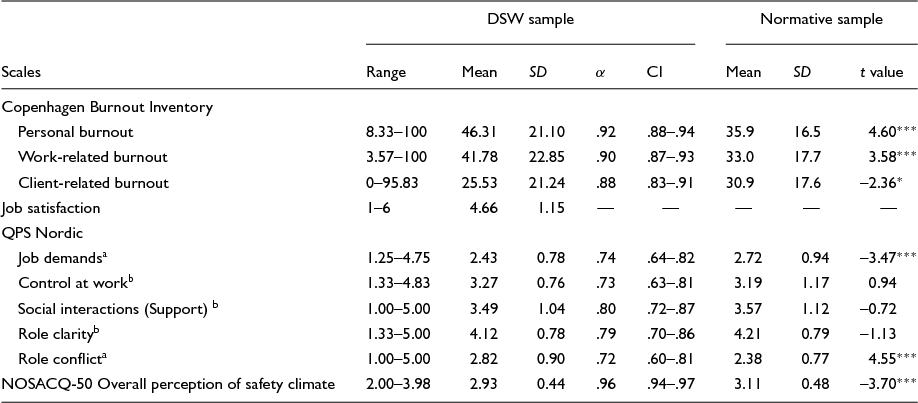
Table 1 provides the reliability statistics for all measures used, with all possessing adequate reliability for subsequent analyses with alphas ranging from .72 to .94. Also in Table 1 are descriptive statistics with t values derived from comparisons with normative samples. Compared to normative samples, DSWs had significantly higher burnout levels on personal and work-related burnout but significantly lower client-related burnout. In particular, burnout (i.e., a score of 50 or more) reported included personal burnout = 43.7% (normative sample = 22.2%), work-related burnout = 33.7% (normative sample = 19.8%), and client-related burnout = 13.8% (normative sample = 15.9%). Of the DSW sample, 48.3% were experiencing burnout in at least one domain.
Descriptive Statistics and Reliability Statistics for the Copenhagen Burnout Inventory, Job Satisfaction Item, QPS Nordic, and NOSACQ-50 for the DSW Sample (N=87) and Comparisons to the Normative Samples

Note: α = Cronbach's alpha; CI = 95% confidence intervals; df = 86; Copenhagen Burnout Inventory Score range 0–100, with higher scores indicating more burnout; QPS Nordic score range 1–5; aHigher scores indicate poorer perceptions of job characteristics; bHigher scores indicate positive perceptions of job characteristics; Job satisfaction scores could range from 1 (very dissatisfied) to 6 (very satisfied).
*p < .05 **p < .01 ***p < .001.
The DSW sample reported adequate overall job satisfaction, with a mean score of 4.7, falling between the partly satisfied (4) and satisfied (5) range. The DSWs job satisfaction ratings ranged from very dissatisfied (1) to very satisfied (6), with most DSWs (46.5%) providing satisfied ratings. DSW qualitative comments revealed 76% considered working with clients contributed to job satisfaction whereas work conditions (e.g., pay, long hours and 12-hour shifts, paperwork, high job demands, lack of advancement opportunities, lack of on-the-job support or direction) were commonly reported as areas of dissatisfaction reported by 48% of DSWs. Regarding safety climate, DSW mean scores were significantly less favourable than the norms, with the mean in the fairly low level of perceived safety with need for improvement range. DSW safety climate scores ranged from 2.00, indicating a low safety climate with a great need for improvement, to 3.98, indicating a good safety climate for maintaining and continuing safety development; however, most DSWs rated the safety climate in the low (29.9%) or fairly low (28.9%) range.
Demographic factors examined to determine differences associated with DSWs experiencing burnout and job satisfaction showed no differences associated with shifts (i.e., day/night/rotating, or shift length), age, hours worked per fortnight, and length of service. However, female DSWs experienced higher personal burnout levels than males, χ2(1, N = 85) = 6.79, p = .009, with no differences for other burnout types or job satisfaction.
Comparisons with the QPS Nordic normative sample revealed two significant differences; in particular, DSWs reported more favourable job demands but perceived greater role conflict. Examination of role conflict items showed DSWs reported significantly greater conflict on two of three items, that is, ‘Do you have to do things that you feel should be done differently?’, t(86) = 4.75, p < .001, and ‘Do you receive incompatible requests from 2 or more people?’, t(86) = 2.23, p = 03. Qualitative response themes identified conflict associated with work practice differences between co-workers (e.g., differences in experience and expertise and, in particular, long-standing employees discouraging newer employees from using person-centred practices, instead preferring ‘institutional’ practices), conflict between organisational support guidelines and worker perceptions of safety associated with the practices (e.g., safety concerns for clients and workers associated with implementing least restrictive support practices), and conflicts between support practices documented in support plans and family or client requests (e.g., not to use assistive technology such as lifters).
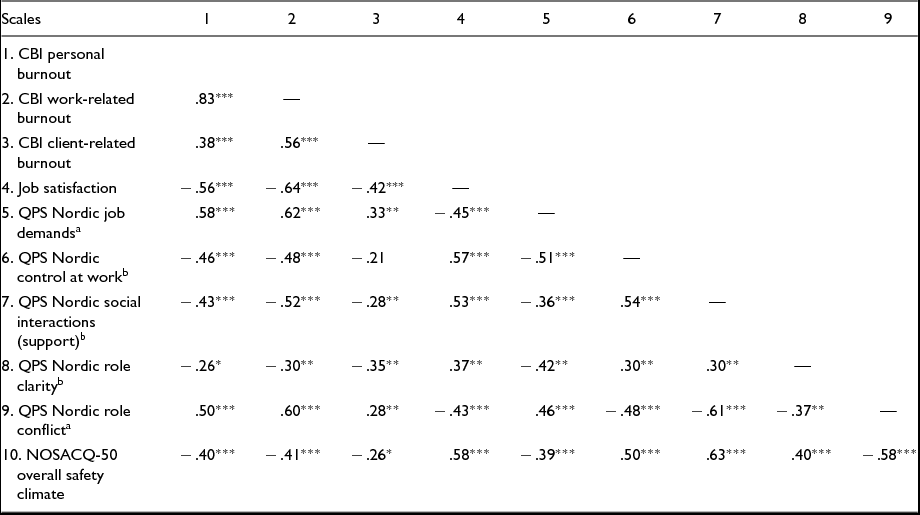
Table 2 provides correlations between measures. All but one of the correlations were significant and consistent with JDCS model predictions for burnout and job satisfaction. Higher burnout and lower job satisfaction were associated with higher job demands and role conflict but lower control at work, social interaction or support and role clarity. The non-significant correlation between client-related burnout and control at work was in the expected direction. Notably, correlations between QPS Nordic subscales and client-related burnout were generally lower than other wellbeing measures, suggesting the need for further exploration with factors other than those in this investigation to understand work contributors to client-related burnout.
Correlation Matrix for the Copenhagen Burnout Inventory, Job Satisfaction Item, QPS Nordic, and NOSACQ-50 Scores
Note: aHigher scores indicate poorer perceptions of job characteristics; bHigher scores indicate positive perceptions of job characteristics.
*p < .05, **p < .01, ***p < .001.
Correlations between QPS Nordic work condition subscales were significant and in expected directions for the JDCS model. Job demands correlated negatively with control at work, support and role clarity, but positively with role conflict. Control at work correlated positively with support and role clarity, but negatively with role conflict. The correlation of highest magnitude was between role conflict and support (r = −.61, p < .001), suggesting the relationship was worthy of further investigation for DSW-type work.
With respect to perceived safety climate, significant negative correlations were obtained with all burnout measures, although the magnitude was lower for client-related burnout. Findings suggest burnout was associated with less favourable safety climate perceptions. Conversely, favourable safety perceptions were significantly positively associated with job satisfaction. Correlations with QPS Nordic work conditions subscales were significant, with positive safety climate perceptions associated with higher job control, support, and role clarity and lower job demands and role conflict. Safety climate correlated most strongly with support and role conflict.
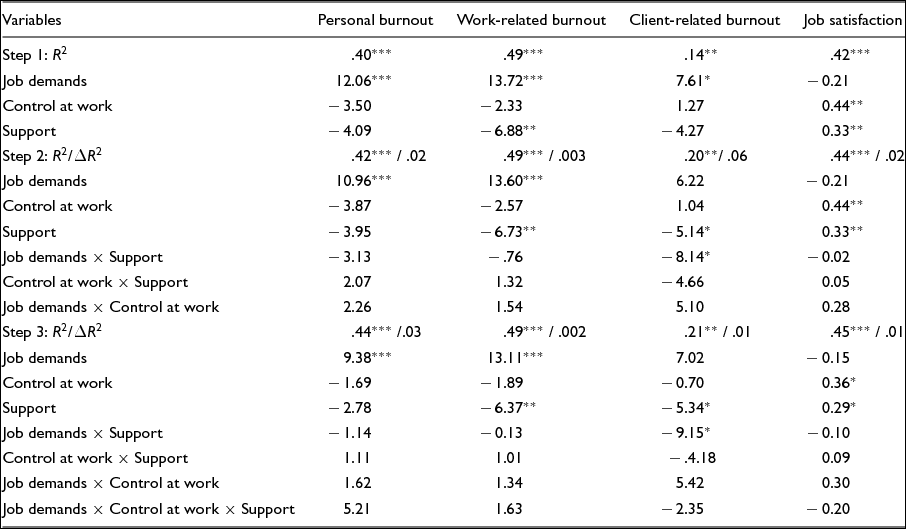
To test the JDCS model iso-strain and buffer hypotheses for the wellbeing measures, a series of regression analyses were performed. As can be seen in Table 3, similar variance was explained in the main-effect models (step 1) for personal burnout, work-related burnout, and job satisfaction (range 40–49%), whereas only 14% was explained for client-related burnout. Job demands demonstrated a significant main effect for all burnout types but not job satisfaction. A significant main effect was demonstrated for support for work-related burnout and job satisfaction. Control at work only demonstrated a significant main effect for job satisfaction. The addition of two-way interaction terms at step 2 resulted in small model improvements to model predictions, with no significant R 2 changes. Only one interaction term was significant for the wellbeing measures of burnout and job satisfaction, with a significant job demand × support interaction, suggesting a buffering effect of support on job demands for client-related burnout. The addition of the three-way interaction term to test the JDCS buffer hypothesis at step 3 minimally changed the variance explained, with no significant effects demonstrated for any model, contrary to the buffer hypothesis predictions.
Results of Multiple Regression Analysis (Unstandardised Coefficients) Testing the JDCS Model using Burnout and Job Satisfaction Scores for DSWs as Measures of Wellbeing (or Strain)
Note: *p <.05, **p < .01, ***p < .001.
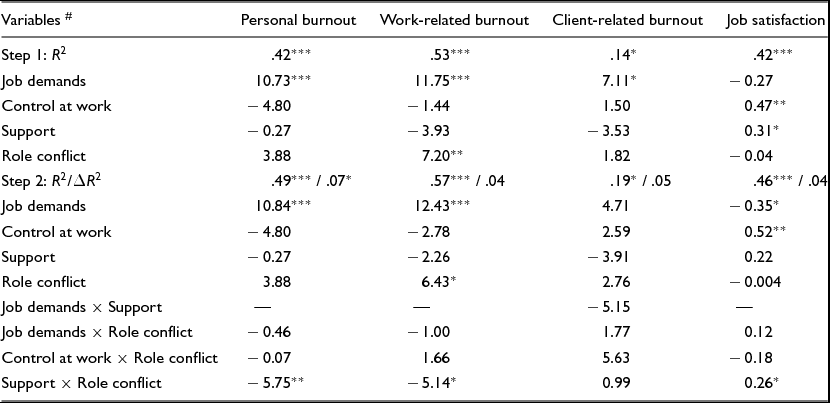
Two step regression analyses were conducted to test the moderating or buffering effect of support on role conflict in the JDCS model. As can be seen in Table 4, the variance explained in the main-effect models (step 1) ranged from 14% for client-related burnout to 53% for work-related burnout. Role conflict demonstrated a significant main effect for work-related burnout. Significant main effects were obtained for control at work and support for the job satisfaction model but not burnout. The addition of two-way interaction terms (step 2) explained 3–7% additional variance, although only the personal burnout R 2 change was significant. The support × role conflict interaction term was significant for all models except client-related burnout, suggesting support moderated role conflict for personal and work-related burnout and job satisfaction.
Results of Multiple Regression Analyses (Unstandardised Coefficients) Investigating the Moderating Effect of Support on Role Conflict using Burnout and Job Satisfaction Scores for DSWs as Measures of Wellbeing (or Strain)
Note: #Other two-way interaction terms used in Table 3 were only entered if significant in the models.
*p < .05, **p < .01, ***p < .001.
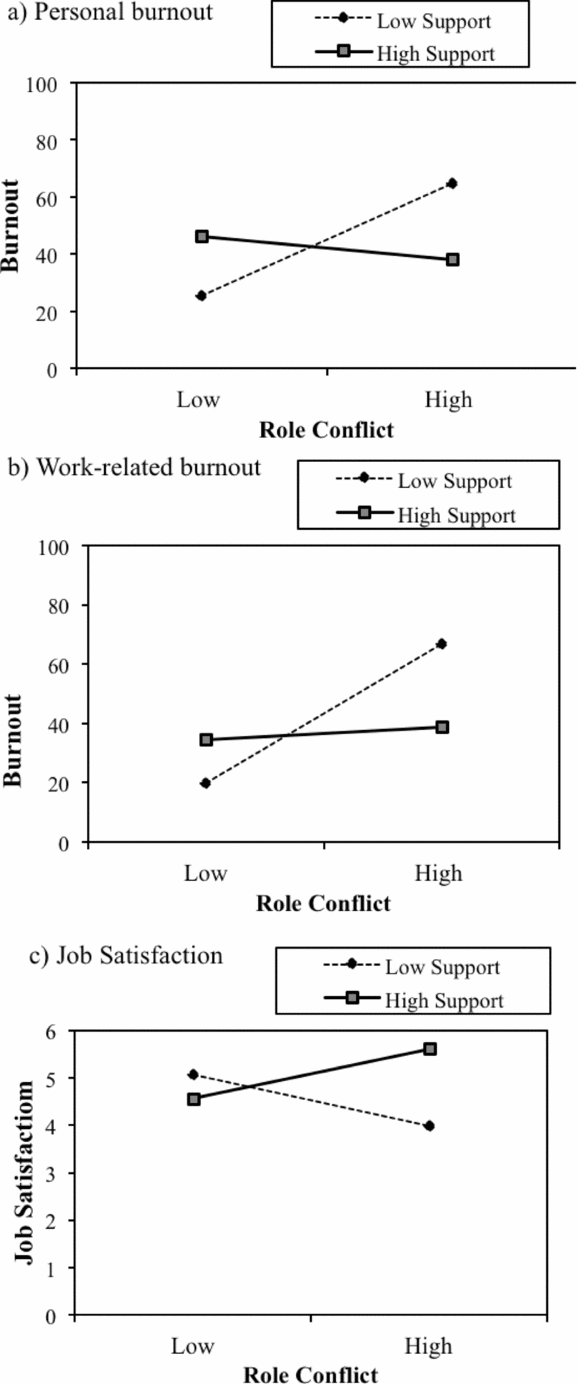
Figure 1 presents the simple slopes for the significant interaction effects of role conflict and support for personal and work-related burnout. As can be seen, the impact of role conflict on burnout differs according to the level of support reported. Post-hoc analyses of the burnout regression slopes of the low support group (1 SD below the mean) were all significantly different from zero, indicating positive associations between role conflict and personal burnout, t(79) = 3.16, p = .002, and work-related burnout, t(79) = 3.78, p < .001. These results suggest increased role conflict was associated with higher burnout when support was low. Conversely, post-hoc analyses of regression slopes for high support (1 SD above the mean) were each not significant, suggesting that in high support situations, burnout did not change as role conflict increased.
Interaction effects between support and role conflict for the outcome variables of (a) personal burnout, (b) work-related burnout, and (c) job satisfaction.
Also in Figure 1 is the simple slope for job satisfaction. Again, the impact of role conflict differs according to support levels, although neither regression slope was found to differ significantly from zero. It is possible that ceiling effects are relevant for job satisfaction, with the satisfaction ratings varying marginally as role conflict levels change and being relatively high in all situations. However, the direction of the slopes suggest that when support was low and role conflict increased then job satisfaction tended to be reduced, whereas role conflict increased when support was high job satisfaction was improved.
Discussion
Consistent with previous research, DSWs were found to be an occupational group at risk of high levels of burnout. Nearly half of DSWs were experiencing burnout in at least one burnout category. Compared to the norms, significantly more DSWs (43.7%) reported fatigue and exhaustion on the personal burnout subscale, consistent with the findings of Kozak et al. (Reference Kozak, Kersten, Schillmöller and Nienhaus2013), who reported around 40% of disability staff experienced personal burnout on the CBI and that there was a disproportionate representation of females, as with this DSW sample. Burnout profiles showed DSWs generally did not attribute fatigue to client work, with client-related burnout significantly lower than the norms, whereas work-related burnout significantly exceeded the norms. These results suggest DSWs considered aspects of their work conditions, but not clients, as relevant to burnout experienced.
Supporting this supposition were correlations between work conditions and burnout, with generally lower magnitude coefficients for client-related burnout. In general, higher burnout was associated with higher job demands and role conflict but lower job control, support, and role clarity. These findings were also associated with lowered DSW job satisfaction. These burnout and job satisfaction associations are consistent with the JDCS model iso-strain hypothesis predictions. Yet, testing this hypothesis produced mixed findings. Whereas direct effect findings indicating high job demands predicted increased burnout, demands did not predict job satisfaction. However, higher job control predicted increased job satisfaction as did support availability, with lower support also significantly predicting work-related burnout. These findings suggests that high job demands could lead to personal, work-related and client-related burnout, and support could act to reduce work-related burnout, whereas job control was important for job satisfaction, along with support availability. Although no other studies appear to have tested the JDCS model for DSW type of work using the three components of demands, control and support, the literature shows that job demands (Devereux, Hastings, Noone et al., Reference Devereux, Hastings and Noone2009; Gray-Stanley & Muramatsu, Reference Gray-Stanley and Muramatsu2011), control (Dyer & Quine, Reference Dyer and Quine1998; Gray-Stanley & Muramatsu, Reference Gray-Stanley and Muramatsu2011), and support (Dyer & Quine, Reference Dyer and Quine1998; Gil-Monte & Peiró, Reference Gil-Monte and Peiró1998; Lin et al., Reference Lin, Lee, Yen, Loh, Hsu, Wu and Chu2009; Vassos & Nankervis, Reference Vassos and Nankervis2012) each predict burnout, which in turn is associated with job satisfaction for DSWs (Kozak et al., Reference Kozak, Kersten, Schillmöller and Nienhaus2013).
Although the three JDCS model components did not all predict any single wellbeing measure, they were nonetheless each important predictors of aspects of burnout and job satisfaction, both of which were also associated with safety performance as established using the safety climate measure. These findings suggests that worker job demands, support availability, and job control are all important for organisations to monitor to improve safety performance. Further supporting these results are the buffer hypothesis findings. No support was obtained for the synergistic effect of job demands, control, and support on burnout or job satisfaction. Only one significant interaction effect was demonstrated for these wellbeing measures, with the significant finding suggesting support moderated client-related burnout associated with high job demands. This pattern of findings, whereby some support was obtained for the direct effect of demands, control, and support but minimal support for the buffering effects of control and support has previously been reported in meta-analytic reviews of JDCS model research (Häusser et al., Reference Häusser, Mojzisch, Niesel and Schulz-Hardt2010; van der Doef & Maus, Reference van der Doef and Maus1999).
Explanations in the literature for modest buffer hypotheses findings include methodological issues such as confounding variables (e.g., worker-related characteristics such as coping styles) and the conceptualisation and operationalisation of job characteristics (De Jonge & Kompier, Reference De Jonge and Kompier1997; Häusser et al., Reference Häusser, Mojzisch, Niesel and Schulz-Hardt2010; Viswesvaran, Sanchez, & Fisher, Reference Viswesvaran, Sanchez and Fisher1999). Indeed, these issues may be relevant in the findings obtained for DSWs in this study. Testing the JDCS model requires measures that effectively capture critical aspects of the job, including the types of demands and control workers experience in particular roles or organisations. Measures in this study included model features that were considered relevant for the DSW job role. Job demands measured quantitative and learning demands, and control measured control of work decisions and work pacing, as well as positive challenges at work. Yet, qualitative comments provided by DSWs revealed features of job demands and control not considered in the measures used. Comments revealed context was important for perceptions of both job demands and control. For example, DSWs noted the work situation varied according to whether unfamiliar replacement DSWs, who may lack the experience and expertise for the situation, were rostered to work with them. Furthermore, the presence of unfamiliar DSWs also contributed to challenging behaviours for some clients, adding to the emotional job demands of the DSW role, which were not examined.
Consideration of the interplay between the person and their situation suggests that factors beyond those considered in the JDCS model may be relevant in understanding worker wellbeing. Indeed, a model that may provide a better understanding of the effects of work conditions on a worker may be the biopsychosocial model of challenge and threat (Blascovich & Mendes, Reference Blascovich, Mendes and Forgas2000; Blascovich & Tomaka, Reference Blascovich and Tomaka1996). According to this model, a situation is a motivational challenge when the individual perceives they have sufficient resources — control and support — to meet the situational demands, whereas threat occurs when resources are perceived as insufficient for the demands. Appraisals of demands and resources mediate performance behaviourally and physiologically. Consequently, in the example described above of unfamiliar co-workers, a DSW's appraisal of the demands and available resources and the reduction in situational familiarity may lead to perceptions of threat rather than challenge.
A further suggestion provided in the literature associated with limited support for the buffer hypothesis involves occupational specificity with respect to stressors and strains (Brough & Biggs, Reference Brough, Biggs, Dollard, Shimazu, Nordin, Brough and Tuckey2014; De Jonge et al., Reference De Jonge, Dollard, Dorman, Le Blanc and Houtman2000; Sparks & Cooper, Reference Sparks and Cooper1999). Occupational specificity has also been noted as important for effective workplace intervention strategies, and was an important consideration in the inclusion of role conflict in the JDCS model for DSWs. Demands in the JDCS model have generally been operationalised as work load, time pressures, and role conflict (Häusser et al., Reference Häusser, Mojzisch, Niesel and Schulz-Hardt2010; van der Doef & Maus, Reference van der Doef and Maus1999), with role conflict previously identified as a concern for human service workers (Dollard et al., Reference Dollard, Winefield and Winefield2001) and for DSWs in this research. Testing the JDCS model incorporating role conflict showed that although direct effects were found for job demands for all three burnout types, role conflict only predicted work-related burnout. Adding interaction terms to the models showed support moderated the negative impact of role conflict on personal and work-related burnout and job satisfaction. Post-hoc analyses of interaction effects revealed that when job support was high, job satisfaction and personal and work-related burnout were not impacted as role conflict increased, possibly because job support from supervisors and co-workers allowed job conflicts to be resolved. Conversely, significant increases in personal and work-related burnout were associated with increased role conflict when such supervisor and co-worker support was low. Furthermore, when role conflict was high, burnout was greater and job satisfaction lower for those with low support than those with high support.
Support as a moderator of role conflict has not previously been widely examined for DSWs. Gil-Monte and Peiró (Reference Gil-Monte and Peiró1998) found role conflict significantly predicted emotional burnout for disability staff but not that support modulated burnout, contrary to this study. The QPS Nordic used here showed DSW role conflict was significantly greater than the norms. It is possible, but not apparent, that staff in Gil-Monte and Peiró’s investigation were not experiencing role conflict that exceeded the norm, possibly contributing to buffering differences noted. The way support interacts with different work stressors to reduce burnout is generally not well understood (Devereux Hastings, Noone et al., Reference Devereux, Hastings and Noone2009; Gray-Stanley & Muramatsu, Reference Gray-Stanley and Muramatsu2011), and variable research findings may be related to the extent that particular work conditions are relevant work stressors (Häusser et al., Reference Häusser, Mojzisch, Niesel and Schulz-Hardt2010). Thus, use of standardised instruments to identify significant stressors and types of support available may facilitate understanding of interrelationships by ensuring stressors under investigation are relevant for the particular occupational group.
Differences in occupational characteristics may further contribute to the disparities identified above. Participants in Gil-Monte and Peiró’s (Reference Gil-Monte and Peiró1998) study worked in occupational settings for people with disabilities, which include the regular continued presence of multiple other staff such as workshop supervisors, social workers, psychologists, and nurses, whereas DSWs in this investigation worked in more isolated accommodation settings that can involve working alone or with only one other staff member. It is possible the two groups of disability workers experience different types and levels of role conflict and support. DSW comments identified role conflict as relevant to accommodation settings where generally lower on-the-job support from supervisors and co-workers was available than in occupational settings to assist with conflict, with DSWs providing examples such as less supervisor support for worker conflicts regarding care practices associated with operational changes and pressure from clients or family members for care practices that differed from support plans or safety guidelines. DSWs in accommodation settings are generally more isolated than workers in occupational settings, with less immediate support for problem solving or managing the complex situations that are an inevitable aspect of their job. Consequently, occupational role conflict and support differences may be relevant to ambiguous findings, highlighting the need to consider contextual factors, including the work context, the type of work, and available support to understand work conditions and worker wellbeing relationships.
Nonetheless, these findings inform interventions to improve DSW wellbeing for the participating organisation, with anticipated safety performance implications. They suggest attention should be focused on improving the psychosocial work environment for DSWs with consideration of aspects of job demands, job control, and support. In particular, there is a need to review job responsibilities to minimise role conflict and increase support for DSWs. DSW comments suggested increased support might involve more supervisor and team work training, more specific training and mentoring to deal with challenging behaviours, more time for staff handover of client-related information, and a rostering system that provides co-workers familiar with each other and with clients.
Current social policy changes towards individualised consumer-driven disability support funding models will increasingly involve DSWs working in less controlled and more isolated community environments, which is associated with the risk of conflict within and between their job functions and continuing issues related to low on-the-job support from co-workers and supervisors. Disability organisations will need to manage the wellbeing and safety consequences that arise from these work conditions. Practical implications for organisations in addition to those listed above could include providing DSWs with training in working safely in low support environments and teamwork training in negotiating and managing complex situations; opportunities for on-the-job mentoring to develop worker competency and self-efficacy; use of comprehensive client support need and risk assessments to ensure adequate support resources are allocated, such as the type and level of expertise and staff numbers required; support plans that are agreed upon by all relevant parties; and flexible methods for providing support to workers, such as ensuring appropriate communication equipment is available, a regular check-in and reporting process for contacting workers and vice versa, help-desk support for DSWs to call for advice, and floating supervisors.
These findings highlight the need to regularly monitor DSW wellbeing, in addition to job satisfaction and safety perceptions. Use of standardised instruments to identify problem work conditions, wellbeing concerns, and safety perceptions in comparison to established norms is recommended, to identify wellbeing and safety concerns applicable for the whole organisation or particular work areas. A further recommendation associated with using standardised measures is to include opportunities for workers to write comments associated with their ratings. Such information can provide important context and insights concerning the quantitative results to guide the development of workplace interventions to improve DSW work safety and wellbeing. Maintaining staff wellbeing and morale has been shown to protect the physical and psychological health of carers as well as contributing to better quality of life for clients (Allen, Reference Allen1999).
The DSW burnout findings raise research issues associated with assessing client-related burnout. First, client-related burnout for DSWs was significantly lower than the norms, despite the direct care responsibilities of the job role placing workers at greater risk of such burnout. Qualitative comments from DSWs revealed high levels of commitment to clients and a reluctance to blame them for problems associated with their support. These comments suggest that DSWs may also have been reluctant to attribute burnout to clients with whom they have — often-long standing — relationships and/or because they feel a client cannot be held responsible for staff stress resulting from actions because of their disability. This finding raises a question about the validity of the client-related burnout measure on its own for DSWs or similar occupational groups and the possibility that artificially low client-related burnout may be reported by such workers. Second, DSW comments also suggested the low client-related burnout reported in this research may misrepresent the range of stress involved with working with clients with different types and levels of disability. For example, DSWs noted that whereas many clients were not stressful to support, there were some particular types of clients (e.g., those with severe challenging behaviours, complex mental health issues, and/or drug and alcohol problems) who were often sources of considerable stress for the DSWs working with them. Yet, the questions concerning client burnout in the CBI all refer just to clients in general without asking about stress with respect to certain clients. Thus, a DSW may be highly stressed by one client but find most clients relatively easy to work with, which makes it difficult to answer a question that just refers generally to clients, and which may predispose them to answer the question with respect to most of their clients. Accordingly, a client burnout measure that asks about clients in general may produce an underestimate of client-related stress, and averaging stress scores over many DSWs may obscure the few DSWs who have indicated high levels of client-related stress, which included 13.8% of DSWs in this study, because they do work with clients, many of whom have stress-inducing challenging behaviours. These assessment issues may lead to client-related burnout mean scores that appear to show no problems related to client-induced stress that need to be addressed in a disability organisation or that may be contributing to burnout and turnover.
This research highlights the need for further consideration of measures for assessing client-related burnout for DSWs. The present findings suggest a need to reconsider questions concerning client burnout that refer to clients in general and do not allow for an indication that a minority of clients may be a cause of considerable stress in some DSWs. The findings also suggest the need to consider the range of individual scores that may indicate that a significant minority of staff, whose scores are obscured by averaging across all DSWs, may be suffering from high levels of stress from clients (e.g., associated with working with clients with challenging behaviours) that lead to costly stress claims and turnover. Such differences in client-related burnout among DSWs have implications for interventions that may need to be targeted to those DSWs providing support to clients with different types and levels of disabilities. A recommendation made by DSWs in this study was for specific mentoring of staff working in accommodation settings with clients who have challenging behaviours. Whereas the lower average level of client burnout compared with personal and work-related burnout in this study may be due partly to the above factors, the differences do suggest that a single client-related burnout measure, or combining client-related burnout scores with other burnout measures to produce a single general burnout measure, should be discouraged when examining DSW wellbeing.
A potential limitation of this research is the relatively small sample size relative to the total workforce. Anecdotal comments provided to researchers for non-participation included the complexity of consent form required by the ethics committee, DSW concerns about consequences for their jobs if they raised safety concerns despite reassurances in project information sheets, and fatigue associated with shift work. A possible bias in samples of this kind may occur because workers who perceive a higher commitment to good health and safety practices may be more inclined to participate (Larsson, Karlqvist, Westerberg, & Gard, Reference Larsson, Karlqvist, Westerberg and Gard2012). The cross-sectional nature of the investigation also meant that causality between factors could not be determined. Accordingly, there is a need for further studies that can demonstrate improvements in DSW wellbeing and the associated work safety climate as a result of implementing changes to working conditions that affect identified safety-related issues, such as role conflict.
Acknowledgments
This research was funded by the SafeWork SA Commissioned Research Grant (CRG) program. SafeWork SA and the South Australian Government do not endorse the content of this material and the views expressed herein are not reflective of SafeWork SA or the South Australian Government.