




On the morning of December 2, 1983, nine Christians from Vermont and New Hampshire stood for more than an hour before the golden icon screen at the front of the St. Nicholas Cathedral in Leningrad. Far from their own plain white churches in New England, they watched Metropolitan Anthony conduct the Russian Orthodox service, smelled incense burning, and heard the soaring voices of more than three thousand Russians. As the service came to a close, the tall, bearded metropolitan, resplendent in golden robes, turned to Clinton Gardner, a retired business owner who helped found a group called Bridges for Peace, and asked whether he would like to greet the congregation.Footnote 1 Though surprised by the invitation, Gardner quickly decided to convey a message he had planned to deliver in Russian later at a lunch:
Dear brothers and sisters in Christ, I bring you greetings from seven churches in New England. We have come on an unusual mission, and we seek your help. We invite you to join us in building bridges of understanding between the US and USSR, bridges of peace that will remove the enemy images that have arisen between us. Since our diplomats seem unable to establish a dialogue between our nations, we hope to begin a dialogue between our peoples, a sort of “citizen diplomacy” that will try to end the Cold War between our countries.Footnote 2
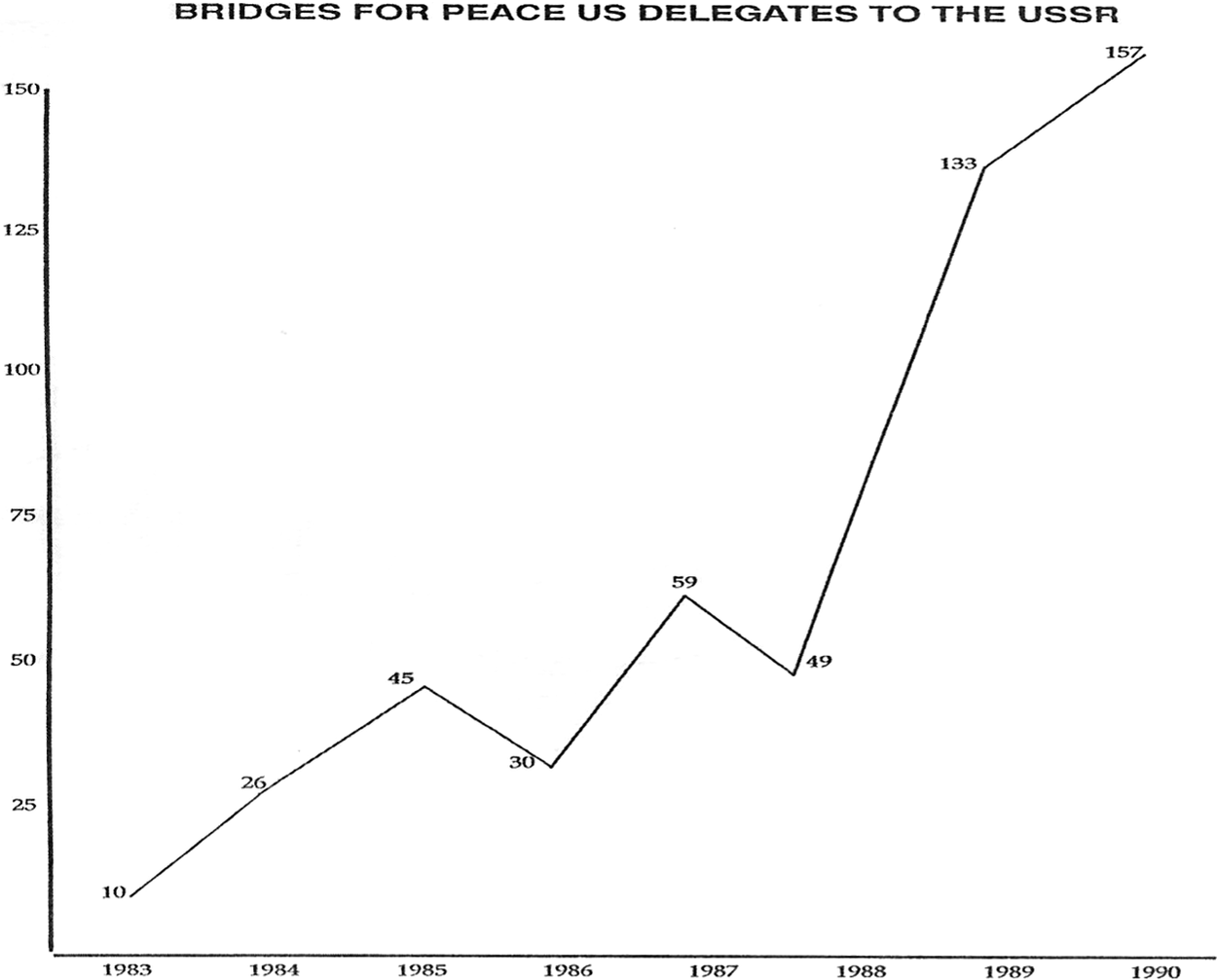
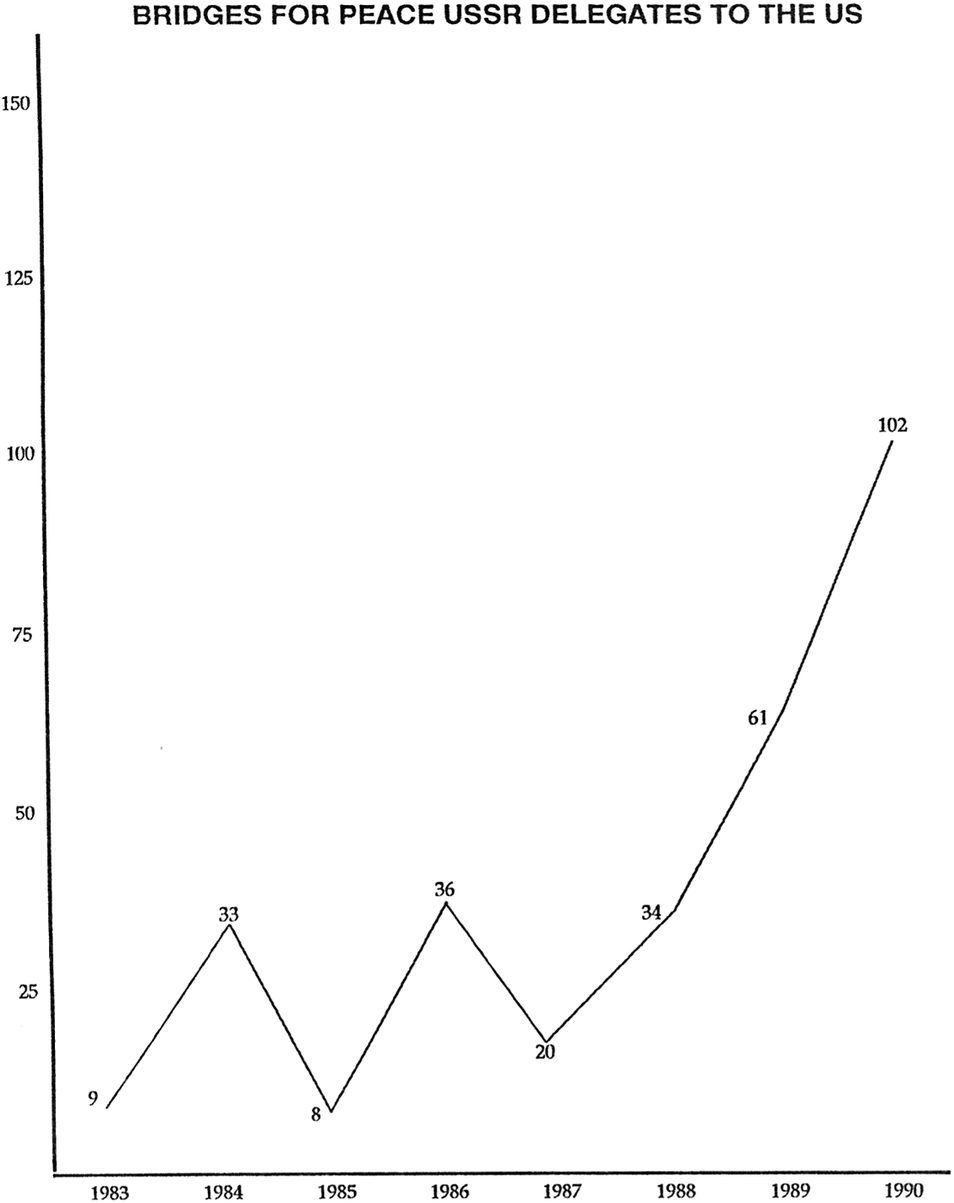
That hope was realized. From 1983 to 1989, Bridges for Peace grew to be a coalition of more than fifty church, peace, and civic groups that organized fourteen exchanges and tours, with over four hundred people traveling from the United States to the Soviet Union and some two hundred Soviet citizens journeying to the United States, where they stayed in the homes of families (see Figures 1 and 2).Footnote 3 Along with parallel tours organized by the National Council of Churches (NCC), the exchanges manifested the enormous energy of Christian churches that opposed the nuclear arms race and sought to overcome US–Soviet enmity.Footnote 4
Chart showing numbers of delegates from the US to the USSR, 1983–90, Mary Teachout Papers (private collection), Norwich, Vermont.

Chart showing numbers of delegates from the USSR to the US, 1983–90, from Mary Teachout Papers, Norwich, Vermont.

They also sparked intense controversies in many communities in the eastern United States during the first few years, with anticommunists charging that visiting Soviet clergy were KGB agents sent to deceive and mislead Americans.Footnote 5 The Bridges for Peace exchanges were part of a wider opening of the Soviet Union to contacts with Christian groups in the West, including Billy Graham’s invitations to preach in the USSR in 1982 and 1984, which were often criticized and even ridiculed in the United States.Footnote 6 The conciliatory and cooperative approaches of Graham, the NCC, and Bridges for Peace sharply diverged from the ways in which many evangelical activists emphasized denunciation of religious persecution and shaming of Soviet leaders.Footnote 7 As Graham’s role suggests, though, there was not a stark divide between mainline and evangelical Christians.Footnote 8 Some prominent evangelicals—including Ronald J. Sider (President of Evangelicals for Social Action), Jim Wallis (editor of Sojourners), and Richard Mouw (a professor first at Calvin University and then at Fuller Theological Seminary)—vigorously supported the anti-nuclear movement, championed exchanges with the USSR, and urged fellow Protestants to “set aside our misunderstandings and stereotypes” about Orthodox Christians.Footnote 9 Moreover, the religious exchanges won much wider acceptance after the middle of the decade, with most Americans rejecting the label of “evil empire” for the Soviet Union by July 1988, many recognizing the genuine faith of Christians from the USSR, and some of the most vehement evangelical critics of ecumenical dialogue themselves traveling to the Soviet Union before it collapsed in 1991.Footnote 10
Although President Ronald Reagan depicted peace activists as dupes of the KGB in the early 1980s, during 1984 he began to see the potential value of people-to-people exchanges, and, at a meeting with the Soviet leader, Mikhail Gorbachev, in Geneva in November 1985, he formally proposed a dramatic expansion of cultural and educational exchanges that had been curtailed after the Soviet invasion of Afghanistan in December 1979.Footnote 11 On Christmas Eve 1985, the top expert on the USSR at the National Security Council, Jack Matlock, informed Clinton Gardner that the Reagan administration was eager to cooperate with Bridges for Peace in the enlargement of people-to-people exchanges.Footnote 12 As US–Soviet citizen diplomacy surged in 1988, Reagan himself journeyed to Moscow, where he recanted his earlier labeling of the Soviet Union as an “evil empire” and hailed the changes there in a speech at the newly restored Danilov Monastery.Footnote 13 By 1989, Gardner believed that Bridges for Peace and other grassroots initiatives had “played no small role in changing the tone of superpower dialogue.”Footnote 14 Yet the Christian exchanges were arguably more important for the way they helped transform popular attitudes toward the Soviet Union in many places in the United States. As one Bridges for Peace leader remembered, local communities were “really where the action was taking place.”Footnote 15
The story of Bridges for Peace challenges widely held views of citizen diplomacy, complicates ideas about the receding of liberal and mainline Protestantism, and sheds new light on the ending of Cold War antipathies. US citizen diplomats have often been disparaged as naive pawns of Soviet propagandists.Footnote 16 But the activists in this story emerge as more knowledgeable and effective than such caricatures indicate. Simplistic triumphalist stories have claimed that exchanges led to Cold War victory, with tales of how Soviet visitors came to the United States, saw its consumer abundance, and “were conquered.”Footnote 17 In contrast, this article reveals more complex and bilateral encounters that changed perspectives in both countries. Historians have often emphasized the rise in the 1980s of the Christian right, and some have argued that it overshadowed the influence of the religious left on issues such as nuclear weapons.Footnote 18 Although this article not dispute the overall ascendancy of the Christian right in the last three decades of the twentieth century, it shows how moderate and progressive Christians were more active and had greater influence on public attitudes toward the Soviet Union than many scholars have realized.Footnote 19 It complicates the standard narrative of the 1980s by illustrating how, during the Reagan presidency, Christians in the center and on the left energetically mobilized on the issue of US–Soviet relations.Footnote 20 Scholars have often seen the Cold War as an international condition that had an impact on people in many localities in the United States.Footnote 21 By contrast, this article shows how local Cold War controversies, in which citizen exchanges challenged anti-Soviet stereotypes at the core of anticommunist identities, were part of a larger international development: the ending of US–Soviet hostility.
The Christian exchanges were part of a much broader array of citizen exchanges between the United States and the Soviet Union in the 1980s. For example, American and Soviet women organized tours of each other’s countries, US and Soviet journalists developed cooperative projects, American and Soviet doctors collaborated on efforts to prevent nuclear war, young people traveled to summer camps in the other country, and many cities in the US and USSR established sister city relationships. As many articles and books have shown, such exchanges led to face-to-face encounters between millions of American and Soviet citizens and were publicized in thousands of newspaper articles, radio interviews, and television broadcasts.Footnote 22 Especially in the second half of the decade, the encounters led many Americans to discard stereotypes about Soviet people and to feel that the Cold War was ending. As numerous newspaper columns and editorials showed, when conservative anticommunists protested against exchanges in the late 1980s they generally lost the struggle for public opinion, in communities from Redding, California to Sherman, Texas and Cazenovia, New York.Footnote 23 Across the United States, the recognitions of commonalities as Christians, mothers, children, editors, and physicians were part of a wider process of transcending ideological enmity.
The US–Soviet religious exchanges differed from the other citizen exchanges by directly challenging the conventional contrast between a supposedly godless Soviet Union and a divinely blessed America that had been crucial to American identity since at least the 1950s and arguably since the 1920s.Footnote 24 President Reagan had invoked the stereotype of godless communism in his “evil empire” speech in 1983, when he summoned evangelicals to “pray for the salvation of all of those who live in that totalitarian darkness” so they “will discover the joy of knowing God.”Footnote 25 As late as December 1987, 49 percent of Americans polled thought the fact that “they’re atheists—they don’t believe in God” was a very important reason for considering the Soviet Union “our enemy,” and another 31 percent thought it was of some importance for the enemy designation.Footnote 26 Yet, that month, Reagan welcomed the General Secretary of the Communist Party of the Soviet Union to the White House for the signing of an arms reduction treaty. Reagan’s shift so angered anticommunist evangelicals such as Howard Phillips that they compared the president’s diplomacy to Neville Chamberlain’s appeasement of Nazi Germany as they futilely campaigned against ratification of the treaty.Footnote 27 The divergence between Reagan and anticommunist evangelicals in the latter years of his presidency has been neglected by students of evangelical influence on US foreign relations.Footnote 28 Yet it helps to highlight why religion greatly mattered in the transformation of American attitudes toward the USSR as the Cold War waned in the late 1980s.
Of course, some key mainline Protestant leaders had believed that ideological differences did not require conflict with the USSR since the beginning of what Americans called the “Cold War.”Footnote 29 Prominent mainline Protestants such as John Bennett (who edited Christianity and Crisis for many years) long believed that the missile race was a worse evil than communism and that Americans should strive to make contact with the people of Russia.Footnote 30 The NCC participated in a first, small-scale exchange with leaders of churches in the USSR in 1956 and a second, with a “Choose Life” theme, in March 1979.Footnote 31 Moreover, mainline Protestants had been involved in ecumenical bridge-building projects in many other countries around the world before 1980.Footnote 32 What was different in the 1980s was that intense fears of nuclear war, sparked by Reagan administration rhetoric and policies in the early part of the decade, spurred much larger-scale American–Soviet exchanges, undeterred by the Red-baiting that had curtailed earlier efforts.Footnote 33
This article is based primarily on Clinton Gardner’s published writing, the personal papers of the Bridges for Peace leader Mary Teachout, and hundreds of articles in local newspapers from Vermont to North Carolina. It is organized in five sections. The first part sketches the roots of Bridges for Peace in the life of Clinton Gardner and the ideas of several other Christians in Vermont. The second section shifts from the local to the transnational, describing the first Soviet visit to Vermont in May 1983, the many heatedly negative reactions to the visitors, and the bonding between the visitors and members of Bridges for Peace. In the third part, I discuss the first Bridges for Peace trip to the USSR in December 1983, which further strengthened the participants’ faith in the value of their citizen diplomacy. The fourth section analyzes intense clashes over a Soviet delegation’s tour of the northeastern United States in the fall of 1984. The final part describes how exchanges from late 1984 through 1988 significantly widened the humanization of Soviets, who had been seen as the enemy for four decades.
Origins of Bridges for Peace
Clinton Gardner (1922–2017) was the son of an executive in the Hearst publishing company. Raised as a Presbyterian in Larchmont, New York, he became a member of the Congregational Church during his first year at Dartmouth College in 1940–41. There he was strongly influenced by Eugen Rosenstock-Huessy, a philosopher whose work inspired Gardner to embrace a Christian vision of “how we’re all connected with each other in the world.” After enlisting in the US Army in 1942, Gardner was wounded twice: at Omaha Beach in June 1944 and then in the Battle of the Bulge at the end of the year. Those experiences and helping to liberate the Buchenwald concentration camp in 1945 had a lasting impact on his feelings about the danger and evil of war.Footnote 34
At Buchenwald, Gardner met some of the five thousand Red Army soldiers who survived imprisonment in the camp and he began to learn Russian, which he continued to study after returning to Dartmouth and in Paris.Footnote 35 Encouraged by Rosenstock-Huessy, Gardner read the work of the Russian religious philosophers Vladimir Soloviev and Nikolai Berdyaev, which led him to see the ideological confrontation between Russia and the West as being rooted not only in a clash between communism and capitalism but also in the divergence between Western and Eastern Christendom.Footnote 36 While overseeing a successful business as an importer of handicrafts from around the world, Gardner gradually developed a vision of the need for East–West dialogue that he articulated in Letters to the Third Millennium: An Experiment in East–West Communication (1981). The book was published at a moment when the new Reagan administration raised “the banners of East–West confrontation and ideological warfare,” as Gardner put it, and showed no public interest in communication with Moscow.Footnote 37
In May 1981 Gardner and other members of the United Church of Christ in Vermont launched the Bridges for Peace project “to seek communication with Christians in the Soviet Union” in order to influence both nations to halt the nuclear arms race.Footnote 38 Among the other early leaders of the group were Mary Miles Teachout and Randolph Major. Teachout, a lawyer and mother of five who had not been a peace activist before, hoped that Bridges for Peace would help to create a climate between US and Soviet citizens that would make arms reductions more likely.Footnote 39 Major, who worked in real estate and had been a Democratic member of the Vermont House of Representatives, had studied Russian at Columbia University and led a student exchange tour of Russia in 1949. Troubled by the Reagan administration’s hostile rhetoric and policies, he believed that it was vital for Americans and Russians to overcome stereotypes and “find a way to live in peace.”Footnote 40
Richard Hough-Ross, a Congregational minister who had been active in the peace movement since the mid-1970s, became executive director of Bridges for Peace in 1984 and would play a key role in organizing exchanges in the following years. Reading some of the writing of the former diplomat and historian George F. Kennan influenced Hough-Ross’s view of the need for “a positive educational program” to correct the severely distorted image of the USSR held by most Americans.Footnote 41 His peace activism provoked controversy in the Peacham, Vermont congregation that he served from 1979 to 1985. One former State Department official in that congregation, for example, opposed his use of the church “as a place to distribute pro-Russia propaganda.”Footnote 42 Yet, although Hough-Ross sharply criticized US foreign policies, including the Reagan administration’s policy toward Central America, he also faulted a tendency among some peace and religious groups “to gloss over and explain away … flaws and evils in the Eastern system.” Believing that Christian churches had a special mission to transcend dividing walls and “bind together the world’s warring factions,” he opposed “giving blanket approval to one bloc or system.”Footnote 43 He rejected what he saw as a self-righteous tendency in the West to judge churches in socialist societies as if their own societies were ideal, viewing peacemaking as part of the Christian work of redemption.Footnote 44
Although Hough-Ross, Gardner, and some other Bridges for Peace activists were certainly aware of scriptural foundations for Christian peacemaking, theology did not drive the group’s development of exchanges as much as worries about nuclear weapons and concerns about animosity between the superpowers. As Teachout recalls, “there was almost nothing about theology” in the Bridges for Peace and Mothers for Peace exchanges in which she participated. Instead of dialogue about religious beliefs, she remembers, “the common thread was the concept of ‘brotherly love.’” The fundamental concept of all being “children of God,” she adds, “infused the exchanges without being specifically discussed.”Footnote 45 Near the end of the decade, one Bridges for Peace veteran in Pennsylvania did elucidate specific scriptural underpinnings for engagement with the Russian Orthodox Church (ROC). He cited the commandment to love one’s enemies (Luke 6:27), the injunction to remove the beam from one’s own eye before trying to dislodge the mote in a brother’s eye (Matthew 7:5), and teaching about the commonality of human sin.Footnote 46 But he published that complex explanation in 1989, after most of the American–Soviet exchanges had taken place.
The original inspiration for the exchanges was simpler. As Gardner explained on the eve of the first exchange, “The basic idea is to activate church groups in both countries to try to change the image that we are enemies and reduce the sense of tension between the Soviet and American publics.”Footnote 47
The First Controversial Exchange, May 1983
Although Gardner knew that the Soviet Peace Committee (SPC) strictly followed the Soviet “propaganda line,” it was difficult for most US citizens to contact Soviet citizens in the early 1980s without going through the SPC. In late 1982, Gardner asked the committee to send a delegation of leaders from different Russian institutions, including churches, to New England.Footnote 48 On the eve of the delegation’s arrival, in an effort to allay opposition and accusations of naivete, the Bennington Bridges for Peace Committee issued a statement that candidly recognized that “all Soviet citizens traveling abroad are screened and even a peace delegation must prove party loyalty.”Footnote 49 The nine Soviet visitors were, as Gardner requested, a diverse group. Led by Professor Yuri Zamoshkin of the Institute for the USA and Canada, the delegation also included Yuri Bandura, deputy editor-in-chief of the Soviet government newspaper Izvestiia (The News); Galina Sidorova, a young correspondent for the news magazine Novoe Vremia (New Times); Ivar Knets, a professor of biomechanics from Latvia; Karina Pogosova, acting secretary general of the Soviet United Nations Association; Ludmila Tarasevich-Skrylnikova, a professor of history at Moscow State University and one of very few self-described “feminists” in the USSR at the time; Dr. Vladimir Rudko, an oral surgeon and member of the International Physicians for the Prevention of Nuclear War; Nikolai Zverev from the International Department of the Council of Evangelical Christian Baptists; and Russian Orthodox Bishop Antony of Stavropol.Footnote 50
Many Vermont residents greeted the Soviet visitors with skepticism, suspicion, or even vehement opposition. Before the Soviets arrived, an unemployed construction worker in Shaftsbury circulated petitions to bar the visitors from the local schools, where he feared they would “run America down” and tell children that “all the world’s problems are our fault.”Footnote 51 When members of the Soviet delegation appeared at forums, they faced many rude hecklers, taunts, and hostile questions.Footnote 52 Ivar Knets complained to an American host that the Soviets weren’t treated as humans “because no one believed they could think or speak or act for themselves.”Footnote 53
Despite the often-fractious public meetings, members of Bridges for Peace felt that the exchange achieved many of their goals, especially fostering communication between US and Soviet Christians. Chuck Higgins recalled after the visit that he “felt an immediate bond” with Nikolai Zverev and that they “called each other brother.” In a more extended comment, Virginia Higgins recorded her impressions of the Soviet visit to Pelham, New Hampshire:
The original hesitation, apprehension on the part of many in our church turned to friendliness and genuine interest as we had dinner together …. By Sunday when we introduced our guests at a public forum at the church people had adopted a very protective attitude toward our guests. They resented the unfavorable press and were displeased with several people who attended the forum to ask unfriendly questions. Nikolai and Karina went from being the Russians to being our Russians.
Although Higgins had feared earlier that “these people might not be what they claimed to be,” she found that “Nikolai was a very effective ambassador of good will. The bond of Christianity was very apparent.”Footnote 54
A community college instructor in Vermont who welcomed Ivar Knets and Galina Sidorova to his house for dinner with his family and friends felt a similarly powerful sense of connection. Daniel Tarnowski had been raised as a Catholic and was so anticommunist that in the early 1960s he attended meetings of the John Birch Society. Yet his views moderated over time and, by 1983, he embraced the pastoral message of American Catholic bishops against the use of nuclear weapons and for a focus on the common problems of the human race. Tarnowski was particularly struck by hearing Knets say, at a separate potluck supper, “We cannot love something or someone we do not know.” A month after the Soviet visitors left, Tarnowski wrote a newspaper column in which he confided, “The next time I read of bomb targeting, I will picture a sensitive man from Latvia and his six-month-old grandson, and Galina, the warm, laughing young Muscovite who reminded me of my own daughter.” Although Sidorova was not a religious believer, growing fond of her and Knets led Tarnowski to conclude that “Soviets are human beings made, like us, in the image of God.”Footnote 55
While having the Soviet visitors stay in the homes of Bridges for Peace activists promoted such intimate contacts, their appearances at churches, schools, and colleges throughout Vermont and New Hampshire gave them much broader exposure, as they spoke to an estimated ten thousand people. The trip also garnered extensive media coverage, with lengthy articles in Newsweek, Izvestiia, Novoe Vremia, and other publications. Most dramatically, on the ABC News program “Nightline,” Ted Koppel interviewed Dr. Rudko and Bishop Antony.Footnote 56 The exchange thus fulfilled Gardner’s desire to show something many Americans did not know: that there was “a significant Christian life in the Soviet Union, with somewhere between 10 and 20 million active Orthodox Christians [a relatively low estimate] and many Baptists and other denominations too.”Footnote 57 The first visit sponsored by Bridges for Peace was therefore part of a much broader challenge in the 1980s to American stereotypes about “godless communism.”
First Tour of the USSR, December 1983
Leaders of Bridges for Peace planned to reciprocate with a trip to the Soviet Union in September 1983, but postponed it because of the furor in the United States over the shooting down of a Korean Air Lines plane by a Soviet fighter pilot in the Far East on September 1.Footnote 58 On the delayed journey, in the first half of December, Clinton Gardner, Mary Teachout, Randolph Major, and seven others visited Moscow, the Trinity–St. Sergius Monastery in Zagorsk, Leningrad, and Volgograd. In a conversation at the Alexander Nevsky Seminary in Leningrad, Metropolitan Antony candidly noted that Soviet law limited the Church, including prohibiting it from disseminating religious propaganda on television or radio. But he also stated that, despite restrictions by the atheist government, the Church was strengthening and growing from year to year.Footnote 59 Visiting the monastery, Esther Farnsworth of Montpelier, Vermont, was “astounded to learn that the church has about 30 million active followers and there are approximately 50 million believers in the Soviet Union,” which was “nearly twice the number of Communist party members.”Footnote 60 At the Moscow Patriarchate, Gardner invited Bishop Sergius of Solnechnogorsk, Vice-Chairman of the Foreign Relations Department of the patriarchate, to send an ecumenical delegation to the United States the next fall.Footnote 61 Thus, the effort to develop communication between US and Soviet Christians gained momentum even as relations between the two countries were extremely tense, with a war scare in the Soviet Union exacerbated by a NATO exercise in November.Footnote 62
In addition to meeting formally with Russian Orthodox clergy, officials of the SPC, and scholars at the Institute for the Study of the United States and Canada, the Bridges for Peace delegates had encounters with a variety of other Soviet citizens, who expressed a range of attitudes toward the United States. Peace rallies at factories that denounced US “imperialist” threats struck the Americans as one-sided propagandistic rhetoric, and they objected to the arguments that the United States was solely to blame for the arms race.Footnote 63 Yet the Bridges for Peace visitors also heard many spontaneous expressions of genuine fear of the United States and nuclear war. As the delegation left a cathedral in Leningrad, an old woman stopped Kay MacLeay and asked, “Why does Reagan want to kill us?”Footnote 64 The Americans often faced that question, Randolph Major recalled, and he concluded that Russians saw Uncle Sam “as an evil, conniving man, out to take over the world.”Footnote 65 Gardner explained that Reagan’s denunciation of the Soviet Union as an “evil empire” in March 1983, in particular, had led Soviet citizens to “associate him with Hitler” and to “fear a Christian-led conspiracy against them,” as people who should be eliminated.Footnote 66 Yet, walking freely around cities, members of the delegation generally found Russians “friendly, hospitable and eager to talk to Americans.”Footnote 67 They also were surprised by how openly many Russians, especially young people, expressed opinions that diverged from Soviet government positions.Footnote 68 Overall, the December 1983 tour strengthened the New England visitors’ belief in the importance of their project and the possibility of promoting positive changes through such citizen diplomacy.
According to an Associated Press correspondent in Moscow, however, the first Bridges for Peace trip to the Soviet Union accomplished nothing. Although Alison Smale met with Clinton Gardner and other members of the delegation, she reported that such “U.S. visitors rarely penetrate the rigid secrecy of Soviet society” or engage in “any free and open discussion that might alter some distorted pictures Soviets have of Americans and their policies.” In addition, Smale argued that there was “no evidence … that the visits have had any success in altering either Soviet or U.S. policy.”Footnote 69 That was a short-sighted judgment. Leaders of Bridges for Peace never claimed that they would have an immediate transformative impact on government policies in either Moscow or Washington. From the beginning in 1981, they hoped to exert a more gradual and indirect influence. The day after Smale’s article was published, Reagan delivered a speech on US–Soviet relations that closed with his vision of a Soviet couple and an American couple meeting and, instead of debating the differences between their governments, talking about their hopes for their children’s futures.Footnote 70 That was one reflection of how, partially in response to the broad popularity of the peace and anti-nuclear movements, Reagan administration policy had begun to shift toward a much greater interest in dialogue and cooperation with the Soviet Union.Footnote 71
Local Cold War Clashes, September–October 1984
In response to an invitation from Bridges for Peace, an ecumenical delegation of ten religious leaders from the USSR visited the US Northeast in September and October 1984. Gardner and Hough-Ross, who coordinated the exchange, saw the trip as a remarkable breakthrough because the delegation included not only Russian Orthodox clergy (who often traveled abroad) but also a Georgian Orthodox leader, an Armenian Apostolic bishop, two Baptist ministers, and a Roman Catholic priest. Like the earlier Soviet visitors in the spring of 1983, the delegation of religious leaders encountered fierce opposition. Peter Vins, the son of the prominent independent Baptist pastor Georgi Vins, who had been sent to a labor camp and then expelled from the USSR in 1979, attended the opening conference with the Soviet delegation in Norwich, Vermont. There he accused one of the Soviets, Baptist pastor Matvey Melnik, of denouncing his mother to the KGB in 1962. That charge, which Melnik denied, dominated press coverage of the three-day conference, to the dismay of Hough-Ross. Yet the confrontation also prompted a Presbyterian pastor from Pennsylvania who observed it to write an article in defense of engagement with Christians like Melnik. Although the Baptist talked the Soviet line on peace and criticized US bellicosity, he struck Rev. Robert Young “as a sincere man who had found a way to lead a church within a totalitarian government.” While advocating pressure for the release of persecuted Christians in the USSR, Young urged Americans not to overlook millions of other Christians in the Soviet Union who could be “the leaven growing quietly in that atheistic environment.” Thus, the visit in September 1984 spurred discussion of a crucial issue: the tension between condemnation of religious persecution by the Soviet state and communication with members of officially recognized religious groups in the USSR.Footnote 72
An even more dramatic confrontation erupted when two members of the Soviet delegation, Archpriest Leonid Kuzminov, Dean of the Church of St. Nicholas in Moscow, and Brother Georgy Glushik, an English-speaking graduate student, traveled to York, Pennsylvania, a relatively conservative city with around 45,000 residents. A longtime fundamentalist and anticommunist crusader from New Jersey, Rev. Carl McIntire, drove to York to protest. According to his biographer, Markku Ruotsila, McIntire’s influence had declined to “close to nil” by the 1980s.Footnote 73 But he was nevertheless able to mobilize between forty and fifty supporters to picket outside the First Presbyterian Church where the Soviet guests worshipped, seven weeks after the movie Red Dawn, which dramatized a Soviet invasion of the United States, had opened in theaters.Footnote 74 Although she did not know the identity of the Soviet clergy, Maggie Kinneman, the local leader of McIntire’s March for Victory Committee, was certain they were KGB agents. The members of her group, who she said would “rather be dead than Red,” held placards reading, “Communists Using the Churches,” “Stop Building Bridges to Russia,” and “The blood of new Russian martyrs cries out against the lies of Soviet apologists.”Footnote 75 McIntire informed the demonstrators that the Soviet visitors were tools of the Communists and were trying to weaken Americans’ personal defenses against the Soviet Union. Although he shook hands with the visitors, McIntire told them they were propaganda tools of the Soviet government rather than authentic Christians (see Figure 3).Footnote 76
Patriot News (Harrisburg, PA), October 2, 1984.

Instead of disrupting the event, however, the protest helped to draw more than three hundred people to attend and it generated extensive, often favorable publicity. The senior pastor of the First Presbyterian Church was Dr. Blair R. Monie (1948–2018), who had been trained at Princeton Theological Seminary. Under his leadership, the church was thriving, with some two thousand members, and it had an active peacemaking program.Footnote 77 In response to the planned protest, he assured a local journalist that he was “not naive about oppression in the Soviet Union. … But we, as Christ was, are called to stand for cooperation and understanding.”Footnote 78 In the first meeting at the church, Kuzminov and Glushik said that peacemaking was the main duty of Christians, emphasized how the massive Soviet suffering in World War II shaped the Soviet people’s desires for peace, and called for building “mutual bridges of understanding.”Footnote 79 Leaving the church, one man told a reporter: “We’re trying to understand each other and Rev. McIntire is preaching hate. That doesn’t seem very Christian to me.”Footnote 80
On the second night of the visit, a full house at the York College art gallery heard Kuzminov, who was nine when Germany invaded the USSR and he lost his father in the conflict, recall that Soviets and Americans fought the same enemy in that war.Footnote 81 He also declared that the ROC was “still alive and active and flourishing.”Footnote 82 When Kuzminov and Glushik spoke to 150 people at Franklin and Marshall College, McIntire and twenty-five others picketed again. But Professor Anthony Ugolnik, an Orthodox believer and Russian speaker who regularly traveled to the Soviet Union, dismissed McIntire’s claims that the visitors were KGB agents.Footnote 83 At a final church service before the Orthodox clergy left, they “received kisses, hugs, and tears from people bidding them goodbye.” One member of the church called the visit “a big step to peace” and said, “I’ve learned to love them and I think they’ve learned to love us too.” Commenting on what she saw, a reporter declared: “You would think the Cold War didn’t exist.”Footnote 84
Thus, the week-long visit to York reflected the waning influence of vehement anticommunists, showed the effectiveness of humanizing encounters with visiting Soviet Christians, and contributed to the growing momentum of exchanges.Footnote 85 It also had substantial legacies. Monie joined a two-week Bridges for Peace tour of the USSR in April 1985, where he sought to “build a bridge of communication between the Christian community in the U.S. and the Soviet Union.”Footnote 86 There, an elderly woman gave him three rubles and asked him to buy a candle for prayers for peace in his church. He did that after his return, and it started a custom of lighting candles for peace in churches across Pennsylvania and around the world.Footnote 87 After Ugolnik came back from the same Bridges for Peace trip to the USSR in 1985 and reported that the ROC showed “significant vitality,” with the situation of the church improving “tremendously,” some harshly denounced him for spreading Soviet propaganda.Footnote 88 Yet, four years later, when he toured the United States to promote his book, The Illuminating Icon (1989), and to urge Americans to look at the ROC and the USSR in a new way, he received very positive responses.Footnote 89
New Breakthroughs: Exchanges from October 1984 to 1988
Soon after the Soviet delegation to the Northeast returned to the USSR, on October 17, 1984, twelve people from Connecticut and Vermont flew to Moscow to begin the second Bridges for Peace tour of the Soviet Union. Led by Bridges for Peace activist Mary Jenkins and Rev. T. Guthrie Speers, Jr., a Presbyterian pastor, the group met with Soviet people and organizations in Yerevan, Armenia, as well as in Moscow and Leningrad. Everywhere, Jenkins reported, they heard about “the Soviet devotion to peace, and also about how the US government (carefully separated from the US people) was a threat to peace.” Like Randolph Major and others in December 1983, Jenkins was startled by the Soviet “distrust and even fear of the US,” which she saw as part of a “siege mentality.” Hearing a white-haired colonel passionately assert his conviction that capitalism would die and communism would triumph, being harangued about Pentagon atrocities by the head of a peace committee in Armenia, and listening to a magazine editor who had visited America complain about the placards she had seen “telling the Soviets to go home” led Jenkins to realize how much work had to be done to “eradicate enemy images.” As the Americans bridled at the harsh criticisms of the United States, they realized that “we talked exactly the same way about the USSR.” In contrast to the sharp rhetoric they heard and the negative stories about US military interventions they saw on Soviet televisions, members of the delegation found many Soviet people friendly and extraordinarily hospitable as they freely moved about the cities. On the last night of the trip, two of the Americans visited the dissidents Yuri and Olga Medvedkov, leaders of the Group to Establish Trust, a small unofficial peace group monitored and suppressed by the KGB. The decision to meet the “brave” dissidents at their apartment reflected a difference between Bridges for Peace and groups such as the Women’s International League for Peace and Freedom that limited their contacts to officially approved organizations.Footnote 90
In the following years, both Soviet and American participants in exchanges observed and contributed to a warming in relations between peoples of the two countries. In April 1985, for example, Dr. Paul Losh, executive minister of the Vermont Baptist State Convention, joined a delegation that toured seven Soviet cities. Losh believed that, during the journey, he was able to “encourage a small bridge between the Baptists and the Orthodox in the Soviet Union.” When he preached at the Central Baptist Church in Kyiv, his Russian Orthodox host, Archpriest Vasilly, initially did not want to attend the service, but Losh convinced him to come. Following the worship, the priest and the local Baptist pastor walked across the chancel to each other and embraced with a triple kiss. Recounting the story in a newspaper column, a United Church of Christ minister lauded the work of Bridges for Peace and explained: “what happens in people’s minds and hearts is what is really important.” After returning from the USSR, Losh gave multiple talks at churches about his trip, with a slide presentation titled “Christ is Risen—in the Soviet Union Too.”Footnote 91 In May 1985, when Bishop Seraphim of Penza arrived in Vermont, he recalled that the first Soviet delegation two years earlier “was received with feelings of fear, mistrust,” but observed that now “the feeling had changed considerably. People are seeing Russians as the same kind of people who want to live in peace.”Footnote 92
Bridges for Peace got a big boost after the superpower summit in November 1985 in Geneva, where Gorbachev accepted a proposal from Reagan for extensive educational, cultural, and civic exchanges between the two countries. In a speech on the eve of the summit, Reagan embraced the kind of agenda Bridges for Peace had been pursuing, saying, “people-to-people contacts can build genuine constituencies for peace in both countries.”Footnote 93 Soon after the meeting in Geneva, Clinton Gardner wrote to Jack Matlock, the White House special assistant for European and Soviet Affairs, to express enthusiasm about Reagan’s recent statements and offer assistance in the development of initiatives. In response, Matlock, who had first learned about Bridges for Peace when he had dinner with Gardner in 1984, alerted the Office of Soviet Union Affairs at the State Department and assured Gardner, “We will be most interested in keeping in touch as we work for an expansion of people-to-people contacts with the Soviet Union.”Footnote 94 Hailing the breakthrough in a 1986 newsletter, Gardner recalled that, when Bridges for Peace had begun years earlier, “some critics of our effort perceived any contact with Soviet citizens as inherently contaminating. Now, with President Reagan’s endorsement of a vast expansion of people-to-people contacts and exchanges, we can expect a significant increase in the scale of our program and its credibility.”Footnote 95
A year later, Alexander Pumpyansky, managing editor of Novoe Vremia, spent two weeks in New Jersey as part of a Soviet delegation. Although he encountered a handful of fanatical anti-Soviet protesters (including Carl McIntire) in Trenton, overall he glowed about the warm welcome the Soviets received. In a series of four long articles in the news magazine, he recounted how a Methodist minister who went to the USSR in 1986 had seen that it was not an evil empire, described the peace movement in the United States as strong, noted that churches had a large, growing influence on the movement, and concluded that Bridges for Peace was right that the only way to win the struggle against genocidal weapons was with the weapon of humanity.Footnote 96
The widening geographical scope of Bridges for Peace projects led to changes in attitudes beyond New England and the Mid-Atlantic states. In November 1987, for example, eleven Soviet citizens, including Bishop Anthony (again) and Baptist Valter Mitskevich, came to North Carolina for two weeks. Rev. Dale Mullinnix, one of the hosts for the visit, had traveled to the Soviet Union in June 1987 and had been impressed by the similarities between the peoples of the two nations, including the desire to avoid war and the love of their countries. That, he commented, challenged the impression many Americans had that Soviets would all leave their country if given the chance. Donna Collins, a church youth leader who planned to travel to the USSR in 1988, remarked, after a forum with Soviet visitors and 175 Americans at a Presbyterian church in Charlotte, that peace involved “looking for goodness in other people and searching for common bonds, rather than trying to find differences.” After Mitskevich declared that, “regardless of our beliefs, we have to learn to coexist,” the audience applauded.Footnote 97
One of the most striking testimonies to how the Bridges for Peace exchanges altered perspectives was voiced when a delegation of Soviet industrial managers visited businesses in Massachusetts in May 1988. A conservative Republican participant in the project reflected afterward that he “entered the program with some anxiety and misgivings. The USSR was our enemy!” Yet his feelings and understanding “greatly changed,” leading him to declare: “I truly believe that on both ends of the visits new bridges have been built with the increase of mutual respect between our nations and people.”Footnote 98
At the end of May 1988, President Reagan, who had long believed that atheism was central to communism and who had famously denounced the Soviet Union as an “evil empire” five years earlier, journeyed to Moscow. In a speech to Orthodox leaders at the restored Danilov Monastery, he expressed “hope for a new age of religious freedom in the Soviet Union,” underscored the “many ties of faith that bind your country and mine,” and highlighted how “we have in America many churches, many creeds, that feel a special kinship with their fellow believers here.”Footnote 99 Soon after Reagan left the country, the ROC, with full support from the Soviet government, lavishly celebrated the millennium of Christianity in Russia, and numerous articles in the US press countered the stereotype of a godless USSR.Footnote 100
Near the end of his presidency, on October 3, 1988, Reagan expressed the humanist universalism that had inspired the leaders of Bridges for Peace. Speaking to students in an exchange between Yale and Moscow State University, Reagan extolled how such visits encouraged “a better realization that we’re all God’s children and, all of us, brothers and sisters in peace.”Footnote 101
Conclusion
In the 1980s, moderate and liberal US Christians energetically challenged images of the Soviet Union as a land of godless communism through ambitious exchanges with Christians in the USSR. While this article has focused on citizen diplomacy projects organized by the New England-based Bridges for Peace, many similar and larger tours were sponsored by the NCC from offices in New York City.Footnote 102 Exchanges with a wider array of Soviet citizens (not solely Christians) were organized by groups such as Beyond War (based in Silicon Valley), which had roots in a foundation that emphasized the teachings of Jesus and the shared wisdom of world religions.Footnote 103 The shift in attitudes promoted by such groups has been neglected in books about the antinuclear movement of the 1980s (which have focused more on a pastoral letter by Catholic bishops in 1983).Footnote 104 It has also been underestimated or disregarded in otherwise excellent studies by historians who have focused on the rise of the Christian right and President Reagan’s apocalyptic demonization of Soviet communism.Footnote 105 That approach has not acknowledged Reagan’s turn to enthusiastic support for people-to-people contacts that would facilitate peaceful change in the USSR, including greater religious freedom and a religious revival. Historians of religion and American culture should recognize not only Reagan’s shift but also how moderate and liberal Christians challenged conservative anticommunist stereotypes about the USSR for years before Reagan recanted his 1983 conjuring of an “evil empire” with people waiting to “discover the joy of knowing God.”
Although it is not possible to be precise or definitive about the extent of the impact of the religious exchanges, the vigor of Bridges for Peace and other groups calls for refinement of the conventional narrative about the rise of the Christian right and the decline of mainline churches. As American–Soviet antipathy faded in the late 1980s, groups such as Bridges for Peace celebrated, while many in the Christian right were disturbed by the loss of the negative pole for their bipolar worldview. For a time, prominent evangelicals such as Pat Robertson and Tim LaHaye denied that the USSR had changed and that the Cold War had ended. Yet, ultimately, they had to accept the loss of their evil enemy—godless Soviet communism.Footnote 106


 Open access

