1. Introduction
In the Manila Amendments to the International Convention on Standards of Training, Certification, and Watchkeeping for Seafarers–STCW Convention–Convention (2010), the International Maritime Organization (IMO) upgraded the principal requirements for ship resource management to mandatory standards (Part A). Ship resource management explicitly calls for the communication problem to be addressed. Effective communication among seafarers is required. Seafarers should maintain clear and unambiguous communication when issuing and receiving instructions, given the increasing frequency of maritime accidents related to communication failures (IMO, 2010).
The life of the seafarer is special in itself. The isolation, harsh physical environment and dangerous, narrow and circumscribed working conditions make seafaring a challenging profession. This working environment also presents unique difficulties for ship management (Tang and Zhang, Reference Tang and Zhang2021; Zhang and Tang, Reference Zhang and Tang2021). Every operation on board requires accurate, timely and reliable transmission of information (Xing and Wu, Reference Xing and Wu2011). Shift work schedules make it difficult to communicate with colleagues to achieve a high level of understanding (Mitroussi and Notteboom, Reference Mitroussi and Notteboom2015). The language and cultural diversity that arise from multicultural and multilingual crew arrangements has also become a major difficulty in communication (Progoulaki and Theotokas, Reference Progoulaki and Theotokas2016; Fan, Reference Fan2017; Taezoon, Reference Taezoon2017). Due to the popularity of computers and mobile phones, it is common for many seafarers to hide in their cabins when off duty, looking at their mobile phones and computers and not communicating with others (An et al., Reference An, Chen, Kan and Deng2013a).
Seafaring is a special category of profession. The work and everyday life of seafarers cannot be completely separated (An et al., Reference An, Liu, Du, Wang, Liu, Fang, Sun and Liu2019). They may have to return to work immediately in case of emergency during their off-duty hours. Therefore, this study also investigates the frequency of communication in everyday life. To some extent, communication in spare-time life can contribute to team coordination and increase team performance (Hinds and Mortensen, Reference Hinds and Mortensen2005; Ek et al., Reference Ek, Runefors and Borell2014). In addition, communication in life often involves discussion of work matters. The specific job content and salary are the motivating factors of work performance (Chaur-Luh and Yan-Wei, Reference Chaur-Luh and Yan-Wei2017). Daily communication and recreational activities between sailors can relieve fatigue and loneliness. These daily activities can reduce the risk of mental problems and add a little colour to the dull life of a seafarer. Mutual communication between crew members can enhance mutual trust and cooperation between crew members and improve the safety of ship operation (An et al., Reference An, Wang, Chen and Kan2013b). At the same time, daily communication may promote the display of skills among seafarers and exploit their advantages to the full, which can optimise team composition and improve the overall working intensity of the team (Luo et al., Reference Luo, Guo, Lu and Chen2018).
This paper starts from how to improve the effective internal communication among seafarers, and examines the impact of seafarer team diversity on communication and performance and the impact of seafarer team communication on work performance, respectively. Through empirical research, some suggestions and enlightenment for management are provided for the communication problems of seafarers. At the same time, this study also understands the seafarers’ real demands in terms of communication. It is beneficial to improve seafarers’ physical and mental health and work performance, and to reduce the occurrence of maritime accidents caused by miscommunication.
2. Methods
2.1 Sample and data collection
The sample in this survey were Chinese domestic seafarers. Due to the COVID-19 outbreak and the escalation of port restrictions, it was not possible to conduct on-site surveys on ships. Therefore anonymous questionnaires were distributed online. The researchers obtained relevant ethical approval for the questionnaire. Network survey is not as reliable as field survey, but it is simple to organise and carry out. It also has wide radiation range, good anonymity and low cost (Wang, Reference Wang2013). The demographic characteristics of the surveyed seafarers can be found in the ‘Respondent characteristic’ section below. The questionnaires were distributed through Sojump, a professional survey platform widely used in China. On Sojump, respondents can be guaranteed complete anonymity, the questionnaire must be answered completely, and each account complete the survey only once. There are set incentives that interviewees can receive immediately after completing the questionnaire on Sojump. The researchers selected ships randomly through the Maritime Safety Administration of China and contacted them via an internal WeChat group of ships. It was explained to the crew through WeChat that the questionnaire is completely voluntary, completely anonymous and only used for academic research, and that the incentives offered would be automatically obtained after completing the questionnaire. The survey lasted for two months and 360 questionnaires were collected. There were 339 valid questionnaires (valid ratio of questionnaires was 94 ⋅ 1%). Invalid data were manually excluded based on whether the questionnaire had significant regularity.
This survey is based on the ship as a unit, and the personnel on a ship form a team. The set of valid questionnaires contains 17 different ships, which represents 17 teams, which will play a role in the team analysis of this study.
2.2 Research hypothesis
Seafarers’ team diversity is divided into diversity of social categories and diversity of knowledge skill categories (Jackson et al., Reference Jackson, Joshi and Erhardt2003). Diversity of social categories includes age, gender, nationality and geography. Diversity of knowledge skill includes rank, education, duration of current tenure and total length of employment. Studies have shown that communication among team members is largely influenced by individual attributes, such as gender, age, education and skill differences. These differences may lead to differences in style, frequency and quality of communication (Huang, Reference Huang2014). Members with differences in social attributes may have lower communication frequency and it may affect communication effectiveness (Jackson et al., Reference Jackson, May, Whitney, Guzzo and Salas1995). Teams with different knowledge, skills and abilities can solve problems better (Wiersema and Bantel, Reference Wiersema and Bantel1992). This diversity will bring more resources and information to the team, so that it can quickly respond to environmental changes, which is conducive to improving the overall communication level of the team. The following hypotheses are developed (Huang, Reference Huang2014):
H1a: There is a significant negative correlation between the diversity of teams based on social categories and the frequency of communication among seafarers.
H1b: There is a significant negative correlation between the diversity of teams based on social categories and the quality of communication among seafarers.
H2a: There is a significant positive correlation between the diversity of teams based on knowledge skill categories and the frequency of communication among seafarers.
H2b: There is a significant positive correlation between the diversity of teams based on knowledge skill categories and the quality of communication among seafarers.Frequency is often used as a measure of the richness of communication between team members, which contributes to project success (Hinds and Mortensen, Reference Hinds and Mortensen2005). Communication frequency is beneficial for team performance. External communication frequency positively correlates with technical quality and schedule performance (Keller, Reference Keller2001). This can also be explained from the opposite point of view. Lower frequency communication can lead to inadequate information transfer between members. The use of all resources will be ineffective. Therefore, the following hypothesis is developed.H3: There is a significant positive relationship between the frequency of team communication and the work performance of seafarers.Communication quality can be classified into two dimensions: communication openness and communication accuracy. Openness of communication is related to team performance (Campion et al., Reference Campion, Medsker and Higgs1993). Open communication combined with supportive behaviours, positive leadership, training and experience can increase employee job satisfaction and overall performance levels (Gladstein, Reference Gladstein1984). The accuracy and timeliness of communication effectiveness is even more important. Communication in ship resource management includes resource management of the bridge and of the engine room (Xing and Wu, Reference Xing and Wu2011; Song, Reference Song2018; Zhang, Reference Zhang2020). The accuracy and timeliness of communication effectiveness is closely linked to work and directly determines the output of seafarers’ performance. Therefore, the following hypothesis is developed.H4: There is a significant positive relationship between the quality of team communication and the work performance of seafarers.International seafarers come from different countries, which leads to cultural differences between them (Sampson and Thomas, Reference Sampson and Thomas2003; Sampson and Zhao, Reference Sampson and Zhao2003; Taezoon, Reference Taezoon2017). Although this survey involved only Chinese seafarers, there are also large cultural differences between different regions and different ethnic groups within China (Jiang, Reference Jiang2008). Seafarers are a highly mobile profession because, in accordance with standard A2 ⋅ 5 ⋅ 2(b) of the Maritime Labour Convention 2006, seafarers must not work continuously on ships for more than 12 months. The seafarers cooperate on the ship for a short time and are relatively unfamiliar with each other. These factors affect performance not only through communication, but also generally have effects on team conflict and team cohesion. It is not sufficient to consider the impact of team diversity on performance purely as a mediator of communication. Therefore, the following hypotheses are developed.H5a: There is a significant negative correlation between the diversity of teams based on social categories and the work performance of seafarers.H5b: There is a significant negative correlation between the diversity of teams based on knowledge skill categories and the work performance of seafarers.Theoretical model diagram: According to the input-mediator-output model (Hong et al., Reference Hong, Vinh and Marta2019), a theoretical model of seafarer team communication is derived. The characteristics of professional communication of seafarers and the research hypotheses are set up as described above, as shown in Figure 1. The diversity of seafarers’ social categories and knowledge skill categories affect the frequency and quality of seafarers’ communication, respectively. The communication frequency based on communications in everyday life or at work, and the communication quality based on openness or precision all have influences on the seafarers’ team performance. Communication frequency and communication quality can be regarded as mediating factors to study directly the impact of team diversity on seafarers’ team performance.
Diagram of the theoretical model of seafarer team communication

2.3 Scale selection
Several senior chief engineers were invited to discuss the questions in the questionnaire. During the discussion, each question was discussed item by item. After revision, a small-scale predictive test was conducted at Shanghai Maritime University on teachers with seafarers’ certificates. The questions were chosen based on the following considerations.
Scales of team diversity can be obtained from the demographic information provided by respondents in the questionnaire. There are many different metrics that can be used to measure team diversity. Research on seafarer teams belongs to the field of group level research. The research content is most consistent with the content applied by Moynihan and Peterson (Reference Moynihan and Peterson2001). The coefficient of variation (CV) is used to calculate the characteristic diversity index of seafarer teams. The mean value of each type of team diversity indicator is used to represent the hierarchical diversity indicator. The specific formula regarding CV is as follows.

The scale for frequency of communication is less researched in the maritime field. The researchers referred to the literature on communication in organisational behaviour for question design (Wang and Hu, Reference Wang and Hu2012; Guro et al., Reference Guro, Fjeld and Danielsen2020). The original scale mainly included the team communication design of the project, the frequency of team communication about the progress of the task and the work experience summary, etc. The researchers mainly selected the last two questions about task progress and summary of work experience, and designed the measurement of communication frequency in everyday life (Chaur-Luh and Yan-Wei, Reference Chaur-Luh and Yan-Wei2017). The items related to communication in everyday life measure the frequency of communication about interests, salaries and benefits (Chaur-Luh and Yan-Wei, Reference Chaur-Luh and Yan-Wei2017). All questions on the frequency of communication were scored on a five-point Likert scale ranging from ‘1 = none’ to ‘5 = always’, with a scale of 1–5 representing the frequency of communication from low to high.
The questions on openness are based on Marlow et al. (Reference Marlow, Lacerenza, Paoletti, Burke and Salas2018) and Hong et al. (Reference Hong, Vinh and Marta2019). Three questions include feedback on reports, information and knowledge sharing, and acceptance of opinions and suggestions. Questions related to accuracy, timeliness and validity are based on the design of questions in O'Connor and Long (Reference O'Connor and Long2011). This section contains five topics, emphasising the accurate understanding of information in the work, the overall release of information, and the accuracy and timeliness of information in the transmission process. Communication is measured both at work and in emergency situations. Again, a five-point Likert scale was used, with scores ranging from ‘1 = strongly disagree’ to ‘5 = strongly agree’. A higher score for most questions indicates a higher quality of communication. However, for the sake of the accuracy of the survey, some of the questions were set in reverse. A lower score for these problems indicates a higher quality of communication.
The team performance measurement used the questions related to the survey of seafarers in Kum et al. (Reference Kum, Hui, Zhou and Yiik2018), which contains three topics. Question 1 was adapted from the original title. That question was inappropriate because seafarers on board rarely miss work. It is sometimes difficult to separate life and work on board. This topic was changed to familiarity with the flow of your work content. The others are how many mistakes were made and how effectively tasks were completed. These two items can effectively reflect the seafarers’ work performance and determine the safe operation of the whole ship.
3. Result
3.1 Respondent characteristics
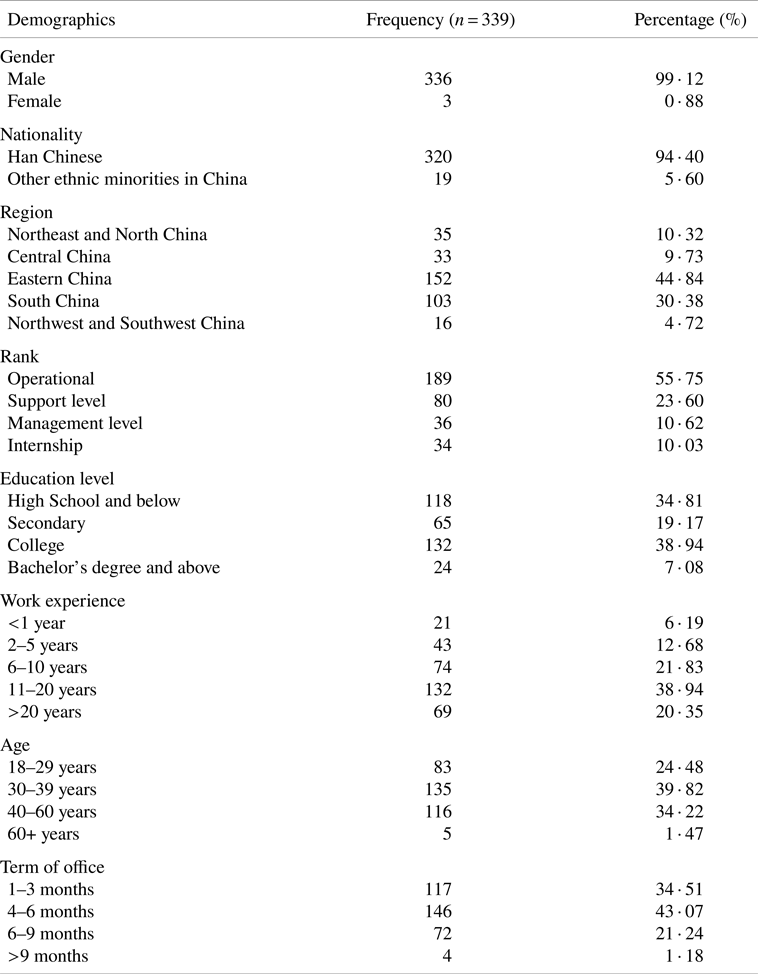
There are 339 valid questionnaires. The age of the respondents ranges from 18 to 65 years. The respondents have different genders and nationalities, come from different regions, hold different ranks, and have different educational levels and work experience. There are only three female seafarers among the respondents, which is a small proportion. However, this is consistent with the large difference in the ratio of males to females among Chinese seafarers (Ministry of Transport, 2021). With the impact of COVID-19, data on the crew development are more volatile than before. The age survey considered that seafarers of different ages would have different influences on social ideology and communication (Markiewicz, Reference Markiewicz2020), and that seafarers of different age groups have relatively consistent characteristics. For example, people who are close in age may share common interests and topics of conversation. Regional differentiation mainly considers that people from different regions in China have obvious cultural differences, and ethnic differentiation is based on the same reason (Jiang, Reference Jiang2008). Table 1 shows the demographic characteristics of the respondents.
Frequency distribution characteristics of the sample demographics

3.2 Reliability and validity analysis
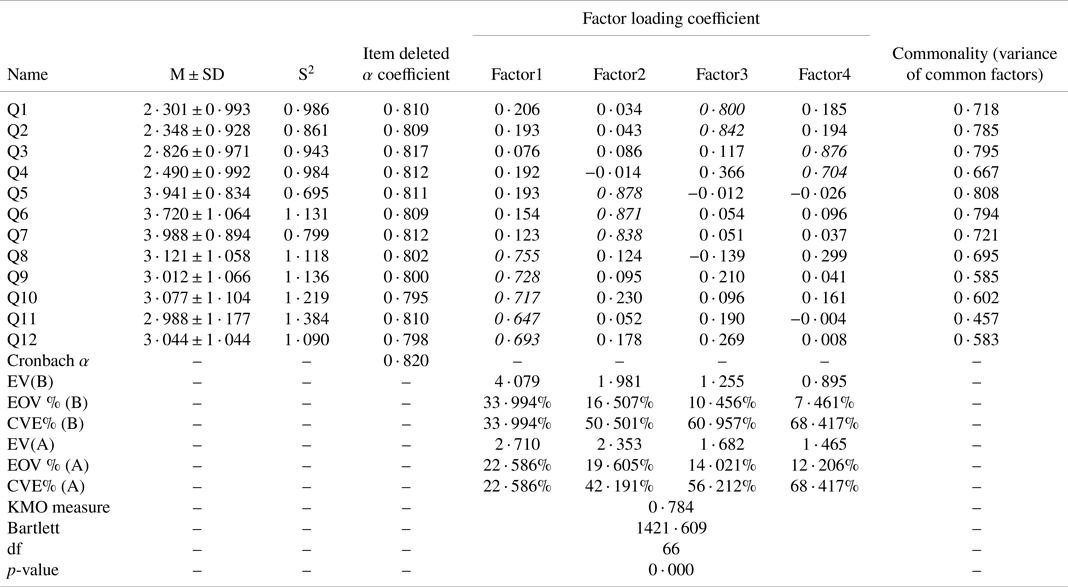
Reliability analysis can be seen in Table 2. The reliability coefficient value α is 0 ⋅ 820, which is greater than 0 ⋅ 8. This indicates that the scale has a good internal consistency reliability. The corresponding common degree values of all studies were higher than 0 ⋅ 4. This suggests that the study information can be extracted effectively. In addition, the KMO (Kaiser-Meyer-Olkin) value of 0 ⋅ 784 is greater than 0 ⋅ 6, which means that the data have validity. In summary, the study data have good reliability and validity and can be used for further analysis.
Reliability and validity analysis table

Note: Figures in italic indicate that the absolute value of the loading coefficient is greater than 0 ⋅ 4 and red indicates that the commonality (common factor variance) is less than 0 ⋅ 4.
EV(B): Eigenroot value (before rotation); EOV % (B): Variance interpretation rate % (before rotation); CVE% (B): Cumulative variance interpretation rate % (before rotation); EV(A): Eigenroot value (after rotation); EOV % (A): Variance interpretation rate % (after rotation); CVE% (A): Cumulative variance interpretation rate % (after rotation); Bartlett: Bartlett ball test results.
3.3 Work performance correlation
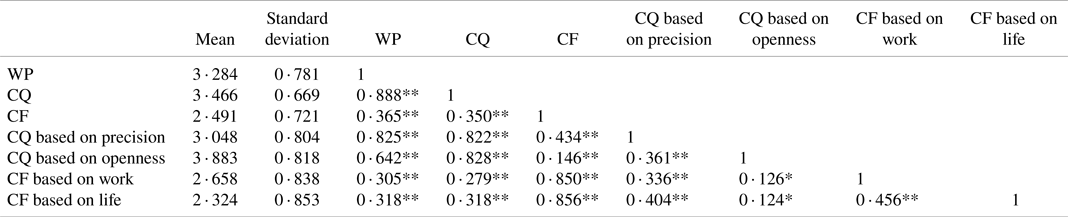
Correlation analysis is used to study the correlation between work performance, communication quality and communication frequency. The correlation is measured among four specific communication dimensions: communication quality based on precision, communication quality based on openness, communication frequency based on work and communication frequency based on everyday life (‘life’). Pearson correlation coefficient is used to represent the size of the correlation (Li, Reference Li2006). The results are shown in Table 3.
Pearson correlation table after the introduction of performance

* p < 0 ⋅ 05, **p < 0 ⋅ 01.
WP: work performance; CQ: communication quality; CF: communication frequency.
Work performance and the above six communication dimensions all show significant correlations. The correlation values are 0 ⋅ 888, 0 ⋅ 365, 0 ⋅ 825, 0 ⋅ 642, 0 ⋅ 305 and 0 ⋅ 318. There is a positive correlation between work performance and the other six items. The positive correlation between communication quality and work performance is greater than that between communication frequency and work performance. Among the four specific communication dimensions, the order of positive correlation with work performance is life-based communication frequency < work-based communication frequency < precision based communication quality < openness-based communication quality.
3.4 Stratified regression analysis
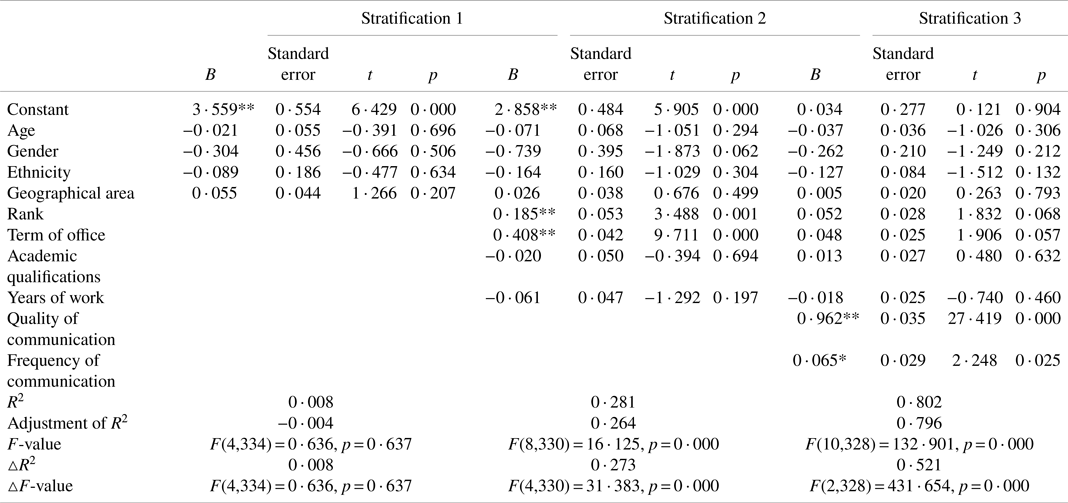
As can be seen from Table 4, this multiple stratified regression analysis involves three models, namely three levels. The independent variables in model 1 are age, sex, nationality and region. Model 2 adds rank, tenure, education and years of work experience on the basis of model 1. Model 3 adds communication quality and communication frequency on the basis of model 2. The dependent variable of the model is work performance. The regression analysis is performed with the need to determine multicollinearity. The regression equation is calculated for each independent variable relative to the other independent variables. The variance inflation factor is between 1 and 3 (all less than 5), implying that there is no cointegration problem. The D-W (Durbin-Watson) values are 1 ⋅ 885, 1 ⋅ 912 and 1 ⋅ 969, which are all about 2. This indicates that the model is not autocorrelated. There is no correlation between the sample data (Premeaux et al., Reference Premeaux, Adkins and Mossholder2007).
Stratified regression analysis table (n = 339)

Dependent variable: work performance.
* p < 0 ⋅ 05; **p < 0 ⋅ 01.
In linear regression analysis, age, gender, nationality and region are taken as independent variables. Work performance is taken as a dependent variable. R 2 = 0 ⋅ 008, suggesting that age, gender, ethnicity and geography explain 0 ⋅ 8% of the variation in work performance. The model does not pass the F-test (F = 0 ⋅ 636, p > 0 ⋅ 05). This indicates that the four indicators of age, gender, ethnicity and geography do not have an effect relationship on work performance by themselves. The relationship between the independent variables on the dependent variable cannot be specifically analysed.
For model 2: The change in F-value after adding rank, tenure, education and years of experience to model 1 is significant (p < 0 ⋅ 05). This suggests that the addition of rank, tenure, education and years of work experience is significant in explaining the model. R 2 value increased from 0 ⋅ 008 to 0 ⋅ 281. This suggests that rank, tenure, education and years of experience can have an explanatory strength of 27 ⋅ 3% on work performance. More specifically:
The regression coefficient value of job title is 0 ⋅ 185 and shows significance (t = 3 ⋅ 488, p = 0 ⋅ 001 < 0 ⋅ 01), suggesting that job title will have a significant positive effect on work performance.
The regression coefficient value of tenure is 0 ⋅ 408 and shows significance (t = 9 ⋅ 711, p = 0 ⋅ 000 < 0 ⋅ 01), suggesting that tenure has a significant positive effect on work performance.
The regression coefficient values of −0 ⋅ 020 and −0 ⋅ 061 for education and length of employment do not show significance. This suggests that education and years of service do not have an effect on work performance.
For model 3, the F-value change is significant (p < 0 ⋅ 05) after adding communication quality and frequency to model 2, suggesting that the addition of communication quality and frequency has an explanatory effect on the model. In addition, the R 2 value increased from 0 ⋅ 281 to 0 ⋅ 802, suggesting that communication quality and communication frequency can have an explanatory strength of 52 ⋅ 1% on work performance. This suggests that communication frequency and communication quality have a strong overall effect on work performance.
Specifically, the regression coefficient value of communication quality is 0 ⋅ 962 and shows significance (t = 27 ⋅ 419, p = 0 ⋅ 000 < 0 ⋅ 01), suggesting that communication quality will have a significant positive relationship on work performance.
The regression coefficient value of communication frequency is 0 ⋅ 065. It shows significance (t = 2 ⋅ 248, p = 0 ⋅ 025 < 0 ⋅ 05), suggesting that communication frequency has a significant positive influence on work performance.
From the above two sets of data, it can be seen that the effect of communication quality on work performance is more significant than the effect of communication frequency on it.
3.5 Analysis of diversity of seafarer teams
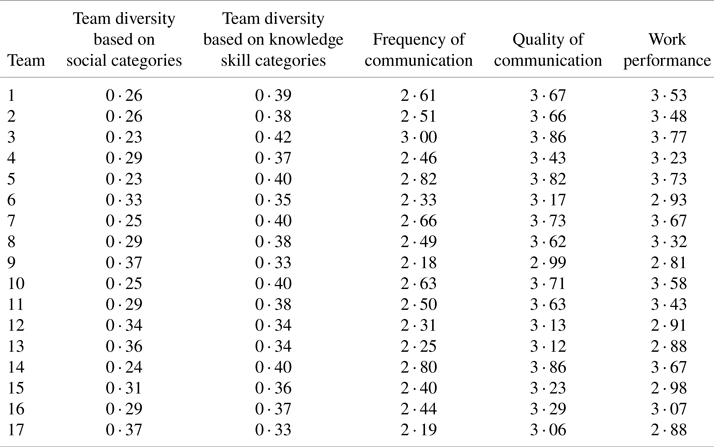
In the survey, the seafarers come from 17 ships. The number of seafarers on each ship ranges from 17 to 22. If each ship can be seen as a team, there are 17 teams in this survey work. These 17 teams are compared longitudinally in terms of team diversity, communication and performance. Their diversity is divided into social category-based diversity and knowledge skill category-based diversity. The specific diversity indicators are mainly expressed by coefficients of variation (Moynihan and Peterson, Reference Moynihan and Peterson2001). Social category diversity is expressed by the mean of the coefficients of variation of age, gender, ethnicity and geography. Knowledge skill category diversity is expressed by the coefficients of variation of tenure, rank, education and years of experience. The team communication frequency, team communication quality and work performance are represented by the average of all members of each team, as shown in Table 5.
Diversity table for 17 seafarer teams

3.6 Path analysis
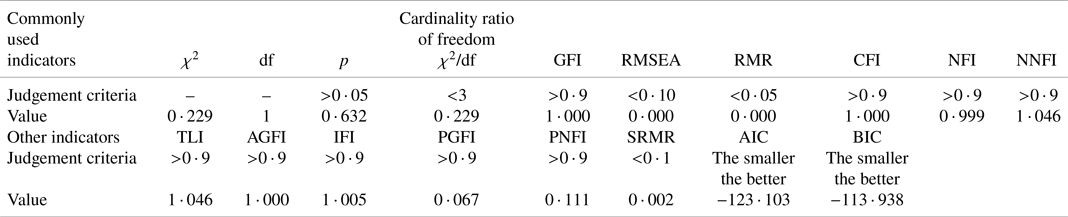
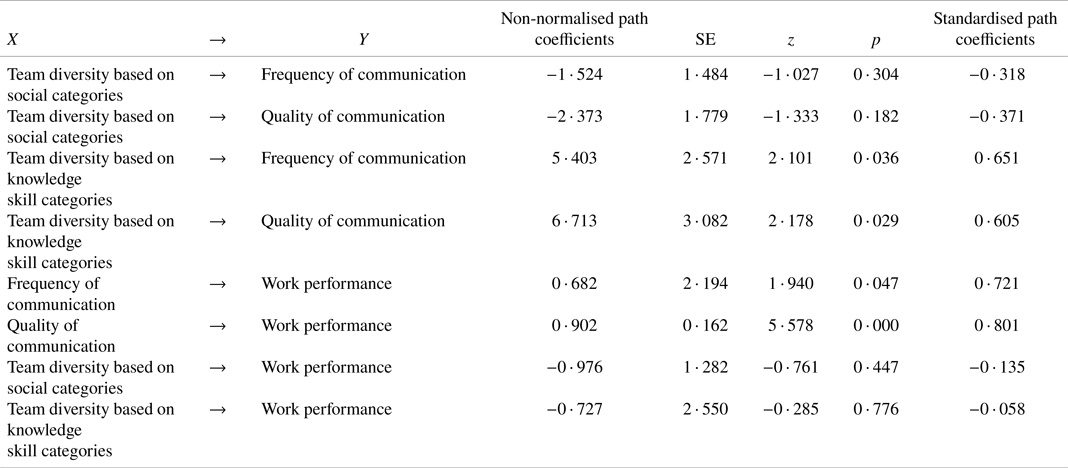
Path analysis is used to investigate the effect of team diversity on communication as well as performance (Fan and Wang, Reference Wang2013). Several model fit indicators are observed to meet the requirements through Table 6, indicating that the model fits well. Through the path analysis the following can be seen in Table 7.
Table of model fit indicators

Note: χ2: Chi-square; df: Degree of freedom; GFI: Goodness-of-fit index; RMSEA: Root mean square error of approximation; RMR: Root mean square residual; CFI: Comparative fit index; NFI: Normed fit index; NNFI: Non-normed fit index; TLI: Tucker-Lewis coefficient; AGFI : Adjusted goodness-of-fit index; IFI: Incremental fit index; PGFI: Parsimonious goodness-of-fit index; PNFI: Parsimonious normed fit index; SRMR: Standardized residual mean root; AIC: Akaike information criterion; BIC: Bayes information criterion.
Summary table of model regression coefficients

Note: → indicates a path influence relationship.
When studying the effect of social category-based team diversity on communication frequency and quality, the paths do not show significance (z = −1 ⋅ 027, P = 0 ⋅ 304 > 0 ⋅ 05; Z = 1 ⋅ 333, p = 0 ⋅ 182 > 0 ⋅ 05). This suggests that team diversity based on social categories has no impact on communication frequency and quality.
When studying the effect of knowledge skill category-based team diversity on communication frequency and quality, the standardised path coefficient values are 0 ⋅ 651 > 0 and 0 ⋅ 605 > 0, and the path presents a significant level of 0 ⋅ 05 (z = 2 ⋅ 101, p = 0 ⋅ 036 < 0 ⋅ 05 and z = 2 ⋅ 178, p = 0 ⋅ 029 < 0 ⋅ 05). This suggests that team diversity based on knowledge skills has a significant positive impact on communication frequency and quality.
On the impact of communication frequency on work performance, the standardised path coefficient is 0 ⋅ 721 > 0, and this path presents a significance level of 0 ⋅ 05 (z = 1 ⋅ 940, p = 0 ⋅ 047 < 0 ⋅ 05). This suggests that communication frequency has a significant positive impact on work performance.
On the impact of communication quality on work performance, the standardised path coefficient value is 0 ⋅ 801 > 0, and this path presents a 0 ⋅ 01 level of significance (z = 5 ⋅ 578, p = 0 ⋅ 000 < 0 ⋅ 01). This suggests that communication quality has a significant positive impact on work performance.
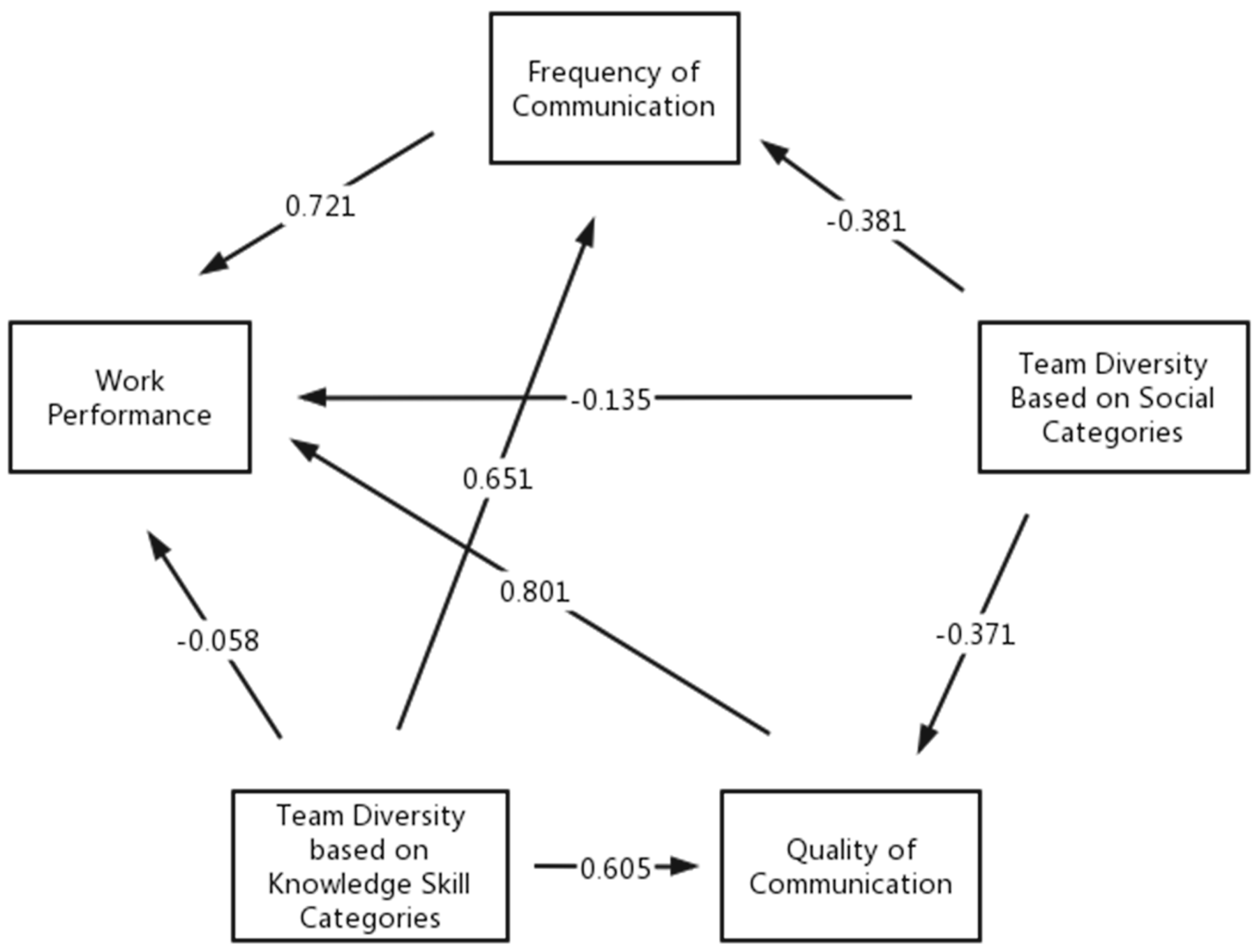
On the impact of team diversity of social category and team diversity of knowledge skill category on work performance, this path does not show significance (z = −0 ⋅ 761, p = 0 ⋅ 447 > 0 ⋅ 05; z = 0 ⋅ 285, p = 0 ⋅ 776 > 0 ⋅ 05). This suggests that team diversities based on social category and team diversity based on knowledge skill category do not have an impact on work performance Figure 2.
Diagram of the relationship between team diversity, communication and performance

The results allow the previous research hypotheses to be tested with the following results.
H1a: There is a significant negative correlation between the diversity of teams based on social categories and the frequency of communication among seafarers.
Reject.
H1b: There is a significant negative correlation between the diversity of teams based on social categories and the quality of communication among seafarers.
Reject.
H2a: There is a significant positive correlation between the diversity of teams based on knowledge skill categories and the frequency of communication among seafarers.
Accept.
H2b: There is a significant positive correlation between the diversity of teams based on knowledge skill categories and the quality of communication among seafarers.
Accept.
H3: There is a significant positive relationship between the frequency of team communication and the work performance of seafarers.
Accept.
H4: There is a significant positive relationship between the quality of team communication and the work performance of seafarers.
Accept.
H5a: There is a significant negative correlation between the diversity of teams based on social categories and the work performance of seafarers.
Reject.
H5b: There is a significant negative correlation between the diversity of teams based on knowledge skill categories and the work performance of seafarers.
Reject.
4. Discussion
The results suggest that the order of the positive correlation with work performance: frequency of communication based on life < frequency of communication based on work < quality of communication based on accuracy < quality of communication based on openness. The statistics from the communication score results indicate that there is a serious deficit in the frequency of life-based communication among seafarers. The frequency of work-based communication is higher than the average score of the life-based communication frequency, but it does not reach its score threshold of 3. This indicates that there is also a deficit of communication frequency in the work context. Specifically, the summary of work experience is much lower than the discussion of work task progress. Discussion of the work task progress can help to complete the whole work task. The summary of work completion is crucial for the efficient completion of the next work (Wang and Hu, Reference Wang and Hu2012; Guro et al., Reference Guro, Fjeld and Danielsen2020). The survey finds that the number of summary discussions is severely inadequate. In terms of communication quality, both dimensions score well, especially in openness. Having good openness indicates that the team members have a good communication atmosphere. In this atmosphere, people have more confidence to express themselves and to say what they think (Kessel et al., Reference Kessel, Kratzer and Schultz2012; Ek et al., Reference Ek, Runefors and Borell2014). In terms of accuracy, the release of shipboard information and work instructions plays a key role in critical operations, such as the operation of a ship's docking or departure from a dock. The principle of closed-loop communication on board is based on the accuracy aspect (Xing and Wu, Reference Xing and Wu2011; Song, Reference Song2018). In this respect, the respondents scored relatively well. It is noteworthy that when investigating daily work communication versus emergency communications, the average score for communication quality in emergency situations is found to be lower than the average score in daily situations due to the presence of situational stress.
The effects of communication frequency and quality on performance through a hierarchical regression analysis were analysed next. The data suggest that both of them had a significant positive effect on performance. Specifically, the impact of communication quality on performance is greater than that of communication frequency. It also means that more attention should be paid to the openness and precision of communication. Leaders on the ship should give accurate work instructions. Leaders should listen to the opinions and ideas of subordinates, both in daily work and in emergency situations, to avoid communication barriers caused by situational stress. They should understand exactly what their subordinates are saying and give clear answers to reports and feedback in a timely manner (O'Connor and Long, Reference O'Connor and Long2011). The other members of the seafarer team should give feedback on problems they encounter, understand the true intent of work instructions issued, put forward their own ideas, be receptive to others’ opinions and suggestions, share information and knowledge with each other (Wahl and Kongsvik, Reference Wahl, Kongsvik, Cepin and Bris2017), and be willing to help others. There is also a significant positive relationship between communication frequency and performance. In their spare time, team members should spend less time alone in their rooms and learn more communication skills. During working time, they should pay more attention to the overall summary of the work task after the completion of the task. As mentioned earlier, seafarers are deficient in the frequency of communication. The frequency of mutual communication between colleagues should be enhanced in order to positively influence work performance.
In addition to the influence of communication on team performance, there are some other social categories and knowledge skill factors that may affect team performance. For the overall data, a stratified regression analysis is applied. The results suggest that age, gender, ethnicity, geography, education and years of work experience had no significant effect on the respondents’ performance. There is a significant positive relationship between rank and performance. This means that the higher the rank, the higher the performance. It is easy to understand that the higher the rank, the higher the relative responsibility. The decision of the leader is related to the safe operation, working style and efficiency of the whole crew. Rank positively affects the individual's performance to some extent. Ship leaders and department heads should play an active leading role. By making full use of their leadership to coordinate team work, they can increase the team performance and avoid accidents.
There is a significant positive relationship between tenure and work performance. The longer a person works on a ship, the more familiar they are with the surrounding work and interpersonal environment, and the more familiar they are with the operation process of the work. This has a positive impact on performance. In response to this result, this paper recommends that crew and organisational changes should be minimised. In this way, the performance can be improved by enhancing the familiarity and cooperation among seafarers, increasing the friendship among colleagues, and emergency drills and training.
The analysis of 17 seafarer teams reveals no significant effect on communication frequency, quality or performance based on social category diversity. As mentioned above, age, gender and geographical differences may exacerbate team conflicts and reduce communication frequency, quality and team performance. But that does not show up in this analysis. In the context of international cooperation, seafarers are an international profession. With the gradual integration of international society and the rapid development of the internet, individual differences caused by social categories have been greatly weakened. This also mitigates the impact of social category factors on seafarers’ communication and performance. Since all the seafarers in this survey are Chinese, regardless of age and geographical differences, all of them speak fluent standard Chinese, so some communication barriers are removed. In addition, it was found that there is a significant positive relationship between the effect of diversity based on knowledge skill categories on communication frequency, communication quality and team performance. This confirms the previous hypothesis of this paper. In other words, difference instead promotes the willingness of seafarers to communicate. In this way, seafarers can learn from each other and help each other, and thus enhance the effect of communication and increase their performance. Finally, both communication frequency and communication quality have a significant positive effect on work performance. This corroborates the results of the overall crew analysis. When making crew assignments, ship managers should try to take best advantage of differences in knowledge skills among the whole crew.
5. Conclusion
5.1 Summary
Based on the theoretical model and basis, this study proposes research hypotheses on the impact of team diversity on communication and performance, and the impact of communication on performance. By introducing classic communication and performance measurement scales, a communication scale suitable for seafarers’ occupation is designed. After collecting questionnaires, excluding invalid data, reliability analysis and validity analysis were conducted on the valid data, and stratified regression analysis was conducted to explore the effects of demographic factors and communication factors on seafarers’ work performance. The results suggest that age, gender, nationality and region have no influence on work performance. Gender and work experience have a significant positive impact on work performance; education level and years of work experience have no impact on work performance; communication frequency and communication quality have a significant positive effect on work performance. The CV formula was used to calculate the diversity of each team of seafarers, and the relationship between team diversity, communication and work performance was analysed through path analysis. The previous hypotheses were verified one by one: team diversity based on social category had no impact on communication frequency and quality, while team diversity based on knowledge and skills had a significant positive impact. Communication frequency and communication quality have significant positive impacts on work performance. Team diversity based on social category and team diversity based on knowledge and skill category had no effect on work performance.
5.2 Managerial implications
In the shipping industry, mistakes are rare but costly. Team members are bound to treat every little incident as a learning event. To create such an atmosphere of learning, team members must not only be willing to speak their minds, but also believe that what they say or do will not be held against them. All team members should be able to speak up when needed. This is the importance of being good at communication and expression. It is also a core element of ship resource management training. If people cannot communicate effectively, elements such as team assistance, leadership, situation awareness, etc., cannot be improved. In order to promote effective communication among seafarers, it is necessary to be aware of communication barriers, and then to improve their ability to effectively solve communication barriers through training.
First, communication should be frequent and continuous. During specific ship operations, seafarers should keep each other updated and coordinate their work through frequent messages. However, too much communication can be a distraction. In stressful situations, such as emergency drills, people can be overwhelmed by the volume of communication and information. The ability to absorb and understand information should be maintained.
Second, communication must be clear and unambiguous to avoid misunderstandings. During manoeuvring and performing operations, communication among team members or with other units is conducted using simple, clear and precise language.
Third, communication strategies can keep communication channels open when communication difficulties are encountered (Celce-Murcia, Reference Celce-Murcia2007). The strategy may be the use of techniques such as rephrasing sentences, asking for repetition, clarification or slower speech (Canale, Reference Canale, Richards and Schmidt1983). It has also been shown that nonverbal behaviours, such as facial expressions and body movements, can convey a person's thoughts or feelings better than words (Carter et al., Reference Carter, Messinger, Stone, Celimli, Nahmias and Yoder2011). Working on board should take full advantage of this.
Fourth, company managers should enhance communication training for seafarers. Seafarer deployment should pay attention to effectively adjusting the diversity of seafarer teams. They should also promote the diversity of their teams in terms of knowledge skills. Ship leaders should be good at regulating the communication atmosphere, accepting subordinates’ opinions and suggestions, and creating an open communication environment.
5.3 Research deficiencies and prospects
1. Seafarers are an international profession, which cannot avoid large cultural differences and language communication barriers (Progoulaki and Theotokas, Reference Progoulaki and Theotokas2016; Fan, Reference Fan2017; Taezoon, Reference Taezoon2017), as has been studied in previous articles (An et al., Reference An, Liu, Sun and Liu2020). Due to the existence of COVID-19 and the escalation of port restrictions, this paper did not investigate seafarers from outside China. The respondents to this survey are all from Chinese seafarers. Therefore, the conclusions of this paper can only be applied to Chinese seafarers.
2. About the sampling problem, in this research, the ships were randomly sampled in cooperation with the Maritime Safety Administration of China, and the size of the sample was limited by the specific research time. As a result, the size of the sample in this paper is insufficient compared with the number of Chinese seafarers. According to the data analysis conducted, however, it has a certain credibility.
3. From the perspective of research methods, this paper adopts the method of subjective questionnaire survey. Although the questionnaire method as a mature subjective survey method has various advantages, it also has its shortcomings. Whether it is communication or performance, there must be a certain deviation in the subjective answer due to the existence of psychological motivation, which cannot be denied. In future research, we will conduct more objective investigation and research as a comparison.
Supplementary material
Supplementary material for this paper can be found at https://doi.org/10.1017/S0373463322000479.