Introduction
The next generation of materials scientists is dependent on the K–12 educational system. As discussed in the previous articles in this issue, materials scientists can collaborate with teachers, administrators, parents, and students to develop outreach programs that are designed to improve K–12 education. Many such programs rely on materials scientists visiting the K–12 classrooms, assisting teachers in the preparation of classroom materials, and organizing professional development workshops. These programs can be offered in various locations, such as in K–12 schools, colleges, or universities, and some are offered outside of school hours. This presents a challenge for materials scientists who wish to participate in educational outreach and who have limited time available. Other challenges include developing programs that are broadly accessible and effective, and finding ways to motivate students to pursue studies in the field. Educational technologies can provide a medium for overcoming some of these challenges.
By bringing together the worlds of academia and technology, we can create educational environments that were not previously possible. Technology can change the way educators and scientists interact and communicate with their audience, the way learning materials are presented, and the place and time learning occurs. Moreover, enhancing education through technology can increase the level of students’ motivation, attention, and engagement while learning, as well as provide a more diverse and accessible learning environment. Successful technology integration in K–12 education can capitalize on students’ enthusiasm for technologyReference Rideout, Foehr and Roberts1 and serve as a motivation for learning. This article discusses possible ways technology can be used to enhance materials science K–12 outreach programs, known challenges of incorporating technology into such programs, and suggestions on how to overcome such challenges.
Use of technology in K–12 outreach programs
This section describes some educational technologies that are available for enhancing K–12 materials science outreach programs (targeting student learning, classroom instruction, or teacher professional development) along with how these technologies may be incorporated into outreach programs. A list of all the resources mentioned in this article along with their access links are included at the end of the article.
Educational software
Educational software can be used as an aid for teaching or individual learning. In the last few decades, there has been a rapid growth in the development and use of educational software, especially for K–12 education.
There are several types of educational software, including drill-and-practice, simulations, electronic games, visualization, and tutorial software. One of the main benefits of educational software is that it can incorporate multimedia (e.g., graphical representations, animations, and sound), thus accommodating multimodal learning.Reference Bitter and Legacy2 It is well documented that students learn in different manners and have different learning preferences.Reference Zhang and Bonk3 Most students learn best when they use a combination of sensory modalities (i.e., auditory, visual, and kinesthetic) simultaneously—multimodal learning—and they use different combinations of sensory modalities for learning different concepts.Reference Zhang and Bonk3 These different modalities can be accommodated through well-designed educational software. The subsections that follow discuss and provide examples of two primary types of educational software—simulations and electronic games.
Simulations
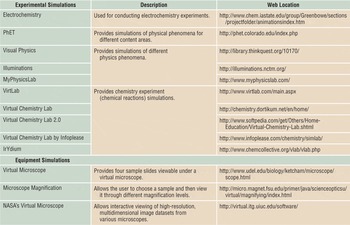
“Simulations attempt to provide an environment that represents or mimics reality so as to facilitate learning of the user.”Reference Bonk and Dennen4 Educational simulations are used to simulate real-world environments (or phenomena) that are difficult to explore in a classroom setting,Reference Bonk and Dennen4, Reference Tan and Biswas5 such as chemical reactions, weather conditions, and biological processes.Reference Bitter and Legacy2 Students can perform scientific experiments using simulations (virtual laboratories) without physically being in a laboratory environment.Reference Tan and Biswas5–Reference Thomas and Hooper7 Through simulations, students can generate hypotheses and manipulate simulation variables to confirm their hypotheses, observe an experiment, explain the results of the experiment, and connect their experience to their existing knowledge.Reference Tan and Biswas5 Simulated experiments can be performed as part of a classroom activity (individual or group activity) or as take home experiments.Reference Tuvi-Arad and Nachmias6 Another application of simulations is to train students on using expensive equipmentReference Bitter and Legacy2, Reference McGregor, Hargrave, Crawford, Davis, Price, Weber and Willis8 (e.g., microscopes) in a safe environment without danger to themselves or the equipment.Reference Bitter and Legacy2 Some examples of simulations that materials scientists can incorporate into their K–12 outreach programs are listed in Table I.
Simulations that materials scientists can incorporate into their K–12 outreach programs.

Incorporating simulations into materials science outreach programs can have a range of benefits. Students can slow down or speed up simulated processes, accommodating individual learning. Simulations can be used to generate discussions and encourage cooperation among students toward achieving a common goal.Reference Bitter and Legacy2 Results from recent studies suggest that simulations can increase students’ motivation and engagement with a task as well as help students retain information better and achieve deeper understanding.Reference Tan and Biswas5
Materials scientists who would like to include simulations in their outreach programs should understand that simulations are effective only if used properly. Simulations will not have the expected learning outcomes when used just for demonstration purposes without allowing students to interact with the simulation, or when students are provided with step-by-step instructions for using the simulation instead of experimenting with it.Reference Windschitl and Andre9, Reference Brant, Hooper and Sugrue10 Another issue is that simulations model real-life phenomena, but they are not real-life phenomena.Reference Bitter and Legacy2, Reference Flick and Bell11 The outcome of a simulation experiment is controlled by predefined conditions modeled in the simulation software, therefore simulations do not expose students to the “messiness of the natural world,”Reference Chinn and Malhotra12 which may lead to student misconceptions if not made explicit.
Electronic games
“[Electronic] games are activities that do not attempt to replicate reality, have clearly defined sets of rules including scoring systems, and produce winners and losers.”Reference Ireland, Kaufman, Sauvé, Reeves and Yamashita13
With the advances in technology and the increasing number of electronic games targeting youth, it is not surprising that children spend hours of their leisure time playing electronic games,Reference Etuk14 and many researchers argue for their potential to support education,Reference Bitter and Legacy2, Reference Ireland, Kaufman, Sauvé, Reeves and Yamashita13, Reference Van Eck15, Reference Prensky16 especially in terms of motivating, exciting, and engaging students in the learning process. Thus, educational games can serve as a medium for capturing students’ interest and draw it to the field of materials science as well as for improving instruction of science concepts related to the field.
Educational games can be designed as fun activities where students can learn or practice different concepts. Games that are focused on learning provide students with information that allows them to explore different scenarios and construct knowledge through game play. Alternatively, games intended for practice rather than learning include questions related to the targeted content and provide students with incentives to answer the questions correctly by either offering resources necessary to continue playing the game, moving up a skill level, or earning points. Such questions can be directly related to the subject area and the appropriate educational standard (see the article by Nucci et al. in this issue). Effective games should contain different kinds of problems, especially in terms of the content and level of difficulty, as well as provide students with immediate and detailed feedback on their performance so that they can learn from their mistakes.
Two good examples of educational games that can be incorporated into materials science outreach programs are “Nanoquest,” which introduces players to nanotechnology concepts through game challenges, and “City Of Materials,” which introduces players to the use of materials in everyday life.
In Nanoquest, users select a character who works as a student in a nanotechnology research lab. The character is trapped in a quantum scaling chamber and is transported to the nanoworld (shrunk to the nanoscale with the ability to see things at an atomic level). The character can get out of the nanoworld by completing an assigned task (e.g., collecting all the parts necessary to build a nano-car and use an atomic force microscope to put the parts together). There are obstacles slowing down the character (e.g., charged molecules may strike the character). The game times how long it takes the character to complete the task. The game also includes a nano-gallery where users learn interesting facts about nanotechnology and a map to help them navigate the nanoworld.
Participants in the “City of Materials” become private investigators by taking a quiz that allows them to get their private investigator badge. They can then be assigned an unsolved case (crime) related to materials. The goal is to collect and analyze evidence using equipment in the CSI lab and solve the case. The game provides users with a list of objectives that needs to be completed so that the case can be solved, as well as current information related to the case (e.g., witness statements). Here is one example case: “A pair of shatter-resistance eyeglasses breaks under mysterious circumstances. Use your materials and chemical know-how to unravel this curious case. You will need to research plastics, chemicals and mechanical properties to reach the solution and figure out just how something “unbreakable” came to break.” The game also includes Matching Materials, which is a card matching game to test users’ memory of materials.
When identifying educational games for their outreach programs, materials scientists should carefully examine the goals, rules, objectives, and outcomes of the games and how these are aligned with the appropriate learning goals. The pedagogical content of a game should not be overshadowed by its “fun” aspects.
Other technologies
Podcast
Even though podcasts are a relatively new concept (introduced in 2004), their usage is expanding rapidly.Reference Watson, Boggs, Bastiaens and Carliner17 A podcast is “a series of media files (either audio or video) that are released episodically and often downloaded through web syndication.”18 Currently, podcasts are available for many different topics, ranging from audio tours of museums, campuses, and cities to newscasts and class lectures. Podcasts can be played on different portable media as well as personal computers.
Because of their popularity, podcasts are slowly moving into the education community. Podcasts can be used to complement instruction, as students can listen or watch parts of full lectures during their own time and at their own pace. Lecture podcasts provide a permanent record of instruction, allowing students the opportunity to review materials as needed, and cover material missed.Reference Price, Gay, Searle and Brissenden19 Studies have shown that students have positive attitudes toward using podcasts, and they believe that they are effective,Reference Brittain, Glowacki, Ittersum and Johnson20, Reference Lee and Chan21 but at the same time, they do not favor the replacement of a lecture by a podcast.Reference Watson, Boggs, Bastiaens and Carliner17 The “Kids Know it Network” provides different video podcasts (Nanna KnowItAll), which explore different K–12 science concepts and can be used in materials science outreach programs.
For outreach programs aimed at improving K–12 classroom instruction, materials scientists can develop podcasts on a topic of their expertise to supplement teacher instruction. Podcasts can also supplement professional development programs and be available online for teachers to access, thus accommodating the needs of teachers located in rural areas as well as reaching international audiences. Developing podcasts is not a difficult task—it only requires access to a computer, a microphone, and audio or video editing software or a video camera. Dissemination of podcasts is easy, since they are platform independent and accessible through any computer that has audio or video downloading capabilities.Reference Piecka, Studnicki and Zuckerman-Parker22 Smithsonian Education is one source that provides podcast support information.
Weblog
A weblog (or a blog) is a website where people can exchange ideas and share their opinions and experiences. Many people can post comments on the same weblog. Educational weblogs can be created by scientists, educational organizations, school districts, or schools for the purpose of discussing and sharing ideas about topics of interest and things occurring in their community.
Materials scientists can use weblogs as part of their outreach programs to develop diverse online communities with teachers, students, and scientists. Through weblogs, teachers and students can share ideas, ask questions, and communicate with scientists, thus increasing the effectiveness of the program. The use of weblogs allows scientists throughout the world to be part of the community, providing teachers and students in rural locations with access to diverse expertise. A weblog can provide a support system for an outreach program and work as a feedback mechanism for different stages of the program. Weblogs can be used to post information related to the program (e.g., program schedule, reading materials, and surveys). “Edublogs” and “Blogger” provide tools for easy development and management of weblogs, and “SchoolBlogs” and “SupportBlogging” provide information and support for the use of weblogs in education.
Videoconferencing
Videoconferencing (or teleconferencing) is a two-way connection of people located in two or more different places using simultaneous video and audio transmission through the use of interactive telecommunication technologies.23
Videoconferencing can be used in outreach programs for the purpose of having scientists “visit” the classroom without the need to physically be there. This can allow scientists to contact numerous schools while saving time as well as travel expenses.Reference Rusnak, Barker and Rebelsky24 Videoconferencing also allows the participation of content experts from different cities and countries into K–12 professional development programs, thus expanding the expertise provided to the participants. An example of videoconferencing where graduate students and scientists “visit” the K–12 classroom is provided through the sidebar by Van Stephen Blackwood.
Videoconferencing
Van Stephen Blackwood (Colorado School of Mines GK–12 Teaching Fellow)
Through the support of the ExxonMobil Corporation, scientists and graduate students at the Colorado School of Mines (CSM) are connected with the Meeker Elementary School (MES) via an interactive videoconferencing unit. CSM and MES are approximately 250 miles apart, and MES is located in the rural Rocky Mountains. Using this unit, a graduate student provides classroom support to the teachers by completing live demonstrations and responding to questions concerning scientific and engineering phenomena. Additionally, CSM scientists can address MES’s classrooms without leaving their offices. A similar but parallel program is being offered onsite in 50 elementary schools in the Adams County District and is funded by the Bechtel Foundation. The main difference between these two programs is the use of the videoconferencing unit with MES. The intention of the program is to extend local opportunities to schools located in the rural Rocky Mountains. For example, a graduate student “meets” with elementary school students once a week during their lab time using the teleconferencing equipment. During this “meeting,” the graduate student introduces elementary school students to a science concept by performing a live lab experiment for the students to see and then discusses the results of the experiment with them. In some cases, the graduate student may demonstrate how an experiment can be performed, and then the elementary school students will perform it themselves.
An image from the K–12 videoconferencing project at Colorado School of Mines, showing Van Stephen Blackwood (graduate student) demonstrating a lab experiment to fifth grade students at Meeker Elementary school (seen on the TV screen) through the use of videoconferencing equipment.

Moreover, videoconferencing can be used to “replace” field trips to libraries, museums, and other field sites, especially when financial resources and time are scarce, for safety reasons, and for schools located in rural locations.Reference Falco, Barbanell, Newman, Nall and Robson25 The Columbus Zoo26 for instance has already developed K–12 videoconference programs.
One drawback of videoconferencing is that the underlying technology can be expensive. All sites must have television monitors, cameras, speakers, microphones, teleconferencing software, and high speed internet connections. Rusnak gives recommendations for materials scientists who would like to incorporate videoconferencing into their programs.Reference Rusnak, Barker and Rebelsky24 For materials scientists who would like to use teleconferencing as part of their outreach programs, the Knowledge Network provides good K–12 teleconferencing resources.
Other resources
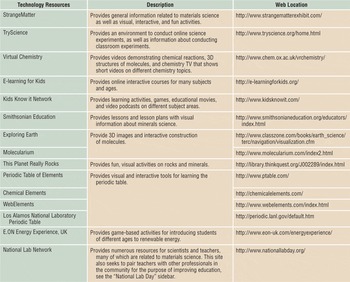
In addition to what has been discussed, there are numerous technology resources for use in materials science K–12 outreach programs ranging from visual and interactive tools for learning science concepts to videos and classroom support websites (see Table II).
Additional electronic resources
Nanoquest: http://www.nanoquest.ie/home.html
City Of Materials:http://www.cityofmaterials.net/
Edublogs:http://edublogs.org/
Blogger:https://www.blogger.com/start
SchoolBlogs:http://www.school-blogs.com/
SupportBlogging:http://supportblogging.com/
The Knowledge Network:http://www.nhptv.org/kn/vs/vc2.htm
PBS TeacherLine:http://www.pbs.org/teacherline?cc=tlredir
Columbia Interactive:http://ci.columbia.edu/ci/eseminars/index.html
National Teachers Enhancement Network:http://btc.montana.edu/courses/aspx/ntencourses.aspx
Teacher Tap:http://www.eduscapes.com/tap/
CARET:http://caret.iste.org/
Technology resources for use in materials science K–12 outreach programs.

Online professional development
Technology can also be used to improve the delivery of professional development (PD) programs. This is true especially for teachers located in rural locations where access to PD programs is limited, costly, and time consuming, as well as for teachers in schools where funding is not available to support PD. Online PD programs are delivered through the internet and can be accessed by anyone with a high speed internet connection. (See the sidebar by Camsie Matis.)
National Lab Day
Camsie Matis (K–12 Educator, National Lab Day Leadership Team)
National Lab Day (NLD) is a grass-roots effort to connect educators, students, and working professionals in the STEM (science, technology, engineering and mathematics) fields. Launched in November 2009 as part of the White House Educate to Innovate initiative, NLD works as an “e-harmony” site—matching up educators in STEM classrooms (or afterschool providers) with professionals in these fields. Educators can go online and post a project asking for guest speakers, laboratory assistance, field trips, science fair judges, etc. Once registered (free of charge), educators can search the more than 5,000 registered volunteers to e-mail them for assistance. Scientists who are looking for outreach opportunities are encouraged to visit the NLD website and search the “Community” section or the “Projects” sections to see if educators in their area are seeking assistance.
In addition to reaching a broad audience, online PD programs are convenient, since teachers do not have to attend the program at a predefined time, date, and place that may not fit their busy schedules.Reference Labec and Luft27, Reference Chan Lin, Hong, Horng, Chang and Chu28 However, materials scientists may have to provide additional support to the teachers participating in online PD programs. Similar to regular courses, some reports suggest that teachers lack commitment to online courses/seminars due to factors such as (1) limited time availability, (2) absence of external motivation (in the forms of grades, progress toward a degree or credits), and (3) lack of personal accountability.Reference Labec and Luft27 Materials scientists using online PD programs can address these issues in different ways. For example, they can keep participating teachers motivated and create the feeling of accountability by organizing weekly online meetings in which teachers provide an update of their progress, discuss what they learned, and ask any questions they may have on the online materials. Providing ongoing online support to the teachers is key for maintaining their interest in the program, since teachers feel that online programs lack immediate feedback.Reference Labec and Luft27 Online support can be provided through some of the ideas discussed earlier, such as weblogs and videoconferencing.
Some online professional development programs available that may be of interest are:
• PBS TeacherLine, which provides online workshops on different subject areas, including mathematics and science.
• Columbia Interactive, which provides many science-related online seminars, including one on nanoscience.
• National Teachers Enhancement Network, which provides numerous online courses, including some related to earth science, physics, and soil science.
Challenges of incorporating technology into K–12 outreach
The intent of educational technologies is not to replace or change the role of the teachers or scientists, but rather to assist them in enhancing education.Reference Flick and Bell11 Materials scientists who would like to incorporate technology into their outreach programs should be aware that participating teachers may be reluctant to use them because of obstacles, such as limited time available to learn new technologies, lack of technical skills, and lack of initial and ongoing technical support.Reference Bitter and Legacy2, Reference Pelton, Francis Pelton, McFerrin, Weber, Carlsen and Willis29, Reference Hayes, Jin, Price, Willis, Willis, Muktha and Boger-Mehall30
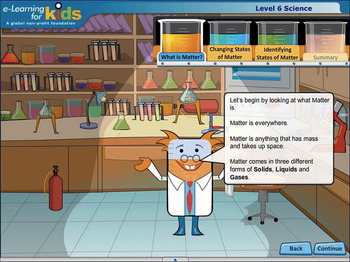
When identifying resources to support teachers participating in outreach programs, scientists should keep in mind that most teachers prefer to use technology that “makes their lives easier,” such as using computers to prepare classroom materials, lesson plans, tests, homework assignments, and to record students’ progress.Reference Chan Lin, Hong, Horng, Chang and Chu28 Moreover, it was found that teachers prefer sources (websites) that provide classroom materials (e.g., lesson plans, classroom activities, and flash cards) (Figure 1), information that can supplement teachers’ knowledge about a specific topic, management tools (e.g., to monitor students’ scores and progress), teacher support communities, and PD.Reference Archambault and Crippen31
A screenshot from the e-learning for Kids website States of Matter course showing “Mr. Beaker” discussing matter; http://e-learningforkids.org/.

One way scientists can help teachers become more comfortable using technology in their outreach programs is by providing teachers with resources available to assist them with integration of technology and by organizing or referring teachers to existing workshops that prepare them for teaching with the aid of technology.Reference Shafer32 Such workshops should not focus on the general use of technology, but rather on specific technologies and how these technologies can be used, as well as provide teachers with sample lectures and lesson plans that integrate these technologies.Reference Pelton, Francis Pelton, McFerrin, Weber, Carlsen and Willis29, Reference Kersaint33
Materials scientists can also assist teachers in locating resources available to support integration of technology in education, such as TeacherTab, PBS TeacherLine, CARET, and EdWeb. Studies have shown that the ongoing support of teachers and their participation in “learning communities” have a positive effect in teachers’ willingness to integrate technology into their classrooms.Reference Guzey and Roehrig34
Another issue with the integration of technology in K–12 outreach programs is cost. The specific technologies chosen for a program depend on the financial resources available to program organizers, schools, or school districts. Many organizations, companies, foundations, and agencies (private, state, or national) have programs designed to financially support the integration of technology in education, especially for schools located in rural locations. Examples include the One Laptop Per Child (OLPC) Project at the Massachusetts Institute of Technology,35 the Engineering information foundation (EiF) grants,36 the HP Catalyst Initiative awards,37 and various Intel projects.Reference Light38 Other creative ways to address cost issues also exist. For example, students located in rural locations or from low-income families may not have access to computers at home. Working with administrators for after school programs and access to the schools’ libraries and computer laboratories as well as working with parents to identify facilities within the community may provide students with the needed access to computers.Reference Kelly39
Conclusions
Effective use of educational technologies in materials science K–12 outreach programs can actively engage participants in the learning process and capture their attention and interest in the field. The success or failure of an educational technology does not depend solely on the technology used, as “There is no ‘one best way’ to integrate technology into curriculum.”Reference Koehler and Mishra40 Technology by itself cannot improve education, but when combined with other educational factors, such as instructional approaches, pedagogy models, and content, it can provide environments that would otherwise not be possible.Reference Zhang and Bonk3 Educational technologies should only be used when they have something to offer and as a supplement to instruction rather than replacement.Reference Garofalo, Drier, Harper, Timmerman and Shockey41 Technology changes at a rapid pace, and scientists and teachers will continue to be challenged to keep up to speed.