Introduction
Burnout is characterised by depersonalisation, a decreased sense of accomplishment, cynicism, and both physical and mental exhaustion.Reference Lacy and Chan1,Reference Gazelle, Liebschutz and Riess2 It is well known that burnout is especially prevalent among physicians. By 2025, the US Department of Health and Human Services predicts that there will be a nationwide shortage of nearly 90 000 physicians, many driven away from medicine or out of practice because of burnout.Reference Swain, Soegaard Ballester, Luc and Han3 Surgeons and residents in training represent a particularly vulnerable population, as they are exposed to a high degree of emotional stress, long work hours, and difficulty finding a balance between personal and professional life. Along with burnout, anxiety and depression are commonly reported among surgical residents.Reference Swain, Soegaard Ballester, Luc and Han3–Reference Gleason, Baker, Wood, Wood, Hollis and Chu7 Rates of burnout in surgical residents have been shown to be as high as 69 per cent, with associated rates of depression as high as 20 per cent.Reference Lebares, Guvva, Ascher, O'Sullivan, Harris and Epel8,Reference Elmore, Jeffe, Jin, Awad and Turnbull9 Multiple institutions have reported on their concerted efforts to enact a structured wellness programme within their residency programme.Reference Kashat, Falcone, Carter, Parham and Kavanagh10–Reference Gurland12
This year, surgical residents and faculty members faced a new level of stress while dealing with the changes and challenges amidst the severe acute respiratory syndrome coronavirus-2 (SARS-CoV-2) pandemic. Multiple studies have already shown an increased mental strain on healthcare workers during the SARS-CoV-2 pandemic, reflected through validated surveys on anxiety, depression, insomnia and distress.Reference Civantos, Byrnes, Chang, Prasad, Chorath and Poonia13–Reference Pappa, Ntella, Giannakas, Giannakoulis, Papoutsi and Katsaounou16 Not only are physicians at increased risk of contracting the virus, but surgeons in particular are seeing a reduction in both elective operations and out-patient clinic volume.Reference Yoon, Koller, Duldulao, Ault, Lee and Cologne17–Reference Kuhar, Heilingoetter, Bergman, Worobetz, Chiang and Matrka21 A reduction in clinical volume undoubtedly affects resident training and faculty reimbursement. Surgical case backlogs are an especially high source of stress and anxiety for both residents and faculty members.
We present a prospective, randomised, controlled trial that aimed to assess whether practising daily meditation for a short period of time can improve burnout, anxiety and depression among surgical faculty members and residents at our academic institution. The first objective of our study was to assess the feasibility of a meditation programme in the hope of providing a foundation for future programmes within our own department. The second objective was to determine whether a well-known and easily accessible meditation application could serve as an effective intervention to improve burnout, anxiety and depression scores, determined using validated measures.
Materials and methods
This study was exempt from institutional review board approval, as it was considered an internal quality improvement project.
Eighteen otolaryngology surgery residents and 15 otolaryngology faculty members at a large academic institution were invited to participate in this prospective, randomised, controlled pilot study between March and April 2020. Participants were randomised to either the control or the intervention group using Research Randomizer online randomisation software.Reference Urbaniak and Plous22 Participants were given a subject number in order to ensure that the first author (MDH) remained blinded to participant group status. One author (LAB) was not blinded, so they could provide information to participants about group assignment and study requirements.
All participants completed three surveys prior to initiation of the study. These surveys were: the Generalized Anxiety Disorder scale-7, the Patient Health Questionnaire-9 and the Professional Quality of Life scale. Participants in both groups were given one week to complete the surveys prior to study commencement.
Specifically, the Generalized Anxiety Disorder scale-7 is an anxiety screening tool based on seven questions, with a possible score of 0–3 per question. Scores range from 0–5 (no anxiety) to 6–10 (mild), 11–15 (moderate), and 16–21 (severe). The Patient Health Questionnaire-9 is a depression questionnaire that scores each of the nine Diagnostic and Statistical Manual of Mental Disorders, Fourth Edition criteria for major depressive disorder from 0 (not at all) to 3 (nearly every day). Scores range from 0–4 (no depression) to 5–9 (mild), 10–14 (moderate), 15–19 (moderately severe), and 20–27 (severe). The Professional Quality of Life scale measures the fulfilment that one derives from work. There are three categories within this scale: compassion satisfaction, burnout and secondary trauma. Compassion satisfaction reflects the pleasure one derives from being able to do one's work well and from helping others through one's work. Scores range from less than 22 (low) to 23–41 (moderate) and more than 42 (high). Burnout reflects feelings of hopelessness and difficulty in dealing with work or doing one's job effectively. Scores for the burnout portion are the same as the aforementioned scale. Secondary traumatic stress reflects one's work-related secondary exposure to traumatically stressful events. Scores for the secondary traumatic stress portion are the same as the aforementioned scale.
Participants randomised into the intervention group were instructed on how to download and access meditation sessions using the mobile application Headspace™, an audio-guided mindfulness meditation program application. They were asked to complete 10 meditation sessions over a 14-day period. Each session was 10 minutes in length. The Headspace application organises the meditation sessions in order of intended completion. Participants were given detailed instructions on how to access the Headspace application. Once in the application, meditation sessions were numbered in order of intended completion. Participants in the control group did not participate in any meditation sessions.
At the end of the 14-day period, participants in the intervention group were asked to report how many meditation sessions they had completed. All study participants were then asked to complete the same three surveys administered at the beginning of the study. An author blinded to participant grouping status (MDH) collected the surveys for statistical analysis. Survey total values are presented as change from pre- to post-intervention score.
Statistical analysis was completed using SPSS software, version 26 (IBM, Armonk, New York, USA). The chi-square test was used for the comparison of categorical data, whereas independent t-tests were used for the analysis of continuous, parametric variables. A p-value of less than 0.05 was considered statistically significant.
Results
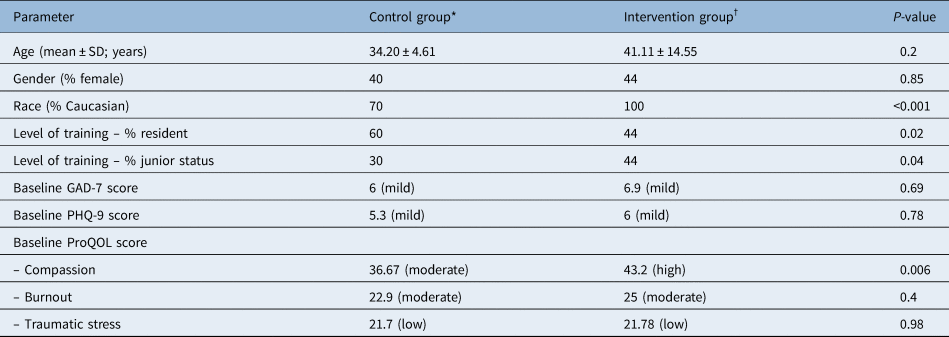
A total of 19 participants completed the study (9 in the control group, 10 in the intervention group) out of 30 eligible participants (63.3 per cent accrual rate) (Table 1). Eleven participants chose not to complete the study because of personal preference.
Baseline characteristics of study participants

*n = 9; †n = 10. SD = standard deviation; GAD-7 = Generalized Anxiety Disorder scale-7; PHQ-9 = Patient Health Questionnaire-9; ProQOL = Professional Quality of Life scale
There was no difference in age between the two groups (34.20 ± 4.61 years vs 41.11 ± 14.55 years; p = 0.2). There was also no difference in gender between the groups (40 per cent female vs 44 per cent female; p = 0.85). There were significant differences between the groups with regard to race and level of training. Seventy per cent of the control group were Caucasian compared with 100 per cent of the intervention group (p < 0.001). There was a higher percentage of residents in the control group (60 per cent) compared with the intervention group (44 per cent) (p = 0.02). Junior status was defined as either a resident in post-graduate years one to three or a faculty member less than five years out from training. Senior status was defined as either a post-graduate year four to five resident or a faculty member more than five years out from training.
There were no differences in baseline Generalized Anxiety Disorder scale-7 and Patient Health Questionnaire-9 scores between groups. There was a significant difference in baseline Professional Quality of Life scale scores for compassion between the two groups, with the control group scoring lower than the intervention group (36.7 vs 43.2; p = 0.006). There were no differences in baseline Professional Quality of Life scores for burnout or traumatic stress between the groups (Table 1).
Only 4 of the 10 participants in the intervention group completed all 10 of the meditation sessions. Five participants completed between six and nine sessions, while one participant only completed five sessions.
Generalized Anxiety Disorder scale
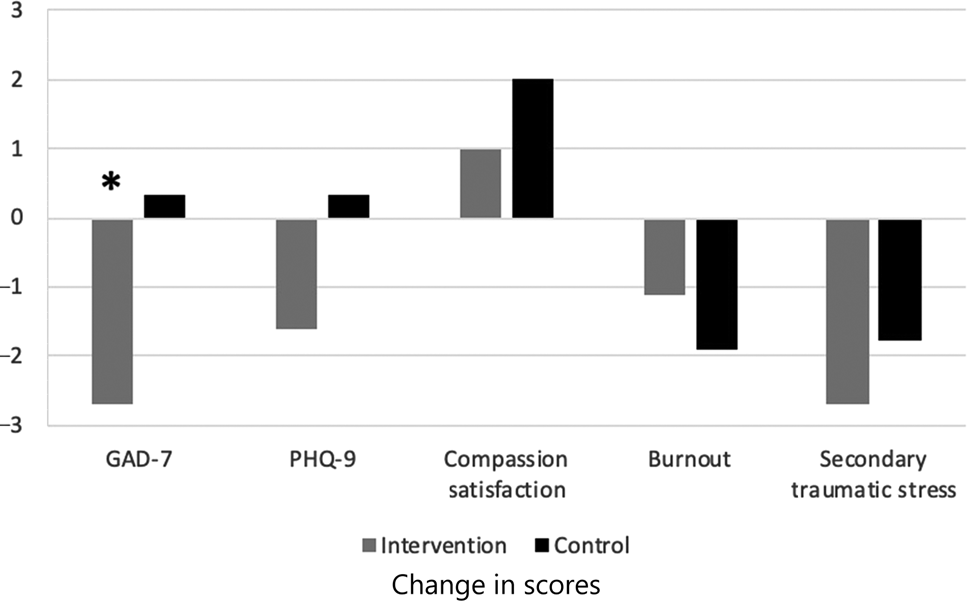
Average pre-intervention Generalized Anxiety Disorder scale-7 scores were 6.90 ± 4.86 (range, 2–18) in the intervention group and 6.00 ± 4.95 (range, 2–15) in the control group (p = 0.69), showing mild anxiety in both groups. Participants in the intervention group had a significantly greater mean change in Generalized Anxiety Disorder scale-7 score when compared with controls. The mean change in Generalized Anxiety Disorder scale-7 scores in the intervention group was significantly different from that in the control group (−2.7 ± 3.335 vs 0.33 ± 1.225; p = 0.04) (Figure 1). The minimal clinically important difference (for the Generalized Anxiety Disorder scale-7 has been reported as four points.Reference Toussaint, Hüsing, Gumz, Wingenfeld, Harter and Schramm23 A significantly greater number of participants met the four-point minimal clinically important difference in the intervention group compared with the control group (4 vs 0; p = 0.03). There was no significant difference in average change in Generalized Anxiety Disorder scale-7 score when comparing residents and faculty members (−1.40 ± 2.68 vs −1.11 ± 3.37; p = 0.554). There was also no significant difference in change in Generalized Anxiety Disorder scale-7 score when we compared junior status (post-graduate years one to three and faculty members less than five years out from training) with senior residents and faculty members (−1.0 ± 3.79 vs −1.42 ± 2.50; p = 0.281).
Change in scores (from pre- to post-intervention) among different validated surveys. Patients in the intervention group had a significantly greater reduction in Generalized Anxiety Disorder scale-7 (GAD-7) scores when compared to the control group (as indicated by the asterisk). No other measure demonstrated significance between patient cohorts. PHQ-9 = Patient Health Questionnaire-9

Patient Health Questionnaire
Average pre-intervention Patient Health Questionnaire-9 scores were 5.30 ± 5.72 (range, 2–17) in the control group and 6.00 ± 4.80 (range, 0–15) in the intervention group (p = 0.78), showing mild depression in both groups. There was no significant difference in Patient Health Questionnaire-9 score reduction between the control and intervention groups (0.33 ± 1.225 vs −1.60 ± 2.87; p = 0.319). There was no significant difference in average change in Patient Health Questionnaire-9 score when comparing residents and faculty members (−1.30 ± 3.37 vs 0.0 ± 3.94; p = 0.703). There was also no significant difference in change in Patient Health Questionnaire-9 score when we compared junior with senior status (−0.57 ± 4.58 vs −0.75 ± 3.14; p = 0.309).
Professional Quality of Life scale
There was a significant difference in average pre-intervention compassion satisfaction scores between groups, with scores of 43.20 ± 4.08 (range, 36–50) in the intervention group and 36.67 ± 5.07 (range, 27–42) in the control group (p = 0.006), showing high satisfaction in the intervention group and moderate satisfaction in the control group. There was no significant difference in change of compassion satisfaction scores between the control and intervention groups (2.00 ± 5.57 vs 1.0 ± 1.94; p = 0.319).
Average pre-intervention burnout scores were 22.90 ± 4.43 (range, 15–32) in the intervention group and 25.00 ± 6.16 (range, 18–38) in the control group (p = 0.4), showing moderate burnout in both groups. There was no significant difference in change of burnout score between the intervention and control groups (−1.10 ± 2.81 vs −1.89 ± 2.76; p = 0.973).
Average pre-intervention secondary traumatic stress scores were 21.70 ± 6.02 (range, 13–32) in the intervention group and 21.78 ± 4.92 (range, 18–32) in the control group (p = 0.98), showing low exposure to traumatically stressful events at work. There was no significant difference in change of secondary traumatic stress scores between the intervention and control groups (−2.7 ± 2.79 vs −1.78 ± 4.74; p = 0.15).
• Surgeons and residents in training experience a high level of burnout that negatively impacts patient care
• Burnout, anxiety and depression are interrelated, and can affect a physician's overall mental health and ability to function in personal and professional life
• Efforts to maintain resident and faculty wellness within academic teaching hospitals are critical to curve the negative impacts of physician burnout
• This proof of principle study showed that a simple mobile meditation practice can improve anxiety, depression and burnout among surgical residents and faculty
There was no significant difference in any of the Professional Quality of Life scale category scores when comparing residents versus faculty members or when comparing junior versus senior status.
Discussion
Burnout, anxiety and depression are interrelated, and they can significantly affect a physician's overall mental health and ability to function in their personal and professional life. Physicians are particularly at risk of struggling with these emotional challenges. It is paramount that we not only recognise the prevalence of these mental health challenges in physicians, but also provide simple, attainable and effective interventions. Here, we describe a pilot study in which we sought to investigate whether just 10 meditation sessions using the mobile application Headspace can improve anxiety, depression and quality of life within our surgical trainees and faculty members.
Understanding burnout and other related psychological phenomena, such as anxiety and depression, is becoming more important, as the rate of physician suicide has tragically increased over the last several decades. It is believed that 300–400 physicians commit suicide annually.Reference Pappa, Ntella, Giannakas, Giannakoulis, Papoutsi and Katsaounou16,Reference Dutheil, Aubert, Pereira, Dambrun, Moustafa and Mermillod24 Research has shown that stressors including having to face breaking bad news to patients, and frequent contact with illness, suffering and death, are associated with higher suicidality among physicians. In addition, trends in personality traits among those individuals who pursue a career in medicine, such as perfectionism, compulsive attention to detail and an exaggerated sense of duty, place physicians at a particularly high risk for suicide.Reference Carr25,Reference McManus, Keeling and Paice26 Traditionally, the culture of medical education has failed to prioritise the wellbeing of trainees and staff physicians. It has taken decades of research and concerted efforts to start the change we see in tackling the stigma surrounding mental health struggles in the medical community.
Promoting wellness initiatives in order to reduce physician burnout and improve the mental health of trainees remains an important mission of the Accreditation Council for Graduate Medical Education. Many different strategies have been adopted by institutions to implement a streamlined and effective wellness initiative. Kashat et al.Reference Kashat, Falcone, Carter, Parham and Kavanagh10 described a pilot study in which otolaryngology residents attended focus groups centred on Maslow's hierarchy of needs (physiological needs, safety needs, love and belonging, esteem, and self-actualisation). They found that this focus group resulted in immediate changes that directly improved residents’ quality of life. Riall et al.Reference Riall, Teiman, Chang, Cole, Leighn and McClafferty27 described a wellbeing and resiliency programme that was part of the formal education for general surgery residents at the University of Arizona. The programme was based on an executive coaching model, and included discussions, challenges and group activities. Their study showed that this structured programme improved residents’ perceived stress, exhaustion, emotional intelligence, life satisfaction and perception of the residency programme. Interestingly, they did not show an overall improvement in those residents who met the criteria for burnout with their validated measures. Aggarwal et al.Reference Aggarwal, Deutsch, Medina and Kothari28 described a wellness curriculum offered to residents across five subspecialties; it was centred on a mandatory informative lecture, followed by weekly booster sessions that focused on exercises in deep breathing, gratitude, optimism and reframing. These examples support the effectiveness and importance of wellness initiatives in residency programmes.
Our goal with the current pilot study was to assess whether a simple and convenient meditation practice has the potential to significantly reduce burnout, anxiety and depression within our department. Headspace has been shown to be effective in reducing stress perceived by medical studentsReference Yang, Schamber, Meyer and Gold29 and improving mindfulness in resident physicians.Reference Yang, Schamber, Meyer and Gold29,Reference Wen, Sweeney, Welton, Trockel and Katznelson30 Our study showed that participants randomised to the intervention group had a significant reduction in anxiety. Interestingly, most participants in the intervention group did not actually complete all 10 meditation sessions. This shows that even as few as five meditation sessions have the potential to reduce feelings of anxiety. Of the four participants who met the minimal clinically important difference on the Generalized Anxiety Disorder scale-7, only one completed the full 10 sessions. Although we only saw a significant change in the Generalized Anxiety Disorder scale-7 scores, and not the Patient Health Questionnaire-9 or Professional Quality of Life scale scores, this is an important finding. Anxiety can lead to burnout, and, if left uncontrolled, can result in a lack of physical activity, substance abuse, insomnia and errors in clinical judgement.Reference Arora, Sevdalis, Nestel, Woloshynowych, Darzi and Kneebone5,Reference Lebares, Guvva, Ascher, O'Sullivan, Harris and Epel8 Interestingly, we did not find any differences in quality of life, anxiety or depression scores when we compared junior versus senior status, or even residents versus faculty members. Although we recognise that residents are a particularly vulnerable population, physicians at all training levels can still benefit from wellness initiatives.
There are several important limitations to our study. First, the small number of participants in each group limits the power of this study. All participants were given the option of not participating if they were not willing or able to complete meditation sessions should they be randomised into the intervention group. This limited the number of participants to those who were willing to complete the meditation. Another limitation of this study is the variability in completed number of meditation sessions within the intervention group. This was an expected limitation because participants were given the freedom to complete the meditation sessions at their own convenience. A follow-up study in a larger cohort would be helpful in assessing whether there is a correlation between number of sessions completed and changes in scores. The timeframe of intervention was set for only two weeks in order to maintain active participation; further studies with longer interventions may show improvements in scores in all sub-domains.
Conclusion
Meditation can produce an effective improvement in the perceived anxiety of surgical residents and faculty members. We believe that a critical aspect of wellness initiatives is providing an intervention that is convenient and accessible, which fits within the busy and often hectic lives of its users. Participants can be flexible regarding the time of day they meditate, and are hopefully more likely to continue with meditation practices because of this. This pilot study demonstrates the potential of brief meditation sessions to bring about meaningful improvements in anxiety, depression and quality of life.
Competing interests
None declared