Clostridium difficile infection (CDI) is the most common cause of hospital-acquired diarrhea and is associated with significant morbidity. The risk of acquiring CDI during a hospital admission is >1%, with an absolute risk of death of 10% in patients with hospital-acquired CDI. A frequent complication after complete resolution of the primary episode of CDI is symptomatic recurrence. Between 20% and 30% of patients develop symptomatic recurrence within 2 weeks of successful completion of therapy.Reference Louie, Miller and Mullane 1 In hospitalized patients, recurrent Clostridium difficile infection (rCDI) is responsible for increased morbidity and diminished quality of life.Reference Johnson 2 Recurrence can be due either to a relapse or to reinfection with the same or a different strain.Reference Pepin, Routhier, Gagnon and Brazeau 3 Clinical evidence suggests that up to 25% of patients have their first recurrence within 30 days after completion of their treatment. The rate of recurrence, however, doubles after 2 or more recurrences.Reference Kelly 4
While a clear mechanism of recurrence is unknown, several observational studies with small sample sizes and 2 meta-analysesReference Abou Chakra, Pepin, Sirard and Valiquette 5 , Reference Garey, Sethi, Yadav and DuPont 6 have evaluated the risk factors associated with the development of rCDI. The most common risk factors identified were advanced age, comorbidities, use of antibiotics after CDI diagnosis, inadequate immune response, and concomitant receipt of acid-suppressive therapy.Reference Abou Chakra, Pepin, Sirard and Valiquette 5 , Reference Garey, Sethi, Yadav and DuPont 6 However, with the changing epidemiology and increasing severity and morbidity, uncertainty remains regarding the current risk factors associated with symptomatic CDI recurrence. Identification of novel and common risk factors can strengthen current risk prediction tools, improve their diagnostic accuracy, and help to optimize the management of rCDI. The goal of this study was to systematically review and evaluate current evidence on the most common risk factors associated with the development of rCDI.
METHODS
All procedures used in this study were consistent with Preferred Reporting Items for Systematic Reviews and Meta-Analyses (PRISMA) guidelines.Reference Moher, Liberati, Tetzlaff, Altman and Group 7
Data Sources and Searches
Two investigators (VP and AD) systematically searched the literature independently using the following predetermined inclusion criteria: (1) randomized and non-randomized studies (case control, and cohort) evaluating the risk factors for rCDI, (2) studies that employed a multivariate analysis for identifying risk factors associated with rCDI, and (3) studies in any language that met the first 2 criteria. Studies were excluded if they did not define rCDI or if they exclusively studied the pediatric population. Studies that performed only univariate analyses were excluded because they usually contain inflated association measures. The following databases were searched from inception to June 2014 with no language restriction: MEDLINE (PubMed), EMBASE, Web of Science, The Cochrane Library, University of York Center for Reviews and Dissemination (CRD), and Scopus. Search terms were Clostridium difficile infection, C. difficile infection, CDI, risk factor, predictor, marker, relapse, recurrence, and recurrent. Reference lists from included studies and meeting abstracts from Infectious Diseases Week (ID Week) 2010–2013, American Gastroenterological Association (AGA), American Society of Microbiology, Society for Healthcare Epidemiology of America, and the European Society of Clinical Microbiology and Infectious Diseases were also searched. The electronic PubMed search strategy is available in the Supplemental Appendix.
Study Selection and Data Extraction
A list of retrieved articles that met the inclusion criteria was reviewed by 2 investigators independently (VP and AD). These 2 investigators (AD and VP) independently extracted data from the full text of the included studies. Data collected included study design, study population, patient demographics and clinical characteristics, CDI diagnostic criteria, duration of follow-up and all identified risk factors of rCDI. We also assessed the number of events (rCDI) per predictor variable (EPV) in the final multivariate model of each study. A generally accepted “rule of thumb” was that an EPV >10 maintains bias and variability at acceptable levels.Reference Peduzzi, Concato, Kemper, Holford and Feinstein 8 Any disagreements or discrepancies were resolved in consensus with a third investigator (AVH). The Cohen’s inter-rater κ statistics for inclusion agreement and data abstraction were 0.90 and 0.91, respectively, which indicated excellent inter-rater agreement.
Quality Assessment
The quality of case-control and cohort studies was assessed independently by two authors (AD and VP) using the Newcastle-Ottawa Scale (NOS).Reference Wells, Shea and O’Connell 9 NOS scores>7 were considered high-quality studies, and NOS scores of 5–7 were considered moderate-quality studies. Study quality was assessed independently by 2 investigators (VP and AD). Any disagreements or discrepancies were resolved in consensus with a third investigator (AVH). The Cohen’s inter-rater κ statistic of 0.90 for study quality assessment was indicative of excellent inter-rater agreement.
Data Synthesis and Analysis
Because of the variety of risk factors that can be evaluated, we decided a priori that only those risk factors that have been reported in ≥3 studies were eligible for a meta-analysis. DerSimonian and Laird random-effects models were used for all meta-analyses.Reference DerSimonian and Laird 10 The meta-analysis was performed using the inverse variance method for pooled relative RRs and 95% CIs. The inverse variance method converts the 95% CI to the standard error on a natural logarithmic scale and back, and the forest plots may occasionally have rounded-up values of 95% CI.Reference Kwok, Arthur, Anibueze, Singh, Cavallazzi and Loke 11 Only a few studies used a different measure of effect size (odds ratio), which could not be pooled in a meta-analysis with risk ratios and/or hazard ratios because the prevalence of the outcome in the non-exposed group was >10%. However, odds ratios can be converted to risk ratios, which then can be combined with hazard ratios in a meta-analysis as forms of relative risks.Reference Zhang and Kai 12 We evaluated statistical heterogeneity using the Cochran χ 2 and the I 2 statistic.Reference Higgins and Thompson 13 I 2 values of 40%–60% were considered to represent a moderate level of heterogeneity.Reference Deeks, Higgins and Altman 14 A P value <0.1 for χ 2 was considered to indicate the presence of heterogeneity.
Assessment of Publication Bias
To check for publication bias, we generated funnel plots and used Egger’s regression asymmetry test. Where asymmetry was detected, we assessed the potential impact of the publication bias using the Duval and Tweedie nonparametric “trim and fill” method.Reference Egger, Davey Smith, Schneider and Minder 15 , Reference Duval and Tweedie 16
We used Review Manager software (RevMan, version 5.1 for Windows, Oxford, UK; The Cochrane Collaboration, 2008) for our statistical analyses.
RESULTS
Study Characteristics
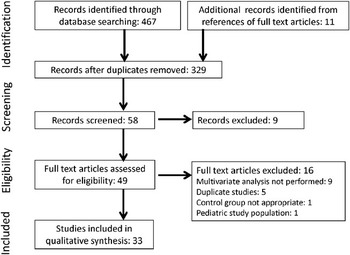
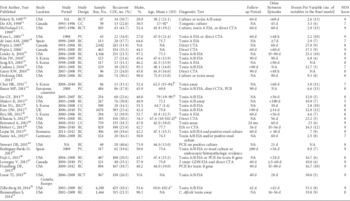
Our search identified 478 publications (Figure 1). After removing duplicates and screening titles of the studies, 58 articles were selected based on relevance to the study topic. After screening the abstracts of these potentially relevant articles, 49 were selected for full-text review based on relevance to study topic (Figure 1). A total of 33 articles reported risk factors for rCDI and were included in the systematic review. The reasons for exclusion of the remaining 16 articles are listed in Figure 1. Table 1 summarizes the main characteristics of the included studies. A total of 18,530 patients (range, 59–4,200) were included in the systematic review and meta-analysis. A total of 21 studies were retrospective cohorts; 6 studies were prospective cohorts; 3 studies were case-control studies; and 3 studies were part of randomized controlled trials (RCTs). The risk of rCDI in the included studies varied between 10.1% and 50.8% (median, 21.6%). Study data pertaining to age were provided as age per each additional year in 7 studies and as age ≥65 years in 6 studies. The median number of variables in the final model was 8 (range, 3–15). A total of 16 studies (48.5%) had an EPV≥10, while 4 studies did not provide enough information to calculate the EPV. The median EPV was 10.9 (range, 1–53.1) (Table 1).
Flow diagram of study selection process. After screening the title and abstract of the retrieved studies, 58 and 49 studies, respectively were included based on relevance to our study. After assessing 49 full-text studies for eligibility, 33 studies were included in our systematic review and meta-analysis.

Basic Characteristics of Included Studies

NOTE. CC, case control; CDI, C. difficile infection; CTA, cytotoxin assay; EIA, enzyme immunoassay; GDH, glutamate dehydrogenase; NA, not available; NOS, Newcastle-Ottawa scale; PC, prospective cohort; PCR, polymerase chain reaction; RC, retrospective cohort; RCT, randomized control trial; SD, standard deviation.
a Range.
b Median (range); d, days.
Quality Assessment
Using the modified NOS scale, 27 of 33 studies were identified as high-quality studies, and the rest were identified as moderate-quality studies (Supplemental Table 1). All studies clearly identified the study population and defined the outcome and outcome assessment. Considerable variation was observed in the type of CDI diagnostic confirmation test used, with older studies relying on C. difficile culture and toxin enzyme immunoassay (EIA) and more recent studies using toxin-gene polymerase chain reaction (PCR). Also, the definition of recurrent CDI and the study follow-up period varied across the studies (Table 1). Multivariate models in the included studies varied in the type of model used and the selection of available confounding variables for adjustment. It is possible that a few confounding variables were not fully identified and recorded. The most common confounders adjusted were age, antibiotic usage, and comorbidities such as chronic renal insufficiency and tube feeding.
Publication bias was not assessed because of an inadequate number of included studies (<10 for each risk factor that was meta-analyzed) needed to properly assess a funnel plot or to assess the use of other more advanced regression-based methods. However, we constructed a funnel plot for 2 of the variables, proton pump inhibitor (PPI) and concurrent antibiotics, as these risk factors had a large number of patients included from 8 and 9 studies, respectively (Supplemental Figure 1).
Meta-Analyses of Risk Factors for rCDI
Age per each additional year
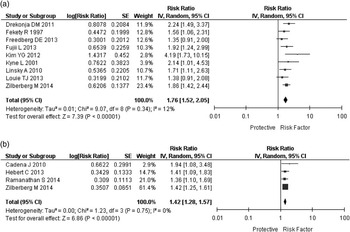
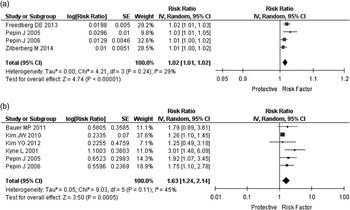
Meta-analysis of 4 studies (n=7,599) showed a significantly higher risk of rCDI with an increase in age per additional year (RR, 1.02; 95% CI, 1.01–1.02; P<.00001) (Figure 2a). Heterogeneity was low across these studies (I 2=29%).
Forest plot of the association between age and recurrent C. difficile infection (rCDI). (a) Forest plot of the association between age, per each additional year and rCDI. (b) Forest plot of the association between age, ≥65 years and rCDI. The vertical line corresponds to the no difference point between the 2 groups. Squares, the size of which indicates the proportion of information given by each study, correspond to hazard ratios (HRs) or risk ratios (RRs). Horizontal lines represent the 95% CIs. The diamond indicates the pooled relative risk ratios. df, degrees of freedom; IV, inverse variance.
Age≥65 years
Meta-analysis of 6 studies (n=3,375) showed a significantly higher risk of rCDI in patients≥65 years of age (RR, 1.63; 95% CI, 1.24–2.14; P=.0005) (Figure 2b). Heterogeneity was moderate across these studies (I 2=45%).
Additional antibiotics during follow-up
Meta-analysis of 9 studies (n=8,194) showed a significantly higher risk of rCDI in patients who received additional non-CDI antibiotics during follow-up (RR, 1.76; 95% CI, 1.52–2.05; P<.00001) (Figure 3a). Heterogeneity was low across these studies (I 2=12%).
(a) Forest plot of the association between additional antibiotics during follow-up and recurrent C. difficile infection (rCDI). (b) Forest plot of the association between previous fluoroquinolone use and recurrent C. difficile infection (rCDI). The vertical line corresponds to the no-difference point between the 2 groups. Squares, the size of which indicates the proportion of information given by each study, correspond to hazard ratios (HRs) or risk ratios (RRs). Horizontal lines represent the 95% CIs. The diamond indicates the pooled relative risk ratios. df, degrees of freedom; IV, inverse variance.

Previous fluoroquinolone use
Meta-analysis of 4 studies (n=6,622) showed a significantly higher risk of rCDI in patients who had previously been treated with fluoroquinolones (RR, 1.42; 95% CI, 1.28–1.57; P<.00001) (Figure 3b). There was no heterogeneity across these studies (I 2=0%).
Proton pump inhibitors during follow-up
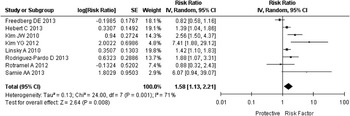
Meta-analysis of 8 studies (n=4,392) showed a significantly higher risk of rCDI in patients on a PPI during follow-up (RR, 1.58; 95% CI, 1.13– 2.21; P=.008) (Figure 4). Heterogeneity was high across these studies (I 2=71%).
Forest plot of the association between proton-pump inhibitors during follow-up and recurrent C. difficile infection (rCDI). The vertical line corresponds to the no difference point between the two groups. Squares, the size of which indicates the proportion of information given by each study, correspond to hazard ratios (HRs) or risk ratios (RRs). Horizontal lines represent the 95% CIs. The diamond indicates the pooled relative risk ratios. df, degrees of freedom; IV, inverse variance.

Renal insufficiency
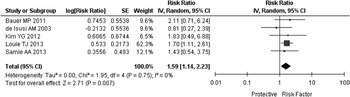
Meta-analysis of 5 studies (n=1,486) showed a significantly higher risk of rCDI in patients with renal insufficiency (RR, 1.59; 95% CI, 1.14–2.23; P=.007) (Figure 5). There was no heterogeneity across these studies (I 2=0%).
Forest plot of the association between renal insufficiency and recurrent C. difficile infection (rCDI). The vertical line corresponds to the no difference point between the two groups. Squares, the size of which indicates the proportion of information given by each study, correspond to RRs. Horizontal lines represent the 95% CIs. The diamond indicates the pooled relative risk ratios. df=degrees of freedom; IV=inverse variance.

Nasogastric tube feeding
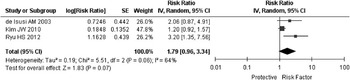
Meta-analysis of 3 studies (n=532) showed that the risk of rCDI in patients being fed by nasogastric tube was not significantly different from patients without a nasogastric tube (RR, 1.79; 95% CI, 0.96–3.34; P=.07) (Figure 6). Heterogeneity was high across these studies (I 2=64%).
Forest plot of the association between tube feeding and recurrent C. difficile infection (rCDI). The vertical line corresponds to the no difference point between the 2 groups. Squares, the size of which indicates the proportion of information given by each study, correspond to RRs. Horizontal lines represent the 95% CIs. The diamond indicates the pooled relative risk ratios. df, degrees of freedom; IV, inverse variance.

Several other risk factors associated with rCDI were not meta-analyzed beause they were reported in <3 studies. These infrequent risk factors with the corresponding effect estimates are listed in Supplemental Table 2.
DISCUSSION
In this systematic review and meta-analysis of 33 studies and 18,530 CDI patients, the most frequent risk factors associated with rCDI were advanced age, additional antimicrobial therapy during follow-up, and PPI therapy. The risk was also greater in patients previously on fluoroquinolones and in those with chronic renal insufficiency.
Recurrent CDI is a complex condition that is difficult to treat. The potential risk factors identified through our meta-analysis appear to be congruent with the pathogenesis of the disease. Advanced age is an important risk factor, and numerous studies have suggested that an impaired immune response to C. difficile toxins contributes to an increased risk of disease recurrence.Reference Kelly 4 Previous clinical studies of antibiotic treatment have shown that the gut microbiota are significantly disrupted by broad-spectrum antibiotic therapy and that the susceptibility to rCDI correlates with the extent of disruption of the gut microbiota.Reference Peterfreund, Vandivier and Sinha 17 Therefore, additional antibiotics following CDI treatment may alter the recovering colonic microbiome and decrease the colonization resistance, further contributing to an increased risk of C. difficile recurrence.Reference Peterfreund, Vandivier and Sinha 17 Similarly, it has been hypothesized that PPI may disrupt the colonic microbiome in a manner similar to antibioticsReference Kanno, Matsuki and Oka 18 and thus may contribute to rCDI. It is possible that a regimen of antibiotics plus a PPI has an additive effect that causes significant and persistent changes to the gut microbiome. Previous studies have also implicated renal insufficiency as a risk factor for CDI. Individuals with renal insufficiency have been reported to have reduced gastric acid secretion, which in turn can increase the risk of C. difficile colonization.Reference Muto, Pokrywka and Shutt 19
The findings from our meta-analyses are in agreement with a previous meta-analysis of 12 studies (sample size=1,382 patients).Reference Garey, Sethi, Yadav and DuPont 6 Garey et al performed a pooled analysis of data from univariate/multivariate studies and reported 3 specific risk factors significantly associated with increased risk of rCDI: (1) continued use of non–C. difficile antibiotics after diagnosis of CDI, (2) concomitant receipt of antacid medications, and (3) older age.Reference Garey, Sethi, Yadav and DuPont 6 In a more recent systematic review, Chakra et alReference Abou Chakra, Pepin, Sirard and Valiquette 5 reviewed the risk factors for recurrence, complications, and mortality in patients diagnosed with CDI. These researchers chose to not perform a meta-analysis because of their concerns regarding the small sample sizes of individual studies and the varied definitions of CDI outcomes and follow-up periods across studies. From their systematic review of 24 studies that assessed risk factors for recurrence, they concluded that advanced age, use of concomitant antibiotics, use of PPI, and CDI strain type were the most frequent risk factors for recurrence. The goal of our study was not only to statistically combine observational studies but also to systematically assess the most common risk factors for rCDI and to assess heterogeneity across studies. However, potential risk factors were eligible for a pooled meta-analysis only if they were assessed in at least 3 independent studies that met the inclusion criteria. Therefore, it is possible that a few important risk factors for rCDI, such as CDI strain type and severity, were not pooled for a summary statistic in this review. Risk factors for infectious diseases such as CDI cannot be tested by RCTs for ethical reasons. Therefore, we must rely on observational studies that are performed rigorously. A meta-analysis of observational studies is challenging; greater emphases must be placed on study quality and on addressing reasons for potential heterogeneity among the studies. The major strengths of our study are these: (1) our findings are consistent with previous studies; (2) this work was a comprehensive review over multiple years with a significantly large patient population; (3) our study included only studies that used multivariate analyses; and (4) we used the NOS scale for quality analysis. In addition, our meta-analysis of the risk factors for rCDI strictly followed the PRISMA guidelines for reporting systematic reviews (Supplemental Table 3).
Our study had several limitations. The studies in our meta-analysis varied in several ways: study design; diagnostic tests used to detect CDI; type, dose, and duration of antibiotic therapy; definition of rCDI; and follow-up period. The data reported regarding the majority of these variations were either unavailable or insufficient to permit subgroup analysis. Although relatively fewer studies were included in our meta-analyses, they were inclusive based on a comprehensive literature search and a large sample size of >18,500 subjects. Included studies were observational in nature and therefore were subject to residual confounding even after statistical adjustment. An inherent limitation of a random-effects model, compared with a fixed-effects model, is that greater reliance may be placed on small studies with possibly inferior data. It is also possible that patients who received antibiotics and/or acid-suppressive therapy both tended to be sicker at baseline, which introduces confounding by indication. Also, patients with recurrent episodes might have presented as outpatients, and some episodes of recurrence may have been missed if testing was not done in a laboratory to which investigators had access. Our meta-analyses had <10 studies for each risk factor; therefore, the results of the meta-analyses should be interpreted with caution. Lastly, because of the observational nature of the studies analyzed, causality cannot be established based on this meta-analysis. Better-designed, large, prospective studies are needed to ascertain causality and to understand the contribution of each risk factor.
Our systematic review and meta-analysis identified advanced age, renal insufficiency, and 3 other modifiable risk factors (ie, previous use of fluoroquinolones and antibiotics and PPI use during the follow-up period) for developing rCDI. Future work should include a deliberate approach to limiting PPI use in older patients with CDI for 30–90 days post diagnosis, as this is potentially the most easily modifiable intervention. This study provides primary care physicians, gastroenterologists, and other healthcare professionals additional information with which to counsel their patients on the risk of recurrence, modifiable risk factors, and high-risk populations in order to target prevention efforts.
Acknowledgments
Financial support. No financial support was provided relevant to this article.
Potential conflicts of interest. AD reports having received a research grant from 3M. CJD reports having received research grants from Merck, GOJO, STERIS, and Pfizer. All other authors report no conflicts of interest relevant to this article. All authors submitted the ICMJE Form for Disclosure of Potential Conflicts of Interest, and the conflicts that the editors consider relevant to this article are disclosed here.
Supplementary material
To view supplementary material for this article, please visit http://dx.doi.org/10.1017/ice.2014.88