INTRODUCTION
In England, Section 136 of the Mental Health Act 1983 (MHA 1983) grants a police constable the power to remove a person from a place to which the public have access to a place of safety, if that person appears to be mentally disordered, requires urgent care or control, and needs to be removed to a place of safety either in the person’s own interest or for the protection of other people (Mental Health Act, 1983).
The number of people detained under Section 136 of the MHA 1983 has increased significantly over the years. It was estimated that the police in London used this power on average between 28 and 71 times per week in 2005–06 (Barther, Reference Bather2006). In England, the rate of detention in psychiatric hospital-based places of safety has risen from 5.2 per 100 000 adult population in 1984–85 to 33.4 per 100 000 adult population in 2010–11 (Keown, Reference Keown2013). During the six years up to 2011–12, the number of detentions in psychiatric hospital-based places of safety under Section 136 of the MHA 1983 increased more than two-fold from 5 900 detentions in 2005–06 (Docking et al. Reference Docking, Grace and Bucke2008) to 14 902 detentions in 2011–12 (Health and Social Care Information Centre, 2013). On the other hand, the number of detentions in police custody suites as places of safety under Section 136 of the MHA 1983 decreased from 11 517 in 2005–06 (Docking et al. Reference Docking, Grace and Bucke2008) to 8 667 in 2011–12 (Health and Social Care Information Centre, 2013), a one-quarter reduction during the same six-year period. In 2005–06, two thirds of people detained under Section 136 of the MHA 1983 were detained in a police custody suite as a place of safety (Docking et al. Reference Docking, Grace and Bucke2008); whereas in 2011–12, just over a third of those detained were detained in a police custody suite as a place of safety (Health and Social Care Information Centre, 2013). This suggests a changing trend of people being detained in a psychiatric hospital-based place of safety under Section 136 of the MHA 1983 rather than in a police custody suite. We have very limited reliable information on the rates of detention in other places of safety such as the accident and emergency department of a general hospital.
The total number of detentions under Section 136 of the MHA 1983 reduced for the first time in almost 20 years, from 23 569 detentions in 2011–12 to 21 814 detentions in 2012–13 (Health and Social Care Information Centre, 2013), a 7% reduction in a one-year period alone. The data from 2012–13 highlighted the fact that a reduction in the number of detentions in police custody suites as places of safety under Section 136 of the MHA 1983 (10% reduction) was double the reduction in the number of detentions in psychiatric hospital-based places of safety (5% reduction). In April 2014, the Department of Health and the Home Office began a public consultation exercise to review the use of section 136 of the MHA 1983 and ensure that the current legal framework offers prompt and appropriate support to persons detained under Section 136 of the MHA 1983. The outcome of this consultation had not been published at the time of writing this article.
Under Section 136 of the MHA 1983, a person may be detained in a place of safety for up to 72 hours for the purpose of being assessed by a registered medical practitioner and an Approved Mental Health Professional (Mental Health Act, 1983). The average length of time spent in a police custody suite by a person detained under Section 136 of the MHA 1983 was estimated to be around ten and a half hours (Her Majesty’s Inspectorate of Constabulary et al. 2013). There is evidence that delays may be associated with the availability of Approved Mental Health Professional and Section 12 approved doctors required to complete a Mental Health Act assessment (Care Quality Commission, 2014). There is limited information available on either the number of persons transferred between places of safety or the average length of time spent detained in a psychiatric hospital-based place of safety under Section 136 of the MHA 1983. The Royal College of Psychiatrists’ guidance recommends that the registered medical practitioner and the Approved Mental Health Professional should ideally commence the assessment within three hours of the person being detained under Section 136 of the MHA 1983 (Royal College of Psychiatrists, 2013). Many mental health trusts recommend that the person detained under Section 136 of the MHA 1983 should not have to spend more than eight hours in a place of safety. One of the statutory requirements within the Mental Health Crisis Concordat agreement between the Department of Health and all organisations involved in caring for people experiencing mental health crisis, is to address this issue and ensure that persons detained under Section 136 of MHA 1983 receive timely and competent assessments (Department of Health and Concordat Signatories, 2014).
During the detention and whilst awaiting an assessment, it is feasible that a person might require intramuscular medications for rapid tranquillisation, often with the use of physical restraint. For example, in 2005–06, restraint (which does not imply the use of rapid tranquillisation) was used in one in four such detentions in police custody (Docking et al. Reference Docking, Grace and Bucke2008). The National Institute for Health and Clinical Excellence (2011) guidance on improving the experience of patients in adult mental health services within the National Health Service (NHS) recommended that physical restraint and administration of intramuscular medication for rapid tranquillisation should be exercised as a last resort, after all efforts at de-escalation have proven unsuccessful, and by trained staff using minimum force. This guidance advocated professionals to make every attempt to involve and engage the person before, during and after physical restraint and administration of intramuscular medication for rapid tranquillisation. The Care Quality Commission (2014) referred to the 2008 Code of Practice of the MHA 1983 when emphasizing that physical restraint should be used as a last resort. The Care Quality Commission (2014) raised concerns over the practice of using ‘face-down’ physical restraint in mental health services in the NHS, and reiterated Mind’s (2013) concerns about the associated risks to physical health and ‘dehumanising effects’ of this practice. The Department of Health is working with national and voluntary organisations to develop measures to ensure that physical restraint is used safely and appropriately used by healthcare professionals (Department of Health and Concordat Signatories, 2014).
Use of intramuscular medications for rapid tranquillisation comes with its own risks, especially if the person has to be physically restrained. Over an 11-year period between 1998 and 2009, less than two persons per year died during or following detention under Section 136 of the MHA 1983, with less than one person per two years dying in a psychiatric hospital-based place of safety and less than one person per year dying in police custody (Hannan et al. Reference Hannan, Hearnden, Grace and Bucke2010). This translates to a rate of less than one death per 10 000 detentions per year under Section 136 of the MHA 1983. The Royal College of Psychiatrists (2013) recommended that staff involved in caring for persons detained under Section 136 of the MHA 1983 should be competent in physically restraining and administering medications to such persons. The Code of Practice for the MHA 1983 states that the registered medical practitioner examining the person detained under Section 136 of the MHA 1983, if possible, should be approved under Section 12 of the MHA 1983 (Department of Health, 2008). Contrary to most recommendations, anecdotal evidence suggests that assessment of persons detained under Section 136 of the MHA 1983 and/or decisions to physically restrain and administer intramuscular medications for rapid tranquillisation to such persons are often undertaken by relatively inexperienced trainee doctors (Tate, Reference Tate2010), who are unlikely to possess an in-depth understanding of the medico-legal frameworks for physically restraining and administering intramuscular medications for rapid tranquillisation to persons detained under Section 136 of the MHA 1983.
Section 136 of the MHA 1983 does not grant the power to treat a person against their will (Department of Health, 2008) and none of the currently available guidance explicitly explains the legal framework for physically restraining and administering intramuscular medications for rapid tranquillisation to such persons. The Code of Practice of the MHA 1983 states that persons detained under Section 136 of the MHA 1983 are ‘in exactly the same position in respect of consent to treatment as patients who are not detained under the Act.’ (Department of Health, 2008, p. 83)
Most guidance, including that of the Royal College of Psychiatrists, simply states that any such treatment may be provided under the provisions of the Mental Capacity Act 2005 (MCA, 2005). Trust-specific guidance from individual mental health trusts varies significantly. For example, one mental health trust policy stipulates the use of common law for providing urgent treatment in a place of safety and the use of the MCA 2005 for providing urgent treatment of physical conditions in an accident and emergency department, whereas another mental health trust policy stipulates the use of the MCA 2005 for both these purposes. A third mental health trust policy recommends the use of common law for providing urgent 'fast-acting treatment' in an emergency, if this is felt to be necessary to prevent the person from harming themselves or others. Such wide variations in guidance provided by mental health trusts highlight the lack of clarity on the most appropriate legal framework.
In this article, we attempt to explore the various legal frameworks available and endeavour to identify the most appropriate legal framework for physically restraining and administering intramuscular medications for rapid tranquillisation to a person detained under Section 136 of the MHA 1983.
MENTAL CAPACITY ACT 2005
Section 1
Section 1 of the MCA 2005 lists the five ‘statutory’ principles that professionals must apply when assessing a person’s capacity to make decisions and providing necessary treatment to that person under the provisions of the MCA 2005. The Code of Practice for the MCA 2005 (Department for Constitutional Affairs, 2007) asserts that these statutory principles are aimed at protecting persons lacking the capacity to make decisions and enabling them to participate in the decision-making process. However, healthcare professionals routinely fail to recognise the empowering nature of these principles (House of Lords, 2014). Therefore, the importance of applying these statutory principles cannot be over-emphasized.
The first principle is the presumption of the person’s capacity to make decisions unless proven otherwise (House of Lords, 2014). This must be the initial assumption in every situation considered under the provisions of the MCA 2005 (Department of Constitutional Affairs, 2007). This principle is poorly understood and applied in healthcare settings, with professionals making initial assumptions based on the person’s impairment and conducting an inadequate assessment of capacity (House of Lords, 2014). The second principle is to take ‘all practicable steps’ to support and enable the person to participate as much as possible in the decision-making process (Mental Capacity Act, 2005). The main objective is to empower the person to have a prominent role in the decision-making process (Department of Constitutional Affairs, 2007) but concerns have been raised that this principle is seldom applied in practice (House of Lords, 2014). The third principle is to respect the person’s right to make an unwise decision and not to label the person as lacking capacity simply because of their unwise decision (Mental Capacity Act, 2005). This principle adds to the empowering nature of the MCA 2005 but this is infrequently recognised or appreciated by healthcare professionals (House of Lords, 2014). The fourth and fifth principles relate to decisions made when a person lacks the capacity to make those decisions (Mental Capacity Act, 2005). The fourth principle states that such decisions must be in the person’s best interests (Mental Capacity Act, 2005). However, decisions on best interests are not frequently conducted as recommended within the MCA 2005 (House of Lords, 2014). The fifth principle states that alternative least restrictive options must be considered before decisions are made (Mental Capacity Act, 2005) but this is not regularly and sufficiently explored by healthcare professionals (House of Lords, 2014).
Sections 2–4
Section 2 of the MCA 2005 states that a person can lack capacity due to either impairment or disturbance in the functioning of the person’s brain or mind, and that any decision to conclude that a person lacks capacity must be made on the balance of probabilities (Mental Capacity Act, 2005). The 2007 Code of Practice of the MCA 2005 explains that the assessment of a person’s capacity to make decisions is a two-stage process (Department of Constitutional Affairs, 2007). The first stage is to establish whether the person has an impairment or disturbance in the functioning of their brain or mind (Department of Constitutional Affairs, 2007). The second stage is to establish whether that person is unable to make a specific decision at that specific time due to that impairment or disturbance in the functioning of their brain or mind (Department of Constitutional Affairs, 2007). The Code of Practice of the MCA 2005 confirms ‘Stage 2 can only apply if all practical and appropriate support to help the person make the decision has failed.’ (Department of Constitutional Affairs, 2007, p. 45)
Section 3 of the MCA 2005 describes the criteria for establishing a person’s capacity to make decisions (Mental Capacity Act, 2005). If a person is deemed to lack capacity, then Section 4 of the MCA 2005 describes the steps that need to be taken to establish whether an agreed treatment is in the best interests of that person (Mental Capacity Act, 2005). Section 4 does not define the term ‘best interests’ but it highlights the steps that professionals need to take and factors that professionals need to consider when establishing what is in a person’s best interests. Best interest decisions must follow capacity assessments and not overlap (House of Lords, 2014).
If the provisions under the MCA 2005 are to be used as the legal framework for physically restraining and administering intramuscular medications for rapid tranquillisation to a person detained under Section 136 of the MHA 1983, then the first step in this process would be to apply the first three principles of the MCA 2005 and support the person in the decision making process. If all practical steps taken to help the person make the decision have failed, then the next step would be the assessment of that person’s capacity as per Sections 2-3 of the MCA 2005. If the person is deemed to have the capacity to make decisions, then treatment can only be given with that person’s valid consent. If the person is deemed to lack the capacity to make decisions, then steps described under Section 4 of the MCA 2005 need to be followed when establishing if a particular treatment is in that person’s best interest, and alternative least restrictive options must be explored. The legal obligations that affect a professional’s decision to provide treatment to a person lacking capacity are addressed in Section 5 of the MCA 2005 and the legal restrictions placed on providing treatments in certain situations are addressed in Section 6 of the MCA 2005.
Section 5
Section 5 of the MCA 2005 offers the possibility of legal protection to a professional for decisions made regarding the treatment of a person lacking capacity (Mental Capacity Act, 2005). The 2007 Code of Practice of the MCA 2005 explains that this legal protection is offered as long as the professional reasonably believes that the person lacks capacity after having taken reasonable steps to establish whether the person lacks capacity, and as long as the treatment is felt to be in the best interests of the person lacking capacity. The 2007 Code of Practice of the MCA 2005 clarifies that the steps that are considered to be reasonable can vary according to the situation and the speed with which such decisions need to be made in that situation but that professionals will need to complete as detailed an assessment of capacity as possible depending on the situation. Section 5 of the MCA 2005 refrains from listing the treatment modalities that are covered under the provisions of the MCA 2005. The 2007 Code of Practice of the MCA 2005 confirms that ‘The Act does not define ‘care’ or ‘treatment’. They should be given their normal meaning.’ (Department of Constitutional Affairs, 2007, p. 94)
The 2007 Code of Practice of the MCA 2005 gives examples of actions taken in healthcare settings that could be considered to be part of providing treatment, and can be provided with possible legal protection under Section 5 of the MCA 2005. Examples listed include ‘carrying out diagnostic examinations, … providing professional medical, dental and similar treatment, … giving medication, … providing nursing care (whether in hospital or in the community) … and providing care in an emergency.’ (Department of Constitutional Affairs, p. 95)
Section 5 of the MCA 2005 emphasizes that the professional taking any such action would not be any more liable for providing that particular treatment than they would have been liable if the person lacking capacity had retained the capacity to make that decision and consented to that treatment (Mental Capacity Act, 2005). This includes liability for criminal negligence (Mental Capacity Act, 2005). Section 5 of the MCA 2005 also confirms that an advance decision to refuse treatment will supersede decisions made by professionals to provide treatment to a person lacking capacity (Mental Capacity Act, 2005)
Section 6
Section 6 of the MCA 2005 sets restrictions on using the powers conferred under Section 5 of the MCA 2005. Section 6 of the MCA 2005 states that if the intention is to restrain the person lacking capacity under the provisions of Section 5 of the MCA 2005, then such restraint can only be performed if the professional reasonably believes that such restraint is necessary to prevent any potential harm occurring to the person lacking capacity, and as long as such restraint is considered to be a proportionate reaction on balance of the probability of harm occurring to that person lacking capacity and the potential severity of the harm (Mental Capacity Act, 2005). The 2007 Code of Practice of the MCA 2005 clarifies that when restraint is considered, the duration and form of proposed restraint should be proportionate to the probability and the potential severity of the harm posed towards that person lacking capacity.
The 2007 Code of Practice of the MCA 2005 states that the definition of what constitutes harm has not been provided within Section 6 of the MCA 2005 as this can vary according to the situation (Department of Constitutional Affairs, 2007). It instead gives situation-specific examples of what could be considered as potential harm towards a person lacking capacity. Examples listed include that of a person who might be considered to be at risk of sustaining harm due to the nature of that person’s behaviour being such that it incites others to retaliate, assault, abuse or take advantage of that person lacking capacity (Department of Constitutional Affairs, 2007). Brindle et al. (Reference Brindle, Branton, Stanfield and Zigmond2013) quoted another example, describing a situation wherein measures taken to restrain a person lacking capacity are likely to be endorsed by the MCA 2005 if it could be justified that such restraint was necessary to ensure another medical intervention is administered safely and appropriately, and as long as there are no other legal obligations described under Section 5 of the MCA 2005, such as an advance decision that restricts the proposed second medical intervention and would in turn restrict use of restraint for that purpose. The 2007 Code of Practice of the MCA 2005 defines ‘proportionate response’ as ‘the least intrusive type and minimum amount of restraint to achieve a specific outcome in the best interests of the person who lacks capacity.’ (Department of Constitutional Affairs, p. 108)
Section 6 of the MCA 2005 also highlights that Section 5 of the MCA 2005 does not support professionals to act on their decision to provide treatment to a person lacking capacity if that decision is not in agreement with the decisions made either by a donee of a lasting power of attorney or a nominated deputy appointed by the court for that person (Mental Capacity Act, 2005). Section 6 of the MCA 2005 states that any such disagreements between decisions of donees or appointed deputies and decisions of professionals should not stop a professional from ‘(a) providing life-sustaining treatment, or (b) doing any act which he reasonably believes to be necessary to prevent a serious deterioration in [the person’s] condition, while a decision as respects any relevant issue is sought from the court.’ (Mental Capacity Act, 2005, p. 4–5)
The 2007 Code of Practice of the MCA 2005 confirms that ‘Sometimes people who lack capacity to consent will require emergency medical treatment to save their life or prevent them from serious harm. In these situations, what steps are ‘reasonable’ will differ to those in non-urgent cases. In emergencies, it will almost always be in the person’s best interests to give urgent treatment without delay. One exception to this is when the healthcare staff giving treatment are satisfied that an advance decision to refuse treatment exists.’ (Department of Constitutional Affairs, p. 104–105)
Depending on the emergency and depending on individual situations, provisions under the MCA 2005 could potentially be utilised to physically restrain and administer intramuscular medications for rapid tranquillisation to a person lacking capacity and detained under Section 136 of the MHA 1983, but only after every attempt is made to support the person to engage in the decision-making process, and only if this action is felt to be necessary, least restrictive, and in the best interests of that person, and if this action is felt to be proportionate to the probability and the potential severity of the harm posed towards that person.
Section 28
Section 28 of the MCA 2005 states ‘(1) Nothing in this Act authorises anyone - (a) to give a patient medical treatment for mental disorder, or (b) to consent to a patient’s being given medical treatment for mental disorder, if, at the time when it is proposed to treat the patient, his treatment is regulated by Part 4 of the Mental Health Act. (2) “Medical treatment”, “mental disorder” and “patient” have the same meaning as in that Act.’ (Mental Capacity Act, 2005, p. 17)
However, Section 56 of the MHA 1983 below clearly highlights that Part IV of the MHA 1983 does not apply to a person detained under Section 136 of the MHA 1983 (Mental Health Act, 1983).
MENTAL HEALTH ACT 1983
Part IV: Consent to treatment
Section 56 of the MHA 1983 specifies that the Part IV of the MHA 1983, which relates to consent to treatment, does not apply to persons detained under Section 136 of the MHA 1983 (Mental Health Act, 1983). The person detained under Section 136 of the MHA 1983 needs to be treated as if the person is not detained under the MHA 1983 with regard to consent to treatment (Department of Health, 2008). One of the fundamental principles of the MHA 1983 is to ensure the least amount of restriction on a person’s liberties when actions are taken without that person’s consent (Department of Health, 2008) and Section 56 of the MHA 1983 upholds this principle. Therefore, Part IV of MHA 1983 cannot be used as a legal framework for physically restraining and administering intramuscular medications to a person detained under Section 136 of the MHA 1983.
Implied powers
Implied powers of an Act of Parliament have been described as ' … those “derived by reasonable implication” from the provisions of the statute (Baroness Wenlock).’ (Bailey, Reference Bailey2005, p. 395)
In other words, in the absence of an expressed power within a statute and following a reasonable interpretation of that statute, if it can be inferred that the statute intended to confer a power, then that power can be considered to have been conferred by implication.
The implied powers under the MHA 1983 were highlighted in the following case: ‘R. v Broadmoor Special Hospital Ex p. S, H and D [1998] C.O.C. 199, where the Court of Appeal held that the power to detain patients for treatment under the Mental Health Act 1983, ss.3, 37, included such implied powers for control and discipline for which the hospital could show “a self-evident and pressing need” (Steyn L.J. in R. v Secretary of State for the Home Department Ex p. Leech (No.2) [1994] Q.B. 1980. These include powers to restrain patients...’ (Bailey, Reference Bailey2005, p. 395)
Application of any implied powers on a person detained under Section 136 of the MHA 1983 is limited by Section 56 of the MHA 1983 which clearly states that the person detained under Section 136 of the MHA 1983 needs to be treated as if the person is not detained under the MHA 1983. Therefore, implied powers of the MHA 1983 cannot be used as a legal framework for physically restraining and administering intramuscular medications for rapid tranquillisation to a person detained under Section 136 of the MHA 1983 without consent.
CRIMINAL LAW ACT 1967
Section 3
Section 3 of the Criminal Law Act 1967 (CLA 1967) specifies circumstances when force can be used for specific purposes. It states that '(1) A person may use such force as is reasonable in the circumstances in the prevention of crime, or in effecting or assisting in the lawful arrest of offenders or suspected offenders or of persons unlawfully at large. (2) Subsection (1) above shall replace the rules of the common law on the question of when force is used for a purpose mentioned in the subsection is justified by that purpose.’ (Criminal Law Act, 1967, p. 2)
In a mental health ward setting, Section 3 of the CLA 1967 appears to endorse the use of reasonable force to restrain a patient, either informal or detained under the MHA 1983, for the purposes of self-defence, defence of others or protection of property, but it does not appear to endorse the provision of treatment. Therefore, Section 3 of the CLA 1967 cannot be used as a legal framework for physically restraining and administering intramuscular medications for rapid tranquillisation to a person detained under Section 136 of the MHA 1983. The use of reasonable force by mental health professionals under Section 3 of CLA 1967 for the sole purpose of physically restraining a person detained under Section 136 of the MHA 1983 in order to prevent a crime, such as that which can be prevented through self-defence, defence of others or protection of property, can possibly be justified in certain situations as long as the purpose itself justifies such action.
COMMON LAW ‘DOCTRINE OF NECESSITY’
Common law, also known as case law, comprises of judgements from individual court cases, which then sets precedents on specific legal matters that do not have a specific statute in the legislature covering them. Prior to the MCA 2005 receiving the Royal Assent, decisions on a person’s capacity and what was in the best interests of a person lacking capacity were routinely guided by common law. Since the codification of the common law within Section 5 of the MCA 2005, in relation to acts done on behalf of a person who lacks capacity, the MCA 2005 has replaced the common law as the legal code for safeguarding the best interest of people lacking capacity (Owino, Reference Owino2008). Therefore, the extent to which common law powers are still valid for specific situations that are not covered by the MCA 2005, is unclear. Most case law discusses physical restraint in isolation and none of the case law specifically provides legal authority for administering intramuscular medications, with or without physical restraint, to a person lacking capacity and detained under Section 136 of the MHA 1983.
The 2007 Code of Practice of the MCA 2005 goes as far as stating that ‘in addition to the requirements of the Act, the common law imposes a duty of care on healthcare and social care staff in respect of all people to whom they provide services. Therefore, if a person who lacks capacity to consent has challenging behaviour, or is in the acute stages of illness causing them to act in way which may cause harm to others, staff may, under the common law, take appropriate and necessary action to restrain or remove the person, in order to prevent harm, both to the person concerned and to anyone else.’ (Department of Constitutional Affairs, 2007, p. 106)
The 2007 Code of Practice of the MCA 2005 does not expressly endorse physical restraint for the purpose of administering intramuscular medications for rapid tranquillisation of a person lacking capacity. In the case of R (Sessay) v South London & Maudsley NHS Foundation Trust and The Commissioner of Police for the Metropolis (2011), the judge concluded that Part II of the MHA 1983 is a complete code for the purpose of forcibly admitting a mentally disordered person lacking capacity against the person’s wishes and common law does not apply where the MHA 1983 can be applied. The judge did not comment on whether or not Part IV of the MHA 1983 was a complete code for the purposes of treatment. Therefore, the existence of residual common law powers for the purpose of administering intramuscular medications for rapid tranquillisation, with or without restraint, to a person detained under Section 136 of the MHA 1983, cannot be completely ruled out.
Conclusion
Section 136 of the MHA 1983 does not confer the power to treat a person against their will. Any decision to physically restrain and administer intramuscular medications for rapid tranquillisation to a person detained under Section 136 of the MHA 1983 must comply with the provisions of the MCA 2005. The professional must first make every attempt to help the person engage in the decision-making process. If this is unsuccessful, then the professional must take reasonable steps to establish the detained person’s capacity to make decisions. In an emergency, what steps are reasonable will vary according to the situation and the speed with which such decisions need to be made in that situation.
If the person detained under Section 136 of the MHA 1983 is deemed to have the capacity to consent to treatment, then the treatment can only be provided with the person’s valid consent. If the person detained under Section 136 of the MHA 1983 is reasonably believed to lack such capacity, then physically restraining and administering intramuscular medications to that person can be considered in certain situations under the provisions of the MCA 2005, if the conditions stated in Sections 1-6 of the MCA 2005 are fulfilled, including the ‘best interests’ and ‘least restrictive’ principles of the MCA 2005.
An emergency situation should not significantly delay the main purpose of detaining a person under Section 136 of the MHA 1983, which is for the person to undergo an assessment for the evaluation of their mental health and for appropriate care to be organised for that person. On the contrary, such an assessment should be expedited in these situations, and if compulsory admission to hospital under Part II of the MHA 1983 is felt appropriate, this should be completed as soon as possible to facilitate any required treatment under Part IV of the MHA 1983.
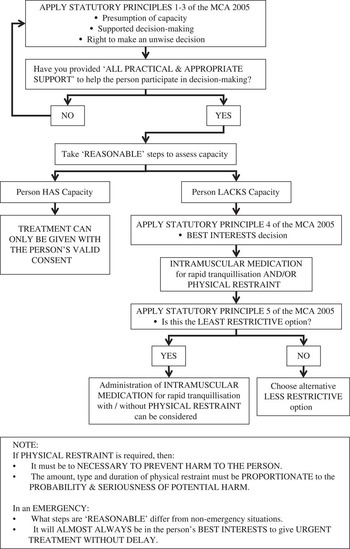
In Figure 1, we suggest an algorithm that could be followed when considering physical restraint and administration of intramuscular medications for rapid tranquillisation to a person detained under Section 136 of the MHA 1983.
Decision process for considering physical restraint and administration of intramuscular medications for rapid tranquillisation to a person detained under Section 136 of the Mental Health Act 1983.

The primary message in this flow diagram is the need for an early application of principles of the MCA 2005 and early assessment of capacity to drive the decision-making process in relation to interventions such as physical restraint and rapid tranquillisation in psychiatric hospital-based places of safety under Section 136 of the MHA 1983. There continues to be a variation in the knowledge and understanding of the basis upon which clinicians might use such interventions. In this review we highlight the legal framework when considering this area of clinical practice. We hope that this will lead to clearer guidelines, which are designed for the practical use of clinicians with the input of hospital managers and legal professionals. The pathway into and out of places of safety under Section 136 of the MHA 1983 is complex and impacted upon by multi-agency roles and functions. The healthcare system is one component of this pathway, with the police, ambulance and social services playing an equal role.
Financial support
This research received no specific grant from any funding agency, commercial or not-for-profit sectors.
Conflict of interest
None.