

Introduction: The Work and Contributions of Universities
Higher education in East Asia is at an important historical juncture where its flagship universities are locked in a race to internationalise. However, unlike its Australian counterparts where internationalisation was driven by the need to increase student revenues in the face of declining state financial support (Altbach and Knight Reference Altbach and Knight2007), the East Asian experience is driven by two goals. First, East Asian flagship universities are given more resources by the state on the expectation that university-industry research collaborations will drive the country's economic development. A second goal is that in the midst of declining birth rates in East Asia, international students are seen as a vital inflow of foreign talent which will support primarily the work of the university and, upon graduation, the economy.
So-called ‘triple-helix’ studies recognise the role of state support in creating science and technology clusters through deliberate policies initiated by governments which provide funding to universities (in contrast to funds raised by venture capital) that link up research capacities with industry applications (see for example the triple-helix studies initiated by Etzkowitz and Leydesdorff Reference Etzkowitz and Leydesdorf2000). At the heart of understanding the research of universities is the argument that this output can be transferred in some form and that this movement has a significant economic impact. This line of thinking is captured in the concept of ‘knowledge spillovers’. The role of a large research university can give rise to different types of knowledge spillover impacts on the economy at different spatial scales: local, national, and regional. Such spillovers include collaborative arrangements with companies which link the research, product development, and marketing abilities of firms to the funding, equipment, and manpower resources of the university (Audretsch et al. Reference Audretsch, Lehmann and Warning2005; Hegde Reference Hegde2005; Jensen et al. Reference Jensen, Thursby and Thursby2011; Walcott Reference Walcott2001). Belderbos et al. (Reference Belderbos, Carree and Lokshin2004: 1488) compared different types of research and development partners and found that university-company partnerships result in more radical partnerships through access to basic research.
Knowledge spillovers also include the learning and boarder experiential component of university education and its transference into new ventures (Wennberg et al. Reference Wennberg, Wiklund and Wright2011). Wennberg and his colleagues found that the more effective route to sustaining spinoffs occurs after individuals move from the university to the corporate sector. Recognising that students (and other university researchers) are the potential carriers of such knowledge spillovers, and, more generally, that their activities in supporting the research endeavours of the university as well as their wider potential contribution to the economy and society, mean that it is critical we understand them (their aims, objectives, and motives). This understanding becomes even more important when universities look to other countries to recruit students. Thus, when international students become a critical element in university strategy and when a critical mass of international students is important for the university and country, this is where higher education research must direct its attention. This focus should be on international students and their impetus to move, in terms of the cultural factors explaining the migration process (Liu-Farrer Reference Liu-Farrer2009; Pimpa 2006), as well as features of the university system and the education process which are attractive to university students (Joseph and Joseph Reference Joseph and Joseph1997; Mazzoral and Souter Reference Mazzoral and Souter2002; Price et al. Reference Price, Matzdorf, Smith and Agahi2003; Veloutsu Reference Veloutsu, Lewis and Paton2004) and the nature of the adjustment process in the host environment (Al-Sharideh and Goe Reference Al-Sharideh and Goe1998; Kashima and Loh Reference Kashima and Loh2005; Sam Reference Sam2001, Sawir et al. Reference Sawir, Marginson, Deumert, Nyland and Ramia2008). Additionally, if international student recruitment is tied to their potential contribution to the economy, then it is also important to understand their plans after graduation.
This article examines the issue of student migration from three perspectives. The first section focuses on the Asia Pacific region, and the growing numbers of students moving out of their home countries to study abroad. By examining the outbound and inbound students within this region, it is possible to gauge the scale of this movement. Using Singapore as a case study, the role of state policy in the internationalisation of higher education is then discussed to highlight how state and university policies shape the new work of flagship universities. Drilling down further and using a survey sample of National University of Singapore international students, the main body of the article examines the process of decision making, the elements which attract students to Singapore, their adjustment process, and their plans after graduation.
This article argues that the internationalisation of education brings about a powerful set of influences to the host society particularly when there are policies facilitating foreign students and their insertion into the host economy and society. Far from being a small temporary minority locked away in ivory towers, foreign students become the focus of policy, a talent that is sourced, a pillar supporting the economy, the hope of new marriage formation and a mechanism to the arrest the declining birth rate, and, an essential ingredient in the resultant multicultural society.
Higher Education in Pacific AsiaFootnote 1
Ten years ago Altbach (Reference Altbach2004) made two observations which captured the growth and change in the higher education landscape in Pacific Asia. He noted that a number of universities in Japan, China, Singapore, and South Korea were approaching the status of “world class research institutions”. These universities were already flagship universities in their own countries having achieved strong reputations in the education of the country's elite (Yonezawa Reference Yonezawa2007). What has changed since that time is the expansion of the work of these universities internationally in an attempt to secure a world class reputation. As suggested above, the growing role of research for government officials and university administrators alike is increasingly linked to the larger issues of being internationally competitive by having strong research outputs and being able to attract top faculty and students not only domestically, but increasingly from abroad. This focus on ‘research’ is also matched by a shift to the internationalisation of teaching, the aim being that the presence of foreign faculty and students will allow for a superior environment which prepares ‘world ready’ students.
Alongside this push from Asian universities is the large and growing number of students studying outside their home countries (Altbach Reference Altbach2004: 11). Historically, higher education student migrants from Pacific Asian countries have opted to go to established higher education markets in the United States and Europe. However, while this flow to the established markets continues, a new migration has risen alongside as students decide to move to higher education destinations closer to home. Reading Figure 1 (outbound students) and Figure 2 (inbound students) reveal four patterns between sending and receiving countries:
Outbound: Numbers of students moving away from home countries for study in 2011. (Source: http://databank.worldbank.org/Data/Views/VariableSelection/SelectVariables.aspx?source=Education%20Statistics#).

Inbound: Numbers of international students studying in selected countries in Pacific Asia (2000, 2010). Inbound student figures for China, Singapore, Thailand, and Indonesia were not available for 2000. Cambodia and Myanmar figures are not available for 2000 and 2010. (Source: http://databank.worldbank.org/Data/Views/VariableSelection/SelectVariables.aspx?source=Education%20Statistics#).

Senders
Having the two largest populations in the world, both China and India have produced large numbers of students moving out of their countries for further studies. China is quite clearly the dominant force in student migration with more than half a million Chinese moving overseas for higher education in 2011. This is followed by India, with just over 200,000 student migrants. Both China and India take in substantially less international students than they send out. Umemiya (Reference Umemiya2008: 287) has observed that “Southeast Asian countries have for a long time been characterised as being one of the largest ‘exporters’ of quality students to developed countries”. Figure 1 certainly shows that many Southeast Asian countries send significant numbers of outbound students. Vietnam and Indonesia emerge as net senders.
Receivers
Within Pacific Asia, the two countries which receive significant numbers of international students – Australia and New Zealand – do not send significant numbers of students overseas. Both countries have established higher education infrastructures and Australia in particular has deployed this as a strategic resource in attracting fee paying international students (Altbach and Knight Reference Altbach and Knight2007).
Senders and Receivers
Japan, Korea, Singapore, Malaysia, and Thailand are both senders and receivers. Dispatching significant number of students overseas, they are themselves absorbing large numbers as well. This group is quite diverse. Japan, Korea, and Singapore have a stronger higher education system. Malaysia is also unusual in that the country's Islamic background makes its universities attractive to students from the Middle East (Sirat Reference Sirat2008).
Not Senders or Receivers
Lastly, there are a number of countries – Cambodia, Laos, Myanmar – where higher education systems remain under-developed and travel restrictions create low numbers of outbound and inbound students. Outbound students are most likely to be those sent on government scholarships. For example China and Japan award university scholarships to developing countries through government channels (The Japan News, 3 June 2013; Xinhua News Agency, 21 April 2011). Likewise, the Singapore government has a long standing arrangement to provide university scholarships to Laos, Cambodia, and Myanmar within the ASEAN cooperation framework (Associated Press, 25 November 2000; Business Times, 26 March 1997; Xinhua News Agency, 5 September 2003).
We noted from Figure 1 that China and India send significant numbers of students to overseas universities. Table 1 shows how dependent receiving countries are on these two large nations. In particular, 61.1% and 77.3% of international students studying in Japan and Korea respectively are from China. This is understandable since China is their closest neighbour and there has been a long history of trade and contact, including for education. The same argument can be made for the 18.1% of Korean students making up the enrolment in Japanese universities. Indian students are less attracted to Japan and Korea for language considerations. However, even for English-speaking countries like Australia and New Zealand, the numbers are not overwhelming. From the receiving countries viewpoint, Australia and New Zealand can be seen to attract a more diverse range of international students.
Asian Regional Mobility in 2010: Composition of International Students in Selected Countries. (Source: OECD Education at a Glance 2012: 376)

This set of figures provides the important context for the arguments of this article. It is this movement of young people in search of fulfilling their educational aspirations along with the lure of the universities (and cities) that host them that are the focus of this article. Using Singapore and the National University of Singapore as a case study, the two key arguments pursued below are firstly, that there are systematic differences between Southeast Asian and non-Southeast Asian students with regard to enrolment decisions, experiences on campus, and the city, as well as future plans. Secondly, these differences in turn allow us to make inferences about Southeast Asia as a region, in particular about the rather underdeveloped state of higher education institutions in Southeast Asia in general and the inability of its metropolitan economies to absorb effectively youths with high level skills the exception being Singapore as a destination for youths with high educational ambitions.
Singapore and The Hinterland
Developed as a port city by the British, Singapore's growth and orientation have been around a hinterland which grew up around trade. British efforts at developing trade in Southeast Asia were aided by the exchange of a plentiful supply of low cost British manufactured goods for the produce of the region (Dick Reference Dick, Booth, O'Malley and Weidemann1990: 300; Sardesai Reference SarDesai1977: 37; Van Der Wal Reference Van de Wal, Bromley and Kossmann1968: 194–95). This trade formed the basis of Singapore's early development in the nineteenth century as the successful development of trading activities meant a focus of the sub-regional trade around Singapore. As Wong's (1960: 160) research indicated, Singapore became an important trading node for the exchange of goods from Europe, India, and China for the produce of Indonesia, Malaysia, Vietnam and Cambodia. As Malayan export volumes expanded, the trading activity in Singapore expanded as well (Buchanan Reference Buchanan1972: 22).
The 150 years of port development resulted in an efficient port infrastructure (harbour, warehouses, storage, transportation, and communication facilities) along with various services that were developed in conjunction with the port (banks, trading houses, wholesalers, transport and communication services). This set of infrastructure and activities from the first economic phase of Singapore's development supported the next phase of industrial expansion in the 1960s as Singapore progressed through internal self-government and then independence. Unlike the laissez-faire policy of the British, the Singapore government developed a number of agencies which were responsible for investment promotion (Economic Development Board), industrial land development (Jurong Town Corporation), the redevelopment of the city centre (Urban Redevelopment Authority), tourism promotion (Tourist Promotion Board), and public housing (Housing and Development Board). This set of agencies combined to redevelop the city state into a modern metropolis. The Housing Board embarked on an ambitious building programme which allowed the population to be resettled from the city centre, which then allowed the Urban Redevelopment Authority to create the central business district. The Jurong Town Corporation worked with the Housing Board to build industrial estates close to the public housing estates. As the urban environment was being restructured, the Economic Development Board attracted foreign investments, while the Tourism Board focused on attracting visitors. Because of Singapore's small size, its focus on industrial development was not focussed on building Singaporean industrial champions, the way Japan and Korea have done. Instead, its focus was on investment promotion looking outside the country to bring established companies to set up operations in Singapore. The incentive for such relocations to Singapore was an efficient urban environment and a relatively well educated and low cost labour force. Thus, like the phase of port development, Singapore's economic engagement was outward. As industrial production became more costly, Singapore worked with its neighbours Indonesia and Malaysia to actively develop a sub-region where more land was available and labour intensive activities could take place, with Singapore acting as the management centre.
Both legacies, the port development along with its trading and financial services, and transport and communications, and Singapore's subsequent industrial and urban development, were important in supporting a services strategy, as manufacturing production activities moved away from Singapore. In particular, the banking sector which had grown up during the port development phase, expanded as financial and business services expanded. These activities in turn were located in the city centre, which was transformed from a mixed land use development (including residential and also lower value added activities) to one which hosted financial and business services. However, the differences within these urban economies are important and were determined by location choices of transnational companies as well as the state's capacity for primarily infrastructural developments aimed to host such higher end activities and the presence of supporting services coupled with the general growth of the sub-region or city region serviced by such activities. Bunnell, Muzaini and Sidaway (Reference Bunnell, Muzaini and Sidaway2006) for example examined the state-sponsored development of the growth corridor around the Singapore city region. This city region incorporates the areas of Malaysia and Indonesia closest to Singapore, namely Southern Johor and the Indonesian Riau islands respectively. Yeung, Poon and Perrys' (Reference Yeung, Poon and Perry2001) study of firms with regional headquarters in Singapore found the availability of good quality business services to be a significant factor in the location choices of their establishment. This close relationship between regional headquarter activity and business services suggests a regional service complex centred on Singapore.
The Internationalisation of Higher Education in Singapore
In the 1990s, faced with the shift of manufacturing out of the city-state and into lower cost production sites like China and Vietnam, the Singapore government reacted by furthering a service industry strategy initially developed in the mid-1980s (Dicken and Kirkpatrick Reference Dicken and Kirpatrick1991; Ho Reference Ho2000). With the service industry as the platform of the new economy, education became the new driver for development (Mok and Lee Reference Mok and Lee2003: 25), marking the shift from “industrial development to education reform” (Olds and Thrift Reference Olds, Thrift, Daniels, Ho and Hutton2005: 7). The link between services and education was direct in terms of education services as a direct source of revenue, and indirect in terms of the attraction of talented students who could contribute to research at the university, and later to the economy. Significantly, this policy refocused the social and political goals of higher education to serve the community and society so fostering a dominant perception of education as a lucrative market (Ho Reference Ho, Shin and Kehm2013: 228).
This reform was supported at several levels. With education as a service policy, the Economic Development Board (EDB) assumed the new task to “build up the Singapore education brand name [and] develop a vibrant community of tertiary, pre-tertiary, and corporate training institutions, so that it can attract even more students, faculty, researchers and professionals from all over the world” (Today, 16 November 2010). Investment promotion and branding are activities the EDB does well. Since the 1960s, it has worked to attract transnational companies to set up bases in Singapore. To this end, it has built up an international network of overseas offices. As a point of comparison, in 1996 Singapore had 100 key personnel overseas, compared to 35 for Hong Kong, and 43 for Australia (Ho Reference Ho2000: 2344, Table 1). Significantly, with the shift to a service based economy the EDB added the role of attracting skilled human resources to its department of “International Manpower”, with two offices started in London and San Francisco in 1994 (Ho Reference Ho and Chen2009). This capacity was put to good use with the shift to attract educational activities to Singapore.
The effort to build a strong international education system is appropriately often termed ‘the Global Schoolhouse’. At pre-tertiary levels, schools with strong academic records have been encouraged by the government to increase their foreign student intakes. At the tertiary level, top international universities have been courted to set up overseas campuses in Singapore through various incentives. The business school, INSEAD, for example, was given funding for research as well as land for its Singapore campus at a fraction of the market rate (Times of India, 21 March 2010). Sidhu's (Reference Sidhu2009) analysis of two failed projects in Singapore highlights the difficulties of grafting foreign university systems onto Singapore. The third effort at building a strong international education system is focussed on the Singapore universities. The internationalisation of Singaporean universities required an overhaul of the existing system. As outlined by Ho (Reference Ho, Shin and Kehm2013: 229–232) these changes were many, including: financial and operational autonomy which enabled restructured universities to become more nimble without checking with the Ministry of Education, rationalising academic recruitments and promotions to attract personnel internationally, new avenues of research funding to strengthen university research capacity, build their international status, and attract foreign researchers and academics, and building on university-industry relations in order to exploit commercial applications of university research. Besides a sustained effort to attract international students, Singaporean universities are also creating opportunities for their students to spend part of their education in another country. The National University of Singapore developed a system of overseas colleagues in high technology centres to allow its students high-technology and entrepreneurship training. The first was developed in Silicon Valley in 2002, then Philadelphia in 2003, Shanghai in 2004, Stockholm in 2005 and Bangalore in 2006 (Wong et al. Reference Wong, Ho and Singh2007: 949).
Wong, Ho and Singh (Reference Wong, Ho and Singh2007) made a comparison of faculty and research staff of the National University of Singapore (NUS) between 1997 and 2005, the first phase of restructuring at the university. During this period, the share of Singaporean professors and research staff fell from 61% to 48.1% for faculty, and from 29.9% to 21.3% for research staff. Malaysia's share also fell by 2% for faculty and 3% for research staff. This decline is balanced by increases in US/Canadian, India, and China faculty and a 10% jump in China research staff. Figures compiled by Wong et al. (Reference Wong, Ho and Singh2007) also show an increase in share of research publications in referred journals increase from 34.7% in 1997 to 53.1% in 2006, as well as the percentage share of foreign students increase from 13% to 33.3% within the same period.
This 20 percentage point jump in foreign student enrolment within a ten year period represents one of the most significant changes in NUS. Where once, NUS was almost totally populated by Singaporean students with a sprinkling of Malaysian and Indonesians, now, one third of the student body is foreign. Students are moving in larger numbers than ever before (Altbach Reference Altbach2004), and the major universities in Asia are responding to the forces of globalisation by increasing their research output and opening their doors to international students. Alongside the major higher education destinations of the United States, Europe and Australia, new sources of higher education are now made available.
In the restructuring process, Singapore universities have clearly developed international ambitions. As Kong (Reference Kong1999: 1525) pointed out, “A key effort…has been to capitalise on ‘core competencies’ identified through strategic planning exercises, so that the university may be positioned as a ‘world-class’ institution that keeps ‘good company’, collaborating/networking with other institutions of ‘quality’”. Kong (Reference Kong1999: 158) also notes that “clearly in some ways, a colonial mentality persists in former colonies, evident in employment policy, for example, which emphasises bringing the best from around the world, often interpreted as the best is West. Yet, at the same time, there is a desire to be located in the centre as well as a reluctance to remain in the peripheries.” Yet, as the next section will show, the support for this restructuring and internationalisation of NUS, as far as non-Singaporean students are concerned, is predominately regional.
Regional Support
Aside from India and China, Southeast Asian students collectively form the largest international student market for NUS. Malaysia has been the traditional sender, alongside that of Indonesia. These students are now joined by students from the Philippines and Vietnam. Cambodia and Laos send fewer students, largely because of the lack of exposure to English, the main medium of instruction at NUS. The intention in the following section is to highlight the ways in which Southeast Asian students are quite different from non-Southeast Asian students, in terms of how they perceive Singaporean universities, their adjustment to campus life and the city, and their plans after graduationFootnote 2 . This analysis in turn helps us to understand the role the Singapore universities plays within the Southeast Asian region.
The university selection process
Figure 3 shows the main sources of information that students rely on to make their decision to study at NUS. The reputation of NUS is the main factor for all international students, but significantly more Southeast Asian students cite reputation than non-Southeast Asian students. One possible reason to account for the difference has to do with non-Southeast Asian students having highly reputable and well resourced universities in their home countries. This in turn suggests that NUS's reputation is less significant among these students compared to Southeast Asian students. Another reason may be that because Singapore is geographically a lot closer to these Southeast Asian students' home countries, its reputation is more likely to be known to them than to non-Southeast Asians. Both factors are important in understanding Singapore's role as a provider of higher education for students in Southeast Asia. The relative economic development of Singapore compared to other countries in Southeast Asia as well as its very small geographic size and population has meant both a higher share of financial resources devoted to higher education, as well as the concentration of these resources in a few universities, the National University of Singapore being one of these. Moreover, the nature of Singapore's economic development has also meant an increasing importance of the university in the training of highly educated manpower for the labour force to support this economy. The second reason of geographical proximity is linked to Singapore's strategic location at the crossroads of Southeast Asia, a fact that benefitted the city state in its first 150 years of development as a port city and it is still an important resource for foreign students coming to Singapore. Its proximity to their home countries means that they enjoy convenient access to home and this also facilitates visits from their families.
Relative percentages of sources of information about NUS used by the students before applying.

Southeast Asian students value family opinion when selecting which universities to apply toFootnote 3 . This is clearly shown in Figure 3, where 41.5% of Southeast Asian students cited family as an important source of information, compared to 27.7% non-Southeast Asian studentsFootnote 4 . Senior students and alumni are also another important source. Biographic interviews at NUS as well as Seoul National University and the National Taiwan University show the importance of such networks through forums and social media as sources of information, along with the provision of important services such as ‘pick ups’ at the airport and housing arrangements. To the extent that geographic proximity favours a flow from neighbouring countries to these universities, this flow becomes institutionalised in terms of alumni clubs in the home country as well as country associations in the host university. These flows act effectively as bridges, strengthening the ties between the two countries. Thus, for NUS as well as for other Asian major universities with a significant number of international students, geographical proximity becomes an important factor making families and friends, as well as senior students and alumni, important information sources.
Related to the point made earlier about Southeast Asian universities being less resourced and less well known is how Southeast Asian students are more impressed by NUS's reputation, the facilities on the campus, and teaching methods (Fig. 4). Having been to good universities at home, non-Southeast Asian students are less likely to cite these reasons for studying at NUS. One particularly critical reason for going to a Singapore university (and by extension NUS) is the anticipation of good job prospects in Singapore upon graduation. This is a significant difference between Southeast Asian students and non-Southeast Asian students; it is Southeast Asian students who are more likely to want to work in Singapore. This says a lot about the differences between Singapore and other Southeast Asian urban economies in terms of their abilities to absorb and effectively utilise the skills of these bright and talented youths. Proximity is another reason why Southeast Asian students want to stay and work in Singapore since they are able to earn higher wages than compared to in their home country, and, at the same time, be in a position to visit home several times a year because of the proximity and the ease of air travel in and out of Singapore.
Reasons for choosing the National University of Singapore (%). (SEA Stds, Southeast Asian Students; Non-SEA Stds, non-Southeast Asian Students.)

In Figure 5, the relatively high percentages for non-Southeast Asian students for the category “did not get financial support from other university”, suggests the importance of financial support in attracting international students from further afield. However this also suggests that NUS represents the second choice after the other (first choice) university did not offer support. If this is true then it suggests that the much lower levels recorded by Southeast Asian students reinforce the ‘regional support’ argument, namely that Southeast Asian students, because they (and importantly their families and friends) are more likely to know NUS, are more likely to choose NUS as the first choice, compared to non-Southeast Asian students who are likely to choose top universities in their home countries and elsewhere. Besides scholarships, there is an indirect form of financial support in the tuition grant scheme, where the foreign student can opt for a tuition fee reduction if this student agrees to work for three years in Singapore after graduationFootnote 5 .
Financial reasons for studying at the National University of Singapore (%). (SEA Stds, Southeast Asian Students; Non-SEA Stds, non-Southeast Asian Students.)

More generally, working in the host country is an important option for international students. The idea of studying overseas becomes an important consideration when this is tied to job prospects in the host country. Thus, the degree in the host country becomes especially relevant when this opens doors to jobs in the host country. Thus the category of ‘good job prospects’ in Singapore is important when the Singapore economy is capable of absorbing university graduates in a variety of sectors. Singapore plays the role as the major or preferred city for work in the vast Southeast Asia skilled labour hinterland. In this sense, studying at NUS is a rational choice for Southeast Asian students because the local degree ensures them a Singapore job and at the same time, the growing international reputation of NUS bestows a stronger currency on the degree such that they will have options in their home country and elsewhere should the job in Singapore fail to materialise.
International Student Experience in Host Country
Figure 6 reveals the set of significant differences in experience between Southeast Asian and non-Southeast Asian students. To summarise the differences across five features, Southeast Asian students are satisfied with the facilities and activities of NUS, but they are less likely to cope as well as their non-Southeast Asian counterparts when it comes to studying and exams. These five indicators again suggest the poorer education support in Southeast Asia.
Experience of studying at the National University of Singapore (%). (SEA Stds, Southeast Asian Students; Non-SEA Stds, non-Southeast Asian Students.)

When it comes to living experience in Singapore, non-Southeast Asian students like the food as well as the blend of things to see and do in Singapore, while Southeast Asians find mixing and socialising easier to do. These divergences suggest that in Singapore's attempt to attract students from near and far, its multicultural environment as well as good amenities are all important features.
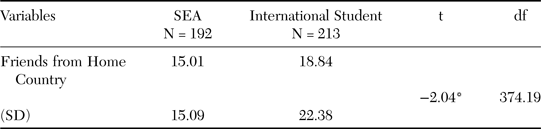
The experience of Singapore is also mediated by one's social network and Figure 7 shows an interesting difference between Southeast Asian home country networks which tend to be smaller than non-Southeast Asian home country networks. Drilling deeper, we find that India and China home country networks among co-nationals tend to be larger. Since Southeast Asian students form a high proportion of international students (Table 2), this suggests that Southeast Asian students find it easier to cross ethnic and nationality boundaries compared to India and China students.
Experience of living in Singapore (%). (SEA Stds, Southeast Asian Students; Non-SEA Stds, non-Southeast Asian Students.)

Social network of international student numbers of friends in four regions/countries: Southeast Asia (SEA) 15; China, 19.04; India, 18.97; Other countries, 18.51. (*p < .05; **p < .01; ***p < .005; ****p < .001).

Plans after Graduation
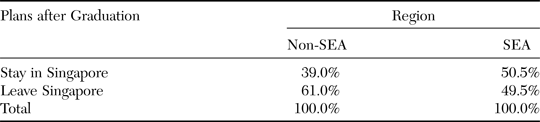
The previous tables have already indicated that Southeast Asian students are attracted by work opportunities in Singapore and therefore it is of no surprise that more Southeast Asian students expressed a desire to stay on after graduation (Table 3).
Plans after graduation by nationality of student. (N = 464; Pearson Chi-square = 6.121; df = 1; p-value = .013).

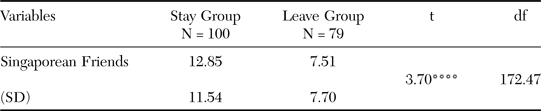
It is interesting that among the Southeast Asian students, those opting to stay have more Singaporean friends than those indicating they plan to leave (Table 4). In terms of causality, we are unable to say if having more Singaporean students motivates Southeast Asian students to stay or if those intending to stay deliberately set out to cultivate Singaporean friends. However, the relationship between Singaporean friendship size and intention to stay suggests that the staying group is likely to cross nationality borders to form friendships with host students and this bodes well for integration.
T-tests between staying group and leaving group of Southeast Asian students' social network. (*p < .05; **p < .01; ***p < .005; ****p < .001).

Conclusion
This article examined two characteristics in the Asian higher education landscape: the growing international reputation of Asia's universities and the increased mobility of students. Using Singapore and NUS as examples of this regional tendency, NUS has and will continue to build its international reputation by looking to the West for education and research excellence (Kong Reference Kong1999: 158). This ‘look West’ (or more accurately ‘skewed West’) orientation will involve developing an international curriculum, expanding international student numbers, student exchanges with recognised international partners and also the international recruitment of faculty, publishing in international journals and strengthening international research collaborations.
While NUS has developed an international orientation, its success had important regional support, tied to Singapore's development within the Southeast Asian region. Singapore's rapid economic development and continued success have been due in a large part to being a major hub within Southeast Asia. Historically, Singapore was developed as a port city, later as an industrial hub, and more recently as a business centre. This development has affected NUS in three ways. First, Singapore's role as an advanced industrial producer not only requires skilled labour but also research and development; functions supported by its universities. Second, Singapore's role as a major economic hub in Southeast Asia has also resulted in a set of close economic ties with Southeast Asian countries. Such ties invariably support the flow of skilled labour to the city state resulting in significant numbers of the urban middle class in Southeast Asia having links with Singapore. Singapore, in their eyes, became an option for further studies for their children. Supported by good air transport links, especially with the recent development of budget airlines centred in Singapore, journeys there (in both cost and time) became no different for Southeast Asians than a journey to their own capital cities. In terms of culture, the use of Malay, Tamil, and Mandarin, along with significant migrant communities in Singapore, allows Southeast Asian, South Asian and Chinese students to fit in easily. Moreover, the widespread use of English, along with its cosmopolitan outlook, will also draw students from further afield, although in smaller numbers. Third, unlike East Asia which has both the institutional capacity, local talent, as well as state resources, Southeast Asian development lags somewhat behind. Singapore has developed economically by being more nimble and has directed more financial resources to its two comprehensive universities, the National University of Singapore and Nanyang Technological University. Thus, the better resourced Singaporean universities, along with financial support and good job prospects will trigger new generations of Southeast Asian youths to seek their fortunes in the city state.
As Singapore universities continue to play a regional role in being host to students from the region, Singapore has contributed to new forms of mobility; networks as such students are likely to work in the region after graduation, either in terms of returning to their home country, staying on in their host country, or moving to a third country in the region. Thus, Singapore's international ambitions and regional growth in demand for higher education combine to ensure that it plays an important role in regional integration, as in its previous economic incarnations as port city, industrial hub and supporting its present status as a regional services centre.