Introduction
Dementia is a major cause of disability among older people and constitutes one of the greatest challenges currently facing families and health and social care services in the developed world (Care Services Improvement Partnership, 2005). It is estimated that there are over 35 million people living with dementia worldwide (Alzheimer Disease International, 2009). This includes an estimated 800,000 people in the United Kingdom, a figure expected to double within the next 40 years (Alzheimer's Society, 2012).
The total estimated worldwide costs of dementia in 2010 were US$604 billion (Alzheimer Disease International, 2010). The United Kingdom spends £17 billion a year on dementia care and in the next 30 years this annual cost is predicted to rise to over £50 billion (Department of Health, 2009).
While these numbers are daunting, the impact on those with the lived experience of dementia and on their families is also profound (Department of Health, 2009). The condition leads to progressive decline in multiple areas of function such as memory, reasoning, communication skills, and the capacity to carry out daily activities (Department of Health, 2009).
In response to trends in dementia prevalence and the impact the condition has on peoples’ lives, dementia care has been placed high on the public and political agenda in the United Kingdom (Alzheimer's Society, 2012). As a result, the UK Government has recently considered how health and care services for people with dementia in the United Kingdom can continue to be delivered and improved. In 2009, the National Dementia Strategy was published, outlining plans and an aspiration to help people live well with dementia (Department of Health, 2009). This was promptly followed by the development and launch of regional dementia programmes across the United Kingdom (Scottish Government, 2010; Department of Health, Social Services and Public Safety, 2011; Welsh Assembly Government, 2011).
However, despite significant public resources being allocated to combat the impact of the illness, the National Audit Office (NAO; 2010) found that the implementation of the Strategy (Department of Health, 2009) had been slow. Moreover, reports from the NAO (2010), National Health Service (NHS) Atlas of Variation (NHS Right Care, 2011), and Alzheimer's Society (2012) highlight numerous challenges in relation to service provision.
Van der Roest et al. (Reference van der Roest, Meiland, Maroccini, Comijs, Jonker and Dröes2007) argue that to be able to provide appropriate care, it is important to know the needs of community-dwelling people with dementia. This paper presents findings of a qualitative study undertaken to develop a deeper understanding of the lived experience of people with dementia and their service-related needs. In order to achieve this, the study aims to address the following questions:
1. What is the lived experience of individuals with dementia?
2. How dementia services are perceived by their users?
3. What are the main service-related needs of people with dementia and their carers?
Methods
Ethical approval
The study has been reviewed by the South East Scotland Research Ethics Service (SESRES) and was classified as an opinion survey seeking the views of NHS patients and their unpaid carers on service delivery (ref: NR/1109AB20). Following the SESRES advice, the East and Midlothian CHP Quality Improvement Team was informed about the project and granted formal approval to proceed with the study.
Recruitment
The recruitment of participants was facilitated by a range of health and social care services provided to people with dementia by the local authority and the voluntary sector in Midlothian, Scotland. Potential participants were approached by representatives of the services (e.g. Community Mental Health Nurses) and asked to consider participation in the study. If agreeable, the participant's contact details were forwarded to the researcher (first author) at Queen Margaret University, Edinburgh, who then contacted the person by telephone to arrange an interview. Participants were provided with detailed information about the study, both verbally and in writing, and granted written consent.
Sample
A purposeful, maximum variation sampling (Patton, Reference Patton2002) approach was adopted to represent fully the range of people with the lived experience of dementia and the people who support them. To facilitate this, a partnership was developed between Queen Margaret University and services in Midlothian, including specialist health and social care dementia services, primary care services, voluntary sector services, such as Alzheimer Scotland, and patients’ forum. Care was taken to ensure participation of those with the experience of mild, moderate, and severe dementia. The decision about group assignment was based on the professional judgment of the health professionals supporting the recruitment process. In those cases where the information regarding the diagnosis and/or dementia severity was not available through the recruitment site, it was, with participants’ consent, verified with the appropriate health services. Guidance was sought from relevant medical services, and from significant family members, to evaluate the potential participant's ability to make an informed decision, to consent, and to participate in the study. Only those individuals who were able to give informed consent were asked to participate. In those cases where the ability to provide informed consent was limited, only the unpaid carer was asked to take part.
In line with study objectives, the sampling strategy was aimed at collecting in-depth data from a focused sample. This is a standard practice in qualitative research aiming to develop understanding and give meaning to a social process, rather than quantify and generalize to the wider population (Fox et al., Reference Fox, Hunn and Mathers1998).
Data gathering process
This study made use of the data gathered through individual semi-structured, narrative interviews of people with experience of dementia and their unpaid carers residing in Midlothian, Scotland.
The aim of data collection in this study was to elicit detailed stories, thoughts, and feelings from participants. It was the researchers’ intention to facilitate an interaction which permitted participants to tell their own stories in their own words. Therefore, the interview comprised two components. The main narrative aimed to encourage participants to recount their experience since the onset of dementia. This was followed by further questions to explore areas of enquiry not covered during the narrative account (Smith et al., Reference Smith, Flowers and Larkin2009). See Box 1 for example interview questions.
Example interview questions
Main narrative
Tell me about the time when you first noticed things were different, when you noticed first symptoms of dementia?
• Tell me about your experience before diagnosis.
• Tell me about your experience after diagnosis.
Follow-up questions, e.g.
Please tell me about the services you use in Midlothian.
Please tell me about dementia services that you use.
Who are the people you interact with most [within your local services]?
Would you please describe how decisions are made about the care and treatment you receive?
Is there anything or anyone that is particularly helpful? Please tell me more about it.
Is there something you would like to change in Midlothian services for people with experience of dementia?
What do you find most challenging in relation to your local services?
The first author conducted all interviews. The interviews were arranged to take place in venues most convenient for the participants. Most were conducted in participants’ own houses; however, in two cases Queen Margaret University counseling rooms were used as an interview site. In nine cases the interviews with the person with lived experience of dementia and the unpaid carer were conducted separately, in one case it was the person with experience of dementia and the unpaid carer's wish to be interviewed together. The average interview time with service users was 40 min (range 17–75 min), and 79 min with carers (range 35–118 min). Total average interview time was 70 min. Interviews were transcribed prior to data analysis.
Data analysis
The data analysis involved thematic content analysis using the constant comparative method (Glaser and Strauss, Reference Glaser and Strauss1967). The transcripts were read in detail word by word to construct initial coding (Morse and Field, Reference Morse and Field1995). An open coding procedure was used to identify words and passages of text that appeared to capture key thoughts or concepts (Glaser and Strauss, Reference Glaser and Strauss1967). Notes were made of initial impressions, thoughts, and suppositions and a more detailed coding scheme was developed. Coding was carried out by one qualitative researcher and then analyst triangulation (Whittemore et al., Reference Whittemore, Chase and Mandle2001) was performed by peers with experience in qualitative research and clinical experience of dementia. Comprehensive coding covering areas of interest was then carried out and the data were further sorted into themes. Themes were derived to express directly the content of participant's narratives or resulted from higher level analysis (Patton, Reference Patton2002). Relationships between themes were identified through diagrams and peer debriefing (Creswell and Miller, Reference Creswell and Miller2000).
The results detailed below report themes relating to participants’ experience of living with dementia in terms of their service-related needs discovered during our analysis.
Results
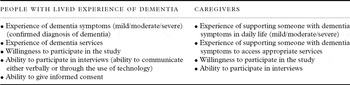
Thirty-one participants were included in the study. The sample comprised 12 persons with dementia (39%) and 19 unpaid carers (61%). A further nine potential participants, three persons with dementia and six unpaid carers, opted to withdraw from the study at the stage of being contacted by the researcher. Eight of them exercised their right not to disclose the reason for the withdrawal, and one carer declined her participation due to her husband's deteriorating health. Table 1 details inclusion criteria.
Inclusion criteria

In all 92% of the participants with experience of dementia were females; with the unpaid carers’ gender being 74% female and 26% male. The average age of those with experience of dementia was 84 years (range: 77–93 years), and unpaid carers 65 years (range: 40–84 years). The majority of the participants with experience of dementia were widowed (59%), with 33% being married and 8% divorced. The unpaid carers’ employment status was as follows: 58% were retired; 21% were unemployed; 5% were in full-time employment; 11% were in part-time employment, and 5% were self-employed.
The average time between the onset of symptoms and formal diagnosis of dementia was 2.5 years (range: 1–5 years). In all 58% of the participants with lived experience of dementia relied on informal support provided by their adult children, 42% of unpaid carers were their spouses. Altogether 68% of the people with experience of dementia included in this study lived within the community, 32% were users of residential care. The average time spent living at the current address for community-dwelling participants was 48 years (range: 27–58 years), whereas the average time of living within residential care setting was 19 months (range: 5–47 months).
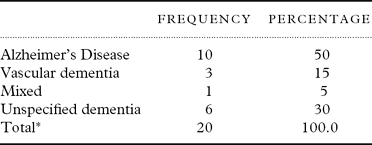
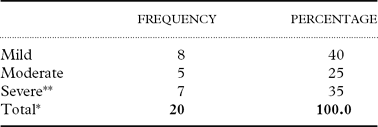
A breakdown by diagnostic category is presented in Table 2. Table 3 details participants according to the severity of experienced dementia symptoms.
Diagnostic group
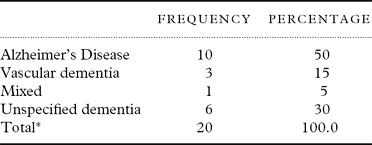
Note: *Including persons cared for by the unpaid carers participating in the study.
Severity of experienced dementia symptoms
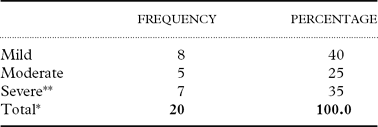
Notes: *Including persons cared for by the unpaid carers participating in the study.
**Only unpaid carers represented this group in the study.
Themes
All participants identified that as the condition progressed, the impact it had on a person's life, and in particular their physical and mental health, and ability to engage in daily activities increased. Participants were generally satisfied with the services received. Particularly relationships with professionals involved across the services were described as positive, respectful, and caring. Nevertheless, a number of needs that were not met by current services were identified. These needs were consistent across the dementia spectrum. Data analysis allowed formulation of two main themes reflecting areas of need as recognized by the participants: diagnostic services and post-diagnostic support.
Theme 1: Diagnostic services
Significance of diagnosis: Early diagnosis was perceived as crucial as it afforded service users’ access to appropriate services and medication. Delayed diagnostic procedures were often associated with lost opportunities to maintain the health and well-being of a person with dementia and to slow down the progression of the condition:
As soon as she was diagnosed all the doors opened, which was wonderful, it was absolutely fantastic. [. . .] but it was too late because she needed the stimulation before that. And she wasn't getting any drugs or anything for memory before that. (Rose,* service user's daughter)
Numerous obstacles in obtaining the diagnosis were identified by the participants. One of the perceived reasons for this delay was the dismissal of concerns by the local primary care doctors over the health of persons who were thought to experience dementia. In some cases, especially when the concerns were raised at very early stages, service users were advised to treat their symptoms as signs of normal aging. Some participants believed that their self-knowledge, or knowledge of their loved ones, and concerns in relation to observed changes in cognitive abilities were dismissed by their primary care doctors:
I contacted the doctor originally about my memory and he advised me just to forget about it, to leave it, not to worry about it. [. . .] He made light of it, I felt. I felt the doctor made light of it and I felt it was quite an important thing. . . (Sophia,* a service user)
The perceived lack of communication between the services involved (primary care and specialist dementia services) was described as another reason for potential delay in diagnosis. These poor communication mechanisms meant that the services often relied on unpaid carers to ensure that the appropriate information was passed between the services, and that appointments were arranged and attended by a person with dementia:
I think it took that length of time to get there because of the fact that the services were not joined up. If each of them had been talking to one another, I think things would have moved a bit quicker. [. . .]. (Hailey,* service user's daughter)
Challenges related to the diagnostic procedures: Another issue highlighted in relation to diagnostic processes was the perceived inappropriateness of the assessment tools used. The unpaid carers in this study were concerned that the diagnostic procedures were based mainly on the assessment of the cognitive abilities and did not consider the person's daily functioning. The process of cognitive testing was also seen as distressing for persons with dementia, who often were acutely aware of the decline in their cognitive skills.
[. . .] my mother finds it totally distressing you know when they ask all these questions about who's the Prime Minister? What's his name? I mean she just can't get that out. [. . .] There must be some other way that they can gauge the severity of the dementia. (Grace,* service user's daughter)
The difficulty in recognizing the value of the diagnostic procedures was related to a lack of understanding about their purpose, clinical significance, and the value of repeated administration. Inadequate explanation and insufficient sensitivity by the clinical staff also appeared to have an impact:
I said to [the Community Psychiatric Nurse] “What's the value of these questions? Why are you doing this [cognitive testing]?” And she said, “Well it's data.” And I said, “How does that help the patient?” (Lyn*, service user's wife)
Participants usually understood that clinicians need assessment tools to gauge the severity of dementia symptoms and to monitor changes in patients’ status. However, carers often thought that in the early stages the tools used were not sensitive enough to detect subtle changes in their loved ones cognitive abilities. It was perceived that the assessment tools could not capture deterioration in the ability to engage in daily routines, activities, and interactions which previously would be considered a part of a person's normal daily life.
Theme 2: Post-diagnostic support
Co-ordination: Poor coordination of available services was identified as a source of major challenges. It was noted that there are many agencies and departments responsible for providing dementia care services. The participants particularly emphasized poor communication between existing services, which results in unsatisfactory case management and delays in service provision. The need for a single point of access to information and service coordination was expressed as a means to manage these challenges and to facilitate more efficient and effective service delivery. Participant reports also highlighted inconsistencies in care provision and suggested the need for well-defined care pathways. It was indicated that introducing a care pathway managed by a single service would enable services to provide care more consistently allowing continuous monitoring, appropriate and timely actions, and the same standards of care to be applied to all patients:
I'd just like a joined-up service, it's the main thing. [. . .] I know it's an overstretched system, but I think it maybe needs checklists that are not there. Just to tick off, right, this is where we are. (Hailey,* service user's daughter)
Carers commonly believed that they were expected to manage the care provided to their loved ones. This included facilitating communication between the various services involved and ensuring that appropriate actions are undertaken, such as arranging appointments and ensuring they were kept.
Continuity: Continuity of care, particularly in relation to the involvement of health and social care personnel was seen as essential for providing high-quality care, ensuring its efficiency, and giving people with dementia a sense of familiarity and security. It was felt that, due to the nature of the condition, failure to ensure continuity of personnel involved often causes anxiety and distress for people with dementia who may experience difficulty memorizing and recognizing new individuals. In the unpaid carers’ opinions this affects the quality of care as people with dementia often take time to develop positive working relationships with health and social care personnel. Lack of time to develop such relationships is exacerbated by frequent changes in staffing and may result in distress and poor response to care efforts. By contrast, those people with dementia who experienced long-term, consistent professional involvement were reported to enjoy social interaction with their paid carers and to respond positively to their caring efforts. Another issue linked to the lack of service continuity was poor communication, which was also perceived as a factor reducing the quality and efficiency of care:
You were getting different people coming in which I really objected to. [. . .] because of the changing, information was not passed on. (Lillian,* service user's daughter)
There was a general appreciation among the participants that securing continuity of staff can be extremely challenging for service providers. Despite expressing their understanding of the factors impacting on this aspect of service provision, the need for greater consistency of health and social care personnel was identified as one of the priority requirements for this client group.
Access to non-pharmacological interventions to support identity and social engagement: The majority of participants described the impact of dementia through changes in physical and mental health, diminishing life skills, and reduced levels of activity and interest. In many cases these changes affected people's ability to engage successfully in previously valued activities and this was reported as the major area of need requiring professional interventions:
I had kept seeing my mother is deteriorating, she's bored, she's doing nothing, she's sleeping all day. She's lost interest in everything. I want to try and get some kind of stimulation for her. She needs mental stimulation. (Rose,* service user's daughter)
The need for increased access to non-pharmacological interventions as a means to ameliorate negative impact of these changes, and to support identity and social engagement was highlighted as an essential element of high quality of care for people experiencing dementia. This included access to services such as occupational therapy, physiotherapy, and speech and language therapy as well as enhanced access to day services and other services supporting social involvement and facilitating activity:
If they had more day centers [. . .] which my mum really enjoys and it gets her away from this environment instead of just being stuck [at home] all the time. (John,* service user's son)
Both people with dementia and their unpaid carers valued the support that allowed access to these sorts of services but also reported experiencing challenges around limited resources and long waiting times which resulted in significant delay to access.
Discussion
The current study aimed to develop a deeper understanding of the lived experience of people with dementia in terms of their service-related needs. Although participants were generally satisfied with the services received, they identified a number of unmet needs in relation to diagnostic services and post-diagnostic support.
Diagnostic services
The importance of early diagnosis in dementia care has been stressed as a key policy priority in recently formulated national dementia strategies for high-income countries (Department of Health, 2009; Scottish Government, 2010; Congress of the USA, 2011). It has been recognized that early diagnosis has the potential not only to afford prompt access to much needed services and support by those living with dementia (Alzheimer Disease International, 2011) but also to reduce cost of outpatient care (McCarten et al., Reference McCarten, Anderson, Kuskowski, Jonk and Dysken2010). The value of diagnosis as “a gateway to services” has also been recognized by the participants in our study. However, in contrast with the existing policy (Scottish Government, 2010), the examples of delay in diagnosis, due to various factors, have also been reported by the participants. Our findings suggest that more emphasis should be placed on early recognition and validation of concerns over changes in cognitive skills in individuals by health professionals. This could be achieved through rising awareness among primary care health professionals about dementia symptomology and the importance of early recognition of health problems that may be suggestive of developing dementia. Access to dementia-specific health advisors (e.g. dementia nurse; dementia consultant) would also aid early diagnosis.
Another issue identified in this study related to the perceived inappropriateness of the assessment tools used to diagnose and monitor the progression of the condition, and the focus on cognitive skills in dementia care. The existing policy documents recommend that persons with dementia receive a comprehensive assessment, which includes a person's life history, cognitive and mental state examination, physical and other appropriate investigations (National Institute for Health and Clinical Excellence (NICE), 2011). Our findings indicate that integration of functional and environmental aspects into the existing assessment procedures would make them less distressing and more relevant to the daily lives of persons with experience of dementia and their caregivers.
Post-diagnostic support
In comparison with services for older people in general, and with mental health services for working age adults, services for people with dementia are underdeveloped, and their provision is patchy and poorly coordinated (McDonald and Heath, Reference McDonald and Heath2008). McDonald and Heath (Reference McDonald and Heath2008) hold the lack of a strategic approach to the development of these services responsible for this situation. Our study revealed similar issues around the organization and coordination of services provided to persons with dementia and their carers. The need for a single point of information and service coordination as a means to improve the efficiency of care was highlighted by the participants. This is supported by policy documents within the United Kingdom which recommend that clear care coordination mechanisms should be in place to ensure high quality of care for people with dementia and their families (NICE, 2011; Scottish Government, 2011).
One of the challenges raised by the participants in relation to dementia services was inadequate continuity of the personnel involved. It has been recognized that consistent and stable staffing is important for the quality of care in dementia (NICE, 2011). Our study indicates that such continuity is essential as it provides people with dementia with a sense of security, helps to establish trusting relationships, promotes their cooperation and active involvement in treatment, and results in more efficient, higher quality of care. Although the participants appreciated that, due to the limited resources and staffing problems, achieving continuity of personnel can be challenging, they stressed that it should be aimed for whenever possible.
The profound influence of dementia on the lives of people experiencing the condition and on their families is well documented in literature and reflected in the most recent policy documents (Bourgeois and Hickey, Reference Bourgeois and Hickey2009; Department of Health, 2009; Scottish Government, 2010; NICE, 2011). Our findings suggest that people with dementia would benefit greatly from enhanced access to non-pharmacological interventions such as psychology, occupational therapy, physiotherapy, and speech and language therapy as well as increased access to day services and other services promoting activity and facilitating social involvement. This is supported by policy documents in the United Kingdom (NICE, 2011; Scottish Government, 2011) which recommend that people with dementia and their carers should have access to a range of non-pharmacological, evidence-based interventions to ameliorate the impact of cognitive and non-cognitive symptoms, to support independence and engagement in meaningful activities, and to address their psychological and emotional needs. Despite this, recent evidence shows that the support, care, and treatment needs of people with dementia and their caregivers are often under-delivered (The Royal College of Psychiatrists, 2011). Moreover, although research findings support the use of non-pharmacological interventions as cost-effective and beneficial to people with dementia and their carers (Powell, Reference Powell2000; Christofoletti et al., Reference Christofoletti, Mércia Oliani, Sebastiao and Florindo2007; Graff et al., Reference Graff, Vernooij-Dassen, Thijssen, Dekker, Hoefnagels and Olderikkert2007), they are poorly represented in clinical guidelines across Europe (Vasse et al., Reference Vasse2012) and under-utilized in clinical practice (Rimmer et al., Reference Rimmer, Wojciechowska, Stave, Sganga and O'Connell2005).
Limitations
Although informative in terms of identification of service-related needs of people with dementia, the current findings represent the views of a group of users within one geographical area. We acknowledge that those who chose not to participate may have different experiences and views of the services. In addition, considering the average age of the participants (84 years, range: 77–93 years), it is possible that they experienced other medical conditions, either psychiatric or physical, that could affect their perception of needs and services. The information about comorbidity was not gathered in this study, which is a further limitation of the presented findings.
Conclusion
This study contributes to a better understanding of service-related needs of people with dementia. Although in general satisfied with the services received, both persons with dementia and their unpaid carers identified a number of unmet needs. These fall into two broader categories: needs related to diagnostic procedures, and post-diagnostic support. The findings of the current study indicate that the following factors should be considered as crucial when designing services for this client group:
1. Early diagnosis delivered through a comprehensive assessment package
2. Access to well-coordinated care
3. Continuity of personnel involved
4. Access to non-pharmacological interventions to support identity and social engagement.
*Participants' names were changed to ensure anonymity.
Conflict of interest
None.
Description of authors' roles
S. Gorska assisted with development of the research proposal, collected and analyzed the data, and wrote the paper. Prof. K. Forsyth designed the study, supervised data collection, and assisted with writing the paper. L. Irvine assisted with study design and supervised data collection. S. Prior and J. Whitehead assisted with data analysis. Dr D. Maciver assisted with study design and data analysis. J. Flockhart, J. Fairnie, and J. Reid facilitated recruitment of the participants.
Acknowledgments
The authors would like to thank all the participants of this study for their contributions. We also want to acknowledge the support from all the dementia services in Midlothian, both statutory and non-statutory, for their part in the recruitment of the participants. Thanks also to Dr Duncan Pentland for his helpful comments and suggestions.