Introduction
To achieve adequate growth and health, poultry should be provided with sufficient amounts of all necessary nutrients, including the mineral, selenium (Se). Se is essential for human and animal nutrition, as it is incorporated in at least 25 proteins that play important roles in the regulation of various functions of the body (Surai and Fisinin, Reference Surai and Fisinin2014). One of the most important selenoproteins is the enzyme, glutathione peroxidase (GSH-Px), which is involved in the cellular defense against oxidative stress by catalyzing the reduction of reactive oxygen species to less harmful molecules (Arthur, Reference Arthur2000). The appropriate level of Se is important for the reproductive performance of animals, bone metabolism, immune function, and metabolism of iodine (Rayman, Reference Rayman2000).
Nutritional Se requirement for poultry
Although Se is essential for animal nutrition at low dietary concentrations, Se toxicosis appears when dietary concentrations are slightly over essential levels (Ohlendorf, Reference Ohlendorf, Hoffman, Rattner, Burton and Cairns2003). The addition of Se at 0.15 mg kg−1 in the diet is recommended for broiler chickens throughout the growth period (National Research Council. Nutrient Requirements of Poultry, 1994), while the dietary Se intake of more than 0.5 mg kg−1 is not allowed (European Commission, 2014). However, Se is not equally distributed in soils and plants in all parts of the world, so some regions, including the Balkans, are Se-deficient areas (Oldfield, Reference Oldfield2002). Addition of recommended quantities of Se to feed can compensate for the adverse effects of Se-deficient diets (Surai, Reference Surai2002).
Selenium sources and their efficacy
The efficacy of Se in inducing Se-containing enzymes in vivo and in vitro depends on its chemical form (Ortuno et al., Reference Ortuno, Ros, Periago, Martinez and Lopez1996). Nowadays, a few differing sources of Se are used as feed supplements. Organic forms of Se containing selenomethionine (Se-Met) and selenocysteine (Se-Cys) perform a key role in biological processes due to the fact they are more active, less toxic (Suchý et al., Reference Suchý, Straková and Herzig2014), have higher bioavailability (Mahan et al., Reference Mahan, Cline and Richert1999) and accumulate at higher levels in all tissues than inorganic Se salts (Payne and Southern, Reference Payne and Southern2005; Suchý et al., Reference Suchý, Straková and Herzig2014). The advantages of organic Se compared with inorganic Se have now been reported in numerous meat-enrichment studies in poultry (Choct et al., Reference Choct, Naylor and Reinke2004; Payne and Southern, Reference Payne and Southern2005; Marković et al., Reference Marković, Jovanović, Baltić, Šefer, Petrujkić and Sinovec2008, Reference Marković, Baltić, Šefer, Radulović, Drljačić, Ðorđević and Ristić2010). Organic Se is mostly used in the form of Se-enriched yeast (Briens et al., Reference Briens, Mercier, Rouffineau, Vacchina and Geraert2013; Baltić et al., Reference Baltić, Dokmanović, Bašić, Zenunović, Ivanović, Marković, Janjić and Mahmutović2015, Reference Baltić, Dokmanović, Bašić, Zenunović, Ivanović, Marković, Janjić, Mahmutović and Glamočlija2016; Marković et al., Reference Marković, Ćirić, Drljačić, Šefer, Jovanović, Jovanović, Milanović, Trbović, Radulović, Baltić and Starčević2018) or in other preparations, such as Se chelate (Chadio et al., Reference Chadio, Pappas, Papanastasatos, Pantelia, Dardamani, Fegeros and Zervas2015), proteinates (Leeson et al., Reference Leeson, Namkung, Caston, Durosoy and Schlegel2008), pure Se-Met (Wang et al., Reference Wang, Zhan, Yuan, Zhang and Wu2011) or a new organic Se source, which is a selenomethionine hydroxyanalogue, 2-hydroxy-4-methylselenobutanoic acid or HMSeBA (Briens et al., Reference Briens, Mercier, Rouffineau, Vacchina and Geraert2013, Reference Briens, Mercier, Rouffineau, Mercerand and Geraert2014). HMSeBA is fully converted into selenomethionine and selenocysteine and shows higher relative bioavailability through muscle Se enrichment compared with other sources of Se (Briens et al., Reference Briens, Mercier, Rouffineau, Vacchina and Geraert2013, Reference Briens, Mercier, Rouffineau, Mercerand and Geraert2014). With the recent development of nanotechnology, nano-products have begun to be applied in the area of nutritional supplements and have become largely available and usable (Suchý et al., Reference Suchý, Straková and Herzig2014). Nano-materials exhibit novel properties, such as a large surface area, high surface activity, high catalytic activity, strong adsorbing ability, and low toxicity (Wang et al., Reference Wang, Zhang and Yu2007; Zhang et al., Reference Zhang, Wang and Xu2008). It has been reported that nano-Se possesses comparable efficiency to sodium selenite (SS) and Se-methylselenocysteine in upregulating selenoenzymes, but with dramatically decreased toxicity (Zhang et al., Reference Zhang, Wang and Xu2008). Also, Mohapatra et al. (Reference Mohapatra, Swain, Mishra, Behera, Swain, Mishra, Behura Sabat, Sethy, Dhama and Jayasankar2014) indicated that the range between optimal and toxic dietary levels of nano-Se was greater than that of sodium selenite.
European Union legislation 427/2013 and 445/2013 suggested to the maximum inclusion of organic Se sources when inorganic Se is added.
Dietary selenium and glutathione peroxidase activity
An integrated antioxidant system has been described in avian tissues (Surai, Reference Surai2002) and it has been suggested that the cell's first line of antioxidant defense is based on the activity of three enzymes: superoxide dismutase, GSH-Px, and catalase (Surai, Reference Surai2002). GSH-Px inhibits lipid oxidation in both live tissues and post-slaughter meat (Daun and Akesson, Reference Daun and Akesson2004a; Cai et al., Reference Cai, Wu, Gong, Song, Wu and Zhang2012). Its activation requires small amounts of selenocysteine, which probably substitutes sulfur in the glutathione molecule and causes increases in GSH-Px activity of up to a thousand times (Burk, Reference Burk2002; Suchý et al., Reference Suchý, Straková and Herzig2014). Chen et al. (Reference Chen, Wu and Li2013) observed that oxidation resistance in broilers increased significantly along with Se level. Further, other authors found that the activity of GSH-Px in serum and tissues of broilers increased along with dietary Se content (Yoon et al., Reference Yoon, Werner and Butler2007; Wang and Xu, Reference Wang and Xu2008; Jiang et al., Reference Jiang, Lin, Zhou, Luo, Jiang and Chen2009; Heindl et al., Reference Heindl, Ledvinka, Englmaierova, Zita and Tumova2010; Wang et al., Reference Wang, Zhan, Yuan, Zhang and Wu2011; Zhou and Wang, Reference Zhou and Wang2011; Cai et al., Reference Cai, Wu, Gong, Song, Wu and Zhang2012; Chen et al., Reference Chen, Wu and Li2013; Boostani et al., Reference Boostani, Sadeghi, Mousavi, Chamania and Kashana2015) (Table 1). Similarly, GSH-Px activity in plasma was related to the level of dietary Se supplementation (Dean and Combs, Reference Dean and Combs1981), while a high positive correlation was found between GSH-Px activity and Se level in plasma of ducks (Baltić et al., Reference Baltić, Dokmanović, Bašić, Zenunović, Ivanović, Marković, Janjić and Mahmutović2015). The linear correlation between Se concentration and GSH-Px activities of the blood and various tissues has been well documented (Pavlata et al., Reference Pavlata, Illek and Pechová2001). Further, decreased GSH-Px activity was found in Se-deficient turkeys compared with Se-adequate turkey poults (Sunde and Hadley, Reference Sunde and Hadley2010; Taylor and Sunde, Reference Taylor and Sunde2016). In turkeys, at least 0.2 mg of Se kg−1 was required in their diet to achieve maximum Se concentrations in tissues and GSH-Px activity in liver and plasma (Hadley and Sunde, Reference Hadley, Sunde, Fischer, L'Abbë, Cockell and Gibson1997), while other authors (Fischer et al., Reference Fischer, Bosse, Most, Mueller and Pallauf2008; Taylor and Sunde, Reference Taylor and Sunde2016) determined higher dietary Se requirements for turkeys (0.3 mg kg−1).
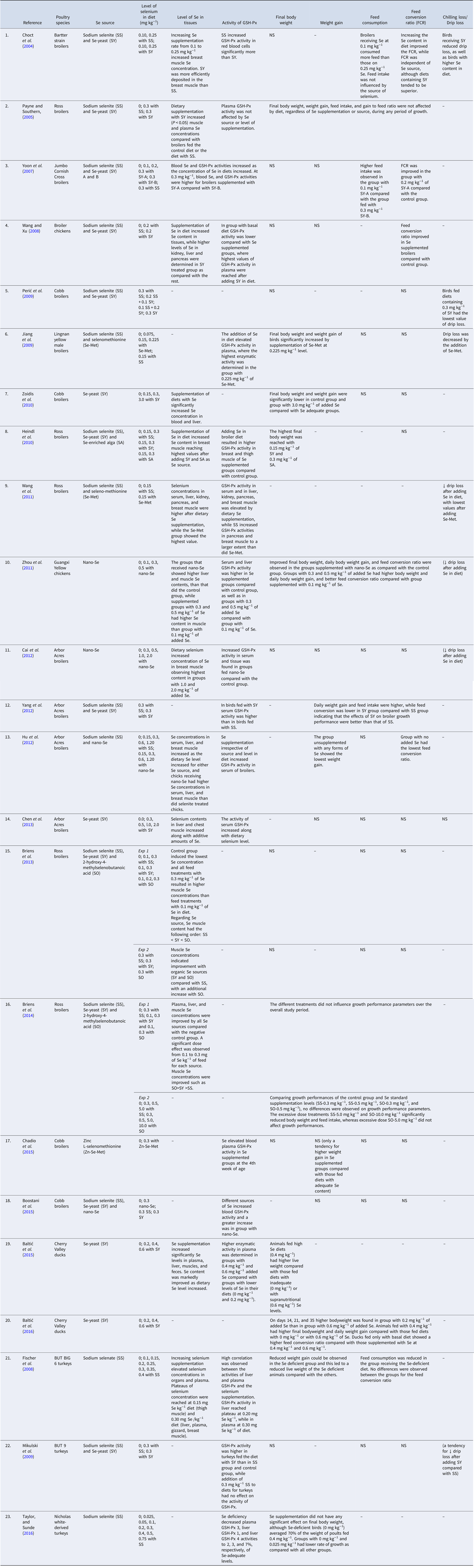
Selected studies that investigated the effects of different sources and levels of Se in the diet on GSH-Px activity, level of Se in tissues, and growth performance in poultry

NS, no significant differences were found among compared groups.
Furthermore, Hu et al. (Reference Hu, Li, Xiong, Zhang, Song and Xia2012) observed that GSH-Px produced the greatest response when 0.15 mg kg−1 of dietary Se was fed to broilers, plasma GSH-Px activity reached a plateau, and did not increase further with higher Se concentrations in the diet. Similarly in turkeys, increased Se supplementation (approximately 0.3 mg kg−1) resulted in well-defined plateaus for all blood, liver, and gizzard GSH-Px activities, showing that these selenoprotein biomarkers could not be used as biomarkers for supernutritional-Se status (Taylor and Sunde, Reference Taylor and Sunde2016). On the contrary, Baltić et al. (Reference Baltić, Dokmanović, Bašić, Zenunović, Ivanović, Marković, Janjić and Mahmutović2015) found that a plateau for plasma GSH-Px activity was reached with 0.4 mg kg−1 of dietary Se in 14-days-old ducks, while at the end of the study, the highest enzymatic activity was achieved in the group with 0.6 mg kg−1 of Se in diet. According to these results, it seems that Se dietary requirements for ducks are higher than those of other poultry species, and that a plateau for GSH-Px could be reached with higher dietary Se content. Moreover, comparing GSH-Px activity in different species fed with similar amounts of Se, Daun and Akesson (Reference Daun and Akesson2004a) found that ducks produced the highest enzymatic activity in muscles. Those authors concluded that the diversity in muscle GSH-Px activity among and within species is probably due to differing needs for antioxidant protection.
On the contrary, changing the Se level in the diet did not influence GSH-Px activity in erythrocytes (Choct et al., Reference Choct, Naylor and Reinke2004), plasma, breast muscle (Leeson et al., Reference Leeson, Namkung, Caston, Durosoy and Schlegel2008), chicken thighs (Daun and Akesson, Reference Daun and Akesson2004a; Cichoski et al., Reference Cichoski, Rotta, Scheuermann, Cunha and Barin2012), or liver (Leeson et al., Reference Leeson, Namkung, Caston, Durosoy and Schlegel2008; Heindl et al., Reference Heindl, Ledvinka, Englmaierova, Zita and Tumova2010). This could be attributed to the fact that Se ingested by the birds is used for producing several selenoproteins besides GSH-Px (Cichoski et al., Reference Cichoski, Rotta, Scheuermann, Cunha and Barin2012). Thus, Se distribution in the avian body is regulated by its metabolic needs (Daun and Akesson, Reference Daun and Akesson2004b).
With respect to the dietary Se source on GSH-Px activity, some studies indicated that the effects of organic Se were superior to those of inorganic Se in chickens (Jiang et al., Reference Jiang, Lin, Zhou, Luo, Jiang and Chen2009; Yang et al., Reference Yang, Meng, Wang, Jiang, Yin, Chang, Zuo, Zheng and Liu2012; Chen et al., Reference Chen, Wu and Li2014), suggesting higher bioavailability of organic forms compared with inorganic forms. In turkeys, similar results were found by Mikulski et al. (Reference Mikulski, Jankowski, Zduńczyk, Wróblewska, Sartowska and Majewska2009), while Cantor et al. (Reference Cantor, Moorhead and Musser1982) did not observe any differences in plasma GSH-Px activity between different dietary Se sources (SS vs. selenomethionine). However, the effect of dietary Se source had inconsistent effects on GSH-Px activity in broilers. Using organic Se resulted in a highly significant decline of GSH-Px activity in plasma, liver, pancreas, breast muscle, and in erythrocytes compared with inorganic Se (Choct et al., Reference Choct, Naylor and Reinke2004; Leeson et al., Reference Leeson, Namkung, Caston, Durosoy and Schlegel2008; Wang et al., Reference Wang, Zhan, Yuan, Zhang and Wu2011). However, other authors (Kuricova et al., Reference Kuricova, Levkut, Boldizarova, Gresakova, Bobcek and Leng2003; Payne and Southern, Reference Payne and Southern2005; Marković et al., Reference Marković, Jovanović, Baltić, Šefer, Petrujkić and Sinovec2008) reported no differences in the GSH-Px activity in plasma and tissues of broilers fed Se in either an organic or inorganic form. There is some suggestion, therefore, that GSH-Px activity could be lower in certain broiler tissues when organic rather than inorganic Se is used as a feed supplement. This seems contrary to the general assumption that organic sources are more bioavailable. A more logical interpretation is that with better oxidative stability there is, in fact, less need for a synthesis of GSH-Px, so lower levels are indicative of better health status (Leeson et al., Reference Leeson, Namkung, Caston, Durosoy and Schlegel2008). Another possible explanation for lower GSH-Px activity after consuming organic Se compared with inorganic Se is due to the fact that Se, regardless of its form, must be converted to Se-Cys before it can be incorporated into the selenoprotein enzyme GSH-Px (Forstrom et al., Reference Forstrom, Zakowski and Tappel1978). It was reported that SS was metabolized into Se-Cys more efficiently than organic Se sources containing Se-Met (Sunde and Hoekstra, Reference Sunde and Hoekstra1980). Another likely possibility is that Se-Met can be incorporated into a wide spectrum of cellular proteins in place of methionine and is only later incorporated into GSH-Px, whereas Se from SS was rapidly incorporated into GSH-Px (White and Hoekstra, Reference White and Hoekstra1979).
In many studies, increased GSH-Px activity in serum and tissues was found in groups fed nano-Se compared with the control group (Zhou and Wang, Reference Zhou and Wang2011; Cai et al., Reference Cai, Wu, Gong, Song, Wu and Zhang2012; Hu et al., Reference Hu, Li, Xiong, Zhang, Song and Xia2012; Boostani et al., Reference Boostani, Sadeghi, Mousavi, Chamania and Kashana2015). The results of some authors (Zhou and Wang, Reference Zhou and Wang2011; Cai et al., Reference Cai, Wu, Gong, Song, Wu and Zhang2012; Boostani et al., Reference Boostani, Sadeghi, Mousavi, Chamania and Kashana2015) indicate that elevation of GSH-Px activities in serum, liver, and muscle can be optimized by supplementation with 0.3 mg kg−1 of nano-Se, while the maximum supplementation of nano-Se should not be more than 1.0 mg kg−1.
Dietary selenium and its content in tissues and feces
Se is a semi-metallic element that is physiologically required by birds, but at increased levels, it can be toxic and cause deleterious effects (Hoffman, Reference Hoffman2002; Yoon et al., Reference Yoon, Werner and Butler2007). It is clear that Se accumulation in tissues is related to dietary Se supplementation, but this accumulation depends on type of tissue, and can vary according to animal species, the source, and level of Se supplementation (Vignola et al., Reference Vignola, Lambertini, Mazzone, Giammarco, Tassinari, Martelli and Bertin2009). Regarding differences in species, the highest average total Se content was found in duck, followed by lamb >chicken >ostrich >turkey (Daun and Akesson, Reference Daun and Akesson2004a). Combs and Combs (Reference Combs and Combs1986) indicated that Se concentrations are usually highest in kidney, intermediate in the liver, and lowest in skeletal muscle. Pan et al. (Reference Pan, Huang, Zhao, Qin, Chen and Hu2007) found a similar order of Se distribution: liver >kidney >spleen >cardiac muscle >egg >blood >breast muscle, irrespective of the Se level or source. Moreover, deposition of Se in tissues increases as Se content in diet increases (Choct et al., Reference Choct, Naylor and Reinke2004; Zhou and Wang, Reference Zhou and Wang2011; Chen et al., Reference Chen, Wu and Li2013; Briens et al., Reference Briens, Mercier, Rouffineau, Mercerand and Geraert2014; Baltić et al., Reference Baltić, Dokmanović, Bašić, Zenunović, Ivanović, Marković, Janjić and Mahmutović2015). A consistent improvement in Se accumulation was observed from organic Se sources compared with SS or control diet (Briens et al., Reference Briens, Mercier, Rouffineau, Vacchina and Geraert2013). Thus, higher Se concentrations in plasma and various tissues were found by many authors after organic Se was incorporated into diets compared with inorganic Se (Kuricova et al., Reference Kuricova, Levkut, Boldizarova, Gresakova, Bobcek and Leng2003; Choct et al., Reference Choct, Naylor and Reinke2004; Payne and Southern, Reference Payne and Southern2005; Pan et al., Reference Pan, Huang, Zhao, Qin, Chen and Hu2007; Leeson et al., Reference Leeson, Namkung, Caston, Durosoy and Schlegel2008; Marković et al., Reference Marković, Jovanović, Baltić, Šefer, Petrujkić and Sinovec2008, Reference Marković, Ćirić, Drljačić, Šefer, Jovanović, Jovanović, Milanović, Trbović, Radulović, Baltić and Starčević2018; Perić et al., Reference Perić, Milošević, Žikić, Kanački, Džinić, Nollet and Spring2009; Heindl et al., Reference Heindl, Ledvinka, Englmaierova, Zita and Tumova2010; Wang et al., Reference Wang, Zhan, Yuan, Zhang and Wu2011; Briens et al., Reference Briens, Mercier, Rouffineau, Vacchina and Geraert2013, Reference Briens, Mercier, Rouffineau, Mercerand and Geraert2014; Chen et al., Reference Chen, Wu and Li2014). The effects of different Se levels and sources in the diet on the accumulation of Se in tissues are summarized in Table 1. Furthermore, by replacing inorganic Se with organic Se in diets, the concentration of Se in excreta was decreased and a higher level of Se retention was observed (Choct et al., Reference Choct, Naylor and Reinke2004; Yoon et al., Reference Yoon, Werner and Butler2007; Briens et al., Reference Briens, Mercier, Rouffineau, Vacchina and Geraert2013). Some studies also proved that turkeys receiving inorganic Se retained less Se in tissues than those receiving organic Se (Cantor et al., Reference Cantor, Moorhead and Musser1982; Mikulski et al., Reference Mikulski, Jankowski, Zduńczyk, Wróblewska, Sartowska and Majewska2009). This is probably due to the different absorption mechanisms for organic and inorganic forms of Se. Inorganic Se is passively absorbed from the intestine by a simple diffusion process, competing with a number of mineral elements for the same absorption route, whereas organic Se is actively absorbed through the amino acid transport mechanisms (Wolfram et al., Reference Wolfram, Berger, Grenacher and Scharrer1989). Further, the different concentrations of Se in tissues from inorganic and organic Se sources might also be explained by differences in metabolic routes. As mentioned above, Se in both forms can be incorporated into GSH-Px, but Se-methionine is also incorporated non-specifically into other body proteins too, in substitution for methionine (Schrauzer, Reference Schrauzer2000; Kim and Mahan, Reference Kim and Mahan2003). Enriching muscle with Se-methionine does not affect protein structure or properties and produces an endogenous Se pool available in challenging conditions due to environmental or physiological stress (Schrauzer, Reference Schrauzer2003). Accordingly, Se-methionine-supplemented animals maintain higher activities of selenoenzymes during Se depletion for longer periods than selenite-supplemented animals (Schrauzer, Reference Schrauzer2000). Thus, Se-yeast contains predominantly Se-methionine which is accumulated mostly in proteins as evidenced by greater contents of Se in breast muscle (Leeson et al., Reference Leeson, Namkung, Caston, Durosoy and Schlegel2008). On the other hand, inorganic Se is less efficiently retained and usually excreted via the urine (Kim and Mahan, Reference Kim and Mahan2003). The amount of Se assimilated into tissues depends on the Se source, but the dietary Se concentration also plays a role. In some studies Se retention decreased as the level of Se increased in the diets (Choct et al., Reference Choct, Naylor and Reinke2004; Yoon et al., Reference Yoon, Werner and Butler2007). This was also observed in 14-day-old-ducks, but in 49-day-old-ducks, the highest retention was found in animals fed diets with the highest Se level (Baltić et al., Reference Baltić, Dokmanović, Bašić, Zenunović, Ivanović, Marković, Janjić and Mahmutović2015). A possible explanation of the discrepancy between those studies could be due to the fact that different sources of Se were used; inorganic Se (Choct et al., Reference Choct, Naylor and Reinke2004) or organic Se (Baltić et al., Reference Baltić, Dokmanović, Bašić, Zenunović, Ivanović, Marković, Janjić and Mahmutović2015).
Due to the many advantages of nano-materials, nano-Se has been recently introduced as a Se supplement in animal diet. Accumulation of Se in serum, liver, and breast muscle increased as dietary nano-Se levels increased (Zhou and Wang, Reference Zhou and Wang2011; Cai et al., Reference Cai, Wu, Gong, Song, Wu and Zhang2012; Hu et al., Reference Hu, Li, Xiong, Zhang, Song and Xia2012; Selim et al., Reference Selim, Radwan, Youssef, Salah Eldin and Abo2014). Supplementing diets with 0.30 mg kg−1 of nano-Se effectively increased Se in tissues (Zhou and Wang, Reference Zhou and Wang2011; Cai et al., Reference Cai, Wu, Gong, Song, Wu and Zhang2012). Some authors indicated that nano-Se was accumulated to a greater extent in liver and muscle than SS (Hu et al., Reference Hu, Li, Xiong, Zhang, Song and Xia2012; Selim et al., Reference Selim, Radwan, Youssef, Salah Eldin and Abo2014). Moreover, the transfer of nano-Se from the intestinal lumen to the body was higher than that of selenite, while the intestinal retention of nano-Se was lower than that of selenite (Hu et al., Reference Hu, Li, Xiong, Zhang, Song and Xia2012). The different retentions of nano-Se and SS are probably related to the different absorption process and metabolic pathways. Chithrani and Chan (Reference Chithrani and Chan2007) suggested that the superior performance of nanoparticles is attributed to their smaller particle size and larger surface area, increased mucosal permeability, and improved intestinal absorption due to the formation of nanoemulsion droplets. In addition, nano-Se upregulates selenoenzymes more efficiently and exhibits less toxicity than inorganic Se (Zhang et al., Reference Zhang, Wang, Yan and Zhang2005; Wang et al., Reference Wang, Zhang and Yu2007) (Table 1).
Selenium and growth performance
Although Se supplementation in broilers did not have any effect on growth performance or feed conversion (Payne and Southern, Reference Payne and Southern2005; Perić et al., Reference Perić, Milošević, Žikić, Kanački, Džinić, Nollet and Spring2009; Cai et al., Reference Cai, Wu, Gong, Song, Wu and Zhang2012; Briens et al., Reference Briens, Mercier, Rouffineau, Mercerand and Geraert2014; Boostani et al., Reference Boostani, Sadeghi, Mousavi, Chamania and Kashana2015; Chadio, et al., Reference Chadio, Pappas, Papanastasatos, Pantelia, Dardamani, Fegeros and Zervas2015), many authors found an increase in live weight in broilers (Ševčíková et al., Reference Ševčíková, Skrivan, Dlouha and Koucky2006; Upton et al., Reference Upton, Edens and Ferket2008; Zhou and Wang, Reference Zhou and Wang2011; Marković et al., Reference Marković, Ristić, Drljačić, Šefer, Šević, Pantić, Đurić and Baltić2014), turkeys (Hadley and Sunde, Reference Hadley, Sunde, Fischer, L'Abbë, Cockell and Gibson1997; Taylor and Sunde, Reference Taylor and Sunde2016) or ducks (Dean and Combs, Reference Dean and Combs1981; Baltić et al., Reference Baltić, Dokmanović, Bašić, Zenunović, Ivanović, Marković, Janjić, Mahmutović and Glamočlija2016) due to higher dietary contents of Se. It seems that dietary intake of 0.15 mg kg−1 of Se (National Research Council. Nutrient Requirements of Poultry, 1994) does not meet the growth requirements for faster growing and higher yielding poultry, and additional quantities of Se might be used in poultry nutrition (Upton et al., Reference Upton, Edens and Ferket2008). However, high concentrations of selenium in diet (exceeding 1 mg kg−1) could impair animal growth (Kirchgessner et al., Reference Kirchgessner, Gabler and Windisch1997; Zoidis et al., Reference Zoidis, Pappas, Georgiou, Komaitis and Fegeros2010; Briens et al., Reference Briens, Mercier, Rouffineau, Mercerand and Geraert2014), or lead to development of Se toxicosis, seen after adding 6 mg kg−1 to feed for broilers (Echevarria et al., Reference Echevarria, Henry, Ammerman, Rao and Miles1988) or 4 mg kg−1 of Se to diet for ducks (Hoffman and Heinz, Reference Hoffman and Heinz1998). Moreover, it was observed that adding Se to diet improved feed conversion of poultry (Choct et al., Reference Choct, Naylor and Reinke2004; Mahmoud and Edens, Reference Mahmoud and Edens2005; Zhou and Wang, Reference Zhou and Wang2011; Baltić et al., Reference Baltić, Dokmanović, Bašić, Zenunović, Ivanović, Marković, Janjić, Mahmutović and Glamočlija2016), which could be a result of lower feed intake while maintaining the same weight gain (Choct et al., Reference Choct, Naylor and Reinke2004). Since Se is a part of iodothyronine deiodinases, which are involved in the metabolism of thyroid hormones necessary for normal growth and development (Arthur, Reference Arthur1992), better activation of thyroid hormones by increased selenium content may explain the improved feed efficiency (Choct et al., Reference Choct, Naylor and Reinke2004). Moreover, increased yields of leg, thigh, breast, and neck were measured in Se treated broilers (Choct et al., Reference Choct, Naylor and Reinke2004; Upton et al., Reference Upton, Edens and Ferket2008; Marković et al., Reference Marković, Ristić, Drljačić, Šefer, Šević, Pantić, Đurić and Baltić2014), while other authors did not observe any effect of selenium on carcass cut yields (Payne and Southern, Reference Payne and Southern2005; Ševčíková et al., Reference Surai and Fisinin2006; Baltić et al., Reference Baltić, Dokmanović, Bašić, Zenunović, Ivanović, Marković, Janjić, Mahmutović and Glamočlija2016).
Regarding the effect of Se source on growth performance results in poultry, it was found that organic forms of Se improved final body weight, daily weight gain, feed consumption or feed conversion ratio compared with inorganic forms (Choct et al., Reference Choct, Naylor and Reinke2004; Wang and Xu, Reference Wang and Xu2008; Jiang et al., Reference Jiang, Lin, Zhou, Luo, Jiang and Chen2009; Heindl et al., Reference Heindl, Ledvinka, Englmaierova, Zita and Tumova2010; Yang et al., Reference Yang, Meng, Wang, Jiang, Yin, Chang, Zuo, Zheng and Liu2012), while other authors did not find any difference between those two forms of Se (Payne and Southern, Reference Payne and Southern2005; Yoon et al., Reference Yoon, Werner and Butler2007; Mikulski et al., Reference Mikulski, Jankowski, Zduńczyk, Wróblewska, Sartowska and Majewska2009; Perić et al., Reference Perić, Milošević, Žikić, Kanački, Džinić, Nollet and Spring2009; Briens et al., Reference Briens, Mercier, Rouffineau, Vacchina and Geraert2013, Reference Briens, Mercier, Rouffineau, Mercerand and Geraert2014). Table 1 reports the major effects of adding different levels and sources of Se to diet on growth performance parameters in poultry.
In addition, dietary Se reduced chilling loss and drip loss in pigs (Mahan et al., Reference Mahan, Cline and Richert1999) and poultry (Choct et al., Reference Choct, Naylor and Reinke2004; Jiang et al., Reference Jiang, Lin, Zhou, Luo, Jiang and Chen2009; Perić et al., Reference Perić, Milošević, Žikić, Kanački, Džinić, Nollet and Spring2009; Zhou and Wang, Reference Zhou and Wang2011; Cai et al., Reference Cai, Wu, Gong, Song, Wu and Zhang2012) by protection from cell damage caused by free radicals, indicating better meat quality.
Conclusion
Based on the brief data presented, it can be concluded that Se plays an important role in broiler nutrition. The appropriate level of Se is important for broiler growth, antioxidant protection, reproductive performance, bone metabolism, immune function, and metabolism of iodine. The minimal dietary requirement for Se for broiler chickens is 0.15 mg of Se kg−1 of diet, while the dietary selenium intake of more than 0.5 mg kg−1 is not allowed. Nano-Se and organic Se possess at least comparable (and sometimes improved) efficiency to inorganic Se in upregulating selenoenzymes, and have higher bioavailability and lower toxity. Moreover, higher levels of Se increase GSH-Px activity in the body, but this plateaus with higher Se concentrations in the diet, while the accumulation of Se in animal tissues is dose-dependent. In addition, many studies have shown positive effects of adding Se to diet on growth performance in poultry and yields of carcass cuts. Optimal Se supplementation is necessary not only for good poultry health but also to ensure and preserve meat quality during storage and to provide people with this microelement.
Acknowledgments
The authors wish to thank Dr Sheryl Avery and Professor Sava Buncic for their linguistic and scientific comments.
Financial support
This paper is a part of research project ‘Selected biological hazards to the safety/quality of food of animal origin and the control measures from farm to consumer (31034)’ financed by the Ministry of Education, Science and Technological Development, Republic of Serbia.
Conflict of interest
The authors report no conflicts of interest. The authors alone are responsible for the content and writing of this article.