Introduction
Trichinellosis is a zoonosis, caused in humans by the ingestion of raw or undercooked meat containing viable larvae of Trichinella. Species of Trichinella can be found worldwide in a variety of hosts, ranging from mammals to birds and reptiles. Trichinellosis is considered one of the re-emerging diseases, with surveillance and control methods constantly gaining more importance worldwide. Recent changes in European Union (EU) legislation introduced Trichinella-free production, and the assessment of risk-based monitoring for Trichinella in pigs. This has increased the role of wildlife surveillance programmes and their impact on protecting human health, as well as highlighting the need for harmonized surveillance protocols and test methods for these infections (Zimmer et al., Reference Zimmer, Hunter, Morgan, Hunt, Smith, Howell and Taylor2008).
Within the EU member states, the annual number of reported cases of trichinellosis in humans varied between 48 and 97 cases during the period 1999–2003. These figures include imported cases, either through humans travelling abroad, or through imported meat. In 2004 this number increased to 270, with over 80% of these cases reported in 4 of the 10 new EU member states (EFSA, 2006a, b).
Natural wild boar populations are distributed almost all over Europe, with the exception of the British Isles and large parts of Scandinavia and Finland. Wildlife represent the most important reservoir of worms belonging to the genus Trichinella, which makes eradication impossible and explains why the parasites continue to circulate, even though the prevalence in wildlife can remain very low for many years (Rafter et al., Reference Rafter, Marucci, Brangan and Pozio2005; Hars et al., Reference Hars, Rossi, Boue, Garin-Bastuji, Le Potier, Boireau, Hattenberger, Louguet and Toma2007).
In Spain, the epidemiological data on trichinellosis surveys seem to be biased in favour of the information available from the International Trichinella Reference Centre (ITCR, www.iss.it/site/Trichinella/index.asp). In consequence, a trichinellosis survey was carried out in the context of a surveillance programme on wildlife diseases in the wild boar from the Toledo Mountains (south-western Spain, EU).
Materials and methods
Habitats and wild boars captured
Castilla-La Mancha is located in the centre of the Iberian Peninsula, in the southern plateau to be precise, with an extent of 79,463 km2 (15.7% of the whole Spanish territory). This is a strategic location, since the region links the north and the south of Spain. From a zoogeographical point of view, we can distinguish two different scenarios: plains and mountains. Here, the most important mountains skirt the boundaries of the region (the Sistema Central, Somosierra Mountains, the Sistema Ibérico, Alcaraz and Segura Mountains and the Toledo Mountains). Plains predominate in the rest of the Castilian territory, since almost 80% of the region is below 1000 m above sea level. The trichinellosis survey was carried out in the Toledo Mountains and neighbouring regions with a mean elevation of 800 m above sea level. The predominant habitats in this region are forests and areas used for hunting (seminatural areas) next to rural areas. In the present campaign (2007–2008), a total of 2216 wild boars were captured during the hunting season (autumn and winter) by hunters or official game-keepers.
Trichinella: isolation and reference strains
Meat samples (diaphragm, tongue, masseter, intercostals and foreleg) from the animals obtained were examined by trichinoscopy and/or standard digestion by the Veterinary Services of Castilla-La Mancha in a local abattoir (Matadero Municipal de Toledo). Positive samples were sent to the Department of Parasitology (Facultad de Farmacia UCM, Madrid) for isolation and specific identification by inter-simple sequence repeat-polymerase chain reaction (ISSR-PCR). The following Trichinella reference strains were used for reference: T. britovi (MCAN/SP/76/ISS11 C-76) and T. spiralis (MFEL/SP/62/ISS48 GM-1).
DNA isolation
Infective larvae were recovered from ground muscle tissue by pepsin–HCl standard digestion. Genomic DNA isolation from single larvae was performed according to the protocol of Fonseca-Salamanca et al. (Reference Fonseca-Salamanca, Nogal-Ruiz, Benito, Camacho and Martínez-Fernández2006). Total nucleic acids were isolated from individual larva in a final volume of 15 μl: 12.5 μl H2O, 1.4 μl PCR buffer [Tris–HCl 75 mm, pH 9.0; MgCl2 2 mm; KCl 50 mm; (NH4)2SO4 20 mm] and 1.1 μl proteinase K (20 mg/ml). Microscopically selected muscle larvae were placed in PCR buffer and pre-heated at 90°C for 10 min. The temperature was reduced to 65°C after which the solution was adjusted to 20 mg/ml with proteinase K, overlaid with mineral oil and incubated for 3 h. Proteinase K was inactivated by raising the reaction temperature to 90°C for 15 min. Samples were stored at − 20°C prior to PCR assays.
The Trichinella isolates were passed in Swiss CD-1 female mice (600 larvae/mouse) for further molecular and biological studies.
Inter-simple sequence repeat-PCR
We have adapted the protocol of Zietkiewicz et al. (Reference Zietkiewicz, Rafalski and Labuda1994). In this case, the reactions were carried out in 25 μl final volume containing 1.5 units of Taq polymerase PCR Master Mix Kit (Qiagen, Iberia SL, Madrid, Spain), 10 ng of genomic DNA template, 10 pmol primer 816 (5′-CACACACACACACACAT-3′), 200 μm of each of dATP, dCTP, dTTP, dGTP, 10 μl 10 × reaction buffer (Taq polymerase PCR Master Mix Kit), and 5 μl H2O. DNA amplifications were performed in a PTC-100 (MJ Research Inc, Spain) or Mastercycler® gradient 5331 (Eppendorf España SA, Spain) thermocycler, in both cases with a preliminary step of 5 min at 94°C, followed by 40 cycles of 30 s at 94°C, 45 s at 52°C and 2 min at 72°C and a final 6-min extension at 72°C. Samples of 10 μl ISSR-PCR products were analysed on 1.5% agarose gels in Tris–acetate–EDTA (TAE) buffer running at 100 V for 4 h. The gels were stained using ethidium bromide.
Results
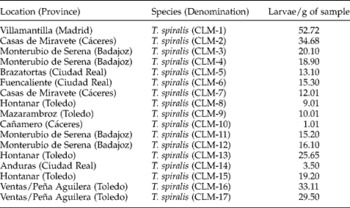
The trichinellosis prevalence in the wild boars (2216) from the Toledo Mountains was next to 0.77% during the 2007–2008 hunting campaign. The results of positive samples and the specific identification are summarized in table 1.
Trichinella positive samples in the wild boar from the Toledo Mountains in south-western Spain (2007–2008 survey).

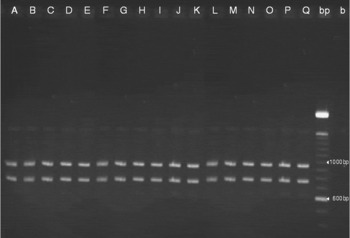
In all cases, the positive samples (17) were successfully identified by ISSR-PCR. The results show that all isolates identified with the primer 816 as T. spiralis were indistinguishable from the Trichinella reference strain, T. spiralis (ISS48). This analysis provided a quick, reliable and highly informative single larva DNA fingerprint (fig. 1).
Agarose gel electrophoresis of ISSR-PCR banding patterns from Trichinella reference strain and isolates with primer 816. Lanes: A, T. spiralis (ISS48); B–Q, T. spiralis isolates (from CLM-1 to CLM-17, respectively); bp, molecular size marker (100 bp); b, negative control.

Discussion
The high prevalence of T. spiralis in wild boar in the Toledo Mountains and neighbouring regions (100% of our observations), in practically the absence of a domestic epidemiological cycle, is a good example of the transmission and persistence of a species under sylvatic conditions and in sympatry with the endemic species T. britovi, if a good wild host is abundant. In Spain, the wild boar population has grown in parallel to the abandonment of agriculture in marginal fields and with the development and improvement of areas used for hunting. Wild boar may play a key role as a reservoir for the maintenance and spread of T. spiralis through the sylvatic cycle and this phenomenon should be monitored due to the potential risk of transmission to pigs. In Castilla-La Mancha and Extremadura (Spain), more than 7,000,000 hectares are used for hunting activities, which generate tourism and leisure activities in rural areas, producing an income of more than €240 million. The economic importance of this sector implies the co-operative action of the agents involved (i.e. hunters, public administration, etc.). In this context, it is necessary to establish management plans that include the veterinary control of meat from hunting catches (wild boar) with high gastronomic value.
The results from our study are consistent with those from Pozio et al. (Reference Pozio, Rinaldi, Marucci, Musella, Galati, Cringoli, Boireau and La Rosa2009), who suggested that T. spiralis is more prevalent than T. britovi in sylvatic swine (75% and 25%, respectively, P < 0.01) in Extremadura (Spain), where, until a few years ago, the domestic cycle was still active (Pérez-Martín et al., Reference Pérez-Martín, Serrano, Reina, Mora and Navarrete2000). However, they are in contrast with our previous surveys carried out in Castilla-León (north-west Spain) (Fonseca-Salamanca et al., Reference Fonseca-Salamanca, Nogal-Ruiz, García-Sánchez, Bolas-Fernandez, Jiménez, Álamo, Gárate and Martínez-Fernández2009), where T. britovi appears to be more prevalent than T. spiralis in the wild boar (66.7% and 33.3%, respectively, P < 0.01), and by those carried out previously by Perteguer et al. (Reference Perteguer, Rodríguez, García-Sánchez, Nogal-Ruiz, Bolas-Fernández, Martínez-Fernández and Gárate2009) in other regions. The orographical complexity and the diversity of these natural spaces, with a great choice of ecosystems and abundant wolves and foxes as predators, might explain this variation (Fonseca-Salamanca et al., Reference Fonseca-Salamanca, Nogal-Ruiz, García-Sánchez, Bolas-Fernandez, Jiménez, Álamo, Gárate and Martínez-Fernández2009). The size of the wild boar population is greatly regulated by humans and larger predators, such as the wolf (Järvis et al., Reference Järvis, Kapel, Moks, Talvik and Mägi2007). The sylvatic cycle is interrupted when carnivores rely on food sources other than those derived from cannibalistic and scavenging behaviour (Pozio, Reference Pozio1998) and the human impact on the natural ecosystem can either favour or impede the sylvatic cycle (Casulli et al., Reference Casulli, La Rosa, Amati and Pozio2001). Thus, the marked character of the area as a place for hunting, where the present study was carried out, may limit the distribution of foxes and wolves as main predators, thus perhaps lowering the flow of T. britovi.
Wild animals also represent the most important source of infection for domestic pigs, which, in turn, are the main source of infection for other reared animals (e.g. horses) as well as for humans (Pozio & Murrell, Reference Pozio and Murrell2006). In Spain the recent surveys indicate that T. britovi is responsible for most human outbreaks of trichinellosis (Rodriguez de las Parras et al., Reference Rodriguez de las Parras, Rodriguez-Ferrer, Nieto-Martínez, Ubeira and Garate-Ormaechea2004) whereas in other European countries, such as Poland, where both T. spiralis and T. britovi were also found (Cabaj, Reference Cabaj2006), the former is mainly responsible for human cases. Defining the global picture of the circulation patterns of Trichinella species in the wild fauna will help to determine the key factors influencing the occurrence of human trichinellosis in regions where both the sylvatic and domestic cycle coexist.
In summary, first we confirm that ISSR-PCR is a useful new technique for the molecular identification of Trichinella isolates in epidemiological studies. The uniformity found within T. spiralis isolates is in line with the suggestion of its recent introduction in Europe (Rosenthal et al., Reference Rosenthal, La Rosa, Zarlenga, Dunams, Chunyu, Mingyuan and Pozio2008). Second, our observations reinforce the complexity of the trichinellosis wild cycle and the potential role of the wild boar as sylvatic reservoir for Trichinella. Consequently, the consumption of uninspected wild boar meat represents the main risk for human trichinellosis in Spain.
Acknowledgements
This work was supported by TRICHIMED: MED-VET-NET (FOOD-CT-2004 506122).