Introduction
Multiple factors contribute to the development of behavioral symptoms in dementia (BSD), which is a significant problem in nursing homes (NH). One such factor may be the apolipoprotein E (APOE) genotype status APOE ϵ4 allele. The role of APOE genotype in moderating behavioral symptoms and psychopathology has been studied in community-dwelling persons with Alzheimer's disease (AD) with mixed findings; however, this relationship has not been studied in the NH population (Gabryelewicz et al., Reference Gabryelewicz2002; Scarmeas et al., Reference Scarmeas2002; Craig et al., Reference Craig, Hart, McCool, McIlroy and Passmore2004).
APOE, a 299 amino acid protein, is a major determinant of lipid transport and metabolism (Mahley and Rall, Reference Mahley and Rall1999). Genetic polymorphisms result in three common alleles: 2, 3 and 4, coding for three major isoforms ϵ2, ϵ3, and ϵ4; the predominant form, APOE ϵ3, and two mutant forms, APOE ϵ2 and APOE ϵ4 at a single gene locus on chromosome 19. Individuals are either homozygous, having two of the same alleles (4/4) or heterozygous, having two different alleles (2/3). The ϵ4 allele is a genetic risk factor for preclinical cognitive decline and for both familial and late-onset AD (Haan et al., Reference Haan, Shemanski, Jagust, Manolio and Kuller1999).
APOE ϵ3 is the most common form, with a frequency of 77% in European and Caucasian populations; the ϵ2 allele occurs in only 8% of the population (Davignon et al., Reference Davignon, Cohn, Mabile and Bernier1999). Approximately 15–30% of the general population has at least one APOE ϵ4 allele, which has been shown to confer a confirmed risk for AD in over 90 worldwide studies (Kozauer et al., Reference Kozauer, Mielke, Chan, Rebok and Lyketsos2008; Woods et al., Reference Woods, Kovach, Raff, Joosse, Basmadjian and Hegadoren2008). The risk for AD is increased 2.5 times or approximately 47% in the presence of one APOE ϵ4 allele (Evans et al., Reference Evans1997). Although the role of APOE polymorphisms in the development of AD has been studied extensively, the relationship of APOE and BSD has received only limited attention. Information related to APOE genotype and the relationship to BSD would add needed data to assess risk factors for behavioral symptoms.
Behavioral symptoms of dementia are problematic in the NH setting, with prevalence ranging between 30% and 84% (Bedford et al., Reference Bedford, Melzer and Guralnik2001). While classifications and labels may vary across studies, behaviors generally include four categories: physically aggressive, physically non-aggressive, verbally aggressive and verbally non-aggressive (Beck et al., Reference Beck1998; Cohen-Mansfield and Werner, Reference Cohen-Mansfield and Werner1998). The most frequent behaviors include problematic vocalizations, restlessness, wandering, and pacing. In two prevalence studies of BSD, 38% of residents had repetitive purposeless activity, 29% had problematic vocalizations, 18% acted inappropriately, and 9% wandered (Cohen-Mansfield, Reference Cohen-Mansfield1986; Cariaga et al., Reference Cariaga, Burgio, Flynn and Martin1991). Although studies have examined the association of residents' characteristics to BSD (Cohen-Mansfield and Werner, Reference Cohen-Mansfield and Werner1998) with varying results, few studies have included genetic variability as one of the resident characteristics that may be associated with the frequency and intensity of behavioral symptoms (Scarmeas et al., Reference Scarmeas2002; Caselli et al., Reference Caselli, Reiman, Hentz, Osborne and Alexander2004; Craig et al., Reference Craig, Hart, McCool, McIlroy and Passmore2004)
Several studies using proxy reporting (i.e. information provided by a caregiver, usually from memory) have explored the relationship between APOE and BSD in community-dwelling persons with dementia, resulting in mixed findings (Gabryelewicz et al., Reference Gabryelewicz2002; Scarmeas et al., Reference Scarmeas2002; Craig et al., Reference Craig, Hart, McCool, McIlroy and Passmore2004). These studies indicate that the risk for BSD, such as restlessness, pacing and vocalization, may be increased relative to the APOE genotype. However, to date no studies have assessed this relationship in nursing home residents with AD. The present pilot study examined APOE genotype as one factor that contributes to BSD using direct observation. Additionally, direct behavioral observations of BSD were compared to the expected behavior when staff screened NH residents for BSD using retrospective memory.
Methods
Using a comparative non-randomized two-group design with continuous measures, 36 participants were enrolled in the study. At the start of the study, nursing staff screened residents for BSD using the Brief Agitated Rating Scale (BARS) screening tool, a commonly used screening tool to ensure the presence of the target variable, BSD (Finkel et al., Reference Finkel, Lyons and Anderson1993). This instrument uses retrospective memory, frequently referred to as informant proxy rating, to assess BSD. The independent variable was the APOE genotype which was obtained by buccal swab after consent was obtained, and prior to the beginning of the observation period. The dependent variable measured was a cluster of six agitated behaviors exhibited by the person with dementia (restlessness, escape restraint, tapping and banging, searching and wandering, pacing and walking, and vocalization) measured using the Modified Agitated Behavior Rating Scale (mABRS) (Woods and Dimond, Reference Woods and Dimond2002). During the study, behaviors were observed and recorded for five days every 20 minutes from 8.00 am until 8.00 pm by trained research assistants.
Participants
A comparative sample of approximately equal numbers of residents with and without behavioral symptoms, who had moderate to severe dementia and who met the inclusion criteria were selected from the 130 residents screened. Thirty-eight participants, out of a total of 42 originally approached aged 71–102 (SD = 6.8), were enrolled into the study, based on a sample size power analysis of a minimum of 35 residents. Two deaths prior to the start of data collection resulted in a total of 36 active participants. Participants were included if they (i) were aged ≥65 years; (ii) had lived on the unit for at least two months (Brooke, Reference Brooke1989); (iii) were stabilized if on anti-psychotic medication for at least 1 month; (iv) continued to reside in the nursing home for the duration of the study; and (iv) had a diagnosis of dementia according to the DSM-IV criteria (American Psychiatric Association, 1994) as reported on the participant's medical record, and a Mini-mental State Examination score (MMSE; Folstein et al., Reference Folstein, Folstein and McHugh1975) ≤25 (range 0–30). Residents were excluded if they had acute psychiatric or physical illness; mental retardation or developmental delay; a stroke that caused gross motor, visual or sensory impairment; and end-stage or Parkinson's dementia (as reported in the participant's medical record).
Measures
The Brief Agitation Rating Scale (BARS)
The BARS (Finkel et al., Reference Finkel, Lyons and Anderson1993), completed by nursing staff, was used to screen residents for BSD prior to commencement of the study to ensure that an adequate number of participants with and without BSD were included in the study. The BARS is a 10-item scale, correlated (r = 0.95) to the 30-item Cohen-Mansfield Agitation Inventory (Cohen-Mansfield, Reference Cohen-Mansfield1986), which assesses behavior including physical aggressiveness, physical non-aggressiveness and verbally agitated behavior. Scores range from 0 to 60, with higher scores reflecting more behavioral symptoms. For the purposes of this study, residents with scores ≤11 were classified as exhibiting no behavioral symptoms of dementia (NBSD), while those with a score ≥15 were classified as exhibiting BSD.
Descriptive data
Demographic data including age, gender, length of stay in nursing home, dementia severity, co-morbid medical diagnosis, and medications were abstracted from each participant's medical record. The Katz Activities of Living scale (Katz and Akpom, Reference Katz and Akpom1976), a hierarchical scale for dependency in activities of daily living (ADL), with an internal consistency of 0.89 was used to score six activities: bathing, dressing, going to the toilet, continence, transferring and feeding. Scores range from 0 (no disability in basic functions) to 6 (disability in all basic functions). The MMSE (Folstein et al., Reference Folstein, Folstein and McHugh1975), a widely used screening tool, was used to confirm eligibility for the study. Scores of <25 were considered indicative of dementia (Vertesi et al., Reference Vertesi2001). Scores range from 0 to 30, with lower scores indicative of more severe cognitive impairment.
Behavioral Observation
The modified Agitated Behavior Rating Scale (mABRS) was used to measure the presence/ absence, and intensity of BSD by direct observation. The modification consisted of the addition of the behavior “pacing/walking” with intensity scores. Categories are scored on a four-point Likert-type scale ranging from not present (0) to high intensity (3). A total score range of 0–18 points for each observation period is possible by summing the intensity scores for that period. For example, there was a total of 36 observation periods per day for each participant. For each 20-minute observation period each participant can have a maximum score of 18 for total behavior (maximum score of 3 in each cell × 6 behaviors = 18) (Woods and Dimond, Reference Woods and Dimond2002).
APOE genotyping
APOE genotyping was completed using the University of California Los Angeles (UCLA) Alzheimer's Disease Center (ADC) Genetics Subcore (Geschwind) using TaqMan single nucleotide polymorphism (SNP) Genotyping Assays (Applied Biosystems, Foster City CA). APOE genotypes were determined by analysis of DNA extracted from buccal cell samples, using the Puregene DNA purification kit from a buccal brush. Validity has been established between DNA extracted from buccal swabs and DNA extracted from blood (R = 1.00). To ascertain the SNP variant at each of the two relevant sites, two made-to-order assays were run separately for each sample. Experimental samples as well as positive and negative controls were run in triplicate and genotype calls (APOE ϵ2, ϵ3, ϵ4) accepted only if two of a sample's three reactions achieved a correlation of at least 98.5 and the remaining reaction's call did not conflict.
Procedure
Once approval for the study had been obtained from the (UCLA) Institutional Review Board (IRB) as well as from the ethics committee of the nursing home, the research team was introduced to the NH staff. Participants were screened for behavioral symptoms (Finkel et al., Reference Finkel, Lyons and Anderson1993) by nursing staff. Trained research assistants (RAs) abstracted demographic data from residents' charts, completed the ADL scale (Katz and Akpom, Reference Katz and Akpom1976), and the MMSE (Folstein et al., Reference Folstein, Folstein and McHugh1975). Buccal swabs (Medical Packaging Corporation, Camarillo, CA) for APOE genotyping were collected by RAs from all participants prior to beginning behavioral observations. The swabs were allowed to dry for one minute before being placed into an envelope, labeled with the participant's ID number and the collection date, then taped to reduce the chance of contamination from outside sources. The swabs were transferred to the UCLA School of Nursing laboratories for DNA extraction. DNA was extracted from the buccal swabs using a Puregene (r) DNA purification kit (Gentra systems, Minneapolis, MN) according to the manufacturer's protocol. After DNA extraction, samples were assayed at the UCLA ADC Genetics Core laboratory for APOE genotype.
Trained RAs recorded behavioral observations on a palm pilot (PDA) (PalmOne Inc, Milpitas, CA), using the mABRS, from 8.00 am to 8.00 pm every 20 minutes for five days. Data were downloaded to a laptop at the NH each day after completion of data collection and entered onto an Excel spreadsheet for transfer to SPSS.
To ensure the validity and reliability of behavioral observations, RAs completed a two-hour training session on the coding system by viewing videotapes of resident behavior and scoring behaviors using the modified mABRS in a location outside the NH. One week prior to data collection, RAs observed and scored two residents simultaneously every 20 minutes for two hours. Interclass correlation was calculated to ascertain inter-rater reliability using a two-way mixed effects model where people effects are random and measures effects are fixed. Measures for restlessness, escape restraint, tapping and banging, searching and wandering, pacing and walking, and vocalization ranged from 0.82 to 0.93 (95% confidence interval), which is considered excellent agreement (Shrout and Fleiss, Reference Shrout and Fleiss1979).
Data analysis
Data were analyzed using SPSS 14.5. Descriptive statistics and measures of central tendency were calculated for APOE and BSD. χ2 was completed to determine group (APOE 4+/4−) similarities and differences for age, gender, medications, length of stay, functional ability (ADL), dementia severity (MMSE) and type. A one-way ANOVA was used to determine the relationship of behavioral symptoms (BSD/NBSD) to APOE 4 status; p values of 0.05 were considered statistically significant.
Results
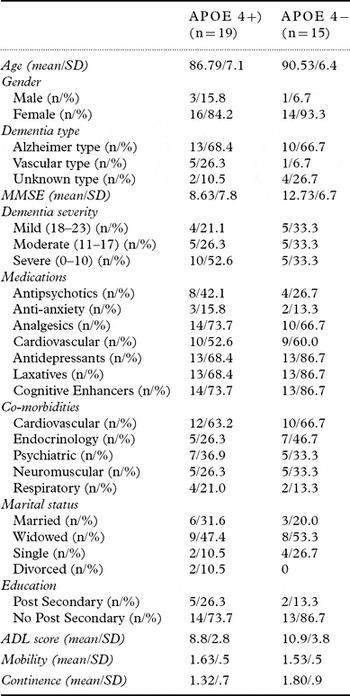
The sample analyzed consisted of 34 participants. Owing to deaths during the study we were unable to obtain buccal swabs for APOE genotyping from two of the residents and so 34 participants were included in the APOE analysis. Fifty-six percent of the residents had at least one ϵ4 allele present, while 44% did not. Residents were categorized into APOE 4+ (2/4, 3/4, 4/4), (N = 19) and 4- (2/3, 3/3) (N = 15). There were no significant differences in resident characteristics according to APOE status (4+/4-) (Table 1). Overall, the mean age of participants was 88.4 years (SD ± 6.9, range 71–102 years); 88% were female; all were Caucasian. Participants had an average MMSE score of 10.44 out of a total possible score of 30 (SD ± 7.5, range 0–21), indicating moderate to severe dementia, and a mean of 3.44 (SD ± 1.85, range 0–6) medical co-morbidities. Twenty-three residents (65%) showed cardiovascular problems such as hypertension (36%). Types of dementia included AD (69% of participants), vascular dementia (14%) and dementia unknown (17%). Seventy-one percent of residents were prescribed analgesics, 35% antipsychotics, 15% anxiolytics, and 77% antidepressants. The average length of stay at the facility was 3.2 years (SD ± 3.8, range 0.5–14.3 years).
Resident characteristics according to APOE ϵ4 allele status (APOE4+/APOE4−) Mean/SD (N = 34)

APOE and behavioral symptoms
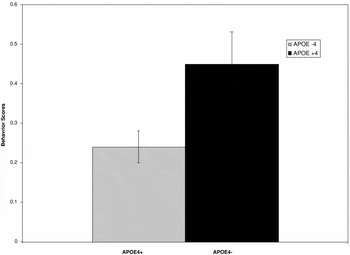
Mean and standard deviation for behavioral scores (frequency and intensity) were calculated for each resident for five days. The scores were grouped according to the presence or absence of APOE 4 (4+ = 0.45 ± 0.34), (4− = 0.24 ± 0.16) (Figure 1). One participant with a score greater than 2 standard deviations from the mean was removed from the analyses. Residents with an APOE ϵ4 allele present (3/4, 4/4) exhibited significantly more behavioral symptoms, mainly restlessness (53%) and vocalizations (26%), compared to those with no APOE ϵ4 allele (2/3, 3/3) (F 1,30 = 4.40, p = 0.04). In addition, restlessness, was significantly inversely correlated with MMSE score (r = −0.37, p = 0.03).
Observed behavior scores of residents with an APOE ϵ4 allele (APOE4+) compared to residents with no APOE ϵ4 allele (APOE4-).

Direct observation and informant rating
Once the analysis of the APOE status was completed, post hoc analysis was undertaken comparing the screened assessment of behavioral symptoms to the behavioral scores obtained from direct observation. At the beginning of the study participants were screened by nursing staff (Finkel et al., Reference Finkel, Lyons and Anderson1993) as either exhibiting behavioral symptoms (≥15) or not. After the five-day observation period, 21 participants were observed to have high BSD (total behavior five-day mean ≥0.27) while 15 residents exhibited low or no BSD. However, the behavior screened by the nursing staff indicated the opposite (15 BSD, 21 NBSD). Of those screened for BSD (15), four (24%) were observed to have no behavioral symptoms. Of those screened as having NBSD (21), 10 (49%) exhibited behavioral symptoms. Spearman's ρ of 0.257 (p = 0.13) indicated a non-significant relationship between the two methods of scoring behavior.
Discussion
The present study revealed that those with an APOE ϵ4 allele (4+) had a significant increase in their observed BSD, including restlessness and vocalizations, compared to those who did not have an APOE ϵ4 allele present (4−). Restlessness, highly prevalent in NH residents with AD, may be one manifestation of higher anxiety, which is related to the presence of the APOE ϵ4 allele (Raber, Reference Raber2007). Additionally, in rodents and humans, it was found that the presence of the APOE ϵ4 allele was related to amygdala atrophy and to increased anxiety (Robertson et al., Reference Robertson, Curley, Kaye, Quinn, Pfankuch and Raber2005), suggesting an association between genotype status and behavior in addition to specific negative effects on neurons.
While diagnosis of AD in a NH population is generally not exact, this study showed the presence of an APOE ϵ4 allele in 55% of the participants, somewhat higher than the risk documented for those with one APOE ϵ4 allele in the general population, suggesting a high probability of AD in this sample (Corder et al., Reference Corder1993).
There was no significant difference in the number of comorbidities between the two groups (APOE4+/APOE4−). While several studies (Eichner et al., Reference Eichner, Dunn, Perveen, Thompson, Stewart and Stroehla2002; Kolovou and Anagnostopoulou, Reference Kolovou and Anagnostopoulou2007) found that up to 69% of those with APOE4+ exhibit cardiovascular disease, this study did not find any significant differences in cardiovascular disease according to APOE status. One explanation for this lack of association in this study may be the small sample size (APOE 4+, N = 19 versus APOE 4−, N = 15), coupled with the manner in which the variable “cardiovascular disease” was categorized. The cardiovascular variable included several related variables such as aortic stenosis, coronary artery disease, congestive heart disease, paroxysmal atrial tachycardia, peripherial artery disease, atrial fibrillation and hypertension. A single resident could have one or more of these diagnoses, the accuracy of which was dependent on the NH resident charts.
Since mental status was inversely correlated with restlessness, it could be interpreted that those with less severe dementia (i.e. a higher MMSE score) have more restless episodes. The correlation between MMSE and restless behavior is interesting; however, given the small sample this must be interpreted with caution.
Recent studies (Craig et al., Reference Craig, Hart, McCool, McIlroy and Passmore2004; van der Flier et al., Reference van der Flier2007) found a significant association between APOE ϵ4 allele presence and BSD such as agitation and aggression, using the Neuropsychiatric Inventory Caregiver Distress Scale (NPI-D).The NPI-D relies on caregiver retrospective memory to report BSD over the previous two weeks, though this recollection may not always be accurate. Although the NPI-D scale is reliable, these studies are limited by the same issues as those found in similar studies using a proxy, e.g. limitations related to caregiver exaggeration/or denial of behavioral symptoms (Gabryelewicz et al., Reference Gabryelewicz2002; Scarmeas et al., Reference Scarmeas2002).
Studies completed by Gabryelewicz et al. (Reference Gabryelewicz2002) and Scarmeas et al. (Reference Scarmeas2002) found no relationship between APOE genotype and behavioral pathology. However, both used proxy reporting to determine BSD, which is susceptible to caregiver bias and/or inaccurate memory. Using direct observations (mABRS) the present study found a statistically significant relationship between APOE ϵ4 allele (4+) and BSD, a result that would not have been found using only the proxy reporting for behavioral categorization by the NH staff (BSD/NBSD).
Findings from the present study did not show any significant correlation between the instrument used for screening and direct observation. However, Cohen-Mansfield and Libin (Reference Cohen-Mansfield and Libin2004) reported a highly significant positive relationship between informant rating using the CMAI and direct observation using the Agitated Behaviors Mapping Instrument (ABMI). The high concurrence is likely explained by the fact that the ABMI is directly derived from the CMAI instrument and utilizes identical language. The items that showed high convergence were verbal agitation and physical agitation. The different results found in the Cohen-Mansfield and Libin study and the present study may be explained in part by the use of different language in the instruments used for direct observation (the ABMI compared to the mABRS).
While the mABRS is not the only instrument available for direct observation of behavior, it does have the advantage of assessing both the frequency (presence or absence), and intensity of BSD, thus providing more discrete information about a particular behavior. Most other instruments used in direct observation, such as the ABMI and the CMAI, assess only frequency. Hence the mABRS used for direct observation provides more reliable behavioral estimates than relying solely on proxy reporting, a critical component of behavioral research which can shed light on the nature and causes of these behaviors.
Using the noninvasive techniques, 34 buccal swabs for assessing APOE ϵ4 genotype status were obtained successfully. Thus buccal swab collection is feasible, providing samples appropriate for APOE genotyping in this NH population. Exploring noninvasive techniques, such as buccal swabs, to obtain physiological data from NH residents exhibiting BSD provides an opportunity to assess potential risk factors for the development of BSD without increasing the burden inherent in invasive techniques (Woods et al., Reference Woods, Kovach, Raff, Joosse, Basmadjian and Hegadoren2008).
Describing the relationship of risk factors such as APOE ϵ4 genotype status to behavioral symptoms in people with AD is critical to increasing our understanding of BSD. Identifying those at risk for BSD may lead to the development of individualized interventions for prevention or treatment. Since behavioral symptoms are a major cause of institutionalization and a concern for caregivers, describing risk factors such as APOE ϵ4 genotype is essential to elucidate possible mechanisms underlying BSD. Further research focused on these mechanisms will help to identify persons at risk for BSD and promote the development of appropriate individualized interventions, which may help to prevent or treat BSD. The results of the present study are a first step along this road.
Conflict of interest
None.
Description of authors' roles
Dr. Woods was the principal investigator on the original project, analyzed the data and wrote the original manuscript. Brittany Bushnell and Haesook Kim assisted in the data analysis and writing. Dr. Geschwind analyzed the DNA for apolipoprotein E genotype, and Dr. Cummings reviewed the paper prior to submission.
Acknowledgments
This study was supported by the University of California, Los Angeles, School of Nursing Intramural Grant.