Healthcare-associated infections (HAIs) continue to be a cause of concern within hospitals despite programs instituted to reduce the rate of HAI. In the United States, ∼90,000 people die every year due to HAIs, and another 2 million patients are diagnosed with an HAI during their hospital stay.Reference Stone1 Furthermore, HAIs are a financial burden on the healthcare system, costing ∼$28–$45 billion per year.Reference Stone1
Many HAIs are preventable through compliance to HH protocols, including the use of ABHR or soaps,Reference McCalla, Reilly, Thomas and McSpedon-Rai2 but HH compliance among providers is reportedly lowReference Pittet, Hugonnet and Harbarth3 and is challenging to measure accurately.Reference Pfoh and Dy4 Numerous initiatives to increase HH compliance have been created, including performance feedback (ie, coaching), education and training, visual or scent cues, managerial support, and reminders,Reference Gould, Moralejo, Drey, Chudleigh and Taljaard5 with varying levels of success.
To improve HH compliance, hospitals must be able to improve behavior and monitor compliance rates reliably and accurately. Although the World Health Organization supports observation as the highest standard for measurement for HH compliance,Reference Pittet, Allegranzi and Boyce6 personal observations can be unreliable.,Reference Chang, Reisinger and Jesson8 They may not accurately reflect what is taking place in a patient room when the observer is outside, and facilities are unable to maintain constant supervision.Reference Pittet, Allegranzi and Boyce6,Reference Chang, Reisinger and Jesson8,Reference Edmisten, Hall and Kernizan9 For this reason, some hospitals have begun investigating the feasibility of implementing an automated HH compliance system (AHHCS).Reference McCalla, Reilly, Thomas and McSpedon-Rai2,Reference Edmisten, Hall and Kernizan9
In our facility, monthly HH compliance rates in the year prior to the implementation of the automatic HH system ranged from 42% to 90%. Compliance rates were assessed based on observational reports made by infection control and frontline staff managers who used a handheld mobile software application (ie, an app) to make reports. Observers were trained to conduct observations and coach when staff members were not compliant. This coaching included carrying and offering alcohol-based hand rub (ABHR) sanitizer when appropriate. We sought to determine the impact of an AHHCS real-time audible alert reminder for healthcare worker (HCW) HH compliance compared to a period when the audible alert was turned off.
Materials and methods
Study design and setting
This single-site, retrospective before-and-after implementation cohort study was conducted in selected inpatient units at an academic medical center between December 2018 and January 2019. The study included 3 periods: baseline with the alarm on (baseline), test of change 1 with the alarm off (TOC 1), and test of change 2 with the alarm on (TOC 2). For the baseline and TOC 2, the periods with the alarm on, the system’s real-time audible alert and vibration was active. During TOC 1, the system’s real-time audible alert and vibration was turned off. The phases lasted 16, 17, and 18 days, respectively. The University of Louisville Institutional Review Board determined this study to be a quality improvement project and not human-subject research (IRB no. 20.0704 and reference no. 713066).
Participants
The AHHCS was implemented in 9 inpatient units: 3 adult medical-surgical step-down units and 6 adult intensive care units. These locations were nonrandomly selected to utilize the AHHCS as part of a facility-wide, phased implementation plan. These units were selected based upon similarity in illness acuity of patients. The AHHCS badges were assigned to selected patient care assistants, registered nurses, physical therapists, occupational therapists, speech therapists, and physicians who worked in these locations. Badges were stored on the unit at the nurses’ station when not in use. Badges charged at the nursing station overnight. Badge use was mandatory, but there were no consequences associated with not using the badge. Badges were assigned to each individual person and were not shared by those in the same assignment or role.
How the AHHCS works
Sensors were placed at the entrance of each patient’s room and at hand washing sinks in the units. Participating HCWs were issued wearable badges that detected entry into and exit from a patient room, that is, an HH opportunity. An HH event was registered after the staff performed HH with soap and water or ABHR. HH events were sensed by the HCW placing a clean hand in front of the wearable badge, thus allowing the sensor in the badge to detect soap or ABHR. In addition, the AHHCS registered an HH event if the user stood in front of a sink for at least 15 seconds. If a required HH event was not detected by the wearable badge within a specified time, the badge activated a real-time alert sequence consisting of an auditory beep and vibration. Additionally, the green light on the wearable badge changed to yellow and then to red, serving as a visual alert. The timing of both the initial and second alerts could be customized. During the study period, the initial alert occurred 20 seconds after entry or exit from the patient room if an HH event was not registered. The second alert occurred 34 seconds from the entry or exit into the patient room if a required HH event was not registered. An HH opportunity was recorded for each entry into a patient room lasting ≥60 seconds without exit and for each exit from a patient’s room without re-entry into the same room within 60 seconds. Additional configurations of the AAHCS are listed in the Supplementary Material (online).
All HCWs utilizing the AHHCS were provided in-person and/or video-based training, including instructions on the timing of alerts, expectations regarding compliance, when HH events were expected, and how they were registered. Use of the AAHCS was mandatory, and the badges were placed in a central and accessible location for staff. HCWs were reminded to grab a badge upon walking onto their respective units. Weekly reports provided daily compliance data for the user and department. This information was shared directly with the user and the department leader through e-mail; however, there were no recommendations for department leaders for coaching or individual feedback.
Data collection and measurement
We collected HH opportunities and events in accordance with the AHHCS software configurations (Supplementary Material online). HH opportunities included the time when HH should be performed, and an HH event was recorded for each hand washing lasting 15 seconds or longer, or when the user registered an ABHR event by waiving a sanitized hand near the wearable badge. Compliance was calculated as the number of times HH was completed divided by the number of HH events and then converted to a percentage. Compliance was automatically calculated using the AHHCS software based on workflow configurations and individual user compliance.
During the baseline and TOC 2, all 3 alert types were utilized: vibration, auditory, and visual. During TOC 1, vibration and auditory alerts were disabled. The visual reminder remained active.
The AHHCS recorded when HH was performed with the use of a chemical sensor located in the badge. After the staff member performed HH, they held a hand over the badge to allow the chemical sensor to detect clean hands.
Statistical analysis
Descriptive analysis and inferential statistics were used to examine the effect of the AHHCS reminder alerts for and between each period. Comparisons of HH compliance during the baseline, TOC 1, and TOC 2 were assessed using one-way analysis of variance (ANOVA). Appropriate post hoc tests were used to detect the difference between each pair of means. Analysis and data management were conducted using Minitab version 18 statistical software (Minitab, State College, PA).
Results
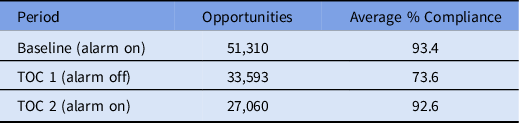
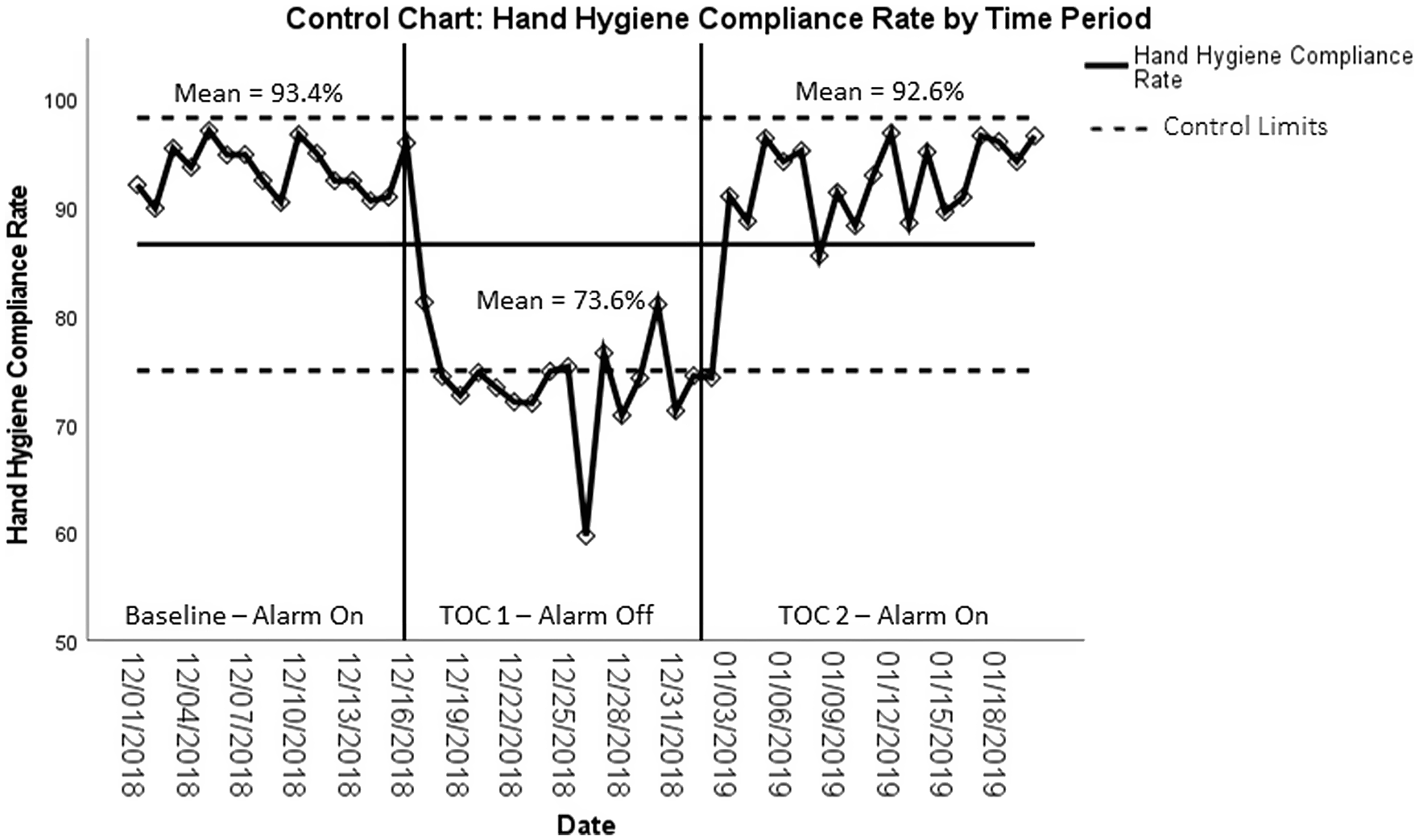
The AHHCS software recorded 111,963 HH opportunities. Table 1 presents the number of HH opportunities and compliance rate per period. The AHHCS software also recorded the daily HH compliance. HH compliance was calculated by dividing the number of events by the number of opportunities for HH. The baseline, TOC 1, and TOC 2 periods had average compliance rates of 93.4%, 73.6%, and 92.6%, respectively (Table 1). Daily total compliance rates were also compared (Fig. 1 and Table 1). Furthermore, the shift in means created a shift in the control limits during each period. Within TOC 1, any data point within the baseline period or TOC 2 would have been considered a special cause event because it was outside 3 SD of the mean per period.
Hand Hygiene Opportunities and Average Percentage Compliance for Baseline, TOC 1, and TOC 2

Note. TOC, test of change.
Daily total hand hygiene compliance during baseline, test of change 1 (TOC 1), and TOC 2.

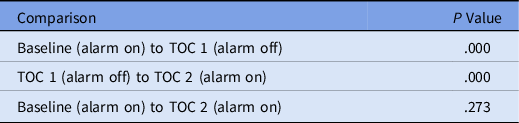
A one-way ANOVA demonstrated a significant difference between the periods (F(2, 48) = 160.42; P < .001). Post hoc comparisons using Tukey honestly significant difference (HSD) one-way t tests revealed that HH compliance was significantly different when comparing the baseline and TOC 1 and TOC 1 and TOC 2, but HH was not significantly different when comparing TOC 1 and TOC 2. A 2-sample t test demonstrated a significant difference between the baseline and TOC 1 and between TOC 1 and TOC 2. P values are presented in Table 2.
Comparison of Significance Between Periods With And Without Use of an Automated Hand Hygiene Compliance System (AHHCS)

Note. TOC, test of change.
Discussion
In this study, HH compliance was significantly higher during the periods when participants received auditory alerts and vibration from the AHHCS. When the alert and vibration were deactivated, an immediate decline in HH compliance occurred, which suggests that relying on the HCW’s memory to perform HH is insufficient to achieve compliance rates >90%. A significant difference in the present study was detected despite the light alarm remaining active on the wearable badge in TOC 1.
This study follows other literature supporting the conclusion that AHHCSs may increase HH complianceReference McCalla, Reilly, Thomas and McSpedon-Rai2 and that reminder alerts play a key role in producing this effect. The reduction in HH compliance during the baseline period demonstrates that an effective reminder is necessary to sustain HH behavior within the system. Additionally, the successful use of an audible alarm to remind providers to perform HH supports the hypothesis that to increase reliability, healthcare systems must implement strategies that decrease the cognitive effort needed to remember all actions needed to provide quality healthcare.Reference Larson and Mickelsen10
The use of the AAHCS with an audible alarm and vibration system to improve HH could potentially decrease the number of HAIs, thus improving patient outcomes. These results demonstrate that visual alerts (when encapsulated on the badge) are not as effective in alerting providers to the need to perform HH. Although this AAHCS only monitored provider entry and exit from the patient room, it potentially increased the compliance of providers regarding 3 of the Five Moments for Hand Hygiene:Reference Pittet, Allegranzi and Boyce6 performing HH before touching a patient, after touching a patient, and after touching a patient’s surroundings.
This study had several limitations. We measured HH compliance based on room entry and exit requirements. If a provider were to interact with an object in the room before touching the patient, this would not be captured by the AAHCS. Similarly, a provider could touch a patient and not wash their hands but remain in the room. The AAHCS would not be capable of signaling to perform HH until the provider walked through the patient room door. Furthermore, the AAHCS is not configured to capture data on HH compliance before performing a clean or aseptic procedure or after body fluid exposure. Other limitations of this study include its retrospective design and the duration of the intervention periods. Over time, the apparent effect of the auditory and vibratory reminders may have diminished. All HCWs were encouraged to utilize the AHHCS system but were not required to do so; thus, the healthcare team was not fully represented in these data. Outcomes may have varied based on job roles or specific demographics, which were not analyzed in this study. Last, a major limitation of this study was that the test of change could not be compared to a control group. Because HH observations are unreliable as a metric for HH compliance, the comparison between observations and the AHHCH would be imperfect at best.
Further studies could expand upon the use of alerts for HH compliance, what types of alerts are most impactful, and where those alerts should be located. Although the badges in this AHHCHS made use of lights and vibrations, the audible alert was correlated with HH compliance. Further investigation should be conducted to address the underlying reasons for behavior change and learning,Reference Michael, Einloth, Fatica, Janszen and Fraser11 for example, to determine whether the audible alert creates a social obligation with expectation to perform HH. Another study might investigate whether HH compliance would potentially remain >90% if the lights were in a more visible location, even when the audible alert and vibration were turned off. Studies are needed to confirm the relationship between the utilization of AHHCS and HAI reduction and the quality and thoroughness of HH. In addition, the tone and type of alarm should be studied to ensure that this alarm does not add to alert or alarm fatigue. In summary, future studies should continue to investigate the benefits and costs of automated HH monitoring systems, their implementation strategies, and ways to reduce the cognitive burden of alarms on staff while increasing HH compliance.Reference Edmisten, Hall and Kernizan9
In conclusion, the use of an AHHCS with audible alert reminders improved HH compliance upon entry and exit of a patient room, and it may be an effective method for increasing HCW HH compliance to >90%. HH system manufacturers and medical facilities should consider including and utilizing real-time reminders to improve compliance.
Acknowledgments
Financial support
No financial support was provided relevant to this article.
Conflicts of interest
C.H. has received support for the APIC Annual Conference, is the Chair of the Annual Conference Committee for APIC, the Vice Chair for the APIC Annual Conference Committee, the Abstract Co-chair for the APIC Annual Conference Committee, and is a member of the Editorial Board for the American Journal of Infection Control. K.W. has received honorarium from Indiana Society for Healthcare Risk Management. All other authors report no conflicts of interest relevant to this article.