INTRODUCTION
In the last decades, the introduction of alien marine invertebrates has increased in the Atlantic European waters and Mediterranean. A growing literature about this subject has been published lately (Zenetos et al., Reference Zenetos, Inar, Pancucci-Papadopoulou, Harmelin, Furnari, Andaloro, Bellou, Streftaris and Zibrowius2005, Reference Zenetos, Meric, Verlaque, Galli, Boudouresque, Giangrande, Inar and Bilecenoglu2008, Reference Zenetos, Gofas, Verlaque, Cinar, García-Raso, Bianchi, Azzurro, Bilecenoglu, Froglia, Siokou, Violanti, Sfriso, San Martín, Giangrande, Katagan, Ballesteros, Ramos-Espla, Mastrototaro, Ocana, Zingone, Gambi and Streftaris2010, Reference Zenetos, Gofas, Morri, Rosso, Violanti, García Raso, Çinar, Almogi-Labin, Ates, Azzurro, Ballesteros, Bianch, Bilecenoglu, Gambi, Giangrande, Gravili, Hyams-Kaphzan, Karachle, Katsanevakis, Lipej, Mastrototaro, Mineur, Pancucci-Papadopoulou, Ramos Esplá, Salas, San Martín, Sfriso, Streftaris and Verlaque2012; Galil et al., Reference Galil, Gollasch, Minchin, Olenin and Nentwig2009). Zenetos et al. (Reference Zenetos, Gofas, Morri, Rosso, Violanti, García Raso, Çinar, Almogi-Labin, Ates, Azzurro, Ballesteros, Bianch, Bilecenoglu, Gambi, Giangrande, Gravili, Hyams-Kaphzan, Karachle, Katsanevakis, Lipej, Mastrototaro, Mineur, Pancucci-Papadopoulou, Ramos Esplá, Salas, San Martín, Sfriso, Streftaris and Verlaque2012) found 296 alien Mollusca from the Mediterranean, of which 38 belong to the heterobranch gastropods traditionally known as ‘Opisthobranchia’ (Zenetos et al., 2010, 2012). The traditional name ‘opisthobranchs’ is used here but as an informal group, since the rejection of the monophyly of the Opisthobranchia has been confirmed by recent studies (e.g. Klussmann-Kolb et al., Reference Klussmann-Kolb, Dinapoli, Kuhn, Streit and Albrecht2008; Jörger et al., Reference Jörger, Stöger, Kano, Fukuda, Knebelsberger and Schrödl2010; Schrödl et al., Reference Schrödl, Jörger, Klussmann-Kolb and Wilson2011; Kocot et al., Reference Kocot, Halanych and Krug2013; Wägele et al., Reference Wägele, Klussmann-Kolb, Verbeek and Schrödl2013). Some examples of alien ‘opisthrobranchs’ in the Mediterranean are the cephalaspidean Haminoea japonica (=cadillegenita) Pilsbry, 1895 and Chelidonura fulvipunctata Baba, 1938; and the nudibranchs Polycera hedgpethi Er. Marcus, 1964; Caloria indica (Bergh, 1896); Godiva quadricolor (Barnard, 1927) and Cuthona perca (Er. Marcus, 1958).
On the other hand, the knowledge about the Moroccan fauna still remains considerably poor because of the lack of comprehensive studies. Only Risbec (Reference Risbec1931), Pruvot-Fol (Reference Pruvot-Fol1927, Reference Pruvot-Fol1953) or Gantès (Reference Gantès1956a, Reference Gantèsb, Reference Gantès1962) provided information of ‘opisthobranchs’ species of this region. Recently, Cervera et al. (Reference Cervera, Tamsouri, Moukrim and Villani2010) reported two new records for Morocco, Polycera hedgpethi and Godiva quadricolor that resulted to be also the first two alien species for this country. The authors suggested the shipping activities as the main way of introduction. In this paper, we present new records of another two nudibranchs, Polycerella emertoni Verril, 1880 and Favorinus ghanensis Edmunds, Reference Edmunds1968, from the Atlantic coast of Morocco. Additionally, the shipping activities conducted in the areas where the specimens were found may suggest that P. emertoni and F. ghanensis are also alien species.
RESULTS
SYSTEMATICS
HETEROBRANCHIA Haszprunar, 1985
NUDIBRANCHIA Blainville, 1814
Family POLYCERIDAE Alder & Hancock, 1845
Genus Polycerella Verrill, Reference Verrill1880
Polycerella emertoni Verrill, Reference Verrill1880
(Figures 1 & 2)
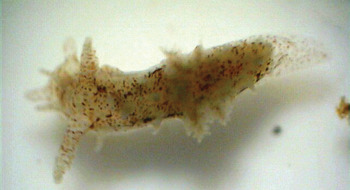
Polycerella emertoni, specimen of 4 mm from marina, Agadir (Morocco, Atlantic).

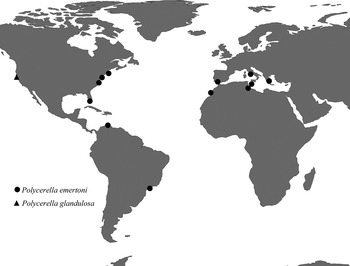
Map of the range of the two species of Polycerella, based on Edmunds (Reference Edmunds1977), Behrens & Gosliner (1988), Valdés et al. (Reference Valdés, Hamann, Behrens and Dupont2006), Cervera et al. (Reference Cervera, García-Gómez, Sánchez-Tocino, Gofas, Moreno and Salas2011) and Zenetos et al. (Reference Zenetos, Inar, Pancucci-Papadopoulou, Harmelin, Furnari, Andaloro, Bellou, Streftaris and Zibrowius2005) among others.

Polycerella davenportis Balch, Reference Balch1899: 150–151, figures 2–7.
Polycerella conyna Er. Marcus, Reference Marcus1957: 429–432, figures 104–110.
Polycerella recondita Schmekel, Reference Schmekel1965: 226–234, figures 1–8
MATERIAL EXAMINED
Marina of Agadir, Morocco (Atlantic): 15 March 2011, 9 specimens from 4 to 5 mm in length collected by N. Tamsouri at 0.3 m depth on colonies of the bryozoan Zoobotryon verticillatum; 15 April 2011, 15 specimens from 4 to 7 mm in length collected by N. Tamsouri at 0.3 m depth on colonies of the bryozoan Zoobotryon verticillatum.
DESCRIPTION
The external morphology and colour pattern of our material (Figure 1) match with those described by Schmekel & Portmann (Reference Schmekel and Portmann1982), García & Bobo (Reference García and Bobo1986) and Cervera et al. (Reference Cervera, García-Gómez, Sánchez-Tocino, Gofas, Moreno and Salas2011).
REMARKS
Polycerella Verril, 1880 is a small genus with only two valid species (Bouchet & Gofas, Reference Bouchet and Gofas2013): P. emertoni Verril, 1880 and P. glandulosa Behrens & Gosliner, 1988. Verrill (Reference Verrill1880) originally described the former from Connecticut, being a common species from Massachusetts to Brazil (Valdés et al., 2006) (Figure 2). This species has also been reported from the eastern Atlantic and Mediterranean. Edmunds (Reference Edmunds1977) collected specimens of Polycerella at Tema Harbour (Ghana) although the author doubted about the identity of his specimens. Additionally, this species has been recorded on the Atlantic coast of the Iberian Peninsula (García & Bobo, Reference García and Bobo1986; Cervera et al., Reference Cervera, García-Gómez, Toscano and García1988; García-Gómez et al., Reference García-Gómez, Cervera, García, Ortea, Garcia-Martin, Medina and Burnay1991; Megina & Cervera, Reference Megina and Cervera2003; Cervera et al., Reference Cervera, García-Gómez, Sánchez-Tocino, Gofas, Moreno and Salas2011). In the Mediterranean, Schmekel (Reference Schmekel1965) published the first Mediterranean record of Polycerella emertoni from Lago Fusaro (Italy). Later on, this species has been found on the Tuscany coasts (Cattaneo-Vietti et al., Reference Cattaneo-Vietti, Chemello and Giannuzzi-Savelli1990), Malta (Sammut & Perrone, Reference Sammut and Perrone1998; Sciberras & Schembri, Reference Sciberras and Schembri2007), Greece (Koutsoubas et al., Reference Koutsoubas, Arvanitidis, Dounas and Drummond2000), Greek Sea (Zenetos et al., Reference Zenetos, Inar, Pancucci-Papadopoulou, Harmelin, Furnari, Andaloro, Bellou, Streftaris and Zibrowius2005) and Tunisia (Antit et al., Reference Antit, Gofas, Salas and Azzouna2011). On the other hand, Polycerella emertoni feeds on the bryozoans Zoobotryon verticillatum in the eastern Atlantic and Mediterranean (Schmekel & Portmann, Reference Schmekel and Portmann1982; García & Bobo, Reference García and Bobo1986; Cervera et al., 2011; present study) while in the western Atlantic it has been recorded feeding on the bryozoans Bowerbankia gracilis, Zoobotryon sp., Amanthia distans and Bugula neritina (Clark, Reference Clark1975; Valdés et al., Reference Valdés, Hamann, Behrens and Dupont2006). Zoobotryon verticillatum grows on submerged elements linked with shipping or port activities and is very abundant in highly eutrophized environments and calm waters. Actually, Z. verticillatum is recognized worldwide as an invasive species in the fouling community (Amat & Tempera, Reference Amat and Tempera2009). Therefore, it is not surprising that the occurrence of Polycerella emertoni usually is linked to harbours (e.g. García & Bobo, Reference García and Bobo1986; Cervera et al., Reference Cervera, García-Gómez, Toscano and García1988, Reference Cervera, García-Gómez, Sánchez-Tocino, Gofas, Moreno and Salas2011; Antit et al., Reference Antit, Gofas, Salas and Azzouna2011).
Since P. emertoni is an inconspicuous species, it may have been overlooked in the past. Nevertheless, the researches conducted by Zenetos et al. (Reference Zenetos, Inar, Pancucci-Papadopoulou, Harmelin, Furnari, Andaloro, Bellou, Streftaris and Zibrowius2005, Reference Zenetos, Gofas, Verlaque, Cinar, García-Raso, Bianchi, Azzurro, Bilecenoglu, Froglia, Siokou, Violanti, Sfriso, San Martín, Giangrande, Katagan, Ballesteros, Ramos-Espla, Mastrototaro, Ocana, Zingone, Gambi and Streftaris2010) indicate that this species is currently considered as an alien species with established populations in the western and central Mediterranean. Although further studies are needed to confirm the amphiatlantic status of P. emertoni, the amphiatlantism is regarded as moderately common in ‘opisthobranchs’. Lately, the amphiatlantic status of some species such as Limenandra nodosa Haefelfinger & Stamm, 1958 (Carmona et al., Reference Carmona, Pola, Gosliner and Cervera2013b), Aeolidia papillosa (Linnaeus, 1761) (Carmona et al., Reference Carmona, Pola, Gosliner and Cervera2013a), Elysia timida (Risso, 1818) (Carmona et al., Reference Carmona, Malaquias, Gosliner, Pola and Cervera2011b) and Babakina anadoni (Ortea, 1979) (Carmona et al., Reference Carmona, Gosliner, Pola and Cervera2011a) was confirmed from a molecular approach. Therefore, although we do not have molecular evidence, we regard it as probable that both populations of P. emertoni (the eastern and western Atlantic) may belong to the same species.
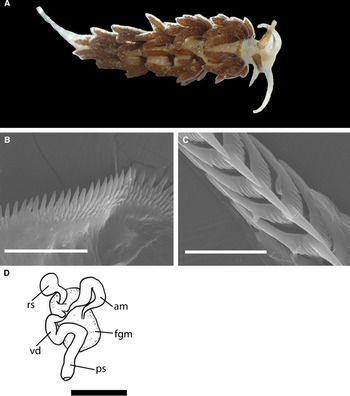
Favorinus ghanensis: (A) specimen of 8 mm from marina, Agadir (Morocco, Atlantic); (B) detailed view of the jaw, scale bar = 50 µm; (C) radular teeth, scale bar = 50 µm; (D) reproductive system, scale bar = 1 mm. am, ampulla; fgm, female gland mass; ps, penial sac; rs, receptaculum seminalis; v, vagina; vd, vas deferens.

Family FACELINIDAE Bergh, 1889
Genus Favorinus Gray, 1850
Favorinus ghanensis Edmunds, Reference Edmunds1968
(Figure 3A–D)
MATERIAL EXAMINED
Marina of Agadir, Morocco (Atlantic): 4 July 2012, 3 specimens from 4 to 5 mm in length collected by N. Tamsouri at 0.3 m depth on colonies of the bryozoan Zoobotryon verticillatum; 29 August 2012, 8 specimens from 5 to 8 mm in length collected by N. Tamsouri at 0.3 m depth on colonies of the bryozoan Zoobotryon verticillatum.
EXTERNAL MORPHOLOGY
The body is elongate tapering gradually to the tail. The anterior foot corners extend into tentaculiform processes. The body colour is translucent (Figure 3A) with iridescent white spots all over the dorsum, head, oral tentacles and tail. Depending on the specimen, these white spots can be more or less conspicuous.
The oral tentacles and the foot corners have the same colour of the background of the animal. The purple-brown or maroon rhinophores are white-tipped. They have three small swellings on them.
The cerata are long with uniform diameter throughout most of their length. The cerata extend from behind the rhinophores to the posterior end of the body and are arranged in arches. Each arch contains 3–10 cerata, decreasing in size towards the foot. The cerata are translucent, so the brownish ramifications of the digestive gland are visible throughout the ceratal wall. The apices of the cerata are translucent white. Some cerata have a few iridescent white dots on the surface. The anus is cleioproctic located within the second right ceratal arch. The genital opening is located among the cerata of the anteriormost group on the right.
ANATOMY
The masticatory border of the jaws has several rows of pointed teeth (Figure 3B). The radular formulae are 14 × 0.1.0 (5 mm) and 9 × 0.1.0 (4 mm). The radular teeth are biarched with 5–7 elongate and acutely pointed denticles on either side of the prominent central cusp (Figure 3C).
Regarding the reproductive system (Figure 3D), the preampullary duct widens into the elongate ampulla. The latter narrows again before dividing into the vas deferens. The elongate vas deferens enters the wider proximal portion of the penial sac. The receptaculum seminis is rounded and enters the female gland.
REMARKS
The external morphology and colour pattern of our material (Figure 3A) match with those described by Edmunds (Reference Edmunds1968) based on 13 specimens collected from Tema Harbour, Ghana (Edmunds, Reference Edmunds1968). Subsequently, Ben Souissi et al. (Reference Ben Soussi, Zaouali, Rezig, Bradai, Quignard and Rudman2004) reported a high number of specimens of Favorinus ghanensis in Radès Harbour (Tunisia). Our 11 specimens were also found close to harbours, suggesting that this weird species is very common on elements linked with shipping or port activities.
Our specimens were collected on Zoobotryon verticillatum. Unlike the remaining species of this genus these feed on egg masses of other ‘opisthobranchs’; Edmunds (Reference Edmunds1975) indicated that F. ghanensis feeds on the polyps of Zoobotryon. Nevertheless, Edmunds (personal communication) considers as possible the hypothesis that F. ghanensis could feed on egg masses of P. emertoni laid on colonies of Zoobotryon verticillatum, which is the prey of P. emertoni in the eastern Atlantic and Mediterranean. Additionally, Z. verticillatum is the known substrate where F. ghanensis has been found very frequently.
As commented for Polycerella emertoni, the small size of Favorinus ghanensis may bias the records of this species. However, this species has been only reported in harbour areas on colonies of the bryozoan Zoobotryon verticillatum, which is recognized worldwide as an invasive species in the fouling community (Amat & Tempera, Reference Amat and Tempera2009). All these features seem to suggest that a possible settlement of a population of F. ghanensis could be expected in the near future, although further molecular studies are needed to confirm this hypothesis.
ACKNOWLEDGEMENTS
Thanks to Badiâa Iazza from the University of Seville and Jaouad Abou Oualid from the University of Ibn Zohr, who helped with our sampling and taking photographs of the living animals. We are deeply grateful to Malcolm Edmunds for his invaluable assistance about the feeding habits of F. ghanensis. This work has benefited from the following research grants: AECID-PCI A/8688/07, Spanish Agency of International Cooperation and Development; and CGL2010-17187, Spanish Ministry of Economy and Competitiveness, which includes the former Ministry of Sciences and Innovation. This is CEI·MAR journal publication 40.