Introduction
Physical restraints are still frequently used in the care of old people in many countries, despite associations with several adverse physical, psychological, and social effects among residents, such as impaired mobility, cognition and social function, and behavioral symptoms such as aggressiveness (Evans et al., Reference Evans, Wood and Lambert2003; Hamers and Huizing, Reference Hamers and Huizing2005). Studies in geriatric care settings have reported prevalence rates of between 4% (Ljunggren et al., Reference Ljunggren, Phillips and Sgadari1997) and 66% (Tinetti et al., Reference Tinetti, Liu, Marottoli and Ginter1991), while more recent studies have reported prevalences of 14% in Norwegian homes for the elderly (Kirkevold et al., Reference Kirkevold, Laake and Engedal2003), 56% in psychogeriatric units in the Netherlands (Huizing et al., Reference Huizing, Hamers, Gulpers and Berger2007), 6.1% in Swiss nursing homes, and 26.2% in German nursing homes (Feng et al., Reference Feng2009; Meyer et al., Reference Meyer, Kopke, Haastert and Muhlhauser2009b).
The large discrepancy between studies in the prevalence of physical restraint use can partly be explained by differing definitions of physical restraints. Use of a broader definition, for example including bedrails as physical restraints, contributes to a higher prevalence in some studies (Kirkevold et al., Reference Kirkevold, Laake and Engedal2003; Meyer et al., Reference Meyer, Kopke, Haastert and Muhlhauser2009b). Differences in the type of settings included (Kirkevold et al., Reference Kirkevold, Laake and Engedal2003; Huizing et al., Reference Huizing, Hamers, Gulpers and Berger2007) and between the countries where the studies were performed (Ljunggren et al., Reference Ljunggren, Phillips and Sgadari1997; Feng et al., Reference Feng2009) might also have contributed.
The use of physical restraints has also been found to vary markedly between institutions (Karlsson et al., Reference Karlsson, Nyberg and Sandman2001; Feng et al., Reference Feng2009; Meyer et al., Reference Meyer, Kopke, Haastert and Muhlhauser2009b) and studies have found that this difference is not solely dependent on differences in residents’ characteristics (Karlsson et al., Reference Karlsson, Nyberg and Sandman2001; Feng et al., Reference Feng2009).
It is mainly the cognitively impaired old who are physically restrained and those with impaired function in activities of daily living (ADL) and in mobility (Tinetti et al., Reference Tinetti, Liu, Marottoli and Ginter1991; Karlsson et al., Reference Karlsson, Nyberg and Sandman2001; Hamers and Huizing, Reference Hamers and Huizing2005). The clinical experience, knowledge of and attitudes of staff toward the use of physical restraint have also been found to be associated with its use (Karlsson et al., Reference Karlsson, Nyberg and Sandman2001; Weiner et al., Reference Weiner, Tabak and Bergman2003; Suen et al., Reference Suen2006).
The most common reason for using physical restraints is to prevent falls and injuries (Evans and FitzGerald, Reference Evans and FitzGerald2002; Hamers and Huizing, Reference Hamers and Huizing2005); however, the preventive effect has not been proven and the use might even increase the risk of falls and injuries (Tinetti et al., Reference Tinetti, Liu and Ginter1992; Evans et al., Reference Evans, Wood and Lambert2003; Hamers and Huizing, Reference Hamers and Huizing2005). On the other hand, studies have also found that the incidence of non-serious falls increased following a restraint reduction program (Ejaz et al., Reference Ejaz, Jones and Rose1994) and that the use of restraints was associated with a slightly reduced risk of falls (Lee et al., Reference Lee, Hui, Chan, Chi and Woo2008). Other reported reasons for restraint use are to prevent interference with treatment, to control behaviors such as aggression and wandering, and to compensate for a shortage of nursing staff (Evans and FitzGerald, Reference Evans and FitzGerald2002).
Apart from affecting the restrained person, physical restraint use has been found to evoke negative feelings among the staff, such as guilt and sadness. Staff may also perceive a struggle between their sense of responsibility to protect the patient and the respect for the patient's autonomy (Chuang and Huang, Reference Chuang and Huang2007). Higher prevalence of physical restraint use has also been found to be associated with a worse work environment for the staff (Karlsson et al., Reference Karlsson, Nyberg and Sandman2001; Pekkarinen et al., Reference Pekkarinen, Elovainio, Sinervo, Finne-Soveri and Noro2006).
Institutional geriatric care in Sweden is financed by taxes and is means-tested. The municipalities are responsible for geriatric care, but private as well as municipal caregivers can provide the care. The quality of care is comparable to other Western countries. Due mostly to economic reasons, institutional geriatric care has been gradually downsized while home-based care has expanded over the last twenty years (National Board of Health and Welfare, 2008). This decrease in the number of beds in institutional geriatric care has resulted in an increase in the proportion of people having dementia or cognitive impairment, an increase in mean age, and decrease in mean level of independence in activities of daily living (Lövheim et al., Reference Lövheim, Sandman, Kallin, Karlsson and Gustafson2008). The rationale for undertaking the present analysis was that information about current physical restraint use in institutional geriatric care in Sweden was lacking, while there have been several changes to institutional geriatric care in recent years that could possibly have affected the prevalence of physical restraint use. Thus, the aim of this study was to investigate the use of physical restraints in institutional geriatric care in the county of Västerbotten, Sweden, in 2000 and 2007.
Methods
Subjects
The present study uses data from two comparable cross-sectional census surveys performed in 2000 and 2007 in the county of Västerbotten in northern Sweden. Both surveys included all types of geriatric care units including residential care facilities, nursing homes, group dwelling units for people with dementia, rehabilitation units, and geriatric and psychogeriatric clinics. In 2007, many forms of care units were simply labeled care units for old people, which made it difficult to differentiate the units.
In 2000, the total study population comprised 4,214 residents (in 120 centers that usually included several units and types of units), while in 2007 the number was 3,532 (in 101 centers). Questionnaires were completed and returned for 3,804 residents (in 117 centers) in 2000 and for 2,970 (in 98 centers) in 2007, corresponding to a response rate of 90.3% in 2000 and of 84.1% in the 2007 survey. Selecting only the residents aged 65 years or older gave the final samples of 3,669 and 2,914 residents, respectively.
The study was approved by the Regional Ethical Review Board in Umeå, (registration number 00–170 and registration number 07–028M).
Procedure
Each municipality in the county was contacted for information about eligible units and the persons in charge. Information about the number of residents and type of unit (when possible) was then supplied by the head of the units. The questionnaires were also sent to this person for distribution to the nursing staff at the units. The heads of the units received one telephone reminder.
The same questionnaire was used in both surveys and included information about how to complete the assessments, whom to contact if they had questions or wanted additional guidance, and a request for the assessments to be completed within one week. The member of staff who knew each resident best and was most involved in the resident's care was asked to carry out the assessment, based on observations made over the preceding seven days.
Assessments
In both surveys, the residents were assessed using the Multi-Dimensional Dementia Assessment Scale (MDDAS) (Sandman et al., Reference Sandman, Adolfsson, Norberg, Nyström and Winblad1988), which includes questions about prescribed drugs, mobility, ADL functions (activities of daily living), behavioral and psychiatric symptoms, cognition, falls, physical restraint use, and work load. The MDDAS has been shown to have good inter- and intra-rater reliability (Sandman et al., Reference Sandman, Adolfsson, Norberg, Nyström and Winblad1988). Questions about physical restraint use, falls, and fall risk were included in the MDDAS at a later stage and have thus not been tested for reliability.
Questions concerning physical restraint use during the preceding week included type of physical restraint, reason for use, and duration of use. Types of restraints included being restrained with a belt or by a similar measure in a chair/bed, with a tray table or similar means in a chair/wheelchair, and being locked in one's room. Bedrails were not included in this study. The rationale for using physical restraints was elicited through predefined suggestions including preventing the resident from falling, wandering, sliding out of their chair, controlling aggressiveness, unknown reason, and also one open ended response alternative. The staff assessed the period of time during which the residents had been restrained: one week, one month, during the last six months or longer than six months. A resident was coded as restrained if he/she had been restrained with a belt or something similar in a chair or been restrained in a chair or wheelchair with a tray table. Being locked in their room and strapped to the bed with a belt or by a similar measure were analyzed separately. The staff rated the residents’ risk of sustaining a fall on a single 100 mm visual analogue scale ranging from low risk (0) to high risk (100). Staff assessments of residents’ fall risks have been found to be fairly good and maybe equally reliable as objective measures (Lundin-Olsson et al., Reference Lundin-Olsson, Jensen, Nyberg and Gustafson2003; Meyer et al., Reference Meyer, Kopke, Haastert and Muhlhauser2009a). The staff also stated whether the resident had fallen during the preceding week (defined as unintentionally coming to rest on the floor/ground) and whether the fall had resulted in a minor (bruises, pain or wound not requiring sutures) or major injury (wound requiring sutures, fractures, head injuries or injury to internal organs). The staff also noted whether the residents had fallen previously during their stay.
An ADL score (a subscale of the MDDAS) ranging from 4 to 24 was calculated based on the resident's ability to cope with hygiene, dressing, eating, and bladder and bowel control. A higher ADL score indicates that the resident is more ADL independent. The behavioral symptoms score and psychiatric symptoms score (subscales of the MDDAS) are based on 25 items and 14 items, respectively, that are rated on a three-point scale (3 = daily, 1 = some time per week, and 0 = never). The indexes (sum of all items) range from 0 to 75 and from 0 to 42, respectively, with higher scores indicating more symptoms. Residents’ cognitive levels were measured using a subscale of the MDDAS developed by Gottfries and Gottfries (Adolfsson et al., Reference Adolfsson, Gottfries, Nyström and Winblad1981). This scale comprises 27 items relating to the person's cognitive function with a score ranging from 0 to 27, where a higher score indicates a higher cognitive level. A cut-off (24/27) on the Gottfries’ cognitive scale has been validated against the cut-off point of 24/30 traditionally used in the Mini-Mental State Examination (MMSE) with a sensitivity of 90% and a specificity of 91% (Adolfsson et al., Reference Adolfsson, Gottfries, Nyström and Winblad1981).
Physical and mental workload (items of the MDDAS) were rated separately for all residents by the staff on a five-point scale, ranging from minimal (1) to maximal (5).
Data concerning prescribed drugs included all ongoing and on demand drug treatments, as well as related doses. A member of the research team coded the medication into groups according to the ATC (Anatomic Therapeutic Chemical) classification index. Only ongoing use of anxiolytics, hypnotics and sedatives, antipsychotics, antidepressants, and antidementia drugs were included in this study and were dichotomized into having one or more and no ongoing treatment.
Statistics
Differences in residents’ characteristics between the two surveys and between restrained and unrestrained residents were analyzed using the Pearson's χ2 test and Student's t‑test, as appropriate. To investigate whether the prevalence of physical restraints use was influenced by the survey year factors associated with physical restraint use (p < 0.100) were entered into a multiple logistic regression analysis together with a dichotomous variable representing the survey year. The independent factors were checked for multicollinearity and if a factor was strongly correlated (r > 0.5) to another, the factor with the largest explanatory value for restraint use (as measured with the r 2 value of univariate logistic regressions with restraint use as dependent variable) was included. Odds ratios, 95% confidence intervals for odds ratios and p-values are reported for the multiple logistic regression analysis. All tests were 2‑tailed, and p‑values < 0.05 were considered to indicate statistical significance. All calculations were made using the SPSS software, version 16.0 for Mac.
Results
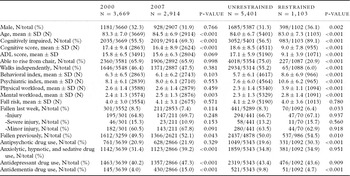
In the 2007 survey, the residents were older, more cognitively impaired, and a higher proportion were prescribed psychotropic drugs compared to the residents in the 2000 survey. The mental workload estimated by the staff had increased, and the proportion of residents who had sustained a fall prior during their stay was higher (Table 1).
Characteristics of residents in the 2000 and the 2007 survey and of unrestrained and restrained residents

N = number of residents; SD = standard deviation; ADL score = activities of daily living (lower score indicate more dependence); Restrained = restrained with a belt or similar measure in a chair or with a table in a chair or wheelchair during preceding week; Fallen last week = sustained a fall (unintentionally coming to rest on the floor/ground) during preceding week; Fallen previously = sustained a fall (unintentionally coming to rest on the floor/ground) sometime during the stay at the unit.
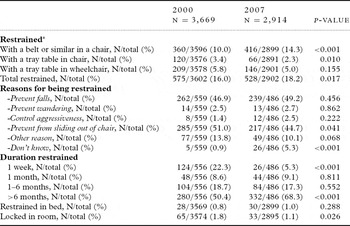
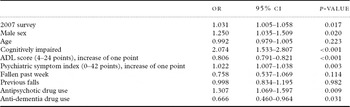
The use of physical restraints had increased significantly from 16.0% (95% confidence interval (CI) 14.8%–17.2%) in 2000 to 18.2% in 2007 (95% CI 16.8%–19.6%, p = 0.017) (Table 2). Adjusting for residents’ characteristics (Table 1) showed that the residents in 2007 were more likely to be physically restrained relative to the residents in 2000 (Odds ratio 1.031, 95% CI 1.005–1.058, p = 0.025) (Table 3). The adjusted analysis also showed that residents with impaired ADL functions, those with psychiatric symptoms, males, people with cognitive impairment, and those using antipsychotic drugs had an increased risk of being subjected to physical restraints, while being prescribed antidementia drugs was associated with a lower risk. There were no significant associations between falls in the past week or previous falls and physical restraint use.
Physical restraint use in 2000 and 2007

N = Number of residents.
*Restrained with a belt or similar measure in a chair or with a table in a chair or wheelchair during the preceding week. Some residents were restrained with more than one type of restraint, and thus the number total of restrained residents is lower than the sum of each type of restraint.
Multiple logistic regression analysis of factors associated with physical restraint use

OR = odds ratio; CI = confidence interval; ADL score = activities of daily living; lower score indicate more dependence.
Model Cox & Snell R2 = 0.220, Nagelkerke R2 = 0.365, concordant = 83.4%, (No. = 4746).
Due to high (>±0.5) correlation with other variables, the following variables were excluded from the regression analysis: “able to rise from chair,” “physical workload,” “walks independently,” and “cognitive score” due to high correlation with “ADL score,” and “mental workload” and “behavioral index” due to high correlation with “psychiatric index.” Please see Statistics section for further details.
Considering different types of restraints, it was found that the number of residents restrained with a belt or by a similar measure had increased while the proportion of residents restrained with a tray table in a chair had decreased between 2000 and 2007. The proportion of residents restrained with a belt in bed remained similar between the surveys, while the proportion of residents locked in their rooms had decreased between the two surveys (Table 2).
In both surveys, the most common reasons for the residents being restrained was to prevent falls and to prevent them from sliding out of a chair. The use of physical restraints to prevent a resident from sliding out of a chair decreased significantly from 2000 to 2007, the use of restraint to prevent falls, prevent wandering, and to handle aggressiveness was as common in 2000 as in 2007, while its use for an unknown reason had increased fivefold. The data concerning the length of time that the residents had been subjected to physical restraints showed that the proportion of residents restrained during a period of more than six months had increased, while the proportion of residents who had been restrained only during the previous week had decreased from 2000 to 2007 (Table 2).
Discussion
The use of physical restraints in Swedish geriatric care seems to have become a little more common between 2000 and 2007, adjusted for changes in residents’ characteristics (OR 1.031). Our figures of 16.0% in 2000 and 18.2% in 2007 are somewhat lower compared to the 21% to 24% reported in previous studies conducted during the 1990s among a similar sample and using the same data gathering method (Karlsson et al., Reference Karlsson, Bucht, Eriksson and Sandman1997; 2001). The length of time the residents had been subjected to restraints also increased between 2000 and 2007. The proportion of residents who had been subjected to physical restraints for more than six months was larger in 2007 than in 2000, while the proportion of residents subjected to restraints only during the previous week was lower in 2007. Residents were restrained for similar reasons, apart from the proportion of residents restrained for an unknown reason, which was considerably higher in 2007 than in 2000. One possible explanation for this might be that more residents had been restrained for a long time in 2007, which could have affected the staff's memory of the reason.
Since the use seems to have increased independently of changes in residents’ characteristics, it is possible that the change might be an effect of changes in staff knowledge and attitudes or to a changed work environment and increased workload, since all these factors have been found to be associated with the use of restraints (Karlsson et al., Reference Karlsson, Nyberg and Sandman2001; Weiner et al., Reference Weiner, Tabak and Bergman2003; Pekkarinen et al., Reference Pekkarinen, Elovainio, Sinervo, Finne-Soveri and Noro2006; Suen et al., Reference Suen2006). During the past decades, the institutional care of old people in Sweden has been downsized, while home care has increased. This downsizing could have had a negative impact on the working environment or increased staff workload, which could explain the increased use of physical restraints. In this study, it was found that the mental workload had increased between the surveys. Although the change in restraint use between the two surveys was marginal, it would be valuable to investigate this trend further in future studies.
Current legislation regulating the use of physical restraints in geriatric care in Sweden does not allow staff to strap a resident to a bed with a belt or a similar device or to lock residents in their rooms. Nevertheless, these types of measures are still used in geriatric care, though not extensively, and the proportion of residents locked in their rooms decreased between 2000 and 2007.
Evans et al. concluded in their review that physical restraint increases the risk of falls (Evans et al., Reference Evans, Wood and Lambert2003), while others have found an opposite effect (Ejaz et al., Reference Ejaz, Jones and Rose1994; Lee et al., Reference Lee, Hui, Chan, Chi and Woo2008). In this study, no significant association was found between physical restraint use and falls in the adjusted analysis.
The use of antipsychotic drugs was much more common among restrained than unrestrained residents. This might be due to the fact that one reason for physically restraining residents is to control aggressive behavior, which is also associated with an increased use of antipsychotics (Lövheim et al., Reference Lövheim, Sandman, Kallin, Karlsson and Gustafson2006). Another possible explanation is that the use of antipsychotic drugs has been considered a risk factor for falls (Bueno-Cavanillas et al., Reference Bueno-Cavanillas, Padilla-Ruiz, Jimenez-Moleon, Peinado-Alonso and Galvez-Vargas2000) and might thereby be one reason for restraining the residents.
One limitation of this study is that all data are based on assessments made by the nursing staff and based on observations made over the preceding seven days, which might result in bias; for example, the data concerning falls and physical restraints might be affected by a recall bias. However, missing values and “do not know” responses were excluded in this study in order to ensure the quality of the data. Furthermore, as the data collection method was similar in both surveys, the effects of possible biases should be equal.
Although physical restraints have been questioned within institutional geriatric care for decades due to the adverse effects associated with their use, the lack of clear evidence of their fall-preventive effect and lack of clear guidance on the ethical and legal aspects of their use, these measures are still common. Some of the reasons for this could be that the use of physical restraints do appear to have some positive effects, including fall preventive effects, facilitation of medical treatment, and increasing a person's sense of security (Hamers and Huizing, Reference Hamers and Huizing2005). Nursing staff also sometimes feel that they do not have any alternatives and that they must find a balance between the person's safety and autonomy (Weiner et al., Reference Weiner, Tabak and Bergman2003; Suen et al., Reference Suen2006).
The present results, which show an increase from 2000 to 2007 in the prevalence of physical restraint use in geriatric care from 16.0% to 18.2% (an odds ratio of 1.031 adjusted for residents’ characteristics), suggest that one cannot expect the prevalence of physical restraint use to decrease by itself. The use of physical restraints in geriatric care is a complex problem and active measures are probably needed to decrease its use. As the prevalence of physical restraints has been found to be affected also by other factors than the characteristics of the restrained person, such as staff knowledge and attitudes, this can possibly be the target for an intervention to decrease restraint use.
There have been attempts, with varying results, to reduce the use of physical restraint in geriatric care settings, for example, through staff education, expert consultation, restraint removal, and policy changes. The most noticeable effects have been gained through staff education, in combination with consultation with experts (Godkin and Onyskiw, Reference Godkin and Onyskiw1999; Evans et al., Reference Evans, Wood and Lambert2002). The combination of staff education and consultation has, however, also been found to have no effect on the use of physical restraints (Huizing et al., Reference Huizing, Hamers, de Jonge, Candel and Berger2006).
We have previously conducted a cluster-randomized controlled intervention study to evaluate a staff education program to decrease the use of physical restraints. The education program consisted of six different themes with videotaped lectures and clinical vignettes for group discussions, which were administered to the staff during a six-month period. The content was not only about physical restraints but also about dementia and complications of dementia, behavioral and psychological symptoms, delirium, falls and fall-prevention, and communication and interaction with people with dementia. With this program, we could demonstrate a significant group difference on physical restraint use after six months without any increase in falls or use of antipsychotic or sedative drugs (Pellfolk et al., Reference Pellfolk, Gustafson, Bucht and Karlsson2010).
There is probably no easy way to reduce the use of physical restraints, especially without increasing the risk of falls. To use legislative measures without proper staff education might increase the risk for negative consequences, and might also not be very effective as tradition is strong in many geriatric care institutions. Furthermore, regulations are a blunt tool and, in some cases, physical restraints might still be the best alternative. In these cases, a better alternative would have been to focus on minimizing the negative consequences of the restraint, for example through scheduled activity to maintain physical function.
Even though the effectiveness of education programs is modest, we are convinced that there is no better way forward than staff education, perhaps together with expert consultation, clinical guidelines, and regulations. Staff members have to be provided with knowledge and tools to replace the restraints and to minimize the negative effects of not using physical restraints. Appropriate support from the management and sufficient human and material resources are also probably prerequisites for an improvement.
Conclusions
Despite concerns over physical restraint use in the care of old people, both from an ethical perspective and because of its potential adverse effects and uncertain effectiveness in preventing falls, it is still commonly used. Moreover, the findings of this study suggest a small increase (OR 1.031) in the prevalence of physical restraint use from 2000 to 2007 adjusted for residents’ characteristics.
Conflict of interest
None.
Description of authors' roles
T. Pellfolk, H. Lövheim, and S. Karlsson analyzed the data and wrote the paper. P‑O. Sandman and S. Karlsson planned and designed the study, recruited the subjects, and collected and interpreted the data. Y. Gustafson reviewed the data and wrote the paper.
Acknowledgments
The authors would like to acknowledge Michael Stenvall for his work in planning the study and data collection. This study was supported by grants from Umeå University, Lions Research Foundation for Age-Related Diseases, the Field Research Center for the Elderly in Västerbotten, the Swedish Research Council (Grant K2005-27-VX-15357-01A) and Swedish Brain Power.