On March 11, 2011, a magnitude 9.0 earthquake occurred in eastern Japan. The epicenter was offshore the Sanriku coast of the Tohoku region. Coastal areas across eastern Japan suffered widespread, severe damage from a massive tsunami. Miyagi Prefecture, where the highest level of 7.0 on the Japanese seismic intensity scale was recorded, suffered the largest number of human casualties; 10 366 people died and 1359 people were missing as of September 30, 2012.1 In the acute phase of the disaster, 14 disaster base hospitals and Miyagi Prefecture disaster medicine headquarters (referred to here as prefectural medical headquarters) constituted the multidisciplinary functional unit that was temporally established within a command center in the prefectural office during the disaster. The unit was expected to take initiatives for the medical and health care-related issues, in cooperation with disaster medical assistant teams (DMAT) from throughout Japan, fire services, and self-defense forces, to deal with the wounded.
In the 1995 Hanshin-Awaji earthquake, which formed the basis for many of the current disaster measures in Japan, the near-field earthquake shaking affected a relatively small area, and most of the injuries were exogenous injuries caused by the collapse of buildings and fires. In contrast, most of the injuries in the 2011 East Japan earthquake were caused by the tsunami, which affected a large area. Many people died before they could be rescued, and people who were seen at hospitals mainly suffered from accidental hypothermia and mild injuries. Because of these differences, reduced treatment or suspension of treatment occurred at institutional and departmental levels due to poorly matched and unforeseen circumstances.Reference Satomi2-6
Ensuring stockpiles of goods and lifeline services in cases of disaster was specified as a condition for the designation of disaster base hospitals in 1996 by the Ministry of Health, Labour and Welfare. The guidelines specified that base hospitals “have function to continue lifelines such as water and electricity” and, “in principle, have supplies such as portable emergency medical equipment and materials, emergency drugs, tents, generators, drinking water, food and daily necessities, in order to be able to provide emergency aid as a self-contained unit in a disaster area.”7 However, not specified was how much of each supply (how many days’ supply) should be prepared, or what to do if supply stoppages occur.
In recent years, having a business continuity plan (BCP) has become important. Based on the prediction of various emergency situations, a BCP determines what activities need to be performed to prepare for a disaster. It also includes the methods and means for ensuring continuity of business in an emergency to minimize damage to business property and to facilitate continuation of core business and early recovery. All businesses in Japan should have BCP policies in place,8 and their importance was confirmed again after the 2011 East Japan earthquake and the floods in Thailand.
Although BCPs for managing pandemic influenzaReference Graham and Connolly9, Reference Horvath, McKinnon and Roberts10 and providing medical insuranceReference Roberts and Molyneux11, Reference Luecke and Hoopingarner12 have been reported, the understanding of BCPs in the medical world appears to be quite limited in Japan. Disaster manuals in individual institutions tend to focus mainly on the content of activities, and most do not address measures to deal with the lifelines and goods that form the basis of these activities; that is, they give insufficient consideration to BCPs.Reference Sasaki13-Reference Yutani and Nakatani15 Operational interruption of disaster base hospitals in a disaster has a major impact, and it appears necessary for hospitals to prepare BCP measures in addition to existing disaster prevention plans.
Within this context, we conducted an investigation aimed at identifying reserve stockpiles of fuel, water, medical goods and equipment, and food in case of disruption to lifelines, the restoration of lifelines, and the actual occurrence of insufficient supplies. The intent was to examine the advance measures and the reality of patient-care service continuity in the context of other business continuity considerations at disaster base hospitals during the East Japan earthquake.
Methods
Process records (event chronologies), reports, and materials from the prefectural medical headquarters and 14 disaster base hospitals in Miyagi Prefecture at the time of the East Japan earthquake were examined to analyze the situation regarding stockpiles related to disaster medicine continuity of operations (eg, liquid fuel, water, medical goods and equipment, food), along with the state of reserve supplies before the disaster and dates of restoration of electricity and water.
A request in writing to provide related materials was sent to the Miyagi Prefecture Medical Provision Department and the disaster base hospitals between March and April 2012. The situation regarding stockpiles before the disaster was elicited from responses to a survey conducted in 2010 provided by Miyagi Prefecture disaster base hospitals under the auspices of a Ministry of Health, Labour and Welfare Health Security and Crisis Management Measures general research project,Reference Koido16 which investigated the readiness of disaster base hospitals throughout Japan. Inquiries from these hospitals to prefectural medical headquarters were abstracted from process records of the prefectural medical headquarters and the hospitals and analyzed for insufficiencies in lifelines and goods and materials. The focus of the study was the 72-hour period after the disaster, when the number of casualties and medical needs peaked, hospital function was at its lowest due to reduced lifelines, and the poor match between supply and demand was at its highest.Reference Nakagawa, Furukawa and Kudo5, 6
Results
Predisaster Reserve Stockpiles
In terms of lifelines, medical supplies and food, the number of disaster base hospitals (total, 14 hospitals) with 1 day of stockpiles or less in reserve before the disaster was 7 (50.0%) for electricity-related supplies (liquid fuel), 8 (57.1%) for water for water tanks, 6 (42.9%) for medical goods and sanitary equipment and materials, and 6 (42.9%) for food and drinking water for inpatients (Figure 1).
Stockpiles of Essential Goods in Reserve for Continuity of Operations in Miyagi Prefecture Disaster Base Hospitals in 2010 (Before Great East Japan Earthquake). A indicates electric generator fuel; B, water; C, medical goods and sanitary equipment and materials; and D, food and drinking water for inpatients. Figures show number of hospitals (%). Total number of disaster base hospitals is 14.

Restoration of Electricity and Water
After the earthquake, electric companies restored electricity to 5 hospitals (38.5%) within 1 day and to 8 hospitals (61.5%) on day 2 or later (longest period, 31 days). Water supplies were not disrupted or were restored to 5 hospitals (38.5%) within 1 day, and to 8 hospitals (61.5%) on day 2 or later (longest period, 30 days). Of the 7 hospitals that did not have water restored until day 5 or later, 3 hospitals suffered damage to water pipes on the premises. These 3 hospitals could not use the water supply in the hospital, even after the water authority had reestablished the supply (Figure 2) (the date when water was restored to 1 hospital was unclear; therefore, the total number is 13 hospitals).
Restoration of Electricity and Water to Miyagi Prefecture Disaster Base Hospitals. Black bar indicates electricity; gray bar, water. Figures show number of hospitals (%). Total number of hospitals is 13 (date of restoration of supply to 1 hospital is unclear).
Insufficiencies in Medical Supplies
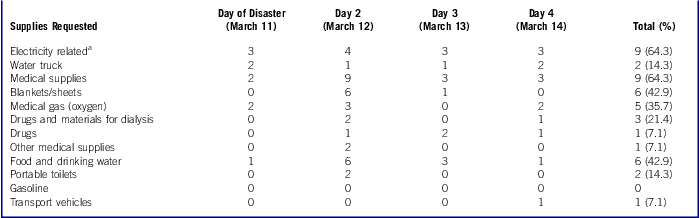
In the first 72 hours or so after the disaster (until day 4, March 14), the number of disaster base hospitals (total number of hospitals = 14) that had requested supplies from the prefectural medical headquarters or had inquired about the progress of requests (total number of inquiries) were 17 inquiries from 9 hospitals (64.3%) regarding electricity supplies (fuel oil, kerosene, and generators), 7 inquiries from 2 hospitals (14.3%) about water trucks, 27 inquiries from 9 hospitals (64.3%) about medical supplies (blankets/sheets, medical gases, dialysis-related supplies, drugs, etc), and 14 requests from 6 hospitals (42.9%) about food and drinking water (Figure 3, Table). The number of requests and inquiries were counted separately when multiple inquiries were made from 1 institution; thus, the data in Figure 3 and the table are different.
Number of Requests and Enquiries From Disaster Base Hospitals to Miyagi Prefecture Disaster Medicine Headquarters for Goods Required for Continuity of Operations. Black bar indicates electricity-related issues; light gray bar, water trucks; dark gray bar, medical supplies; and white bar, food and drinking water. Total number of hospitals is 14. Numbers of requests and inquiries were counted separately when multiple inquiries were made from 1 institution, so data here differ from those in the Table.
Number of Hospitals Requesting Supplies Required for Continuity of Operations from Miyagi Prefecture Disaster Medicine Headquarters
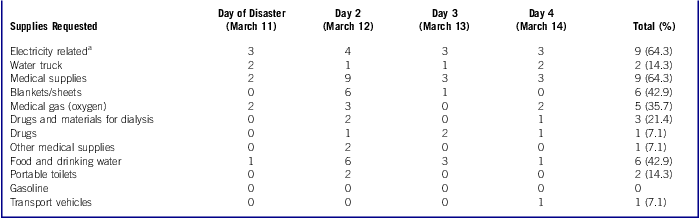
aIncludes fuel oil, kerosene, and generators.
Approximately 24 hours after the disaster (March 12), 2 of the 14 disaster base hospitals had to stop admitting severely injured patients due to electricity and water stoppages and lack of medical and other supplies.
Discussion
Throughout this study, it was evident that many disaster base hospitals in Miyagi Prefecture lacked sufficient reserves or measures for stockpiles (eg, liquid fuel, water, medical supplies, food) required for the continuity of disaster medical operations in the East Japan earthquake. Also, it was noted that many disaster base hospitals did not have electricity and water restored quickly and that they experienced an insufficiency of supplies in the first 72 hours after the disaster.
The Ministry of Health, Labour and Welfare established criteria for the designation of disaster base hospitals in 1996, specifying conditions related to lifelines, medical supplies, and food.7 However, according to a survey conducted in 2010, before the East Japan earthquake, approximately 40% to 60% of disaster base hospitals in Miyagi Prefecture lacked 2 or more days of stockpiles of electricity supplies (liquid fuel), water for water tanks, medical supplies and sanitary equipment and materials, and food and drinking water for inpatients.
Considering this aspect of preparedness, the percentage of hospitals that had both electricity and water restored within 24 hours (March 12) of this disaster was 38.5%, clearly demonstrating that fewer than 2 days of stockpiles was insufficient. Furthermore, even when supplies from the water authority had been restored, not being able to reestablish water use was still a problem due to damage to water pipes on the hospitals’ premises. It was apparent that disruption to electricity, water, and other services, together with the lack of medical supplies, led to a situation in which seriously injured patients could not be accepted at some hospitals, which meant that the facilities could not fulfill their function as disaster base hospitals.
In a workshop document entitled Disaster Medicine, which was aimed at local authority officials and dealt with the revision of medical plans, the Ministry of Health, Labor and Welfare specified that designation as a disaster base hospital should require 3 days of stockpiles of self-sufficient generators and fuel, food, drinking water and medical supplies, and the ability to secure enough water for treatment.17 These revisions to the designation criteria may be implemented in the near future. In addition to stockpiles, there is a need to devise strategies such as securing multiple suppliers and working in collaboration with neighboring hospitals as alternative means when supplies are interrupted.Reference Fukuda, Hashimoto and Suzuki18
When faced with insufficiencies in lifelines, medical supplies, food and other goods, many disaster base hospitals in Miyagi Prefecture requested the provision of supplies from the prefectural medical headquarters. Requests also came from many other places apart from the disaster base hospitals (supplement Table). According to a report by Yamanouchi etal, the important roles fulfilled by the prefectural medical headquarters in this disaster were (1) to gather information about the disaster and the capacity of each hospital to provide treatment; and, based on this information, (2) to coordinate with fire services, self-defense forces, and DMAT operational headquarters to organize transfer of the injured in the prefecture, particularly for large numbers of casualties in coastal areas, and (3) to organize transfer of inpatients from hospitals that had been cut off by the tsunami and could not continue operating to other hospitals within and beyond the prefecture.Reference Nakagawa, Furukawa and Kudo4 It can be surmised that operation of the prefectural medical headquarters when it could not secure sufficient personnel was severely impeded. It was not possible to fulfill these important operational roles because many hospitals, including the disaster base hospitals, were requesting goods and supplies required to continue treatment.
Triage, diagnosis, and preliminary treatment have to be performed at hospitals in the affected area before medical evacuation to other areas can occur, and the hospitals are essential to stabilize the patients’ condition before the transfer.Reference Yamanouchi, Kobayashi and Shinozawa19 To perform these duties, hospitals need to maintain basic minimal treatment functions, which are required of disaster base hospitals. Furthermore, medical departments within prefectural disaster operational headquarters have limited personnel, and ideally need to concentrate their efforts on organizing local and wider medical evacuation.
These findings clearly demonstrate the importance of devising advanced measures for a large-scale disaster, including issues such as stockpiles and coordination with external institutions. It is necessary not only to secure local treatment of disaster victims (triage, diagnosis, preliminary treatment), but also the prefectural disaster operational headquarters need to concentrate on its core work of organizing local, regional, and nationwide evacuation. To achieve these objectives, existing action plans based mainly on manuals of disaster measures are insufficient. Disaster base hospitals urgently need to develop a BCP as the foundation for disaster action plans, and use it as a basis for real preparation.
Limitations
This study was based on data elicited from process records (event chronologies), reports, and materials from the prefectural medical headquarters and disaster base hospitals at the time of the East Japan earthquake; consequently, these data may not have been exhaustive, owing to confusion at the time of the disaster. In addition, because it is difficult to quantify insufficiencies of lifelines and supplies consistently across all disaster base hospitals, requests and inquiries from disaster base hospitals to prefectural medical headquarters were used to reflect this information.
Conclusions
This study found that many disaster base hospitals in Miyagi Prefecture after the East Japan earthquake did not have sufficient stockpiles of fuel for emergency electricity, water, drugs, medical supplies or food; that lifelines such as electricity and water were not restored quickly after the disaster; and that disaster base hospitals had to make requests to the prefectural medical headquarters owing to a lack of medical resources required for disaster medical treatment. This study investigated electricity, water, medical supplies and food, but elements required for business continuity of disaster base hospitals are probably not limited to these elements, and further research is necessary. To prepare for future earthquakes, it is extremely important for disaster base hospitals to develop a BCP.
Support and Funding
This research was funded by Daiwa Securities Health Foundation, 2011; Senshin Medical Research Foundation, 2011; Special projects research, 2012, International Research Institute of Disaster Science, Tohoku University; Marumo Fund, 2012; Daiwa Life Welfare Foundation, 2012; Takahashi Industrial and Economic Research Foundation, 2012; Grant-in-Aid for Scientific Research of Challenging Exploratory Research (No. 24659794), Japanese Ministry of Education, Culture, Sports, Science, and Technology; and supported from Manoa DNA, Hawaii, and Takaya Yokokawa, Osaka.
Acknowledgments
Data were collected from Miyagi Prefecture Medical Provision Department, the disaster base hospitals in Miyagi Prefecture. Yayoi Okano, AA, and Masahiro Tanno, MS, Department of Neurosurgery; and Shizuka Osaki, RN, PHN, BSN, Department of Neurosurgery and Emergency and Critical Care Medicine, Tohoku University Hospital, provided administrative and project assistance for this research.