Penguins (Aves: Sphenisciformes) are interesting to both neontologists and palaeontologists (e.g. Davis & Renner Reference Davis and Renner2003). The fossil record of these extremely specialized inhabitants of the Southern Hemisphere extends back to the Palaeocene epoch (Slack et al. Reference Slack, Jones, Ando, Harrison, Fordyce, Arnason and Penny2006). Extinct penguins are known from localities within the range of their modern-day relatives (Fordyce & Jones Reference Fordyce, Jones, Davis and Darby1990), and the oldest diverse assemblage comes from the Eocene La Meseta Formation of Seymour Island, Antarctic Peninsula, the only such locality south of the Antarctic Convergence (Myrcha et al. Reference Myrcha, Jadwiszczak, Tambussi, Noriega, Gaździcki, Tatur and Del Valle2002, Jadwiszczak Reference Jadwiszczak2006a). Several collections amounting to over three thousand bones (mainly isolated skeletal elements) have been acquired since 1901 from that formation, and 15 penguin species have been erected so far (Jadwiszczak Reference Jadwiszczak2006a, table 1, Tambussi et al. Reference Tambussi, Acosta Hospitaleche, Reguero, Marenssi, Francis, Pirrie and Crame2006). Only ten of them (grouped into six genera) appear to be taxonomically distinct, and their type specimens are tarsometatarsi (Simpson Reference Simpson1971, Myrcha et al. Reference Myrcha, Jadwiszczak, Tambussi, Noriega, Gaździcki, Tatur and Del Valle2002, Jadwiszczak Reference Jadwiszczak2006a, Reference Jadwiszczak2006b, p. 296). Individuals from six species belonging to four genera most probably were not larger than those of Aptenodytes forsteri G.R. Gray, 1844, the heaviest and tallest extant penguin (Jadwiszczak Reference Jadwiszczak2001, table 3). Interestingly, representatives of all ten species may have co-existed in the West Antarctic during the Late Eocene epoch, just prior to the final break-up of Gondwana (Jadwiszczak Reference Jadwiszczak2006a). Presented here is an intriguing partial tarsometatarsus of a small-sized penguin from the Late Eocene of Antarctic Peninsula, probably representing a new genus and species.
The specimen discussed here was collected in 1992 (see Acknowledgements) in the upper part of the La Meseta Formation within the ZPAL 4 locality (64°14′22.856″S, 56°38′43.917″W, 176 m a.s.l.; Tambussi et al. Reference Tambussi, Noriega, Gaździcki, Tatur, Reguero and Vizcaino1994), the place located on the NNW slope of the meseta, within the Telm7 unit (Myrcha et al. Reference Myrcha, Jadwiszczak, Tambussi, Noriega, Gaździcki, Tatur and Del Valle2002, figs 1–3, Jadwiszczak Reference Jadwiszczak2006b, figs 1 & 3). It was buried in sediments most likely close to the transition between E3 and E4 palaeoclimatic zones of Dingle et al. (Reference Dingle, Marenssi and Lavelle1998, fig. 4), i.e. cool, wet, non-seasonal, and cold, relatively dry climate, respectively. However, the only glaciers in the region could have been the alpine ones (Birkenmajer et al. Reference Birkenmajer, Gaździcki, Krajewski, Przybycin, Solecki, Tatur and Yoon2005). The studied specimen is housed at the Institute of Biology, University of Białystok, Poland; abbreviated IB/P/B.
Systematic palaeontology
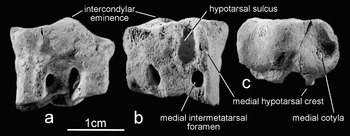
Proximal left tarsometatarsus, IB/P/B-0541c, of the Late Eocene penguin form the La Meseta Formation (Seymour Island, Antarctic Peninsula). a. dorsal view, b. plantar view, c. proximal view of the bone. The fossil was coated with ammonium chloride sublimate prior to photography.

Material
Proximal left tarsometatarsus, IB/P/B-0541c.
Description
(see Myrcha et al. Reference Myrcha, Jadwiszczak, Tambussi, Noriega, Gaździcki, Tatur and Del Valle2002, fig. 4, for the generalized morphology of a fossil penguin tarsometatarsus). This incomplete, but clearly small-sized, tarsometatarsus has two patent proximal intermetatarsal foramens (both are very well preserved). The medial one, unlike in Delphinornis Wiman, 1905, Marambiornis Myrcha et al. Reference Myrcha, Jadwiszczak, Tambussi, Noriega, Gaździcki, Tatur and Del Valle2002 and, especially, Mesetaornis Myrcha et al. Reference Myrcha, Jadwiszczak, Tambussi, Noriega, Gaździcki, Tatur and Del Valle2002, is clearly smaller. It differs from Delphinornis in having the plantar opening of the above-mentioned foramen situated closer to the main axis of the bone than the medial hypotarsal crest. Moreover, this opening is clearly separated from the medial margin by an osseous ridge. The hypotarsal crests are distinct. The intermediate crests are separated by a shallow groove (unlike in Delphinornis), the medial crest is thin (unlike in Delphinornis) and short (unlike in Marambiornis and Mesetaornis). The hypotarsal sulcus is shifted towards the medial margin of the bone. The intercondylar eminence is prominent. The medial cotyla is deep. All metatarsals are strongly fused proximally.
Measurements (in mm)
Proximal width 18.1, width at the level of intermetatarsal foramens 15.6, length of the medial intermetatarsal foramen (dorsal opening) 2.1, length of the lateral intermetatarsal foramen (dorsal opening) 4.1.
Occurrence
Seymour Island (Antarctica), La Meseta Formation, Telm7 unit (Late Eocene), ZPAL 4 locality.
Discussion
The specimen described here, despite missing large portions of all metatarsals, possesses a very characteristic set of features that clearly separates it from other small-sized Eocene penguins (see above). These characters (taken separately) seem to be conservative in both large- and small-bodied La Meseta penguins (observation based on bones from the Polish collection) as well as, to some extent, in Recent ones (e.g. Zusi Reference Zusi and Stonehouse1975, p. 64). In other words, the diagnostic features of the fossil indicate that it represents an undescribed genus and species of penguin. In my opinion, however, it would not be advisable to erect a new taxon on such fragmentary material (cf. the case of specimen IB/P/B-0279b in Myrcha et al. Reference Myrcha, Jadwiszczak, Tambussi, Noriega, Gaździcki, Tatur and Del Valle2002, p. 34). Since the preserved fragment is more massive than its counterpart in some Recent pygoscelid penguins as well as in Delphinornis gracilis Myrcha et al. Reference Myrcha, Jadwiszczak, Tambussi, Noriega, Gaździcki, Tatur and Del Valle2002 from the La Meseta Formation, it does not represent the smallest penguin known, fossil or living.
Millener (1988; cited after Fordyce & Jones Reference Fordyce, Jones, Davis and Darby1990, p. 425) suggested that some 14 penguin species could be present in the La Meseta Formation, i.e. more than is currently accepted. Additionally, Myrcha et al. (Reference Myrcha, Jadwiszczak, Tambussi, Noriega, Gaździcki, Tatur and Del Valle2002), Jadwiszczak (Reference Jadwiszczak2006a) and Tambussi et al. (Reference Tambussi, Acosta Hospitaleche, Reguero, Marenssi, Francis, Pirrie and Crame2006; but see Jadwiszczak Reference Jadwiszczak2006b) indicated the probable existence of more than five small-sized (see Jadwiszczak Reference Jadwiszczak2001) Eocene species. The tarsometatarsus presented here firmly confirms that conviction.
Acknowledgements
I wish to express my appreciation and thanks to A. Gaździcki and A. Tatur (Polish Academy of Sciences, Warsaw) for help over the years. Moreover, they discovered the specimen in 1992. S. Emslie is thanked for his careful review. Photographs were taken by G. Dziewińska.