Introduction
By definition, the diagnosis of post-traumatic stress disorder (PTSD) requires exposure to a traumatic experience (APA, 1994), with the implication being that trauma exposure exerts a direct causal effect on the development of the disorder. However, there is also evidence that individual differences in heritable factors affect risk for PTSD. Specifically, several twin studies focused on veteran and adult samples have suggested that approximately 30–46% of the variance in PTSD is attributable to genetic factors (True et al. Reference True, Rice, Eisen, Heath, Goldberg, Lyons and Nowak1993; Xian et al. Reference Xian, Chantarujikapong, Scherrer, Eisen, Lyons, Goldberg, Tsuang and True2000; Stein et al. Reference Stein, Jang, Taylor, Vernon and Livesley2002; Scherrer et al. Reference Scherrer, Xian, Lyons, Goldberg, Eisen, True, Tsuang, Bucholz and Koenen2008; Sartor et al. Reference Sartor, Grant, Lynskey, McCutcheon, Waldron, Statham, Bucholz, Madden, Heath, Martin and Nelson2012), and one study of young adult women found that 72% of the variance in PTSD was attributable to genetic factors (Sartor et al. Reference Sartor, McCutcheon, Pommer, Nelson, Grant, Duncan, Waldron, Bucholz, Madden and Heath2011). Twin studies also suggest that aspects of the environment that are not shared across members of a twin pair (e.g. severity and type of trauma exposure) tend to contribute the majority of the variance in risk for PTSD (True et al. Reference True, Rice, Eisen, Heath, Goldberg, Lyons and Nowak1993; Stein et al. Reference Stein, Jang, Taylor, Vernon and Livesley2002; Sartor et al. Reference Sartor, Grant, Lynskey, McCutcheon, Waldron, Statham, Bucholz, Madden, Heath, Martin and Nelson2012).
The effects of combat exposure have been studied extensively among veteran populations. Twin studies suggest that traumatic events that occur in the context of combat exposure partially explain the prevalence and chronicity of PTSD (Goldberg et al. Reference Goldberg, True, Eisen and Henderson1990; Roy-Byrne et al. Reference Roy-Byrne, Arguelles, Vitek, Goldberg, Keane, True and Pitman2004; Gilbertson et al. Reference Gilbertson, McFarlane, Weathers, Keane, Yehuda, Shalev, Lasko, Goetz and Pitman2010) and also contribute to the development of other conditions such as depression and substance dependence (Koenen et al. Reference Koenen, Lyons, Goldberg, Simpson, Williams, Toorney, Eisen, True, Cloitre, Wolfe and Tsuang2003). As not all individuals exposed to the same traumatic combat events will develop PTSD, it is likely that combat experiences interact with other individual-difference characteristics to affect risk for PTSD and other psychological disorders. One possibility is that combat exposure interacts with an individual's genetic vulnerability for PTSD to increase risk for the disorder.
Gene by environment interaction (G × E), sometimes referred to as G × E interplay, exists when the effects of a person's genotype on risk for psychopathology is at least partially dependent on the environment. G × E implies that individuals with genetic risk variants are more sensitive to the negative or positive effects of specific environments than are individuals without the genetic risk (Moffitt et al. Reference Moffitt, Caspi and Rutter2005). The diathesis–stress model of disease reflects a form of G × E in which a harmful environment interacts with a genetic predisposition towards pathology and increases the risk for the pathology. Thus, the basic concept underlying G × E is that risk for a given trait or disorder is not static, but instead is dependent on the synergy between basic biological and environmental risk factors. The aim of this study was to evaluate the extent to which combat exposure interacts with genetic factors and affects risk for PTSD. We examined this in a sample of US military monozygotic (MZ) and dizygotic (DZ) twins who served in South East Asia during the Vietnam War era.
There are two competing hypotheses to consider regarding the potential effects of combat exposure on the heritability of PTSD. First, exposure to combat may increase the heritability of PTSD if it causes underlying differences in genetic risk variants to exert their pathological effects. This is the classic example of diathesis–stress wherein the genetic vulnerability is manifested only under certain environmental conditions. For example, G × E research suggests that the effect of single nucleotide polymorphisms (SNPs) in the gene FK506 binding protein 5 (FKBP5) on PTSD is dependent on childhood abuse (Binder et al. Reference Binder, Bradley, Liu, Epstein, Deveau, Mercer, Tang, Gillespie, Heim, Nemeroff, Schwartz, Cubells and Ressler2008; Xie et al. Reference Xie, Kranzler, Poling, Stein, Anton, Farrer and Gelernter2010), such that the effect is only evident under conditions of abuse. Similar genotype by trauma effects have been obtained for other genes in predicting PTSD, including the serotonin transporter (SLC6A4; Xie et al. Reference Xie, Kranzler, Poling, Stein, Anton, Brady, Weiss, Farrer and Gelernter2009), catechol-O-methyltransferase (COMT; Kolassa et al. Reference Kolassa, Kolassa, Ertl, Papassotiropoulos and De Quervain2010) and gamma-aminobutyric acid receptor, alpha-2 (GABRA2; Nelson et al. Reference Nelson, Agrawal, Pergadia, Lynskey, Todorov, Wang, Todd, Martin, Heath, Goate, Montgomery and Madden2009). In these examples, the association between the genotype and PTSD is dependent on exposure to trauma such that the effect is stronger among those exposed to higher levels of trauma.
Alternatively, exposure to combat may decrease the heritability of PTSD. This might occur if the combat experience is so severely traumatic that it overrides the effects of genes (and perhaps other individual difference factors), such that almost everyone so exposed would develop the disorder (Jang et al. Reference Jang, Taylor, Stein and Yamagata2007). As proof of principle, consider the heritability of height: although adult height is highly heritable (e.g. Dubois et al. Reference Dubois, Kyvik, Girard, Tatone-Tokuda, Perusse, Hjelmborg, Skytthe, Rasmussen, Wright, Lichtenstein and Martin2012), its heritability is decreased significantly under conditions of malnourishment such that lack of adequate nutrition (an environmental variable) becomes a primary contributor to height (Silventoinen, Reference Silventoinen2003). Similarly, the heritability of intelligence has been shown to be moderated by socio-economic status among children such that genes contribute negligibly to intelligence under conditions of poverty but contribute the majority of the variance under conditions of affluence (Turkheimer et al. Reference Turkheimer, Haley, Waldron, D'Onorio and Gottesman2003). In theory, a similar relationship could exist between combat exposure, genes and risk for PTSD.
Just as individual-level genetic vulnerabilities may interact with the effects of combat exposure to increase or decrease the risk of PTSD, it is also possible that the effect of the environment on risk for PTSD may vary as a function of combat exposure (i.e. E × E). G × E twin studies provide the opportunity to evaluate if the effects of unmeasured environmental factors (reflected as the common environment and non-shared environment) are dependent on an observed environmental variable. The effects of combat exposure could increase the importance of other environmental variables that have previously been shown to affect risk for PTSD. For example, exposure to combat may amplify the risk for PTSD that is associated with exposure to early childhood trauma (i.e. a childhood trauma by combat exposure interaction). This could manifest in greater severity of childhood trauma-related PTSD symptoms in those exposed to subsequent combat trauma. Alternatively, it is conceivable that combat exposure could decrease the importance of other environmental factors because combat exposure trumps other environmental variables in importance for determining risk for PTSD (e.g. in the same way that extreme exposure might override any genetic effects). In sum, there are reasons to hypothesize that combat exposure may either increase or decrease the strength of the genetic and/or environmental pathways that predict PTSD. This study allowed us to test these competing hypotheses about the effects of measured combat exposure on the genetic and environmental etiology of PTSD.
Method
Participants
This sample was drawn from the larger, nationally representative Vietnam Era Twin Registry (VETR), which began with 14 738 male–male twin pairs born between 1939 and 1957 who served in the US military during the Vietnam War era (see Tsai et al. Reference Tsai, Mori, Forsberg, Waiss, Sporleder, Smith and Goldberg2012). The data analyzed in this study were collected as part of the 1992 Harvard Twin Study of Drug Abuse and Dependence, which included 3372 complete twin pairs (Tsuang et al. Reference Tsuang, Lyons, Eisen, Goldberg, True, Lin, Meyer, Toomey, Faraone and Eaves1996). As we were interested in the moderating role of combat exposure on liability for PTSD, we limited our analyses to twin pairs in which both members served in South East Asia during the Vietnam War (and thus had the potential to be exposed to combat; n = 1240 veterans, comprising 394 MZ and 226 DZ twin pairs). The mean age of this subsample was 43 (range 35–53) years; self-reported racial identity in the sample was 90.16% White, 4.03% Black, 1.77% Hispanic, 0.81% Native American, 0.32% Asian American or Pacific Islander, and 2.90% other. DSM-III-R (APA, 1987) criteria for lifetime PTSD were met by 14% of twins (12.9% of MZ and 14.8% of DZ twins).
Procedure and measures
Diagnostic interviews were completed over the telephone using the Mental Health Diagnostic Interview Schedule, Version III – Revised (DIS-III-R; Robins et al. Reference Robins, Helzer, Cottler and Golding1998), as described in greater detail by Koenen et al. (Reference Koenen, Harley, Lyons, Wolfe, Simpson, Goldberg, Eisen and Tsuang2002) and Lyons et al. (Reference Lyons, Eisen, Goldberg, True, Lin, Meyer, Toomey, Faraone, Merla-Ramos and Tsuang1998). We evaluated DSM-III-R lifetime symptom counts for PTSD wherein each of the 17 DSM criteria was scored as present or not. Inter-rater reliability for the PTSD diagnosis, as determined by reinterview of 146 participants (with a mean interval of 466 days between assessments), was κ = 0.54. Given the length of time between assessments, κ reflects both rater agreement and the temporal stability of the diagnosis.
Combat was assessed using the 18-item Combat Exposure Index, which assessed personal history of specific combat experiences (e.g. retrieving dead bodies, receiving incoming fire, being wounded; Janes et al. Reference Janes, Goldberg, Eisen and True1991). Participants completed this survey by mail. The Combat Exposure Index has previously demonstrated good internal consistency and predictive validity (e.g. association with receipt of military combat medal; Janes et al. Reference Janes, Goldberg, Eisen and True1991). For these analyses, we divided the 18-item measure into three cut-points to reflect no combat exposure (i.e. a score of zero on the measure; n = 325), at or below this sample's rounded non-zero mean of 4 on the Combat Exposure Index (n = 536), and above the non-zero sample mean on combat exposure (n = 379). There were four reasons for doing this: (1) there was low frequency of endorsement of scores in the upper range of the scale; (2) the use of the three-point scale simplified the computation of the latent moderation variables; (3) this approach offered a simple way to interpret the interaction results; and (4) there was no differential strength of association between PTSD and the full combat scale versus the three-point one, suggesting that the use of the shorter scale did not result in significant loss of information.
Trauma exposure was assessed during the study interview: participants reported on their exposure (yes/no) to a maximum of three self-identified ‘worst’ traumatic events from a predefined list of 11 types of traumatic experiences (military combat, rape, physical assault, seeing someone hurt or killed, natural disaster, threat, narrow escape, sudden injury, news of a sudden death, other personal shock, or shock to someone else). Approximately 26% of the sample reported no exposure to combat on the self-report Combat Exposure Index; of these individuals, 10% endorsed combat exposure during the telephone interview but not on the self-report measure, 7% endorsed sudden injury, 6% endorsed seeing someone hurt and 3% endorsed physical assault as the ‘worst’ traumatic event that PTSD symptoms were linked to (other events were endorsed at a prevalence < 3%). Individuals who did not endorse exposure to any traumatic event on the interview were coded as zero on PTSD. Zygosity was determined through a questionnaire and blood-group matching approach that achieved 95% accuracy (Eisen et al. Reference Eisen, Neuman, Goldberg, Rice and True1989).
Statistical analyses
As a general overview, twin studies examine the extent to which genetic (A), common environmental (C) and non-shared environmental (E) factors contribute to a phenotype. These associations can be evaluated because of known relationships among MZ and DZ twins; namely, that MZ twins are genetically identical whereas, on average, 50% of genetic variation is shared across DZ twin pairs. In addition, the common environment is, by definition, fully shared across all twin pairs reared together whereas the non-shared environment is fully unshared across members of a twin pair. G × E models are used to evaluate if the strength of the genetic and environmental factors predicting the phenotype is dependent on a measured environmental variable.
There are several analytic approaches for examining G × E in twin designs (Purcell, Reference Purcell2002; Rathouz et al. Reference Rathouz, van Hulle, Rodgers, Waldman and Lahey2008; van der Sluis et al. Reference van der Sluis, Posthuma and Dolan2012). We evaluated the evidence for G × E in these data using two of these analytic methods. The first was a bivariate model described in detail by Purcell (Reference Purcell2002). This model, depicted in Fig. 1 a, accounts for the extent to which the same versus different genetic and environmental factors contribute to the moderator (combat) and the phenotype (PTSD) by modeling this overlap directly. When the same genetic factors account for variance in the moderator and the phenotype, this is referred to as gene–environment correlation (r GE; see Plomin et al. Reference Plomin, DeFries and Loehlin1977). r GE as it applies to this study would occur if the same genetic factors that influence risk for combat also influence the likelihood of PTSD. This could occur, for example, if a genetically influenced temperament led an individual to volunteer for more dangerous combat missions and also put the individual at risk for PTSD following combat exposure. It is important to account for potential r GE because it may erroneously be reflected as G × E (Purcell, Reference Purcell2002). It is also relevant because prior studies using the VETR showed evidence for r GE between combat and PTSD (McLeod et al. Reference McLeod, Koenen, Meyer, Lyons, Eisen, True and Goldberg2001; Scherrer et al. Reference Scherrer, Xian, Lyons, Goldberg, Eisen, True, Tsuang, Bucholz and Koenen2008) and studies using other datasets have similarly found overlapping genetic variance between assaultive trauma and PTSD (Jang et al. Reference Jang, Stein, Taylor, Asmundson and Livesley2003). This bivariate analytic approach is commonly used in G × E of psychopathology research (see Hicks et al. Reference Hicks, South, Dirago, Iacono and McGue2009; Distel et al. Reference Distel, Middeldorp, Trull, Derom, Willemsen and Boomsma2011; South & Krueger, Reference South and Krueger2011) and Rathouz et al. (Reference Rathouz, van Hulle, Rodgers, Waldman and Lahey2008) and van Hulle et al. (2013) indicated that it is appropriate when there is a temporal ordering of the moderator and the phenotype (e.g. combat before PTSD). In our bivariate model, both the genetic and environmental paths that are shared across combat and PTSD and those that are unique to PTSD were examined to determine whether they were dependent on combat exposure (see Fig. 1 a).
(a) The baseline bivariate model included genetic (A) and non-shared environment (E) latent variables that were common to combat and post-traumatic stress disorder (PTSD) (A1 and E1) and A and E factors that were specific to PTSD (A2 and E2). All paths implicated in the etiology of PTSD were also moderated by combat exposure. (b) The univariate model included regressive paths from combat exposure in both twins to PTSD in twin 1 (the complimentary model for twin 2 is not show here). The model also includes A and E effects for PTSD and moderation of these effects by combat exposure. In both types of models the cross-twin correlation between the A factors was set to 1.0 and 0.50 for monozygotic (MZ) and dizygotic (DZ) twins respectively, and the cross-twin correlation between the E factors was set to 0. M, moderator; SX, symptoms.

Although the bivariate approach is commonly used and is a sophisticated method for distinguishing r GE from G × E, the model also has several limitations, including risk of false-positive moderation results (Rathouz et al. Reference Rathouz, van Hulle, Rodgers, Waldman and Lahey2008; van der Sluis et al. Reference van der Sluis, Posthuma and Dolan2012). It is also computationally more demanding, less parsimonious and achieves less statistical power than a univariate model described originally by Purcell (Reference Purcell2002) and recently extended by van der Sluis et al. (Reference van der Sluis, Posthuma and Dolan2012).Footnote 1 Footnote † The univariate approach used in this study (see van der Sluis et al. Reference van der Sluis, Posthuma and Dolan2012) models the genetic and environmental contributions to the phenotype and controls for r GE by regressing the phenotype on the moderator for both twins, and allowing these regression coefficients to vary across MZ and DZ twins. This model is shown in Fig. 1 b. van der Sluis et al. (Reference van der Sluis, Posthuma and Dolan2012) demonstrated that this approach reduces the risk of false-positive G × E effects when the moderator and phenotype are correlated and the moderator is also correlated across twins, which is the case in these data. Given the different strengths and limitations of each type of model, we examined the data both ways to evaluate the replicability of the findings across these different analytic approaches.
The common environment (C) was not modeled in either set of analyses because preliminary analyses found no such effect (details available from E.J.W.), consistent with other studies of this type (True et al. Reference True, Rice, Eisen, Heath, Goldberg, Lyons and Nowak1993; Stein et al. Reference Stein, Jang, Taylor, Vernon and Livesley2002; Sartor et al. Reference Sartor, Grant, Lynskey, McCutcheon, Waldron, Statham, Bucholz, Madden, Heath, Martin and Nelson2012). For both types of models, the interaction between combat and the latent genetic and environmental factors was modeled as a latent interaction term (scripts available from E.J.W.).
In both models we tested the necessity of the moderated paths by setting them to zero in nested models and determining whether doing so significantly damaged model fit using the χ 2 difference test (i.e. –2 × log likelihood value) and by comparing the values of Akaike's Information Criterion (AIC; Akaike, Reference Akaike1987) and Bayesian Information Criterion (BIC; Schwartz, Reference Schwartz1978) with lower relative values indicating the preferred solution on these two indices. We also compared the fit of the moderated models with a null model that included no moderation.
Finally, we conducted secondary analyses to determine whether including non-combat trauma as a covariate impacted our main results. To do so, we re-evaluated the best-fitting univariate model and regressed PTSD not only on combat exposure but also on a dichotomous variable that reflected exposure to non-combat trauma.
All analyses were conducted using Mplus 7 (Muthén & Muthén, Reference Muthén and Muthén2012) with maximum likelihood (ML) estimation. All reported parameter estimates are unstandardized, as recommended by Purcell (Reference Purcell2002) and Rathouz et al. (Reference Rathouz, van Hulle, Rodgers, Waldman and Lahey2008); standardized results in G × E analyses can be misleading because all variance components must sum to 1.0 (therefore, by definition, as standardized variance attributable to one factor increases, the standardized variance attributable to the other must decrease). We also report 95% confidence intervals (CIs) for the parameter estimates for the final models to aid interpretation of the results.
Results
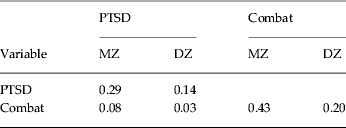
Table 1 shows the cross-twin correlations between PTSD symptom count and the three-point Combat Exposure Index for MZ and DZ twins separately. The within-twin phenotypic correlation between combat exposure and PTSD was r = 0.32 for MZ and r = 0.34 for DZ twins. A simple AE model of PTSD revealed that the heritability of PTSD was 23% (95% CI 17–28) and the variance attributed to the non-shared environment was 77% (95% CI 75–79). The fit of the model is shown in the first row of Table 2.
Cross-twin correlations for PTSD symptom count and combat exposure

PTSD, Post-traumatic stress disorder; MZ, monozygotic; DZ, dizygotic.
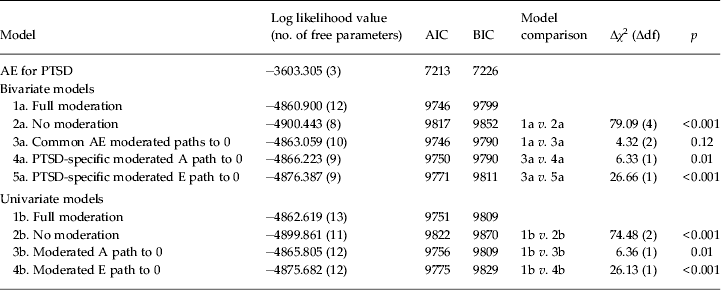
Fit of biometric models

AIC, Akaike's Information Criterion; BIC, Bayesian Information Criterion; A, genetic; E, non-shared environment; PTSD, post-traumatic stress disorder; df, degrees of freedom.
The p values reflect the statistical significance of the difference in χ 2 values across competing models.
Bivariate models
The fit of the full bivariate model with moderation of both the genetic and non-shared environment paths common to combat and PTSD and specific to PTSD (i.e. Fig. 1 a) is shown in Table 2 (model 1a). The results yielded significant shared genetic effects on combat (β = 0.50, p < 0.001) and PTSD (β = 0.99, p < 0.001), and common non-shared environmental effects on combat (β = 0.57, p < 0.001) and PTSD (β = 0.60, p = 0.014). This suggests that some of the genetic and environmental risk for combat exposure and PTSD is shared. In addition, the model yielded genetic (β = 1.28, p < 0.001) and non-shared environmental effects (β = 2.92, p < 0.001) specific to PTSD. Finally, the model revealed no significant moderation by combat of the genetic (β = 0.36, p = 0.18) or non-shared environmental (β = 0.18, p = 0.45) paths that were common to combat and PTSD but did suggest that combat moderated the genetic (β = 0.71, p = 0.012) and non-shared environmental (β = 0.75, p < 0.001) paths that were specific to PTSD. The results of this model suggested that the genetic and environmental contributions shared across combat and PTSD were not dependent on level of combat exposure whereas the strength of the PTSD-specific genetic and environmental risk factors varied as a function of level of combat exposure. The fit of this full moderation model provided a substantially better fit compared to a model that included no moderated effects, as shown by the significant χ 2 difference test in Table 2, model 2a.
Given that there was no evidence for significant moderation of the genetic and non-shared environment paths common to combat and PTSD, we set the moderated portion of these paths to zero in a nested model to test whether this would significantly degrade the model fit. The fit of this model is shown in Table 2 (model 3a); the χ 2 test indicated that eliminating these paths did not degrade the model fit. Next, we evaluated the necessity of moderation of the genetic path specific to PTSD. As shown in Table 2 (model 4a), eliminating the effect of the moderator on this path resulted in significant degradation of model fit and no improvement in AIC or BIC values. This suggests that the PTSD-specific genetic by combat exposure interaction was significantly different from zero and important for overall model fit. Finally, we tested the necessity of the moderated portion of the non-shared environmental path that was specific to PTSD. Eliminating the moderated portion of this path also significantly degraded the model fit and was associated with higher (worse) AIC and BIC (Table 2, model 5a).
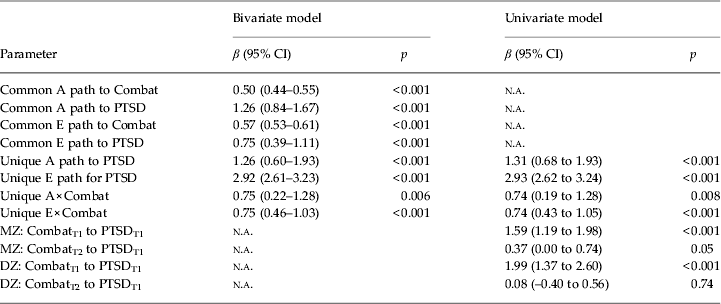
Thus, the final model included significant genetic and non-shared environmental effects common to combat and PTSD in addition to significant genetic and non-shared environmental effects that were specific to PTSD. The effect of these PTSD-specific factors was dependent on level of combat exposure.Footnote 2 The parameter estimates for this model are shown in Table 3.
Parameter estimates for the best-fitting bivariate and univariate G × E models

A, genetic; E, non-shared environment; PTSD, post-traumatic stress disorder; CI, confidence interval; MZ, monozygotic; DZ, dizygotic; T1, twin 1; T2, twin 2; n.a., not applicable.
All β are unstandardized coefficients.
Univariate models
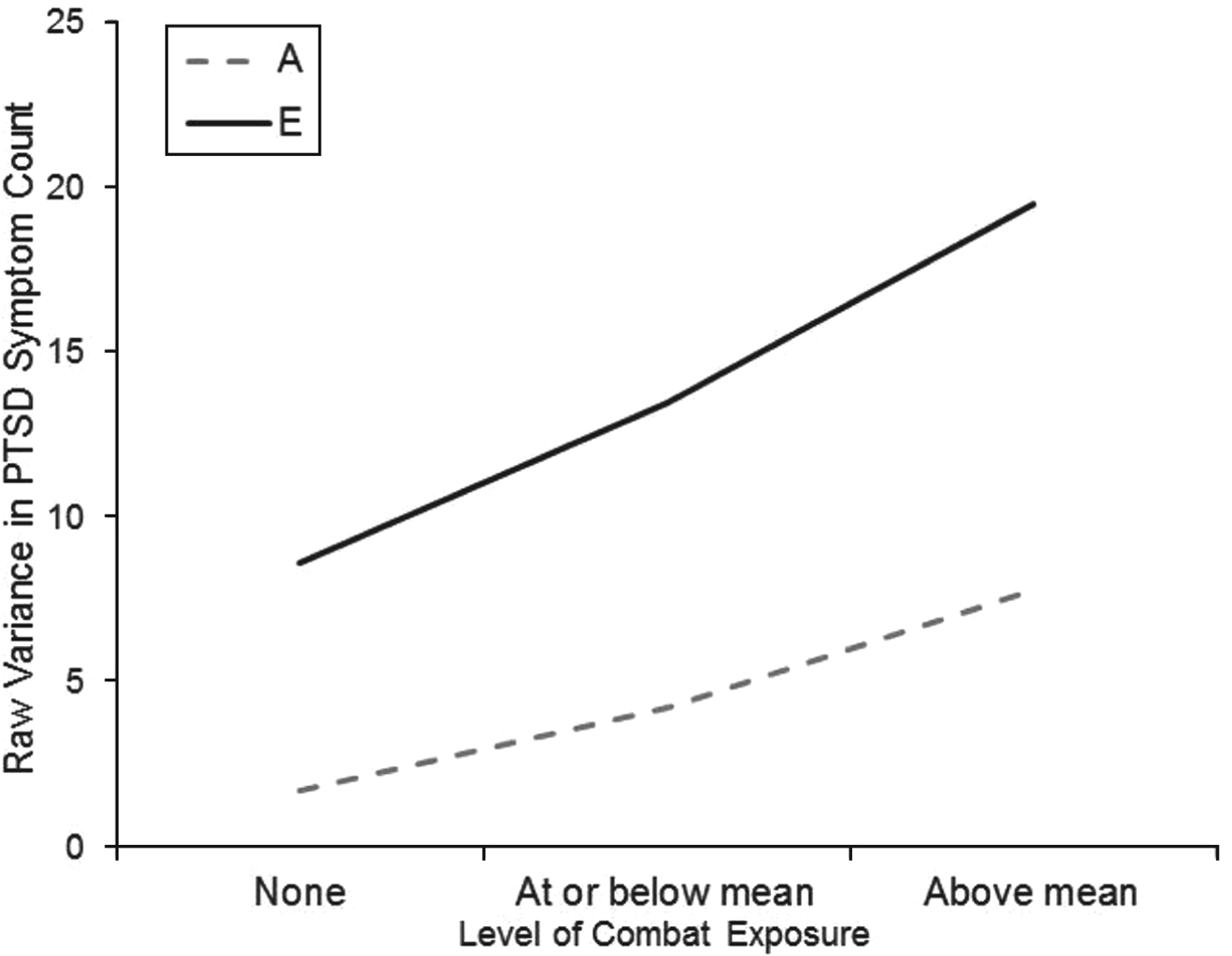
We next conducted a series of parallel analyses using the van der Sluis et al. (Reference van der Sluis, Posthuma and Dolan2012) extended univariate approach. The first model included combat exposure in both twins as a predictor of PTSD, A and E factors for PTSD, and moderation of both factors by combat exposure. The parameter estimates for this model are shown in Table 3. This model yielded significant genetic and non-shared environmental effects on PTSD along with significant moderation of both these paths; the fit of this model is shown in Table 2 (model 1b). In addition, the within-twin, but not the cross-twin, regression of PTSD on combat exposure was significant for MZ and DZ twins. We then tested a model with both moderated effects set to zero and determined that this model yielded a significantly degraded fit compared to the model with both moderated effects (Table 2, model 2b). Next, we tested a model that set only the moderated genetic path to zero (Table 2, model 3b) and found that this model yielded a worse fit compared to the model with both moderated paths. Finally, we tested a model that set only the moderated non-shared environmental path to zero (Table 2, model 4b) and found that this, too, yielded a worse fit compared to the model with both moderated paths. Given this, the model with moderated A and E paths was retained. The results were very similar whether evaluated using the bivariate or the univariate analytic approach. The moderated effects from the final univariate model are depicted graphically in Fig. 2, which shows that the heritability and non-shared environmental contributors to PTSD increased with higher levels of combat exposure. The figure depicting the pattern of results when using the bivariate analytic approach (not shown) was almost identical to Fig. 2.
Results from the best-fitting univariate model, showing how the variance in post-traumatic stress disorder (PTSD) attributable to genetic (A) and non-shared environment (E) factors is dependent on the level of combat exposure such that the importance of genetic and non-shared environment factors is increased at higher levels of combat exposure.

Effects of other trauma exposure
Finally, we conducted secondary analyses to examine the effects of additional forms of trauma exposure on our main results. Exposure to any non-combat trauma was reported by 23% of the sample; 24% of those who reported combat exposure reported additional exposure to non-combat trauma. The results of the univariate model controlling for exposure to other forms of trauma revealed that this variable was a significant predictor of PTSD (β = 3.53, p < 0.001); however, inclusion of this covariate did not affect the pattern of results from the univariate model reported in the preceding paragraph (details available on request).
Discussion
The results of this study suggest that the genetic and environmental influences on the development of PTSD in Vietnam veterans were moderated by the level of exposure to traumatic combat experiences. The genetic and non-shared environment factors showed stronger associations with PTSD symptom counts at higher levels of combat exposure. Rather than exerting a fixed influence on risk for PTSD, these results, consistent across two different analytic procedures, suggest that the influences of genes and environment on PTSD vary as a function of level of exposure to a measured environmental pathogen (i.e. combat). Combat exposure may act as a catalyst to amplify the pathological effects of both biological and environmental risk factors for the development of PTSD.
Our study cannot speak directly to the mechanisms through which combat exposure alters the strength of genetic and environmental risk factors for PTSD and thereby affects risk and resilience to the disorder. With respect to G × E, one possibility is that combat trauma has an effect on the function of one or more neurobiological systems underlying PTSD (i.e. a main effect) that is moderated by genotype (G × E). For example, the effects of combat on neurobiology may be greater among individuals with genetic risk variants that are associated with either exaggerated or inadequate responses to the challenges of combat stress. Epigenetics, that is the process by which environmental factors affect gene expression by turning genes ‘on’ or ‘off,’ is another possible mechanism of G × E (see Bagout & Meaney, Reference Bagout and Meaney2010) that has been implicated in the etiology of PTSD (see Uddin et al. Reference Uddin, Aiello, Wildman, Koenen, Pawelec, de los Santos, Goldmann and Galea2010, Reference Uddin, Galea, Chang, Aiello, Wildman, de los Santos and Koenen2011; Koenen et al. Reference Koenen, Uddin, Chang, Aiello, Wildman, Goldmann and Galea2011; Smith et al. Reference Smith, Conneely, Kilaru, Mercer, Weiss, Bradley, Tang, Gillespie, Cubells and Ressler2011; Chang et al. Reference Chang, Koenen, Galea, Aiello, Soliven, Wildman and Uddin2012). It is conceivable that combat stress operates through epigenetic processes, causing some genes to be expressed and/or others inhibited in a fashion that confers increased risk for the development of PTSD.
A similar model may be useful in conceptualizing how the non-shared environment exerts greater influence on the development of PTSD at higher versus lower levels of combat exposure (i.e. E × E). For example, exposure to childhood trauma may sensitize an individual to the effects of subsequent combat trauma, yielding a synergetic effect on neurobiological functioning and psychological symptoms. This hypothesis (Hammen et al. Reference Hammen, Henry and Daley2000) is supported by research showing that the effect of adverse life events on risk for PTSD is heightened among individuals with greater childhood trauma exposure (Breslau et al. Reference Breslau, Chilcoat, Kessler and Davis1999; McLaughlin et al. Reference McLaughlin, Conron, Koenen and Gilman2010).
G × E and E × E processes may occur independently of each other and/or be dependent on one another (i.e. G × E × E). For example, early childhood trauma may negatively affect the functioning of the neurobiological systems underlying stress response and subsequent combat trauma may further augment this pathological process in individuals with at-risk genotypes. Consistent with this general notion, Kilpatrick et al. (Reference Kilpatrick, Koenen, Ruggiero, Acierno, Galea, Resnick, Roitzsch, Boyle and Gelernter2007) reported a three-way interaction between genotype, trauma exposure and social support (G × E × E) in predicting PTSD such that the short allele variant in SLC6A4 was associated with PTSD among hurricane-exposed individuals only when hurricane exposure was high and social support was low. Similar G × E × E results were obtained for the regulator of the G-protein signaling 2 (RGS2) gene by Amstadter et al. (Reference Amstadter, Koenen, Ruggiero, Acierno, Galea, Kilpatrick and Gelernter2009).
The results of this study provide support for diathesis–stress models of PTSD, which posit that individuals with a genetic vulnerability are more sensitive to the pathological effects of an adverse environmental condition (e.g. combat). They are also compatible with results from molecular genetic studies suggesting that the effects of genetic variation on PTSD are observed only among those with sufficient trauma exposure (see Binder et al. Reference Binder, Bradley, Liu, Epstein, Deveau, Mercer, Tang, Gillespie, Heim, Nemeroff, Schwartz, Cubells and Ressler2008; Xie et al. Reference Xie, Kranzler, Poling, Stein, Anton, Farrer and Gelernter2010). In our study, the non-shared environment also exerted an effect on risk for PTSD across levels of combat exposure, suggesting multiple pathways to the development of the disorder.
The heritability of PTSD, independent of combat exposure, in this sample was 23%. This estimate was somewhat lower than that previously reported in other investigations of PTSD, including others using the VETR (35% reported by Xian et al. Reference Xian, Chantarujikapong, Scherrer, Eisen, Lyons, Goldberg, Tsuang and True2000, 33% by Scherrer et al. Reference Scherrer, Xian, Lyons, Goldberg, Eisen, True, Tsuang, Bucholz and Koenen2008 and 13–34% by True et al. Reference True, Rice, Eisen, Heath, Goldberg, Lyons and Nowak1993). Differences in the sampling strategy and methodology between our study and these other investigations probably account for this variation. Specifically, we restricted our analyses to twin pairs concordant for South East Asia service and used an interview-based dimensional symptom count of PTSD, whereas prior estimates were based on larger samples using dichotomous PTSD diagnostic variables or self-report inventories. Nevertheless, the magnitude of the difference may be trivial given that the CI for the heritability of PTSD in this study overlaps with those reported in prior investigations (Xian et al. Reference Xian, Chantarujikapong, Scherrer, Eisen, Lyons, Goldberg, Tsuang and True2000; Scherrer et al. Reference Scherrer, Xian, Lyons, Goldberg, Eisen, True, Tsuang, Bucholz and Koenen2008).
Limitations
The generalizability of this study was limited by our focus on male–male twin pairs who served in South East Asia during the Vietnam War, and it is not clear whether these results generalize to other demographic or trauma-exposed groups (i.e. women, civilians, individuals who experienced sexual assault). In addition, participants were assessed approximately 30 years after the Vietnam War, raising questions about possible recall bias in reports of combat exposure. Diagnostic determinations were based on DSM-III-R definitions of PTSD, and this is a concern given differences in the criteria between DSM-III-R and DSM-IV. However, this concern is offset by our focus on symptom counts, as the same symptoms appeared in both manuals. Analytically, we could not distinguish between error variance and variance attributed to the non-shared environment, a problem common to all twin models using observed indicators of the phenotype. Aspects of combat exposure not covered in the Combat Exposure Index would also be reflected in the non-shared environment. Related to this, the finding that about 10% of veterans with a score of zero on the self-report Combat Exposure Index endorsed exposure to combat during the PTSD interview probably reflects unreliability of one or both assessment instruments. Finally, we could not fully evaluate the role of other trauma types and whether this might also moderate the risk for PTSD, thus this and other unmeasured variables are collectively reflected in the non-shared environmental pathways. Nevertheless, preliminary analyses did indicate that exposure to other forms of trauma did not account for the primary results obtained in the study. These analyses were considered preliminary because of concerns about the limited breadth and specificity of the assessment of other forms of trauma, and the need to collapse all other forms of trauma exposure into a simple dichotomous index.
Conclusions
This is the first twin study to evaluate the effects of combat exposure severity on the role of the genetic and environmental pathways implicated in risk for PTSD. The results reveal that the roles of both heritability and the non-shared environment increased at higher levels of combat exposure. One implication of these findings is that studies aimed at examining the specific genetic and environmental factors that contribute to risk and resilience to PTSD among veterans may be more powerful when conducted in high combat- or trauma-exposed samples. Future work should aim to identify the specific molecular, biological, neurological and sociocultural mechanisms responsible for the effects observed in this study. Twin and molecular genetic studies that include neuroimaging parameters could be helpful in determining how individual differences in genetic risk interact with trauma exposure to yield symptoms of PTSD. More work is also needed to clarify other aspects of the environment that might similarly moderate the genetic and environmental etiology of PTSD. It would be particularly helpful to have a better understanding of protective factors that might be associated with reduced genetic and environmental risk so as to promote resiliency and well-being. Such work in combat-related PTSD might focus on the putative role of modifiable protective factors such as social support, military unit cohesion and psychological intervention that might reduce the likelihood of PTSD, even among those with increased risk for the disorder.
Declaration of Interest
None.
Acknowledgments
E. J. Wolf's contribution to this project was supported by a VA CSR&D Career Development Award. K. S. Mitchell's contribution was supported by K01MH093750. K. C. Koenen's contribution was supported by MH093612. M. Miller's effort was supported by National Institute on Mental Health award MH079806 and the Department of Veterans Affairs Merit Award Program. The Cooperative Studies Program of the Office of Research and Development of the United States Department of Veterans Affairs has provided financial support for the development and maintenance of the VETR. All statements, opinions or views are solely of the author(s) and do not necessarily reflect the position or policy of the VA or the US Government. Most importantly, we gratefully acknowledge the continued cooperation and participation of the members of the VETR and their families; without their contribution this research would not have been possible.