Introduction
Studies examining the association between depression and excess mortality have not yielded consistent findings, although the risk for all-cause mortality generally appears to increase in patients with depression (Wulsin et al., Reference Wulsin, Vaillant and Wells1999; Saz and Dewey, Reference Saz and Dewey2001; Cuijpers and Smit, Reference Cuijpers and Smit2002). The risk of mortality increases especially in male and severely depressive patients (Harris and Barraclough, Reference Harris and Barraclough1998), suggesting that the gender of subjects or type of depression may differentially influence the risk of mortality. The association of mortality with non-major forms of depression (such as minor depressive disorder [MnDD] and subsyndromal depression [SSD]) has been studied much less than mortality's association with major depressive disorder (MDD) (Fredman et al., Reference Fredman1989; Gallo et al., Reference Gallo, Rabins, Lyketsos, Tien and Anthony1997). In some studies, the risk of mortality associated with MDD and MnDD was confined to men, indicating that depression-associated mortality may be gender-dimorphic (Penninx et al., Reference Penninx, Geerlings, Deeg, van Eijk, van Tilburg and Beekman1999; Gallo et al., Reference Gallo, Bogner, Morales, Post, Have and Bruce2005; Ryan et al., Reference Ryan2008). Mortality associated with depression may not be directly attributed to depression itself but to other comorbid conditions. This may be the case, in particular, in late-life depression. In the elderly, non-major depressions are more prevalent than MDD and frequently associated with comorbid illnesses (Lavretsky and Kumar, Reference Lavretsky and Kumar2002; Park et al., Reference Park2010; Reference Park2012).
In this study, we investigated the differential impacts on all-cause mortality of late-life depression by the type of depression (MDD, MnDD, SSD) and gender after adjusting comorbid conditions in the randomly sampled community-dwelling elderly Koreans who participated in the Korean Longitudinal Study on Health and Aging (KLoSHA; Park et al., Reference Park2007). We hypothesized that MnDD or SSD in elderly individuals would have an impact on all-cause mortality, which is greater than that of non-depression but less than that of MDD. Moreover, it would be more significant in elderly males with depression.
Methods
Study participants
This study was a part of the KLoSHA, which is a community-based prospective cohort study on health, aging, and common geriatric diseases in elderly Koreans. The KLoSHA was conducted in Seongnam City, a satellite of metropolitan Seoul. The total population of Seongnam was 977,166 in 2004, and the percentage of people aged 65 year or older was 6.2%. One thousand subjects who selected using age- and sex-stratified random sampling from a roster of people aged 65 year or older participated in the baseline study of the KLoSHA conducted from September 2005 to August 2006. The details of the KLoSHA have been previously published (Park et al., Reference Park2007).
The study protocol was approved by the Institutional Review Board of Seoul National University Bundang Hospital. All subjects were fully informed of the study protocol and provided written informed consent that had been signed by them or their legal guardians.
Assessments
All of the participants received a standardized clinical interview, and physical and neurological examinations by four neuropsychiatrists. Demographics and general health status were evaluated using standardized self-questionnaires and interviews by three research nurses. Depressive disorder, comorbid psychiatric illnesses, and cognitive disorder were diagnosed according to the Korean version of Mini-International Neuropsychiatric Interview (MINI; Youu et al., Reference Youu2006), and the Korean version of the CERAD Clinical Assessment Battery (CERAD-K; Lee et al., Reference Lee2002). The Geriatric Depression Scale (GDS-K; Kim et al., Reference Kim2008), the Hamilton Depression Rating Scale scores (HAMD; Hamilton, Reference Hamilton1967), and the Korean version of Mini-Mental State Examination (MMSE; Lee et al., Reference Lee2004) were administered to evaluate depressive symptoms and global cognition, respectively. Cumulative Illness Rating Scale (CIRS; Miller et al., Reference Miller1992) was also administered to evaluate physical burden of comorbid illnesses. Alcohol Use Disorders Identification Test (AUDIT; Babor et al., Reference Babor, Fuenta, Saunders and Grant1992) was administrated to the subjects to define social drinking and problematic drinking. All assessments were performed at the SNUBH. Participants, who were unable to visit the SNUBH, were assessed in their homes on all measures, except for body fat analysis and radiological exams.
Diagnoses of depression
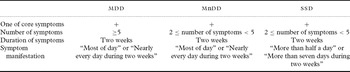
Final diagnoses were made by a panel of four neuropsychiatrists. MDD was diagnosed according to the Diagnostic and Statistical Manual of Mental Disorders-IV (DSM-IV) criteria and MnDD according to the research criteria proposed in Appendix B of the DSM-IV. SSD was diagnosed according to the following operational criteria: (1) two or more symptoms of depression occurring during the same two-week period listed in the criterion A for major depressive episode under DSM-IV; (2) at least one of the symptoms must be depressed mood or anhedonia; (3) each depressive symptom should be present for more than a half of day or more than seven days during the two weeks; and (4) do not meet criteria for the diagnosis of MDD or MnDD. All subjects, who did not meet the criteria for MDD, MnDD, or SSD, were diagnosed as non-depressed controls (NC). Table 1 schematically shows the differences of diagnostic criteria among different depression categories. Numbers of subjects were unequally distributed across the each depressive diagnostic group and control group since they were recruited from community cohort.
Different diagnostic categories in the spectrum of depressive symptoms

Symptoms are listed in DSM-IV criteria; core symptoms are “depressed mood” and “loss of interest.”
MDD = major depressive disorder; MnDD = minor depressive disorder; SSD = subsyndromal depression.
Mortality data
All-cause mortality data until in December 31, 2010, were available for all participants and obtained from the Ministry of Public Administration and Security's National Database.
Statistical analyses
For descriptive statistics, we presented continuous variables as mean values with standard deviations (SD) and categorical variables as frequencies. We performed the statistical comparisons using one-way analysis of variance (ANOVA) with Tukey's post-hoc test for continuous variables and the chi-square test for categorical variables.
The Kaplan-Meier method and the log-rank test were used to assess and compare cumulative survival rates between different depressive diagnostic groups. The hazard ratio (HR) for death from all causes conferred to demographic and clinical variables was estimated by Cox proportional hazard analysis. The effects of variables are described by their Cox regression hazard ratios and 95% confidential intervals (CIs). The potential risk factors (age, cognitive function, and comorbid physical illnesses) were adjusted in the Cox proportional regression models for testing the impacts of different severity of depressions on the all-cause mortality. We used the MMSE score, which was one quantifying value for general cognitive function, as a covariate in the analyses since it was reported to be correlated with mortality (Frisoni et al., Reference Frisoni, Fratiglioni, Fastbom, Viitanen and Winblad1999; Bassuk et al., Reference Bassuk, Wypij and Berkman2000). Non-depressed subjects were chosen as reference group in Cox proportional hazards regression models. We set the significance level at a two-tailed p value of ≤ 0.05.
All analyses were performed using SPSS software (SPSS version 17.0; SPSS Inc., Chicago, IL, USA).
Results
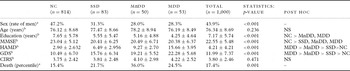
Of the 1,000 participants at the baseline, 561 (56.1%) were female and 439 (43.9%) were male. The mean age was 76.34 ± 8.69 years (range, 65–98 years). The numbers of MDD, MnDD, and SSD patients were 53, 50, and 83, respectively. The characteristics of the participants are presented in Table 2.
Demographic and clinical characteristics of the subjects

Data analyzed by aChi-squared test and bANOVA; post-hoc test was conducted by Tukey method; values expressed as: mean ± SD.
NC = normal control; SSD = subsyndromal depression; MnDD = minor depressive disorder; MDD = major depressive disorder; MMSE = Mini-Mental State Examination; HAMD = Hamilton Depression Rating Scale; GDS = Geriatric Depression Scale; CIRS = Cumulative Illness Rating Scale; NS = non-significant.
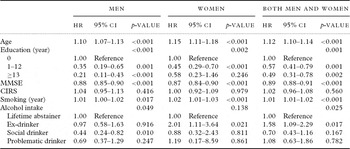
By the end of 2010, 174 subjects (17.4%) died. Mean duration of follow-up was 52.24 ± 12.84 months (range, 0–63 months). In univariate Cox proportional hazard models, age (p < 0.001), education (p = 0.002), MMSE score (p < 0.001), smoking duration (p < 0.001), alcohol intake (p = 0.017), and depressive disorders (p = 0.001) were associated with all-cause mortality, while CIRS score was not (HR = 1.02, 95% CI = 0.96–1.08, p = 0.560) (Table 3).
Risks of all-cause mortality associated with demographic and clinical characteristics of the subjects

The hazard ratio (HR) for all cause-mortality was calculated by the Cox proportional hazard model. MMSE = Mini-Mental State Examination; CIRS = Cumulative Illness Rating Scale.
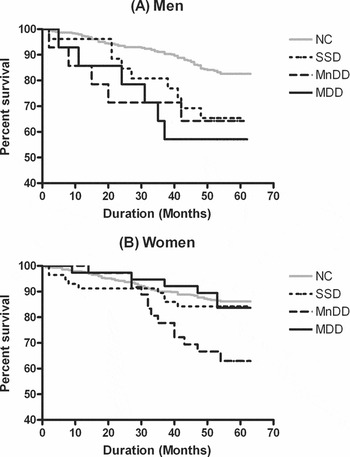
Survival rates in MDD, MnDD, SSD, and NC group were 75.5%, 64.0%, 78.3%, and 84.6%, respectively, and MnDD group showed significantly lower survival rate than NC group (p < 0.001). In men, not only MDD (53.3%) but also MnDD (64.3%) and SSD (65.4%) showed significantly lower survival rate than the NC group (82.8%; p < 0.05). In women, only MnDD showed the lower survival rate (63.9%) than the NC group (p < 0.001). The survival rates of the MDD (75.5%) and SSD (78.3%) groups were comparable to that of the NC group (84.6%). Kaplan-Meier survival curves on the cumulative probability according to subtypes of depression are presented in Figure 1.
Survival curves stratified by the subtypes of late-life depression in men (A) and women (B). The Kaplan-Meier Survival model was assessed (p-value = 0.002 for men and 0.006 for women, analyzed by log-rank test).

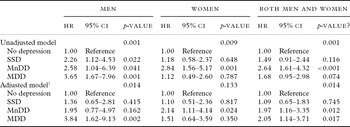
In the multivariate Cox proportional hazard model that computed all the risk factors for all-cause mortality in the univariate models, depressive disorders remained as a significant risk factor for all-cause mortality (p = 0.001) and its interaction term with gender was significant (p < 0.001). In all subjects, MDD (HR = 2.05, 95% CI = 1.14–3.71, p = 0.017) and MnDD (HR = 1.97, 95% CI = 1.16–3.35, p = 0.012) but not SSD (HR = 1.09, 95% CI = 0.65–1.83, p = 0.745) were associated with the risk of all-cause mortality after adjusting other risk factors of all-cause mortality (Table 4).
Risks of all-cause mortality associated with major depression and non-major depression

†Model adjusted for age, education level, cognitive function, alcohol use, and smoking.
The hazard ratio for all cause-mortality was calculated by the Cox proportional hazard model. HR = hazard ratio; MDD = major depressive disorder; MnDD = minor depressive disorder; SSD = subsyndromal depression.
In men, MDD (HR = 3.65, 95% CI = 1.67–7.96, p = 0.001), MnDD (HR = 2.58, 95% CI = 1.04–6.39, p = 0.041), and SSD (HR = 2.26, 95% CI = 1.12–4.53, p = 0.022) were all associated with the risk of all-cause mortality, and the risk of all-cause mortality conferred to MDD remained significant after adjusting other risk factors for all-cause mortality such as age, education, MMSE score, smoking, and alcohol intake (HR = 3.84, 95% CI = 1.62–9.13, p = 0.002).
However, in women, only MnDD (HR = 2.84, 95% CI = 1.56–5.17, p = 0.001) was associated with the risk of all-cause mortality, but this MnDD-conferred risk of all-cause mortality lost its statistical significance when other risk factors for all-cause mortality were adjusted (p = 0.133).
Discussion
This study tried to elucidate the impact of LLD on the all-cause mortality by stratifying LLD into MDD, MnDD, and SSD. The impact of MDD on all-cause mortality showed a gender-dimorphism; MDD increased all-cause mortality in men after adjusting other risk factors but not in women. MnDD was associated with the risk of all-cause mortality in both sexes in the unadjusted models. However, these risks of all-cause mortality conferred to MnDD lost their statistical significance when other risk factors were adjusted. SSD also showed a gender-dimorphism in the unadjusted models; SSD increased all-cause mortality in men but not in women. However, the SSD-conferred risk of all-cause mortality in men was not found when other risk factors were adjusted. In summary, MDD was an independent risk factor for all-cause mortality in elderly men. The increased risk of all-cause mortality observed in the patients with non-major depressions (MnDD, SSD) may not directly be attributed to depression itself but possibly to various comorbid conditions in the elderly.
MDD as the independent risk factor for all-cause mortality
The mechanisms underlying the relationships between MDD and all-cause mortality are complicated. Harmful health behaviors may mediate the excess mortality of MDD patients: depression has been associated with greater likelihood of smoking, alcohol and drug abuse, and poor therapeutic compliance for comorbid illnesses (Roeloffs et al., Reference Roeloffs, Fink, Unützer, Tang and Wells2001; Dierker et al., Reference Dierker, Avenevoli, Stolar and Merikangas2002; Kim et al., Reference Kim, Park and Kim2010). Besides these, MDD, the most severe form of depressive disorders, may directly influence excessive mortality in elderly men. Supporting this, in our multivariate analysis, MDD patients showed about four times higher risk for all-cause mortality than the NC after controlling various cofounders in elderly men. Biological mechanisms such as neurohormonal dysregulation and inflammatory dysfunction may influence directly the excess mortality of MDD patients: patients with MDD showed dysregulation in autonomic nervous system and the hypothalamic-pituitary-adrenal (HPA) axis although they are medically well (Carney et al., Reference Carney, Freedland, Miller and Jaffe2002; Sherwood et al., Reference Sherwood2007). Thus, MDD is commonly accompanied with increased level of pro-inflammatory cytokines such as interleukin-6, C-reactive protein, and tumor necrosis factor-α (Carney et al., Reference Carney, Freedland, Miller and Jaffe2002; Sherwood et al., Reference Sherwood2007). MDD has also been described as an independent risk factor for cardiovascular disease and a number of cancers (Pratt et al., Reference Pratt, Ford, Crum, Armenian, Gallo and Eaton1996; Gross et al., Reference Gross, Gallo and Eaton2010). Recent preliminary study reported that MDD is associated with accelerated telomere shortening, a measure of accelerated aging (Simon et al., Reference Simon2006). These mechanisms may possibly explain why all-cause mortality associated with depression was confined to MDD, the most severe form of depression after controlling confounders.
Gender dimorphism in the association between depression and mortality
Both major and non-major depressions are more prevalent in women than in men. This gender difference in depression rates has been consistently reported over three decades (Parker and Brotchie, Reference Parker and Brotchie2010). Responses to drug and non-drug therapies were also different by gender in depressive patients (Parker and Brotchie, Reference Parker and Brotchie2010). The gender-dimorphism in the depression-conferred risk of mortality was reverse to that in the risk of depression. In a previous meta-analysis on 25 community-based cohort studies, the relative risk of all-cause mortality was larger in men than in women, although the difference did not reach a statistical significance (Cuijpers and Smit, Reference Cuijpers and Smit2002). In this meta- analysis, gender dimorphism was analyzed not in MDD but in overall depression, and other potential confounding risk factors were not adjusted.
Although the mechanisms that may underlie this gender dimorphism on MDD-conferred risk of all-cause mortality are not well understood yet, there are several plausible explanations in terms of biological and psychosocial aspects. First, increased mortality of cardio- or cerebrovascular disease associated with MDD may contribute to the higher mortality in men than in women. It is well known that depression is associated with the morbidity and mortality of stroke (Pan et al., Reference Pan, Sun, Okereke, Rexrode and Hu2011) and ischemic heart disease (Jiang, Reference Jiang2008). These vascular diseases are common in the elderly. Age-associated decline in testosterone may also increase the mortality in cardiovascular diseases in men since it may decrease blood high-density lipoprotein and increase low-density lipoprotein (Viña et al., Reference Viña, Borrás, Gambini, Sastre and Pallardó2005). Second, depression has been linked to oxidative stress in general (Irie et al., Reference Irie, Asami, Nagata, Ikeda, Miyata and Kasai2001; Reference Irie, Miyata and Kasai2005; Forlenza and Miller, Reference Forlenza and Miller2006; Yager et al., Reference Yager, Forlenza and Miller2010), and oxidative damage plays a role in reducing lifespan (Johnson et al., Reference Johnson, Sinclair and Guarente1999). Men express lower levels of protective enzymes such as superoxide dismutase and catalase than women and consequently suffer higher levels of oxidative damage (May, Reference May2007). Third, depressed men commit suicide more often than depressed women (Hawton, Reference Hawton2000; Oquendo et al., Reference Oquendo, Ellis, Greenwald, Malone, Weissman and Mann2001). Suicide attempts in men are more lethal than those in women and this difference is more pronounced in old age (Dombrovski et al., Reference Dombrovski, Szanto, Duberstein, Conner, Houck and Conwell2008). Fourth, hazardous health behaviors and accidental deaths may also contribute to the gender dimorphism in MDD-conferred mortality. Depression is frequently comorbid with problematic alcohol drinking and driving impairment, which are far more common in men (Wingen et al., Reference Wingen, Ramaekers and Schmitt2006; Kim et al., Reference Kim2009; Jeong et al., Reference Jeong2012b). Fifth, women are culturally more prone to report depressive complaints. Therefore, broader definition of depression in women would conceal the real effect that more severe, clinically relevant levels of depression may have on mortality (Schoevers et al., Reference Schoevers2000).
Relationship between non-major depression and mortality
The majority of elderly people with clinically significant depressive symptoms do not meet the DSM-IV diagnostic criteria for MDD (Lavretsky and Kumar, Reference Lavretsky and Kumar2002; Park et al., Reference Park2010; Reference Park2012). In contrast to the impact of MDD on mortality, the impact of these non-major depression on mortality has been in controversy yet (Hermens et al., Reference Hermens2004). Risk of mortality associated with depression was correlated with the severity of depressive symptoms (Adamson et al., Reference Adamson, Price, Breeze, Bulpitt and Fletcher2005; Wulsin et al., Reference Wulsin, Evans, Vasan, Murabito, Kelly-Hayes and Benjamin2005). This was the case in the present study. The relative risk of all-cause mortality was highest in the MDD group and lowest in the SSD group. However, the increase of mortality that is directly attributable to depression may be “on and off” rather than linear. In our previous work, we showed that a failure of compensation mechanism might underlie the development of MDD from SSD in elderly men (Jeong et al., Reference Jeong2012a); plasma adiponectin level was significantly increased in proportion to the severity of depressive symptoms in the SSD patients but was not increased in the MDD patients. Some mechanisms that confer the risk of mortality may possibly be turned on when depressive symptoms reach to a certain threshold. We could conjecture that this turning-on threshold of increasing mortality may be present somewhere in the severity spectrum of non-major depression, and the biological mechanisms hazardous to survival of depression patients may be more easily turned on in men than in women.
In this study, we found that the increased mortality conferred to non-major depression in the univariate model disappeared when comorbid conditions were taken into consideration in the multivariate model. These results suggest that SSD, the most prevalent type of late-life depression, may not be a risk factor for increased mortality in itself but an indicator of increased mortality conferred to other comorbid conditions. In addition, these results may explain, at least in part, the conflicting results on the association of non-major depression with the risk of mortality in previous studies.
Strengths and limitations
This study has several strengths. First, we adjusted risk factors that may be associated with mortality in estimating the impact of depressive disorders on all-cause mortality. Second, research neuropsychiatrists interviewed all participants face-to-face using a structured clinical interview and thus minimized misclassification of subtypes and under- or overdiagnosis of non-major depression. Notwithstanding these strengths, several limitations warrant consideration. First, medications were not controlled. Second, sample size was relatively small. Third, cause-specific mortality was not available. In the future, we need to elucidate how the change of depression has an impact on the mortality in our prospective study.
In conclusion, MDD was a direct risk factor for all-cause mortality in elderly men whereas non-major depressions may be an indicator of increased all-cause mortality in both genders.
Conflict of interest
None.
Description of author' roles
KW Kim designed the study and the analytical approach, obtained funding, and had overall responsibility for data collection. HG Jeong contributed to the design of analysis, and wrote the first draft of the paper. TH Kim, JJ Lee, SB Lee, JH Park, and YS Huh contributed to the acquisition of data. HJ Chin provided methodological and statistical support. JW Han along with all other authors participated in the review and revision of the paper.
Acknowledgments
We thank all the participants who so generously gave us their time and support. This study was supported by an Independent Research Grant (IRG) from Pfizer Global Pharmaceuticals (Grant No. 06-05-039) and a grant of the Korean Health Technology R&D Project, Ministry for Health, Welfare & Family Affairs, Republic of Korea (Grant No. A092077).