Introduction
Nursing homes house a high prevalence of residents with pathogen colonization, creating a high risk for resident-to-resident transmission of Staphylococcus aureus (SA) and carbapenem-resistant organisms (CRO) including Enterobacterales, Pseudomonas aeruginosa and Acinetobacter spp. A subset of nursing homes provide care for residents requiring respiratory support using a mechanical ventilator. Residents who require chronic ventilator support are frequently colonized with pathogens because of chronic indwelling medical devices such as tracheostomy tubes, extensive exposure to the healthcare environment and frequent antibiotic use. Reference Munoz-Price1 These nursing home chronic ventilator unit (NH-CVU) residents are typically clustered together in groups of 10–12 beds on units of 20–30 beds. These beds with residents on chronic ventilators can share staff with beds with residents not on chronic ventilators. Hands and clothing of nursing home staff are the most frequent vector for pathogens, including multidrug-resistant organism (MDRO) transmission as their clothing and hands may become contaminated with MDROs during the care of MDRO-colonized residents. Reference Blanco, Johnson and Sorkin2,Reference Roghmann, Johnson and Sorkin3
Until recently, a consistent approach to personal protective equipment (PPE) use for MDRO prevention in nursing homes has not been in place. Since 2019, CDC guidance on the implementation of PPE use in nursing homes has recommended targeted gown and glove use as a part of Enhanced Barrier Precautions (EBP) to prevent the spread of MDROs as part of outbreak responses 4 . In June 2021, the Healthcare Infection Control Practices Advisory Committee (HICPAC) finalized a white paper based on expert opinion for broader use of EBP. 5 In July 2022, the CDC published guidance that expanded the use of EBP to include any resident with an indwelling medical device or wound (regardless of MDRO colonization or infection status) and expanded MDROs for which EBP may apply. Full adoption of EBP by most nursing homes has been variable 6,7 given persistent challenges with frequent staff turnover and vacancies. 8–Reference Bowblis, Brunt, Xu, Applebaum and Grabowski10 The release of updated EBP guidance occurred during the COVID-19 pandemic, a time when SARS-CoV-2 outbreak response and prevention was the focus. In addition, there were no federal or state regulations requiring its use. Effective April 1, 2024, the Centers for Medicare and Medicaid Services (CMS) now includes EBP in F880 Infection Prevention and Control, requiring EBP use in nursing homes. 11 The objective of this study performed in 2022–2023 was to test the feasibility of EBP implementation for residents with a medical device or chronic wound and the effect of EBP in preventing SA and CRO transmission in residents in a NH-CVU. The mechanistic hypothesis underlying this study was that the use of gowns by HCP for high contact care in residents with medical devices or chronic skin breakdown or known history of MDRO colonization leads to reduced transmission in the group of residents cared for by the HCP.
Methods
Study design and setting
We conducted a pre-post interventional study in the NH-CVU at two community-based nursing homes (205 and 62 total licensed beds in each nursing home, respectively) in Maryland between February 15, 2022, and May 30, 2023. NH-CVU1 had 26 beds, and NH-CVU2 had 22 beds. Both units had a mix of residents on ventilators with residents who were not on ventilators. At baseline, NH-CVU1 used gowns and gloves for all direct care (directly touching the resident) in all residents, while NH-CVU2 only used gowns and gloves for high-contact care (aka EBP) in residents with targeted MDROs. Both units used reusable cloth gowns with disposable gowns available as needed. NH-CVU2 receives more patients who are early in the ventilator weaning process and has a shorter length of stay. Neither facility used chlorhexidine bathing or nasal mupirocin for decolonization. All adult residents living in either NH-CVU during that period, who were not identified by nursing home staff as combative, were eligible for inclusion. The study was reviewed and approved by the University of Maryland, Baltimore Institutional Review Board (IRB) with an alteration of informed consent.
Design of the intervention
The intervention was the implementation of EBP for residents on the chronic ventilator unit (regardless of if the resident was on a ventilator) with medical devices or chronic wounds or known to be infected or colonized with an MDRO. Gowns and gloves were used for high-contact care activities including assistance with bathing, toileting, dressing or other hygiene, transfers, changing linens, tracheal tube care such as suctioning or dressing changes, other wound care and care of devices such as indwelling catheters. We used a transdisciplinary, human factors engineering and infection prevention approach to understand the baseline process and workflow, and to identify necessary changes in work system design and workflow to make it easy for healthcare personnel (HCP) to follow EBP more consistently. To develop a scalable, multifaceted intervention, we employed the following methods: (1) Environmental assessment and initial evaluation of NH-CVU layout and work systems; (2) Participatory design/feedback sessions; (3) Contextual inquiry sessions (direct observations followed by probing); and (4) Training. (See Supplemental Materials for additional details)
Data analysis during the design phase
Qualitative data from interviews, feedback sessions, and contextual inquiry sessions were analyzed guided by the Systems Engineering Initiative for Patient Safety (SEIPS) model 2.0 Reference Carayon, Wooldridge, Hoonakker, Hundt and Kelly12 and included sub-themes of (1) tools and technologies; (2) the environment; (3) people; (4) tasks; (5) the organization; and (6) processes.
Data and specimen collection
Resident’s nares, inguinal fold, and skin around the tracheostomy site (if present) in the NH-CVU were swabbed using an E-swab (Copan, Murrieta, CA, USA) at the start of both study periods (baseline and intervention) or when they were admitted (Figure 1). One swab from each body site, (nares, inguinal fold, and skin around the tracheostomy) were collected monthly for the duration of the study period. Direct observations of HCP caring for residents on EBP were performed weekly using an observation instrument designed based on existing literature and input from multidisciplinary stakeholders (see Supplemental Data- EBP auditing tools). These observations included assessment of whether the HCP wore new gloves and a new gown when entering the room, hand hygiene practices, PPE disposal practices, and the type(s) of care provided. We also collected basic demographic data and length of stay prior to enrollment for all study participants.
Study flow diagram for intervention in two Maryland nursing home chronic ventilator units between February 15, 2022, and May 30, 2023.

Outcomes
Our pre-specified primary outcome was a change in acquisition and transmission rates of any organism (SA or CRO) between baseline and intervention periods. The criteria used to define outcomes of acquisition and resident-to-resident transmission are described in detail in Figure 2. To analyze our dataset, we first assembled the sequences from each sample using SPAdes (version 4.0). Reference Workneh, Wang and Kazmi13 We applied MLST Reference Jolley, Bray and Maiden14,Reference Seeman15 to each assembled FASTA file to determine the isolate’s sequence type (ST). Reference Lydecker, Osei and Pineles16 For each identified MLST group, we generated a core single nucleotide polymorphism (SNP) alignment using Snippy. Finally, we grouped the isolates by defining clusters within each MLST group that differed by <15 SNPs. See Supplemental Data for additional details.
Criteria used to define outcomes of acquisition and resident-to-resident transmission.

The determinations of acquisition and transmission were done while the two authors (LO, MR) were blinded to the facility and study period. Two authors separately made determinations, and then consensus was reached on any discrepancies prior to unmasking. Acquisition and resident-to-resident transmission rates for each study period were calculated by dividing the number of acquisitions or transmissions by the number of days between first and last study culture sets subtracting days away from the unit between these dates. Rate ratios and corresponding 95% confidence intervals were then estimated for both acquisitions and resident-to-resident transmissions. New acquisitions were based on the first set of surveillance cultures during each study period and not accounting for cultures during the baseline period when assessing acquisition to limit potential bias. The secondary outcome was compliance with each component of the intervention. This included identifying and flagging residents at high risk, appropriate use of gowns and gloves for high-contact care, and adherence to hand hygiene. We did not culture HCPs. Detailed microbiology laboratory procedures and whole genome sequencing methods are described in detail in Supplementary Materials- Microbiology and Whole Genome Sequencing Methods.
Results
Design of the intervention
Thirty-eight contextual inquiry sessions and fifteen semi-structured, face-to-face interviews conducted across both facilities before, during and after the intervention revealed numerous possible considerations for EBP implementation in the NH-CVU setting. Before the intervention, sixteen HCP provided feedback on signage, PPE storage, and PPE disposal preferences. NH-CVU1 selected a bag that hangs over the door to store gowns, and the other preferred a cart in the hallway. HCP also suggested that it is necessary to clearly differentiate between PPE disposal and linen disposal, and that bright reminders at room entry would help to improve adherence to EBP. Figure 3 highlights the interplay among work system elements, the impact of individual work system elements on the whole system, and relationship between work system, care processes, and system outcomes.
Systems Engineering Initiative for Patient Safety (SEIPS) 2.0 model for implementation of enhanced barrier precautions in chronic ventilator units.

Intervention adherence and effectiveness
Both CVUs had residents with and without ventilator support. Here we describe the residents who resided in the sections of the CVUs where residents typically require ventilator support by their EBP indication and the effect of our intervention on adherence to EBP in this population. Of the 58 residents enrolled in the study who resided in the sections of the CVUs that typically required ventilator support, 54 (93%) had at least one indication for EBP. Among the 54 residents that met EBP criteria, a chronic wound was documented for 51 residents (94%), 52 (96%) had an indwelling medical device, and 8 (15%) were known to be colonized with an MDRO. Of the 51 residents that met EBP criteria and had a chronic wound, 50 (98%) had a tracheostomy, 16 (31%) had a pressure ulcer, 2 (4%) had a venous ulcer and 1 (2%) had a surgical wound and 7 (14%) had a wound of a different type. Of the 52 residents that met EBP criteria and had an indwelling medical device, 49 (94%) had a tracheostomy tube, 39 (75%) had a feeding tube, 19 (37%) had a urinary catheter and 11 (21%) had a vascular catheter. Among all residents at NH-CVU2, the proportion of residents who met EBP criteria and were appropriately placed on EBP increased from 65% in the baseline period to 87% in the intervention period. This information was not available at baseline for NH-CVU1 because at baseline all residents were on a form of EBP. As shown in Figure 4, among all residents on EBP, glove use was high during both the baseline and interventions periods in both NH-CVU. In NH-CVU1, gown use for high contact care for residents on EBP increased from 39% at baseline to 77% in the intervention period. For NH-CVU2, gown use increased from 26% to 72% after implementation of the intervention.
Healthcare personnel hand hygiene and glove and gown usage during high contact care for residents on Enhanced Barrier Precautions by facility and study period in two Maryland nursing home chronic ventilator units between February 15, 2022, and May 30, 2023.

Acquisition and transmission of Staphylococcus aureus and CRO
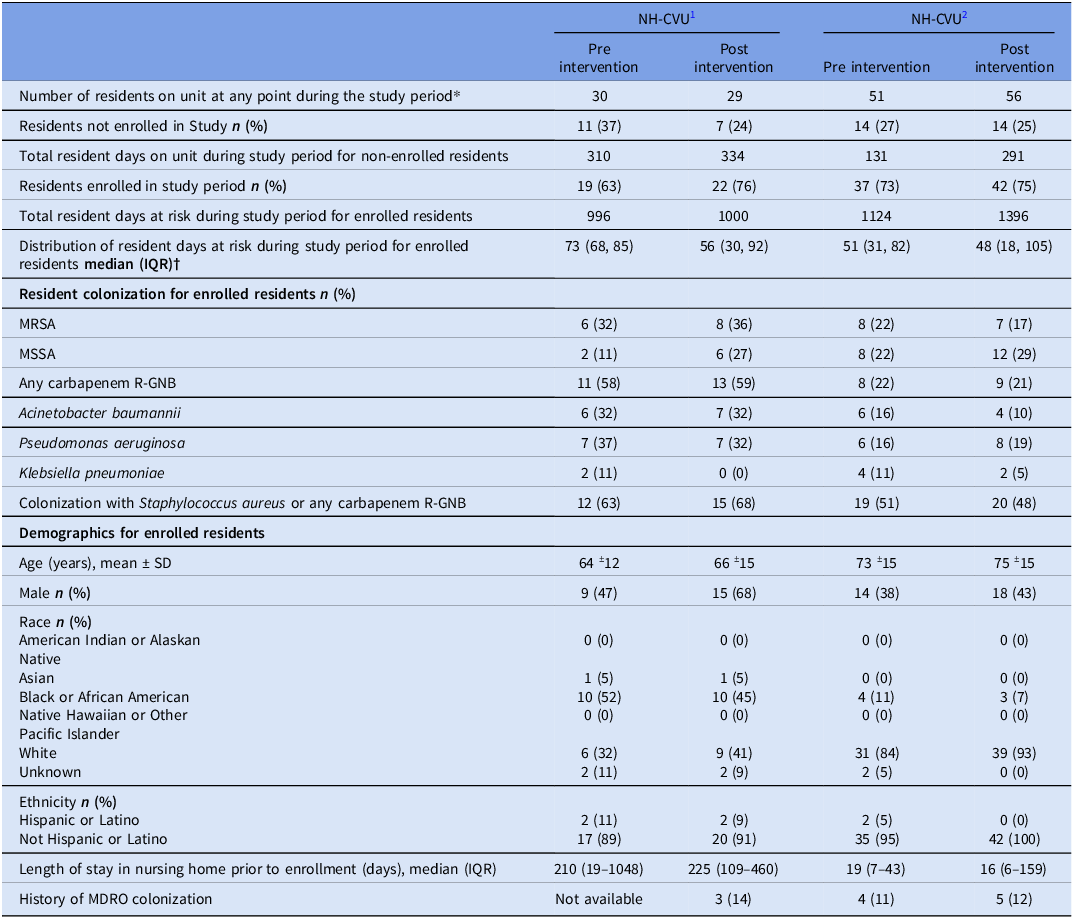
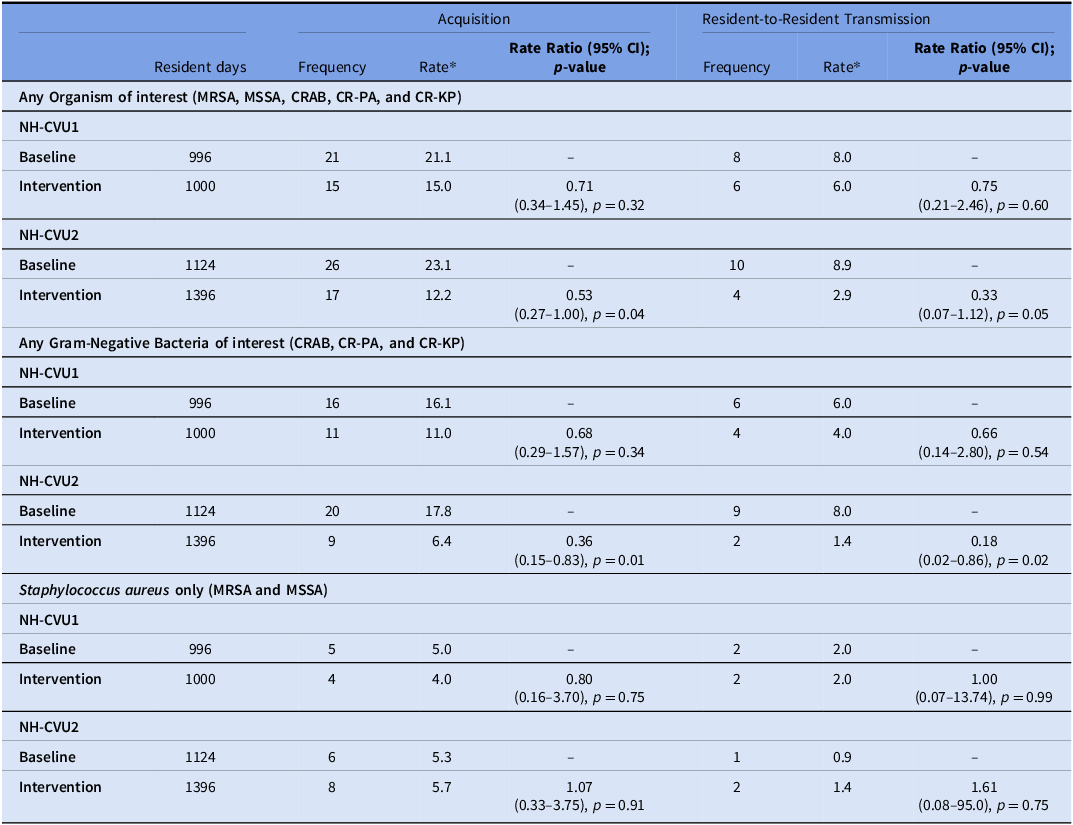
Since HCP in both NH-CVUs cared for residents with and without ventilator support, we cultured both resident populations. Among enrolled residents at NH-CVU1, 63% were colonized with MSSA, MRSA, or a CRO during the baseline period and 68% were colonized during the intervention period. Among enrolled residents at NH-CVU2, 51% were colonized with MSSA, MRSA, or a CRO during the baseline period and 48% were colonized during the intervention period. Table 1 presents colonization data stratified by study site and study period. The determination of acquisition and resident-to-resident transmission in shown in Supplemental Data- Whole Genome Sequencing Outcome Graphs. In NH-CVU1, the acquisition rate of any gram-negative bacteria decreased from 16.1/1,000 resident days at baseline to 11.0/1,000 resident days after the intervention. In NH-CVU2, the acquisition rate of any gram-negative bacteria decreased from 17.8/1,000 resident days to 6.4/1,000 resident days. The resident-to-resident transmission rate of any gram-negative bacteria decreased from 8.0 to 6.0/1,000 resident days in NH-CVU1 (Relative risk (RR)=0.75, 95% CI: 0.21–2.46, p = 0.60) and from 8.9 to 2.9/1,000 resident days in NH-CVU2 (RR = 0.33, 95% CI: 0.07–1.12, p = 0.05) (Table 2). The resident-to-resident transmission rate of S. aureus only was 2.0/1,000 resident days in both the baseline and intervention periods in NH-CVU1 (RR = 1.00, 95% CI: 0.07–13.74, p = 0.99) and increased from 0.9 to 1.4/1,000 resident days in NH-CVU2 (RR = 1.61, 95% CI: 0.08–95.0, p = 0.75). The resident-to-resident transmission rate of CRO only (carbapenem-resistant A. baumannii (CRAB), carbapenem-resistant P. aeruginosa (CR-PA), or carbapenem-resistant K. pneumoniae (CR-KP)) decreased from 6.0/1,000 resident days in the baseline period to 4.0/1,000 resident days after the intervention in NH-CVU1 (RR = 0.66, 95% CI: 0.14–2.80, p = 0.54). In NH-CVU2, the transmission rate of CRO decreased from 8.0 to 1.4/1,000 resident days (RR = 0.18, 95% CI: 0.02–0.86, p = 0.02).
Resident characteristics in two Maryland nursing home chronic ventilator units by facility and study period between February 15, 2022, and May 30, 2023

NH-CVU1: nursing home chronic ventilator unit 1; NH-CVU2: nursing home chronic ventilator unit 2; R-GNB: resistant gram-negative bacilli; MRSA: methicillin resistant Staphylococcus aureus; MSSA: methicillin sensitive Staphylococcus aureus; IQR: Inter quartile range; MDRO: multidrug resistant organism
* Because of prolonged lengths of stay in CVU, some residents were present in the pre intervention period and the post intervention period. In this instance, the resident appears in both time periods.
† Days at risk for enrolled residents defined as the number of days the resident was in the facility between their first and last swab collection of the study period. Residents who did not have at least two sets of swabs collected do not contribute any days at risk.
Effect of the implementation of enhanced barrier precautions on acquisition and resident-to-resident transmission in two Maryland nursing home chronic ventilator units between February 15; 2022; and May 30; 2023

* per 1,000 resident days
MRSA: Methicillin-resistant Staphylococcus aureus; MSSA: Methicillin-susceptible Staphylococcus aureus; CRAB: Carbapenem-resistant Acinetobacter baumannii; CR-PA: Carbapenem-resistant Pseudomonas aeruginosa; CR-KP: Carbapenem-resistant Klebsiella pneumoniae; NH-CVU1: nursing home chronic ventilator units 1; NH-CVU2: nursing home chronic ventilator unit 2
Discussion
Despite the widespread use of EBP due to recent CMS regulations, there is limited direct data on the effectiveness of EBP. In an earlier study Reference Lydecker, Osei and Pineles16 , we demonstrated that when short stay nursing home residents with wounds and indwelling medical devices are placed on targeted gown and glove precautions during high-contact care, there was a greater than 50% reduction in Staphylococcus aureus acquisition when comparing the intervention period to the baseline period. This study adds to that evidence base focusing on residents of nursing home chronic ventilator units. We aimed to evaluate the feasibility and impact of EBP on reducing the transmission of SA and CROs among residents at high risk in NH-CVUs. We conducted a pre-post interventional study in two community-based nursing homes with ventilator units. We showed almost all residents on the chronic ventilator units had indications for EBP with having an indwelling medical device (tracheostomy tube) through a wound (a tracheostomy) as the most common reason. During our intervention, gown use increased by almost 2-fold with larger increases observed in NH-CVU2. Glove use and adherence to hand hygiene remained high in both study periods in both nursing home CVUs. Resident-to-resident transmission either SA or CRO decreased by 25% in NH-CVU1 and by 67% in NH-CVU2. The most substantial decrease in transmission rates was observed for CRO in NH-CVU2.
During this project, we demonstrated the feasibility of implementing EBP in two NH-CVUs with almost 80% adherence to gown use. The human factors engineering and infection prevention approach used to design and implement the intervention revealed that integrating human factors engineering principles and infection control strategies can significantly enhance compliance and effectiveness. This approach was also successful in an earlier study implementing EBP in short- and long- stay units of two community-based nursing homes. Reference Lydecker, Osei and Pineles16 Other approaches incorporating similar elements can also be successful, as shown by our recent quality improvement intervention for EBP using the 4E model (Engage, Educate, Execute, Evaluate) to optimize EBP in four Maryland nursing homes. Reference Mayoryk, O’Hara and Robinson17 These findings underscore the importance of a comprehensive, collaborative approach to infection prevention in nursing homes.
We were also able to assess the impact of EBP on the acquisition and transmission of MSSA, MRSA, and CRO. We used WGS of the cultured isolates to determine whether the isolate was a new acquisition as identified by a new sequence type and cluster. We purposely defined clusters within each sequence type as within 15 SNPs. This cut point has been used by others to define closely related organisms that may represent a transmission event in the healthcare setting. Reference Sundermann, Chen and Kumar18 We used this method to assess SA transmission in our earlier work assessing the feasibility and impact of EBP for residents with devices or chronic wounds in short stay nursing home residents. In that study, we saw a 70% decrease in MRSA, and 56% decrease in MSSA acquisition, and 75% decrease in MRSA, and a 100% decrease in MSSA transmission. Reference Lydecker, Osei and Pineles16 Interestingly, in the NH-CVU residents, the largest decrease was seen in CRO which could reflect a greater burden of colonization with CRO at the tracheostomy site.
Our study has important limitations and strengths. The study was intended to demonstrate feasibility and to estimate effect but was not powered to be a definitive clinical trial for efficacy. It was a simple pre-post intervention in two typically sized ventilator units within nursing homes. Thus, it is limited in both sample size and geographic diversity. In addition, we were unable to culture all the residents in the NH-CVU, and thus, there may have been resident-to-resident transmissions that were not identified because the source of transmission was not cultured. We also only sequenced a single isolate of each Genus species from each culture only performed surveillance of cultures monthly and did not have access to clinical cultures potentially missing acquisition events. We did not culture HCP who could also be a source of transmission. Finally, the intervention period for this study was a limited duration of time and we are not able to comment on the long-term impact on both outcomes and resources. A strength of our study was that we were able to focus the intervention on a subset of the nursing home population that we know are at increased risk of MDRO colonization, movement in and out of healthcare settings, and use of indwelling medical devices. The approach used to design and implement the intervention allowed us to optimize uptake of EBP by tailoring the strategies to the preferences of HCP at each nursing home. However, this method was labor intensive and may not be feasible for all nursing homes to use.
Our study adds to the evidence that targeted use of gowns and gloves for specific subsets of residents is feasible and may prevent the transmission of pathogens, including SA and CRO, in units that provide chronic ventilator support. Of note, in this study, the greater the change in gown utilization, the greater the decrease in transmission. EBP also improves challenges with resource utilization by targeting gown use Reference Roghmann, Lydecker, Mody, Mullins and Onukwugha19 and potential adverse outcomes by implementing the recommendation for gown and glove use during high contact care activities and eliminates the necessity for room restriction and social isolation. In prior work, we found that residents and family members were accepting of EBP if their rationale was explained. Reference Albrecht, Croft, Morgan and Roghmann20 Our findings highlight the importance of tailored infection control measures to enhance resident safety and care quality.
Supplementary material
To view supplementary material for this article, please visit https://doi.org/10.1017/ice.2025.10237
Acknowledgements
This work was supported by funding from the CDC Office of Acquisition Services Contract Award 75D30120C07669. Authors have no relevant conflicts of interest. We would also like to thank the residents, staff and leadership of the participating nursing homes, Georgia Papaminas, Debbie Stevens and the members of the research microbiology lab for their contributions to the project.