The coronavirus disease 2019 (COVID-19) (severe acute respiratory syndrome coronavirus 2 [SARS-CoV-2]) pandemic has demonstrated the utmost need of effective handwashing practices to prevent the spread of virus. 1 The World Health Organization (WHO) recommends handwashing together with physical distancing, and wearing a face mask to prevent COVID-19 in the community. 2 There are two methods of handwashing, including handwashing with soap and water and hand disinfection with alcohol-based formulas. 2 Several studies had been extensively conducted to examine handwashing practices among health professionals before COVID-19 emerged in both developed and developing countries. Reference Price, MacDonald and Gozdzielewska3 However, information regarding these practices in the community, particularly in the context of COVID-19 pandemic, is scarce.
Vietnam is considered one of the few countries successful in fighting the first wave of COVID-19. Reference Duong, Le and Ha4 Indeed, the local government has encouraged the community to practice hand hygiene together with other preventive measures, such as mask-wearing in public and social distancing, since Vietnam reported zero cases. Reference Duong5 Social media users in Vietnam have also spread awareness by sharing videos, such as the viral handwashing song that has since gone global. Reference Duong5 However, the actual levels of handwashing practices among university students, the most educated group in the community, remain unknown. To ensure effective hand hygiene practices, not only during COVID-19 pandemic but also universally, this study aimed to provide data to inform future efforts focusing on increasing community awareness and adherence to correct hand hygiene practices. We examined the frequency and characteristics of hand hygiene as well as an association between hand hygiene practices and academic majors among university students in Vietnam during the COVID-19 pandemic.
Methods
Study Design and Setting
A cross-sectional study was conducted between July 2, 2020, and August 2, 2020, at Phenikaa University, a large multidisciplinary university in Hanoi, Vietnam. All 902 students, including 576 health students from Faculty of Nursing and Faculty of Pharmacy and 326 students from nonhealth related faculties, were invited to participate in the study. Written informed consent was obtained from all study participants. The study was approved by the University Ethics Committee (reference No. 09/TT-KDD). Based on the recommendations of WHO and Vietnam Ministry of Health, 1,2,6 a questionnaire comprised of 7 questions was developed to assess participants’ viewpoint regarding the effectiveness of hand hygiene, the moments to wash hands, and the most appropriate hand hygiene practices for the community and in 4 situations (before wearing a face mask, after removing a face mask, when hands are visibly dirty and are not visibly dirty—the dirt is not visible). These 7 questions included an array question in which, participants could either chose “yes,” “no,” or “not sure” for their responses and 6 single-choice questions in which, participants could only choose 1 response from a predetermined list. Another additional 8 questions were developed to evaluate their handwashing frequency in a normal day and in 7 situations indicated for hand hygiene by WHO including after sneezing or coughing; before and after taking care of sick people; before, during, and after preparing foods; before eating; and after toilet use, handling animals, and waste of animals. 1 To ensure that study participants fully understood the questionnaire, the questionnaire was in Vietnamese and further assistance was provided by the researchers (H.T.N. and M.T.V.).
Statistical Analysis
Data were managed and analyzed using the Statistical Package for the Social Sciences (SPSS) version 26 (IBM, Armonk, New York). Categorical variables were displayed as an absolute count and percentage. The chi-squared test was used to calculate significance levels for categorical data. The significance was set at P ≤ 0.05.
Results
Knowledge and Characteristics of Hand Hygiene Practices as Well as an Association Between Hand Hygiene Practices and Academic Majors Among University Students
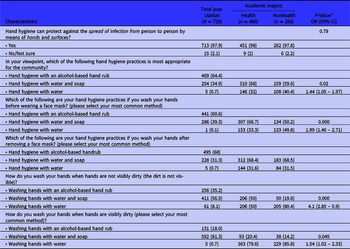
Eighty-one percent (728/902) of all 902 invited students participated in the study with a mean age of 20.8 ± 1.4 years of whom, 298 (40.9%) were male and 460 (63.2%) were from health-related faculties. Most students (97.9%; 713/728) knew that hand hygiene can protect against the spread of infection from person to person by means of hands and surfaces (Table 1). There was no statistical association between this correct response rate and academic majors (P > 0.05). Two-third (66.4%; 469/728) of participants believed that hand hygiene with an alcohol-based hand rub is most appropriate for the community. There was a statistical association between this belief and health majors (P = 0.02).
Association between characteristics of hand hygiene practices and academic majors in 728 university students

* Participants who performed hand hygiene with water only were excluded from the analysis, chi-squared test.
Abbreviations: CI, confidence interval; OR, odds ratio.
Just under two-thirds (60.6%; 441/728) of participants practiced handwashing with an alcohol-based hand rub when they washed their hands before wearing a face mask, followed by hand hygiene with water and soap (39.3%; 286/728). There was a statistical association between these practices and health majors (P < 0.001). Just above two-thirds (68%; 495/728) practiced hand hygiene with an alcohol-based hand rub when they washed their hands after removing a face mask, followed by hand hygiene with water and soap (31.3%; 228/728). There was no statistical association between these practices and health majors (P > 0.05).
Most (92.6%; 674/728) students washed their hands when hands are both visibly dirty and not visibly dirty, while 7.4% (54/728) reported to wash hands when hands are visibly dirty only (data not shown). Regarding the handwashing methods, just above one-third (35.2%; 256/728) washed their hands with alcohol-based handrub when hands are not visibly dirty, followed by hand hygiene with water and soap (56.5%; 411/728). There was a statistical association between these practices and health majors (P < 0.001). Eighteen percent (131/728) washed their hands with alcohol-based handrub when hands are visibly dirty, followed by hand hygiene with water and soap (81.3%; 592/728). There was a statistical association between these practices and health majors (P = 0.045).
Hand Hygiene Frequency Among University Students
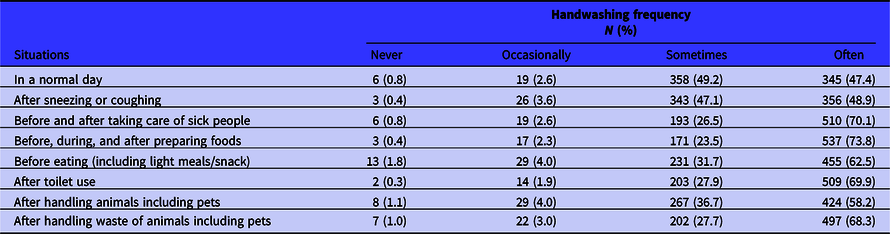
Just under half reported to wash their hands often in a normal day (47.4%; 345/728) and after sneezing or coughing (48.9%; 356/728) (Table 2). In the remaining 6 situations indicated for hand hygiene by WHO, handwashing frequency was mostly reported as “often,” ranging from 58.2% (424/728) to 73.8% (537/728).
Hand hygiene frequency among 728 university students

Discussion
Hand hygiene is one of the most effective measures to reduce the spread of pathogens and prevent infections. 1 The level of knowledge regarding the effectiveness of hand hygiene among our participants is high as almost all of them knew that hand hygiene can protect against the spread of infection from person to person by means of hands and surfaces. The study found that two-thirds of participants believed that hand hygiene with an alcohol-based hand rub is most appropriate for the community. This is probably because the alcohol-based hand rub is convenient and requires less time for application. Reference Chan and Chan7 The study also found an association between this belief and health majors, which may be due to the common practices of hand hygiene with an alcohol-based hand rub among health professionals in their daily practice that have influenced health students. Reference Chan and Chan7 Almost all students washed their hands before wearing (99.5%) and after removing (99.3%) a face mask. Once again, the study found a statistical association between health majors and hand hygiene with an alcohol-based hand rub when study participants washed their hands before wearing a face mask. Most (92.6%) students washed their hands when hands are both visibly dirty and not visibly dirty which is good, while the remaining (7.4%) students reported to wash hands only when hands are visibly dirty only.
In addition, although WHO recommends hand hygiene with water and soap when hands are visibly dirty, Reference Chan and Chan7 18% of our participants washed their hands with an alcohol-based hand rub in this situation and health majors were statistically associated with these practices. The findings of our study show that, although the proportion of hand hygiene compliance is high among study participants, health students tend to practice hand hygiene with alcohol-based handrub in all situations, including those that require hand hygiene with water and soap. This highlights an urgent need to improve community education to help reinforce correct hand hygiene.
WHO emphasizes an important role of community members in fighting COVID-19 by adopting frequent hand hygiene as part of their day-to-day practices. Reference Chan and Chan7 WHO has also indicated 7 specific situations in which handwashing must be performed. Reference Chan and Chan7 However, the proportions of those who washed their hands often in a normal day and after sneezing or coughing were suboptimal in our study. Although we did not examine reasons for not regularly performing hand hygiene, the availability of handwashing equipment would have an impact on hand hygiene practices. Reference Jing, Pei Yi and Bose8
There are five 7-level buildings with several lecture rooms on each level at Phenikaa University. Of these buildings, 2 toilets with 6 handwashing with soap and clean water stations in each toilet were available on each level. Two hand hygiene stations with an alcohol-based hand rub were provided in each lecture room. A special team was responsible for regularly checking these hand hygiene stations to make sure they were in working order and refilling soap and alcohol-based hand rub. However, hand dryers and disposable paper towels to dry hands were not available at all handwashing stations at the time the study was conducted. Given it is important to thoroughly dry hands after each wash, the unavailability of hand-drying equipment could be attributable to the suboptimal hand hygiene frequency in our study participants. In addition, hand hygiene with an alcohol-based hand rub can cause skin reactions with symptoms such as dryness, pruritus, and erythema. Reference Jing, Pei Yi and Bose8 This may adversely affect the willingness to perform hand hygiene with an alcohol-based hand rub among our study participants.
A comparable study was conducted to examine the levels of hand hygiene practices in the Vietnamese community in the middle of 2020. Reference Huong, Hoang and Tuyet-Hanh9 Although this study did not examine the hand hygiene frequency like ours, this study found that 39.4% of their respondents did not perform handwashing, when necessary, which is in line with our findings. Reference Huong, Hoang and Tuyet-Hanh9 The COVID-19 outbreak was under good control in Vietnam at the time when that study and our study were conducted. Perhaps, this made our study participants feel reluctant to frequent wash their hands, which was originally not their habit. Given the ongoing COVID-19 pandemic, this emphasizes the importance of continuous community education regarding hand hygiene practices as a disease prevention and control measure. The role of coughs and sneezes in disseminating respiratory pathogens has been well documented. Reference Dhand and Li10 The respiratory transmission of the SARS-CoV-2 virus that causes COVID-19 is mainly by respiratory droplets created by coughs and sneezes. Reference Dhand and Li10 In light of this, it is important to educate the community that a simple, effective measure to minimize the spread of COVID-19 is to not only covering coughs and sneezes, but also performing correct hand hygiene right after this action.
This study has some limitations. Given it was a single-center study, the study population may not be representative of all Vietnamese university students. Nevertheless, 81% of all enrolled students of one of the largest multidisciplinary universities in Vietnam were participated in our study. Given COVID-19 is a novel disease, there was no internationally validated questionnaire developed to examine hand hygiene practices and other preventive measures in the community. The questionnaire used in this study was developed based on the recommendations of WHO and Vietnam Ministry of Health. 1,2,6 To the best of our knowledge, most similar, published studies also used questionnaires that were developed by the same method as ours.
Conclusions
The levels of knowledge regarding the effectiveness of handwashing among study participants are high, but actual practices of handwashing are suboptimal. It is believed that hand hygiene with alcohol-based handrub is the most appropriate practice for the community. To ensure the effectiveness of handwashing as a COVID-19 preventive measure, it is pivotal to continue to improve community education to help reinforce correct hand hygiene behaviors including when to wash hands and which method should be used.
Data availability statement
All data and related material are included in the manuscript
Author contributions
Drs. M.C. Duong and Nguyen contributed equally to the work. M.C.D. conceived the study. M.C.D. and H.T.N. developed the protocol. H.T.N. and M.T.V. collected data. M.C.D. and B.T.D. analyzed data. M.C.D., H.T.N., B.T.D., and M.T.V. interpreted the findings and wrote the study. All authors reviewed the study.
Conflict(s) of interest
The authors have no conflicts of interest to declare.
Ethical standard
The study procedure was performed in accordance with the ethical principles of the Declaration of Helsinki and was approved by Phenikaa University Ethics Committee (reference No. 09/TT-KDD).
Consent to participate
Informed consent was obtained from all study participants.