Introduction
Frontotemporal lobar degeneration (FTLD) describes a heterogeneous group of neurodegenerative diseases that share a predominance of degeneration in the frontal and temporal lobes. Under the umbrella of FTLD are a number of neuropathologic subtypes, with the most common being FTLD-tau and FTLD-TDP (Cairnes et al., Reference Cairns, Bigio, Mackenzie, Neumann, Lee, Hatanpaa, White, Schneider, Grinberg, Halliday, Duyckaerts, Lowes, Holm, Tolnay, Okamoto, Yokoo, Murayama, Woulfe, Munoz and Mann2007; Mackenzie et al., Reference Mackenzie, Neumann, Bigio, Cairns, Alafuzoff, Kril, Kovacs, Ghetti, Halliday, Holm, Ince, Kamphorst, Revesz, Rozemuller, Kumar-Singh, Akiyama, Baborie, Spina, Dickson and Mann2010). Clinically, FTLD comprises distinct syndromes, one of which has been referred to as FTD. The FTD clinical syndrome is itself heterogenous, being composed of various distinct subtypes including behavioral variant FTD (bvFTD), motor neuron disease (FTD-MND), and the semantic and non-fluent variants of primary progressive aphasia (SV-PPA, NFV-PPA; Bang et al., Reference Bang, Spina and Miller2015).
Most common among the FTD subtypes is bvFTD, a clinical syndrome marked by progressive deterioration of social comportment and executive functions. Behavioral symptoms supportive of a diagnosis of bvFTD include behavioral disinhibition, apathy or inertia, loss of empathy, perseverative or stereotyped behaviors, hyperorality, and dietary changes (Rascovsky et al., Reference Rascovsky, Hodges, Knopman, Mendez, Kramer, Neuhaus, van Swieten, Seelaar, Dopper, Onyike, Hillis, Josephs, Boeve, Kertesz, Seeley, Rankin, Johnson, Gorno-Tempini, Rosen and Miller2011). From a neuropsychological standpoint, diagnostic criteria of bvFTD specify evidence of executive/generation deficits with relative sparing of memory and visuospatial functions. Further diagnostic clarity may be reached with neuroimaging evidence of frontal and anterior temporal atrophy or hypometabolism/hypoperfusion, while a definitive diagnosis can be made only with evidence of a pathogenic mutation or histopathological features at autopsy.
Due to the heterogeneity of neuropathology in bvFTD, finding a targeted treatment is a monumental challenge, and recent work has therefore sought to identify clinical features of bvFTD that may differentiate underlying pathology. A study by Perry et al. (Reference Perry, Brown, Possin, Datta, Trujillo, Radke, Karydas, Kornak, Sias, Rabinovici, Gorno-Tempini, Boxer, De May, Rankin, Sturm, Lee, Matthews, Kao, Vossel and Seeley2017) found that early loss of empathy was found to be far more frequent in those with Pick’s disease, TDP type C, and FTLD due to fused in sarcoma pathology (FTLD-FUS) compared to CBD or PSP tauopathies. The specific pattern of neurodegeneration was thought to be driving these distinctions, as Pick’s disease, FTLD-FUS, and TDP-C are all typically associated with more anterior temporal involvement as opposed to the dorsal-frontal pattern of CBD and PSP (Perry et al., Reference Perry, Brown, Possin, Datta, Trujillo, Radke, Karydas, Kornak, Sias, Rabinovici, Gorno-Tempini, Boxer, De May, Rankin, Sturm, Lee, Matthews, Kao, Vossel and Seeley2017). Other studies have found that the right anterior temporal lobe in particular is critical for empathic behavior (Rankin et al., Reference Rankin, Gorno-Tempini, Allison, Stanley, Glenn, Weiner and Miller2006).
While loss of empathy has been shown to be a useful marker for distinguishing between distinct subtypes of FTLD neuropathology, it may also be effective for distinguishing between bvFTD and other neurodegenerative disorders. This kind of marker could be particularly helpful because bvFTD can be difficult to discriminate neuropsychologically, especially early in the disease course. Desmarais et al. (Reference Desmarais, Lanctôt, Masellis, Black and Herrmann2018) found that socially inappropriate behaviors, including loss of empathy, were present in bvFTD and AD but absent in idiopathic Parkinson’s disease and Lewy body dementia. Although AD patients may experience loss of cognitive empathy due to general cognitive decline, bvFTD patients experience loss of empathy as a primary feature, typically before other cognitive domains are affected (Dermody et al., Reference Dermody, Wong, Ahmed, Piguet, Hodges and Irish2016). In fact, a recent meta-analysis emphasized the importance of loss of empathy as a core feature of bvFTD and highlighted the paucity of studies that assess affective empathy (Carr & Mendez, Reference Carr and Mendez2018).
Therefore, the present study seeks to determine the utility of an informant-report measure of empathy in the diagnosis of bvFTD in comparison to commonly used measures of executive functioning using data from the National Alzheimer’s Coordinating Center (NACC) database. Because bvFTD patients underreport empathy-related behavioral changes in comparison to caregiver observations (Eslinger et al., Reference Eslinger, Moore, Anderson and Grossman2011), and informants may be most likely to observe lack of empathy in everyday contexts, we utilize a standardized informant-report measure to assess empathy. First, we examined differences in empathy between individuals with bvFTD and those with non-bvFTD dementia syndromes. Next, because studies using smaller samples suggested that certain aspects of neurocognitive functioning, including verbal fluency and mental flexibility, contribute to empathy capacity (Eslinger, Reference Eslinger1998; Rankin et al., Reference Rankin, Kramer and Miller2005), we examined associations between empathy and executive functions. Finally, we tested whether empathy distinguished between bvFTD and non-bvFTD better than a traditional measure of executive functioning.
Methods
The Alzheimer’s Disease Center (ADC) program was created by the US National Institute on Aging to support large-scale research on Alzheimer’s disease and related disorders, resulting in the National Alzheimer’s Coordinating Center (NACC) database. ADCs located across the United States began collecting prospective and standardized longitudinal data in September 2005, compiled in the Uniform Data Set (UDS). An additional module, the NACC FTLD Behavior & Language Domains (NACC FTLD), was added in 2012 to collect clinical information specifically related to FTLD. Previous publications describe NACC data in detail (Beekly et al., Reference Beekly, Ramos, Lee, Deitrich, Jacka, Wu and Kukull2007; Besser et al., Reference Besser, Kukull, Knopman, Chui, Galasko, Weintraub, Jicha, Carlsson, Burns, Quinn, Sweet, Rascovsky, Teylan, Beekly, Thomas, Bollenbeck, Monsell, Mock, Zhou and Morris2018). As determined by the University of Washington Human Subjects Division, the NACC database itself is exempt from IRB review and approval because it does not involve human subjects, as defined by federal and state regulations. However, all contributing ADCs are required to obtain informed consent from their participants in accordance with the Helsinki Declaration and to maintain their own separate IRB review and approval from their institution prior to submitting data to NACC. Authors were granted access to a limited data set for use in this study by NACC (Proposal ID 1232).
Participants
The current clinical case series includes data from 791 UDS participants who completed UDS visits with an FTLD module between February 2012 and March 2019 at 25 ADCs. The sample was nearly evenly split by sex (56.9% male), and most had completed post-secondary education. A majority of participants identified as White (93.7%), followed by African American (2.7%), Asian (2.3%), and other/unknown (1.3%). The sample was separated into bvFTD (n = 406) and non-bvFTD (n = 385) based on clinical diagnosis, most often reached by consensus conference, according to formal criteria (i.e., Rascovsky et al., Reference Rascovsky, Hodges, Knopman, Mendez, Kramer, Neuhaus, van Swieten, Seelaar, Dopper, Onyike, Hillis, Josephs, Boeve, Kertesz, Seeley, Rankin, Johnson, Gorno-Tempini, Rosen and Miller2011 international consensus criteria for bvFTD). The non-bvFTD group was primarily composed of patients diagnosed with other forms of FTD (n = 212) but also included primary clinician diagnoses of Alzheimer’s disease (n = 58), progressive supranuclear palsy (n = 44), corticobasal degeneration (n = 32), dementia with Lewy bodies (n = 15), posterior cortical atrophy (n = 13), and other/unspecified (n = 11). Descriptive characteristics of participants by group and corresponding references for diagnostic guidelines are provided in Table 1. Inclusion criteria required a diagnosis of dementia and the completion of all items on an empathy informant-report scale.
Sample characteristics and IRI scores by diagnostic group

Note. IRI, interpersonal reactivity index; PT, perspective taking; EC, emotional control; bvFTD, behavioral-variant frontotemporal dementia (Rascovsky et al., Reference Rascovsky, Hodges, Knopman, Mendez, Kramer, Neuhaus, van Swieten, Seelaar, Dopper, Onyike, Hillis, Josephs, Boeve, Kertesz, Seeley, Rankin, Johnson, Gorno-Tempini, Rosen and Miller2011); PPA, primary progressive aphasia (Gorno-Tempini et al., Reference Gorno-Tempini, Hillis, Weintraub, Kertesz, Mendez, Cappa, Ogar, Rohrer, Black, Boeve, Manes, Dronkers, Vandenberghe, Rascovsky, Patterson, Miller, Knopman, Hodges, Mesulam and Grossman2011); nfvPPA, nonfluent/agrammatic variant PPA; svPPA, semantic variant PPA; lvPPA, logopenic variant PPA; NOS, not otherwise specified; FTLD-MND, frontotemporal lobar degeneration with motor neuron disease (Brooks et al., Reference Brooks, Miller, Swash and Munsat2000); AD, Alzheimer’s disease (McKhann et al., Reference McKhann, Knopman, Chertkow, Hyman, Jack, Kawas, Klunk, Koroshetz, Manly, Mayeux, Mohs, Morris, Rossor, Scheltens, Carrillo, Thies, Weintraub and Phelps2011); PCA, posterior cortical atrophy (Crutch et al., Reference Crutch, Schott, Rabinovici, Boeve, Cappa, Dickerson, Dubois, Graff‐Radford, Krolak‐Salmon, Lehmann, Mendez, Pijnenburg, Ryan, Scheltens, Shakespeare, Tang‐Wai, Filer, Bain, Carrillo and Fox2013); PSP, Progressive Supranuclear Palsy (Bensimon et al., Reference Bensimon, Ludolph, Agid, Vidailhet, Payan and Leigh2009); DLB, dementia with Lewy bodies (Litvan et al., Reference Litvan, Bhatia, Burn, Goetz, Lang, McKeith, Quinn, Sethi, Shults and Wenning2003 and McKeith et al., Reference McKeith, Boeve, Dickson, Halliday, Taylor, Weintraub, Aarsland, Galvin, Attems, Ballard, Bayston, Beach, Blanc, Bohnen, Bonanni, Bras, Brundin, Burn, Chen-Plotkin and Kosaka2017); CBD, corticobasal degeneration (Armstrong et al., Reference Armstrong, Litvan, Lang, Bak, Bhatia, Borroni, Boxer, Dickson, Grossman, Hallett, Josephs, Kertesz, Lee, Miller, Reich, Riley, Tolosa, Troster, Vidailhet and Weiner2013). Data are complete for all variables except for education, where bvFTD n = 398 and non-bvFTD n = 371. Data presented in Mean (SD) format where relevant. Primary groups are significantly different at *p < .05, ***p < .001.
Procedures
Upon initial UDS visit, demographic, clinical, and neuropsychological data were collected using standardized UDS and NACC FTLD module protocols. Each participant was paired with a co-participant who knows them well (e.g., family member, caregiver, etc.) to complete informant-report measures. Only data from initial patient visits are included in the current study to minimize the impact of advanced disease state. For some participants, cognitive data were partially missing because a test was not administered or the patient was unable to provide a response because of a physical, cognitive, or behavioral problem.
In 2015, Version 2 of the standardized UDS neuropsychological battery was partially updated to include equivalent nonproprietary tests in Version 3 (Weintraub et al., Reference Weintraub, Besser, Dodge, Teylan, Ferris, Goldstein, Giordani, Kramer, Loewenstein, Marson, Mungas, Salmon, Welsh-Bohmer, Zhou, Shirk, Atri, Kukull, Phelps and Morris2018). Thus, participants assessed using UDS Version 3 were assessed with different, but similar, measures in some cognitive domains from those enrolled in the study prior to 2015. All updated measures showed strong correlations with corresponding tests in the previous version (Monsell et al., Reference Monsell, Dodge, Zhou, Bu, Besser, Mock, Hawes, Kukull and Weintraub2016). Raw score equivalents established by the Crosswalk study (Monsell et al., Reference Monsell, Dodge, Zhou, Bu, Besser, Mock, Hawes, Kukull and Weintraub2016) were used to equate like measures when relevant.
Measures
Empathy
The Interpersonal Reactivity Index (IRI) is an informant-report measure of the cognitive and emotional components of dispositional empathy (Davis, Reference Davis1980, Reference Davis1983). A 14-item, 5-point Likert scale short form with two main subscales was used. The Empathic Concern scale (IRI-EC), representing the original Emotional Empathy scale, is intended to capture reciprocal other-centered emotional responding. The Perspective Taking scale (IRI-PT), representing the original Cognitive Empathy scale, measures the tendency for spontaneously imagining others’ cognitive perspective. Raw scores for each scale range from 7 to 35, with higher scores interpreted as reflecting a greater degree of empathy.
Cognition
Global cognitive functioning was assessed using the Montreal Cognitive Assessment (Nasreddine et al., Reference Nasreddine, Phillips, Bédirian, Charbonneau, Whitehead, Collin, Cummings and Chertkow2005; UDS-V3) or the Mini-Mental State Exam (Folstein et al., Reference Folstein, Folstein and McHugh1975; UDS-V2). Naming ability was measured using a 30-item version of the Boston Naming Test (Kaplan et al., Reference Kaplan, Goodglass, Weintraub and Goodglass1983; UDS-V2) or the Multilingual Naming Test (Ivanova et al., Reference Ivanova, Salmon and Gollan2013; UDS-V3). Letter and semantic fluency were assessed with the total number of words that begin with the letter F and total number of animals generated in one minute, respectively (Weintraub et al., Reference Weintraub, Salmon, Mercaldo, Ferris, Graff-Radford, Chui, Cummings, DeCarli, Foster, Galasko, Peskind, Dietrich, Beekly, Kukull and Morris2009). Visuomotor speed was measured with a version of Trail Making Test-Part A (TMT-A) that was customized for the UDS protocol (Weintraub et al., Reference Weintraub, Salmon, Mercaldo, Ferris, Graff-Radford, Chui, Cummings, DeCarli, Foster, Galasko, Peskind, Dietrich, Beekly, Kukull and Morris2009). A version of Trail Making Test-Part B (TMT-B), also customized for the UDS protocol, was used to assess set-shifting skills and divided attention (Weintraub et al., Reference Weintraub, Salmon, Mercaldo, Ferris, Graff-Radford, Chui, Cummings, DeCarli, Foster, Galasko, Peskind, Dietrich, Beekly, Kukull and Morris2009). Working memory was measured by the digit span backward length score from the Wechsler Memory Scale-Revised (Wechsler, Reference Wechsler1987) or the Number Span Test (norms not yet published).
Analyses
SPSS version 25.0 was used for all statistical analyses. Chi-square and t-tests were used to examine group differences in demographic variables. Kolmogorov-Smirnov and Shapiro-Wilk tests were used to determine normality of data from the IRI and cognitive tests, and based on findings, nonparametric tests were used for group comparisons. Mann-Whitney U tests with Bonferroni correction for multiple comparisons were conducted to determine differences between bvFTD and non-bvFTD groups on the IRI-PT and IRI-EC empathy subscales, as well as for each cognitive measure. Additional analyses were conducted to determine difference on the same measures between the bvFTD group and subsets of the non-bvFTD group. Partial correlations controlling for age were used to examine associations between empathy subscales and selected neuropsychological measures. Area under receiver operating characteristic (ROC) curves were generated to examine the ability of the IRI subscales and a commonly used executive functioning measure (Trails B) to differentiate participants with bvFTD from the non-bvFTD group and two subgroups (AD and svPPA).
Results
Participants in the bvFTD group were significantly younger than those in the non-bvFTD group, and the bvFTD group had a greater proportion of males than the non-bvFTD group. No statistically significant differences between groups were found for race or education (see Table 1).
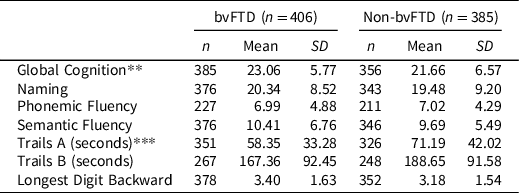
Mann-Whitney U tests with Bonferroni correction (α = 0.0055) showed that empathic concern [U(N bvFTD = 406, N non-bvFTD = 385) = 45,437.50, z = −10.20, p < .001, r = −0.36] and perspective taking [U(N bvFTD = 406, N non-bvFTD = 385) = 41,604.00, z = −11.40, p < .001, r = −0.41] scores were significantly lower for the bvFTD group (Mdn IRI-EC = 20, IQR = 10 and Mdn IRI-PT = 13, IQR = 7) than the non-bvFTD group (Mdn IRI-EC = 25, IQR = 10 and Mdn IRI-PT = 19, IQR = 9). Importantly, MMSE/MoCA scores were significantly better [U(N bvFTD = 385, N non-bvFTD = 356) = 60,214.50, z = −2.86, p = .004, r = −0.11] in the bvFTD group (Mdn = 25, IQR = 8) than in the non-bvFTD group (Mdn = 23, IQR = 9), suggesting that lower IRI scores in the bvFTD group are likely not attributable to lower global cognitive functioning (see Table 2). Review of cognitive test performances found only one additional significant difference between groups for Trails A scores [U(N bvFTD = 351, N non-bvFTD = 326) = 48,010.00, z = −3.62, p < .001, r = −0.14], with slower visuomotor speed demonstrated in the non-bvFTD group (Mdn = 56, IQR = 196) as compared to the bvFTD group (Mdn = 49, IQR = 34).
Cognitive test scores by diagnostic group

Note. bvFTD, behavioral-variant frontotemporal dementia. Groups differences are significant at **p < .006, ***p < .001.
Further analyses were conducted to determine whether group differences on empathy and cognitive measures were present between the bvFTD group and subsets of the non-bvFTD group (AD and svPPA), which revealed similar findings to overall group analyses. Specifically, Mann-Whitney U tests with Bonferroni correction (α = 0.0055) again showed that empathic concern [U(N bvFTD = 406, N AD = 58) = 6494.50, z = −5.53, p < .001, r = −0.26; U(N bvFTD = 406, N svPPA = 61) = 8433.50, z = −4.02, p < .001, r = −0.19], and perspective taking [U(N bvFTD = 406, N AD = 58) = 6369.50, z = −5.67, p < .001, r = −0.26; U(N bvFTD = 406, N svPPA = 61) = 9119.00, z = −3.32, p < .001, r = −0.15] scores were significantly lower for the bvFTD group compared to the AD group (Mdn IRI-EC = 27, IQR = 11 and Mdn IRI-PT = 18, IQR = 27) and the svPPA group (Mdn IRI-EC = 24, IQR = 9 and Mdn IRI-PT = 16, IQR = 10). Global cognition was significantly lower [U(N bvFTD = 385, N AD = 55) = 7946.50, z = −3.00, p = .003, r = −0.14] in the AD group (Mdn = 22, IQR = 8) than in the bvFTD group and did not significantly differ between the svPPA and bvFTD groups. Further, a significant difference [U(N bvFTD = 267, N AD = 36) = 3407.00, z = −2.86, p = .004, r = −0.16] in visuomotor set-shifting scores on Trails B was found between the bvFTD group (Mdn = 134, IQR = 273) and the AD group (Mdn = 239, IQR = 227), with greater impairment demonstrated in the latter group. In the svPPA subgroup analyses, significant differences were also found for naming scores [U(N bvFTD = 376, N svPPA = 48) = 2850.50, z = −7.73, p < .001, r = −0.38] and longest digit span backward [U(N bvFTD = 378, N svPPA = 57) = 8090.00,z = −3.10, p < .002, r = −0.15], with comparatively superior naming skills in the bvFTD group (Mdn bvFTD = 24, IQR = 30 and Mdn svPPA = 6, IQR = 27) and longer digit span backward length in the svPPA group (Mdn bvFTD = 3, IQR = 1 and Mdn svPPA = 4, IQR = 2). No other significant differences were found on cognitive tests when comparing the bvFTD group with AD or svPPA subgroups.
Partial correlations examining whether a portion of the variance in empathy could be accounted for by cognitive performance did not yield significant associations of IRI scores with any neuropsychological measure in either group, contrary to expectations (see Tables 3 and 4). Most neuropsychological measures were moderately intercorrelated for the bvFTD and non-bvFTD groups.
Partial correlation matrix of bvFTD group IRI empathy subscales and cognitive scores, controlling for age

Note. IRI, interpersonal reactivity index; PT, perspective taking; EC, emotional control; bvFTD, behavioral-variant frontotemporal dementia. ***p < .001.
Partial correlation matrix of non-bvFTD group IRI empathy subscales and cognitive scores, controlling for age

Note. IRI, interpersonal reactivity index; PT, perspective taking; EC, emotional control; bvFTD, behavioral-variant frontotemporal dementia. *p < .05, **p < .01, ***p < .001.
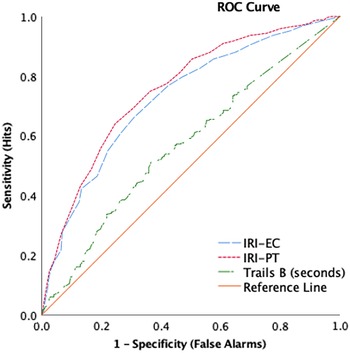
Figure 1 shows ROC curves depicting the ability of the IRI subscales to differentiate the bvFTD group from the non-bvFTD group, as compared to the predictive value of a classical measure of executive functioning. When examining the two main groups, the IRI-PT scale showed the greatest clinical utility, with fair to good diagnostic accuracy for classifying bvFTD versus non-bvFTD participants (areas under the curve (AUC) = 0.76; SE = 0.02; 95% CI = 0.71, 0.80; p < .05). A cutoff score of less than or equal to 16.5 on the IRI-PT short-form scale produced a sensitivity of 75% and specificity of 64%. Similarly, the IRI-EC scale showed fair diagnostic accuracy in differentiating groups (AUC = 0.73; SE = 0.02; 95% CI = 0.68, 0.77; p < .05). A cutoff score of less than or equal to 23.5 on the IRI-EC short-form scale produced a sensitivity of 72% and a specificity of 63%. In contrast, Trails B failed to demonstrate clinical utility in differentiating groups, with diagnostic accuracy reaching poor levels at best at the upper end of the confidence interval (AUC = 0.57; SE = 0.03; 95% CI = 0.52, 0.62; p < .05).
Receiver operating characteristic (ROC) curves comparing sensitivity and specificity of the Interpersonal reactivity index (IRI) emotional control (EC) and perspective taking (PT) scales with that of Trails B performance in seconds for the purpose of differentiating the bvFTD group (n = 267) from the non-bvFTD group (n = 248). Cases with missing Trails B data were excluded.

Subgroup ROC curve analyses comparing classification of bvFTD and AD participants again found fair to good diagnostic accuracy of the IRI-PT scale (AUC = 0.76; SE = 0.04; 95% CI = 0.68, 0.84; p < .001) and the IRI-EC scale (AUC = 0.73; SE = 0.05; 95% CI = 0.64, 0.82; p < .001), with poor diagnostic accuracy of Trails B (AUC = 0.64; SE = 0.05; 95% CI = 0.56, 0.73; p = .005). Optimal cutoff scores were again identified as 16.5 on the IRI-PT scale (sensitivity = 75%, specificity = 61%) and 23.5 on the IRI-EC scale (sensitivity = 72%, specificity = 63%). When comparing classifications of the bvFTD and svPPA participants, a similar but less robust pattern of fair diagnostic utility was found for the IRI-PT (AUC = 0.66; SE = 0.04; 95% CI = 0.58, 0.73; p < .001) and the IRI-EC (AUC = 0.68; SE = 0.04; 95% CI = 0.60, 0.76; p < .001); Trails B again failed to demonstrate clinical utility in differentiating groups (AUC = 0.38; SE = 0.04; 95% CI = 0.30, 0.46; p = .006). Cutoff scores were identified as 14.5 on the IRI-PT (sensitivity = 64%, specificity = 64%) and 22.5 on the IRI-EC (sensitivity = 66%, specificity = 64%).
Discussion
The results of the current study indicate that informant-reported cognitive and emotional empathy was significantly lower in the bvFTD group than the non-bvFTD group. This finding is consistent with existing literature and the primary diagnostic features of bvFTD (i.e., changes in social and emotional functioning), as opposed to the primary diagnostic features of primary progressive aphasias (i.e., language deficits) or FTD with motor neuron disease (i.e., motor decline). These findings remained true in subgroup comparisons of AD and svPPA, selected because of a greater likelihood of behavioral disturbance in these syndromes compared to other subgroups. Importantly, the non-bvFTD group demonstrated significantly worse performances on measures of global cognitive functioning and visuomotor processing speed than the bvFTD group, indicating that the lower ratings on measures of informant-reported empathy in the bvFTD group cannot be explained by lower overall cognitive functioning. Similarly, the AD group demonstrated lower global cognitive functioning and visuomotor set-shifting than the bvFTD group; the svPPA group showed no difference in global cognition but worse naming skills and longer digit span backward performances than the bvFTD group, which again are consistent with expectations and would not account for difference in empathy findings. Further, the IRI scales showed significantly better clinical utility in differentiating groups than a commonly used measure of executive functioning, the Trailmaking Test, Part B on all group and subgroup comparisons. The current investigation highlights the potential importance of including social-emotional symptoms of bvFTD as a significant element in neuropsychological evaluations for which a progressive dementia is in the differential diagnosis, as neuropsychological evaluations often under-emphasize these areas of functioning. While many neuropsychologists may ask about changes in social and emotional functioning during the neurobehavioral interview, typically little objective data are gathered via performance-based neuropsychological tests or informant- or self-report measures in these domains.
No associations were found between measures of neurocognitive functioning and informant-reported empathy, indicating that neuropsychological measures of language and executive functioning that tend to target higher-level cognitive processes may not adequately capture the skills necessary for perspective taking and inference of emotional state. Thus, the executive functioning measures may have targeted the functional capacity of certain regions of the prefrontal cortex (i.e., the dorsolateral prefrontal cortex) but did not identify deficits in social and emotional functioning that have been linked to degeneration in the orbitofrontal cortex (Beer et al., Reference Beer, John, Scabini and Knight2006). However, this finding contrasts with that of Rankin et al. (Reference Rankin, Kramer and Miller2005), who also evaluated neurocognitive correlates of the IRI in patients with various dementias, including bvFTD. Their study reported significant correlations between cognitive and emotional aspects of empathy and measures of nonverbal generation, letter and semantic fluency, and abstract reasoning, with nearly a third of variance on the Perspective Taking scale attributable to semantic fluency performance. These disparate findings are unlikely to be attributable to sample characteristics such as age, education, or global cognition, which appear to be similar across samples. Factors that may explain this discrepancy include the substantially larger sample size in the current study and inclusion of non-bvFTD participants in correlational analyses in the Rankin et al. (Reference Rankin, Kramer and Miller2005) study.
Executive functioning is a complex construct, and the ecological validity of executive functioning measures is variable, making it difficult to measure comprehensively and coherently (Burgess et al., Reference Burgess, Alderman, Evans, Emslie and Wilson1998; Odhuba et al., Reference Odhuba, van den Broek and Johns2005). More specifically, many neuropsychological measures of executive functioning target higher order reasoning abilities that heavily implicate the dorsolateral prefrontal cortex (Possin et al., Reference Possin, LaMarre, Wood, Mungas and Kramer2014). However, these tests are less effective at measuring subtle changes in personality and social behavior caused by damage to the orbitofrontal cortex or deficits in drive and motivation caused by damage to the cingulate cortex. This is problematic for the diagnosis of bvFTD, as degeneration tends to begin in the anterior cingulate cortex and lateral orbitofrontal cortex (Ravdin & Katzen, Reference Ravdin and Katzen2013; Seeley et al., Reference Seeley, Crawford, Rascovsky, Kramer, Weiner, Miller and Gorno Tempini2008). Thus, family and friends may notice differences in the way that patients function interpersonally before neuropsychological test data identify a clear pattern of cognitive deficits typically associated with frontal and temporal lobe functions, especially early in the disease process. This may be especially true for individuals with a high cognitive reserve, relevant to the current study given the high educational attainment in this sample (Placek et al., Reference Placek, Massimo, Olm, Ternes, Firn, Van Deerlin, Lee, Trojanowski, Lee, Irwin, Grossman and McMillan2016; Maiovis et al., Reference Maiovis, Ioannidis, Gerasimou, Gotzamani-Psarrakou and Karacostas2018). Perspective-taking and empathic concern represent unique aspects of empathy, yet we found similar results in these two scales in this study. While cognitive aspects of empathy, such as perspective taking, may be impaired in other neurodegenerative etiologies such as Alzheimer’s disease, this is most likely due to widespread atrophy and global cognitive decline (Dermody et al., Reference Dermody, Wong, Ahmed, Piguet, Hodges and Irish2016). In bvFTD, early neurodegeneration is selective for fronto-insular and temporal networks that are critical for social cognition (Dermody et al., Reference Dermody, Wong, Ahmed, Piguet, Hodges and Irish2016), thus likely to impact both dissociable aspects of empathy.
The current study was limited by the lack of a control group with no diagnosis and participants with dementias outside of the FTD syndromes. Further, though attempts were made to minimize the impact of advanced disease duration on these findings by comparing global cognition between groups and limiting data to that collected during the initial UDS visit, participants were permitted to enroll at any stage of cognitive impairment and this study did not directly control for disease duration. Additionally, the high education level of our sample may limit generalizability to patients with lower educational attainment, as the presence of increased cognitive reserve could have buffered the association between neurocognitive performance and empathy ratings. The neurocognitive measures available in the data set were restricted by nature of the UDS and FTLD module protocols, which limited the ability of constructs to be optimally represented in this study’s analyses. For example, a wider range of executive tests that are less impacted by other domains (e.g., impact of motor speed on TMT-B), such as measures of abstraction and mental set-shifting, may be more useful in distinguishing bvFTD from other dementia presentations; additionally, scores on a word reading test would have been preferable to years of education in efforts to accurately control for premorbid ability, but such data was unavailable. Finally, while it is possible that informant ratings on the IRI implicitly factored into the overall conceptualization of the patient presentation, clinician diagnoses were ultimately based on formal diagnostic criteria; thus, we believe that these results provide valuable information about effective means of quantifying loss of empathy and its usefulness in diagnosing a condition that is often misdiagnosed. Future research should examine the neuroanatomical correlates of neurocognitive measures (particularly executive functioning), their ecological validity, and their sensitivity in identifying underlying neuropathology, especially as it relates to social cognition. Of particular interest might be performance-based measures that assess empathy or similar constructs more objectively for use in FTD evaluations (e.g., affect recognition tasks, social problem-solving tasks), as recent literature suggests a scarcity of such measures specifically validated for neurocognitive disorders (Wright et al., Reference Wright, Grainger, Coundouris and Henry2021). Furthermore, a multimodal approach to assessing empathy that includes performance-based measures, informant-report, and self-report, as opposed to any singular method in isolation, is recommended as best practice (Wright et al., Reference Wright, Grainger, Coundouris and Henry2021).
Overall, results indicate that informant ratings of empathy offer a unique source of clinical information that could have utility in detecting neurobehavioral changes specific to bvFTD before a clear neurocognitive pattern emerges on testing. In particular, these findings support the usefulness of obtaining information about changes in empathy using a readily available and standardized method that takes little time to administer. Given lack of convergence of performance on traditional neurocognitive measures with early neurobehavioral changes in bvFTD, it could prove beneficial to use informant-report measures of empathy in evaluations for which this disorder is included in the differential diagnosis.
Conflicts of Interest
None.
Funding Statement
The NACC database is funded by NIA/NIH Grant U24 AG072122. NACC data are contributed by the NIA-funded ADCs: P50 AG005131 (PI James Brewer, MD, PhD), P50 AG005133 (PI Oscar Lopez, MD), P50 AG005134 (PI Bradley Hyman, MD, PhD), P50 AG005136 (PI Thomas Grabowski, MD), P50 AG005138 (PI Mary Sano, PhD), P50 AG005142 (PI Helena Chui, MD), P50 AG005146 (PI Marilyn Albert, PhD), P50 AG005681 (PI John Morris, MD), P30 AG008017 (PI Jeffrey Kaye, MD), P30 AG008051 (PI Thomas Wisniewski, MD), P50 AG008702 (PI Scott Small, MD), P30 AG010124 (PI John Trojanowski, MD, PhD), P30 AG010129 (PI Charles DeCarli, MD), P30 AG010133 (PI Andrew Saykin, PsyD), P30 AG010161 (PI David Bennett, MD), P30 AG012300 (PI Roger Rosenberg, MD), P30 AG013846 (PI Neil Kowall, MD), P30 AG013854 (PI Robert Vassar, PhD), P50 AG016573 (PI Frank LaFerla, PhD), P50 AG016574 (PI Ronald Petersen, MD, PhD), P30 AG019610 (PI Eric Reiman, MD), P50 AG023501 (PI Bruce Miller, MD), P50 AG025688 (PI Allan Levey, MD, PhD), P30 AG028383 (PI Linda Van Eldik, PhD), P50 AG033514 (PI Sanjay Asthana, MD, FRCP), P30 AG035982 (PI Russell Swerdlow, MD), P50 AG047266 (PI Todd Golde, MD, PhD), P50 AG047270 (PI Stephen Strittmatter, MD, PhD), P50 AG047366 (PI Victor Henderson, MD, MS), P30 AG049638 (PI Suzanne Craft, PhD), P30 AG053760 (PI Henry Paulson, MD, PhD), P30 AG066546 (PI Sudha Seshadri, MD), P20 AG068024 (PI Erik Roberson, MD, PhD), P20 AG068053 (PI Marwan Sabbagh, MD), P20 AG068077 (PI Gary Rosenberg, MD), P20 AG068082 (PI Angela Jefferson, PhD), P30 AG072958 (PI Heather Whitson, MD), P30 AG072959 (PI James Leverenz, MD).