Introduction
The impact of psychosocial distress experienced after traumatic events such as disasters is not just immediate, but often prolonged. Disasters are exceptional events as they tend to cause widespread trauma to many individuals at the same time.Reference Katz, Pellegrino, Pandya, Ng and DeLisi1 The majority of people affected by a natural disaster exhibit mild psychological distress that tends to resolve over a short period of time.Reference Leon2, Reference Gray, Litz and Maguen3 Immediately following the event, survivors often experience fear, anxiety, despair, shock and disbelief.Reference Gray, Litz and Maguen3 A few others present with chronic distress, severe depression and anxiety.Reference Van Ommeren, Saxena and Saraceno4 However, a small percentage of survivors will go on to develop serious psychological sequelae, the most prevalent of which is posttraumatic stress disorder (PTSD);Reference North, Smith and Spitznagel5, Reference North, Pfefferbaum, Narayanan, Thielman, McCoy, Dumont, Kawasaki, Ryosho, Kim and Spitznagel6 intrusive recollections of the event, insomnia, difficulty in concentrating, and irritability are also common.Reference Gray, Litz and Maguen3-Reference North, Pfefferbaum, Narayanan, Thielman, McCoy, Dumont, Kawasaki, Ryosho, Kim and Spitznagel6
The need to manage psychological symptoms after disasters can result in an increase in the prescription of psychotropic drugs including antipsychotics, antidepressants and anxiolytics.Reference Rossi, Maggio, Riccardi, Allegrini and Stratta7 Antipsychotic drugs are used mostly for people with serious mental illness, but changes in the prescription of antidepressants and anxiolytics could be an indicator of general psychological distress in the community. Few studies have considered changes in the prescription and usage of these drugs following a disaster as a proxy measure of the extent of psychological distress in a community. This paper presents the findings of a study undertaken to determine whether the prescription of antidepressants and anxiolytic drugs increased after a natural disaster, specifically after Cyclone Yasi struck North Queensland, Australia.
Psychological distress is a common occurrence documented after a variety of natural events such as earthquakes, fires, floods, and volcanic eruptions.Reference Shore, Tatum and Vollmer8-Reference Goenjian, Najarian and Pynoos15 In addition, people with pre-existing mental illnesses are likely to become more symptomatic or experience a relapse as a result of the disaster.Reference DiMaggio, Galea and Madrid16, Reference Ford, Adams and Dailey17 The two latter conditions can lead to the prescription of psychotropic drugs in an attempt to relieve the symptoms of distress, particularly the symptoms of acute stress disorder (ASD) and PTSD.Reference Rossi, Maggio, Riccardi, Allegrini and Stratta7, Reference Davidson18
To date, only three studies have attempted to determine the extent of psychological distress in a community by measuring the changes in psychotropic drug prescription rates.Reference Rossi, Maggio, Riccardi, Allegrini and Stratta7, Reference DiMaggio, Galea and Madrid16, Reference Boscarino, Galea, Ahern, Resnick and Vlahov19 All three studies reported an increase in the prescription of psychotropic drugs, and hence assumed an increased usage of drugs used to treat psychological distress by members of the community. The first study used a telephone survey,Reference Boscarino, Galea, Ahern, Resnick and Vlahov19 the second measured the use of a specific group of antidepressant drugs only,Reference DiMaggio, Galea and Madrid16 and the most recent study used a pharmaco-epidemiological approach to compare the usage of antidepressant and antipsychotic drugs after the event with the same time period in the previous year.Reference Rossi, Maggio, Riccardi, Allegrini and Stratta7, Reference Rossi, Stratta and Allegrini20 Rossi et al (2011) reported a 37% increase in new antidepressant prescriptions and a 129% increase in new antipsychotic prescriptions following an earthquake in Italy.Reference Rossi, Maggio, Riccardi, Allegrini and Stratta7 In a telephone survey of Manhattan residents following the World Trade attack, participants were asked if they had increased their use of psychiatric medications such as antidepressants or sleeping pills.Reference Boscarino, Galea, Ahern, Resnick and Vlahov19 The study found a significant increase in the use of these drugs. A similar study of New York residents after the World Trade Center attack gathered Medicaid data on new antidepressant prescriptions and found a 18.2% increase in prescription rate.Reference DiMaggio, Galea and Madrid16
On February 3, 2011, Cyclone Yasi, a large Category 5 system, struck the North Queensland coast of Australia between Cairns and Townsville. The towns of Innisfail, Tully, Mission Beach, Cardwell and their surrounding areas bore the brunt of the cyclone.Reference Woods, Goodman, Mills, Usher and McBride21 As a result of the cyclone, there was widespread destruction, leaving many people homeless; large numbers of towns across North Queensland were left without electricity and other essential services; and residents experienced difficulty accessing supplies of food and other staples because of flooded and damaged roads.Reference Woods, Goodman, Mills, Usher and McBride21 As natural events of this proportion are known to have a psychological impact on survivors, a correlational study was undertaken to compare the prescription rate of antidepressants and anxiolytics in the six-month period after the cyclone to the same period in the previous year.
Method
Procedure
A quantitative evaluation of new prescriptions of antidepressants and anxiolytics was conducted. Medicare Prescription Benefit Scheme (PBS) data were collected for all antidepressant and anxiolytic prescriptions during the two comparison periods: February through August 2011 (after Cyclone Yasi) and February through August 2010 (before Cyclone Yasi). Medicare PBS data for the same time periods were also collected for two control drugs, an oral anti-diabetic (glucose lowering) and a lipid- lowering statin medication, to rule out changes in general drug prescription rates in the affected communities. The total number of new prescriptions for these drugs was determined for both time periods.
Ethical approval to conduct the study was received from the relevant human research ethics committee. All data collected were de-identified, so consent to access the data was deemed unnecessary.
The PBS reports data by “statistical local areas” (SLAs). The SLA-specific data were aggregated to determine total prescriptions issued in each of the study months for each type of medication. Total prescriptions, total prescriptions for males and females 14-54 years of age, and total prescriptions for males and females 55-95 years of age were calculated. Also, for each study month, the weighted populations of the represented SLAs were aggregated to estimate the total population at risk during that month. Using these data, prescriptions per 1,000 population at risk were also determined for each medication type for each study month.
Data Analyses
The primary analysis tested two null hypotheses: (1) the number of monthly prescriptions (for each medication type) did not increase significantly from 2010 (before Cyclone Yasi) to 2011 (after Cyclone Yasi); and (2) the population-based monthly rate of prescriptions (for each medication type) did not increase significantly from 2010 to 2011. Secondary analyses explored the same comparisons within each of the four age- and sex-specific subgroups. Because of the small sample sizes and nonparametric nature of the data, the year-to-year changes in number of prescriptions or rate of prescriptions for each month were analyzed using Wilcoxon Sign Rank test with exact P values, with P < .05 used to establish statistical significance. Statistical analysis was conducted using the Statistical Package for the Social Sciences (SPSS) (IBM Corporation, Armonk, New York USA).
Results
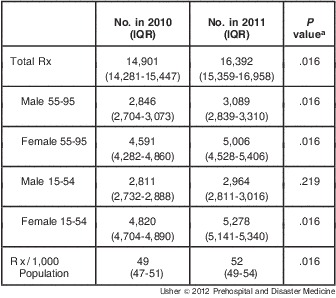
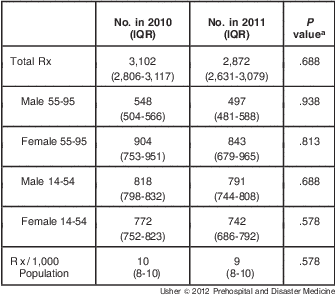
During February through August 2010, 14,901 antidepressant prescriptions, 3,102 anxiolytic prescriptions, and 5,303 prescriptions for lipid- and glucose-lowering medications were filled. For the same months in 2011, 16,392 antidepressant prescriptions, 2,872 anxiolytic prescriptions, and 5,502 prescriptions for lipid- and glucose-lowering medications were filled. There was considerable month-to-month variability in the number of prescriptions for all of the medications included in this analysis.
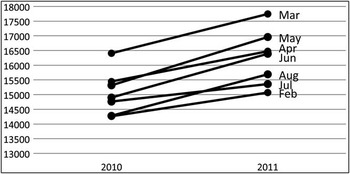
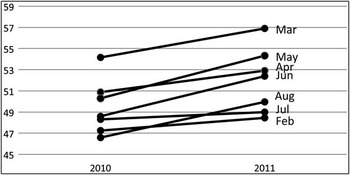
Antidepressant prescriptions increased from 2010 to 2011 in every month, both in terms of raw number of prescriptions issued within the month (P = .016) and the population-based rate of prescriptions for the month (P = .016). The same year-to-year increase in number of monthly prescriptions was seen in all of the age and sex subgroups except for the subgroup of males 14-54 years of age (Table 1, Figures 1 and 2).
Median and Interquartile Range (IQR) Monthly Antidepressant Prescriptions

aWilcoxon Sign Rank test, exact P value.
Median Interquartile Range (IQR) Monthly Antidepressant Prescriptions

Median Interquartile Range (IQR) Monthly Antidepressant Prescriptions per 1,000 Population

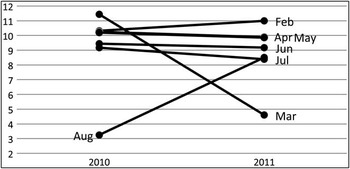
There was no significant overall increase in monthly anxiolytic prescriptions from 2010 to 2011, either in terms of raw number of prescriptions issued within the month (P = .688) or the population-based monthly rate of prescriptions (P = .578). Similarly, there were no significant changes in the number or rate of prescriptions within the age and sex subgroups (Table 2, Figures 3 and 4). There was a notable decrease in anxiolytic prescriptions in March 2011 over March 2010, and a notable increase in anxiolytic prescriptions in August 2011 over August 2010.
Median and Interquartile Range (IQR) Monthly Anxiolytic Prescriptions
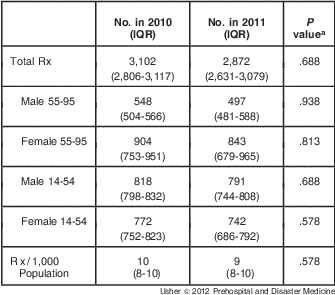
aWilcoxon Sign Rank test, exact P value.
Median (IQR) Monthly Anxiolytic Prescriptionsa. aApril and May data are not combined, but the data are nearly identical and therefore indiscernible in this figure.

Median (IQR) Monthly Anxiolytic Prescriptions per 1,000 PopulationaaApril and May data are not combined, but the data are nearly identical and therefore indiscernible in this figure.

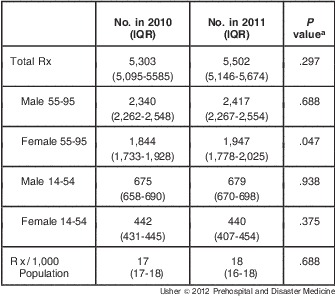
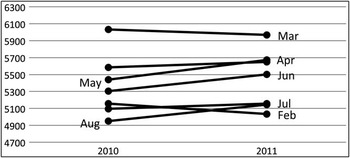
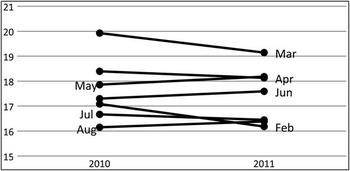
Finally, there was no significant change in monthly prescriptions of the control medications from 2010 to 2011, either in terms of raw number of prescriptions (P = .297) or the population-based rate of prescriptions (P = .688). There was, however, a statistically significant increase in the monthly number of control medication prescriptions among females in the 55-95 years of age group (P = .047) (Table 3, Figures 5 and 6).
Median (IQR) Monthly Lipid- and Glucose-Lowering Prescriptions

aWilcoxon Sign Rank test, exact P value.
Median (IQR) Monthly Lipid- and Glucose-Lowering Prescriptions

Median (IQR) Monthly Lipid- and Glucose-Lowering Prescriptions per 1,000 Population

Discussion
Psychosocial distress following natural disasters such as volcanic eruptions, floods, fires and cyclone has been confirmed in several studies.Reference Leon2 In fact, Leon (2004) claims that when the aftermath of disasters does not result in extensive environmental damage or contamination, the most likely outcomes are psychosocial in nature.Reference Leon2 Antidepressant and anxiolytic drugs are indicated for the treatment of the mental health symptoms prevalent after traumatic events.Reference Katz, Pellegrino, Pandya, Ng and DeLisi1, Reference Davidson18 This study found an increase in antidepressant prescription in the six-month period following Cyclone Yasi in North Queensland, which indicates that residents of the affected communities were experiencing some form of psychological distress that caused them to seek treatment from a doctor. Studies have previously reported an increase in antidepressant prescription following a disaster.Reference Rossi, Maggio, Riccardi, Allegrini and Stratta7, Reference DiMaggio, Galea and Madrid16 In one study, the increase occurred in response to the World Trade Center attack, whereas in the other study it occurred in response to an earthquake—a natural event like a cyclone.Reference Rossi, Maggio, Riccardi, Allegrini and Stratta7, Reference DiMaggio, Galea and Madrid16
The anxiolytic prescription rate increased by the end of the six-month post disaster period, but actually decreased immediately after the event compared to the same time period in the previous year. The three previous studies that explored psychiatric drug prescription after a disaster either did not distinguish among the different types of psychiatric drugs,Reference Boscarino, Galea, Ahern, Resnick and Vlahov19 or did not include the anxiolytic group in their study.Reference Rossi, Maggio, Riccardi, Allegrini and Stratta7, Reference DiMaggio, Galea and Madrid16 However, the most recent study recommended the collection of data on anxiolytic drugs in future studies as the authors suspected the increase in antipsychotic drug prescription in their study may have been motivated by symptoms such as agitation, insomnia and anxiety which may be managed with anxiolytics.Reference Rossi, Maggio, Riccardi, Allegrini and Stratta7 The six-month peak in the prescription of anxiolytic drugs found in this study may indicate a higher than usual rate of psychosocial distress in the community compared to the same time period the year before.Reference Hennessy22, Reference Hoff23 However, the drop in the prescription rate of anxiolytics following the event is confounding. It may be that people residing in the community for whom these drugs are usually prescribed move on after the cyclone, or required a different type of psychiatric drug.
Limitations
The conclusions from this study should be treated with caution. This study compared prescription rates on an aggregate level only, and hence the authors cannot comment on individual behaviors.
Conclusion
The results from this study indicate there was a quantifiable increase in psychiatric drug prescription following Cyclone Yasi in affected communities in North Queensland. These data have potential implications for both mental health professionals and pharmacy professionals working in disaster-affected communities.
Abbreviations
- ASD:
acute stress disorder
- IQR:
interquartile range
- PBS:
Prescription Benefit Scheme
- PTSD:
posttraumatic stress disorder
- SLAs:
statistical local areas