Idiopathic chest pain is a clinical exclusion diagnosis characterised by short periods of pain in the middle of the sternum or inframammary region that is aggravated by deep breathing or palpations and is not accompanied by inflammation.Reference Xu, Zhang and Long1 Idiopathic chest pain is defined as chest pain that cannot be organically explained and that persists after a follow-up period of 6 months.Reference Coleman2 Idiopathic chest pain is the most common cause of chest pain in children, with an incidence rate of 51.0–73.6%.Reference Chun, Kim and Han3,Reference Khalilian, Emami Moghadam and Torabizadeh4 Ten percent of the patients who consulted to paediatric cardiology clinic with chest pain and diagnosed with idiopathic chest pain as a result of clinical evaluation are not satisfied with the result. These patients apply to at least two different paediatric cardiology clinics. Idiopathic chest pain increases the hospital visit and test burden.Reference Cohn and Arnold5
The origin of idiopathic chest pain is unknown. Recently, Kenar et al searched psychological disorders in idiopathic chest pain and found that anxiety levels are related to idiopathic chest pain.Reference Kenar, Örün and Yoldaş6 Moreover, pain sensitisation has been thought to be the underlying cause of other idiopathic pain syndromes in the paediatric group. Previous studies have compared pain pressure thresholds of patients and healthy controls and revealed lower pain pressure thresholds in patients with recurrent abdominal pain, growing pain, and patellofemoral pain syndrome than in healthy controls.Reference Hashkes, Friedland and Jaber7–Reference Duarte, Goulart and Penna9 A decrease in pain pressure thresholds is thought to be the result of altered central processing of nociceptive information.Reference Arendt-Nielsen and Graven-Nielsen10 This decrease is explained as pain sensitisation that develops as a result of a change in the central processing of nociceptive stimuliReference Merskey and Bogduk11. Interventional studies showed that aerobic exercise programme,Reference Koltyn, Garvin and Gardiner12 resistance exercises,Reference Koltyn and Arbogast13 and rolling massageReference Aboodarda, Spence and Button14 help increase pain pressure thresholds and decrease pain perception.
To the best of our knowledge, to date, no study in the literature has evaluated pain sensitisation in children and adolescents with idiopathic chest pain. Hence, the primary goal of the present study was to assess thoracic and extrathoracic pain pressure thresholds in children and adolescents with idiopathic chest pain. We aimed to determine whether there is a difference between genders in terms of pain pressure thresholds in the patient group and whether there is a correlation between pain pressure thresholds and the patients’ pain characteristics and quality of life.
Materials and methods
Study design and setting
The present cross-sectional study was conducted in accordance with the Declaration of Helsinki and in line with the Strengthening the Reporting of Cross-Sectional Studies (STROBE) statement. The study was conducted between August 2019 and September 2020 at the Health Sciences University, Konya Training and Research Hospital, Turkey. Ethical approval was obtained from Konya Meram University Ethics Committee (No: 2019/1996 Date: 07.12.2019).
Patients
Patients diagnosed with idiopathic chest pain between the ages of 10 and 18 years were included in the patient group. Patients with organic chest pain (caused by respiratory or cardiac issues, gastrointestinal diseases, musculoskeletal disorders, and others), endocrinological disease, neurological disease, rheumatological disease, oncological disease, cognitive disorder, continuous medication use, psychiatric disease, or pregnancy as well as those with a history of trauma within the last year were excluded from the study.
The control group consisted of individuals without idiopathic chest pain who met the following criteria, applied to the general paediatrics outpatient clinic, and volunteered to participate in the study: between 10 and 18 years old; not having endocrinological disease, neurological disease, rheumatological disease, oncological disease, cognitive disorder, psychiatric disease, continuous medication use, or pregnancy; and not having a history of trauma in the last year.
Regarding patients with missing data, only one patient with idiopathic chest pain who did not complete the Pediatric Quality of Life Inventory Child version questionnaire was excluded from the study.
Of the patients who applied to the general paediatric outpatient clinic with a complaint of chronic chest pain, those with pain caused by musculoskeletal, gastrointestinal, or respiratory disorders as well as those with pain attributed to any organic reason were excluded. The remaining patients were evaluated in the paediatric cardiology outpatient clinic. Their detailed anamnesis was assessed, and physical examinations were performed. Echocardiographic and electrocardiographic examinations were also performed. Finally, based on the findings, patients who had chest pain that persisted for at least 6 months and was not associated with organic causes were included in the study.
Variables and outcomes
A paediatric cardiologist recorded the age and gender of all the patients. The cardiologist asked the patients about their pain characteristics, symptom duration (months), type of pain, mean pain intensity, mean duration of painful periods, pain frequency, and Pediatric Quality of Life Inventory Child scores. An algologist who was blinded to the study groups measured pain pressure thresholds using an algometer.
A visual analogue scale (0–100 mm) was used to examine the severity of pain, with 0 denoting “no pain” and 100 denoting “the most severe pain possible”. The visual analogue scale is accepted as an easy-to-apply and reliable scale for assessing the severity of pain in children aged ≥ 8 years.Reference Stinson, Kavanagh and Yamada15
The mean duration of painful periods was classified as less than 1 minute, 1–30 minutes, and more than 30 minutes; the patients were asked to select the suitable option from these categories. Moreover, the frequency of chest pain was classified as many times a day, several times a day, several times a week, several times a month, and several times a year; the patients were asked to select their pain frequency from these categories. The type of pain was classified as blunt, squeezing, stabbing, and a burst of painful sensations.
A manual pressure algometer (Baseline Dolorimeter®) was used to measure pain pressure thresholds. The investigator placed the algometer on the site to be examined and pressed against the site in a vertical direction while increasing the force at a constant rate of 1 kg/cm2. Algometry has previously been shown to be reliable in measuring pain pressure thresholds in children.Reference Chaves, Nagamine and de Sousa16 The patients were instructed to express pain either by saying stop or by raising their hands when they felt slight discomfort. The algologist gradually increased the pressure by 1 kg/cm2/second until the patients felt the first sensation of pain (pain pressure threshold). A maximum pressure of 22 kg/cm2 was applied for all the patients. Pain pressure thresholds were bilaterally measured from seven reference areas using the algometer. In the extrathoracic region, measurements were performed in four areas: the supraspinatus origin, trapezius middle fiber midpoint, deltoid midpoint, and proximal medial tibial point. In the thoracic region, measurements were performed in three areas where the midclavicular line intersected with thoracic 2, 4, and 10 dermatomes. The value for each reference area was obtained by calculating the arithmetic mean of the bilateral measurements. Moreover, three mean pain pressure threshold values were mathematically obtained in the patient group: the mean thoracic pain pressure threshold was obtained by calculating the arithmetic average of the pain pressure threshold values in the three thoracic regions, the mean extrathoracic pain pressure threshold was obtained by calculating the arithmetic mean of the pain pressure threshold values in the other four regions, and the mean all-region pain pressure threshold was obtained by calculating the arithmetic mean of the pain pressure threshold values in all the reference points.
The Pediatric Quality of Life Inventory Child inventory was developed to assess the health-related quality of life of children and adolescents aged 2–18 years. It assesses the domains of physical health, emotional functionality, and social functionality. It contains two subscales scores, namely psychosocial health and physical health scores, in addition to the total health score.Reference Varni, Seid and Rode17
Statistical analysis
Statistical analyses were performed using SPSS version 20.0 software (IBM Corp., Armonk, New York, United States of America). There were no missing data for any variable in the study. The Shapiro–Wilk test was used to evaluate the distribution of the data. Descriptive data are presented as the frequencies (n) and percentages (%) for categorical variables and as the medians with the interquartile ranges for non-normally distributed numerical variables. Confidence intervals of the median differences were calculated at 95%. The chi-square test was used to compare categorical variables between independent groups, while the Mann–Whitney U test was used to compare linear variables between independent groups. The correlation between numerical variables was assessed using Spearman’s correlation analysis. p < 0.05 was considered statistically significant.
Results
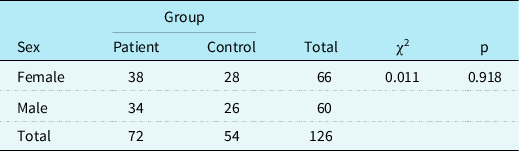
The present study included 72 children and adolescents with idiopathic chest pain in the patient group and 54 children and adolescents without idiopathic chest pain in the healthy control group. There were no significant differences between the two groups in terms of age and gender (Tables 1 and 2, respectively).
Age values of the groups

Comparison of the groups in terms of gender distribution

The type of pain in the patient group was evaluated as blunt in 8.33% of the patients (n = 6), compression in 19.44% (n = 14), stabbing puncture in 25% (n = 18), burst of sensation in 23.61% (n = 17), compression and stabbing in 9.72% (n = 7), and stabbing and burst of sensation in 13.89% (n = 10). Moreover, the frequency of chest pain was evaluated as multiple times a day in 9.72% of the patients (n = 7), several times a day in 27.78% (n = 20), several times a week in 30.55% (n = 22), several times a month in 27.78% (n = 20), and several times a year in 4.17% (n = 3). The mean duration of pain periods was less than 1 minute in 54.17% of the patients (n = 39), 1–30 minutes in 30.55% (n = 22), and more than 30 minutes in 15.28% (n = 11).
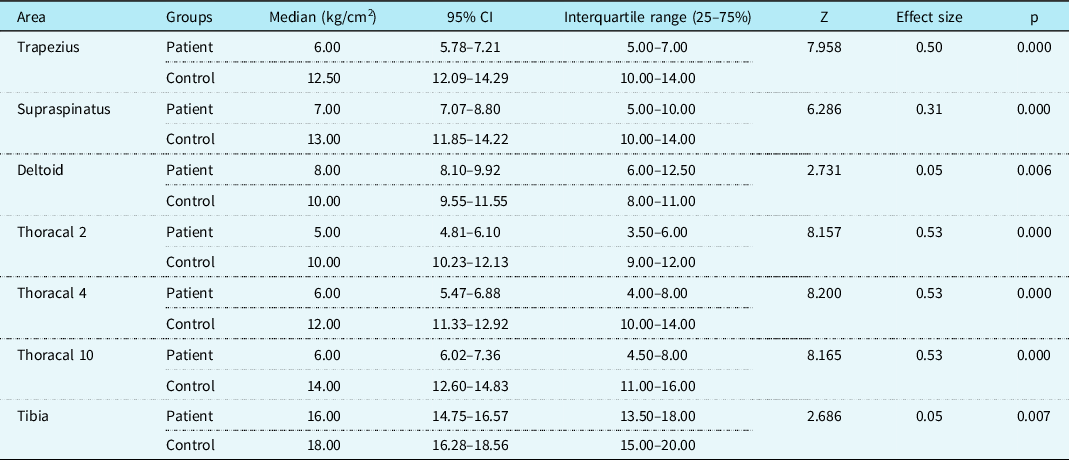
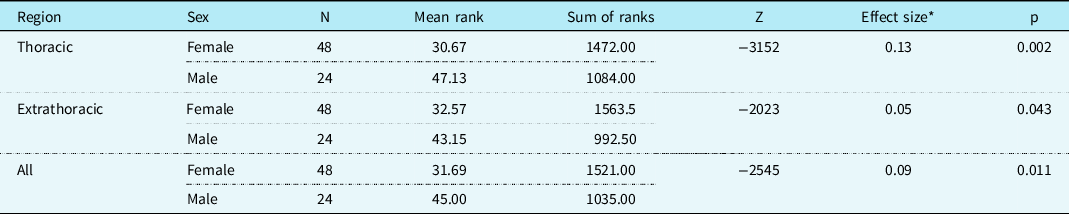
The severity of pain and symptom duration in the patient group are provided in Table 3. Pain pressure thresholds in the patient and healthy control groups are provided in Table 4. Moreover, the mean thoracic pain pressure thresholds, mean extrathoracic pain pressure thresholds, and mean all-region pain pressure thresholds by gender in the patient group are provided in Table 5.
Pain characteristics of the patients

Comparison of pain pressure thresholds of the groups

Comparison of pain thresholds of the patients by gender

In the patient group, although there was no correlation between the mean thoracic pain pressure thresholds and the patients’ age, symptom duration, and mean pain intensity (p = 0.057, r = −0.225; p = 0.83, r = −0.30; and p = 0.648, r = −0.55, respectively), there was a positive correlation between the mean all-region pain pressure thresholds and age (p = 0.047, r = 0.235). Moreover, there was no correlation between the mean all-region pain pressure thresholds and symptom duration and mean pain intensity in the patient group (p = 0.368, r = −0.108 and p = 0.929, r = −0.011, respectively). Similarly, there was no correlation between the mean all-region pain pressure thresholds and Pediatric Quality of Life Inventory Child physical health, psychosocial health, and total health scores in the patient group (p = 0.517, r = 0.078; p = 0.208, r = 0.150; and p = 0.176, r = 0.161, respectively). Although there was no correlation between the mean thoracic pain pressure thresholds and Pediatric Quality of Life Inventory Child physical health, psychosocial health, and total health scores in the patient group (p = 0.783, r = 0.033; p = 0.294, r = 0.126; and p = 0.353, r = 0.111, respectively), there was a positive correlation between the mean thoracic region pain pressure thresholds and mean extrathoracic region pain pressure thresholds in this group (p = 0.000, r = 0.807).
Discussion
In the present study, we found that pain pressure thresholds in the trapezius, supraspinatus, deltoid, tibia, and thoracic 2, 4, and 10 areas were lower in the patient group than in the healthy control group. Similar results have been reported in children groups diagnosed with persistent abdominal pain,Reference Duarte, Goulart and Penna9 juvenile fibromyalgia,Reference King, Mano and Barnett18 growing pain,Reference Hashkes, Friedland and Jaber7 patellofemoral pain,Reference Rathleff, Roos and Olesen8 and juvenile idiopathic arthritis.Reference Leegaard, Lomholt and Thastum19 Alfven compared children with recurrent abdominal pain with healthy controls and found that in the pectoral reference fields, trapezial, subclavian, temporal, and abdominal pain pressure thresholds were lower in children with recurrent abdominal pain than in healthy controls. However, they found no difference in lower extremity pain pressure thresholds between the two groups.Reference Alfvén20 Furthermore, Metsahonkala et al compared extracephalic pain pressure thresholds in children with migraine and tension-type headaches with those in healthy controls and found no difference between the groups.Reference Metsahonkala, Anttila and Laimi21
We found that the mean thoracic pain pressure thresholds, mean extrathoracic pain pressure thresholds, and mean all-region pain pressure thresholds were lower in females than in males in the patient group. Consistent with our findings, Leegaard et al found lower pain pressure thresholds in females than in males with juvenile idiopathic arthritis.Reference Leegaard, Lomholt and Thastum19 However, Hashkes et al found no difference in pain pressure thresholds between female and male children with growing pain.Reference Hashkes, Friedland and Jaber7
In the present study, the mean all-region pain pressure thresholds were found to increase with age. No correlation was detected among the mean thoracic region pain pressure thresholds, mean all-region pain pressure thresholds, pain severity, symptom duration, and quality of life (physical health, psychosocial health, and total health scores). In line with this result, Duarte et al. revealed that pain pressure thresholds in children and adolescents increase with age.Reference Duarte, Goulart and Penna22 On the other hand, Hashkes et al reported no correlation between pain pressure thresholds and age in children with growing pain.Reference Hashkes, Friedland and Jaber7 Moreover, Leegaard et al revealed no correlation between pain pressure thresholds and age, pain experience, and duration of illness in children with juvenile idiopathic arthritis.Reference Leegaard, Lomholt and Thastum19. Rathleff et al revealed a positive correlation between increased symptom duration and pain pressure thresholds but no correlation between pain pressure thresholds and quality of life in adolescents with patellofemoral pain.Reference Rathleff, Roos and Olesen8
We found that thoracic and extrathoracic pain pressure thresholds are correlated in children and adolescents with idiopathic chest pain. Similarly, Metsahonkala et al. revealed that cephalic and extracephalic pain pressure thresholds are correlated in children with headaches.Reference Metsahonkala, Anttila and Laimi21 We also found no correlation between pain pressure thresholds and quality of life; these findings are in line with previous findings.Reference Grundström, Gerdle and Alehagen23
Limitations
The present study has a few limitations. First, the study has a cross-sectional design. When it is accepted that pain hypersensitivity develops as a result of neuronal plasticity, it can be concluded that pain is not a passive process.Reference Woolf and Salter24 By assessing the pain pressure threshold values from the early diagnosis till the long-term follow-up period, more detailed information about possible pain sensitivity can be obtained.
Second, low pain pressure thresholds may not be sufficient to reveal the presence of central sensitisation. It may be more appropriate to reveal pain sensitisation in children and adolescents with idiopathic chest pain using electrophysiological methods, such as laser- or pinprick-evoked potentials, nociceptive withdrawal reflex and reflex receptive field analyses, and cutaneous silent period evaluations.Reference Woolf25
Third, a detailed psychiatric evaluation was not performed in the present study. Although different results have been reported in the literature, pain pressure thresholds are lower in individuals with anxiety and depression than in healthy individuals.Reference Thompson, Correll and Gallop26,Reference Vedolin, Lobato and Conti27 We questioned the history of psychiatric illness and drug use to reduce bias.
While designing the study methodology, we ensured that contributing factors were included in the exclusion criteria, for example, pain pressure threshold measurements were performed by the researcher blinded to the study groups. Moreover, patients with missing data were excluded from the evaluation. These factors helped improve the generalisability of our findings.
Conclusion
Despite its benign course, idiopathic chest pain increases the burden of clinical visits. The fact that its physiopathology is unclear makes it difficult for clinicians to diagnose and treat idiopathic chest pain. The present study is the first step towards investigating probable pain sensitivity mechanisms in children and adolescents with idiopathic chest pain. We found lower thoracic and extrathoracic pain pressure thresholds in children and adolescents with idiopathic chest pain than in healthy controls. Moreover, although there was a positive correlation between pain pressure thresholds and age, there was no correlation between pain pressure thresholds and the patients’ pain severity, symptom duration, and quality of life.
Studies evaluating potential psychological factors associated with pain sensitisation can be planned in larger patient groups. Such studies may help understand the relationship between pain sensitisation and idiopathic chest pain. It is known that pain pressure thresholds increase with exercise programmesReference Koltyn, Garvin and Gardiner12,Reference Koltyn and Arbogast13 and therapeutic massage.Reference Aboodarda, Spence and Button14 In this context, randomised controlled studies in which improvement is evaluated with physiotherapy programmes can be designed. It should be kept in mind that the underlying problem in patients with idiopathic chest pain may be pain sensitisation.
Acknowledgements
None.
Financial support
This research received no specific grant from any funding agency, commercial, or not-for-profit sectors.
Conflicts of interest
None.
Ethical standards
This study was conducted in accordance with the Declaration of Helsinki and in line with the Strengthening the Reporting of Cross-Sectional Studies (STROBE) statement. The study was performed between August 2019 and September 2020 at the Health Sciences University, Konya Training and Research Hospital, Turkey. Ethical approval was obtained from Konya Meram University Ethics Committee (No: 2019/1996 Date: 12.07.2019).
Contributors’ statement
Dr Balta and Ass Prof Arslan conceptualised and designed the study, collected data, drafted the initial manuscript, and reviewed and revised the manuscript. All authors approved the final manuscript as submitted and agree to be accountable for all aspects of the work.