Introduction
Prosper Ménière gave his name to a disorder characterised by recurrent episodes of spontaneous vertigo, fluctuating hearing loss and tinnitus, often accompanied by a sensation of otic fullness.
Most patients with this condition improve with medical treatment; surgical treatment is reserved for resistant or severely incapacitated cases. However, conventional surgical treatments may cause severe side effects (e.g. cophosis following labyrinthectomy) or complications (e.g. due to the intracranial approach used in vestibular neurectomy), or may be ineffective in vertigo control (e.g. endolymphatic sac decompression).
In an attempt to control vertigo while minimising iatrogenic morbidity, researchers have investigated the use of ‘chemical labyrinthectomy’, utilising the ototoxicity of aminoglycoside drugs.
In 1948, FowlerReference Fowler1 was the first to use systemic streptomycin in Ménière's disease. In 1957, SchuknechtReference Schuknecht2 performed the first intratympanic streptomycin injections. The resultant vertigo control was excellent but there was a high incidence of cophosis, since as much streptomycin was administered as necessary to overcome the caloric response. The technique was abandoned until 1978, when Beck and SchmidtReference Beck and Schmidt3 published their results for intratympanic gentamicin administration; they reported vertigo control in 90 per cent of patients and hearing preservation in 42 per cent, based on incomplete ablation of vestibular function. Since then, numerous protocols have been described which vary in the number and concentration of antibiotics injected and in the periodicity and mode of administration.
Ménière's disease is not always easy to diagnose. Therefore, the American Academy of Otolaryngology-Head and Neck Surgery4 have proposed diagnostic guidelines, firstly in 1972, with revisions in 1985 and 1995. Although these guidelines are not universally accepted, they provide a standard which can be easily applied during diagnosis and can also be used to evaluate the efficacy of clinical treatment.
The present study aimed to analyse the results, with regard to vertigo control and hearing changes, for Ménière's disease patients treated with intratympanic gentamicin at the Miguel Servet University Hospital, Zaragoza, Spain, between June 1998 and September 2007.
Materials and methods
This was a longitudinal, prospective, descriptive study. Subjects comprised Ménière's disease patients treated with intratympanic gentamicin, using the protocol described below, at Miguel Servet University Hospital between June 1998 and September 2007.
During this period, 89 patients were treated with intratympanic gentamicin, 71 of whom were included in the study.
Inclusion criteria were as follows. The first was a definitive diagnosis of Ménière's disease, according to the American Academy of Otolaryngology-Head and Neck Surgery guidelines, i.e. (1) two or more episodes of rotatory vertigo lasting longer than 20 minutes; (2) neurosensory hypoacusia reported on at least one occasion; (3) tinnitus or a sensation of otic fullness in the affected ear; and (4) exclusion of other causes. The second inclusion criterion was unsuccessful medical treatment for at least one year (including dietary measures, betahistine, calcium antagonists, diuretics and vasodilators). The third and fourth inclusion criteria were normal auditory and vestibular function in the contralateral ear, and a minimum of six months' follow up after the last injection.
Before intratympanic gentamicin treatment was commenced, patients were evaluated. Each patient underwent a complete neurotological, tonal audiometric, videonystagmographic, magnetic nuclear resonance and/or computed tomography examination.
Vertigo disease stage were defined using the 1995 American Academy of Otolaryngology-Head and Neck Surgery staging system (with regard to pure tone average tonal threshold) as follows: stage one, 25 dB or less; stage two, 26–40 dB; stage three, 41–70 dB; and stage 4, more than 70 dB.
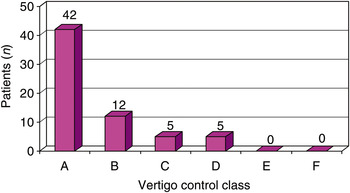
Control of vertigo was quantified using the American Academy of Otolaryngology-Head and Neck Surgery vertigo control class. This system compares the number of vertigo episodes in the six months before treatment versus the number of episodes 18 to 24 months after treatment (or, in the case of patients for whom follow-up data were not available during the relevant time interval, versus the most recent six-month period). Vertigo control class was defined as follows: class A, elimination of vertigo; class B, reduction of vertigo episode frequency to 40 per cent or less of pretreatment frequency; class C, reduction to 41–80 per cent of pretreatment frequency; class D, change in vertigo frequency to 81–120 per cent of pretreatment frequency; class E, increase in vertigo frequency to more than 120 per cent of pretreatment frequency; and class F, initiation of secondary treatment due to persistent or recurrent vertigo.
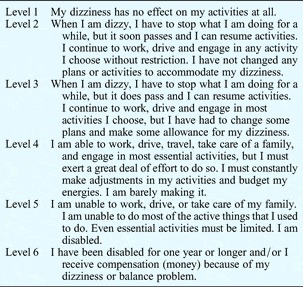
During the consultation before the first gentamicin administration, each patient was also assessed using the American Academy of Otolaryngology-Head and Neck Surgery 1995 functional vertigo scale. This scale describes six levels of quality of life for patients with vertigo (Table I). Patients were also asked about the number of Ménière's crises they had suffered per month in recent months.
AAO-HNS 1995 functional vertigo scale
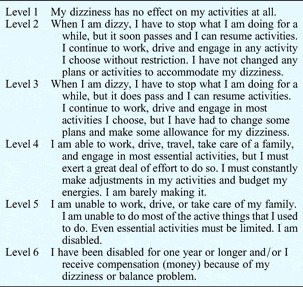
AAO-HNS = American Academy of Otolaryngology-Head and Neck Surgery
Gentamicin administration
All injections were performed in the operating theatre under local anaesthetic and microscopic view. Normally, 40 mg of gentamicin (1 cm3) was buffered with one-sixth M Molar mass (symbol M) of an atom or molecule is the mass of one mole of the particle in grams bicarbonate (0.5 cm3), giving a gentamicin concentration of 26.7 mg/ml. A broad myringotomy was performed under local anaesthetic in the postero-inferior region of the tympanic membrane, through which the gentamicin was introduced. Once administration was complete, the patient was kept supine with the head in the lateral position for 30 minutes, and was instructed to avoid swallowing as much as possible.
An initial series of three to four gentamicin doses was administered, separated by intervals of 7 to 30 days. In recurrent cases, gentamicin was administered on demand, according to the patient's symptomatology.
Patients were evaluated approximately a week after each dose, using audiometry and vestibular assessment. In patients showing an auditory deterioration greater than 10 dB in two consecutive frequencies, or reporting an intense vertigo crisis lasting more than one day, treatment was suspended.
After the first series of gentamicin treatments, long-term follow up was carried out in the out-patient department.
A telephone survey of study patients was also conducted, which noted patients' new functional scale rating, whether they had perceived a subjective auditory change after their injections, and their subjective evaluation of the treatment (i.e. very good, good, normal or poor).
Data were collected in a Microsoft Excel spreadsheet and analysed using the Statistical Package for the Social Sciences software program (version 15.0). The Wilcoxon test was used for analysis of qualitative variables (e.g. disease stage and functional scale rating). The t-test for related samples was used for analysis of quantitative variables (e.g. the mean tonal threshold and the number of pre- and post-treatment crises). The dependent t-test for paired samples was used when there was only one sample which was tested twice. The present study investigated one sample (i.e. the one patient series), and calculated the differences between all measurement pairs (i.e. each patient's pre- and post-test functional scale ratings). The degree of freedom used was n − 1, and the level of statistical significance was set at p < 0.05.
Results and analysis
The 71 patients included comprised 30 men and 41 women, with a mean age of 54.7 years (range, 27 to 87 years). The right ear was affected in 37 patients and the left in 34. The mean duration of disease was 9.39 years, with a minimum of three years and a maximum of 25 years. The mean duration of control with medical treatment was 1.39 years. The mean follow-up time after treatment was 3.5 years (minimum six months, maximum 8.75 years).
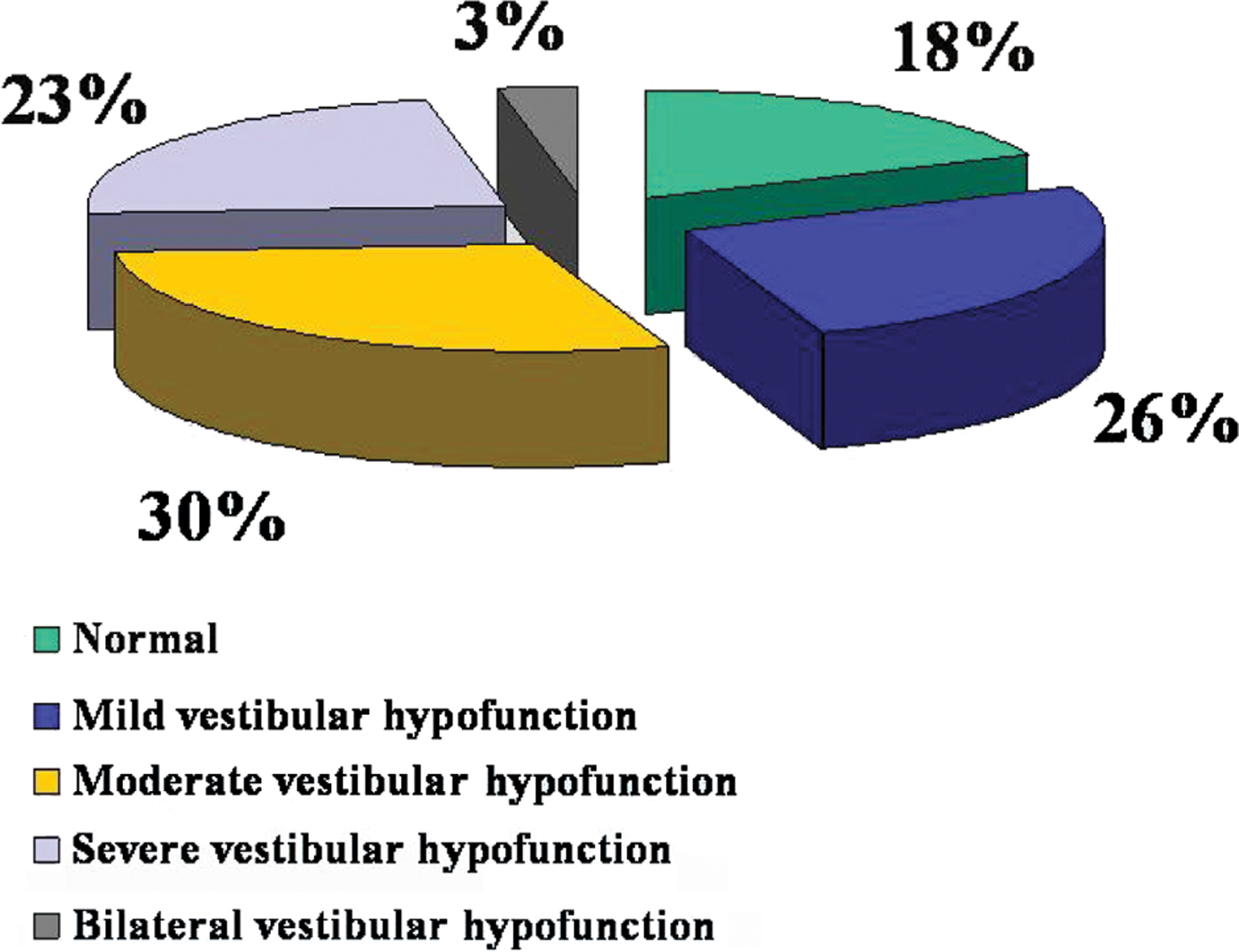
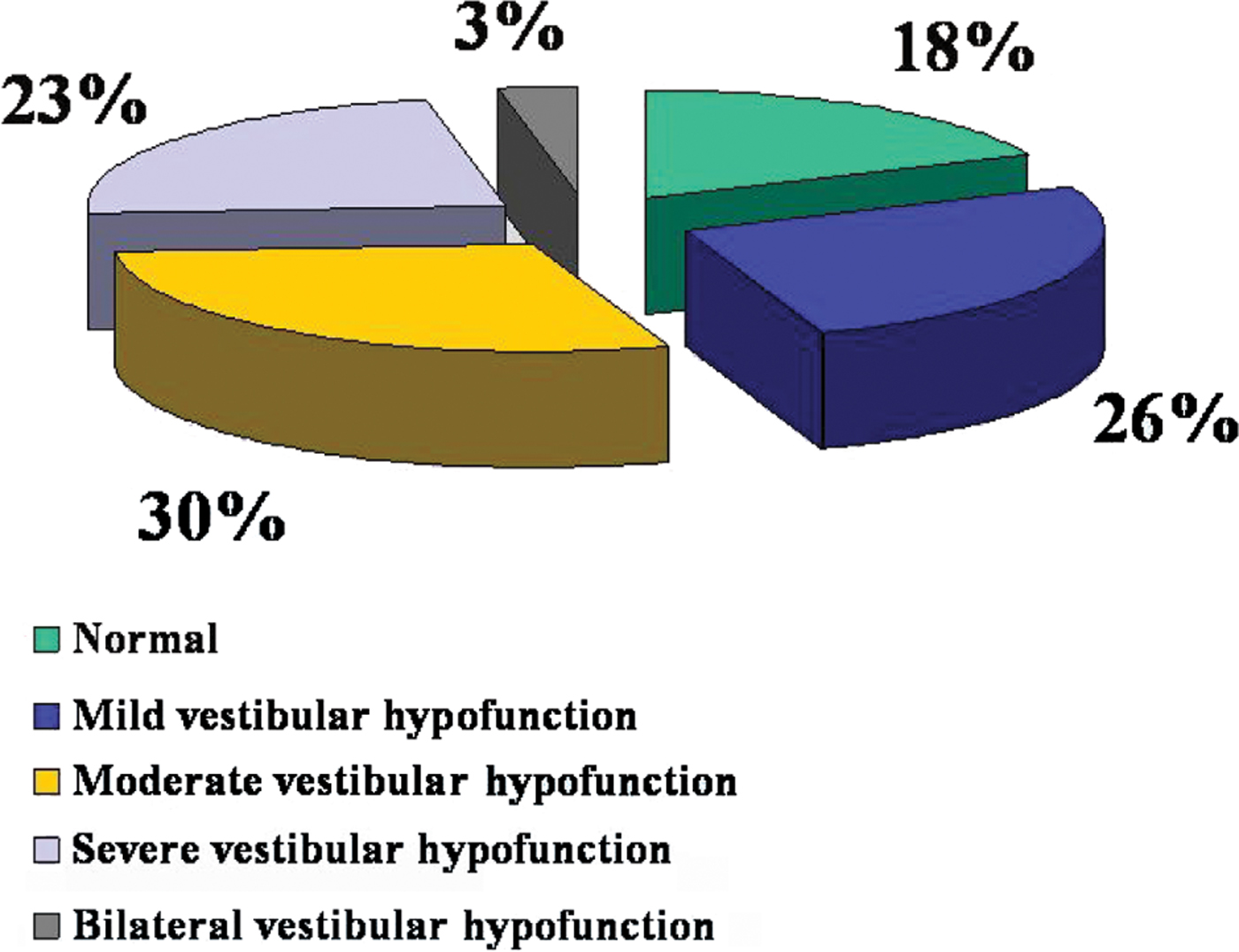
Videonystagmography was normal in 12 patients (18 per cent). Hypofunction was present in the remaining patients, being mild in 17 patients (26 per cent), moderate in 19 (30 per cent), severe in 15 (23 per cent) and bilateral in two (3 per cent) (Figure 1).
Videonystagmography caloric test results.
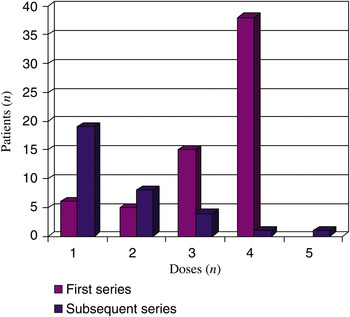
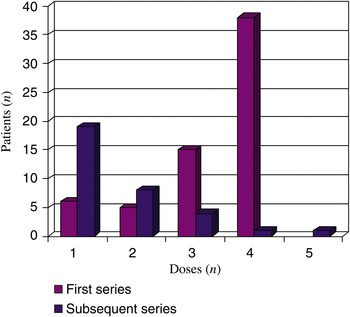
Thirty-eight patients (53.5 per cent) required a single series of injections for control of vertigo, with a mean dose number of 3.33. However, 46.5 per cent of patients suffered recurrence and received further gentamicin doses. The mean number of doses in this subsequent series was 0.87 (Figure 2).
Number of gentamicin doses administered.
Prior to gentamicin treatment, our patients suffered a very variable number of Ménière's crises, with a mean value of 8.8 crises per month and a range of one to 35 crises per month. After treatment, our patients' mean number of crises was 1.41 per month, significantly lower than the pre-treatment number (p = 0.002).
Pre-treatment and post-treatment mean tonal thresholds were obtained by calculating the mean of thresholds at 500, 1000 and 3000 Hz for the poorest audiometric examinations before and after treatment. Mean values of 51.12 and 54.8 dB were obtained pre- and post-treatment, respectively. Although the mean tonal threshold was slightly worse after treatment, this difference was not statistically significant (p = 0.113).
Of the 71 patients, 13 (18.3 per cent) suffered a significant hearing loss (i.e. ≥10 dB), three of whom had cophosis (4.2 per cent). Eleven patients (15.49 per cent) had a significant improvement in hearing, while 47 patients (66.19 per cent) showed no significant change. However, 27 patients (38 per cent) responded affirmatively when asked if they had noticed a subjective hearing loss.
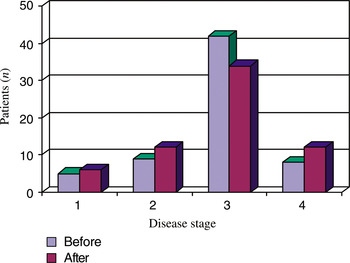
Figure 3 shows patients' Ménière's disease stage (according to the mean tonal threshold values established by the American Academy of Otolaryngology-Head and Neck Surgery Ménière's disease staging guidelines) before and after treatment. Prior to treatment, most patients (64.8 per cent) were at disease stage three; this was also the most frequently reported disease stage after treatment (53.5 per cent). The difference between patients' pre- and post-treatment disease stages was not statistically significant (p = 0.674).
Patients' American Academy of Otolaryngology-Head and Neck Surgery Ménière's disease stage (based on mean tonal thresholds) before and after treatment.
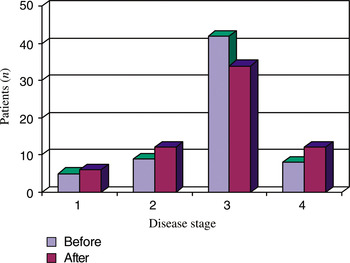
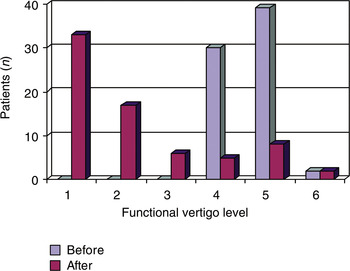
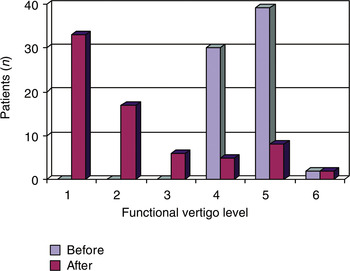
Figure 4 shows our patients' American Academy of Otolaryngology-Head and Neck Surgery functional vertigo scale level before and after treatment. Before treatment, all the patients were at vertigo levels four, five and six, with 97.1 per cent being at either level four or five. After treatment, 33 (46.47 per cent) patients were at level one and 17 (23.9 per cent) at level two, while only 15 (21.1 per cent) were at levels four, five or six. There was a statistically significant difference between the patients' pre- and post-treatment functional vertigo levels (p = 0.000; Wilcoxon test).
Patients' American Academy of Otolaryngology-Head and Neck Surgery functional vertigo scale level before and after treatment.
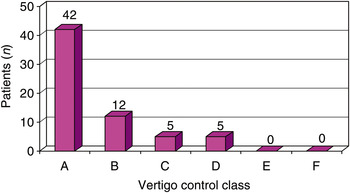
Based on the American Academy of Otolaryngology-Head and Neck Surgery guidelines for the evaluation of Ménière's disease treatment, complete vertigo control was obtained in 65.6 per cent of our patients, and complete or substantial control in 84.37 per cent (Figure 5). As six-months' follow-up is in many cases insufficient to ascertain treatment response, we calculated the same results in a subgroup of patients who had been followed up for at least 24 months after their last gentamicin injection. Of the 47 patients in this group, complete vertigo control was achieved in 68.1 per cent, and complete or substantial control in 87.23 per cent.
Patients' American Academy of Otolaryngology-Head and Neck Surgery vertigo control class. See text for explanation of vertigo control classes.
Following treatment, 17 patients (23.9 per cent) reported residual vertigo instability, five of whom (7.8 per cent) suffered incapacitating instability. Of these five patients, four received surgical treatment and one improved with vestibular rehabilitation involving posturography.
Post-treatment, 44 (61.97 per cent) of our total 71 patients remained stable, requiring no further medical treatment, while the remainder needed additional treatment. Ten patients (14.1 per cent) received surgical treatment following their gentamicin injections: seven underwent surgical labyrinthectomy and three vestibular neurectomy.
Eight patients (11.35 per cent) reported Tumarkin crises (sudden, severe attacks of dizziness or vertigo causing the sufferer (if standing) to fall without warning) before gentamicin treatment. Five of these patients obtained complete vertigo control following gentamicin injections, two obtained substantial control, and one underwent surgical intervention after showing no improvement post-treatment.
Observed complications of treatment were as follows: cophosis (three patients), tympanic perforation (four), temporary facial paresis after local anaesthesia (three), otitis (three) and intense vertigo crisis (one). In general, the gentamicin injections were well tolerated by patients.
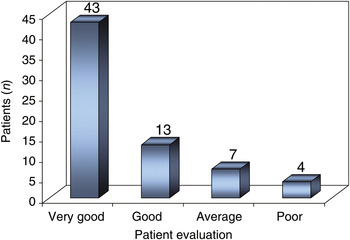
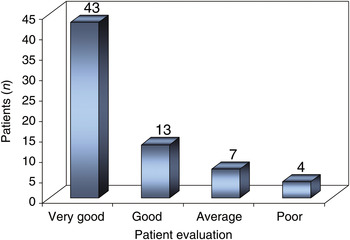
Regarding subjective evaluation of treatment, 78.87 per cent of patients (56 of 71) evaluated their treatment as ‘very good’ or ‘good’ (Figure 6).
Patients' subjective evaluation of their gentamicin treatment.
Discussion
Ménière's disease can cause serious deterioration of patients' everyday quality of life, due most importantly to vertigo crises, and also hearing loss. In patients with severe vertigo for which medical treatment is ineffective, we believe that administration of intratympanic gentamicin is indicated, as this technique has good results with regard to vertigo crisis control, together with a lower risk of severe side effects than conventional surgical treatments.
When assessing the various published series of Ménière's disease patients treated with gentamicin, evaluation of the exact treatment technique is fundamental to accurate comparison of results. In 2004, Chia et al. Reference Chia, Gamst, Anderson and Harris5 published a meta-analysis comparing the efficacy (with regard to vertigo control and hearing loss) of five different methods of gentamicin administration. The method with the best complete vertigo control rate (81.7 per cent) consisted of daily or weekly applications until the appearance of intense crises, spontaneous nystagmus or hypoacusia. Multiple daily gentamicin doses were associated with the highest prevalence of hypoacusia (43.7 per cent), while low, infrequent doses (i.e. one or two doses, repeated only if the patient suffered a crisis) resulted in the lowest complete vertigo control rate (66.7 per cent). Gentamicin administration via a microcatheter resulted in rates of vertigo control and hypoacusia similar to those for other administration methods.
In comparison, our patients received gentamicin injections at intervals of between 7 and 30 days, to a maximum of four doses, and injections were suspended in cases of significant hypoacusia or intense vertigo crisis.
If we limit comparative analysis to those studies which injected gentamicin at one-weekly intervals, the mean number of injections administered before achievement of vertigo control varied between 2.8 (in Minor's series),Reference Minor6 3.4 (in Hirsch and Kamerer's series)Reference Hirsch and Kamerer7 and 3.15 (in Pérez and colleagues' series).Reference Perez, Martín and García-Tapia8 These results are all comparable to our mean of 3.33 injections, obtained in our initial series of gentamicin injections.
At present, there are no known predictive parameters which specify the number of injections necessary for vertigo control in any given patient. In a recent study using tridimensional magnetic resonance imaging, Nakashima et al. Reference Nakashima, Naganawa, Sugiura, Teranishi, Sone and Hayashi9 demonstrated that gadolinium injected intratympanically penetrated the inner ear in the same manner as gentamicin. Introduction of gadolinium into the vestibule was observed to be restricted in patients with Ménière's disease and also in patients with absent or diminished vestibular evoked auditory myogenic potentials; this was attributed to the presence of a large endolymphatic hydrops. Further research in this field would be of interest.
There are similarities between the volumes and concentrations of gentamicin injections used by different authors. The majority injected 1 ml inside the middle ear, at a concentration of 25–30 mg/ml. One studyReference Abou-Halawa and Poe10 compared two groups of patients receiving gentamicin at either 30 or 40 mg/ml and found similar rates of vertigo control, although the patients receiving the higher concentration required fewer injections. There was no statistically significant difference in the two groups' hearing outcomes. Despite this result, we usually used 1 ml of gentamicin solution at a concentration of 26.7 mg/ml.
Following intratympanic gentamicin treatment, reported recurrence rates have varied between 47.3 per cent (Kaasinen et al.),Reference Kaasinen, Pyykkö, Ishizaki and Aalto11 30 per cent (Rauch and Oas)Reference Rauch and Oas12 and 21 per cent (Minor).Reference Minor6 Our patients had a somewhat higher recurrence rate, 46.5 per cent; however, in most of these patients a single subsequent gentamicin injection was sufficient for vertigo control. All of these authors agree that recurrences are more frequent in the first 12 or 13 months after the first gentamicin treatment; therefore, long-term patient follow up is necessary.
For this reason, we calculated our treatment response results for a subgroup of 47 patients with two or more years' follow up (since their last gentamicin dose), and found similar or even somewhat higher figures (complete or substantial vertigo control was achieved in 87.23 per cent of these patients), compared with our overall treatment results. By comparison, a recent study of 103 Ménière's disease patients treated with intratympanic gentamicin reported complete control in 81 per cent of patients at five years, although 15.5 per cent reported instability.Reference Boleas-Aguirre, Sánchez-Ferrandiz, Guillén-Grima and Perez13
With regard to videonystagmography caloric test results, Stahle and BergmanReference Stahle and Bergman14 reported normal results in 16 per cent of 300 Ménière's disease patients, while Dobie et al. Reference Dobie, Snyder and Donaldson15 observed normal results in 25 per cent of their 206 Ménière's disease patients. In our study, caloric testing was normal in 18 per cent of patients; this is comparable to previous findings. All authors have reported that a videonystagmographic finding of hypofunction or monolateral vestibular areflexia has a high predictive value for Ménière's disease, while directional preponderance does not. Hulshof and BaarsmaReference Hulshof and Baarsma16 have reported that the magnitude of vestibular hypofunction significantly increases with the duration of Ménière's disease. These authors have also noted the existence of fluctuations in vestibular test results. Most authors believe there is no relationship between the caloric response after intratympanic gentamicin treatment and the degree of vertigo control.Reference Perez, Martín and García-Tapia8, Reference Lange, Maurer and Mann17, Reference Bertino, Durso, Manfrin, Casati and Mira18
In 2004, Cohen-Kerem et al. Reference Cohen-Kerem, Kisilevsky, Einarson, Kozer, Koren and Rutka19 published a meta-analysis of intratympanic gentamicin treatment for Ménière's disease. Unfortunately, the evaluated data were not completely comparable, since the various studies had differing administration techniques and improvement criteria. Our results for complete (65.6 per cent) and complete or substantial (84.37 per cent) vertigo control (including relapsed cases requiring further gentamicin treatment) were inferior to those reported in Cohen-Kerem and colleagues' meta-analysis (being 74.7 per cent for complete vertigo control and 92.7 per cent for complete or substantial control).
In comparison, Pérez et al. Reference Perez, Martín and García-Tapia8 (using a similar administration technique to our own) obtained complete vertigo control in 69 per cent of their 71 patients, and complete or substantial control in 83.1 per cent. In other studies, complete or substantial vertigo control was achieved in 87 per cent (Carey),Reference Carey20 82 per cent (Harner et al.)Reference Harner, Driscoll, Facer, Beatty and McDonald21 and 81.3 per cent (Flanagan et al.)Reference Flanagan, Mukherjee and Tonkin22 of patients.
With regard to hearing loss, Cohen-Kerem and colleagues' meta-analysis of various studiesReference Cohen-Kerem, Kisilevsky, Einarson, Kozer, Koren and Rutka19 reported mean pre- and post-treatment tonal thresholds of 56.6 and 58.2 dB, respectively, and a global hearing loss of 1.5 dB. Our study gave similar pre- and post-treatment results, i.e. 51.12 and 54.8 dB, respectively; this difference was not statistically significant.
In our patient series, 13 (18.3 per cent) suffered significant hearing loss (i.e. a loss equal to or greater than 10 dB, comparing mean pre- and post-treatment tonal thresholds, as defined by the American Academy of Otolaryngology-Head and Neck Surgery). Three (4.2 per cent) of these patients had cophosis; this result is comparable to previous findings.Reference Boleas-Aguirre, Sánchez-Ferrandiz, Guillén-Grima and Perez13 Wu and MinorReference Wu and Minor23 reported cophosis in 3 per cent of their series, while Bertino et al. Reference Bertino, Durso, Manfrin, Casati and Mira18 reported a prevalence of 2.8 per cent and Abou-Halawa and PoeReference Abou-Halawa and Poe10 4.6 per cent. Our three cophosis patients had mean pre-treatment tonal thresholds of 43.75, 53.75 and 72.5 dB, variously. All three obtained complete vertigo control and were satisfied with their treatment, despite their hearing loss. Furthermore, our rate of hearing loss (18.3 per cent) was lower than that reported for most published protocols and series (i.e. significant hearing loss in 25 to 30 per cent of patients).Reference Bertino, Durso, Manfrin, Casati and Mira18, Reference Peterson and Isaacson24–Reference Kaplan, Nedzelski, Chen and Shipp26
• In this study of 71 patients with Ménière's disease, intratympanic gentamicin was administered in a series of doses with weekly review
• Complete or substantial vertigo control was achieved in 84 per cent
• Eighteen per cent of patients experienced significant hearing loss
Following intratympanic gentamicin application, the risk of vestibular or cochlear toxicity may be related to the duration of treatment, patient's age, number of doses, individual susceptibility, renal function and exposure to concomitant noise.Reference Assimakopoulos and Patrikakos27 When questioned, 27 of our patients (38 per cent) reported subjective hearing loss, although audiometric testing indicated that only 13 (18.3 per cent) had suffered significant actual hearing loss. This difference between subjective and objective hearing loss results may be due to patients' detection of actual hearing losses too small to be considered audiometrically significant, or to the compounding effects of sound dispersion or tinnitus upon hearing loss (due to gentamicin injection or disease progression).
In the present study of the use of intratympanic gentamicin injections to treat Ménière's disease related vertigo, treatment was well tolerated by most patients, and was subjectively rated as good or very good by 78.87 per cent.
Conclusion
In the present study of the use of intratympanic gentamicin injections as treatment for Ménière's disease related vertigo, complete or substantial vertigo control was obtained in 84.37 per cent of patients; 18.3 per cent suffered hearing loss. The weekly administration protocol was well tolerated, with a lower risk of hearing loss than other reported protocols.
Therefore, we believe that intratympanic gentamicin administration is a safe and effective method for the treatment of Ménière's disease related vertigo which is refractory to medical treatment. This method also represents an excellent therapeutic alternative to invasive surgical techniques.
Although this technique is not innocuous, the risk of complications is acceptable given the treatment's beneficial results.