Introduction
The production and exchange of flint, higher value ground stone, and early metals has long been a major topic in European archaeology. This article takes a broadly comparative and strongly quantitative vantage point. We use newly synthesized radiocarbon data on siliceous as well as ground stone mines and quarries, alongside aggregate typological evidence for the circulation of copper artefacts, to examine the way in which the use of high-quality source material for stone tools, axeheads, adzeheads, and daggers related to the development of copper production and the local circulation of copper artefacts. Our focus is on the central-western part of Europe, from the beginning of farming around 5500 bc to the start of the Early Bronze Age shortly before 2000 bc.Footnote 1
Mining and quarrying to produce large quantities of smaller flint tools as well as axeheads from flint or ground stone, far in excess of local needs, is one of the most characteristic and best-known features of the European Neolithic. In principle, all Neolithic communities were involved and connected in some way via the production and/or exchange of stone tool raw materials. Within this general network revolving around raw material and tool procurement, socially differentiated consumption patterns also existed: some stone tools like shoe-last adzeheads, jade axeheads, and later flint and copper daggers can be linked to practices of highly symbolic significance (e.g. Pétrequin et al., Reference Pétrequin, Cassen, Errera, Klassen, Sheridan and Pétrequin2012). While simple daily tools no doubt comprised the majority of stone artefacts, the demand for special items caused the production of extraordinarily large quantities of favoured materials, which can, therefore, be seen as a driver for the preference of one source over others. The wide distribution of distinct and recognizable flint varieties, for example, indicates how desirable they were even to distant communities, despite alternative, local raw materials often being available (Kerig, Reference Kerig, Benz and Helms2018). We do not need to think of the producers as full-time specialists to recognize that the effort invested in producing such large quantities of material for distribution at the major sites was substantial and could involve a degree of specialized production. In the Mons Basin flint-mining region, for example, Collin (Reference Collin2016) has shown that some mines invested substantially in standardized extraction techniques and played an important role in raw material provision at an inter-regional scale.
In recent articles (Schauer et al., Reference Schauer, Shennan, Bevan, Cook, Edinborough and Fyfe2019; Edinborough et al., Reference Edinborough, Shennan, Teather, Baczkowski, Bevan and Bradley2020) we have shown that the main phases of exploitation and supra-regional distribution of many of the major mines were much shorter than the mine's extraction period as a whole and that their rise and demise reflected changing patterns of demand for their products. In Britain, the main period of systematic flint mining and quarrying was ~4000–3500 bc and the first and strongest demand for axeheads was created by the need to clear forest among an incoming immigrant farmer population (Edinborough et al., Reference Edinborough, Shennan, Teather, Baczkowski, Bevan and Bradley2020), who brought the relevant technologies with them. In southern Scandinavia too, the main phase of underground flint mining for which we have radiocarbon dates coincided with the arrival of incoming farmer groups (Mittnik et al., Reference Mittnik, Wang, Pfrengle, Daubaras, Zarina and Hallgren2018).
In continental northwest Europe (France, the Low Countries, and western Germany), however, the picture was different. Our radiocarbon data do not show any evidence of large-scale shaft mining for the first 1000 years after the initial arrival of farming, even though it was associated with a major population increase, beginning around 5300 bc. In contrast, two major mining episodes in these regions, the first in ~4200–3800 bc and the second in ~3500–3000 bc, were correlated with, but far in excess of, what would be expected from a regional consumer population. Schauer et al. (Reference Schauer, Shennan, Bevan, Cook, Edinborough and Fyfe2019) have suggested, following others, that the onset of mining was a result of demand prompted by the arrival of polished jadeitite and similar axeheads (hereafter referred to generically as jade) from the Alps (Pétrequin et al., Reference Pétrequin, Cassen, Errera, Klassen, Sheridan and Pétrequin2012; see Giligny et al., Reference Giligny, Bostyn, Le Maux, Pétrequin, Cassen, Errera, Klassen, Sheridan and Pétrequin2012). The number of large jade axeheads increased over the course of the fifth millennium bc, reaching a high point ~4200 bc, i.e. contemporary with an inferred population peak, and slightly preceding but strongly overlapping with observable intensities in mining activity. From ~3800 bc, jade axeheads, mining evidence, and inferred population all appear to decline.
Here, we adopt a broad spatial and temporal scale to ask: what was the relationship between fluctuations in the large-scale production of lithic artefacts for exchange and the local appearance of copper artefacts? We focus on Europe north of the Alps and north and west of the Carpathian Basin, but include northern Italy, over the period ~5500–2000 bc. Until late in the period, there was no copper production within most of this region; hence the key question is whether the inclusion of parts of our area within the networks of circulation of copper artefacts originally produced in south-eastern Europe (see below) had an impact on local stone production.
To address this, we focus on observable patterns of change in copper deposition—i.e. all processes by which copper ended up in the ground, whether intentional or unintentional—close to sources of both stone and copper raw materials.
Materials and Methods
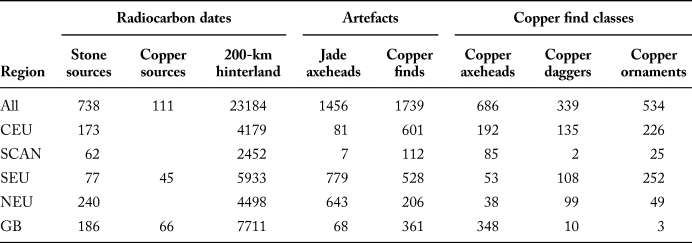
We used a variety of information sources, summarized in Table 1 and outlined as follows:
1. A geo-referenced database of radiocarbon dates for stone quarries or mines and copper mines in central-western Europe (see Figure 1 and online Supplements S1 and S2). As previously (e.g. Schauer et al., Reference Schauer, Shennan, Bevan, Cook, Edinborough and Fyfe2019), we have used weighted summed probability distributions of the dates as a proxy measure for the intensity of mine exploitation through time.
2. Since large jade axeheads are the most striking example of socially/symbolically important axeheads and have an exceptionally wide distribution, we have used the database and typological attributions in Pétrequin et al. (Reference Pétrequin, Cassen, Errera, Klassen, Sheridan and Pétrequin2012) to show their incidence through time in different regions, following Schauer et al. (Reference Schauer, Shennan, Bevan, Cook, Edinborough and Fyfe2019).
3. Dates from the sources of the flint daggers that are characteristic of specialized production from the later fourth to the third millennium are much less widely available than for earlier phases, not least because of the open-cast nature of production (e.g. Vaquer & Remicourt, Reference Vaquer, Remicourt, Sohn and Vaquer2012). Accordingly, in order to include this production in our analysis, we have used published sources that provide semi-quantitative information on the periods of circulation and frequency of their products, based on their contexts: Grand-Pressigny (Ihuel et al., Reference Ihuel, Mallet, Pelegrin, Verjux, Prieto Martínez and Salanova2015); the flint daggers of southern Scandinavia (Apel, Reference Apel2001); and sources in southern France (Vaquer & Remicourt, Reference Vaquer, Remicourt, Sohn and Vaquer2012), Switzerland (Honegger & de Montmollin, Reference Honegger, de Montmollin and Eriksen2010), and northern Italy (Mottes, Reference Mottes and Nicolis2001).
4. A similar problem of dating sources affects the early use of copper: many of the early copper sources are unknown, so the few dated mines do not give an adequate picture of early copper exploitation. Moreover, since the earliest known mines are outside our study area, in south-eastern Europe, the mine dates do not necessarily correlate with the circulation of their products in our area of interest; indeed, we know that initially this was not the case (summarized in Rosenstock et al., Reference Rosenstock, Scharl, Schier, Bartelheim, Horejs and Krauß2016; see discussion below). To obtain information on copper circulation, we built a geo-referenced database of known copper artefacts from Poland to Britain, excluding the Carpathian Basin but including northern Italy, from the earliest known, in the fifth millennium bc, down to ~2000 bc, using a variety of sources (see Figure 1 and online Supplement S3; key in S4), though we do not claim that coverage is complete. Previous typological studies have provided date ranges for different types of copper artefacts, or for the contexts in which they are found, and we have used aoristic methods based on these date ranges (e.g. fifty artefacts whose date range is believed to be 4500–4000 bc are evenly distributed across the range, ten per century; see Rosenstock et al., Reference Rosenstock, Scharl, Schier, Bartelheim, Horejs and Krauß2016) to produce summed distributions of the frequencies through time of all copper artefacts together and of axes, daggers, and ornaments separately, for different regions, with a fifty-year resolution.
5. A database of radiocarbon dates for non-mine/quarry sites for the period and area concerned has been created and summed probabilities of these dates (SPDs) have been used as a proxy for changing patterns of population within our region (for technical details of this methodology, see Timpson et al., Reference Timpson, Colledge, Crema, Edinborough, Kerig and Manning2014; Crema & Bevan, Reference Crema and Bevan2020).
Method summary.

Our published studies (e.g. Schauer et al., Reference Schauer, Shennan, Bevan, Cook, Edinborough and Fyfe2019) suggest some relationship between periods when mines and quarries were being exploited and the size of the regional population around each extraction site. Accordingly, for each study area (see Table 2), we obtained a population proxy based on the SPD of all non-mine radiocarbon dates, following the method described by Schauer et al. (Reference Schauer, Shennan, Bevan, Cook, Edinborough and Fyfe2019; see also Timpson et al., Reference Timpson, Colledge, Crema, Edinborough, Kerig and Manning2014); the probabilities of these dates within 200 km of the mining sites in each region were binned (i.e. multiple dates from the same phase at a site were summed and then downweighted to count as a single date) and summed.
Map of sampled area, showing the total area covered by the 200-km hinterland, which extends from the centre of each stone or copper source for which radiocarbon dates are available.

Counts of radiocarbon dates, jade axeheads, and copper finds per type and region, plus all regions. The total number of copper finds is sometimes slightly greater than the sum of the axeheads, daggers, and ornaments because artefacts outside these classes (or uncertain or not given) have been included. The total number of copper finds (All) is slightly smaller than the total when all the regions are summed because of some overlap in the circles defining the different regions. Though shown on the plots, stone daggers are not included in this table as we do not have precise counts in each region. For Britain, the dates from the Ross Island mine in Ireland are included because it was the source of the metal for the early copper artefacts in Britain. The early copper artefacts from Ireland are not included.

In the plots that follow, we present the changing frequency of three categories of radiocarbon date—stone mines, copper mines, and all non-mine dates—and four artefact types—large jade axes and copper axes, daggers, and ornaments—within each of five regions, plus all regions combined, based on the combined 200-km hinterland circles around all radiocarbon-dated stone and copper sources within the region. The 200-km hinterland SPDs, which are considered a proxy for changes in regional population, are present in all plots. Our rationale for choosing this 200-km spatial focus is that, since the deposition locations of most products from a given stone source fall within a 200-km radius of the source (e.g. Schauer et al., Reference Schauer, Bevan, Shennan, Edinborough, Kerig and Parker Pearson2020) (with the exception of jade axes, treated separately here), and areas more than 200 km away from a source would be unlikely to be exerting a direct demand on source production in any case, it is necessary to focus on the occurrence of copper finds within a 200 km radius of the stone sources if we are to assess the potential impact of copper circulation on the exploitation of the stone sources. The SPDs of stone sources within the region are plotted against this hinterland. Each stone source SPD is a ninety-five per cent envelope created by sampling no more than five dates per site, repeated 1000 times. This prevents certain well-dated sites, such as Grime's Graves in Britain, from distorting the SPD. Where available (southern Europe (SEU), Britain (GB), and all regions together (All)), we repeat this process for all dated copper sources within the region, again including no more than five dates per site, repeated 1000 times to create a ninety-five per cent envelope. This sampling procedure was not required for the hinterlands, given the very large sample size in each.
Plotted against these radiocarbon SPDs are the changing relative quantities of jade axeheads, copper finds, and estimated stone dagger frequencies within 200 km of each radiocarbon-dated stone or copper source, where the latter occur within our region. Each of these three lines is scaled to its own maximum on the y axis, so that the changing relative quantity of each material type can be compared. In a second plot for each region, the copper finds are divided into three categories (axeheads, daggers, and ornaments) to show the relative frequency of each within that region. In these plots, the y scale is shared between the three shape classes, with the maximum y value determined by the maximum value in any of the three classes. These counts are plotted against the same hinterland, stone source, and copper source SPDs shown in the previous plots.
Results
Central Europe (CEU)
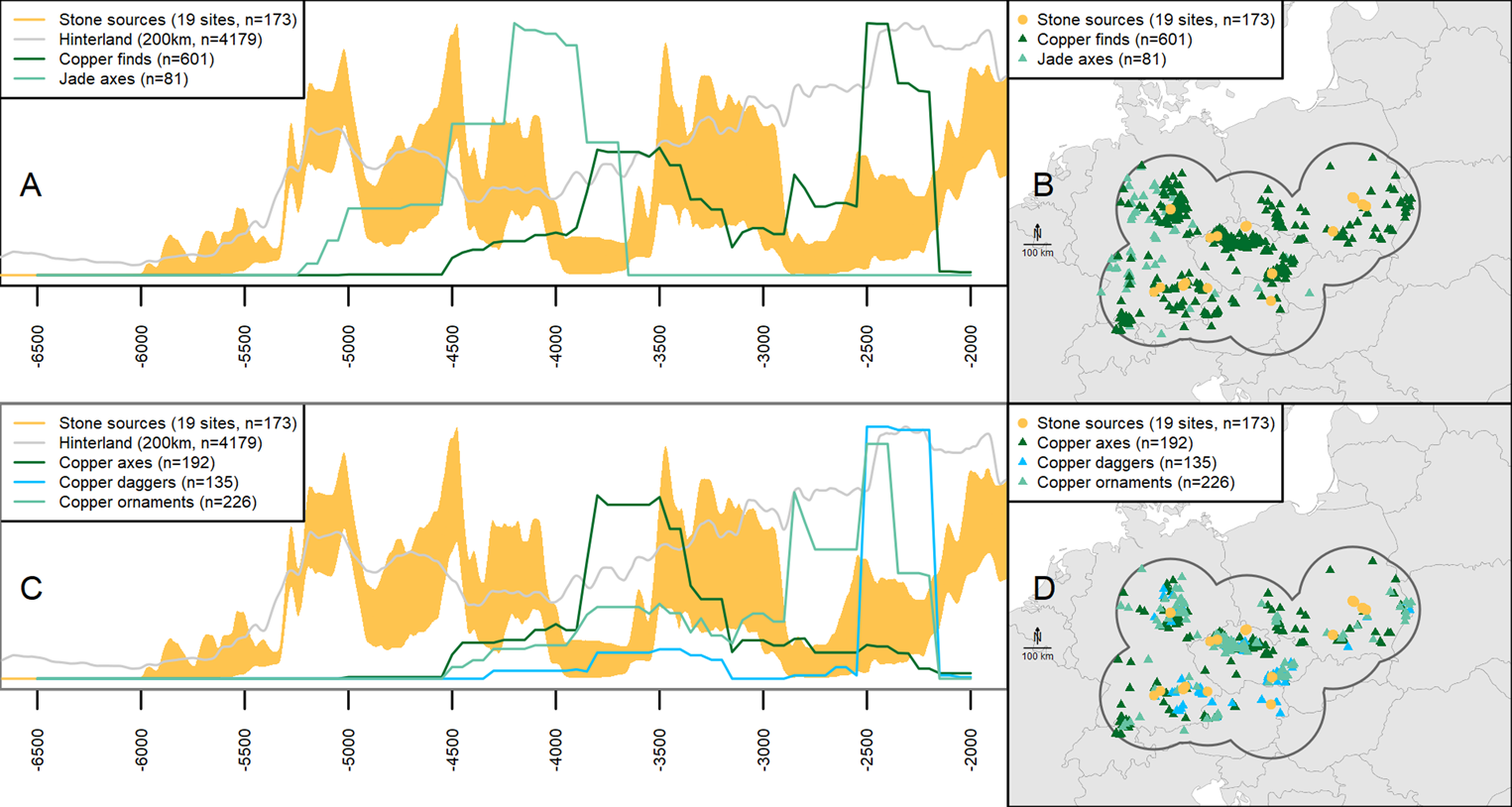
Figure 2A shows the results for central Europe defined by the combined 200-km radius of the nineteen stone sources in this region. The first major rise in mine and quarry activity coincides with the arrival of Linearbandkeramik (LBK hereafter) farmers ~5400 bc, followed by a very rapid drop at the end of the LBK in ~4900 bc, in keeping with the general evidence for a decline in exchange at this time (Zimmermann, Reference Zimmermann1995). The pattern then fluctuates before reaching a low point ~4000 bc. Mining activity stays low until ~3500 bc, when it increases and remains high until ~3000 bc, after which it drops once more before rising again in the second half of third millennium, at the beginning of the local Early Bronze Age. Imported large jade axeheads appear in the region after the first increase in local stone extraction, peaking in ~4200–3800 bc and declining sharply thereafter. However, the total number is only eighty-one, an order of magnitude smaller than in Circum-Alpine and northwest Europe, which are nearer the source. The period of diminished mining activity sees a rapid rise in the number of copper items deposited (see Bartelheim et al., Reference Bartelheim, Eckstein, Huijsmans, Krauß, Pernicka, Bartelheim, Pernicka and Krause2002; Bartelheim, Reference Bartelheim, Burmeister, Hansen, Kunst and Müller-Scheeßel2013; Rosenstock et al., Reference Rosenstock, Scharl, Schier, Bartelheim, Horejs and Krauß2016: figs 13–15), with a peak at ~3800–3400 bc, which then declines gradually as local flint-mining activity increases again. Copper item frequency reaches a low just before 3000 bc, after which it rises again into the Early Bronze Age.
Central Europe (CEU). A: Chronological patterns in the deposition of copper items, based on the aoristic distribution of different dated types, against the aoristic distribution of different dated types of jade axeheads, the summed probabilities of radiocarbon-dated stone mining activity, and the summed probability of all non-mining dates within 200 km of the mines as a population proxy. B: Distribution of dated stone sources, jade axes, and copper finds, and the composite 200-km hinterland of all the stone sources. C: As A, but without the jade axes and with the copper items differentiated by type. D: As B, but with copper items differentiated by type. The known copper mines in this region all fall after the cut-off date of 2000 bc.

After the initial rise in population with the arrival of farming, there does not appear to be any correlation between stone quarrying/mining and the hinterland population proxy in central Europe. This is also true for the relationship between copper frequency and the population proxy, at least until the end of the sequence after 2500 bc, when both increase together. The fourth-millennium copper peak in Central Europe is dominated by axeheads; the first half of the third millennium sees a steady rise in copper ornaments, while daggers increase rapidly from 2500 bc (Figure 2C), associated with the Bell Beaker culture. There are no early copper mines known so far in this region. While there are indications that copper smelting took place in the lower Inn valley at the end of the fifth millennium (Höppner et al., Reference Höppner, Bartelheim, Huijsmans, Krauss, Martinek, Pernicka and Schwab2005), results of metal analyses of early objects, including those of the so-called Mondsee metal characteristic of the fourth millennium, point to sources in south-eastern Europe (Frank & Pernicka, Reference Frank, Pernicka, Midgley and Sanders2012; Bartelheim, Reference Bartelheim, Burmeister, Hansen, Kunst and Müller-Scheeßel2013).
Southern Scandinavia (SCAN)
The pattern for southern Scandinavia (Figure 3A) shows a short-lived peak in flint mining, coinciding with the introduction of agriculture by incoming farmers and its associated population increase (Warden et al., Reference Warden, Moros, Neumann, Shennan, Timpson and Manning2017; Mittnik et al., Reference Mittnik, Wang, Pfrengle, Daubaras, Zarina and Hallgren2018). Only seven large jade axeheads have been found in the region and it seems clear, from the dates of currency of the types concerned, that most if not all must have been heirlooms by the time the first farmers arrived here. The end of the major mining phase coincides with the well-known episode of copper import and deposition (of axeheads and to a lesser extent ornaments, Figure 3C; Klassen, Reference Klassen2000, Reference Klassen2004), which also now includes evidence of local casting ~3800–3500 bc (Gebauer et al., Reference Gebauer, Sørensen, Taube and Wielandt2020). This phase, which corresponds with the local population peak, was over by ~3200 bc.
Scandinavia (SCAN). A: Chronological patterns in the deposition of copper items, based on the same criteria as Figure 2, plus a semi-quantitative estimate of the frequency of Late Neolithic I flint daggers. B: Distribution of stone sources, jade axeheads, and copper finds, and the composite 200-km hinterland of all the stone sources. C: As A, but without the jade axeheads and flint daggers, and with the copper items differentiated by type. D: As B, but with copper items differentiated by type.

Some flint mine activity continued until ~2500 bc, but there is no indication of a resurgence in flint mining. The end of copper imports occurs shortly after the start of a decline in the population proxy that continues until after 3000 bc. A massive local production of flint daggers produced by bifacial techniques then began around 2350 bc with the start of the local Late Neolithic I period (Lomborg, Reference Lomborg1973; Apel, Reference Apel2001), dated by their contexts. There are no known mine radiocarbon dates for this period despite the large-scale dagger production and evidence for associated mining (e.g. Sarauw, Reference Sarauw2009). Figure 3A includes a semi-quantitative representation of the floruit of dagger types I–II, characteristic of the Late Neolithic I (n = 8063; Apel, Reference Apel2001: table 9.2). Copper items also began to reappear in southern Scandinavia in the Late Neolithic I (Vandkilde, Reference Vandkilde1996).
Southern France and Circum-Alpine Europe (SEU)
As in other regions, the growth of mining and quarrying in this area is associated with the arrival of farming from ~5500 bc (Figure 4A) and a resulting population increase. A possible downturn after ~4700 bc is followed by a major but short-lived peak in ~4300–4000 bc, which also corresponds to an increase in the population proxy. This is also the peak in the frequency of large jade axeheads, whose source lies in this region. They increase steadily through the fifth millennium, followed by a rapid decline. This decline is paralleled by the growing number of copper items deposited, maintaining a peak from ~3800 to 3400 bc, when it drops rapidly to a low that continues to just after 3000 bc. From then until ~2500 bc, there is a rapid increase in the incidence of copper finds. Shortly after 4000 bc, we see the first radiocarbon dates for copper mines in northern Italy (Maggi & Pearce, Reference Maggi and Pearce2005).
Southern France/Alps (SEU). A: Chronological patterns in the deposition of copper items, based on the same criteria as Figure 2, plus copper mining activity, and a semi-quantitative estimate of the frequency of flint daggers. B: Distribution of stone sources, copper mines, jade axeheads, copper finds, and the composite 200-km hinterland of all the stone and copper sources. C: As A, but without the jade axeheads and flint daggers, and with the copper items differentiated by type. D: As B, but with copper items differentiated by type.

As noted above for southern Scandinavia, the radiocarbon-dated stone mines and quarries do not accurately reflect the importance of specialized stone dagger production on both long blades and bifacially-worked pieces in this region after ~3500 bc. Problems with finding and dating the specific source sites make it necessary to infer the periods of use of the sources from the contexts of the products. Thus, the period from ~3500 to ~3000 bc across this region was a time of growing production and wide distribution of flint daggers (Vaquer & Remicourt, Reference Vaquer, Remicourt, Sohn and Vaquer2012). These came from specialized sources in western and southern France, especially Grand-Pressigny (Ihuel et al., Reference Ihuel, Mallet, Pelegrin, Verjux, Prieto Martínez and Salanova2015) and Forcalquier (Honegger, Reference Honegger, Briois and Vaquer2006; Vaquer & Remicourt, Reference Vaquer, Remicourt, Sohn and Vaquer2012), based on long blades, and northern Italy, especially the Monti Lessini, based on bifacial techniques (Mottes, Reference Mottes and Nicolis2001; Borrello et al., Reference Borello, Mottes and Schlichterle2009; Guilbeau, Reference Guilbeau, Frieman and Eriksen2015). Their occurrence increases again from ~3000 to ~2800 bc maintaining a high level until ~2500 bc, after which they rapidly decline (dotted line, Figure 4A).
After 3000 bc, there is much more evidence of local copper mining, including in southern France, where copper items, especially ornaments, from local sources are frequent (Mille & Carozza, Reference Mille, Carozza, Kienlin and Roberts2009), coinciding with a peak in the radiocarbon mining record. Local mining continues into the Bell Beaker period but seems to tail off thereafter. In southern Europe, axeheads and ornaments are equally frequent during the first copper peak, unlike further north, while the second peak is largely made up of small ornaments and secondarily by daggers (Figure 4C).
Northwest Europe (NEU)
The pattern for continental northwest Europe (Figure 5) is different in several respects from the other regions examined. As mentioned, the arrival of farming in the late sixth millennium bc did not lead to a visible start of mining and quarrying, although most flint finds can be accurately sourced to areas where shaft mining would later take place. Shaft mining did not begin until ~4200 bc, only reaching a peak in ~4000–3800 bc, just as the population began to decline. The deposition of large jade axeheads in the region also declined precipitously at this time. This had been rising steadily through the fifth millennium, peaking at ~4200–4000 bc, when local flint mining started. Local flint mining then rose to a second peak in ~3300–3100 bc before fading away. This second peak does not seem to be associated with a population increase. The period from ~3100 bc, especially ~2800 to ~2400 bc, is characterized by the exploitation of the Grand-Pressigny flint sources for specialized production of large numbers of long flint blades for daggers that were widely distributed (red dotted line on Figure 5A, based on Ihuel et al., Reference Ihuel, Mallet, Pelegrin, Verjux, Prieto Martínez and Salanova2015). Deposition of copper objects first occurred after 3500 bc, but these are almost exclusively small ornaments using very little metal (Mille & Bouquet, Reference Mille and Bouquet2004). There may have been a drop in the number of copper items in ~2700–2500 bc, but the situation changed after 2500 bc with a major increase, dominated by daggers (Figure 5C), associated with the appearance of the Bell Beaker culture and coinciding with the demise of Grand-Pressigny production.
Northwest Europe (NEU). A: Chronological patterns in the deposition of copper items, based on the same criteria as Figure 2, plus a semi-quantitative estimate of the production of the Grand-Pressigny flint dagger source. B: Distribution of stone sources, the Grand-Pressigny dagger source, jade axeheads, copper finds, and the composite 200-km hinterland of all the stone sources. C: As A, but without the jade axeheads and flint daggers, and with the copper items differentiated by type. D: Distribution of stone sources and of copper items differentiated by type.

Britain (GB)
Britain (Figure 6) is located even further from the centres of innovation than southern Scandinavia. After a peak in stone mining and quarrying associated with the arrival of the first immigrant farmers, stone extraction activity declined steadily through the fourth millennium as population also decreased. As in central Europe and southern Scandinavia, the number of jade axeheads in Britain is small compared with the regions nearer to the sources, and the date distribution of types suggests that many were heirlooms by the time farmers arrived in Britain around 4000 bc. There are indications of a short-lived upturn in local mining in ~3000 bc and another in~2600–2400 bc. The latter corresponds to the exploitation of the Grime's Graves flint mine (Healy et al., Reference Healy, Marshall, Bayliss, Cook, Bronk Ramsey, Van der Plicht and Dunbar2018). Grime's Graves came to an end with the arrival of Bell Beaker immigrants (Olalde et al., Reference Olalde, Brace, Allentoft, Armit, Kristiansen and Booth2018) and the beginning of copper mining at Ross Island in Ireland (O'Brien, Reference O'Brien2004), whose products, including the first daggers, circulated in Britain (Bray & Pollard, Reference Bray and Pollard2012). Figure 6C shows the large quantity of axeheads associated with the earliest copper exploitation dates in Britain, especially in eastern Scotland (Needham, Reference Needham, Shepherd and Barclay2004). However, from ~2250 to 2000 bc, flint daggers also circulated in Britain in Bell Beaker contexts (Frieman, Reference Frieman2014) (Figure 6A).
Britain (GB). A: Chronological patterns in the deposition of copper items, based on the same criteria as Figure 2, plus the summed probabilities of radiocarbon-dated copper mining activity. B: Distribution of stone sources, copper mines, jade axeheads, copper finds, and the composite 200-km hinterland of all the stone and copper sources. C: As A, but without the jade axeheads and flint daggers, and with the copper items differentiated by type. D: Distribution of stone sources and copper items differentiated by type. For all plots, all information from Ireland is excluded except for the location and dates of the Ross Island mine.

Discussion
From ~5500 to ~2500/2000 bc, over the period spanning the arrival of farmers to the beginning of the Bronze Age, it is possible to identify two broad trends in the social and symbolic dimension of materials and artefacts across central-western Europe. The first is a shift from the value attached to high-quality stone artefacts (especially jade) that characterized the period up to ~4000 bc to a new system based on the value attached to copper (and gold, not considered here). The second is a shift in social importance from axeheads to daggers (and halberds, again not considered here; see Horn, Reference Horn2014).
Klassen et al. (Reference Klassen, Cassen, Pétrequin, Pétrequin, Cassen, Errera, Klassen, Sheridan and Pétrequin2012) proposed that the decline in the circulation of large, socially important jade axeheads during the fourth millennium bc was the result of competition from copper, which was beginning to circulate more extensively in regions close to the Alpine jade sources. The sources continued to be exploited, but for smaller utilitarian axeheads which had a much more local circulation. The same is true of the quarries for axeheads of pelite-quartz in the Vosges hills of eastern France (Pétrequin & Jeunesse, Reference Pétrequin and Jeunesse1995). At ~4000 bc these quarries reached a peak of production in terms of both the quantity of axeheads being produced and their length, but they declined in both respects from ~3850 bc, while the spatial scale of their distribution also decreased, especially to the east. The North Alpine foreland lake settlements now show evidence for the local production of copper artefacts (Pétrequin & Jeunesse, Reference Pétrequin and Jeunesse1995: 111–12), with people reverting to local stone sources for the production of smaller work-related axeheads. Pétrequin and Jeunesse (Reference Pétrequin and Jeunesse1995: 117–18) suggest that in the North Alpine region both stone axeheads and metal prestige goods declined in the mid-fourth millennium bc, as a result of a demographic decline provoked by a climatic downturn.
The period ~4500–3500 bc is, however, not the only time for which a relationship has been postulated between specialized stone tool production and the manufacture and circulation of copper in central-western Europe. From the late fourth millennium until ~2000 bc, there was a new interest in the highly-skilled production of high-quality stone artefacts, such as axeheads (e.g. at Krzemionki in Poland: Balzer, Reference Balcer2002) but also now the daggers made at restricted sources and widely exchanged, as described above. These are usually regarded as a response to the introduction of copper daggers (e.g. Honegger, Reference Honegger, Briois and Vaquer2006), which occurred earlier further east, for example in the late fifth-millennium Carpathian Basin (e.g. Csányi et al., Reference Csányi, Raczky and Tárnoki2009), though in many areas there is no clear evidence that copper daggers preceded those of flint and the significant novelty may be the dagger form rather than its material (Frieman, Reference Frieman2012; and see discussion below).
In central Europe the exploitation of special hard stone sources and the widespread exchange of their products began in the LBK Early Neolithic with the production and distribution of shoe-last adze- and axeheads whose main source was in north-western Bohemia (Nowak, Reference Nowak2008; Přichystal, Reference Přichystal, Kerig and Shennan2015). At the beginning of the fourth millennium bc, the circulation of copper from south-eastern European mines—which had begun in ~5000 bc (Radivojević et al., Reference Radivojević, Rehren, Pernicka, Šljivar, Brauns and Borić2010)—expanded north and west of the Carpathian Basin, as mapped by Bartelheim et al. (Reference Bartelheim, Eckstein, Huijsmans, Krauß, Pernicka, Bartelheim, Pernicka and Krause2002) and Rosenstock et al. (Reference Rosenstock, Scharl, Schier, Bartelheim, Horejs and Krauß2016; see Radivojević & Grujić, Reference Radivojević and Grujić2018). Moreover, it is clear from the presence of crucibles and the existence of specific local types that the know-how to melt and cast copper was also transmitted (e.g. Strahm, Reference Strahm1994).
Our results show a number of significant transformations that conform well with these established patterns. As deposition of copper from the south-eastern European mines, mainly in the form of axes, increased in central Europe, there was an abrupt and massive decline in stone quarrying and in the circulation of large jade axes (Figure 2). Stone mining and quarrying temporarily resumed from ~3500 to 3000 bc, coinciding with a temporary decline in copper deposition, after which stone mining reached a low at ~2900 bc. Concurrently, with the beginning of the Corded Ware phase, there was an increase in copper deposition, but now mainly in the form of small ornaments requiring little metal, in contrast to the dominance of axeheads in the previous phase. Axeheads were important among Corded Ware grave goods, but without exception these were made of stone (Maran, Reference Maran, Falkenstein, Schade-Lindig and Zeeb-Lanz2008). The Bell Beaker phase from ~2500 bc saw a rapid rise in the deposition of copper, reflected by the presence of copper daggers in many Bell Beaker burials.
Up to the later fourth millennium bc, the pattern in the Circum-Alpine region roughly corresponds to that in central Europe. Quarrying and the circulation of large jade axes decreased as south-eastern European copper began to circulate in the North Alpine region and copper circulation declined with the disappearance of those contacts after 3500 bc. However, there are two significant differences. In northern Italy, local copper mining and smelting appear in the early fourth millennium (Maggi & Pearce, Reference Maggi and Pearce2005), most probably as a result of earlier Balkan-Carpathian connections (Dolfini, Reference Dolfini2013), though there is little sign of its impact on metal deposition. The situation changes after 3000 bc, when our data show a large increase in radiocarbon-dated copper mining activity, including its expansion to southern France, as well as a significant rise in the deposition of copper items (Figure 4; see Cattin, Reference Cattin, Villa and Besse2009; Mille & Carozza, Reference Mille, Carozza, Kienlin and Roberts2009; Peruchetti, Reference Perucchetti2017). This record is dominated by the presence of small ornaments, and secondarily by daggers.
The presence of copper daggers accompanies a second significant difference between central and Circum-Alpine Europe in the late fourth millennium, the large-scale production and widespread distribution of flint daggers from specialized sources (Figure 4A). Whether this production stimulated or was stimulated by early copper daggers remains disputed. The first cast copper daggers appear in burials at the end of the fifth millennium in the Carpathian Basin (e.g. Csányi et al., Reference Csányi, Raczky and Tárnoki2009; Hansen, Reference Hansen, Burmeister, Hansen, Kunst and Müller-Scheeßel2013: 151). Early daggers are very widely but thinly distributed, from the Black Sea to southern France, but are rarely found north of the Carpathian Basin or further west, north of the Danube (Hansen, Reference Hansen, Burmeister, Hansen, Kunst and Müller-Scheeßel2013: fig. 22); an early example is dated to the thirty-eighth century bc at the Pfyn culture lake-side settlement of Reute in south-western Germany.
Müller (Reference Müller, Bergerbrant and Sabatini2013) suggested that these daggers that appear in the early fourth millennium represent an innovation in male equipment associated with individualized competition that, with the rare exceptions he discusses, was not taken up until the Bell Beaker period in areas to the north of the Danube. In Circum-Alpine Europe, on the other hand, they seem to have rapidly acquired a major social significance much earlier. This is clearly indicated by the appearance of copper daggers in rich burials such as Fontaine-les-Puits in southern France (Rey et al., Reference Rey, Perrin, Bressy and Linton2010) dated to ~3500–3250 bc, and, after ~3000 bc, the circulation of the Remedello copper dagger type (De Marinis, Reference De Marinis and De Marinis2013) whose social/symbolic significance is indicated by numerous representations on Alpine statue-stelae (e.g. de Saulieu, Reference de Saulieu2004).
In western Switzerland, Honegger (Reference Honegger, Briois and Vaquer2006: 52–53; Honegger & de Montmollin, Reference Honegger, de Montmollin and Eriksen2010) argues that copper daggers were the stimulus for specialized flint dagger production—though Steiniger (Reference Steiniger, Frieman and Eriksen2015) argues the opposite for Italy. The former identifies an initial phase, ~3500–3000 bc, after the first copper daggers had appeared, when flint daggers had a high social value because they were rare and came from distant sources (e.g. Honegger & de Montmollin, Reference Honegger, de Montmollin and Eriksen2010). From ~3000–2700 bc, copper objects were still uncommon and imported flint daggers, especially from Grand-Pressigny, increased in frequency and were occasionally recycled to make other types of object (Honegger, Reference Honegger, Briois and Vaquer2006). From ~2700 bc, copper was much more frequent, yet the import of Grand-Pressigny flint daggers, and the production of local imitations, reached its highest level, two to three times higher than previously (Figures 4A & 5A); recycling of flint daggers also increased as they gradually lost their prestige value to copper. There were no more flint daggers in the subsequent Bell Beaker phase (Honegger, Reference Honegger, Briois and Vaquer2006; Honegger & de Montmollin, Reference Honegger, de Montmollin and Eriksen2010).
While we cannot be certain of the relation between circulation and deposition of these different materials—copper daggers could have been in wide circulation but extensively recycled—the view taken here is that the new interest in acquiring specialist-produced flint and copper daggers from exotic sources was a response to the local demand for what were indispensable items in the context of the new social importance of daggers.
Northern France and the Low Countries lay outside the sphere of early connection with copper circulation networks originating in south-eastern Europe, with only a few copper ornaments appearing in the late fourth millennium bc (Figure 5C), at the time of the second peak of flint mining. However, this is when production of blades began at Grand-Pressigny, using a unique chaîne opératoire based on indirect percussion (Pelegrin, Reference Pelegrin, Marquet and Verjux2012). These products acquired an increasingly broad circulation from ~3100 bc, reaching a peak in both distance covered and quantity produced in 2650–2450 bc (Figure 5A). The success of these products, Honegger (Reference Honegger, Briois and Vaquer2006: 51) suggests, was due at least partly to the fact that Grand-Pressigny lies in a region without local copper sources. Its production ceased with the appearance of Bell Beakers and copper daggers, as Figure 5A & C shows, presumably a result not only of the increasing scale of copper production but also because the region was now connected through the Bell Beaker network to the metal sources.
Although outside the area of copper circulation, Grand-Pressigny was in contact with the newly emergent southern-central European sphere where copper was circulating and daggers had become a key male status indicator. This was not the case in Britain, where flint mining and quarrying mainly accompanied the initial stages of farming (Figure 6A). A third-millennium phase of mining at Grimes Graves, contemporary with the main phase of exploitation at Grand-Pressigny, has no evidence of specialized flint dagger production (Saville, Reference Saville1981), and the lack of Grand-Pressigny blades in Britain, given their wide distribution in France and adjacent areas, is striking. The demise of Grime's Graves around 2400 bc may have been linked to the arrival of Bell Beaker immigrants in Britain, introducing copper and copper metallurgy, as well as the dagger-focused status system embodied by their use as grave goods. In contrast, copper axeheads were never placed in Beaker burials, despite their overwhelming numbers in other contexts and overall (Figure 6C). Interestingly, flint daggers had a phase of use alongside copper exemplars in British Beaker graves around 2250 bc, prior to the deposition in burials of bronze knives and daggers in the Early Bronze Age (Needham, Reference Needham2005; Frieman, Reference Frieman2014; Parker Pearson et al., Reference Parker Pearson, Sheridan, Jay, Chamberlain, Richards and Evans2019: 185–87). Given the large number of copper axeheads deposited in Britain during this period, it seems unlikely that this is owing to a lack of available copper; flint daggers must have been significant in their own right.
In Scandinavia, too, the initial period of flint mine production was associated with the arrival of farming (Figure 3A). Its decline may be associated with the end of initial large-scale forest clearance but it also coincided with the import of copper objects from the south, and the arrival of the know-how to cast metal and produce local forms (Gebauer et al., Reference Gebauer, Sørensen, Taube and Wielandt2020), a phase that ended around 3200 bc. It was the appearance of Bell Beakers in southern Scandinavia that connected the region to the male dagger practice (see Vandkilde, Reference Vandkilde2005; Sarauw, Reference Sarauw2009), as in Britain, and indeed central Europe. Yet, unlike Britain and Ireland—where the Ross Island mines were producing copper from 2450 bc— southern Scandinavia had no local sources. The result was, in effect, a repeat of the Grand-Pressigny phenomenon but some 600 years later; the massive local production of flint daggers, though here using bifacial techniques. This served to meet a new demand resulting from the shift in ritual/material values, beginning around 2350 bc (Apel, Reference Apel2001; Earle, Reference Earle2004), as copper items began to reappear (Vandkilde, Reference Vandkilde1996). Production continued until ~1500 bc although from ~2000 bc onwards increasing quantities of copper and bronze items were imported from the south.
Conclusion
In central-western Europe as a whole (Figures 7 and 8), the overall picture is of a gradually rising population following the arrival of farming, albeit with local demographic fluctuations. Yet fluctuations in stone quarrying and mining, as well as in copper deposition, still feature prominently, so are unlikely to be due exclusively to changing population sizes. Declines in stone quarrying and the circulation of large jade axeheads correspond with a rise in the deposition, and presumably circulation, of copper, resulting from the establishment of networks connecting the majority of the regions examined with the copper mines of south-eastern Europe and associated with the spread of casting technology, the items deposited being mainly axes. This peaked around 3500 bc and then declined. Following Pétrequin et al. (Reference Pétrequin, Cassen, Errera, Klassen, Sheridan and Pétrequin2012), we interpret this as reflecting a decline in demand for prestigious, high-quality stone axeheads brought about by the novel attraction of copper axeheads and, to a lesser extent, ornaments, which had become more accessible when copper circulation spread westwards. Given this metal's desirability and extensive use, it seems unlikely that the decline in copper deposition and evidence of local casting in central Europe at the end of the fourth millennium was created by declining demand; more probably it was generated by a decline in availability caused by the breakdown of the relevant exchange networks and perhaps decreased production in the south-eastern European ore sources (Radivojević & Grujić, Reference Radivojević and Grujić2018). In any case, the decline is correlated with increased activity at stone quarries around 3000 bc. Although copper ornaments increased in frequency in the following centuries, by this time central Europe was in the Corded Ware sphere, where the main item of male equipment was the stone shafthole ‘battle-axe’, though a very small number of copper exemplars are known (discussed in Maran, Reference Maran, Falkenstein, Schade-Lindig and Zeeb-Lanz2008). This situation only changed with the Bell Beaker culture.
All regions treated as a single European hinterland, A: Chronological patterns in the deposition of copper items, based on the same criteria as Figure 2, plus a semi-quantitative estimate of the frequency of flint daggers. B: Distribution of stone sources, copper mines, jade axeheads, copper finds, and the composite 200-km hinterland of all the stone sources. C: As A, but with the stone source SPD replaced by the SPD of radiocarbon dates from copper mines that fall within the period, constructed on the same principle as the stone source SPD.

All regions treated as a single European hinterland. A: Chronological patterns in the deposition of different types of copper items, based on the based on the same criteria as Figure 2, minus the aoristic distribution of different dated types of jade axeheads. B: Distribution of stone sources, copper mines, different types of copper finds, and the composite 200-km hinterland of all the stone sources. C: As A, but with the stone source SPD replaced by the SPD of radiocarbon dates from copper mines that fall within the period, constructed on the same principle as the stone source SPD.

Circum-Alpine Europe was very different from central Europe because it took up the dagger practice much earlier, in the later fourth millennium. The social significance of the new dagger custom led to huge demand for both copper and high-quality flint daggers of exotic origin. The production of flint daggers involved specialized techniques and their circulation was on a massive scale. It continued until the Bell Beaker phase.
In southern Scandinavia, the loss of contact with south-eastern European copper networks in the late fourth millennium did not lead to any response in flint production. Mass-production of flint daggers began here a thousand years later, when southern Scandinavia became connected to the Bell Beaker network, but it was too far away from its copper sources. Before that, like central Europe, it was part of the Corded Ware sphere, with its predominantly stone shafthole ‘battle-axe’ focus.
It was also the Bell Beaker connection that introduced the dagger practice to Britain and Ireland as well as the first metallurgy, though here it resulted in the extensive production and deposition of flat axeheads in non-burial contexts characteristic of the British and Irish record. Nevertheless, despite having local copper sources, Britain too had an episode of flint dagger production, albeit much shorter and more modest than the massive long-lived production of southern Scandinavia.
In sum, by adopting the ‘view from space’, we have quantified, confirmed, and enlarged earlier claims that the initial circulation of the first copper artefacts was associated with a decline in specialized stone production but then itself saw a decline. Our study also demonstrates that the second phase of copper circulation, now including local production, initially took off especially strongly in the Circum-Alpine region, at the same time as an explosion in the specialized production and exchange of flint daggers. The latter only declined as different regions became better connected to Bell Beaker copper production and exchange networks.
Supplementary material
To view supplementary material for this article, please visit https://doi.org/10.1017/eaa.2020.56.
Acknowledgements
The research described here was funded by a Leverhulme Trust Research Project Grant (RPG-2015-199), for which we are extremely grateful. We would also like to thank Miljana Radivojević, several anonymous reviewers, and the editor, who provided very helpful comments on an earlier draft, as well as the technical editor for her improvements to the text.