Introduction
Schizophrenia is a common chronic and disabling brain disorder. It is now well established that schizophrenia is associated with structural brain abnormalities (Wright et al. Reference Wright, Rabe-Hesketh, Woodruff, David, Murray and Bullmore2000; Haijma et al. Reference Haijma, van Haren, Cahn, Koolschijn, Hulshoff Pol and Kahn2012) that are already present prior to the development of the disease (Steen et al. Reference Steen, Mull, McClure, Hamer and Lieberman2006; Vita et al. Reference Vita, De Peri, Silenzi and Dieci2006). However, whether these brain abnormalities observed at the onset of the illness might be static or change over time remains controversial. Some longitudinal magnetic resonance imaging (MRI) studies have shown a progressive brain tissue loss during the early years after the first episode of schizophrenia (Cahn et al. Reference Cahn, Hulshoff Pol, Lems, van Haren, Schnack, van der Linden, Schothorst, van Engeland and Kahn2002; Ho et al. Reference Ho, Andreasen, Nopoulos, Arndt, Magnotta and Flaum2003; Andreasen et al. Reference Andreasen, Nopoulos, Magnotta, Pierson, Ziebell and Ho2011; Olabi et al. Reference Olabi, Ellison-Wright, McIntosh, Wood, Bullmore and Lawrie2011) but other studies failed to reveal such progressive brain volume changes during first phases of the illness (Dickey et al. Reference Dickey, Salisbury, Nagy, Hirayasu, Lee, McCarley and Shenton2004; Zipursky et al. Reference Zipursky, Christensen and Mikulis2004; DeLisi & Hoff, Reference DeLisi and Hoff2005; Schaufelberger et al. Reference Schaufelberger, Lappin, Duran, Rosa, Uchida, Santos, Murray, McGuire, Scazufca, Menezes and Busatto2011; Roiz-Santianez et al. Reference Roiz-Santianez, Perez-Iglesias, Ortiz-Garcia de la Foz, Tordesillas-Gutierrez, Mata, Gonzalez-Mandly, Pazos, Tabares-Seisdedos, Vazquez-Barquero and Crespo-Facorro2012; for a review, see Olabi et al. Reference Olabi, Ellison-Wright, McIntosh, Wood, Bullmore and Lawrie2011; Kempton et al. Reference Kempton, Stahl, Williams and DeLisi2010). It could be expected that progressive brain tissue loss would be associated with an inherent clinical and functional decline following a first episode of psychosis. However, longitudinal studies on schizophrenia have observed that a significant percentage of patients do not suffer a deteriorating course of the illness (Crumlish et al. Reference Crumlish, Whitty, Clarke, Browne, Kamali, Gervin, McTigue, Kinsella, Waddington, Larkin and O'Callaghan2009; Crespo-Facorro et al. Reference Crespo-Facorro, Perez-Iglesias, Mata, Martinez-Garcia, Ortiz, Pelayo-Teran, Valdizan and Vazquez-Barquero2012). The fact that only about 55–60% of the patients who suffer a first episode of psychosis may have functional disability in the long term (Menezes et al. Reference Menezes, Arenovich and Zipursky2006; Lambert et al. Reference Lambert, Naber, Schacht, Wagner, Hundemer, Karow, Huber, Suarez, Haro, Novick, Dittmann and Schimmelmann2008; Ayesa-Arriola et al. Reference Ayesa-Arriola, Perez-Iglesias, Rodriguez-Sanchez, Pardo-Garcia, Tabares-Seisdedos, Ayuso-Mateos, Vazquez-Barquero and Crespo-Facorro2013) might cast doubt on whether this progressive neuropathological pathway is present in all patients (Zipursky et al. Reference Zipursky, Reilly and Murray2012). In line with this notion, cognitive deficits that are core features of schizophrenia (Bilder et al. Reference Bilder, Lipschutz-Broch, Reiter, Geisler, Mayerhoff and Lieberman1991) and correlate with measures of brain structure (Crespo-Facorro et al. Reference Crespo-Facorro, Barbadillo, Pelayo-Teran and Rodriguez-Sanchez2007a ) do not seem to decline over time (for a review, see Bozikas & Andreou, Reference Bozikas and Andreou2011).
In a previous cross-sectional study exploring the same sample of first-episode schizophrenia spectrum patients, we found that, at the early stages of the disease, total brain tissue and thalamic volume were reduced whereas cortical cerebrospinal fluid (CSF) and lateral ventricle (LV) volume were increased (Crespo-Facorro et al. Reference Crespo-Facorro, Roiz-Santianez, Perez-Iglesias, Tordesillas-Gutierrez, Mata, Rodriguez-Sanchez, de Lucas and Vazquez-Barquero2009). In the present 3-year longitudinal study, we aimed (1) to investigate whether these reported brain abnormalities progress after the first psychotic episode and (2) to determine whether progressive volume changes might be related to clinical, cognitive and functioning outcome. Based on previous longitudinal MRI studies (Olabi et al. Reference Olabi, Ellison-Wright, McIntosh, Wood, Bullmore and Lawrie2011), we hypothesized that first-episode schizophrenia spectrum patients, compared to healthy controls, would have a greater decrease over time in total brain volume, whole brain and frontal grey matter (GM) volume, and frontal, parietal and temporal white matter (WM) volume, in addition to a greater increase in LV volume.
Method
Study setting and financial support
Data for the present investigation were obtained from an ongoing epidemiological and 3-year longitudinal intervention programme of first-episode psychosis (PAFIP) conducted at the out-patient clinic and the in-patient unit at the Marqués de Valdecilla University Hospital (HUMV), Spain (Pelayo-Teran et al. Reference Pelayo-Teran, Perez-Iglesias, Ramirez-Bonilla, Gonzalez-Blanch, Martinez-Garcia, Pardo-Garcia, Rodriguez-Sanchez, Roiz-Santianez, Tordesillas-Gutierrez, Mata, Vazquez-Barquero and Crespo-Facorro2008). Conforming to international standards for research ethics, this programme was approved by the local institutional review board. Patients meeting inclusion criteria and their families provided written informed consent to be included in the PAFIP. The Mental Health Services of Cantabria provided funding for implementing the programme.
Subjects
All patients included in the PAFIP from February 2001 to December 2007 were invited to participate in this study. Patients referred to the programme were selected if they met the following criteria: (1) age 15–60 years; (2) lived in the catchment area; (3) were experiencing their first episode of psychosis; (4) had no prior treatment with antipsychotic medication or, if treated previously, a total lifetime of adequate antipsychotic treatment of less than 6 weeks; (5) and met DSM-IV criteria for schizophrenia, schizophreniform disorder, brief psychotic disorder, schizo-affective disorder or psychosis not otherwise specified (NOS). Patients were excluded for any of the following reasons: (1) meeting DSM-IV criteria for drug dependence (except nicotine dependence); (2) meeting DSM-IV criteria for mental retardation; and (3) having a history of neurological disease or head injury. Our operational definition for a ‘first episode of psychosis’ included individuals with a non-affective psychosis (meeting the inclusion criteria defined above) who had not previously received antipsychotic treatment regardless of the duration of psychosis.
As this study is part of the PAFIP, individuals who participated received extensive clinical and psychopathological assessments and MRI scans. At baseline, 142 patients and 83 healthy comparison subjects were MRI scanned (Crespo-Facorro et al. Reference Crespo-Facorro, Roiz-Santianez, Perez-Iglesias, Tordesillas-Gutierrez, Mata, Rodriguez-Sanchez, de Lucas and Vazquez-Barquero2009). Clinical and MRI assessments were also completed at 1 year and 3 years. For the present longitudinal investigation, only those individuals who completed at least two MRI scans with high-quality images were included. Thus, 109 patients with a schizophrenia spectrum disorder [79 (72.5%) with schizophrenia, eight (7.3%) with schizophreniform disorder, eight (7.3%) with schizo-affective disorder, six (5.5%) with brief psychotic disorder, seven (6.4%) with psychosis NOS and one (0.9%) with delusional disorder] and a control group of 76 healthy subjects were included in the study. The diagnoses were conducted using the Structured Clinical Interview for DSM-IV Axis I Disorders (SCID-I; First et al. Reference First, Spitzer, Gibbon and Williams2001) and confirmed by an experienced psychiatrist 3 years after inclusion for those subjects who attended the 3-year follow-up visit (n = 102). Those subjects who did not attend this visit (n = 7) had the diagnosis confirmed 6 months after the baseline visit. Our retention rate was 76.8%. Patient attrition was due to a variety of factors: death by suicide (n = 1); lost to follow-up or moved out of the area (n = 9); poor segmentation images (n = 5); unable to complete the follow-up MRI scan (n = 2); and refusal of the MRI scan (n = 16). There were no significant differences in a variety of variables [e.g. gender, age at MRI scan at intake, age of onset, intracranial volume (ICV), academic level, alcohol, cannabis or tobacco consumption, IQ, duration of untreated psychosis (DUP), symptomatology factors, outcome] between those patients in the attrition group and those who decided to continue in the study.
Healthy comparison subjects were recruited from the community through advertisements. They had no past or present psychiatric, neurological or general medical illness, including substance abuse or significant loss of consciousness, as determined by an abbreviated version of the Comprehensive Assessment of Symptoms and History (CASH; Andreasen et al. Reference Andreasen, Flaum and Arndt1992). They were selected to have a similar distribution to the patients in age, gender, laterality index, drug history and years of education. The absence of psychosis in first-degree relatives was also confirmed by clinical records and family interview.
Clinical assessment
Clinical symptoms were assessed by the Brief Psychiatric Rating Scale (BPRS; Overall & Gorman, Reference Overall and Gorman1962), the Scale for the Assessment of Negative Symptoms (SANS; Andreasen, Reference Andreasen1983) and the Scale for the Assessment of Positive Symptoms (SAPS; Andreasen, Reference Andreasen1984). We also divided psychopathology into three dimensions of symptoms: positive (scores for hallucinations and delusions), disorganized (scores for formal thought disorder, bizarre behaviour and inappropriate affect) and negative (scores for alogia, affective fattening, apathy and anhedonia) (Grube et al. Reference Grube, Bilder and Goldman1998).
Duration of untreated illness (DUI) was defined as the time from the first unspecific symptoms related to psychosis (for such symptom to be considered, there should be no return to previous stable level of functioning) to the date of initiation of an adequate dose of antipsychotic drug taken regularly. DUP was defined as the time from the first continuous (present most of the time) psychotic symptom to initiation of adequate antipsychotic drug treatment. Duration of prodromic period (DPP) was defined as the period from the first unspecific symptoms related to psychosis (as defined above) to the first continuous (present most of the time) psychotic symptom.
To rate functionality, we used the global disability item from the Spanish version of the World Health Organization Disability Assessment Schedule (WHODAS; Janca et al. Reference Janca, Kastrup, Katschnig, Lopez-Ibor, Mezzich and Sartorius1996). Patients were categorized into two groups: good functionality if ⩽1 in the WHODAS and deficit functionality if ⩾2 in the WHODAS at 3 years.
The baseline scans were conducted as soon as the patients could tolerate the procedure following the initiation of treatment. The mean time between initiation of antipsychotic medication and initial MRI scanning was 35.5 days (s.d. = 30, maximum = 161 days); the median was 25.5 days. There were no significant differences between patients and controls in the intervals between follow-up MRI scans.
Medication assessment
The amount and type of medication being prescribed during the 3-year follow-up period was recorded. At intake, patients were randomly assigned to haloperidol (n = 19, 17.4%), olanzapine (n = 19, 17.4%), risperidone (n = 20, 18.3%), quetiapine (n = 17, 15.6%), ziprasidone (n = 18, 16.5%) and aripiprazole (n = 16, 14.7%). At the 1-year follow-up patients were on: haloperidol (n = 10, 10.21%), olanzapine (n = 19, 19.59%), risperidone (n = 21, 22.65%), quetiapine (n = 16, 16.49%), ziprasidone (n = 6, 6.19%), aripiprazole (n = 13,13.40%), amisulpride (n = 2, 2.06%), clozapine (n = 1,1.03%) and risperidone depot (n = 7, 7.22%). One patient was not taking antipsychotic medication at the 1-year interview. No reliable information on medication intake was available for one patient at this time point. At the 3-year follow-up, patients were on: haloperidol (n = 4, 4.82%), olanzapine (n = 13, 15.66%), risperidone (n = 18, 21.69%), quetiapine (n = 7, 8.43%) ziprasidone (n = 6, 7.23%), aripiprazole (n = 10, 12.05%), amisulpride (n = 1, 1.20%), clozapine (n = 3, 3.61%) and risperidone depot (n = 5, 6.02%). Eleven patients were not taking antipsychotic medication at the 3-year interview. No reliable information on medication intake was available for five patients. Additional information about concomitant medications is available on request. To derive the total antipsychotic dose, the dose of each antipsychotic drug was converted to chlorpromazine (CPZ) milligram equivalent units (Andreasen et al. Reference Andreasen, Pressler, Nopoulos, Miller and Ho2010).
Adherence to antipsychotic drugs was assessed by the information obtained from patients and close relatives by the staff (nurses, social workers and psychiatrists) involved in the clinical follow-up. For the present investigation, patients were dichotomized consensually into having a good (defined as patients regularly taking at least 90% of their prescribed medication) and a poor adherence (medium or poor compliance) (Crespo-Facorro et al. Reference Crespo-Facorro, Perez-Iglesias, Mata, Martinez-Garcia, Ortiz, Pelayo-Teran, Valdizan and Vazquez-Barquero2012).
Neuropsychological assessments
Cognitive functioning was evaluated at baseline (14 weeks after inclusion), 6 months, 1 year and 3 years after recruitment (Rodriguez-Sanchez et al. Reference Rodriguez-Sanchez, Ayesa-Arriola, Perez-Iglesias, Perianez, Martinez-Garcia, Gomez-Ruiz, Tabares-Seisdedos and Crespo-Facorro2013). A detailed description of the cognitive battery of tests has been described elsewhere (Gonzalez-Blanch et al. Reference Gonzalez-Blanch, Crespo-Facorro, Alvarez-Jimenez, Rodriguez-Sanchez, Pelayo-Teran, Perez-Iglesias and Vazquez-Barquero2007). For this investigation, differences between baseline and 3-year follow-up measures of six cognitive domains comprising eight cognitive tests were used, with the outcome measures in square brackets as follows: (1) verbal memory: the Rey Auditory Verbal Learning Test (RAVLT) [two measures were obtained: total number of words recalled over learning trials and number of words recalled from the list after delay period]; (2) visual memory: the Rey Complex Figure Test (RCFT) [long-term recall measure]; (3) executive functions: Trail Making Test B (TMT-B) [time to complete] and FAS fluency test [number of words in time limit]; (4) working memory: Wechsler Adult Intelligence Scale – Third Edition (WAIS-III) Backward Digits (BD) [total score]; (5) speed of processing: WAIS-III Digit Symbol (DS) [standard total score]; and (6) attention: Degraded Stimulus Continuous Performance Test (DS-CPT) [total number of correct responses] and the Brief Test of Attention (BTA) [total correct responses]. The WAIS-III subtest of Vocabulary [number of words generated] was used as a covariate to control the effect of pre-morbid IQ. Handedness was assessed by the Edinburgh Inventory (Oldfield, Reference Oldfield1971).
MRI data acquisition
A multimodal MRI protocol (T1, T2 and PD sequences) was undertaken at the HUMV, Spain, using a 1.5-T General Electric SIGNA System (GE Medical Systems, USA). This multimodal approach was designed to optimize discrimination between GM, WM and CSF. The longitudinal relaxation time (T1)-weighted images, using a spoiled gradient recalled (SPGR) sequence, were acquired in the coronal plane with the following parameters: echo time (TE) = 5 ms, repetition time (TR) = 24 ms, number of excitations (NEX) = 2, rotation angle = 45°, field of view (FOV) = 26 × 19.5 cm, slice thickness = 1.5 mm, matrix = 256 × 192. The proton density (PD)- and transverse relaxation time (T2)-weighted images were obtained with the following parameters: coronal slice thickness = 3.0 mm, TR = 3000 ms, TE = 36 ms (for PD) and 96 ms (for T2), NEX = 1, FOV = 26 × 26 cm, matrix = 256 × 192. The in-plane resolution was 1.016 × 1.016 mm. MRI scans of patients and controls were evenly acquired during the follow-up time.
Image processing
The images were processed by using the software BRAINS2 (Imaging Processing Laboratory, University of Iowa Hospitals and Clinics, USA) (Andreasen et al. Reference Andreasen, Rajarethinam, Cizadlo, Arndt, Swayze, Flashman, O'Leary, Ehrhardt and Yuh1996; Magnotta et al. Reference Magnotta, Harris, Andreasen, O'Leary, Yuh and Heckel2002). In brief, T1-weighted images were spatially normalized and resampled to 1.0 mm3 voxels. These images were then transformed into Talairach space to generate automated measurements of the frontal, temporal, parietal and occipital lobes in the cerebellum and subcortical regions (Andreasen et al. Reference Andreasen, Rajarethinam, Cizadlo, Arndt, Swayze, Flashman, O'Leary, Ehrhardt and Yuh1996). To classify volumes into GM, WM and CSF, the data sets were segmented by using the multispectral data and a discriminant analysis method based on automated training class selection (Harris et al. Reference Harris, Andreasen, Cizadlo, Bailey, Bockholt, Magnotta and Arndt1999). The caudate and thalamus were delineated using a reliable and validated semiautomated artificial neural network (Magnotta et al. Reference Magnotta, Andreasen, Schultz, Harris, Cizadlo, Heckel, Nopoulos and Flaum1999). The procedure for measuring the volume of the caudate and thalamus has been described previously (Crespo-Facorro et al. Reference Crespo-Facorro, Roiz-Santianez, Pelayo-Teran, Gonzalez-Blanch, Perez-Iglesias, Gutierrez, de Lucas, Tordesillas and Vazquez-Barquero2007b ,Reference Crespo-Facorro, Roiz-Santianez, Pelayo-Teran, Rodriguez-Sanchez, Perez-Iglesias, Gonzalez-Blanch, Tordesillas-Gutierrez, Gonzalez-Mandly, Diez, Magnotta, Andreasen and Vazquez-Barquero c ).
In this study we examined the volumes of total brain tissue (GM and WM), whole-brain GM, whole-brain WM, cortical sulcal CSF, LV, and both GM and WM volumes of cortical (occipital, parietal, temporal and frontal lobes) and subcortical (caudate nucleus and thalamus) regions.
Statistical analysis
All statistical analyses were performed with SPSS version 19.0 (SPSS Inc., USA). A linear mixed model was used to compute volume changes over the three time points. This model is able to take into account important time-dependent covariates and the availability of subjects at the time of scanning. Subjects were treated as random effects to take into account within-subject correlations in brain volumes. Scan time was included as a repeated measure. A compound symmetry covariance structure for repeated measures was used in this model because it produced significantly better goodness-of-fit measures (change in –2 log likelihood). The following variables were included as fixed effects and used as independent variables or predictors of volume for different regions of interest (ROIs): diagnosis (patients versus control) (dummy coded), gender, age at initial scan, intracranial volume at initial MRI, scan time and diagnosis × scan time interaction.
A similar linear mixed model was used to examine whether brain volume changes might be mediated by functionality (WHODAS criteria). Here, diagnosis was replaced by functionality (good functionality: 51 subjects; deficit functionality: 34 subjects).
Relationships between brain volume change during the 3-year follow-up period, expressed as percentage change, and clinical improvement (score change between the 3-year and baseline measures of the SANS, SAPS, negative, positive and disorganized dimensions total scores) were examined using Pearson's correlation coefficients with age and ICV as covariates.
Pearson's correlation coefficients with age, ICV and IQ as covariates were used to investigate possible statistical relationships between brain volume and cognitive functioning changes during the 3-year follow-up.
A two-tailed α level of 0.05 was used for statistical testing. A priory, a directional hypothesis had been made for the brain measure analyses, thereby lessening the need for Bonferroni corrections. The analyses examining the relationships between brain measures and clinical and cognitive variables were performed without prespecified hypotheses, and therefore Bonferroni adjustments were applied.
Results
Demographic and clinical characteristics
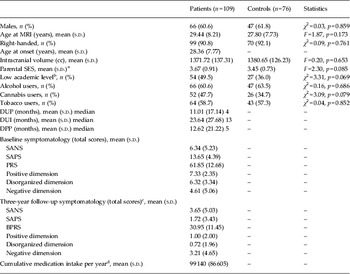
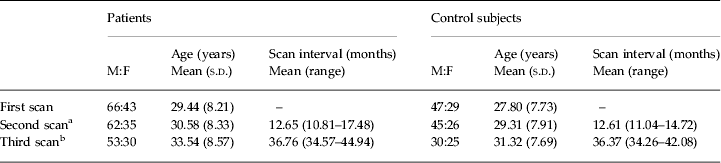
Demographic and clinical data are shown in Table 1. There were no statistically significant differences in relevant demographic and clinical characteristics between patients (n = 109) and healthy subjects (n = 76) at intake (all p's > 0.069) (Table 1). There were no significant differences between those patients who were included in the study and those patients who refused to participate (data available on request). The number of subjects, sex, age and scan interval of each of the groups at the imaging sessions are shown in Table 2. There were no significant differences between the two groups with regard to the age of the individuals and the length of the interval between MRI scans at any of the two follow-up assessments.
Demographic and clinical characteristics of patients and healthy controls (all variables at baseline unless specified otherwise)

MRI, Magnetic resonance imaging; SES, socio-economic status; DUP, duration of untreated psychosis; DUI, duration of untreated illness; DPP, duration of untreated prodromic period; SANS, Scale for the Assessment of Negative Symptoms; SAPS, Scale for the Assessment of Positive Symptoms; BPRS, Brief Psychiatric Rating Scale; s.d., standard deviation.
a Data based in 108 patients.
b Data based in 109 patients and 75 healthy controls.
c Data based in 94 patients.
d In chlorpromazine (CPZ) equivalents (mg) per year.
Number of subjects, sex, age and time interval between scans

M, Male; F, female; s.d., standard deviation.
Seventy-one patients and 50 controls were available for measurements at the 1-year and 3-year follow-ups.
a No significant difference between the first and second scan intervals between patients and control subjects (F = 0.064, p = 0.801).
b No significant difference between the first and third scan intervals between patients and control subjects (F = 2.188, p = 0.141).
Between-group differences over time
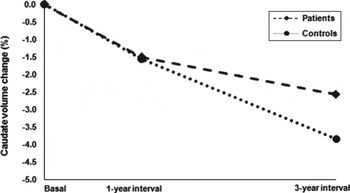
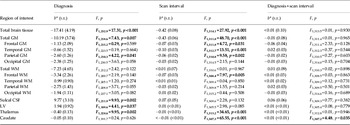
The volumes of the brain regions studied and volume changes between time points are presented in the online Supplementary Table S1. The results of the mixed-model analysis are shown in Table 3. Scan time effects were significant for all GM brain volume measures apart from the occipital lobe GM, indicating an overall GM loss over time in both patients and healthy controls. The diagnosis by scan time interaction revealed that the only ROI with a different pattern of brain changes over time between patients and healthy controls was the caudate nucleus (F 1,307.3 = 2.12, p = 0.035), with healthy subjects showing a greater reduction than patients (3.8% vs. 2.6%) during the 3-year follow up period (Fig. 1). Similarly, the caudate was the only region that showed a significant diagnosis by scan time interaction when only schizophrenia spectrum patients (schizophrenia, schizo-affective and schizophreniform disorders) were considered.
Changes in caudate nucleus volume in patients with schizophrenia and healthy controls during the 3-year follow-up period.

Results of best-fit mixed-effects model analyses in a sample of first-episode schizophrenia and healthy subjects

GM, Grey matter; WM, white matter; CSF, cerebrospinal fluid; LV, lateral ventricles; s.e., standard error.
a Estimate of the fixed effect coefficient.
Relationship between brain volume and clinical changes
We explored the relationship between brain volume change and pre-morbid variables at baseline (DUP, DUI, DPP) and clinical improvement during the 3-year follow-up period.
There were significant correlations between DUI and total (r = 0.219, p = 0.050) and frontal lobe (r = 0.289, p = 0.009) GM volume change, and between DUP and thalamus volume change (r = 0.240, p = 0.032). These positive correlations indicated a lower volume reduction associated with a longer DUI or DUP. However, these weak associations did not reach statistical significance after Bonferroni correction. No significant correlations between brain volume changes and DPP were observed (see the online Supplementary Table S2).
Correlations between brain volume change and clinical improvement during the 3-year scan interval are shown in the online Supplementary Table S3. There was a significant correlation between total brain tissue volume change and disorganize symptom change (r = 0.269, p = 0.017), indicating a greater volume reduction associated with greater clinical improvement. There was also a significant correlation between change in caudate volume and change in SANS total score (r = 0.275, p = 0.016), showing an association between greater volume reduction and greater clinical improvement. Finally, there were significant correlations between LV volume change and SAPS total score change (r = 0.228, p = 0.046) and psychotic symptom change (r = 0.229, p = 0.045), showing an association between greater volume increase and clinical worsening. These associations did not remain significant after correcting for multiple testing (Bonferroni correction).
Relationship between brain volume and cognitive performance change
Correlations between brain volume change and longitudinal change in cognitive performance during the 3-year follow-up period among patients are shown in the the online Supplementary Table S4. A significant correlation was found between verbal memory performance change and occipital lobe WM change (r = –0.271, p = 0.048), indicating an association between greater volume change and cognitive worsening. There were also significant correlations between visual memory performance change and parietal lobe WM volume change (r = 0.318, p = 0.019) and total brain tissue volume change (r = 0.290, p = 0.033), both showing associations between a lower volume decrease and greater cognitive improvement. However, no association remained significant after correcting for multiple comparisons.
Confounding variables
We examined whether brain volume changes might be mediated by potential confounding factors (cannabis, alcohol and tobacco consumption, sex, functionality, body weight change, medication intake and adherence).
There was a trend significance difference (F = 3.472, p = 0.064) in LV volume change between cannabis (−0.2%) and non-cannabis consumers (3.9%) during the 3-year follow-up period. Unexpectedly, non-cannabis users showed a greater increase in LV volume. Alcohol and tobacco consumers showed a similar pattern of volume change than those subjects who did not consume these substances. The original results did not change when the three variables for drug consumption (alcohol, tobacco and cannabis) were introduced in the analyses as fixed factors.
The original results did not change when only males were analysed. A similar pattern of volume change was found for all the brain regions when only females were analysed. There was no significant sex by time interaction when this variable was included as a fixed factor in the original analyses.
No differences in brain volume change were found between patients with good and bad functional outcome (WHODAS criteria) (all p > 0.14).
We analysed whether brain volume changes might be associated with body weight change during the 3-year follow-up period using Pearson's correlation coefficients. We did not find any significant correlations between variations in body weight and volume change during the 3-year follow-up period (all p > 0.054).
We also investigated whether the amount of antipsychotic treatment might be associated with volume changes in the brain regions analysed using Pearson's correlation coefficients. There was no significant correlation between brain volume change and medication intake during the 3-year scan interval (all p > 0.08). To further study how brain volume change might differ according to the amount of antipsychotic treatment, patients were grouped into tertiles of cumulative medication intake (Ho et al. Reference Ho, Andreasen, Ziebell, Pierson and Magnotta2011): most treatment (358 856 CPZ mg equivalents), intermediate treatment (193 862 CPZ mg equivalents) and least treatment (99 181 CPZ mg equivalents). We conducted an extreme group comparison to contrast brain volume changes between the most- and the least-treatment groups. The original linear mixed model was duplicated, replacing diagnosis with tertile group membership (most versus least treatment) and included a tertile group × scan time interaction time. Only the occipital lobe WM showed a statistically significant main effect of tertile group × time interaction (F = 4.21 p = 0.042), with the least-treatment group showing a greater increase in the occipital lobe WM. We also explored treatment effects further by including the CPZ dose equivalence measure as an independent variable in the mixed model analyses involving patients only. The CPZ dose equivalence was not related to brain volume change for any of the regions investigated (all F < 3.68, all p > 0.058).
Finally, we investigated whether brain volume changes might be influenced by antipsychotic medication adherence. No significant differences were found in brain volume changes between patients with good adherence and those with poor during the 3-year follow-up period (all p > 0.099).
Discussion
Overall, patients and healthy volunteers had a similar pattern of brain volume change, although schizophrenia spectrum patients showed a significantly lower progressive decrease in the volume of the caudate nucleus. Clinical and cognitive outcomes in schizophrenia do not seem to be related to progressive brain volume change during early years of the illness. To the best of our knowledge, this is the largest longitudinal population-based study to date, including clinical data and an extensive neuropsychological battery, that has examined progressive brain volume changes in a sample of first-episode schizophrenia spectrum patients evaluated at regular time points and using the same scanner.
We found that the brain tissue volume decrease in patients in early years after the first episode was similar to that found in healthy controls. Although several studies have described a greater degree of brain tissue volume decrease in the early stages of schizophrenia (Cahn et al. Reference Cahn, Hulshoff Pol, Lems, van Haren, Schnack, van der Linden, Schothorst, van Engeland and Kahn2002; Ho et al. Reference Ho, Andreasen, Nopoulos, Arndt, Magnotta and Flaum2003; Andreasen et al. Reference Andreasen, Nopoulos, Magnotta, Pierson, Ziebell and Ho2011; Olabi et al. Reference Olabi, Ellison-Wright, McIntosh, Wood, Bullmore and Lawrie2011), longitudinal studies have failed to confirm these findings (Dickey et al. Reference Dickey, Salisbury, Nagy, Hirayasu, Lee, McCarley and Shenton2004; Zipursky et al. Reference Zipursky, Christensen and Mikulis2004; DeLisi & Hoff, Reference DeLisi and Hoff2005; Schaufelberger et al. Reference Schaufelberger, Lappin, Duran, Rosa, Uchida, Santos, Murray, McGuire, Scazufca, Menezes and Busatto2011; Roiz-Santianez et al. Reference Roiz-Santianez, Perez-Iglesias, Ortiz-Garcia de la Foz, Tordesillas-Gutierrez, Mata, Gonzalez-Mandly, Pazos, Tabares-Seisdedos, Vazquez-Barquero and Crespo-Facorro2012). It is noteworthy that some studies have reported that brain volume reductions found in first-episode patients may be reversible over time (Keshavan et al. Reference Keshavan, Haas, Kahn, Aguilar, Dick, Schooler, Sweeney and Pettegrew1998; Schaufelberger et al. Reference Schaufelberger, Lappin, Duran, Rosa, Uchida, Santos, Murray, McGuire, Scazufca, Menezes and Busatto2011).
Our results do not provide support for the current renewal of Kraepelin's concept in the brain imaging literature that suggests a marked progressive brain change in schizophrenia individuals from the earliest stages of the illness (DeLisi, Reference DeLisi2008). However, our findings are consistent with what is now known about the clinical course of schizophrenia (Zipursky et al. Reference Zipursky, Reilly and Murray2012) and with our experience in day-to-day clinical practice (Ayesa-Arriola et al. Reference Ayesa-Arriola, Perez-Iglesias, Rodriguez-Sanchez, Pardo-Garcia, Tabares-Seisdedos, Ayuso-Mateos, Vazquez-Barquero and Crespo-Facorro2013). Supporting this notion, our group recently reported that there is no evidence of a significant cognitive decline during the first 3 years after initiation of antipsychotic treatment (Rodriguez-Sanchez et al. Reference Rodriguez-Sanchez, Ayesa-Arriola, Perez-Iglesias, Perianez, Martinez-Garcia, Gomez-Ruiz, Tabares-Seisdedos and Crespo-Facorro2013).
Of interest, the patients showed a lower degree of caudate nucleus volume reduction than the healthy individuals after 3 years. Although unexpected, the results are in accordance with some longitudinal studies that have reported a different pattern of change over time in the caudate nucleus volume between schizophrenia patients and healthy subjects (Chakos et al. Reference Chakos, Lieberman, Bilder, Borenstein, Lerner, Bogerts, Wu, Kinon and Ashtari1994; Keshavan et al. Reference Keshavan, Bagwell, Haas, Sweeney, Schooler and Pettegrew1994; Lieberman et al. Reference Lieberman, Chakos, Wu, Alvir, Hoffman, Robinson and Bilder2001). Most of those studies observed that the volume of the caudate nucleus increased in patients, whereas in control subjects there was a significant decrease with time. Caudate enlargement might occur early in the course of treatment in young, first-episode schizophrenia patients as an interaction between antipsychotics and the plasticity of dopaminergic neuronal systems (Chakos et al. Reference Chakos, Lieberman, Bilder, Borenstein, Lerner, Bogerts, Wu, Kinon and Ashtari1994). A meta-analysis by Haijma et al. (Reference Haijma, van Haren, Cahn, Koolschijn, Hulshoff Pol and Kahn2012) on cross-sectional volumetric brain alterations in both medicated and antipsychotic-naive patients indicated that volume reductions in the caudate nucleus were more pronounced (d = −0.38) in a sample of antipsychotic-naive patients than in medicated patients. Although the initial descriptions of an increase in caudate nucleus volume were linked to long exposure to typical antipsychotics (Chakos et al. Reference Chakos, Lieberman, Bilder, Borenstein, Lerner, Bogerts, Wu, Kinon and Ashtari1994; Keshavan et al. Reference Keshavan, Bagwell, Haas, Sweeney, Schooler and Pettegrew1994), more recent investigations have also reported a volume increase in patients receiving atypical antipsychotics (i.e. clozapine or risperidone) (Staal et al. Reference Staal, Hulshoff Pol, Schnack, Hoogendoorn, Jellema and Kahn2000; Massana et al. Reference Massana, Salgado-Pineda, Junque, Perez, Baeza, Pons, Massana, Navarro, Blanch, Morer, Mercader and Bernardo2005). We did not find a statistically significant correlation between time on antipsychotic medication and volume of the caudate at the baseline scan (r = 0.03, p = 0.792). It is of interest that most of the patients in our study were being treated with atypical antipsychotics. We might speculate that antipsychotics exert a relative increase in caudate volume in patients compared to controls by ameliorating the natural caudate shrinkage seen in healthy individuals associated with age.
Previous investigations have not provided a consistent description of the pattern of brain changes over time in schizophrenia patients. Clinical heterogeneity (Ho et al. Reference Ho, Andreasen, Nopoulos, Arndt, Magnotta and Flaum2003), small sample sizes and the effect of confounding factors such as poor nutrition (Hulshoff Pol et al. Reference Hulshoff Pol, Hoek, Susser, Brown, Dingemans, Schnack, van Haren, Pereira Ramos, Gispen-de Wied and Kahn2000), diminished social and environmental stimuli (Diamond, Reference Diamond2001), alcohol, tobacco or cannabis consumption (Rais et al. Reference Rais, Cahn, van Haren, Schnack, Caspers, Hulshoff Pol and Kahn2008; van Haren et al. Reference van Haren, Koolschijn, Cahn, Schnack, Hulshoff Pol and Kahn2010; Smith et al. Reference Smith, Wang, Cronenwett, Goldman, Mamah, Barch and Csernansky2011) and lifestyle (Pajonk et al. Reference Pajonk, Wobrock, Gruber, Scherk, Berner, Kaizl, Kierer, Muller, Oest, Meyer, Backens, Schneider-Axmann, Thornton, Honer and Falkai2010; Falkai et al. Reference Falkai, Malchow, Wobrock, Gruber, Schmitt, Honer, Pajonk, Sun and Cannon2013) may account for discrepancies between studies. A major confounding factor could be the intake of antipsychotic medication (van Haren et al. Reference van Haren, Cahn, Hulshoff Pol and Kahn2012). Some studies have shown a relationship between antipsychotic medication use and longitudinal brain volume change in schizophrenia (Cahn et al. Reference Cahn, Hulshoff Pol, Lems, van Haren, Schnack, van der Linden, Schothorst, van Engeland and Kahn2002; Lieberman et al. Reference Lieberman, Tollefson, Charles, Zipursky, Sharma, Kahn, Keefe, Green, Gur, McEvoy, Perkins, Hamer, Gu and Tohen2005), although others have failed to clearly demonstrate an influence of antipsychotic medication on brain volume change (Kasai et al. Reference Kasai, Shenton, Salisbury, Hirayasu, Lee, Ciszewski, Yurgelun-Todd, Kikinis, Jolesz and McCarley2003; Nakamura et al. Reference Nakamura, Salisbury, Hirayasu, Bouix, Pohl, Yoshida, Koo, Shenton and McCarley2007; Crespo-Facorro et al. Reference Crespo-Facorro, Roiz-Santianez, Perez-Iglesias, Pelayo-Teran, Rodriguez-Sanchez, Tordesillas-Gutierrez, Ramirez, Martinez, Gutierrez, de Lucas and Vazquez-Barquero2008). We failed to demonstrate any significant association between cumulative medication intake and brain volume change at 3 years. The majority of the patients had been taking only atypical antipsychotics during the follow-up but had switched their initially prescribed medication several times during the 3-year follow-up period (Crespo-Facorro et al. Reference Crespo-Facorro, Perez-Iglesias, Mata, Martinez-Garcia, Ortiz, Pelayo-Teran, Valdizan and Vazquez-Barquero2012). Therefore, a valid investigation of the effect of different types of antipsychotics on brain changes was not viable. Differences in the methodology may also account for inconsistencies between investigations. Reliability in MRI-derived automated morphometric measures can be influenced by several sources of variance (Jovicich et al. Reference Jovicich, Czanner, Han, Salat, van der Kouwe, Quinn, Pacheco, Albert, Killiany, Blacker, Maguire, Rosas, Makris, Gollub, Dale, Dickerson and Fischl2009). Thus, reliability can be affected by subject-related factors, such as hydration status (Walters et al. Reference Walters, Fox, Crum, Taube and Thomas2001), instrument-related factors, such as field strength, scanner manufacturer, imaging magnetic gradients (Jovicich et al. Reference Jovicich, Czanner, Greve, Haley, van der Kouwe, Gollub, Kennedy, Schmitt, Brown, Macfall, Fischl and Dale2006) and pulse sequence, and data processing-related factors, including the software package and version and the parameters used in the analysis (Senjem et al. Reference Senjem, Gunter, Shiung, Petersen and Jack2005; Han et al. Reference Han, Jovicich, Salat, van der Kouwe, Quinn, Czanner, Busa, Pacheco, Albert, Killiany, Maguire, Rosas, Makris, Dale, Dickerson and Fischl2006; Gronenschild et al. Reference Gronenschild, Habets, Jacobs, Mengelers, Rozendaal, van Os and Marcelis2012).
Boonstra et al. (Reference Boonstra, Cahn, Schnack, Hulshoff Pol, Minderhoud, Kahn and van Haren2011) hypothesized that DUP, DUI or DPP, through their effect on outcome, might be associated with change in brain volume in schizophrenia, although these authors did not observe any significant association when studying the relationship between DUI and brain volume change. In line with this investigation, we have not found any significant associations between brain volume change and pre-morbid measures (DUI, DUP and DPP). Similarly, a computed tomography study by Madsen et al. (Reference Madsen, Karle, Rubin, Cortsen, Andersen and Hemmingsen1999) did not find any association between DUP and 5-year volume change. It has been suggested that the lack of association between those variables might be confounded by the use of antipsychotic medication (Boonstra et al. Reference Boonstra, Cahn, Schnack, Hulshoff Pol, Minderhoud, Kahn and van Haren2011), given that it might cause either a decrease or an increase in brain volume change over time (Ho et al. Reference Ho, Andreasen, Ziebell, Pierson and Magnotta2011; van Haren et al. Reference van Haren, Schnack, Cahn, van den Heuvel, Lepage, Collins, Evans, Hulshoff Pol and Kahn2011). However, there has been no evidence to support the idea that longer DUI, DPP or DUP could initiate a process of marked progressive brain change (Zipursky et al. Reference Zipursky, Reilly and Murray2012).
An important question regarding brain volume changes over time is whether volume tissue loss might determine outcome. However, this issue has not been extensively investigated, with the few studies yielding inconsistent results. Our results did not reveal a significant association between changes in brain volume and clinical outcome. These findings are in agreement with some (DeLisi et al. Reference DeLisi, Sakuma, Tew, Kushner, Hoff and Grimson1997) but not other studies (Gur et al. Reference Gur, Cowell, Turetsky, Gallacher, Cannon, Bilker and Gur1998; Lieberman et al. Reference Lieberman, Chakos, Wu, Alvir, Hoffman, Robinson and Bilder2001). Furthermore, no evidence of a significant association between brain volume changes and cognitive functioning changes over time was found in the present study. Although previous studies (Ho et al. 2003; Andreasen et al. Reference Andreasen, Nopoulos, Magnotta, Pierson, Ziebell and Ho2011) have found associations between cognitive performance and changes in brain measures, those statistical associations were all weak (all |r| < 0.26) and did not reach a statistically significant level if multiple comparison correction was used.
A reasonably large sample, uniform follow-up intervals using the same MRI scanner and protocol, and a thorough clinical investigation during the follow-up period add strength to the conclusions drawn from this study. However, several limitations should be taken into account when interpreting our results. First, some subjects were not scanned at all time points. Second, and considering that schizophrenia is a life-long disease, a follow-up period of 3 years may be too short to demonstrate subtle changes. Third, some patients withdrew from their medication, and most of them switched medication during the 3-year follow-up period, which makes the investigation of the effects of different types of antipsychotics unfeasible. Fourth, brain volume changes in schizophrenia are subtle, so the sample size might be considered small to make any definitive assertions. Thus, the negative findings reported here could be related to Type II error potentially arising from low statistical power. However, it is of note that the current sample size is larger than most previous longitudinal MRI studies reporting progression of brain volume abnormalities (Pantelis et al. 2005; DeLisi, Reference DeLisi2008). Finally, it has been suggested (Sowell et al. Reference Sowell, Peterson, Thompson, Welcome, Henkenius and Toga2003; Terribilli et al. Reference Terribilli, Schaufelberger, Duran, Zanetti, Curiati, Menezes, Scazufca, Amaro, Leite and Busatto2011) that the trajectory of brain volume change in normal ageing could follow a non-linear pattern. However, GM volume changes in schizophrenia patients have been characterized by the absence of the normal curved trajectory of volume change with age present in healthy subjects (van Haren et al. Reference van Haren, Cahn, Hulshoff Pol and Kahn2008). Therefore, and to be able to compare groups, we chose to correct for age in a linear fashion.
In summary, brain volume abnormalities that have been consistently observed at the onset of non-affective psychosis may not inevitably progress, at least throughout the first years of the illness. Nonetheless, differences between groups were only found in the caudate nucleus, with healthy subjects showing a greater volume reduction than patients. Taking together with clinical and cognitive longitudinal data, our findings, showing a lack of deteriorating malignant processes in a substantial number of individuals, suggest a less pessimistic and more reassuring perception of the illness. Chronic and disabling outcomes frequently experienced by patients may not be an unavoidable consequence of a progressive brain disease.
Supplementary material
For supplementary material accompanying this paper visit http://dx.doi.org/10.1017/S0033291713002365.
Acknowledgements
This study was carried out at the HUMV, University of Cantabria, Santander, Spain, with the following grant support: Instituto de Salud Carlos III PI020499, PI050427, PI060507, Plan Nacional de Drogas Research Grant 2005-Orden sco/3246/2004, SENY Fundació Research Grant CI 2005-0308007 and Fundación Marqués de Valdecilla API07/011.
Declaration of Interest
Unrestricted educational and research grants from AstraZeneca, Pfizer, Bristol-Myers Squibb and Johnson & Johnson provided support for PAFIP activities. No pharmaceutical industry has participated in the study concept and design, data collection, analysis and interpretation of the results, and drafting of the manuscript.
B.C.-F. has received unrestricted research funding from AstraZeneca, Pfizer, Bristol-Myers Squibb and Johnson & Johnson that was deposited into research accounts at the University of Cantabria. B.C.-F. has received honoraria for his participation as a speaker at educational events from Pfizer, Bristol-Myers Squibb and Johnson & Johnson and consultant fees from Pfizer. R.P.-I. has received support from Lilly to attend conferences.