Introduction
In his critique of the visions of change pursued by the state of high modernity, James Scott uses the phrase ‘Vos papiers, Monsieur’—spoken by a gendarme to a man he wishes to question—to capture the paper-mania characteristic of the modern state. Scott refers to the myriad of paper representations of the citizen of the modern state, like birth certificates, identity cards, title deeds, tax returns, and death certificates.Footnote 1 The modern state appears as a virtual paper machine in which officials produce, exchange, consume, and store immense quantities of information on paper.
In Siam at the turn of the twentieth century, we witness the same obsession with the correct handling and storage of information inscribed on paper. With its very existence, the National Archives in Bangkok—established in 1916—testifies to this concern to store documents for posterity. In its collections, cases concerning various aspects of mismanagement of documents abound. One case from 1916, for example, involves an investigation of outgoing letters from the Ministry of Local Government. It involved two invitation cards sent to two high-ranking police officers to attend a celebration at the Ministry. The invitations should have been delivered more speedily and an internal investigation was carried out to find the reasons for the delay. Through an interrogation of a handful of officials, it was possible to piece together in detail the transfer of the two cards from the sender to the receiver. When did they reach the different stages in the transmission? Who received them? To whom were they passed? And what instructions did the various carriers of the cards receive or give along the way? The investigation concluded that the handling of the cards had been in accordance with the regulations for ordinary letters. The fault, therefore, belonged to the first clerk who did not specify that the cards should have been treated as urgent.Footnote 2
Another example is an internal investigation carried out by the Department of the Metropolitan Police and Provincial Gendarmerie in September 1918. Clerks in the department had discovered that they could not locate several reports from the provinces sent to the inspector in Bangkok. While the reports were recorded in the register, they were missing from the archive. It turned out that a former employee of the department had kept 29 reports at his private residence. This was considered a blatant violation of regulations concerning the correct storage of documents which should never have entered the private home of an employee—the office, not the private home, was the place for the production and storage of documents. In his defence, the guilty official argued that he had brought the documents home in order to study them closely and that he had intended to restore them to the archive. This, however, he had forgotten to do.Footnote 3
At first sight these cases may seem small and trivial—two invitations circulated too slowly and some official documents stored outside the confines of the office by a forgetful employee. On a deeper level, however, the cases reflect precisely a marked sensitivity to documentary practices in early twentieth-century Siam. Officials took care to inscribe these cases on paper and the paper trails have been stored for us to encounter a century later. More specifically, the particular problems dealt with in the cases highlight different aspects that were central to the bureaucratic handling of documents: correct storage, spatial specificity, and correct procedures and speed for the exchange of official papers.
The cases reflect the main arguments of this article. First, the centrality of documents is emblematic of bureaucratic practices, and documentary practices are essential to the ethos of government officials. To be a government official is to know the importance of documentary practices and to master them. Second, although these obsessive documentary practices are a recent phenomenon, they have their history. We trace their coming into being from the anxieties and concerns of the mid-nineteenth century when papers were not in order. Third, and most importantly, we argue that these mundane acts of writing, reporting, filing, and ordering of documents in the offices produce the effect that the state exists.
With such an approach, we wish to engage in a dialogue with the existing literature, both with the local aspect of Siamese/Thai studies and with the theoretical facet of the studies of documentary practices elsewhere, although these are not mutually exclusive. For the former, we highlight new aspects of administrative reforms in Siam at the turn of the twentieth century. These reforms and the related processes of state formation are probably some of the most studied topics in the history of Thailand. Within the royalist-nationalist narrative, these reforms are often considered the epitome of how the royal elite transformed Siam into a modern nation and safeguarded the country's independence. Since Benedict Anderson's path-breaking critique of the pre-1970s studies of the Thai state, revisionist approaches have proliferated and focused on different aspects of the processes of state formation at the turn of the twentieth century.Footnote 4 In general, the revisionist approaches register transformations of how space and territory, state apparatuses, and the population are perceived and organized. In doing so, these studies highlight different aspects of the triad ‘territory–state-apparatus–population’—so axiomatic of the conception of the state—and changes in how the state organizes and perceives things of the state.Footnote 5 So far, however, the production, consumption, movement, and storage of documents have received only limited attention and the few existing studies of this topic still tend to presuppose the predominance of the ‘state’ and treat documents as instruments through which to achieve political and administrative centralization or integration of the nation-state.Footnote 6
In comparison, we analyse changing documentary practices to highlight intrinsic dynamics of state formation without subscribing to the notion of the state as an entity. We focus on mundane practices of documentation that produce the effect that the state exists, rather than taking the state as the starting point. It is through these practices that the existence of the state is formed. We show how this new regime articulated a standardization of written official documents, the birth of the file as a technology to deal with the avalanche of documents circulating between sections of the burgeoning administration, and the spatial organization that created the office—fields where officials produced and stored documents according to specific regulations. Further, we exemplify this new regime of documentary practices beyond the administrative centre in Bangkok, with special reference to the paperwork of the provincial gendarmerie.
This brings us to the dialogue with other studies on documentary and material practices. The intimate link between the modern bureaucratic states, acts of documentation, and the ability to govern is a central theme in the classic literature on processes of state formation—documents are central tools to govern people and things.Footnote 7 We do not wish to dispute that paper, writing, and documents play a role in the governance of the modern state by making society, people, and resources legible to government officials. In fact, as we shall see, the architects of new documentary practices linked these with instrumental and disciplinary ends. Yet, we also draw inspiration from new studies, which have renewed the focus on documentary practices.Footnote 8 These studies argue that the importance of documentary practices is not so much the functionality of the documents in a more traditional sense. Rather, they accentuate the very materiality of the documents and how these help generate larger-scale forms of sociality—from organizations to states—not simply as instruments of control through their links to the entities that they document but through coordination of perspectives and activities, and as ‘vehicles of imagination’.Footnote 9 In the next section of the article—before we turn our attention to the production, flow, and storage of documents in Siam—we will first outline the theoretical and conceptual framework supporting our approach.
The state and documents: framing our approach
The intimate link between the state's ability to govern and the production, circulation, and storage of documents is a classic theme in the literature dealing with the techniques that enable a state to govern. The classic text in this connection is Max Weber's writing on modern bureaucracy. For Weber, the modern state's ability to govern rests on an effective bureaucratic basis (the bureau), which in turn is based on files, specialization of officials, calculable rules, and painstaking obedience.Footnote 10 While both Anthony Giddens and Jack Goody also emphasize how all states are linked with written forms of information, they single out the modern state for its ability to store information relevant to the direct supervision of people and things. Written information makes it possible for the modern state to expand its administrative range of control as writing, in the words of Giddens, enhances ‘time-space-distanciation’ or, in the words of Goody, militates against the ‘tyranny of distance’.Footnote 11
In general, for these approaches, the very act of writing, the production of files and documents, and the accumulation and storage of written information make society legible and enables governmental power. As instruments of bureaucratic organizations, documents promote social and organizational control through storage and transmission of knowledge concerning the state's population, space, and resources, among other things. The documents are tools that facilitate the instrumental ends of government. Embedded in such an approach is the notion of the state as a pre-existing entity that instrumentalizes the use of papers. In doing so, these approaches adopt a state-centric approach in which the state appears as a discrete social fact: a bounded unit and autonomous actor clearly separated from society. Spatially the state is concentrated and spreads outwards across the territory and downwards into the lives of the populace through, for example, healthcare programmes, schooling, conscription, and the production of certificates and permits.Footnote 12
Under keywords like ‘state effect’, ‘imagined state’, and ‘states of imagination’, researchers from different fields have challenged such a state-centric approach.Footnote 13 This rethinking does not focus on the state as an institution, but rather emphasizes the processes that create the notion of the state as a unit and make the state present as a social force in everyday life. Approaches within this tradition focus on the order and meaning-generating practices that help to shape and preserve the impression of a social order consisting of state and civil society. This shift in attention from a government's power centre to processes that create a state illusion or state effect typically highlight everyday practices that organize people and space. From such practices, the state arises as an open field with multiple boundaries, without being stable and institutionally or geographically anchored. One can say that it is the local (order-creating) practices that constitute the state's existence, not the other way around. Hereby, the state is analysed as a structural effect—not as an actual structure but as the powerful, metaphysical effect of practices that makes such structures appear to exist.Footnote 14
Recently, a series of studies has focused on the importance of the very act of writing and documents in relation to an ongoing production and reproduction of the state. Here, the focus is not on the role of documents in making people and resources legible to the state. For whereas the modern state may appear as a paper machine producing endless series of documents, a state-centric and instrumentalist perspective disregards the point that much of what is written is in fact ‘excess writing’. This is the term used by Akhil Gupta to denote how much of the writing produced by officials does not have a consumer:
An argument that focuses on the instrumentality of the state misses the fact that very little of the writing generated and the data gathered by governments is useful and an even smaller percentage of potentially useful information is actually employed for purposes of the state. Even if one were to pursue an argument about writing as a form of self-regulation and self-surveillance in a panoptical system, it would be hard to explain the sheer magnitude of what is written by state officials.Footnote 15
In the same vein, Nayanika Mathur talks about the existence of the ‘paper state’ in India. With this term, she refers at the most obvious level to the overwhelming material culture of the Indian state. Mathur, however, does not link the massive production, circulation, reading, and filing of documents with an exercise of legibility but with practices and things whereby it is believed that legibility has been achieved. Thus, the ‘paper state’ refers to the massive production of documents that creates a situation ‘as if the illegibilities have been overcome, as if orders have been followed, as if NREGA [National Rural Employment Guarantee Act] has been made real’.Footnote 16
Gupta and Mathur, however, do not see this aspect of documentary practices as a reflection of failure in the Indian state's governance. Rather, the point is that the procedural and repetitious actions linked with the production, circulation, and storage of letters, memos, reports, and files produce and reproduce the effect of the state. In that sense, writing is not a by-product of state activities nor a substitute for action but is itself a form of action.Footnote 17 It is through daily documentary practices that the paper state comes to be assembled and maintained.Footnote 18 The writing and the handling of documents is a window through which to understand how the workings of the state as a translocal institution are brought into being in local practices. In the words of Sharma and Gupta, it is the ‘proceduralism, the banal repetition of everyday actions, and the mundane realities of following precedent, [that] reproduce “the state” as an institution across time and space’.Footnote 19
Such an approach to the intimate link between writing and the production of the state resonates well with what other studies have discussed with reference to other contexts and scale. Ilana Feldman, for example, has analysed how quotidian practices of bureaucracy produce and reproduce governing authority in Gaza under various administrations. She locates an important dimension of this regime of practices that produces governing authority in the very basic bureaucratic practice of filing. She discusses, for example, how the regime of practices embedded in the authority of writing, in ‘reiterative writing’ (the repetitive production of files and their regularity), and in the pragmatics of managing file circulation and accessibility, in a very basic sense defines a space and style of interaction among people, which, in turn, produces governing authority. With this analysis, Feldman actually shows how governing authority can subsist without a state.Footnote 20
Likewise, Matthew Hull's study of files and their circulation in an Islamabad bureaucracy suggests that we should, following Bruno Latour, study social organizations as ‘corporate bodies’ or ‘object institutions’—as collectives of humans and artefacts in which the artefacts are not merely the passive instruments of social agents but active in the creation and maintenance of those agents.Footnote 21 Hull analyses ‘graphic artefacts’—materials such as files, maps, letters, reports, and office manuals—and shows how these are central in the construction of collective agency from the agency of individuals. His argument is that ‘bureaucratic agency is at once individualized through autographic writings and ritually collectivized through the dialogic, discursive and circulatory construction of those writings’.Footnote 22 The circulation of files constructs a ‘corporate authority’ or collective agency represented by the note sheet's mapping of the file's movement up and down the chain of command, including its circulation laterally to other departments. For Hull, the file is not merely a communicative tool in the classical sense but a central tool in creating bureaucratic agency that combines individuality with collective agency: ‘[…] graphic artifacts are not simply the instruments of already existing social organizations. Instead, their specific discourses and material forms precipitate the formation of shifting networks and groups of official and nonofficial people and things’.Footnote 23
In this article, we meditate on this process of combining and folding of humans and the flow of artefacts. By ‘artefacts’, we focus in particular on the ordinary things of the state, the micro-technologies or what Patrick Joyce calls the ‘low and slow tech’ aspects of the technostate—papers, documents, files, and inscriptions.Footnote 24 With this approach, we wish to discuss central aspects of how the modern state in Siam was produced, assembled, and reproduced through these acts of writing and inscriptions.
‘I am a lowly face’: the coming of the paper king
The mid-nineteenth century was a period of dramatic transformation for Siam. The Bowring Treaty with Britain in 1855 entrenched Siam deeper within the world market and subjected it to the rule and demand of free trade. This period also saw a great makeover of the world views of the elites. For instance, members of the elite cast a critical eye over the Buddhist cosmology, based on a curious mixture of the scientific and empirical mindset and the refocusing of religious ethos on this-world affairs rather than on the next life. Spatially, geography and astronomy—rather than religious cosmology—played an influential role in shaping the elite's perception of the earth's surface. Time was increasingly shaped into history and the writing of history started to become the dominant mode of perceiving the past. While it is true that, as Chris Baker and Pasuk Phongphaichit observe, ‘Mongkut's intellectual interests leaned towards the west’, ‘his approach to managing the increasingly disorderly kingdom was very traditional’—the reinstallation of royal rituals, city pillar, the use of horoscope, and an administrative system based on personalized ties.Footnote 25 Among all these, however, was the increase in decrees and royal proclamations flowing from the court.Footnote 26 It is this surge in document production that we would like to tackle in detail.
While we maintain that the production, consumption, exchange, and storage of documents took place to an unprecedented extent around the turn of the twentieth century, this is not to imply that documentary practices were not at play earlier. Before, and even during, the administrative reforms, there was the practice of bai bok, a report on various issues sent from further afield to Bangkok. From Bangkok, there were documents called santra and supha askson, which were sent to regional cities and tributary states respectively. Content-wise, these bai bok and letters dealt mostly with spying during wartime and the emergency period. In peacetime, in contrast, the interval between the letters grew and sporadically dealt with what transpired in the courts of the cities as they occurred. In his study of the use of documents during the reigns of King Nangklao (r. 1824–1851) and King Mongkut (r. 1851–1868), Hiroshi Kawaguchi draws attention to the sharp increase in the writing of letters and documents to and from the court from 1829 onwards. This was, Kawaguchi argues, a result of Bangkok's war effort with Vientiane.Footnote 27 In another study, Constable and Nooch have shown how tribute accounts dating from the latter part of Rama IV's reign differs from tax and tribute accounts of earlier periods. Instead of simply listing what products and quantity derived from a specific locality, the later versions also listed outstanding fiscal debts in order to be able claim these.Footnote 28
Increased correspondence, like the shift in accounting practices, meant that more and more things were turned into inscriptions, which flowed slowly to and from the court in Bangkok. Slow speed characterized the flow of these inscriptions. For instance, a paper stamped 3 January 1842, on British interest in forestry in the nearby areas of Chiang Mai, was carried down to Bangkok on 26 February. That is, nearly two months passed before the message was received in Bangkok. Decades later, this seems to have changed very little. In the 1880s, a bai bok from Ubon in the northeast could take up to a month-and-a-half to reach Bangkok.Footnote 29 This can be compared to a one-day exchange of information via telegraph in the 1900s.
What happened when documents reached Bangkok? The following is how Prince Damrong Rajanubhab (1862–1943) understood the ‘paperwork’ procedure before he was appointed minister of the interior in 1892. Contra common sense, these words did not immediately reach the king. In fact, most of them did not go to the palace at all. Once in Bangkok, a bai bok usually arrived at the table of a scribe. The scribe then looked at the paper, or, more accurately, inscribed leaves, and decided whether to report to his superior, the palat thun chalong (secretariat). The recipient was not clearly named and therefore the document was passed on to the palat, who took another day to consider before having it sent off to one of the senabodi (the most high-ranking aristocrats) at his residence the next morning. The senabodi read and gave orders. If, however, he could not make up his mind, he would instruct his assistant to make a copy of the message, or some part of it, and have it carried to the palace, where it would be read aloud before the king, who then gave a verdict on the issue.Footnote 30
Things were, in fact, less orderly than Damrong recollected and allows us to know. His father, Mongkut, relentlessly and bitterly lamented the lack of communication between himself and his supposed subordinates and officials. He complained in a letter to an upcountry aristocrat that, ‘I am a lowly face (na tam), a foul face (na leo), invisible and nameless. No headmen of the cities and towns know me. Nobody pays me a visit. I do not know you and you do not know me.’Footnote 31
Given that most letters to and from outlying regions were written at long intervals, up to six months or a year, and took days or months to arrive in Bangkok, where they did not immediately make their way into Mongkut's hand, this was hardly surprising. Mongkut felt that he was isolated in the palace, lonely, and ignored by the officials and the public alike. As a king, he was fearsome, but he reasoned that this was merely the result of the increasingly irrelevant traditions and rituals, the embellishment and theatrics of which further alienated him from others. In reality, he was mostly bypassed and ridiculed. Most power was instead concentrated in the hand of the senabodi.Footnote 32
At times even Mongkut—not just the aristocrats and the population—lost touch with what went on inside the palace, even on such private issues as the affairs of his consorts. He sometimes missed the chance of meeting his brother, the second king,Footnote 33 and was not informed of the latter's travelling schedule or whereabouts, even though they constantly wrote letters to each other, often by using Roman alphabets to spell Thai words, as if to establish codes.Footnote 34 To counter this, many protocols were put in place, especially the documentary practices and artefacts that would ensure that the king was the centre of authority. In turn, the king, and the Siamese crown and court in general, were shaped by these practices.
To claim the centre stage of authority was to control lines of communication, or to establish one where there was none. To be properly informed and to inform others, in due time, in the right place, to and from the right person, was a prerequisite for acting and producing the real effect of Mongkut's title as the king. Before making new connections, however, Mongkut was already plagued by another, more prosaic problem—that most of the existing communication was miscommunication. Making sure that the king's wishes and decisions were accurately heard, copied, distributed, and properly announced was not a simple matter. This is revealed in other complaints from the monarch, which often made their way into public announcements: when he gave orders in the palace hall, his voice was ‘empty […] echoing across the hall’ and, as a result, sometimes ‘the king said one thing, the listener heard another’. And vice versa: when there were issues to be reported, the king could not grasp what the speaker was saying. This, according to Mongkut, was an estranging outcome of the rituals and customs in the hall, such as the subordinates’ prostration in a place far from the monarch.Footnote 35 Thus, the gap between the monarch's wishes and their actual effects increased as his voice echoed between the walls and faded.
Mongkut quickly came to recognize the importance of writing things down in order to make his thoughts matter. But even writing produced a mess. Confusion and misunderstandings abounded. Three instances testify to this. First, in 1858, he created an official record of proclamations and orders, out of his despair at the documentary situation in the court. As he put it,
I am worried about all the official matters, such as those ordered through the letter of the Palace Affairs, carried by foot by the registrar and the page; those instructed to the district (amphoe) headmen to announce to the populace in Bangkok; those general orders sent to the rulers of cities and towns in the north and in the south […]; those involving new Acts, prohibitions and directives, or the reminders to observe existing laws, such as the cancellation of taxes, the tax rates, the reduction or increase of taxes, the enlisting and the request of labour […]; in short, everything that the bureaucrats and the populace should be aware of. All of these used to be in the letter form which, as in the drafting of announcements, was written in pencil, sent hither and thither, carelessly copied. The copies were too few, not enough for people to read. Whence, the king's wishes are not known. Same with the decisions reached by the elders of the country […]. The [wishes and decisions] only spread by word of mouth. Those who have actually read the original letter were few; even if they had, they would not understand it because there are fewer literate Thais than the illiterate ones.Footnote 36
Mongkut then ordered the compiling of Ratchakitchanubeksa—‘a book for looking into the official affairs’. Its name had to be inscribed in a clear, bold type up front and at the top of every document. Further, he instructed that when ‘the order reaches anybody, that person should not tear or destroy it; when another document arrives, he should stitch them together like a Chinese book, and put them in order, from one, two, three, four’.Footnote 37
Second, similarly, the monarch's authority was not visible enough in the documents. Mongkut lamented the circumstance in which ‘the country bumpkins [khon phrai phrai nai prathet bannok] cannot read and do not know the insignia of the authorities and ranks […] when they see a crest in print with some red lines, they believe whatever the person who hold the paper says […] and hence, many the frauds’.Footnote 38 In Ratchakitchanubeksa, Mongkut ordered the inscription in black of a large crown with tiered umbrellas on the side as the symbol of his throne (mongkut means ‘crown’ in Thai). He also applied this to the epistolary exchanges with his officials and the city rulers, out of fear that they would be uncertain of the king's identity: in a letter to an officer, he recommended that the recipient compare the crest with that in the royal appointment paper, ‘so that you can believe that this letter is from me’.Footnote 39 Such was the precarious state of the monarchy.
Third, after a period of introducing a new type of money, in coin and paper, Mongkut found that there were rumours, followed by panic, among members of the public and a lack of knowledge of the official venue for the exchange of money. As a solution, he ordered a signboard for public notification to be erected.Footnote 40 This seems to be an already existing practice, but, obviously, it was not effective enough and Mongkut stepped up its usage.
Therefore, Ratchakitchanubeksa and the intensified practice of emblems and signboards became a hallmark of the production of documentary artefacts by the Siamese court in the mid-nineteenth century. All of them reflect the changing substance of authority and the uncertain situation in which the Siamese monarchy found itself. The struggle to assert and maintain its power was the struggle to produce, verify, exchange, and conserve the inscriptions at an unprecedented rate, volume, and speed. All of them aimed to boost the king's (otherwise fleeting) presence beyond his immediate environment; all of them pointed to the formation of a material-monarch corporate body, a collective of humans and artefacts, which enabled him to materialize his wishes and orders. At the same time, this served to coagulate the nebulous nature of the monarchy, to have a metaphysical effect as an entity. All of them did not act merely as a symbol or a vehicle of representation of the power of the monarch. Rather, the materials were the power through which the king could assert himself as a king, the stuff he was made of. This made him matter—and the modern monarch emerged at the same moment as the corporate body, or even after it.
Engineering the file
There are certainly more than just documents in the material practices of the Bangkok administration. At the turn of the twentieth century, expeditionary forces had helped bring the geobody of the Siamese nation slowly into existence as they criss-crossed, triangulated, and mapped it. In Bangkok, the royals established a series of new ministerial buildings that shot up in and near the royal palace. These new buildings were peopled with government officials who represented a new breed in the urban jungle and who were clearly sartorially distinguishable. As a contemporary Western observer noted:
These are modernized Siamese. Their costume consists of a soft, felt hat, a longish white jacket with gilt buttons, of a pha-nung that forms baggy pants, white stockings and shoes with a buckle. They lean on a stick with a knob in chiselled silverware. From a distance, they project the false impression of an eighteenth-century bourgeois.Footnote 41
Trains also fanned out from Bangkok on the newly constructed tracks to facilitate the movement of people and things, and the humming and singing telegraphic wires expedited the movement of information within Siam. The absolute monarchy wanted to recast Siam as a modern and civilized state energized by modern technology and an efficient bureaucracy. The modern state, however, is produced and assembled just as much by low-tech products created by file-engineers as the products created by engineers of high-tech disciplines.Footnote 42 A file organizes a series of documents in chronological order and it is these documents that make up an individual case: a file constitutes the reality of the case. The file, as Joyce has noted, can best be understood with reference to Latour's concept of ‘black boxing’ in the sense that files are concerned as much with excluding as with including things: ‘They involve the “engineering out” as well as the “engineering in” of knowledge production and capacities of action.’Footnote 43 Damrong was one of the architects of administrative reforms in Siam at the turn of the twentieth century. In this section, we shall see how he, as one of the country's chief file-engineers behind this new regime of paper, was also concerned with the production and handling of documents and figures.
In contrast to Mongkut's times, the aim of documentary practices had shifted to filtering the issues that required the king's deliberation. King Chulalongkorn (r. 1868–1910), who succeeded Mongkut, complained that too many issues were brought to him and too many decisions had to be made. This implies that Mongkut's personal campaign was at least partly successful in consolidating the documentary network and ensuring that he was a genuine part, if not the centre, of it. But now everything went to the monarch. The new, second-degree task was to screen the flood of inscriptions. One important way to do this, similarly to what went on elsewhere, according to Latour, was to write another inscription, a kind of meta-data that made sense out of overwhelming details.Footnote 44
We can see the coming of a new paper regime which involved a process of screening in connection with the daily audience with the king. Even after the mid-nineteenth-century reshuffle, which saw the division of two types of affairs that required a royal hearing—into ‘general affairs’ and ‘confidential affairs’—Chulalongkorn still had to, ‘out of custom’, sit through all the reporting of general news, such as robbery, the amount of rain, the crop yields. He was so annoyed that he compared the Ministry with a postal service that merely delivered the news which demanded his attention on every petty detail. ‘Nobody helps me think,’ he said.Footnote 45
The yawning bureaucracy needed a stimulant. Part of the acceleration came from the ‘confidential’ aspect of affairs, often referring to the foreign affairs that required a private meeting with the king. For such a meeting, a special ‘black book’ (samut dam)Footnote 46 was devised to enable the king to give his order and comment. Apparently, this had become a custom because when Damrong became a minister, he found his officials brought to the royal audience a pile of these books, which looked like ‘a box of bread loaf sold in the market’, mocked other officials.Footnote 47 More importantly, as deemed by Damrong, what was to be reported for these ‘confidential matters’ had to be written out, rather than read out loud to the monarch as in the ‘general matters’. Writing eventually eclipsed the other practice as ‘His Majesty has more matters to attend to and has no time to grant audience twice a day like in the old days.’Footnote 48 Indeed, the audience was increasingly mediated through writing to and from the monarch. Paper acted as and in place of the person. The visuality of the written word took over the auditory. A personal audience was substituted for a depersonalized chain of command. The king hid behind the paper, yet kept his eye on (technically overseeing all issues in which a document was always ready to be called forth for inspection) and his visibility in (in crest, handwriting, signature, as well as occasionally in photographs later) every document. Paper superseded the curtain of religious theatrics that had previously acted in a similar manner, that is, to render the monarch hidden but omnipresent.
Damrong took up the writing protocol but changed the material. Western paper was preferred and soon became the norm. Rather than bundling and piling, paper, thin as it was, was easier to number and order, and thus the organization of all matters. Quick and cheap to produce, or to buy, it was widely adopted and standardized. Significantly, it allowed Damrong to devise a front letter, which gave a summary of what had transpired, as well as his own opinion and proposal for solutions. This worked out well ‘to the contentment of His Majesty’.Footnote 49 The screening of data—the necessary intervention that ‘helps the king think’—was made possible by the rewiring of human and material practices in the corporate body:
If we cannot find a resolution [at the Ministry of Interior], and if it is an important matter that should not be arbitrarily decided upon, then we bring the issue to His Majesty and request for the royal guidance or, if appropriate, consultation in a private manner. But I have ordered that the request for the royal guidance should not be in the samut dam [black book] like before. I have replaced it with writing a letter, which I often write by myself, describing the situation of the case, offering an analysis, and finally suggesting a solution in the front letter. If there is any statement in the bai bok [notices from the regions] that should require His consideration, then it would be copied and sent along. This, to His Majesty's delight, lessened his plight.Footnote 50
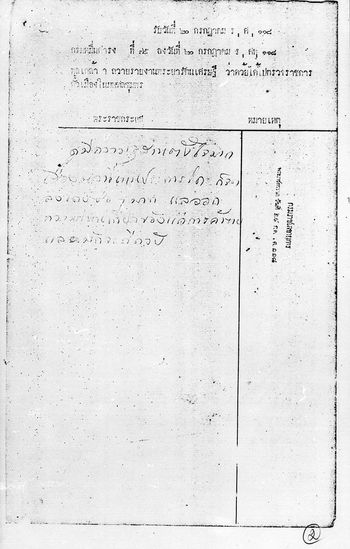
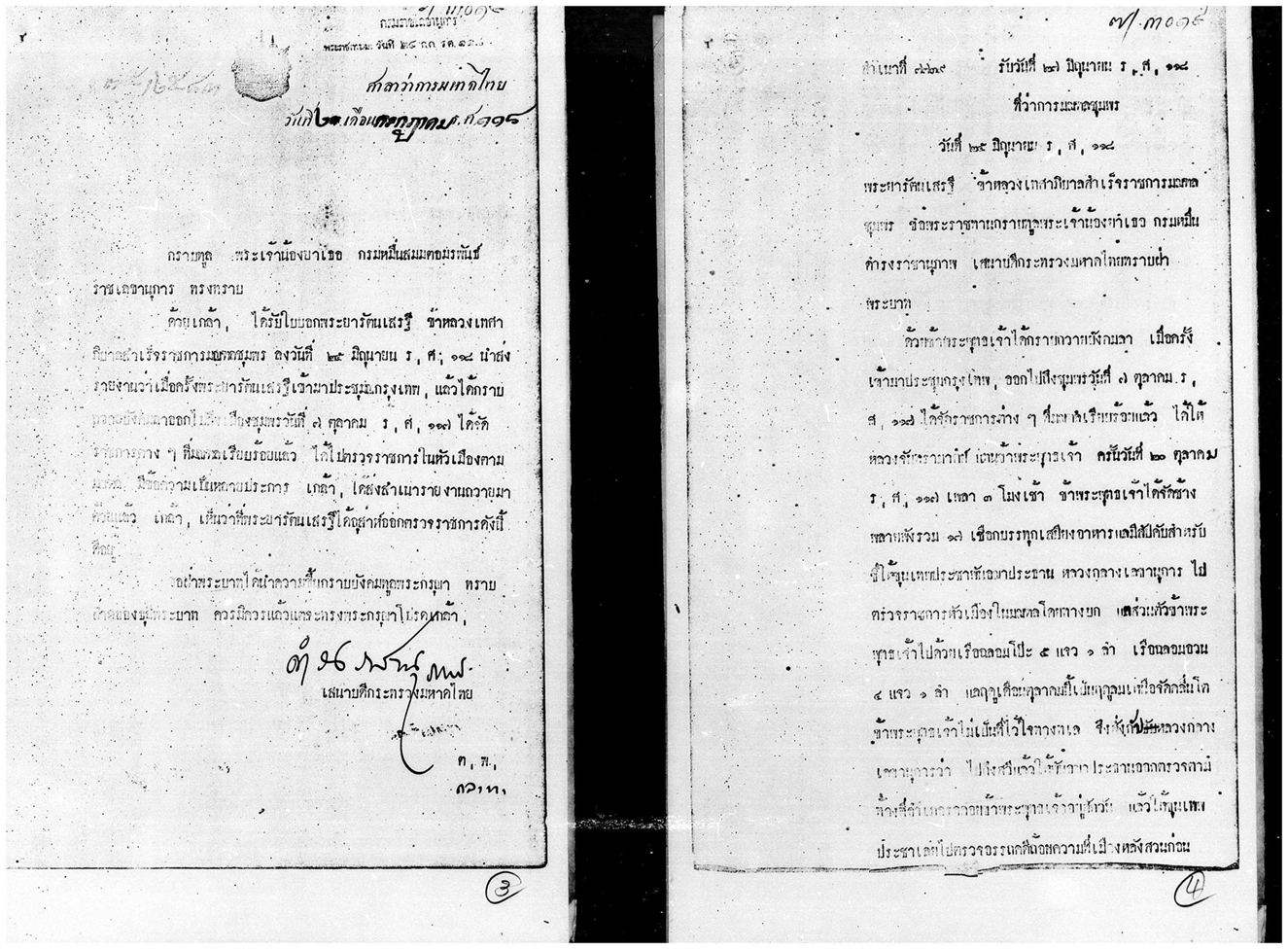
This materialization changed the way in which meetings were organized; decisions made; issues filtered; matters prioritized or de-prioritized, sped up or slowed down, and ranks and bureaus becoming even more solidly hierarchical and compartmentalized. Consider the examples found in Figures 1 and 2.
A typical ‘front letter’ of the Ministry of Interior during Chulalongkorn's reign, which had become a standard opening in the documents and files that are usually found in the National Archives of Thailand. The king's handwritten comment can be seen in the left-hand column of the letter. Source: NA R.5 Mo 2.14/5.

The documents following the ‘front letter’. Here, on the left, Damrong has written a summary of the report by one of his staff. On the right is the first page of the actual report. Source: NA R.5 Mo 2.14/5.

What we encounter here is the file as documentary practice. If we look closely at these letters, front and back, what do they tell us? First, the obvious one, is the order of the pages of the document, which are clearly reflected, and entrenched; the order of the chain of command: up from the inspector to Damrong the minister, Damrong to the king's personal secretary, and then to the king; then down the line from the king to Damrong to the inspector. It is noteworthy that, here, the hierarchy by birth fused neatly with ranking and office in the supposedly modern, merit-based bureaucratic ladder. The careful design and implementation of paperwork, here by the hand of Damrong, made this transition and fusion possible.
Second, the front letter is divided into three sections: the heading, the space for the king's comment on the bottom left, and a miscellaneous note on the bottom right. The heading consists of the date of the receipt of the paper and the date when the actual paper was written; the name of the sender; the running number of the letter; and a brief summary of the issue. Turning the page, Chulalongkorn would find Damrong's letter which reiterates what is already in the heading of the front letter, but with more information and his personal opinion (‘the report contains many points […] it's a good report’). Turning over, the king would eventually encounter the actual report with a narration so detailed that it goes down to how many elephants were recruited and how many boats used for the trip, what time on what date the journey commenced, how many officials went on which routes and why, and so on. Such a narrative, with its emphasis on facts and findings in as much detail as possible, was, in fact, encouraged by Damrong, who, at another time, had criticized older forms of travelogue, such as nirat (a genre of poem usually composed while on a journey), which he deemed trifling and without significant information.Footnote 51 Yet, the monarch was spared the details if he wished not to read them but could still call them forth when he so desired. Information-wise, Damrong's letter is redundant, even unnecessary. However, it is there to stamp that the report had been seen by Damrong and he considered it worthy of the king's attention. If we consider the difference between the date of the report (27 June 1900) and the date on the front letter (20 July 1900), Damrong acted as a filter, which slowed down the progress of this report, most likely to make room for more urgent matters to be considered by the king. The ability to delay or speed up an issue, as well as to call forth its details or ignore them at will, creates ‘centres of centres’ and gives an advantage to the ‘centre’ over the ‘periphery’, even though the centre remains a part of the network and even though such ‘abstraction’ at the centre (that is, the act of forgetting the ‘deluge of specimen on the ground’, here through the front letter) still works heavily through materiality.Footnote 52
A bigger space in the front letter right below the heading is given to the king's opinion. This is often where the decisions were made and began to tumble down the line, now that a line had been firmly established, although it could just as well be a personal complaint or compliment from the monarch. Here, he praised the inspector for his diligence, simplicity in writing, and ‘good observations on the trade situation’. This was done four days after the report was first received by the king's secretary, as marked in the side section. The space on the paper is a space of order and power, where sections are, by design, unequal in size and importance. The time stamp, which became permanently visible, is also subjected to spatial organization. It is there ‘for the record’, but paper-time is also a time for the dissection, tracking, manipulation, and ranking of the importance of matters. Exemplifying the intricacy of the material-monarchy nexus, even the king's opinion is now timed, rather than being a manifestation of eternal, timeless truth.
Taken as a whole, the documentary practice gave rise to a reality. It did this in a number of ways. First of all, it carved a narrow reality out of multiple occurrences and plural ways to associate and make sense of these occurrences. This narrow ‘reality’ reflects the narrow concerns of the elite: Chulalongkorn's predominantly economic concern was only one instance of the broader preoccupation of the elite at that time. In another report, one of the king's brothers, who went on the journey to the south, analysed each city and town he passed through with six criteria:
(1) the locale and its stories, (2) the numbers of household and population, and the reasons for their settlement in the locale, (3) the benefits for the country [mostly taxes] and the occupation of the population, (4) food, which is important for a traveller to find, (5) the ongoing legal cases in the town, (6) the well-being of the populace.Footnote 53
The report was endorsed by Chulalongkorn and praised by Damrong and was reprinted many times afterwards as an exemplary and useful narrative of a journey. Damrong also did the same thing after his first inspection tour to the north as a minister in 1892. He took with him insignia, pen, and papers (and later a camera), stressed the importance of seeing the towns with his own eyes, and began taking notes, often by comparing different places and ordering them into broad categories, so as to push ahead with administration reforms.Footnote 54 In comparison to earlier forms of narrative on areas outside Bangkok, such as in nirat or bai bok, a report looked into and began policing the details of everyday life and at regular intervals. Instead of once a month, or only in wartime, a report now required to know what was going on in the mornings and the afternoons of a place or a people. In Damrong's account, many local headmen were surprised to see him because previously an official from Bangkok would visit only during war efforts.Footnote 55 Now he was going to make inspection a regular occurrence. Damrong emphasized that the ideal of governance was to ‘maintain the unruffled and happy life of the cities and towns (ban muang yu yen pen suk)’ but the meaning of this had changed from ‘having no threats’, such as robbery, crime, and war, to ‘maintaining and nourishing (tamnu bamrung)’ them even in ‘normal times’.Footnote 56 In other words, governance through documentation had also come to cover inspection, policing, and surveillance (truat, truat tra, truat kan).
Furthermore, the report subjected both the population and officials to the reign of enunciation, of constantly turning their activities into words, and words into documents that passed up the line, usually with another written artefact screening off ‘unnecessary’ details. Therefore, Bangkok both wanted and did not want to hear the stories of individuals: ‘The question is not what the state “knows” about a particular individual, say, but what it can should the need ever arise.’Footnote 57 Furthermore, the report permitted local variances and differences in the content, sometimes even celebrated them, especially non-threatening, exotic-sounding ‘cultural’ differences, but nonetheless subjected all to a general, predetermined form. The report set the rhythms and tones of everyday life, though the shades could vary. In so doing, a report sought order and ordinariness, its form aimed at general uniformity. Simultaneously, this means that it sought to identify what is ‘out of ordinary’ and focus on policing it, most importantly by producing more reports. This new paper regime, however, also included new spatial arrangements.
The architecture of things
For Weber, the separation of the bureau (or office) from the private domicile of the official and official activity from the sphere of private life was a key factor in providing optimal conditions for speed and objectivity in bureaucratic work. This separation would ensure that the official would devote his full working capacity to bureaucratic work in accordance with discipline, specialized training, and calculable rules.Footnote 58 In Siam, the new paper regime also required changes in spatial-temporal practice in the ministries as well as upcountry: it involved spatial organization, arrangement of buildings, and the making of an office.
As mentioned above, the old practice had brought documents into the residences of the aristocrat. Damrong resented this and took pride in recollecting that he had terminated the custom: he announced that he went to work every day, sat at the office ‘like the others’,Footnote 59 and received a salary, instead of a fee (kha thamniam).Footnote 60 Moreover, he kept the insignia of the Ministry of Interior at the office, rather than in the home,Footnote 61 in order to signal an increase in the authority of the office, at the expense of the senabodi. Official documents now had to be produced at a specific place. He also ordered a systematic storing of documents at the Ministry, instead of leaving them in bundles in the attic.Footnote 62 In so doing, he tied official documenting to a space designated as an office only. This necessitated a spatial redesign.
The old pavilion (sala lukkhun), the previous centre for administering incoming and outgoing letters, was torn down. The pavilion consisted of three separate wooden (later partly brick), one-storey buildings and these, with partition walls, acted variously as a court of justice, a meeting place for high-ranking administrative officers, for officers of civilian and of military affairs, and a receiving and banqueting hall for foreign guests. There were rooms for offices (samnak ngan) at the back, but, according to Damrong, they did not operate fully as offices because the officials had to go to the residences of the aristocrats, who often had another court of justice and another ‘office’ at home.Footnote 63 In the place of the razed sala came the three two-storey brick buildings that connected what became the Ministry of Interior and the Ministry of Defence.Footnote 64 These were reserved only for the offices and meeting rooms of each Ministry, suggesting a clear split between, first, the ‘public’ office and the ‘private’ residences of officials and, second, the different functions of the ministries (there was no longer a banqueting hall, for instance). Chopping up spaces and making them closed, individual units, compared to the mostly open space of the pavilion, allowed for more control over the staff, the paper, the flow of data and decisions in and out of the office, as well as time management and scheduling.
Among these spaces, the meeting room of the Ministry of Interior proved to be a motor of Bangkok's centralization effort and administrative overhaul, as it provided a space for the regularized meetings of the provincial administration (thesaphiban). With Damrong usually as the head, but also sometimes presided over by Chulalongkorn himself, the annual meeting lasted for 36 years after 1895 and the major noblemen and aristocrats who were sent out to different areas to initiate and oversee the transition to the new administrative system participated in it.Footnote 65 Soon many material rituals were devised in the meeting, such as the production of the minutes that were printed for the record and for transmission to those in the outer regions who could not travel to Bangkok, or the gift-giving ceremony, especially the conferring of the photographs of the monarch, for the officials who usually carried the images back with them to their regions (and thus the photographs became an artefact in the material-monarchy network). When Bangkok sent the first official batch of ‘police-inspectors’ (mahat lek tamruat) to the provinces in 1896, the king had them carry a personal letter from him to show to the aristocrats in the regions.Footnote 66 The denser documentary-photographic practice intensified the monarch's presence in the outer spaces.Footnote 67
The new architecture of things was not only a Bangkok affair. In the areas outside the city, a similar architecture and order of things were in the making. Maruphong Siriphat was one of the pioneers in charge of experimenting with organizing the new provincial administrative structure at the turn of the twentieth century. His reports from trips around Siam are not only emblems of the new paper regime, they also reflect concerns with the institutionalization of a specific architecture of things—graphic as well as non-graphic. For Maruphong, the correct architecture of things involved several dimensions. Government buildings were to be well-kept constructions. They had to be placed so that they were visible from the street and their location had to ensure efficiency in administrative work. He also stressed the importance of the organization of the interior space of the government buildings. A government office needed to be clean, the furniture placed in a well-ordered manner, and documents stored correctly.Footnote 68 Further, government buildings had to be exclusively the domain of government activities. In Nakhon Nayok, for example, people sold various goods at the courthouse, which created the image that trade and government were mixed.Footnote 69
In accordance with the designated space in which they worked, the sartorial ways of the clerks were also important. The administrative staff had to dress correctly, so it was possible to know if you were confronted with a clerk or an ordinary person. It was, for example, not appropriate to wear ‘Chinese trousers’ to work.Footnote 70 At the same time, it was pertinent that government officials perform their duties with punctuality. It was not acceptable to drift in and out of the office as they pleased. A working schedule had to be worked out and the officials had to all register the time of their arrival to and departure from the office by signing a list.Footnote 71 Finally, mundane practices of writing and storing of paperwork were the main characteristics of governmental work. During his trips, Maruphong closely monitored how paperwork was carried out at government offices. The clerks had to keep copies of incoming and outgoing letters, orders received, lists of income and expenses, lists of population and criminals within their administrative jurisdiction, and store them in an orderly manner.
So what was this new administrative system in the provinces if not another practice of the architecture of things: the construction of public offices, the chopping up of spaces, and policing of their functionality (for example, closed doors during meetings, open doors for office hours), standardizing paperwork, and disciplining the personnel (their movement, their supposed place to be for each period of time, their clothing, their eyes and hands, their handwriting and typewriting, their brains, their conduct)? In the following section, we will further exemplify these practices with reference to the workings of the provincial gendarmerie.
The provincial gendarmerie: inscriptions and the order of things and space
There is more to police work than the investigation of crime and the keeping of order in the community. Police work is just as much about the correct handling of documents. To make information durable is key to modern police work and this durability is ensured through elaborate procedures for the correct inscription of information on paper as well as the exchange and storage of documents. The modern police force is not just a central part of the nation-state's coercive power, it also encapsulates the bureaucratic practices and the bureaucratic ethos of the nation-state.Footnote 72 In this section, we will look at the workings of the provincial gendarmerie in Siam from this perspective to show how its activities were intimately connected with the local production of the paper state through the same mechanisms that we identified earlier: spatial specificity, dress, punctuality, and documentary practices.
In Siam, the gendarmerie dates back to 1897 when Damrong created this institution. The gendarmerie was a body of military police patrolling the countryside on horseback. In the first ten years of the provincial gendarmerie's existence, the Ministry of Interior established gendarme stations in all of Siam's provinces—at both the provincial and local levels—and by 1915 the size of the gendarmerie had grown to around 10,000 men.Footnote 73
The gendarme station was part of the new architecture of things, which invoked a distinct official space. The station was marked out simply, with a fence encircling it, thereby singling it out from its surroundings. Further, it was common to have the Siamese flag—red flag with a white elephant—fluttering over the gendarme station to demarcate the space as official, as did the uniforms worn by the gendarmes staffing the station.Footnote 74 Not only the ordering of space but also a detailed ordering of time and activities contributed to produce the distinctiveness of the gendarme station. A maze of rules, regulations, and a timetable organized the gendarmes’ daily activities.Footnote 75 A wall clock hung in the station's main building and every hour a gendarme struck a bell hanging outside the building to ensure the organization of activities in accordance with the timetable and to inculcate punctuality. Physical training, drills, and shooting practices formed an important part of the daily programme.
The gendarme station represented a complex material order of things: everything had its specific location in space. The architecture expressed the very connection between things and space.Footnote 76 In the central building of the gendarme station, each of the three floors constructed an order of things. The upper floor ran along the back wall of the station and had a shelf with hooks. The gendarmes would hang their uniforms on these hooks and place their tightly cylindrically rolled and numbered sleeping blankets on top of the shelf. On the upper floor, beneath the shelf, were boxes—one for each gendarme—in which he would keep his underwear, comb, toothbrush, and other personal utensils. The gendarmes also slept on this floor wrapped in their blankets.
A rifle rack separated the upper floor from the lower level. Belts hung on the back of the rack and cartridge pouches were placed at the foot of the rifles. Bayonets hung together with the belts. A cash box and a cartridge box stood on each side of the staircase leading to the upper floor. The building rested on four rows of heavy poles. Saddlery hung on bars on the front row of poles. Here you would also find the station's bell on which the sentry struck the hours in accordance with the clock placed on the middle of the back wall. The main building also included a series of linked rooms, each containing specific utensils. An armoury stored cartridges, spare guns, spare parts for the guns, uniforms, caps, blankets, tents, saddlery, kerosene, soap, paper and writing utensils, lamps, and lanterns. A central room stored handcuffs, chains, axes, hand pumps, and sables.
The gendarme station was also a writing machine linked intimately with documentary practices. We can gain a good impression of such practices through some of the reports produced by inspectors sent out from Bangkok to oversee the order of things at the stations. The Inspection Division of the Gendarmerie Department in Bangkok coordinated this inspection through which the division could ensure that the gendarme stations throughout Siam were correctly executing the orders and regulations received from the Gendarmerie Department. The inspector would report whatever negligence or wrongdoings he encountered to the inspector-general so that he could correct the situation.Footnote 77 These inspections placed the gendarme stations within a field of writing.
Let us look at a series of reports produced by Major General Kamrob, who later became inspector-general of the Police Department. Kamrob produced these reports after a three-month inspection trip in northeastern Thailand at the turn of the year 1915.Footnote 78 Kamrob's reports follow a standard format and conform well to what Feldman has called ‘reiterative writing’—the repetitive and regular production of files.Footnote 79 He included information about the concrete inspections he carried out under standardized subheadings, such as ‘Locations’, ‘Performance in fulfilling the duties of the department’, ‘Reports’, ‘Lists of public property’, and ‘Inspection of drill/training exercises’. His reports also included information on the distance between the various points of inspection and how long it took him to cover the distance. Typically, the reports also contain some brief notes about farmers and traders whom he encountered, and some information on local living conditions, economy, health, and crime. Besides the gendarme stations, Kamrob's reports also dealt with other manifestations of the state that he passed by, for example, government buildings, roads, bridges, schools, markets, and milestones erected along the roads. Hereby, the reports presented the government in Bangkok with a tunnel vision of the rural areas that seldom ventured beyond the emblems of the state and the arteries that connected them.
When it comes to the inspection of the gendarme stations, Kamrob inspected the state of various buildings making up the gendarme station (for example, living quarters, stables, hospital, enclosure for animals), the state of things such as weapons, uniforms, horses, and the areas around the buildings. He also observed the gendarmes’ drill. He noted if the gendarmes carried out the drill according to the regulations or whether he had to intervene and correct them. This inspection of the outer appearance of the station and the gendarmes was coupled with an inspection of the state of the gendarmes’ knowledge of their duties. Kamrob did this by asking the gendarmes on duty about their obligations, whether they were guarding a market, roads, a court, a treasury, or a government office.
The reports reflect that the gendarme station was also a documentary project. Just as important as the survey of the buildings and activities, Kamrob also undertook a detailed inspection of the numerous lists and documents produced and stored at the gendarme station. The order book was one such prominent document. According to the official regulations, it had to contain, first, all orders received from Bangkok or local civil authorities, and, in addition, a list of which activities the gendarmes performed to carry out individual orders. As Kamrob repeatedly notes, it was not enough for the commander at the gendarme station to give such orders orally. It was pertinent that orders leave a mark in the gendarme station's paper trail.
The patrol book was another important element in the gendarme station's documentary practices. It had to contain information about the patrols carried out by the gendarmes: when the patrol was undertaken, who participated, and what incidents the gendarmes encountered during the patrol. On patrol, the gendarmes had to approach local civil authorities—village leader and sub-district leader—and ask them about local incidents of crime. The gendarmes would then register such information, regardless of whether there was a case to answer or not, and the civil authority had to countersign this information. In case of reported incidents, the gendarmes would follow up on these and note the action taken in the book.
Besides these two books, Kamrob inspected a series of lists (banchi). These included a list of incoming and outgoing letters. Another list contained information about criminals detained at the gendarme station while the civil authorities carried out an investigation. Other lists were of public property at the station, of gendarmes serving at the station, of punishment inflicted on the gendarmes, of monetary matters (accounts of income, expense, and the amount of money present in the coffers), and of the contents of the storehouse. It was not enough that the things of the state were in a proper condition; there also had to be a correspondence between lists and things.
Kamrob's reports reflect how the gendarmes and the gendarme stations had become part of a ‘field of supervision writing’.Footnote 80 This field emerged partly from the inspector's reports, which were passed up the system to the department in Bangkok. With recourse to these inspection reports, it was possible to establish the ‘individuality’ of each gendarme station, compare it to the ‘individuality’ of other gendarme stations, and to correct practices that did not meet the norm. Secondly, the books and lists in each gendarme station served to place the station within the field of surveillance which, in time, exceeded the physical presence of the inspector in the local setting. For Damrong there was no doubt about the disciplinary function of such documentary practices. On the order book, he noted that the practice was indispensable for the administration of the country. It would make it possible for the inspector to see to what extent an order had been carried out or if it had been misunderstood. If necessary, the inspector could advise (tak tuean), instruct (sang son), and decide on a suitable punishment in accordance with the circumstances. Therefore, the order book would ensure that the person receiving the orders would be cautious of making mistakes and it would encourage him to fulfil his tasks. In the same vein, Damrong praised the patrol book as ‘an instrument that compels the gendarmes to be diligent on patrols’.Footnote 81
Earlier we saw how the gendarme station represented a sense of order in which people, things, and activities were regulated by regulations, a timetable, and spatial designs. In the same manner, the documentary practices at the gendarme station had to conform to clearly defined rules. As mentioned earlier, the patrol book, for example, needed to present a mosaic of information gathered from civil authorities, the same authorities’ signatures, and information about actions undertaken by the gendarmes. It was required that the list of beasts of burden at the station would not only list the number of animals, but also details about each animal so it was possible to connect each entry in the list with a specific animal. Payments to the gendarmes were recorded in the list of expenses and each gendarme would sign it to acknowledge receipt for receiving the money. The list of gendarmes serving at the station also had to include the dates the gendarmes were released from service—here it is important that ‘run-a-ways’ were listed separately as a category and not conflated the group of ‘released’. All correspondence to and from the gendarme station had to be registered in a list. Each letter would be numbered and at all times the officer in charge would be able to procure any letter from the list. Finally, standards not only adhered to which information to fill in which columns. It was also a question of how to make corrections in official documents. It was not a correct procedure simply to erase wrong information from a document. The right procedure was to strike out the erroneous information, write the correct information, and enter the name of the person who had made the change.
Kamrob's reports reflect how bureaucratic writing was a core activity of the provincial gendarmes. We have a long series of mundane documentary practices: the local production of lists, the proper maintenance of order and patrol books, the dispatch of copies of the documents to the department in Bangkok, the inspection of the documentary practices at the gendarme station, and the production of inspection reports that the inspector passed up through the system to Bangkok. This flow of documents—coupled with the occasional inspection conducted by an inspector—was not only an instrument for the Gendarme Department in Bangkok to govern at a distance as Damrong dreamed of. The very materiality of the flow of documents also created a field of organization in which the state appears to exist. Routine inspections functioned not only as procedures that enabled the disciplining of subjects and subordinates. As pointed out by Gupta, inspections also functioned as an important ritual that led to government officials writing about inspections before, during, and following them.Footnote 82 It is the procedural and repetitiveness of such inscriptions that continuously assemble and reproduce the paper state.
The paper state
Thai royalist-nationalist historiography hails the turn-of-twentieth-century administrative reforms in Siam as one of the successes of Chulalongkorn, the ‘modernizing monarch’, influenced by what conventional historiography often ascribes to ‘the big concerns’—that is, encroaching colonialism and the struggle to remain an independent nation. As we have shown in this article, the administrative overhaul of Siam was as much a protracted business shaped by mundane, day-to-day documentary hurdles and performance. We have highlighted the central aspects of the formative processes and the day-to-day practices in the cities and towns, from which the paper state emerges. In this investigation, we have traced the materiality of the document, the form, the content, the layout, the sections, the act of writing, the alphabets, and, relatedly, how documents flowed, at first not so smoothly and then efficiently, through the keyholes of doors and windows of an office, to the right personnel in the right place at the right time, in and around Bangkok, out to the regions and back again. Uniforms, objects, specific places where these should be kept, the architecture, the walls and floors, timetables and schedules, are all related to documentary practices to facilitate the flow of the documents, but they themselves were also to appear in the reports. They were reported whether they were correct or incorrect, efficient or incompetent. They were all inscribed. Here, the lowly and anonymous scribes, clerks, inspectors, and file-engineers all contributed as much as the kings and ministers in crafting the writing machinery. It took another degree of documentary practice, such as screening the flood of data and manipulating the partiality of vision, to create the effect of having a bureaucratic hierarchy. Together with other material practices, all these micro-activities formed a semblance of a functioning state.
In other words, we have unpacked the ‘corporate bodies’ ‘black boxed’ as a state. We unpicked the processes comprising the mediators—kings, couriers, scribes, gendarmes, letters and forms, reports, telegraphs, timetables, blueprints, maps, insignia, and uniforms. All these words after ‘king’ become mute or absent when we say ‘kings run the country’ or when we speak of an ‘absolutist state’. In contrast, in this article, a ‘king’ could become a ‘king’ only when he entered into a relationship with artefacts that, together, comprised a corporate body of kingship. Likewise, a state could become a state only in hindsight, that is, only when the blackbox was already closed, shunning from view the micro-practices and everyday life of writing reports, following timetables, organizing office space, cleaning the body and the uniforms, and so on—the quotidian processes through which a peasant became a gendarme, through which the gendarmerie as an institution emerged, and through which the provincial gendarmerie became ‘provincial’ in relation to a ‘centre’. Through the incessant local production of documents for the insatiable handlers of documents, the state—or what we could call the ‘paper state’—consistently came into being.