Introduction
Drosophila suzukii (Matsumura) (Diptera: Drosophilidae), also known as the spotted-wing drosophila, is a widely distributed invasive pest originating from Japan and attacking ripening soft-skinned fruits of many plants, including sweet cherry (Prunus avium Linnaeus; Rosaceae) and berries (raspberry (Rubus Linnaeus; Rosaceae), strawberry (Fragaria Linnaeus; Rosaceae), blueberry (Vaccinium Linnaeus; Ericaceae), etc.), and causing important economic damage (reviewed in, e.g., Asplen et al. Reference Asplen, Anfora, Biondi, Choi, Chu and Daane2015; Bondi et al. Reference Bondi, Traugott and Desneux2016; Nikolouli et al. Reference Nikolouli, Colinet, Renault, Enriquez, Mouto and Gibert2018). In the decade following its discovery in North America in 2008 (Hauser Reference Hauser2011; Walsh et al. Reference Walsh, Bolda, Goodhue, Dreves, Lee and Bruck2011), D. suzukii invaded most fruit producing regions in North America, Europe, and South America and may continue to expand in regions of the world where climate is suitable (Gutierrez et al. Reference Gutierrez, Ponti and Dalton2016; Dos Santos et al. Reference Dos Santos, Mendes, Krüger, Blauth, Gottschalk and Garcia2017).
Developmental plasticity and short-term acclimation (see Stockon et al. Reference Stockon, Wallingford, Rendon, Fanning, Green and Diepenbrock2019 for a review) play important roles in D. suzukii survival to cold temperatures, and thus its capacity to persist and overwinter in northern climates. Winter morphs express enhanced cold tolerance and reproductive diapause (Stephens et al. Reference Stephens, Asplen, Hutchison and Venette2015; Shearer et al. Reference Shearer, West, Walton, Brown, Svetec and Chiu2016; Wallingford and Loeb Reference Wallingford and Loeb2016; Enriquez et al. Reference Enriquez, Renault, Charrier and Colinet2018). In addition to morphological and physiological plasticity, it is possible that adult D. suzukii could use behavioural frost avoidance expressed by shelter-seeking behaviour to survive in northern regions of its range. Stockon et al. (Reference Stockon, Wallingford, Rendon, Fanning, Green and Diepenbrock2019) studied the potential of D. suzukii to overwinter in leaf litter at different latitudes in northern (e.g., New York State, United States of America) and southern states in the United States of America. They concluded that successful overwintering of acclimated winter morphs during winters with prolonged subzero freezing under leaf litter would be very low. Therefore, the question of overwintering of D. suzukii in cold regions such as Québec and elsewhere in eastern Canada remains open. All available research indicates that survival to the next season is unlikely and would depend on fall-acclimated D. suzukii being able to seek protected, natural (e.g., forest debris buried under thick snow cover), or suitable artificial shelters associated with human activity (Stockon et al. Reference Stockon, Wallingford, Rendon, Fanning, Green and Diepenbrock2019 and references therein).
However, it cannot be excluded that recurrent presence and abundance of D. suzukii in Québec are explained by migrating individuals from warmer regions to recolonise these northern parts of its range. This has frequently been suggested mainly based on its known migratory behaviour in Japan (Mitsui et al. Reference Mitsui, Beppu and Kimura2010; Stockon et al. Reference Stockon, Wallingford, Rendon, Fanning, Green and Diepenbrock2019). Long distance transport by wind or in relation to human activity (trade routes, grocery stores, fruit dumps) might explain its presence in regions that do not allow local overwintering (Kimura Reference Kimura2004; Dalton et al. Reference Dalton, Walton, Shearer, Walsh, Caprile and Isaacs2011; Cini et al. Reference Cini, Ioratti and Anfora2012; Langille et al. Reference Langille, Arteca, Ryan, Emiljanowicz and Newman2016).
The Saguenay-Lac-Saint-Jean region of Québec is near the northeastern limits of the known distribution of D. suzukii in North America (Dos Santos et al. Reference Dos Santos, Mendes, Krüger, Blauth, Gottschalk and Garcia2017; Centre for Agriculture and Bioscience 2019). Lowbush blueberry (Vaccinium angustifolium Aiton; Ericaceae) is a very important crop in Saguenay-Lac-Saint-Jean. Lowbush blueberry regularly supports high-density D. suzukii populations in Maine, United States of America (Drummond et al. Reference Drummond, Ballman and Collins2019). Their long-term study indicates that D. suzukii abundance and first appearance in spring can be explained by winter temperature, population density (trap captures) in the past season, local abundance of suitable wild berry plants, and predation (Drummond et al. Reference Drummond, Ballman and Collins2019). Langille et al. (Reference Langille, Arteca and Newman2017) modelled the population dynamics of D. suzukii for different fruit producing regions of Canada and the United States of America and showed that Saguenay-Lac-Saint-Jean, which was represented in their model by climatic conditions in Saguenay (Québec, Canada), is marginally suitable to D. suzukii despite the presence of large lowbush blueberry fields. In the region, D. suzukii abundance, phenology, and risk of damage to lowbush blueberry are unknown.
Lowbush blueberry production areas in Saguenay-Lac-Saint-Jean (and presumably also in other regions in eastern Canada) consist of large semi-natural agroecosystems generally surrounded by forested landscapes. Here, lowbush blueberries are not planted crops, they have grown naturally over very long periods of time. Natural borders surrounding blueberries affect the abundance of D. suzukii in fruit crops due to the presence of shelters, alternative resources, and generalist natural enemies (Haro-Barchin et al. Reference Haro-Barchin, Scheper, Ganuza, De Groot, Colombari, van Kats and Kleijn2018; Santoiemma et al. Reference Santoiemma, Mori, Tonina and Marini2018; Tonina et al. Reference Tonina, Mori, Sancassani, Dall’Ara and Marini2018; Drummond et al. Reference Drummond, Ballman and Collins2019). In invaded territories such as North America, specialised natural enemies are rare or absent, thus biological control by natural enemies has relatively low impact on D. suzukii. In addition to alternative host fruit resources, the semi-natural field borders of berry crop agroecosystems are highly favourable to D. suzukii populations by reducing extrinsic mortality and allowing for the growth of population sizes (Santoiemma et al. Reference Santoiemma, Mori, Tonina and Marini2018).
Drosophila suzukii is an opportunistic exploiter of fruit plants and has a wide range of wild fruit hosts, even in Canadian boreal climates (Ontario Ministry of Agriculture, Food, and Rural Affairs 2015; Little et al. Reference Little, Chapman, Moreau and Hillier2017). Wild berry hosts can provide adequate resources for early season reproduction of winter morph D. suzukii females, which indeed use them as hosts (Panel et al. Reference Panel, Zeeman, van der Sluis, van Elk, Pannebakker and Wertheim2018). In this case, infestation of cherry (Prunus Linnaeus; Rosaceae) crops in early summer involved the winter morphs, not the first generation of summer morph D. suzukii emerged in the new season. Drosophila suzukii are also long lived, very mobile, and can express seasonal migration to locate abiotic conditions, resources, and shelter most suitable for reproduction and survival (Mitsui et al. Reference Mitsui, Beppu and Kimura2010; Walsh et al. Reference Walsh, Bolda, Goodhue, Dreves, Lee and Bruck2011; Stockon et al. Reference Stockon, Wallingford, Rendon, Fanning, Green and Diepenbrock2019).
In this study, we investigated the phenology and spatial distribution of D. suzukii in the Saguenay-Lac-Saint-Jean region over three years, 2016–2018. Drosophila suzukii had been observed in this region since 2012, but it remained unknown whether it was established and can overwinter locally, or if the species colonised the region every year from the southern regions of Québec or the northeastern United States of America.
Our specific objectives were 1) measure D. suzukii abundance and phenology on lowbush blueberry in different years over the whole season of activity and in lowbush blueberry fields covering a large part of the Saguenay-Lac-Saint-Jean region; 2) search for evidence that D. suzukii is established in lowbush blueberry field ecosystems of the region and has potential for overwintering based on early and late season abundance and presence of winter morphs; and 3) model the spatial distribution of captures of D. suzukii and of lowbush blueberry fruit infestation by larvae in the fields, in relation to the lowbush blueberry harvest period to predict the risk of damage to the fruit crop.
Materials and methods
Sampling locations
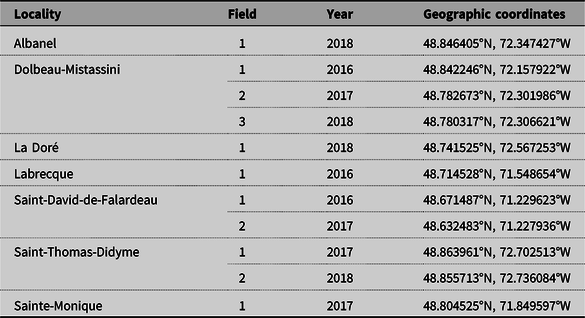
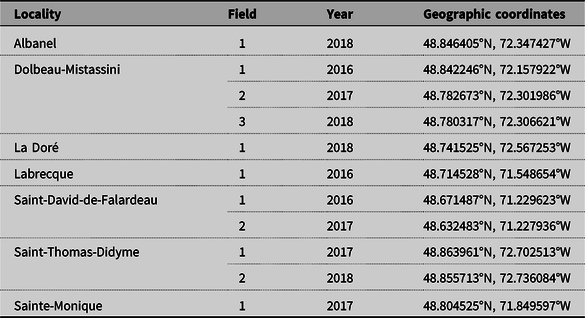
In order to study D. suzukii phenology, sampling for adult D. suzukii and infested fruit was performed in widely distributed fields across the entire Saguenay-Lac-Saint-Jean region. In 2016, three fields were sampled (Saint-David-de-Falardeau, Labrecque, Dolbeau-Mistassini), four fields in 2017 (Saint-David-de-Falardeau, Sainte-Monique, Saint-Thomas-Didyme, Dolbeau-Mistassini), and three fields in 2018 (Albanel, Saint-Thomas-Didyme, La Doré) (see Table 1 for details).
Location and geographic coordinates of lowbush blueberry field sites sampled for Drosophila suzukii in three-year study of its phenology and distribution in Saguenay-La-Saint-Jean, Québec, Canada.
Generally, lowbush blueberry fields in Saguenay-Lac-Saint-Jean are in production every two years, and sites were chosen according to this rotation regime. Selected fields also had to be surrounded mainly by wooded borders. The forested borders were generally dominated by grey pine (Pinus banksiana Lamb; Pinaceae), with substantial arbustive and herbaceous plant diversity. Only fields in production respecting these criteria were considered, which explains why sampling sites differed to some extent between years.
Seasonal phenology of Drosophila suzukii
Adult Drosophila suzukii captures
In 2016 and 2017, adult D. suzukii were trapped with 500-mL drinking-type plastic containers with seven 2.5-cm openings each and coloured in red and black (Ministère de l’Agriculture, des Pêcheries et de l’ Alimentation du Québec 2013). Traps were baited with 200 mL of commercial apple cider vinegar as attractant and a drop of liquid soap to break surface tension. Traps were placed near the border of each lowbush blueberry field (0 m) and were deployed from the beginning of May to mid-November in 2016–2017. Traps were collected on a weekly basis, except in July (2016) and August (2016 and 2017) where traps were collected twice a week to better follow rapid changes in D. suzukii abundance at peak density. Captures were sorted to count and sex D. suzukii. Samples evidently containing too many D. suzukii to be processed within reasonable time with available resources were fractioned once or more as needed by pouring trap content in a marked white tray. The total number of D. suzukii in each sample was thus estimated by multiplying each count by the appropriate number of subsamples. During sample processing in early season (May to July) and fall (September to October), D. suzukii cuticule melanisation and relative wing length were checked for evidence of presence or absence of the winter morphs (Shearer et al. Reference Shearer, West, Walton, Brown, Svetec and Chiu2016) in samples (we did not measure their proportions). Voucher specimens were deposited in the Collection d’insectes du Québec (Ville de Québec, Québec, Canada).
To increase the probability of D. suzukii capture in spring and early summer in 2017 and 2018, a larger trap set-up was put in place in the Dolbeau-Mistassini site, based on D. suzukii abundance in this site in 2016. This set-up consisted of 20 (2017) or 40 traps (2018) that were randomly placed 10 m within the wooded periphery of the lowbush blueberry field at a distance of 50 m from each other. Traps in this site were collected weekly from early May until spring detection of D. suzukii was no longer necessary, or as captures occurred also in the other sites.
Lowbush blueberry fruit infestation
The phenology of lowbush blueberry fruit infestation by D. suzukii larvae was also studied in the 2016 and 2017 summer seasons. Fruits were collected at the border of the field in all sites sampled for D. suzukii, as listed above, from mid-July to mid-October. Up to 150 g of ripening lowbush blueberries were collected by hand near trapping positions every week at each site, brought to the laboratory, and incubated in meshed plastic containers lined with absorbent paper to avoid excess moisture and allow larvae to pupate. Fruits were incubated in Conviron E15 growth chambers (Controlled Environments, Winnipeg, Manitoba, Canada) under “standard” conditions (20 °C, 65% relative humidity, 16:8 light:dark hours), allowing to measure D. suzukii adult emergence from fruit up to three weeks after sampling. Emerged adults were counted and sexed, as well as any aborted pupae and larvae.
In order to follow late season reproductive and diapausing potential of D. suzukii (late August to mid-October) in 2016, live adults were sampled using a modified version of our trap at Dolbeau-Mistassini site. This new version contained a second compartment inside the conventional trap, lined with fine mesh above the liquid bait, which prevented D. suzukii from drowning. The modified trap was also fitted with small funnels around openings to prevent captured D. suzukii from escaping. Blueberry fruits from the supermarket were also placed in the trap to provide a food and water source until the D. suzukii samples were collected and brought to the laboratory. In any trapping event, live traps were deployed at the field border for a maximum of 24 hours. Captured D. suzukii were identified and individually maintained in 100-mL ventilated plastic vials under standard conditions (see above). Two blueberry fruits were placed in the vial as potential oviposition substrates for 48 hours, after which D. suzukii were discarded. The blueberries were then incubated under standard conditions for three weeks to allow development of any eggs laid, in order to count any emerging D. suzukii and any aborted larvae or pupae. Absence of egg laying could be interpreted as reproductive arrest in preparation for overwintering.
Spatial distribution along transects
Adult Drosophila suzukii captures
To examine the spatial distribution of D. suzukii in lowbush blueberry fields and their wooded peripheries, transects of the usual unmodified traps were set up in three study sites in 2016 and 2017, from July to November (see Table 1). The single trapping transect in each site was perpendicular to the field border and consisted of four traps in 2016 and was extended to five traps in 2017 based on 2016 results. The first trap was positioned at 50 m from the field border into the woods, the second at the border (field-wood interface), and two (2016) or three (2017) other traps at distances of 50, 150, and 300 m (2017 only) into the lowbush blueberry field. Traps were collected weekly except during July (2016) and August (2016, 2017), during which traps were collected twice a week. Trap captures were screened for D. suzukii based on morphology, counted, and sexed.
Fruit infestation in lowbush blueberry fields
In parallel to D. suzukii capture distribution, the distribution of fruit infestation was followed in 2017 based on fruit sampling along a perpendicular transect, at 0, 50, 150, and 300-m intervals from the border in each site. Based on results of 2017 showing that fruit infestation away from border was very limited, fruits were sampled in 2018 along a finer scale transect for better resolution of fruit infestation density distribution close to the field border. Lowbush blueberry fruit samples were then collected at five points: 0, 12.5, 25, 37.5, and 50 m from the border. For each point, 150 g of blueberries were collected, brought to the laboratory and kept in growth chambers for a three-week period under standard conditions to monitor for D. suzukii emergence, and to count and sex D. suzukii, as well as record the number of aborted pupae or larvae.
Statistical analyses
Statistical analyses were performed using SAS 9.4 (SAS institute, Cary, North Carolina, United States of America). Seasonal trends in sex ratio (female to male) of trapped D. suzukii and those emerging from collected fruits were obtained and tested for equality (1:1) using chi-square goodness of fit tests for three periods: the preharvest (July to mid-August), harvest (mid-August to mid-September), and postharvest (mid-September to October). Variation in total D. suzukii abundance between sites was compared using PROC GLIMMIX of SAS, for the harvest and postharvest periods with site as a fixed effect.
Spatial distribution of D. suzukii capture density and fruit infestation as a function of distance into the lowbush blueberry agroecosystem was modelled using SAS PROC NLIN. These analyses and modelling were done separately for the harvest period and postharvest period of 2017. Linear and exponential models (y = aexb, where y stands for density) were tested, and 95% confidence interval of model estimates was calculated. Model fitting and comparison based on R2 were done using SAS PROC NLIN.
Results
Seasonal phenology of Drosophila suzukii
Adult Drosophila suzukii captures
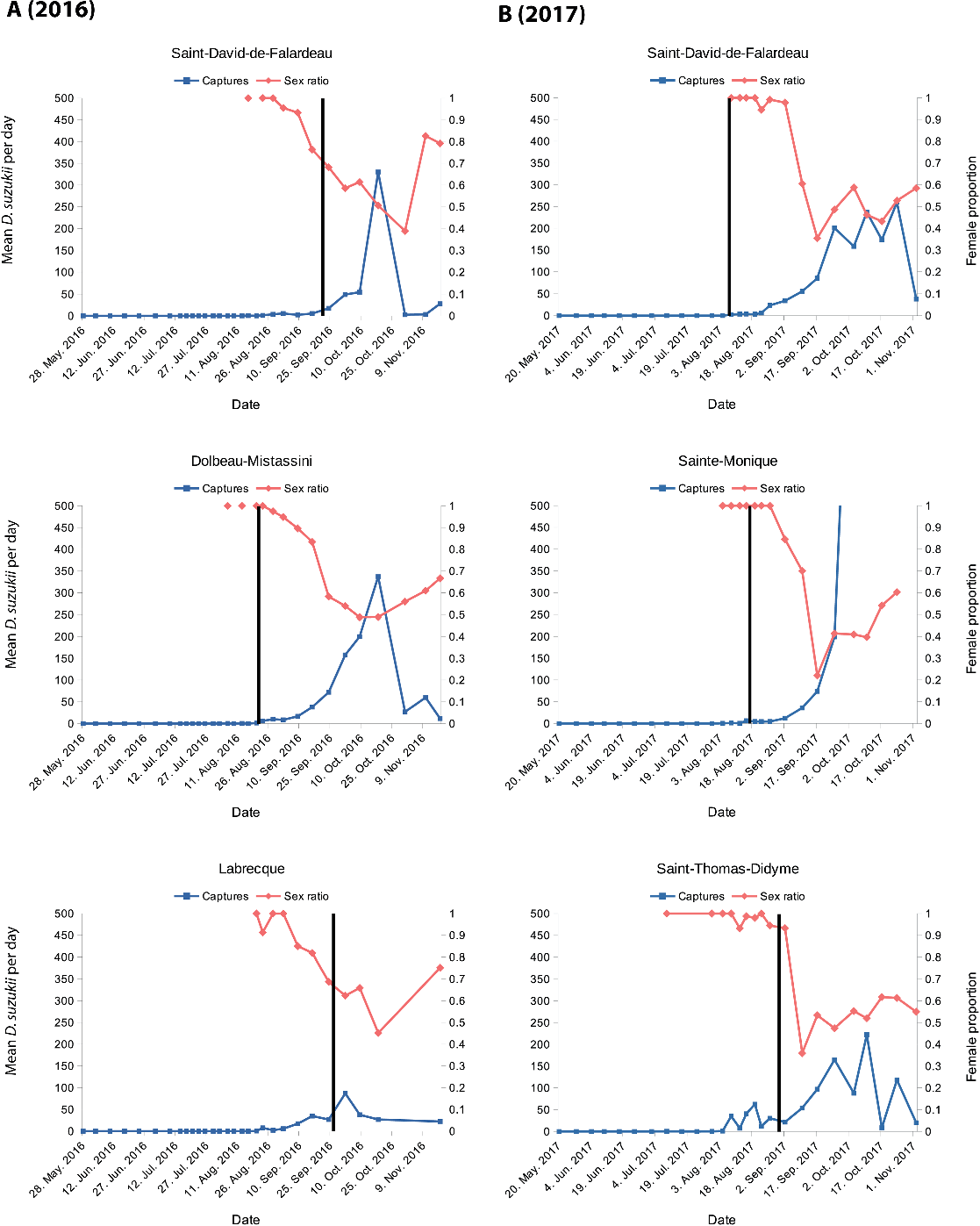
In 2016, D. suzukii were captured in all traps placed at the wooded border/lowbush blueberry field interface (0 m), and significant captures occurred from August to November. During the preharvest season (May to August), no D. suzukii were captured in traps located at 0 m, but complementary traps located nearby 50 m into the woods (data not shown) had captured a few females in June. During the harvest period (August to September), low D. suzukii densities were recorded in all sites. Most catches during the harvest period were female D. suzukii, with an average highly female-biased sex ratio of 0.87 (X² (1, n = 1055) = 581.13, P < 0.001) (Fig. 1A). In all sites, a D. suzukii density peak occurred in October about four weeks after the lowbush blueberry harvest period. An average of up to 340 D. suzukii per day was captured in the Saint-David-de-Falardeau and Dolbeau-Mistassini sites (Fig. 1A). Males then were more abundant, and sex ratio tended to stabilise in late season, averaging 0.51, but being still slightly but significantly female biased (X² (1, n = 12 502) = 10.25, P < 0.005) (Fig. 1A). After peaking, D. suzukii density decreased until the end of the trapping season (20 November). During harvest and postharvest periods, D. suzukii density variation between sites was marginally insignificant (F (2, 18) = 3.50, P = 0.0521 and F (2, 6) = 4.91, P = 0.0545, respectively).
Capture density and female sex ratio of Drosophila suzukii in three lowbush blueberry production sites. A, 2016 at Saint-David-de-Falardeau, Dolbeau-Mistassini, and Labrecque; B, 2017 at Saint-David-de-Falardeau, Sainte-Monique, and Saint-Thomas-Didyme. The vertical line indicates date of harvesting.

In 2017, the first D. suzukii catches occurred in July in traps located at the border of each lowbush blueberry fields (0 m); i.e., slightly earlier than 2016, and all were female. However, as in 2016, traps in nearby wooded areas had already captured females earlier in June. During the harvest period, populations slowly increased and males appeared, with the overall sex ratio being strongly female biased at 0.77 (X² (1, n = 2526) = 732.22, P < 0.001) (Fig. 1B). During the postharvest period, male captures increased gradually and sex ratio finally came close to evenness (0.48), still being slightly but clearly male biased (X² (1, n = 36 875) = 58.20, P < 0.001) (2017) (Fig. 1B). Drosophila suzukii capture density variation between sites was marginally insignificant (F (2, 15) = 3.62, P = 0.0523) during the harvest period. For the postharvest period in 2017, D. suzukii density variation between sites was highly significant (F (2, 9) = 15.34, P = 0.0013), with the Sainte-Monique site having much higher densities of D. suzukii than the other sites.
In the more intensive trapping set-up employed in 2017 at the Dolbeau-Mistassini site to improve early D. suzukii detection, exclusively female D. suzukii were captured and at very low density (1–2 D. suzukii per week) for six weeks, from 18 June to mid-August. Populations started to increase rapidly in early August, concurring with similar increases in other sites (Fig. 1B). Males appeared and grew in numbers in mid-August, when intensive trapping ceased. In 2018, the intensive trapping set-up was operational for a shorter period (from May to late June), and first captures were recorded on 17 June.
Lowbush blueberry fruit infestation
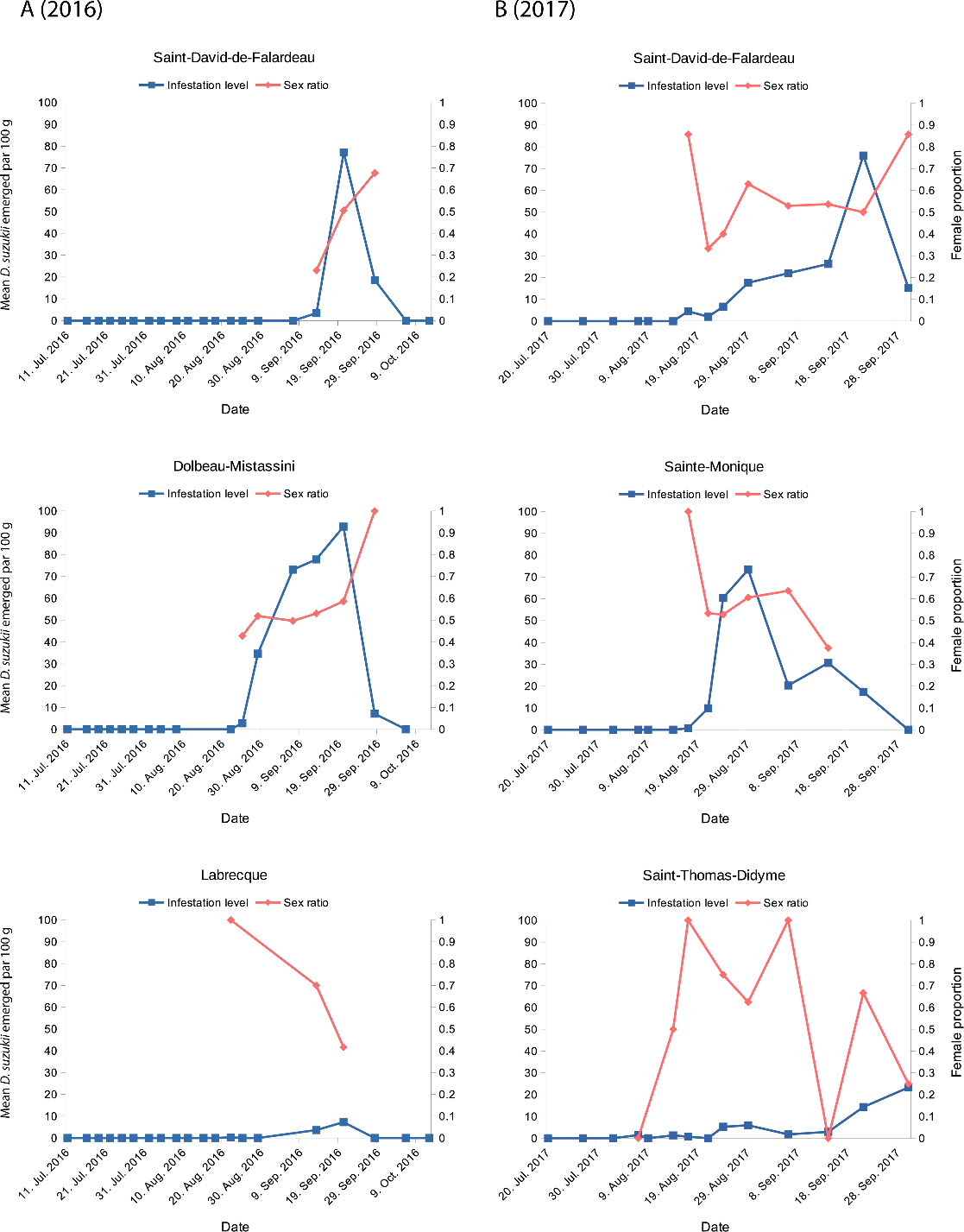
In 2016, mature lowbush blueberry fruits close to the field border were infested with D. suzukii larvae from mid-August until late September (Fig. 2A). Fruit infestation peaked in the third week of September, reaching up to 90 D. suzukii emerged per 100 g of fruits at the Labrecque site. The overall sex ratio of emerged D. suzukii was 0.51 (X² (1, n = 766) = 0.63, 0.25 < P < 0.50), not being significantly different from a 1:1 ratio. In October, no berries remained on lowbush blueberry bushes and sampling ceased.
Lowbush blueberry fruit infestation by Drosophila suzukii larvae as measured by number and sex ratio of flies emerged from 100 g of fruit collected at the field border in the Saguenay-Lac-Saint-Jean region of Québec. A, Summer 2016 at Saint-David-de-Falardeau, Dolbeau-Mistassini, and Labrecque; B, summer 2017 at Saint-David-de-Falardeau, Sainte-Monique, and Saint-Thomas-Didyme.
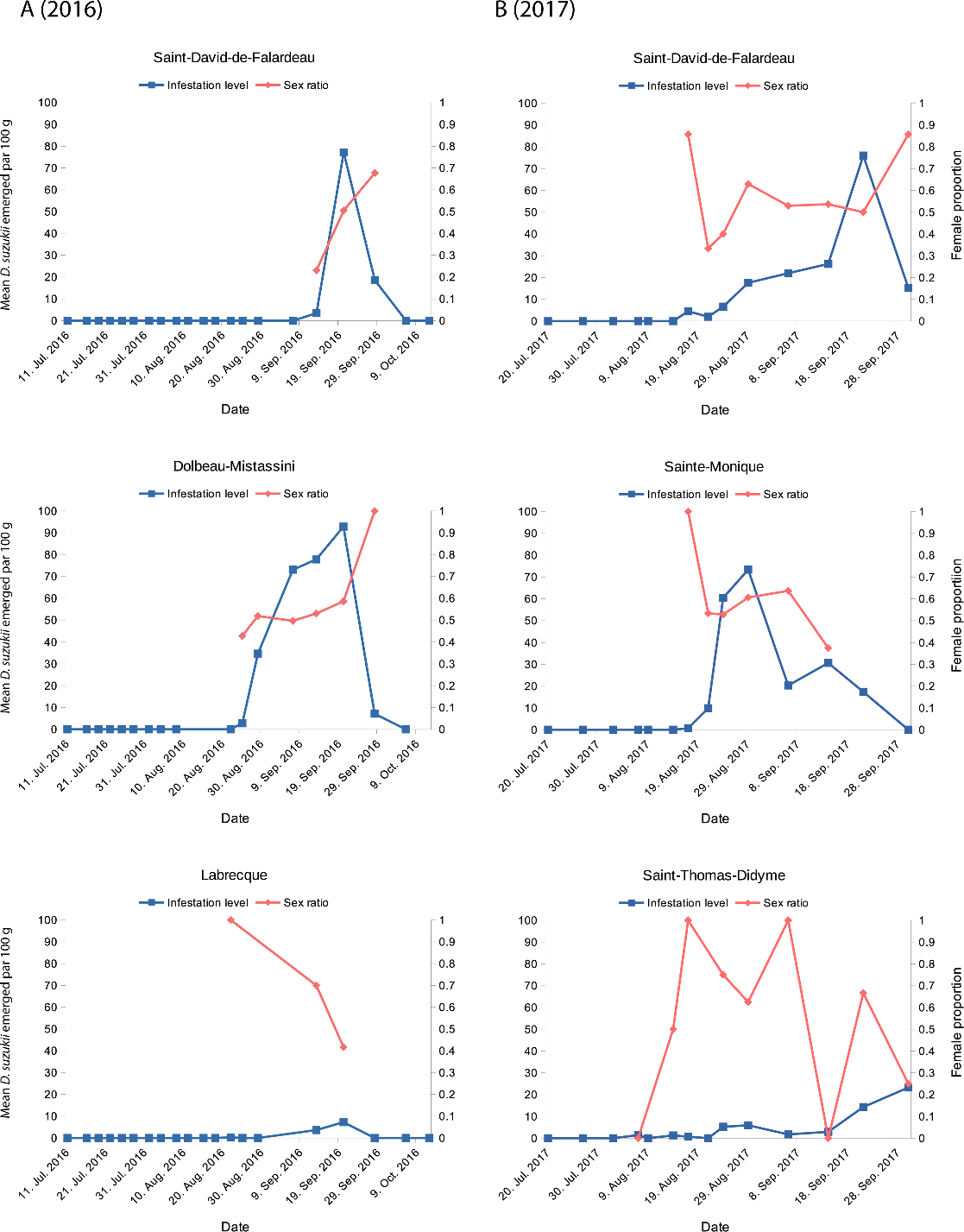
In 2017, lowbush blueberry fruit infestations occurred from early August to late September, thus starting one week earlier than 2016 (Fig. 2B). Peak infestation dates varied according to site in late season, from 29 August at Sainte-Monique to 28 September at Saint-Thomas-Didyme, mostly occurring long after harvest. The maximum recorded fruit infestation density was 75 emerged D. suzukii per 100 g of blueberries, with an overall sex ratio of 0.56 (X² (1, n = 342) = 5.16, P < 0.025); i.e., a small but significant bias towards females. As in 2016, there were no intact lowbush blueberry fruits that were still suitable for sampling in early October.
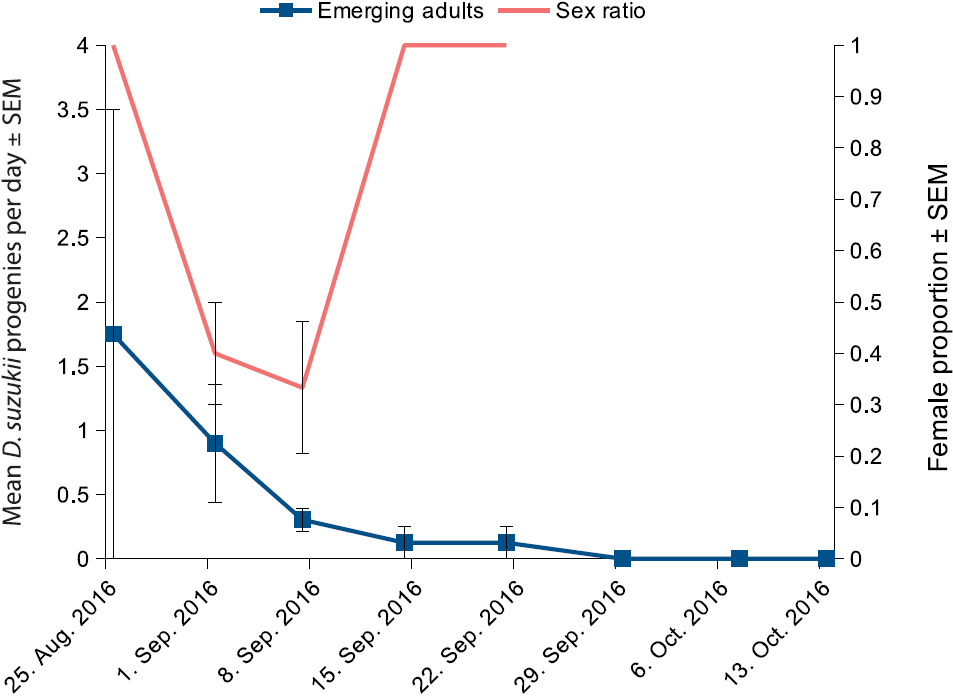
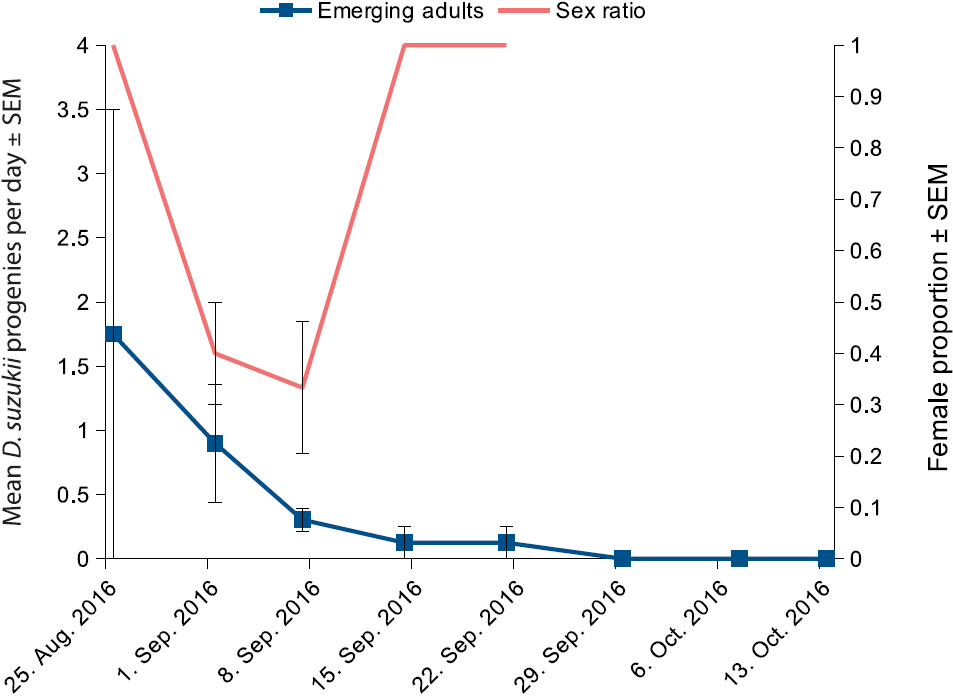
Based on data from live D. suzukii brought back to the laboratory and tested for ability of females to lay eggs in commercial blueberries from the supermarket, mean daily fecundity decreased rapidly during September 2016, from an average of two D. suzukii produced per individual per day to complete arrest in October (Fig. 3), with high variation between individuals (0–4 eggs per day). The sex ratio of emerged D. suzukii born from field capture individuals also varied (see Fig. 3), as expected with estimates based on the low numbers obtained.
Trends in egg laying frequency and sex ratio of progeny per day at 20 ºC, for individually reared females Drosophila suzukii captured alive in late season in sampling site. Dolbeau-Mistassini in 2016. SEM, standard error of the mean.
Spatial distribution along transects
Adult Drosophila suzukii captures
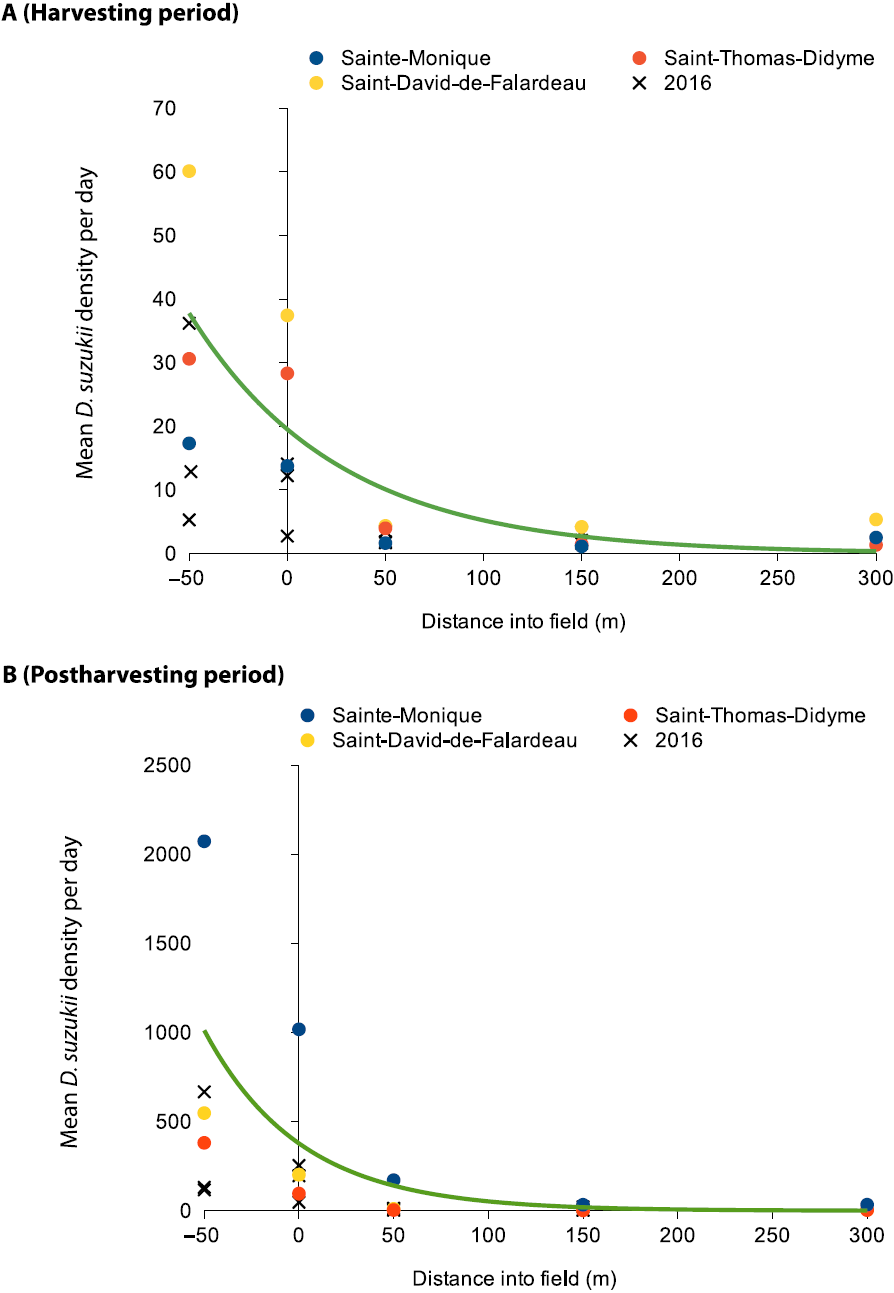
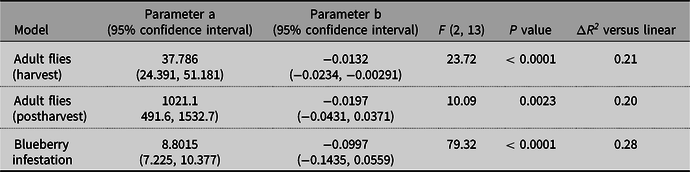
During the harvest period in 2017, the exponential model best fitted the D. suzukii capture data as a function of distance into the lowbush blueberry agroecosystem, with an R² value of 0.63 (R² = 0.42 for linear), showing a sharp decrease in D. suzukii density with distance from the 50-m position within woods, up to 300 m in the field (Fig. 4A). The model predicts that D. suzukii capture density right at the border (0-m trapping position) is only about half as high as 50 m into the woods. Model parameters indicate that D. suzukii density decreased by 1.31% per m with distance from the woods into the field. Data from 2016 trapping were added to Fig. 4A for comparison to predictions of the model based on 2017 data. As already mentioned, the 2016 data were not used in modelling because the trapping transect then consisted of only four rather than five traps (see above). Note that independent prediction of the 2016 data by the 2017 distance model is reasonably accurate (Fig. 4A).
Models of exponentially decreasing capture density of Drosophila suzukii as a function of distance into lowbush blueberry fields (n = 3). A, During the 2017 fruit harvesting period; B, during the 2017 postharvest period. The 2016 data (not used for model parametrisation) are also shown (x symbols) for independent model validation.
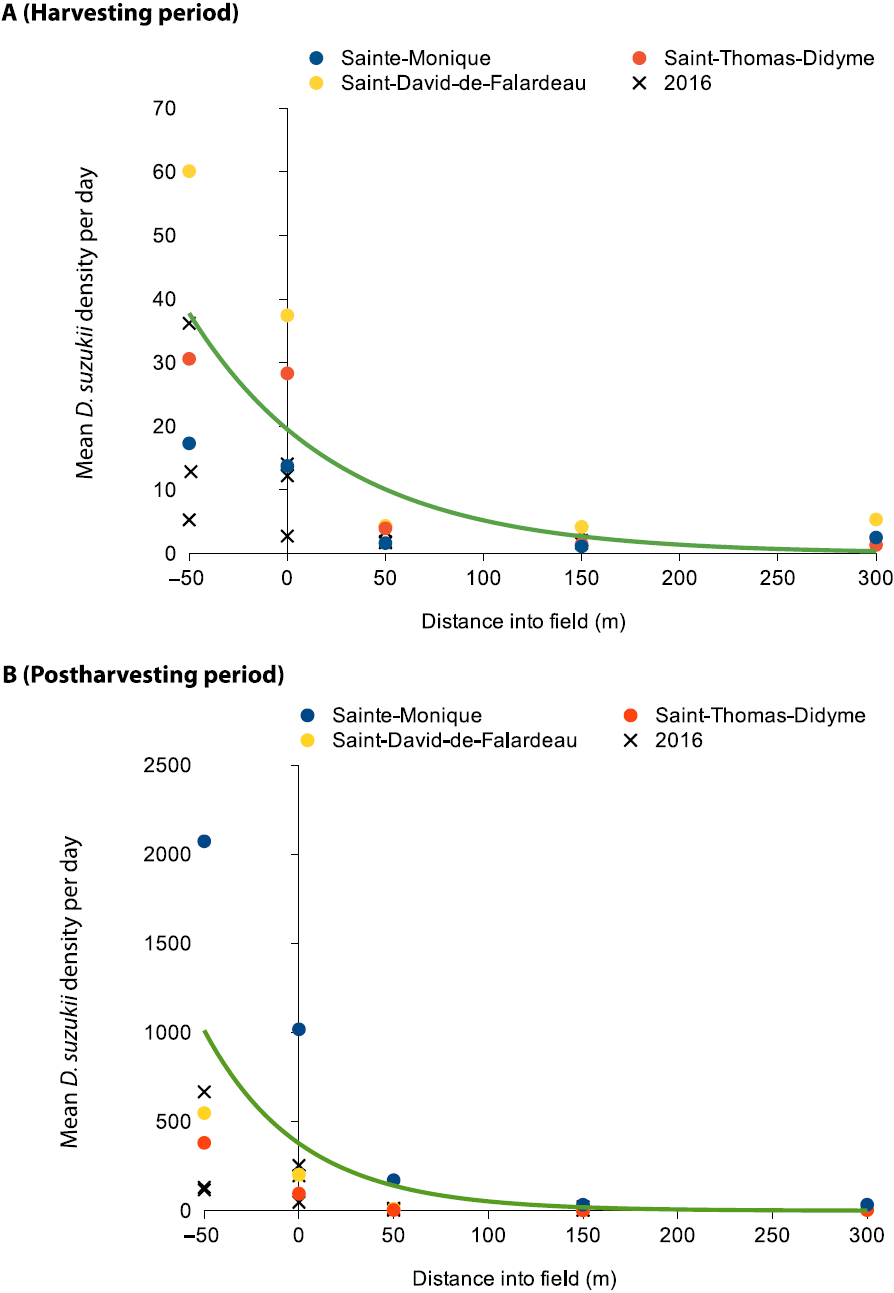
For the postharvest period, it is also an exponential model that best fitted to D. suzukii capture density data, with an R² of 0.48 (R² = 0.38 for linear). This model also predicts that captures decrease exponentially with distance into the field from the woods (Fig. 4B) at a rate of 2% per metre. Right at the border (0 m), 62.66% fewer D. suzukii were caught on average, as compared to 50 m into the woods. Note that most variability in D. suzukii capture density is attributable to the Sainte-Monique site during postharvest when captures averaged 1000 D. suzukii per day, which is 5–10 times more than the two other sites. The Sainte-Monique field site was a relatively small enclosed area on humid terrain, but more work would be needed to explain exceptional D. suzukii densities here. Data for 2016 were also added to Fig. 4B although not being used for model fitting, as independent validation.
Fruit infestation in lowbush blueberry fields
In 2017, lowbush blueberry samples were collected at 0, 50, 150, and 300 m from the border into the field. However, only blueberries that were collected at the 0-m position were actually infested by D. suzukii, thus no model can be fitted to 2017 data on fruit infestation.
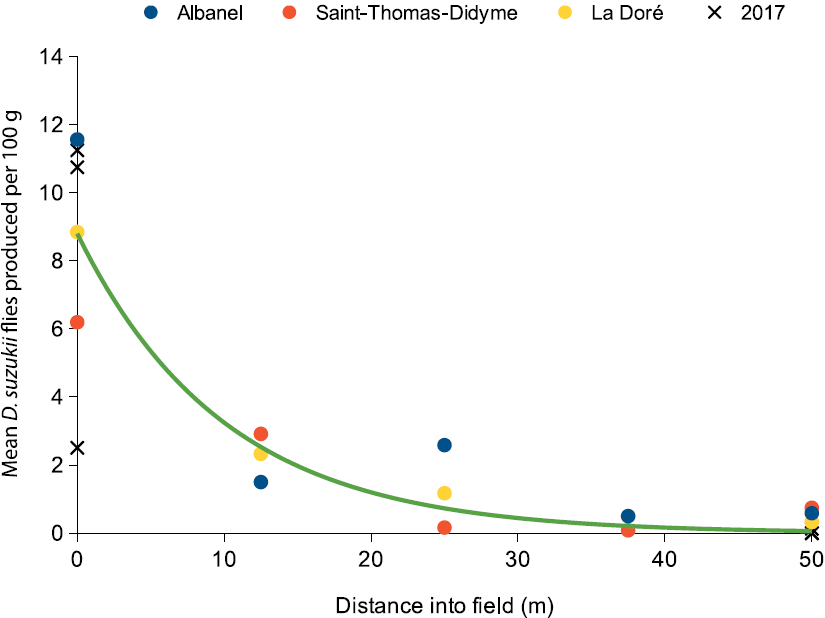
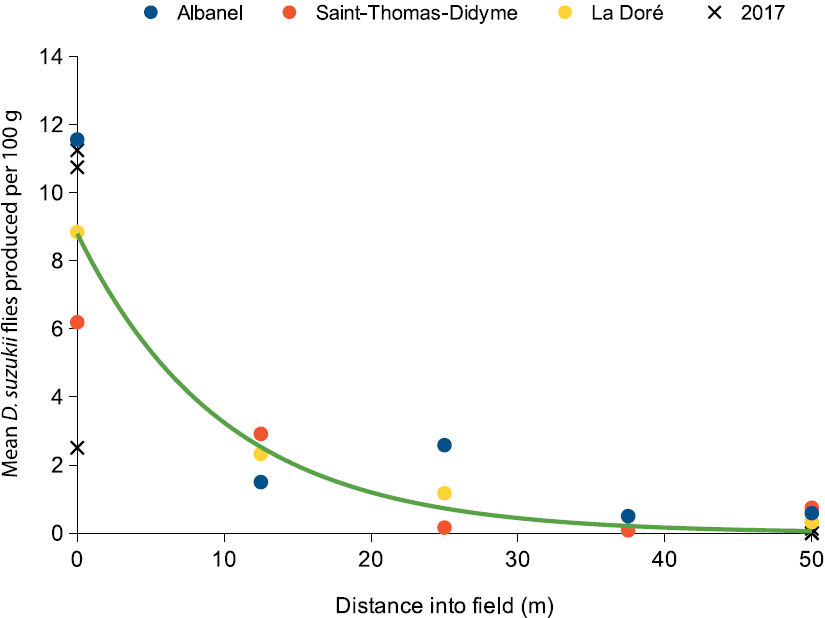
In 2018, finer scale spatial sampling closer to the border allowed modelling D. suzukii fruit infestation (D. suzukii emerged per 100 g of fruits) as a function of distance into the field; i.e., up to 50 m from border. As for D. suzukii capture data, an exponential model of the effect of distance on fruit infestation best fitted the data (R² = 0.88 compared to R² = 0.60 for a linear regression) (Fig. 5). At the border (0 m) 8.80 D. suzukii emerged per 100 g of lowbush blueberry fruits and infestation decreased with distance at the rate of 9.49% per metre into the field. The model predicts that 25 m from the border, fruit infestation would be reduced by 91.73% compared to the border (0 m); i.e., to ≤ 1 D. suzukii emerged per 100 g of fruit. Data for the two sampling points (0 and 50 m) in 2017 were also added in Fig. 5 for validation, as these data were not used in estimating model parameters.
Model of exponentially decreasing lowbush blueberry fruit infestation by Drosophila suzukii as a function of distance from field border, during the harvest season in 2018. The 2017 data for two corresponding fruit collection distances are added (x symbols, 0 and 50 m), showing that they are within predicted levels from independently parametrised model based on 2017 data.
Discussion
The first objective of this study was to document the abundance and phenology of D. suzukii in lowbush blueberry of the Saguenay-Lac-Saint-Jean region over a wide area. We focussed on this region because it comprises most of the lowbush blueberry production in Québec and is likely to be close to the northern limits of the range of D. suzukii in eastern Canada. We found that D. suzukii was very abundant during summer seasons of 2016, 2017, and 2018 although sampling did not cover the whole 2018 season as the focus was on fruit infestation. Density of D. suzukii catches varied greatly among sites, as shown, for example, with peaks averaging from 100 to 1000 D. suzukii captured per day among sites. The seasonal changes in D. suzukii abundance and sex ratio remained similar across sites and varied only slightly between years (Fig. 1), even though global abundance sometimes differed across sites. Captures started with very low numbers of D. suzukii that were exclusively female in early summer, followed by a period of rising densities paralleled by growing proportions of males from mid-summer until early fall, when populations peaked more or less sharply. Then capture density declined in late October when the sex ratio tended towards near equality. The observed phenology might suggest the possibility of three or more generations per year in the region, although this could only be confirmed by more detailed field observations on local population dynamics.
Our second objective was to examine the potential of D. suzukii to overwinter in the Saguenay-Lac-Saint-Jean region, which is likely to be relatively close to the northern limits of its range in eastern Canada, with a maximum of only about six months of warm enough conditions to allow its development and reproduction. Low-temperature thresholds from published work indicate that immatures cannot complete development below approximately 6 °C, and summer morph females cannot reproduce below approximately 10 °C (Dalton et al. Reference Dalton, Walton, Shearer, Walsh, Caprile and Isaacs2011; Tochen et al. Reference Tochen, Dalton, Wiman, Hamm, Shearer and Walton2014; Jakobs et al. Reference Jakobs, Gariepy and Sinclair2015; Stephens et al. Reference Stephens, Asplen, Hutchison and Venette2015; Ryan et al. Reference Ryan, Emiljanowicz, Wilkinson, Kornya and Newman2016).
The first catches of D. suzukii in Saguenay-Lac-Saint-Jean were all summer morph females, which were not continuously captured in our sites until mid to late August in 2016, and until late July-early August in 2017. The intensive trapping set-up that was operational from mid-May onwards in 2017 and 2018 at the Dolbeau-Mistassini site in the field border captured just a few individuals around 15–20 June, which were also summer morph females; i.e., they could not be postdiapause winter morph D. suzukii that overwintered locally. This suggests that overwintered D. suzukii were either absent even in forest borders or they were so rare that they remained undetected even with intensive trapping effort.
The earliest summer morph female captures here could be migrants from another region to the south or, assuming that overwintered D. suzukii were present but remained undetected because they were not sufficiently abundant in spring to be detected, those early summer morphs could be the first current-year (new) generation of D. suzukii born from the rare overwintering D. suzukii that had survived winter locally. If indeed present, when resuming activity in spring overwintered D. suzukii may also have failed to respond to our apple cider vinegar baited traps, which were operational starting in mid or late May, as suggested by Thistlewood et al. (Reference Thistlewood, Gill, Beers, Shearer, Walsh and Rozema2018) to explain similar seasonal patterns of D. suzukii.
The all-female sex ratio of first-captured D. suzukii did not tend to stabilise near equality (1:1) until the postharvest period in late summer, suggesting that males first appeared in these Saguenay-Lac-Saint-Jean populations among progeny of the summer morph females that were first caught. By the end of season, the sex ratio had stabilised, but was still slightly biased either towards females (2016) or males (2017).
It is possible that winter survival did occur in microhabitats such as forest leaf litter (Zerulla et al. Reference Zerulla, Schmidt, Streitberger, Zebitz and Zelger2015), but with high mortality rate, especially among males. The idea that low numbers of D. suzukii indeed survived winter but remained undetected might find indirect support in data from our intensive trapping set-up in Dolbeau-Mistassini in 2017 and 2018, where the first D. suzukii were captured about one month earlier than in other sites. According to Kirkpatrick et al. (Reference Kirkpatrick, Leach, Xu, Dong, Isaacs and Gut2018), the winter morph has reduced antennal response to volatiles, potentially limiting apple cider vinegar-baited trap effectiveness on postdiapause winter morph D. suzukii resuming flight activity in spring.
Overall, it is still unclear if D. suzukii can overwinter in the Saguenay-Lac-Saint-Jean region, as we can report no evidence of it at this stage. However, given the consistent presence of winter morphs D. suzukii in large numbers very late in fall in all sites (Figs. 1, 4), it is probable that many D. suzukii could find suitable overwintering microclimates in the protected forested borders before temperatures were finally too cold to sustain flight activity. Further experimental research on late-season behaviour of D. suzukii and potential overwintering microclimates in the forest borders would be required to better understand the low-season dynamics of these D. suzukii populations.
Concerning fruit infestation, it is very interesting that it started more than one month after the onset of lowbush blueberry harvesting in both the 2016 and 2017 seasons (Fig. 1). This latency to infest lowbush blueberry fruit in the fields could be explained by the exploitation of alternative wild berry hosts in the forest borders (or to some extent also within field margins) in early summer by D. suzukii, such as Canadian bunchberry (Cornus canadensis Linnaeus; Cornaceae) (J.-F.G., unpublished data). Early maturing wild fruits in the protected forest borders could serve as reproductive resources supporting early summer population growth to some extent. With increased D. suzukii density, reproductively mature adults would then spill over on the adjacent cultivated lowbush blueberry to start laying eggs as lowbush blueberry fruit maturation starts.
Whatever the precise dynamics, the observed pattern of late appearance of cultivated lowbush blueberry fruit infestation by larvae is reassuring for lowbush blueberry producers, since according to our data from all sites, fruit was harvested mainly before field infestations started. During the early season, appropriate management of wild berry hosts and a focus on early harvesting could therefore be a suitable pest management strategy to limit the impact D. suzukii on this culture by limiting early season alternative reproductive resources. That the new dynamics thus created in forested borders could indeed decrease crop infestation would need careful study.
Our data on late season reproductive potential (female fecundity) clearly demonstrate a decrease in the number of viable eggs laid under controlled conditions by female D. suzukii from September to October, as indicated by D. suzukii emerging from fruit samples under similarly controlled conditions in the laboratory. This is consistent with previous studies and reflects D. suzukii acclimation to fall conditions in Saguenay-Lac-Saint-Jean; i.e., colder temperatures and rapidly decreasing photoperiod, as previously documented (Stephens et al. Reference Stephens, Asplen, Hutchison and Venette2015; Toxopeus et al. Reference Toxopeus, Jakobs, Ferguson, Gariepy and Sinclair2016; Everman et al. Reference Everman, Freda, Brown, Schieferecke, Ragland and Morgan2018). Decreasing female fecundity in late season can be interpreted as incipient reproductive diapause (Shearer et al. Reference Shearer, West, Walton, Brown, Svetec and Chiu2016; Wallingford and Loeb Reference Wallingford and Loeb2016), although the true diapause status of fall-acclimated D. suzukii has been debated (e.g., Toxopeus et al. Reference Toxopeus, Jakobs, Ferguson, Gariepy and Sinclair2016). Based on experimental induction and termination of reproductive dormancy, Zhai et al. (Reference Zhai, Lin, Zhang, Zhang, Zheng and Yu2016) concluded that D. suzukii is a short-day diapausing species.
The last objective of this study was to examine the spatial distribution of D. suzukii and larvae in fruit of lowbush blueberry in relation to (forested) field borders in the Saguenay-Lac-Saint-Jean, based on D. suzukii capture density and fruit infestation frequency along transects perpendicular to the border. We found that much larger D. suzukii densities occurred in wooded borders than in fields and capture densities decreased exponentially as a function of distance from the woods during both the harvest and postharvest periods in 2017. This can be explained by the natural tendency of D. suzukii to use the forest landscape of the borders for physical protection and to use wild berry hosts for reproduction (e.g., Santoiemma et al. Reference Santoiemma, Mori, Tonina and Marini2018). In the Saguenay-Lac-Saint-Jean region, suitable fruit species include Cornus canadensis, and Aralia hispida Ventenat (Araliaceae), which were common in our sites (J.-F.G, unpublished data).
The marked decrease in D. suzukii densities in the lowbush blueberry fields compared to nearby forest borders suggests that the complex environment of the forest is more suitable to D. suzukii than open lowbush blueberry fields. Temperature, wind, and rainfall can be more extreme in the field than the forest borders, which could limit adult movement and survival (Enriquez and Colinet Reference Enriquez and Colinet2017). Furthermore, air humidity is an important physical factor for D. suzukii (Eben et al. Reference Eben, Reifenrath, Briem, Pink and Vogt2018). Forested habitats are more humid than open fields (e.g., Tochen et al. Reference Tochen, Woltz, Dalton, Lee, Wiman and Walton2016), and lowbush blueberry field borders indeed support higher D. suzukii densities. According to Guédot et al. (Reference Guédot, Avanesyan and Hietala-Henschell2018), maximum humidity interacting with maximum temperature as abiotic factors best explained D. suzukii density variation during the season and between years.
Abiotic factors, wild berries, and shelter could also explain variability between sites, which needs further study. During the postharvest period, the largest numbers of D. suzukii were trapped in the forest borders. Based on laboratory studies, Wallingford et al. (Reference Wallingford, Rice, Leskey and Loeb2018) suggested that D. suzukii about to overwinter would prefer substrates with sufficient nutritional value. In late season, suitable feeding substrates are possibly more abundant in wooded borders than in lowbush blueberry fields, where much of the organic matter has been harvested or is in advanced state of decomposition. However, we caught adult D. suzukii in most traps along the field transects (Fig. 4). As Santoiemma et al. (Reference Santoiemma, Trivellato, Caloi, Mori and Marini2019) reported, D. suzukii move between different habitats in heterogeneous environments and thus use both fields and forests depending on time and seasons.
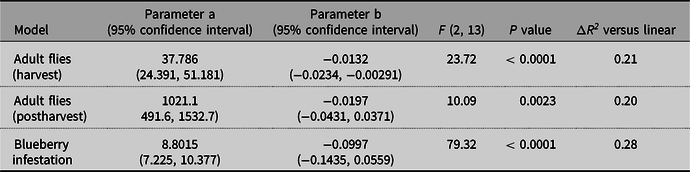
Spatial distribution of lowbush blueberry fruit infestation by larvae along perpendicular transects was also modelled for the 2018 season and the exponential decrease model with distance best fitted the data. Just like the spatial distribution of adult D. suzukii density, results show that fruit infestation occurs mostly close to the wooded border at the edge of the fields. Furthermore, the exponential model fit was better than for spatial distribution of adult D. suzukii (Table 2), with distance to the wooded border explaining 88% of the decrease in infestation (Fig. 5). Close similarity in the fruit infestation trends and that for D. suzukii captures is not surprising and suggest that female D. suzukii do not move very far from the edge to lay their eggs into cultivated lowbush blueberry fruit. Proximity to shelters and alternative wild berry resources in the woods for reproduction are key factors explaining this species presence and abundance in the lowbush blueberry agroecosystem. Our results on spatial distribution of D. suzukii and larvae in fruit could possibly be used in a pest management strategy, where, for example, early harvesting a 50-m strip of ripening lowbush blueberry adjacent to the borders could help prevent or limit D. suzukii from laying eggs further into the field as they tend to move to the crop, assuming that D. suzukii mainly inhabit the woods from where they disperse to lay eggs in lowbush blueberries.
Exponential model parameters and their 95% confidence interval predicting the spatial distribution of adult Drosophila suzukii density and fruit infestation (D. suzukii emerging from 100 g of fruit) as a function of distance from the wooded border in lowbush blueberry, Saguenay-Lac-Saint-Jean, Québec.
Conclusions
We found no evidence that D. suzukii overwinters in the Saguenay-Lac-Saint-Jean, but it was generally abundant in late summer and reached high densities in all our study sites. However, our data indicate that its recurrent presence in very high densities during late summer and fall in forest habitats bordering lowbush blueberry in Saguenay-Lac-Saint-Jean may represent considerable risk to the lowbush blueberry industry. We found clues in the seasonal pattern of abundance that the species might overwinter in the region, although this clearly requires further work. Its reproductive acclimation to fall conditions expressed as decreasing female fecundity from September with complete arrest in early October and the accumulation of very high densities of winter morphs before freezing, both are compatible with overwintering potential in protected microhabitats. We also developed quantitative predictive models of the spatial distribution of both D. suzukii density and concurrent lowbush blueberry fruit infestation, which decrease markedly with distance from the forested border of lowbush blueberry fields. We found that adult D. suzukii mostly inhabit the wooded borders of the lowbush blueberry fields and that annual growth in D. suzukii population density occurs relatively late in the summer. We also found that female D. suzukii lay the majority of their eggs in the first metres of the lowbush blueberry fields and mostly after the normal lowbush blueberry harvesting period. According to our findings, a pest management strategy adapted to the current situation should mainly focus on timing and location (near the borders) of harvesting. Eventually and based on results we present elsewhere, effective management of wild berry hosts in the lowbush blueberry environment should also be considered. Finally, further studies should be developed to better understand the population dynamics of D. suzukii in lowbush blueberry in the Saguenay-Lac-Saint-Jean region, and its behaviour and basic resources during the early season (May to early June) when D. suzukii is rare to absent or possibly unresponsive to the apple-cider baited traps currently used, and is very limited in terms of potential reproductive resources.
Acknowledgements
The authors thank the Natural Sciences and Engineering Research Council of Canada Cooperative Research and Development programme and Discovery programme, the Syndicat des Producteurs de Bleuets du Québec, the Fonds de recherche du Québec-Nature et technologies, and the Fonds de la recherche agroalimentaire axé sur l’agriculture nordique du Saguenay-Lac-Saint-Jean for research grants to C.C. Special thanks are due to Mireille Bellemare and Anna-Marie Devin (Club Conseil Bleuet) and Pierre-Olivier Martel (Ministère de l’Agriculture, des Pêcheries et de l’Alimentation du Québec) for effective collaboration and summer students Jonathan Franchomme, Anne-Marie Olivier, and Emil Shatov for critical help with laboratory and field work. Thanks are also due to the blueberry producers from Saguenay-Lac-Saint-Jean for access to their lowbush blueberry fields.