

Introduction
The rise of the Roman Empire has long been invoked to explain changes observed in husbandry practices, most notably in the evolution of domestic animal growth and morphology, in Gaul and elsewhere (e.g. Brunaux & Méniel, Reference Brunaux and Méniel1983; Audoin-Rouzeau, Reference Audoin-Rouzeau1991, Reference Audoin-Rouzeau and Baratay1995; Méniel, Reference Méniel1996). These changes, believed to coincide with the Roman conquest (first century bc to first century ad), were considered to be a direct manifestation of the process of Rome assuming power over the provinces. However, the hypotheses regarding the chronology of events and their triggers are being reassessed. The economic, and especially the agricultural, changes affecting Gaul actually occurred earlier, most probably from the third century bc onwards, in response to a developing, more dynamic exchange network (e.g. Woolf, Reference Woolf2000, Reference Woolf, Keay and Terrenato2001; Keay & Terrenato, Reference Keay and Terrenato2001; Le Roux, Reference Le Roux2004; Rieckhoff, Reference Rieckhoff2006 and subsequent issues of Bibracte volume 12Footnote 1 ; Buchsenschutz, Reference Buchsenschutz2007, Reference Buchsenschutz2015; Ouzoulias & Tranoy, Reference Ouzoulias and Tranoy2010; Reddé et al., Reference Reddé, Barral and Favory2011). This new line of enquiry has increasingly led researchers not only to reconsider the chronological and geographical origins and mechanisms of change, but also to reassess the relative level of Roman influence over this change (e.g. Malrain & Blancquaert, Reference Malrain and Blancquaert2016). Zooarchaeological research in this domain has likewise advanced, addressing issues such as herd management strategies and the organization of meat supply and their impact on domestic animals (Lepetz, Reference Lepetz and Baratay1995; Forest & Rodet-Belarbi, Reference Forest, Rodet-Belarbi, Meeks and Garcia1997, Reference Forest and Rodet-Belarbi2002; Lepetz & Matterne, Reference Lepetz and Matterne2003; Schlumbaum, et al., Reference Schlumbaum, Stopp, Breuer, Rehazek, Blatter, Turgay and Schibler2003, Reference Schlumbaum, Turgay and Schibler2006; Forest, Reference Forest, Blanchard and Izac-Imberd2008). The growing quantity of available data, development of new methods, renewal of archaeological approaches, and comparison of results from different studies now permits a more accurate understanding of the agro-pastoral practices and ties that existed between Italy and the various provinces of the Western Roman Empire between the Iron Age and the Roman period.
This comparative study aims to throw light on the socio-economic changes occurring between the Late Iron Age and Roman period that may have affected husbandry strategies in Gaul and neighbouring territories. To do so, two domestic animals, characterized by different statuses and modes of exploitation—pig and cattle—are considered. First, the evolution of the size of both species is analysed in Gaul and its neighbouring territories (Germania Magna, Italy, and more eastern provinces such as Germania Inferior and Superior, Rhaetia, Noricum, and Pannonia Superior) between the sixth century bc and the seventh century ad. These wide geographical and chronological frameworks allow us to address both animal growth dynamics and size diversity by geographical region well before, during, and after the Roman period, and enable us to answer questions concerning the origin (indigenous or external) of the morphological changes observed in the livestock. Second, the stable isotope analysis of pigs from Levroux Les Arènes (Indre, France) is presented, providing an overview of husbandry and meat production capacities among the Bituriges Cubi (a Gallic people) at the beginning of the second century bc. The Levroux Les Arènes case study gives further insights into the potential socio-economic mechanisms behind the changes in husbandry strategies—notably those affecting livestock morphology—over the course of the Late Iron Age in Gaul.
Analysis of Pig and Cattle Morphology
Material and methods
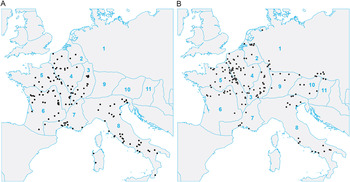
Pig and cattle morphometric analysis was carried out over the territory of Gaul (Figure 1) as one assemblage to document broad growth trends. Early Imperial administrative divisions were then used to address geographical diversity in size. For pigs, the analysis was based on osteometric data (9194 measurements) from 307 Gallic, German, and Italian sites, distributed over 139 parishes in modern France, Belgium, Switzerland, Italy, and the Netherlands (Figure 1A). For cattle, the 14,938 measurements came from 341 sites (representing 168 parishes) in Gaul, Roman Italy, and the provinces adjoining the limes, as well as from Germania Magna, outside the boundaries of the Roman Empire (Figure 1B). Only limb bone length measurements were taken following standards established by von den Driesch (Reference von den Driesch1976).
Distribution maps of the parishes (black dots) that yielded (A) pig and (B) cattle bone measurements (1. Germania Magna, 2. Germania Inferior, 3. Germania Superior, 4. Gallia Belgica, 5. Gallia Lugdunensis, 6. Gallia Aquitania, 7. Gallia Narbonensis, 8. Italia, 9. Rhaetia, 10. Noricum, 11. Pannonia Superior).

In order to identify broad morphological trends, to make the best use of the data, and to ensure that samples are reliable, the Log Size Index (LSI) methodology was applied. This method permits the combined use of measurements taken from different bones of the skeleton and therefore makes it possible to study otherwise inaccessible small assemblages. First developed by G.G. Simpson (Reference Simpson1941) and adapted by R.H. Meadow (Reference Meadow, Becker, Manhart, Peters and Schibler1999), the LSI method consists of calculating the difference between the decimal logarithms for each measurement taken on archaeological material (x) and the corresponding dimensions for an individual or reference group (y): LSI = log(x) − log(y). The reference used for pig LSI calculations corresponds to the averaged measurements from three sows from Gaul discovered in the Région Centre (France), specifically in Neuville-aux-Bois (Loiret), Prasville, and Allonnes (Eure-et-Loir) (see Bayle & Josset, Reference Bayle and Josset2012; for detailed information: Duval, Reference Duval2015). These skeletons are dated to the Early and Middle La Tène period (between 400 and 150 bc). For cattle, a third-century ad bull from the site of Fresnes-lès-Montauban (Pas-de-Calais, France) (Lepetz, Reference Lepetz1996) was used as reference (metric data published in Duval et al., Reference Duval, Lepetz and Horard-Herbin2012). Its age was estimated at 42 months and its wither height 1.35 m.
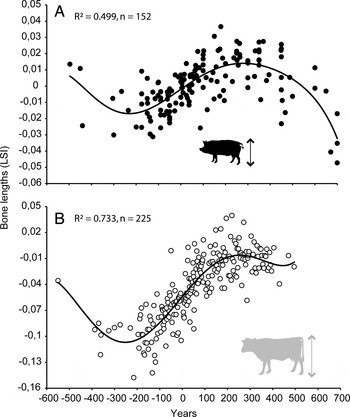
For the morphological analysis undertaken for Gaul, results are displayed in diagrams showing both log size mean values per sites—or groups of sites when data were too scarce—(Figure 2A and 2B, individual circles), and best fit polynomial curves reflecting the general trends in size variation through time. These trends were statistically tested, grouping log ratios by century. As the normality and the homoscedasticity of these newly constituted samples were not always proved (as revealed by Shapiro-Wilk and Levene tests respectively), the adopted statistical approach was to perform a Kruskal-Wallis test, followed by post-hoc comparisons using a Mann-Whitney pairwise test with Bonferroni correction. All results are given in the Supplementary Material.
Evolution of (A) pig and (B) cattle bone length measurements from the sixth century bc to the seventh century ad in Gaul. The circles on the two plots correspond to site mean values. The best fit polynomial curves summarize the general trend in size variation (the strength of the relationship [R2] and the number of samples used [n] are indicated for both curves). Animal silhouettes were drawn by Michel Coutureau, in collaboration with Vianney Forest (INRAP), ©1996 ArcheoZoo.org.

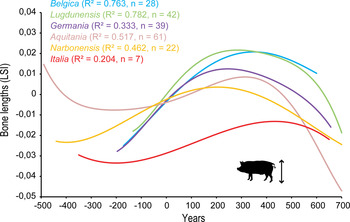
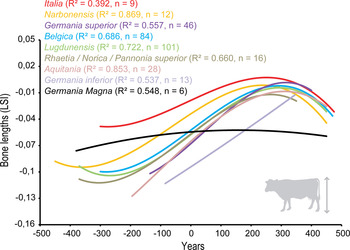
As far as comparisons between Early Imperial administrative divisions are concerned (Figures 4 and 5), only the best fit polynomial curves are displayed to keep the figures easily readable. For each curve, the number of data points and the strength of the relationship (R2 values, ranging between 0.204 and 0.782 for pigs, and between 0.392 and 0.869 for cattle) are directly shown on the diagrams. The detail of site means and standard deviations of log ratios is provided both for Figure 2A and 2B and for Figures 3 and 4 in the Supplementary Material.
Evolution of pig bone length from the fifth century bc to the seventh century ad in different provinces of the Roman Empire. The best fit polynomial curves summarize the general trend in size variation (the strength of the relationship [R2] and the number of samples used [n] for the curve construction are indicated between parenthesis for each administrative region). Animal silhouette was drawn by Michel Coutureau, in collaboration with Vianney Forest (INRAP). See online version for the code colour. ©1996 ArcheoZoo.org.

Evolution of cattle bone length from the fifth century bc to the fifth century ad in different provinces of the Roman Empire and in unoccupied Germany. The best fit polynomial curves summarize the general trend in size variation (the strength of the relationship [R2] and the number of samples used [n] for the curve construction are indicated between parenthesis for each administrative region). Animal silhouette was drawn by Michel Coutureau in collaboration with Vianney Forest (INRAP). See online version for the code colour. ©1996 ArcheoZoo.org.

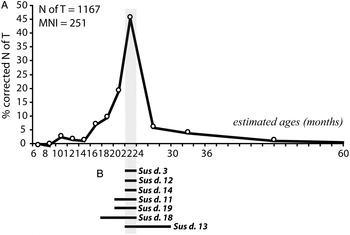
(A) Pig kill-off pattern from the early second century bc at Levroux Les Arènes, established following Horard-Herbin's Reference Horard-Herbin1997 methodology based on the percentage of the corrected number of teeth (for further explanation, see Frémondeau et al., Reference Frémondeau, Horard-Herbin, Buchsenschutz, Ughetto-Monfrin and Balasse2015). (B) The sequentially sampled specimens that participate in the main slaughter peak—the horizontal bar represents the estimated age at death of each specimen (following Horard-Herbin's Reference Horard-Herbin1997 method).

An early and continuous evolution of pig and cattle morphology
The osteometric analysis reveals that, after a conspicuous drop in pig size from the start of the period considered, pig bone lengths increase from the very end of the third century bc (Figure 2A). This growth appears progressive until the first century ad, when pig size rapidly increases (significant pairwise comparisons between the first century bc and the second century ad, see Supplementary Material), and exhibits an increasing diversity, documented by sites with higher or much smaller length mean values (initially in the first century bc, then in second century ad; Ansari-Bradley unilateral tests, p values = 1). This trend is at its most prominent during the second century ad. That century appears to be a turning point, as a relatively stagnant phase is observed afterwards, which may correspond to reaching a morphological optimum, and is accompanied by a progressive decrease in the range of length variation (Ansari-Bradley unilateral test, p value = 1). From the fourth century onwards, pig bone lengths progressively drop.
Cattle size (Figure 2B) seems to conspicuously decrease between the sixth and the third centuries bc. Thereafter, between the end of the third century and the beginning of the second century bc, bone lengths progressively increase. This growth accelerates during the course of the first century bc (significant pairwise comparisons between the second century bc and the third century ad, see Supplementary Material), which is one century earlier than for pigs. As with pigs, this rapid growth is associated with greater size diversity (initially in the first century bc, then in second and third centuries ad; Ansari-Bradley unilateral tests, p values = 1), and is rapidly followed by a drop in values from the start of the fourth century ad; this is slightly earlier than for pigs.
In light of these results, it appears that domestic animal size starts to increase well before the Roman conquest and the subsequent rise of the Roman model in Gaul. Gallic herders would therefore appear to have been instrumental in the evolution of the size of pigs and cattle within a broader La Tène context of demographic, urban, and economic growth (Buchsenschutz, Reference Buchsenschutz2007). Nevertheless, the Roman period saw further change for these two species. A slight increase in size growth, coupled with greater size diversity, is noticeable from the first century ad onwards. The combination of these two phenomena may indicate the strengthening of economic frameworks, the intensification of exchanges and influences, and the emergence of more numerous animal types. This latter may result from the complexification of social and administrative hierarchies, the expression of a stronger regionalism in response to the penetration of the Roman economic model, the import of animals of various types, and/or the reshaping of agro-pastoral systems within the territory of Gaul.
To refine on our perception of these broad morphological trends, the data have been split between the different provinces of Gaul and compared with those from other territories of the Western Roman Empire.
Regional diversity in livestock sizes
Pig size evolution is compared in six different regions (Figure 3). The largest sizes are observed in the provinces of Gallia Belgica and Lugdunensis. It is notable that animals from both provinces are characterized by similar sizes that change in relatively parallel patterns, despite a slight time-lag. In Germania, the size increase follows a similar pattern, but pigs do not become as tall as in Gallia Belgica and Lugdunensis. In Gallia Narbonensis and Aquitania, pigs seem to be taller than in other regions during the La Tène period. However, in these two provinces, pig size increases relatively little through time and, consequently, pigs become comparatively smaller. These first five curves show a geographical progression (from north to south) in diachronic size evolution trends, which is also shown by the Italian curve. In Roman Italy, pigs display the smallest size and are also characterized by a less intense growth than in Gallia Belgica and Lugdunensis. These results strongly challenge the previously held ideas that Italy was the epicentre from which changes in pig husbandry spread. Indeed, Italy cannot have initiated, at least from a zootechnical or genetic point of view, the growth of pigs observed in Gaul.
The data present a different picture for cattle (Figure 4). Among all the cattle from the corpus (spread over nine different regions), the largest are those from Gallia Narbonensis and Italy. In Gallia Belgica, Gallia Lugdunensis, and Aquitania, as well as in the eastern provinces and Germania Superior, cattle size follows a similar increasing pattern and finally catches up with the Mediterranean size during the course of the third century ad. In Germania Inferior, although an increase in size is clearly visible, cattle appear quite small. Germania Magna stands out, with cattle characterized by a rather stable size through time, as if this region had not been culturally or economically affected by the new economic networks during the time-span considered.
By paring down the geographical subdivisions and taking other territories of the Roman Empire into account, a greater diversity in livestock morphology and change dynamics emerges within the Roman Empire and on its fringes. This diversity exists before the Roman conquest and changes through time according to the region considered. Furthermore, pigs and cattle follow different trends, likely to be the result of different modes of exploitation and economic stakes. The existence of such diversity suggests that each territory, including Roman Italy, was driven by an overarching changing economic context and underwent internal mutations related to its own production capacity, know-how, and the livestock available locally. Moreover such a trend is also visible at more local scales, at the level of civitates, valleys, or even individual sites (MacKinnon, Reference Mackinnon2010; Duval et al., Reference Duval, Lepetz and Horard-Herbin2012, Reference Duval, Horard-Herbin and Lepetz2013; Duval, Reference Duval2015; Nuviala, Reference Nuviala, Gardeisen and Chandezon2014, Reference Nuviala2015, Reference Nuviala, Malrain and Blancquaert2016), reflecting local environmental and cultural characteristics, the agro-pastoral (crop/livestock) balance, or supply strategies.
In the following section, this local scale is used to highlight the mechanisms at the basis of the diversity in livestock morphology and change dynamics in the case-study of Levroux Les Arènes. A stable isotope analysis carried out on pigs from this Iron Age village provides further insights into husbandry strategies implemented to promote meat production well before the Roman conquest.
Complex Organization of Meat Production in Gaul in the Second Century bc
The Late Iron Age industrial settlement of Levroux Les Arènes was established at the beginning of the second century bc within the territory of the Bituriges Cubi in central France. It remained occupied until around 80 bc, after which the village was largely abandoned (Buchsenschutz et al., Reference Buchsenschutz, Colin, Firmin, Fischer, Guillaumet, Krausz, Levéry, Marinval, Orellana and Pierret2000). Levroux Les Arènes played an important economic role as a specialized production centre, and as an intermediary between local rural sites, for metalworking. It was also a trading post supplying networks at a regional scale and further afield (Buchsenschutz et al., Reference Buchsenschutz, Colin, Firmin, Fischer, Guillaumet, Krausz, Levéry, Marinval, Orellana and Pierret2000; Berranger & Fluzin, Reference Berranger, Fluzin, Buchsenschutz, Chardenoux, Krausz and Vaginay2009). More than 99 per cent of the identified faunal remains from the excavation are ascribed to domestic species, with the pig predominating. All the main parts of the pig skeleton are present in the faunal assemblage, which indicates that pigs were slaughtered within the village. However, some meat-bearing bones (femora, ribs, and vertebra) are under-represented, suggesting that pork was also exported and consumed outside the village. Interestingly, animals slaughtered at 20–24 months are over-represented among the dental remains (Figure 5A; Horard-Herbin, Reference Horard-Herbin1997; Frémondeau et al., Reference Frémondeau, Horard-Herbin, Buchsenschutz, Ughetto-Monfrin and Balasse2015). In the particular economic context of Levroux Les Arènes, one may wonder what the reasons for such an emphasis on this particular age group are. In an attempt to document the scale of the Bituriges Cubi pig husbandry, and in order to identify the demographic management strategies of pig herds, a stable isotope study was conducted on the faunal assemblage from this site (Frémondeau, Reference Frémondeau2012), the results of which have been partly published elsewhere (Frémondeau et al., Reference Frémondeau, Horard-Herbin, Ughetto-Monfrin, Balasse, Colin and Verdin2013, Reference Frémondeau, Horard-Herbin, Buchsenschutz, Ughetto-Monfrin and Balasse2015; Duval et al., Reference Duval, Frémondeau, Lepetz, Horard-Herbin, Malrain and Blancquaert2016).
The δ18O sequences measured in fifteen lower incisors are used to assess seasonality in pig birth and slaughter (e.g. Balasse et al., Reference Balasse, Smith, Ambrose and Leigh2003, Reference Balasse, Obein, Ughetto-Monfrin and Mainland2012) and to determine whether the standardized demographic management resulted from a strong seasonality of birth and slaughter, or from an intentional selection of an age class and therefore a slaughter weight; the latter would strongly support the hypothesis of specialized meat production at the site. The carbon and nitrogen stable isotope composition of bone collagen from the main domestic species helps determine pig diet and, from this, the environment they were raised in, assuming that omnivorous pigs reflect feeding from human waste activities in the village (e.g. Ervynck et al., Reference Ervynck, Lentacker, Müldner, Richards, Dobney, Albarella, Dobney, Ervynck and Rowley-Conwy2007; Hammond & O'Connor, Reference Hammond and O'Connor2013; Balasse et al., Reference Balasse, Bălăşescu, Janzen, Ughetto-Monfrin, Mirea and Andreescu2013, Reference Balasse, Bǎlǎşescu, Tornero, Frémondeau, Hovsepyan, Gillis, Ughetto-Monfrin and Popovici2015). In addition, the sequential oxygen and carbon stable isotope analysis of nine male lower canines better characterizes pig diet on a seasonal level (e.g. Balasse, Reference Balasse2002; Frémondeau et al., Reference Frémondeau, Cucchi, Casabianca, Ughetto-Monfrin, Horard-Herbin and Balasse2012).
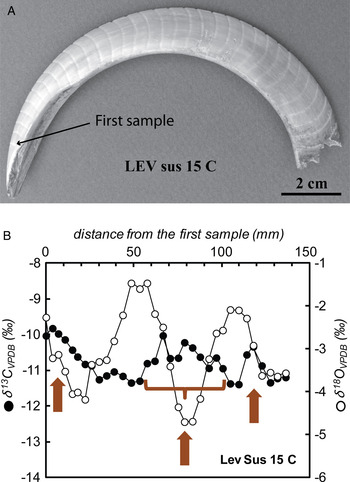
The C and N stable isotope composition of bone collagen reveals that pigs had a herbivorous diet (Frémondeau et al., Reference Frémondeau, Horard-Herbin, Ughetto-Monfrin, Balasse, Colin and Verdin2013). Moreover, the combined interpretation of the δ18O and δ13C sequences measured in the canines suggests that pigs were raised under tree cover at least seasonally: in all nine sampled specimens, δ13C values increase when δ18O values decrease and reach a minimum, probably corresponding to autumn and winter (Figure 6; see Supplementary Material; Frémondeau, Reference Frémondeau2012). This pattern, previously observed in modern Corsican wild pigs living under tree cover (Frémondeau et al., Reference Frémondeau, Cucchi, Casabianca, Ughetto-Monfrin, Horard-Herbin and Balasse2012), may correspond to feeding on forest fruits during autumn and winter. These combined pieces of evidence strongly suggest that the pigs slaughtered in Levroux Les Arènes were not raised within the village, but were mainly herded in surrounding farms with herders likely to be exploiting forest resources to feed their livestock.
Intra-tooth δ18O (open circles) and δ13C (filled circles) variations (B) measured in a male lower canine (A) dated to the early second century bc from Levroux Les Arènes. The arrows indicate the seasonal increase in δ13C values, a pattern suggesting the seasonal consumption of forest fruits in autumn and winter.

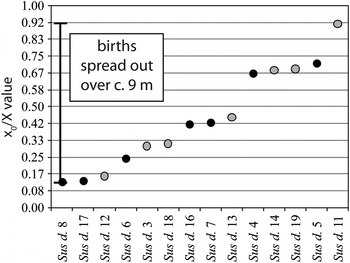
Results from the δ18O sequential analysis indicate that the births of the fifteen pigs sampled are spread over roughly nine months, indicating that there was no strong seasonality of pig births within Bituriges Cubi farms (Figure 7; Frémondeau et al., Reference Frémondeau, Horard-Herbin, Buchsenschutz, Ughetto-Monfrin and Balasse2015). The age at death of these fifteen pigs was estimated from tooth eruption and wear stages of their mandibles following Horard-Herbin's Reference Horard-Herbin1997 method. Seven of them display a tooth development stage compatible with slaughter at around the age of two years, which corresponds to the main slaughter peak (Figure 5B). The δ18O results suggest that their births were spread over roughly nine months—even excluding Sus d. 13 and 18 for which age-at-death estimations are less precise (Figure 7). Therefore, if these seven pigs were actually killed at the same age, this would mean that their slaughter was also spread over nine months. Provided that these specimens are representative of the age class of 20–24 months, the killing of the pigs at Levroux Les Arènes would therefore not have been targeting a specific season of the year, but rather a specific age group or slaughter weight (Frémondeau et al., Reference Frémondeau, Horard-Herbin, Buchsenschutz, Ughetto-Monfrin and Balasse2015). This deliberate and systematic selection of animals approximately two years in age strongly suggests a standardization of meat production. Furthermore, if pork was exported, as suggested by the under-representation of some of the ham-bearing bones, a specialized meat production in Levroux Les Arènes can be proposed (Flad & Hruby, Reference Flad and Hruby2005).
Birth distribution over an annual cycle of fifteen sequentially sampled pig specimens dated to the early second century bc from Levroux Les Arènes. For each specimen the x0/X value is the position (in mm) of the measure δ18O maximum value over crown height divided by the distance (in mm) over which an annual cycle is recorded (Frémondeau et al., Reference Frémondeau, Horard-Herbin, Buchsenschutz, Ughetto-Monfrin and Balasse2015). The specimens likely to be 20–24 months old when killed (i.e. the main slaughter peak) are identified by grey symbols.

The case-study of Levroux Les Arènes thus provides good evidence for a complex organization of meat production. This efficient and organized production system implies the exploitation of a specific environment (the forest) in order to produce a standardized finished product (two-year old pigs) within either a network of farms or in a few specialized farms. Zooarchaeological data, however suggest a specialization in pig husbandry at the scale of the whole civitas (Bayle et al., Reference Bayle, Auxiette, Frère, Germinet, Horard-Herbin, Poupon, Rivière, Salin, Malrain and Blancquaert2016). Pigs were selected and brought on foot to the settlement (involving regular animal movements and likely necessitating regulation or management). There pigs were killed and their carcasses processed by a limited number of specialists (Horard-Herbin, Reference Horard-Herbin1997) and some of the meaty cuts may have been used to make high value-added products (cured pork) that were subsequently put into circulation in the existing trade networks. Therefore, right from the beginning of the occupation of the settlement, the system was well established, indicating an earlier initial development time. In turn, this complex meat production system may have triggered further specialization in animal husbandry strategies, encouraging herders (or making it more profitable for them) to raise larger animals that would consequently produce larger carcasses. Indeed, pigs killed at Levroux Les Arènes are, on average, among the tallest in Gaul for the period considered (Horard-Herbin, Reference Horard-Herbin1997; Duval et al., Reference Duval, Frémondeau, Lepetz, Horard-Herbin, Malrain and Blancquaert2016).
Conclusion
In relation to Gaul, changes in domestic animal morphology and management are visible from the second century bc and result most probably from an internal and voluntary impetus, in response to a changing economic context—the Celtic world playing an active role in the then developing market economy (Buchsenschutz, Reference Buchsenschutz2004, Reference Buchsenschutz2015). The Levroux Les Arènes case-study gives us a glimpse of this new economic context and its impact on husbandry strategies. The stable isotope analysis revealed the existence of a well-developed and complex meat production system—perhaps organized at the wider civitas level (Bayle et al., Reference Bayle, Auxiette, Frère, Germinet, Horard-Herbin, Poupon, Rivière, Salin, Malrain and Blancquaert2016)—already by the beginning of the second century bc, which implies a development at a much earlier age. This new economic organization may, in turn, have fostered the size increase observed in pigs in the upper north of Gaul from the third century bc onwards. It is therefore from Gallic initiatives and available livestock that changes would have arisen.
Comparing results from different territories in the Western Roman Empire has shown that each province possessed herds with their own characteristics, which followed their own distinctive pattern of evolution. Like neighbouring regions, livestock in Roman Italy underwent size changes, potentially as a result of a more dynamic and open developing market. This heterogeneity of patterns, based on a variety of existing situations from the start of the time-span under study, appears also between species, with pigs and cattle following different evolutionary trends. This could reflect the existence of different species' status depending on the territory considered and the adaptation to the characteristics, strategies, and/or (quality or aesthetic) selection criteria existing in the various regions. In a context of generalized economic growth, each region seems to adapt according to its agro-pastoral characteristics, capacities, or ambitions.
In conclusion, it appears that communities in Gaul (and others in the Roman Empire) may have benefited from the blooming of a favourable economic context. Yet, well before the Roman conquest, they adapted according to their own agricultural characteristics and their own level of engagement in the economic market. The practical organization of husbandry production in western Europe, however, remains unclear over the period considered in this study (sixth century bc to seventh century ad). The pre-eminence of cattle from Roman Italy and pigs from northern Gaul in terms of size, and the great diversity in trends in the evolution of size within the various provinces, tend to cloud our view of the interactions between external influences, local initiatives, and the reflection of more indirect factors such as environmental conditions, or the farming, cultural, and broader economic frameworks within the Roman Empire. New light on these issues may come from increasing the database available for the geographical and chronological range considered in this article and enlarging these frameworks, comparing pig and cattle evolution and taking into account other domestic taxa (sheep, goat, horse, or dog). Finally, further case studies like that undertaken for Levroux Les Arènes, integrating traditional zooarchaeological methods and isotope analysis, are needed to deepen our understanding of inter-site variation in husbandry strategies.
Acknowledgements
The osteometric analysis of pig and cattle stature evolution would not have been feasible without the help of the numerous zooarchaeologists who agreed to share their data. We heartily thank: Rose-Marie Arbogast, Thierry Argant, Ginette Auxiette, Alessio Bandelli, Anna Baudry, Grégory Bayle, Francesco Boschin, Céline Bemilli, Estelle Bidault, Aurélia Borvon, Cécile Callou, David Cambou, Nadia Cavanhié, Cécile Callou, Paola Catalano, Benoît Clavel, Aurélien Creuzieux, Sabine Deschler-Erb, Jessie Duval, Alexandre Fontaine, Vianney Forest, Sylvain Foucras, Stéphane Frère, Armelle Gardeisen, Chloé Genies, David Germinet, Alexandra Griffon, Maaike Groot, Jacopo de Grossi Mazzorin, Marie-Pierre Horard-Herbin, Gaëtan Jouanin, Virginie Labonne, Caroline Lachiche, Dominique Lalaï, Jean-Claude Le Blay, Martine Leguilloux, Sébastien Lepetz, Julie Massendari, Patrice Méniel, Elsa Paillot, Fabienne Pigière, Frédéric Poupon, Eric Pucher, Olivier Putelat, Emeline Quilez, Audrey Renaud, Julie Rivière, Opale Robin, Maryline Salin, Barbara Stopp, Antonio Taggliacozzo, Olivier Talluault and Christian Vallet. Stable isotope analyses were carried out at the Service de Spectrométrie de Masse Isotopique du Muséum national d'Histoire naturelle (SSMIM) in Paris, thanks to the financial support of the ERC Starting Grant GA-202881 (SIANHE, directed by M. Balasse), of UMR 7324 CITERES and the Académie d'Agriculture de France, within a PhD funded by the SIANHE Starting Grant. Delphine Frémondeau is currently supported by a post-doctoral fellowship from the Center for Archaeological Sciences (CAS), KU Leuven, Belgium. We thank O. Buchsenschutz for giving us access to the Levroux Les Arènes faunal assemblages. We are also grateful to G. Fahy and two anonymous reviewers whose helpful comments significantly improved the manuscript.
Supplementary Material
List of sites included in the study.
Results from the statistical tests carried out on pig LSI data grouped by century.
Results from the statistical tests carried out on cattle LSI data grouped by century.
Isotopic results from the sequential sampling of LEV Sus 15 canine.
To view supplementary material for this article, please visit https://doi.org/10.1017/eaa.2016.10.