




No CrossRef data available.
Article contents
Psychometric properties of the EORTC Quality of Life Questionnaire in inpatient cancer rehabilitation in Germany
Published online by Cambridge University Press: 04 April 2005
Abstract
Objective: Recent years have shown an increase in the use of questionnaires measuring health-related quality of life to verify the quality of treatment in the field of oncology. An often used cancer-specific questionnaire is the “Quality of Life Core Questionnaire of the European Organization for the Research and Treatment of Cancer” (EORTC QLQ-C30). The purpose of this study is to analyze the psychometric properties of the EORTC QLQ-C30 (version 1) in order to determine the feasibility and appropriateness for its use in inpatient cancer rehabilitation in Germany with heterogeneous diagnoses.
Methods: The questionnaire was administrated to a sample of 972 cancer patients at the beginning of treatment and to 892 patients after treatment. Besides descriptive analysis, the statistical analyses include confirmatory analysis and the multitrait/multimethod approach to test the questionnaire's postulated scale structure (factorial validity) and its reliability (internal consistencies). The analysis also includes a comparison of responsiveness indices (effect size, reliable change index) to test the sensitivity of the instrument.
Results: The EORTC QLQ-C30 showed satisfactory levels of reliability and sensitivity, but the postulated scale structure could not be confirmed. The results illustrate that the varimax-rotated solution of a principal component analysis does not confirm the scale structure postulated by the authors. Correspondingly, the selected fit indices within the scope of the confirmatory factor analysis do not show satisfactory results either.
Significance of results: We therefore consider version 1 of the EORTC QLQ-C30 to be only limitedly useful for the routine assessment of changes in the quality of life of cancer patients in inpatient rehabilitation in Germany, especially because of the instrument's length and possible redundancies. For this reason, a scoring procedure limited to a subset of items is suggested, revealing satisfactory to good psychometric indices. However, further psychometric tests are necessary, especially with regard to validity and sensitivity.
Information
- Type
- Research Article
- Information
- Copyright
- © 2004 Cambridge University Press
INTRODUCTION
As a result of rising costs within the public health care system, increasing efforts have been made in the past to distribute the available funds according to principles of quality assurance. Consequently, in the fields of oncological rehabilitation and palliative care, rising endeavors have been made to verify and optimize the quality of care (Krischke & Petermann, 1995; Stump et al., 1998; Küchler et al., 1999). Nevertheless, due to only limited practical use of common outcome criteria of hospitalized cancer treatment, such as survival time and tumor response, within the scope of rehabilitative and palliative treatment of oncological diseases, standardized outcome criteria have only hesitantly been developed. However, more recently, the patient's subjective perception of the quality of survival time was given more consideration, particularly in the palliative setting. Quality of life assessment is particularly relevant to patients with progressive conditions, particularly in the later phases of the disease (Morgan, 2000; Kyriaki et al., 2001; Paci et al., 2001; Kaasa & Loge, 2003). It is assumed that, independent of prognosis and the course of the illness, cancer influences subjective parameters of quality of life, for example, the perceived state of health or everyday activities, which can be measured by directly posing questions to the patient (Aaronson et al., 1988). The concept of health-related quality of life is therefore increasingly used to evaluate the course and outcome of oncological treatment and surveys that not only measure the strain that accompanies symptoms but also the changes in quality of life during the course of treatment gained high relevance in the field of rehabilitative and palliative care of oncological diseases (Osoba et al., 1994, 1998; King, 1996; Ringdal & Ringdal, 2000; Weis et al., 2000).
Extensive scientific studies have been carried out repeatedly to evaluate the effectiveness of oncological treatment with respect to the patients' quality of life (Schulz et al., 2001), providing some evidence of improvements in the quality of life directly following the end of treatment. An often used instrument to measure changes in the patients' subjective quality of life is the tumor-specific “Quality of Life Core Questionnaire of the European Organization for Research and Treatment of Cancer” (EORTC QLQ-C30; Aaronson et al., 1993). This questionnaire consists of 30 items that are arranged within six scales of functioning oriented aspects (physical functioning [PF], role functioning [RF], cognitive functioning [CF], emotional functioning [EF], social functioning [SF], and global quality of life [GQL]). In addition, the questionnaire includes three symptom scales (fatigue [F], nausea/vomiting [N/V], and pain [P]) as well as six symptom items (dyspnoea, loss of appetite, sleep disorder, constipation, diarrhea, and financial problems). These different dimensions are measured in a period of one week. In version 1 used in this study, the patients answered the questions either dichotomously with a “yes/no” response (items 1–7) or on a 4-point Likert scale (1 = “not at all,” 2 = “somewhat,” 3 = “moderate,” 4 = “very much”) and a 7-point Likert scale (1 = “very bad” to 7 = “excellent”). In the current version 3.0, items 1–7 from the scales “physical functioning” and “role functioning” are measured on a 4-point Likert scale as well. Additionally, items 6 and 7 have been marginally changed linguistically to adapt them to the altered scaling. The scores of the six functioning scales are calculated by first adding up the raw scores of a scale, then dividing by the number of items, and finally mapping the values for each parameter onto a scale of 0 to 100, with 100 representing the highest level of functioning. The symptom scales and items are calculated in a similar manner, except for the difference that higher scores mean a higher symptom burden. On average, it takes 11 min to complete the questionnaire (Aaronson et al., 1993). The questionnaire was validated in an international study with patients suffering from lung cancer (Aaronson et al., 1993) indicating that five (PF, RF, CF, SF, N/V) of the nine scales had reliability coefficients below 0.7, two of them (RF, CF) below 0.6. In addition, three subscales (PF, RF, F) showed substantial interscale correlations. Currently, the EORTC Quality of Life Group is actively developing a shortened version of the questionnaire.
So far, there are only a few examinations of the psychometric properties of the EORTC QLQ-C30 in the field of inpatient oncological rehabilitation in Germany in which patients receive both active antitumor treatment, such as chemotherapy, as well as supportive care. Krischke and Petermann (1995) came to the conclusion that the instrument's psychometric properties are insufficient with relationship to the scales, which show only modest internal consistencies and high floor effects.
Because version 1 is still widely used in rehabilitative and palliative care of oncological diseases in Germany (Küchler et al., 1999; Weis et al., 2000), it seems appropriate to test the psychometric properties of the questionnaire once again. Such an analysis should be conducted with particular regard to the use of the questionnaire with a more extensive sample of heterogeneous cancer diagnoses and the need for reference data within these kind of studies. Due to the instrument's intended use in the measurement of changes in quality of life, not only factorial validity but also sensitivity to change is to be the focus of examination. When appropriate, because of the instrument's length and possible redundancies, an abridged scoring procedure is to be developed that possibly surveys the relevant fields of symptoms in oncological rehabilitation more economically and clearly.
METHODS
Sample
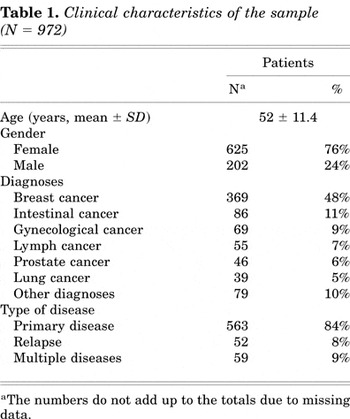
A consecutive sample of patients from the Nordfriesland Clinic in St. Peter-Ording, Germany, and the clinical oncology section of the Habichtswald Clinic in Kassel-Wilhelmshöhe, Germany, was questioned. The clinics offer a rehabilitative treatment program, focusing on the reduction of symptoms and the improvement of the ability to cope with the resulting changes and limitations due to the disease. Possible indications include all solid as well as malignant hematological tumors. The basic medical treatment consists of all necessary internal oncological as well as chemotherapeutical measures. Additionally, overall therapeutic measures such as, for example, physical therapy, pain therapy, or training in coping skills are performed. To measure quality of life, the EORTC QLQ-C30 (version 1) was administered at the time of admission and at discharge. The sample contained 972 patients at the beginning and 892 at the end of treatment. The patients were, on average, 53 years old; 75% of the patients were women. The patients suffered from various tumors, with breast cancer (48%) being the most frequent. Eighty-four percent of the patients had cancer for the first time (see Table 1). The distribution of the socio-demographic and clinical data essentially correspond to that of other oncological rehabilitation clinics in Germany (Küchler et al., 1999; Weis et al., 2000).
Clinical characteristics of the sample (N = 972)

Statistical Analyses
Testing the Psychometric Properties
The factorial structure of the questionnaire was tested by means of a principal components analysis, a confirmatory factor analysis, and the multitrait/multimethod approach of Campbell and Fiske (1959). In addition, the psychometric testing involves descriptive item analysis and the calculation of internal consistencies.
The principal components analysis was performed by determining the factors in accordance with the guidelines of the authors (Aaronson et al., 1993). The results of this analysis were then compared with the varimax-rotated solution based on the current data set with regard to the assignment of the items to the respective scales.
For a confirmatory testing of the postulated scale structure and to examine whether the factor structure can be confirmed with this sample of patients of oncological rehabilitation with heterogeneous diagnoses, the program AMOS 4.0 (Arbuckle & Wothke, 1999) was used, extracting a factor model that is being tested regarding its suitability. The model's suitability was determined by use of the “Comparative Fit Index” (CFI) and the “Non-Normed-Fit Index” (NNFI), regarding values >0.90 as acceptable (Hu & Bentler, 1999). The Chi2-Test (corrected for degrees of freedom) was not used because it is much more conservative within confirmatory analyses of large samples (Hu & Bentler, 1999). As a further measurement for assessing the sufficiency of fit, the “Root Mean Square Error of Approximation” (RMSEA) was also calculated. According to Browne and Cudeck (1993), in the interpretation of the RMSEA results, values <0.05 are considered to indicate a good fit (model confirmed), values between 0.05 and 0.08 (0.05 ≤ RMSEA < 0.08) indicate a moderate fit, and values of RMSEA ≥ 0.08 indicate a poor fit.
A multitrait/multimethod approach was conducted by the MAP program (Hays, 1991) to ascertain item–scale correlations as well as convergent and discriminant validity. Item-convergent validity is assessed by determining whether each item in a scale is substantially related to the total score computed from other items in that scale. Item internal consistency is supported if an item correlates substantially (r > 0.40) with the scale it is hypothesized to represent (Hays, 1991). To correct for overlap, the hypothesized item is deleted from the scale with which it is correlated. Determining that each item correlates most strongly with the scale to which it is hypothesized to belong assesses the item's discriminant validity criterion. Item-discriminant validity is dependent on the magnitude of the correlation between an item and its scale relative to the correlation of that item to other scales. A scale fit is computed indicating the percentage of those items that correlate significantly higher to their own scale than to each of the other scales. This scale fit can take on values between 0% and 100% and indicates the factorial validity of the questionnaire on an item level. Values higher than 90% are considered to confirm the postulated scale (Hays, 1991). All 24 items used by Aaronson et al. (1993) for constructing the scales were included in the analysis.
Sensitivity
Recently, research in quality of life has increasingly analyzed the ability of an instrument to measure changes over time (Wiebe et al., 1997; Pfennings et al., 1999; Liang, 2000). Because widely accepted criteria or procedures have not yet been developed (Liang, 1995, 2000), basic methods mentioned in the literature are compared.
First, the correlation coefficients of the scales between the two points of measurement are calculated. Furthermore, to be able to determine significant differences in means, t tests for paired samples at a significance level of 5% were used. Because tests of significance depend on the sample size, effect sizes (d) were calculated in accordance with Cohen (1988). The coefficients can be distinguished in categories of small (0.2 ≤ d < 0.5), moderate (0.5 ≤ d < 0.8), and large (d > 0.8) effect sizes. However, effect size measurements have the restriction of being of only limited use for slowly progressing diseases because they use the mean change as the numerator (Pfennings et al., 1999). Another disadvantage is that measures of effect size assume that all patients change in the same direction (Liang, 2000). Therefore, the “Reliable Change Index” (RCI) was calculated, representing another measurement of sensitivity (Jacobson & Truax, 1991). The RCI is computed by dividing the difference between the pre- and posttreatment scores by the standard error of the difference between the two scores, which is composed of the standard deviation of the measure and the reliability of the instrument. If the product is larger than the z-score desired level of significance, in this case 1.96 (p ≤ 0.05), the change in pre-to-posttreatment scores is said to occur beyond that of chance variation.
Because up-to-date, norm values for patients with heterogeneous diagnoses in Germany do not exist, and considering the substantial size of the sample, effect sizes and the RCI were calculated by using the corresponding standard deviation and reliability coefficients at the beginning of the treatment derived from the present sample. Because the dispersion of the sample at hand shows rather conservative estimates in comparison with values of an extensive international study (Ringdal & Ringdal, 1993), this procedure seemed to be appropriate.
RESULTS
Factorial Validity
A descriptive analysis of the missing values of all items showed a mean rate of 1.6%; the items varied between 0.2% and 2.5% missing values. For the majority of the analyses, missing values were replaced according to recommendations of Peng et al. (Priv Comm) by means of the expectation-maximization method. However, missing values were not replaced but omitted when calculating the confirmatory factory analysis in order not to affect the results.
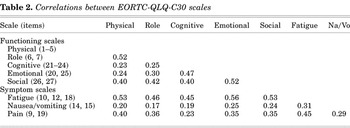
The principal component analysis (with replacement of missing values; n = 972) shows a distribution of eigenvalues as presented (8.2, 2.0, 1.5, 1.4, 1.1, 1.0, 0.9, 0.9, 0.8, 0.7; indicating only the first 10 values); the extracted nine factors explain 74% of variance. The varimax-rotated solution does not confirm the scale structure postulated by the authors. Correspondingly, the selected fit indices within the scope of the confirmatory factor analysis used (without replacement of missing values, n = 755) also show unsatisfactory results (CFI = 0.85; NNFI = 0.82, RMSEA = 0.08). As can be seen in Table 2, the calculation of the correlations between the scales before the treatment shows moderate to high values (0.30 ≤ r ≤ 0.65). Lower correlations with the other scales can be shown for the scale “nausea/vomiting” (0.17 ≤ r ≤ 0.31). The calculation of the mean value of all correlation coefficients (after calculating the Fisher Z-transformed correlations, without the scale “global quality of life”) results in a value of rmean = 0.38.
Correlations between EORTC-QLQ-C30 scales

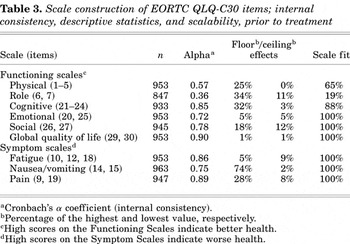
Before treatment, the “scale fit” reaches 100% in six of the nine scales; the scales “physical functioning,” “role functioning,” and “emotional functioning” stay below 90% (see Table 3).
Scale construction of EORTC QLQ-C30 items; internal consistency, descriptive statistics, and scalability, prior to treatment

Floor/Ceiling Effects
Because floor and ceiling effects (percentage of the lowest and highest possible scale value, respectively) depend on, among other things, the range of the scale, there is some indication for floor effects in the scales with dichotomous items. Prior to treatment, this concerns the scales “physical functioning” and “role functioning.” Moderate floor effects prior to treatment can be found despite a 4-point scale in the scales “cognitive functioning” and “pain”; high floor effects are shown for the scale “nausea/vomiting” (see Table 3).
Reliability
At the beginning of the treatment, the calculated reliability coefficients (Cronbach's α) meet the minimum requirements of α ≥ 0.70 in seven scales; the scales “physical functioning” and “role functioning” remain under that criteria (see Table 3).
Sensitivity
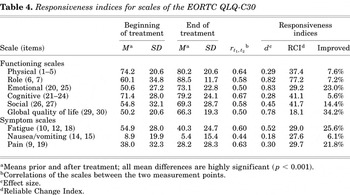
Comparisons of the means showed significant differences for all scales between the two measurement points (see Table 4). The calculations of the effect sizes demonstrate high effects (d ≥ 0.8) on the scales “role functioning,” “emotional functioning,” and “global quality of life” and moderate effects (0.5 ≤ d < 0.8) on the scale “fatigue.” Only small effects were shown on the scales “physical functioning,” “cognitive functioning,” “social functioning,” and “pain”; the scale “nausea/vomiting” did not show any effects. Calculated on the basis of the RCI, the percentage of patients with a higher quality of life varies between 6.1% (“nausea/vomiting”) and 34.2% (“global quality of life”). The correlations of the scales between the two measurement points vary between 0.44 and 0.67.
Responsiveness indices for scales of the EORTC QLQ-C30

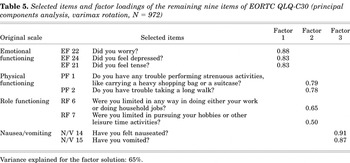
Because of the described limitations especially regarding the factorial validity, an attempt was made to construct a factorial structure more suitable to the given sample of patients of oncological rehabilitation. For this purpose, a principal component analysis with a subsequent varimax rotation (with replacement of missing values, n = 972) was first performed with the number of factors being extracted on the basis of the distribution of eigenvalues indicated in the scree test. For the factor analysis, all items were used, with the exception of the two global items that assess the state of health, because they may not contribute substantially to the construction of individual factors. The principal component analysis results in the presented distribution of eigenvalues (6.9, 2.0, 1.5, 1.4, 1.1, 1.0, 0.9, 0.8, 0.8, 0.7; only the first 10 values mentioned); this justifies a limitation to three factors, explaining 47% of the variance. From each of these three factors, the items with the highest loadings is chosen with the intention of forming scales that have a satisfactory internal consistency of Cronbach's α ≥ 0.70. If the factor loadings are equal, the items with the higher values are selected. According to these selection guidelines, nine items have been chosen (see Table 5) for an abridged scoring procedure.
Selected items and factor loadings of the remaining nine items of EORTC QLQ-C30 (principal components analysis, varimax rotation, N = 972)

To check the factor structure of the remaining nine items, a principal component analysis was first calculated using varimax rotation (with replacement of missing values; n = 972). Again, both of the global items were excluded from the analysis. A three factorial structure was demonstrated (eigenvalues: 3.1, 1.4, 1.4, 0.9, 0.7, 0.5, 0.4, 0.3, 0.3; only the first 10 results mentioned), explaining 65% of the variance. The first factor covers “emotional functioning,” the second factor is made up of items of the initial factors “physical functioning” and “role functioning,” the third factor is identical with the factor “nausea/vomiting” of the original version (see Table 5).
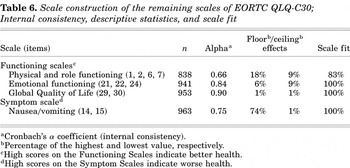
Afterward, the postulated scale structure was checked by means of calculating the internal consistencies, the confirmatory factor analysis, and the multitrait approach. Table 6 shows the resulting scale values of the three newly developed scales. In spite of having a low number of items, the internal consistencies are satisfactory or good. In accordance with the prior analysis, the scale “nausea/vomiting” again reveals high floor effects with 74%.
Scale construction of the remaining scales of EORTC QLQ-C30; Internal consistency, descriptive statistics, and scale fit

The chosen fit indices within the scope of the conducted confirmatory factor analysis (without replacement of missing values, n = 755) also show satisfactory results (CFI = 0.93; NNFI = 0.92, RMSEA = 0.07).
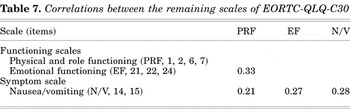
Table 7 shows the interscale correlations of the abridged version. Mainly, there are low correlations between most of the scales, except the scale “global quality of life,” which highly correlates with the other scales, possibly because of the character of a total score.
Correlations between the remaining scales of EORTC-QLQ-C30

The calculation of the mean value of all correlation coefficients (after calculating the Fisher Z-transformed correlation coefficients, without the scale “global quality of life”) results in a value of rmean = 0.28.
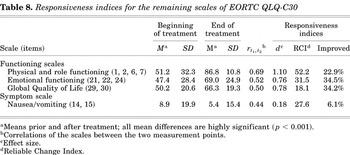
Comparisons of the means showed significant differences for all scales between the two measurement points (see Table 8). The calculations of the effect sizes demonstrate high (d ≥ 0.8) and moderate (0.5 ≤ d < 0.8) effects on all scales except the scale “nausea/vomiting,” which did not show any effects. Calculated on the basis of the RCI, the percentage of patients with a higher quality of life varies between 6.1% (“nausea/vomiting”) and 34.5% (“emotional functioning”). The correlations of the scales between the two measurement points vary between 0.44 and 0.69 (see Table 8).
Responsiveness indices for the remaining scales of EORTC QLQ-C30

DISCUSSION
Quality of life represents an essential criterion in evaluating treatment outcome and in quality assurance measures of oncological and palliative care. In this regard, the present study aimed at investigating the psychometric properties of a widely used questionnaire, the EORTC QLQ-C30, to measure changes in the subjectively perceived quality of life within a sample of cancer patients in oncological rehabilitation in Germany with heterogeneous diagnoses.
The results of this study indicate that the EORTC QLQ-C30 shows some potential for improvement, especially with regard to indices of factorial validity. Aaronson's originally published structure with nine factors (Aaronson et al., 1993) could not be confirmed, neither by the principal component analysis, by confirmatory factor analysis, nor by calculating the scale fit, which showed that three of nine scales stay below the required criteria of a scale fit above 90%. In addition, intercorrelations of the scales are partially high, especially between the scales physical functioning/role functioning, physical functioning/fatigue and fatigue/social functioning. However, reliability measurements return satisfactory or even good values on most of the scales; limitations were found on the physical and the role functioning scales. The responsiveness indices suggest that merely the scales “emotional functioning,” “fatigue,” and “global quality of life” show high sensitivity to change, that is, both high effect sizes and high percentages of improved patients. Descriptive analyses show some restrictions concerning the symptom scale nausea/vomiting; 75% of the patients did not rate any problems with nausea or vomiting. In summary it may be concluded that the original version of the EORTC QLQ-C30 contains redundancies and reveals poor factorial validity, which is why the instrument appears to be uneconomical for oncological rehabilitation in Germany.
We therefore developed an abridged scoring procedure; the postulated four-factor structure of the extracted 11 items was able to be confirmed within the scope of a confirmatory factor analysis and the multitrait approach. Having a more clearly factorial structure, the reduced scoring procedure covers the impairments in relevant areas of quality of life in patients of oncological rehabilitation and shows satisfactory or even good psychometric characteristics and responsiveness indices. The correlations between the remaining scales are low to moderate. Weak points are, on the one hand, the merely moderate internal consistency of 0.66 in the “physical functioning” scale. This can be explained by, among other things, the dichotomous items used in the scale. However, a first application of the shortened questionnaire, using response options on a 4-point scale, revealed noticeable improvements in the internal consistency of the scale “physical functioning” (Koch, Mehnert, & Petersen, 2002). On the other hand, the scale “nausea/vomiting” has high floor effects and, as a consequence, also shows low sensitivity to change.
This study has a number of potential limitations: First of all, the EORTC Quality of Life Group has developed a modified version of the questionnaire in the meantime, which is why any further developments on version 1 could be considered dispensable. However, because of the still widespread use of version 1 in routine documentations in rehabilitative and palliative care in Germany, the results of this study can be useful when analyzing the collected data. Furthermore, factor analysis results are known to be sample dependent. Thus, it has to be considered that the results obtained in this study are possibly not to be replicated in further studies. Nevertheless, by using an extensive sample, the generalizability of the research results seems to be acceptable. Moreover, because of the design of the study (pre-post-design without control group), it is not possible to differentiate between an actually low treatment outcome and a lack of sensitivity to change on part of the instrument and it is also difficult to distinguish between variability by chance and treatment success (Schuck, 2000). In addition, it might also be argued that the use of exploratory factor analyses is inappropriate for dichotomous items and therefore the results may be biased (Floyd & Widaman, 1995). However, according to the literature (Kim & Mueller, 1978; Muthen, 1978; Gorsuch, 1983), factor analysis also applies to binary variables or a mixture of binary and continuous variables and the results of the conducted exploratory factor analyses therefore seem to be significant.
In summary, it seems—especially with regard to the growing numbers of questionnaires to be answered by rehabilitation patients in the progress of developing quality assurance programs—that the time gain is considerable in a scoring procedure that has been reduced by 65% of the items. Nevertheless, the abridged scoring procedure is not intended to substitute for any development of a shortened version of the EORTC QLQ-C30 (version 3), which is, as mentioned before, currently being developed by the EORTC Quality of Life Group.
ACKNOWLEDGMENTS
We are very grateful for the constructive cooperation of all the involved clinics, the helpful support of students Christina Krüger and Miroslaw Witt, and to Dr. Bart for providing the data.
References
REFERENCES
Aaronson, N.K.,
Ahmedzai, S.,
Bergman, B.,
et al.
(1993).
The European Organization for Research and Treatment of Cancer
QLQ-C30: A quality-of-life instrument for use in international clinical
trials in oncology.
Journal of the National Cancer Institute,
85,
365–376.Google Scholar
Aaronson, N.K.,
Bullinger, M., &
Ahmedzai, S.
(1988).
A modular approach to quality of life assessment in cancer clinical
trials.
Recent Results in Cancer Research,
111,
231–249.Google Scholar
Arbuckle, J.L. &
Wothke, W.
(1999).
Amos 4.0 Users' Guide.
Chicago:
SmallWaters.
Browne, M.W. &
Cudeck, R.
(1993).
Alternative ways of assessing model fit. In
Testing Structural Equation Models.
Long, J.S. (ed.), pp.
136–162.
Newbury Park:
Sage.
Campbell, D.T. &
Fiske, D.W.
(1959).
Convergent und discriminant validation by the multitrait-multimethod
matrix.
Psychological Bulletin,
56,
81–105.Google Scholar
Cohen, J.
(1988).
Statistical Power Analysis for the Behavioral Sciences,
2nd ed.
Hillsdale, NJ:
Lawrence Erlbaum.
Floyd, F.J. &
Widaman, K.F.
(1995).
Factor analysis in the development and refinement of clinical
assessment instruments.
Psychological Assessment,
7,
286–299.Google Scholar
Gorsuch, R.
(1983).
Factor Analysis.
Hillsdale, NJ:
Lawrence Erlbaum.
Hays, R.D.
(1991).
Memorandum. Revised Multitrait Analysis Program Software
(MAP-R).
Boston, MA:
Health Institute, New England Medical Center.
Hu, L. &
Bentler, P.M.
(1999).
Cutoff criteria for fit indexes in covariance structure analysis:
Conventional criteria versus new alternatives.
Structural Equation Modeling,
6,
1–55.Google Scholar
Jacobson, N.S. &
Truax, P.
(1991).
Clinical significance: A statistical approach to defining meaningful
change in psychotherapy research.
Journal of Consulting and Clinical Psychology,
59,
12–19.Google Scholar
Kaasa, S. &
Loge, J.H.
(2003).
Quality of life in palliative care: Principles and practice.
Palliative Medicine,
17,
11–20.Google Scholar
Kim, J.O. &
Mueller, C.W.
(1978).
Factor Analysis: Statistical Methods and Practical Issues.
Vol. 14. Thousand Oaks, CA:
Sage Publications.
King, M.T.
(1996).
The interpretation of scores from the EORTC quality of life
questionnaire QLQ-C30.
Quality of Life Research,
5,
555–567.Google Scholar
Koch, U.,
Mehnert, A., &
Petersen, C.
(2002).
Evaluation of the Psycho-Oncological Department of the Herford
Clinic.
Hamburg:
Institute and Polyclinic for Medical Psychology.
Krischke, N.R. &
Petermann, F.
(1995).
Quality of life of cancer patients in inpatient
rehabilitation.
Praxis der Klinischen Verhaltensmedizin und Rehabilitation,
32,
291–299.Google Scholar
Küchler, T.,
Rappat, S.,
Holst, K.,
et al.
(1999).
Impact of psychotherapeutic support on gastrointestinal cancer
patients undergoing surgery: Survival results of a trial.
Journal of Hepathogastroenterology,
46,
322–335.Google Scholar
Kyriaki, M.,
Eleni, T.,
Efi, P.,
et al.
(2001).
The EORTC core quality of life questionnaire (QLQ-C30, version 3.0)
in terminally ill cancer patients under palliative care: Validity and
reliability in a Hellenic sample.
International Journal of Cancer,
94,
135–139.Google Scholar
Liang, M.H.
(1995).
Evaluating measurement responsiveness.
Journal of Rheumatology,
22,
1191–1192.Google Scholar
Liang, M.H.
(2000).
Longitudinal construct validity: Establishment of clinical meaning
in patient evaluative instruments.
Medical Care,
38(Suppl. 9),
1184–1190.Google Scholar
Morgan, G.
(2000).
Assessment of quality of life in palliative care.
International Journal of Palliative Nursing,
6,
406–410.Google Scholar
Muthen, B.O.
(1978).
Contributions to factor analysis of dichotomous items.
Psychometrika,
43,
511–560.Google Scholar
Osoba, D.,
Rodriguez, G.,
Myles, J.,
et al.
(1998).
Interpreting the significance of changes in health-related
quality-of-life scores.
Journal of Clinical Oncology,
16,
139–144.Google Scholar
Osoba, D.,
Zee, B.,
Pater, J.,
et al.
(1994).
Psychometric properties and responsiveness of the EORTC Quality of
Life Questionnaire (QLQ-C30) in patients with breast, ovarian and lung
cancer.
Quality of Life Research,
3,
353–364.Google Scholar
Paci, E.,
Miccinesi, G.,
Toscani, F.,
et al.
(2001).
Quality of life assessment and outcome of palliative care.
Journal of Pain and Symptom Management,
21,
179–188.Google Scholar
Pfennings, L.E.,
van der Ploeg, H.M.,
Cohen, L.,
et al.
(1999).
A comparison of responsiveness indices in multiple sclerosis
patients.
Quality of Life Research,
8,
481–489.Google Scholar
Ringdal, G.I. &
Ringdal, K.
(1993).
Testing the EORTC Quality of Life questionnaire on cancer patients
with heterogeneous diagnoses.
Quality of Life Research,
2,
129–140.Google Scholar
Ringdal, G.I. &
Ringdal, K.
(2000).
A follow-up study of the quality of life in cancer patients with
different prognoses.
Quality of Life Research,
9,
65–73.Google Scholar
Schuck, P.
(2000).
Designs and statistics for assessing change sensitivity of
questionnaires in health-related quality of life research.
Zeitschrift für Medizinische Psychologie,
3,
125–130.Google Scholar
Schulz, H.,
Winzer, A.,
Stump, S.,
et al.
(2001).
The effects of psycho-oncological interventions on the quality of
life of cancer patients.
Onkologe,
7,
157–166.Google Scholar
Stump, S.,
Koch, U.,
Baider, L.,
et al.
(1998).
The effects of a structured psycho-oncological group
program—The German-Israeli intervention study.
Psycho-Oncology,
7(Suppl. 4),
12–14.Google Scholar
Weis, J.,
Moser, M.T.,
Fachinger, D.,
et al.
(2000).
Designs and statistics for assessing change sensitivity of
questionnaires in health-related quality of life research. In
Quality of Life Research from a Medical Psychology and Medical
Sociology Perspective.
Bullinger, M. (ed.), pp.
43–58.
Göttingen:
Hogrefe.
Wiebe, S.,
Rose, K.,
Derry, P.,
et al.
(1997).
Outcome assessment in epilepsy: Comparative responsiveness of
quality of life and psychosocial instruments.
Epilepsia,
38,
430–438.Google Scholar
Clinical characteristics of the sample (N = 972)
Correlations between EORTC-QLQ-C30 scales
Scale construction of EORTC QLQ-C30 items; internal consistency, descriptive statistics, and scalability, prior to treatment
Responsiveness indices for scales of the EORTC QLQ-C30
Selected items and factor loadings of the remaining nine items of EORTC QLQ-C30 (principal components analysis, varimax rotation, N = 972)
Scale construction of the remaining scales of EORTC QLQ-C30; Internal consistency, descriptive statistics, and scale fit
Correlations between the remaining scales of EORTC-QLQ-C30
Responsiveness indices for the remaining scales of EORTC QLQ-C30
 You have
Access
- 8
- Cited by