Introduction
The intensification of livestock production systems and the increased use of starch in the diets of feedlot cattle have raised the need for physically effective neutral detergent fibre (NDF) (Silvestre and Millen, Reference Silvestre and Millen2021). Thus, silages of tropical perennial grasses have become a viable source of physically effective NDF because, unlike corn silage, they do not contribute to increased starch levels in the diet (Daniel et al., Reference Daniel, Bernardes, Jobim, Schmidt and Nussio2019; Moraes et al., Reference Moraes, Auerbach, Bragatto, Piran Filho, Silva, Nussio, Jobim and Daniel2023). However, the production of tropical grass silage has been limited by the challenge of balancing nutritional value with adequate fermentation (Tomaz et al., Reference Tomaz, de Araujo, Sanches, dos Santos-Araujo, de Lima, Lino and Ferreira2018; Moraes et al., Reference Moraes, Auerbach, Bragatto, Piran Filho, Silva, Nussio, Jobim and Daniel2023).
Megathyrsus maximus is one of the main species used for silage in Brazil due to its high productivity, with the BRS Zuri cultivar reaching 23,500 kg/ha per year of dry matter (DM) (Almeida et al., 2024). However, this species has low DM and water-soluble carbohydrate (WSC) content, high buffering capacity (BC) and consequently a low fermentability coefficient (FC) (Carvalho et al., Reference Carvalho, Bragatto, Buttow, Silva, Silva, Silva, Auerbach, Nussio and Daniel2024; Alves et al., Reference Alves, Cruz, Freitas, Silveira, Coutinho, Roseira, Teixeira, Rigueira, Pereira and Ribeiro2025), especially when the forage presents a better balance between productivity per area and nutritional value (Tomaz et al., Reference Tomaz, de Araujo, Sanches, dos Santos-Araujo, de Lima, Lino and Ferreira2018). Some studies have shown that harvesting plants at advanced maturity stages increases DM content, resulting in silages with reduced proteolysis and greater DM recovery (Santos et al., Reference Santos, Pereira, Garcia, Ferreira, Oliveira and Silva2014; Ali et al., Reference Ali, Junges, Gomes, Batistoti, Candido, Gomes, Lima, da Silva, Siqueira, Ítavo, Coelho, Difante and Dias2022). However, tropical grasses, even when harvested at advanced maturity stages, may still undergo undesirable fermentation and exhibit lower silage nutritional value due to an increase in cell wall constituents (Ali et al., Reference Ali, Junges, Gomes, Batistoti, Candido, Gomes, Lima, da Silva, Siqueira, Ítavo, Coelho, Difante and Dias2022; Moraes et al., Reference Moraes, Auerbach, Bragatto, Piran Filho, Silva, Nussio, Jobim and Daniel2023; Lelis et al., Reference Lelis, Morenz, Paciullo, Roseira, Gomide, Pereira, Oliveira, Lopes, Silva, Silveira and Chizzotti2025). This limitation is primarily attributed to the modest increase in DM content typically observed in tropical grasses, which is the main factor influencing the FC of the forage (Tomaz et al., Reference Tomaz, de Araujo, Sanches, dos Santos-Araujo, de Lima, Lino and Ferreira2018; Carvalho et al., Reference Carvalho, Bragatto, Buttow, Silva, Silva, Silva, Auerbach, Nussio and Daniel2024; Alves et al., Reference Alves, Cruz, Freitas, Silveira, Coutinho, Roseira, Teixeira, Rigueira, Pereira and Ribeiro2025). Therefore, the use of additives is essential to optimise fermentation, with the magnitude of the response being directly dependent on the plant’s maturity stage or DM content (Xu et al., Reference Xu, Zhang, Lin, Li, Wang, Yu, Sun, Cheng, Xie, Wang, Li, Chen, Yang and Zheng2022; Moraes et al., Reference Moraes, Auerbach, Bragatto, Piran Filho, Silva, Nussio, Jobim and Daniel2023).
Fibrolytic enzymes are the primary group of enzymes used as additives during the ensiling process (Muck et al., Reference Muck, Nadeau, McAllister, Contreras-Govea, Santos and Kung2018). Within this group, cellulase has shown significant potential in enhancing fermentation (Cruz et al., Reference Cruz, Pereira, Alves, Freitas, Santos, Daniel, Diepersloot, Ferraretto and Ribeiro2025a,b; Du et al., Reference Du, Xu, Jiang and Xiao2025). It acts on cellulose, releasing glucose and cellooligosaccharides, the latter of which can be fermented only by homofermentative or facultative heterofermentative lactic acid bacteria (LAB), creating a synergistic effect (Zhang et al., Reference Zhang, Xu, Wang and Kong2019). Therefore, the application of an inoculant containing facultative heterofermentative strains, in combination with cellulase, could improve its efficiency of fermentation; however, the magnitude of this effect depends on the DM content or maturity stage of the grass at ensiling (Xu et al., Reference Xu, Zhang, Lin, Li, Wang, Yu, Sun, Cheng, Xie, Wang, Li, Chen, Yang and Zheng2022; Alves et al., Reference Alves, Macêdo, Leite, Cruz, Silveira, Coutinho, Anjos, Soares, Pereira and Ribeiro2024). Furthermore, the cellulase activity on the fibre fraction can increase the digestibility of DM and NDF, especially in silages made from grasses harvested at advanced maturity, thus mitigating the negative impact of maturity on nutritional value (Ma et al., Reference Ma, Fan, Wu, Zhou, Huang, Qiu, Xing, Zhao, Yin and Gan2023; Dong et al., Reference Dong, Zhang, Zhao, Dong, Li and Shao2025).
Most bacterial inoculants sold in tropical regions contain strains isolated from temperate grasses (Muck et al., Reference Muck, Nadeau, McAllister, Contreras-Govea, Santos and Kung2018). Selecting new strains under tropical conditions may improve the response to inoculation due to the greater adaptability of microorganisms to tropical environments (Carvalho et al., Reference Carvalho, Sales, Schwan and Ávila2021). Silva et al. (Reference Silva, Pereira, Leandro, Paula, Agarussi and Ribeiro2020) isolated a strain of Lactiplantibacillus pentosus AV 14.17 from alfalfa silage and found that this strain has an inhibitory effect on various pathogenic bacteria, and when used as an inoculant it improves alfalfa silage fermentation. Similarly, Macêdo et al. (Reference Macêdo, Pereira, Leite, Santos, Coutinho, Leite, da Silva, Valadares Filho and Ribeiro2023) observed that the AV 14.17 strain reduced the pH and proteolysis in forage peanut silage. To date, no studies have evaluated the application of this strain in tropical grass silages. Tropical legumes and grasses generally exhibit low ensilability, primarily due to their limited content of WSC (Ke et al., Reference Ke, Wang, Rinne, Franco, Li, Lin, Zhang, Cai and Zhang2023; Alves et al., Reference Alves, Cruz, Freitas, Silveira, Coutinho, Roseira, Teixeira, Rigueira, Pereira and Ribeiro2025). Nevertheless, based on the results observed for the AV 14.17 strain in legume silage, this strain demonstrates considerable potential to enhance fermentation in tropical grass silage, as the fermentation conditions are relatively similar to those of legume silages.
Our hypothesis is that the addition of cellulase will solubilise fibre components and stimulate fermentation by releasing fermentable carbohydrates, in addition to increasing the nutritional value of the silage. This effect is expected to be greater when cellulase is combined with the AV 14.17 strain of L. pentosus, but the response may depend on the regrowth age of the plants at harvest. The objective of this study was to evaluate the effect of using cellulase, either alone or in combination with the AV 14.17 strain, on the fermentation profile and nutritional value of BRS Zuri silage harvested at two regrowth ages.
Materials and methods
Experimental site and BRS Zuri grass management
The experiment was conducted at the Unit of Teaching, Research and Extension in Forage and Pasture Science and at the Forage and Silage Microbiology Laboratory of the Department of Animal Science at the Universidade Federal de Viçosa (UFV), located in Viçosa, Minas Gerais, Brazil (20°46′25” S, 42°51′29” W, 700 m a.s.l.).
The experiment was arranged in a 4 × 2 factorial design (four additives and two regrowth ages) within a randomised block design, with four replications. The tested additives were control (no additives; CT); L. pentosus strain AV 14.17 (LP); cellulase (CE; SMIZYME cellulase, Beijing Smile Feed Sci. & Tech. Co., Ltd.); and LPCE (LP + CE). The regrowth ages were 60 and 90 days.
According to the chemical and physical characteristics, the soil was pre-treated with 3.6 t/ha of dolomitic limestone to increase base saturation to 60%. The BRS Zuri cultivar (M. maximus) was established in four experimental plots of 15 m2 (3 × 5 m) each.
Fertilisation was carried out by applying 26 kg/ha of nitrogen (N), 90 kg/ha of phosphorus pentoxide (P2O5) and 51 kg/ha of potassium oxide (K2O), using the commercial formulation 08-28-16 (N-P-K; Fertilizantes Heringer®, Manhuaçu, MG, Brazil). Thirty days after sowing, fertilisation was supplemented with 50 kg/ha of N in the form of urea. Sixty-one days after sowing, a uniformity cut was made at 10 cm above the soil in all plots, followed by nitrogen fertilisation with 40 kg/ha of N and 40 kg/ha of K2O, using the commercial formulation 20-00-20 (Fertilizantes Heringer®, Manhuaçu, MG, Brazil).
Harvest, preparation of the AV 14.17 strain and ensiling
Half of the area of each experimental plot was designated for harvest and ensiling at a specific regrowth age. The forage was harvested using an automatic mower (FR-220; Stihl®, São Leopoldo, RS, Brazil), with a 30-day interval between cuts to create the difference in regrowth age. The material was chopped to a theoretical particle size of 1.5 cm using a stationary chopper (PN Plus 2000; Nogueira®, São João da Boa Vista, SP, Brazil) and divided into individual piles of 5 kg each (four piles per half-plot, totalling 32 piles). The cutting height of the plants was 10 cm above ground level and the forage was not wilted before ensiling.
Cellulase was applied at a dose of 0.1 % of fresh matter (FM), manually distributed over the chopped forage by hand, while 50 ml of distilled water was simultaneously applied using a manual sprayer, ensuring even mixing of the material. The same volume of distilled water was applied to the control treatment. The cellulase contained 3000 U/g, as specified by the manufacturer (Beijing Smile Feed Sci. & Tech. Co., Ltd, Beijing, China).
The AV 14.17 strain was previously prepared before ensiling as described by Alves et al. (Reference Alves, Pereira, Macêdo, Leite, da Silva, Leite, Ribeiro and Valadares Filho2023) and applied at a dose of 1 × 10⁵ colony-forming units (CFU)/g of FM (Silva et al., Reference Silva, Pereira, Leandro, Paula, Agarussi and Ribeiro2020; Macedo et al., Reference Macêdo, Pereira, Leite, Santos, Coutinho, Leite, da Silva, Valadares Filho and Ribeiro2023). The inoculants were diluted in 50 ml of distilled water and sprayed onto the forage. This strain was previously isolated from alfalfa silage by Silva et al. (Reference Silva, Pereira, Leandro, Paula, Agarussi and Ribeiro2020) and is part of the Microorganism Bank of the Forage and Silage Microbiology Laboratory at the UFV. The sequencing data for this strain are available in GenBank (AV 14.17; Lactiplantibacillus pentosus; MK713801).
After treatment application, approximately 500 g of the material was ensiled in nylon–polyethylene bags (25.4 cm × 35.56 cm; Doug Care Equipment, Springville, CA, USA). Anaerobic conditions inside the bags were achieved using a vacuum sealer (Eco Vacuum-1040; Orved®, Turin, Italy), resulting in a total of 32 experimental silos that were stored out of direct sunlight at ambient temperature (average of 19.1 °C).
Chemical, microbiological and fermentation profile analysis
After 60 days of storage, the bags were opened and the silage was homogenised. Samples of 250 g were collected from each bag for partial drying in a forced-air oven at 55 °C for 72 hours. The partially dried samples (fresh forage and silage) were ground using a Willey mill (Tecnal®, Piracicaba, SP, Brazil) with a 1 mm sieve and analysed for their chemical composition and in vitro degradability of DM and NDF (only for the silages).
To quantify the microbial population in the fresh forage and silages, an aqueous extract was prepared according to Alves et al. (Reference Alves, Macêdo, Leite, Cruz, Silveira, Coutinho, Anjos, Soares, Pereira and Ribeiro2024). Briefly, 25 g of the material was homogenised in an industrial blender for 1 min with 225 ml of sterile saline solution (Ring Solution®; Oxoid™, Hampshire, UK). The aqueous extract was filtered through a double layer of sterile gauze and subjected to serial dilutions, ranging from 10−1 to 10−7. Plating was performed using the pour plate technique on sterile Petri dishes.
The population of LAB was determined using MRS agar (Difco™ Lactobacilli MRS Agar, Le Pont de Claix, France) and incubated at 37 °C for 48 hours. Enterobacteria (ENT) were cultured on VRB agar (CM0107 Violet Red Bile Agar; Oxoid™, Hampshire, UK) and incubated at 37 °C for 24 hours. Yeasts and filamentous fungi (FUN) were cultured on DRBC agar (Dichloran Rose Bengal Chloramphenicol; Oxoid™, Hampshire, UK) at 25 °C for 72 hours for yeasts and 120 hours for FUN. Plates containing between 25 and 250 CFU were considered countable.
A second aliquot of the aqueous extract was used to measure the pH using a digital pH metre (Tecnal, Piracicaba, SP, Brazil). Subsequently, 10 ml aliquots of the aqueous extract were collected and stored in tubes containing 100 μl of sulphuric acid (1:1 v/v), which were then frozen at −20 °C for later analysis of ammonia, according to Okuda et al. (Reference Okuda, Fujii and Kawashima1965), as well as for organic acids in the silages. The WSC content was quantified in both fresh forage and silage using the methodology proposed by Nelson (Reference Nelson1944). To quantify organic acids, the samples were treated with calcium hydroxide and copper sulphate and analysed by high-performance liquid chromatography (HPLC), according to Siegfried et al. (Reference Siegfried, Ruckemann and Stumpf1984). The HPLC instrument (SPD-10 AVP; Shimadzu, Tokyo, Japan) was equipped with a refractive index detector and an Aminex HPX-87H column (Bio-Rad, CA, USA), with the mobile phase containing 0.005M sulphuric acid at a flow rate of 0.6 ml/min at 50 °C.
The BC was measured according to Playne and McDonald (Reference Playne and McDonald1966). The BC was converted to g lactic acid/kg DM using the equation proposed by O’Kiely and Pahlow (Reference O’Kiely and Pahlow2003): BC = 0.0154 × BC (mEq/kg DM) – 0.2115 (R 2 = 0.95). The FC was calculated according to the equation proposed by Weissbach et al. (Reference Weissbach, Schmidt and Hein1974): FC = DM (g/kg) + 80 × WSC (g/kg DM)/BC (g lactic acid/kg DM).
Samples of fresh forage and silage, ground to 1−mm, were analysed for their DM content (Method 934.01), ash (Method 942.05), crude protein (CP; Method 984.13), acid detergent fibre (ADF) and lignin (Method 973.18), according to the Association of Official Analytical Chemists (AOAC, 1990). The NDF concentrations were determined with the addition of thermostable α-amylase, without the use of sodium sulphite, according to Mertens et al. (Reference Mertens, Allen, Carmany, Clegg, Davidowicz, Drouches, Frank, Gambin, Garkie, Gildemeister, Jeffress, Jeon, Jones, Kaplan, Kim, Kobata, Main, Moua, Paul, Robertson, Taysom, Thiex, Williams and Wolf2002). The residues from the NDF and ADF analyses were subjected to ash analysis (Mertens et al., Reference Mertens, Allen, Carmany, Clegg, Davidowicz, Drouches, Frank, Gambin, Garkie, Gildemeister, Jeffress, Jeon, Jones, Kaplan, Kim, Kobata, Main, Moua, Paul, Robertson, Taysom, Thiex, Williams and Wolf2002) and nitrogen compounds (Licitra et al., Reference Licitra, Hernandez and Van Soest1996) to obtain the corrected values (NDFap and ADFap). The concentrations of neutral detergent insoluble protein (NDIP) and acid detergent insoluble protein (ADIP) were determined by multiplying the nitrogen content in the NDF and ADF residues by a correction factor of 6.25 (Licitra et al., Reference Licitra, Hernandez and Van Soest1996). Hemicellulose (HEM) was calculated as the difference between NDFap and ADFap, and cellulose (CEL) was calculated as the difference between ADFap and lignin, all expressed in g/kg DM (Detmann et al., Reference Detmann, Rodrigues, Silva, Brito Neto and Franco2025). These calculations of HEM and CEL were performed through sequential analyses of the same sample.
In vitro degradability assay
For estimation of in vitro degradability, rumen material was collected from two heifers (Nelore × Red Angus), with an average weight of 330 kg, fitted with rumen cannulas and housed in individual pens. The animals were adapted for 14 days (Machado et al., Reference Machado, Detmann, Mantovani, Valadares Filho, Bento, Marcondes and Assunção2016) to a diet containing 120 g of CP and a forage-to-concentrate ratio of 80:20 on a DM basis. The procedures for the use and management of the animals in this study were previously approved by the Animal Experimentation Ethics Committee of the UFV (Protocol 019/2021).
The ground silages were weighed (500 mg) and placed in F57 filter bags (Ankom Technology Corp™, Macedon, NY, USA). The ruminal fermentation simulation process was conducted in a Daisy incubator (Ankom Technology Corp™, Macedon, NY, USA), following the method proposed by Tilley and Terry (Reference Tilley and Terry1963) and adapted by Holden (Reference Holden1999). Rumen fluid was collected 1 hour after feeding, with three incubation runs being conducted. The bags were incubated at 0, 3, 6, 12, 24, 48, 72 and 96 hours, with two bags per time point in each incubation run for each treatment (Benedeti et al., Reference Benedeti, Valadares Filho, Zanetti, Silva, Silva, Alhadas, Pereira, Pacheco, Pucetti, Menezes, Silva, Godoi and Santos2019). Each treatment was incubated in separate jars to isolate the effect of the additive. Whenever the jars were opened, CO2 was infused to maintain anaerobic conditions. Incubations were performed in reverse order of the incubation times to allow simultaneous removal of all the bags and uniform washing, which was done manually in running water until it became clear. The bags for time zero were not incubated, only washed like the others. After washing, all the bags were pre-dried in a forced-air oven at 55 °C for 72 hours and subsequently analysed for DM and NDF content (without correction for ash and nitrogen compounds) according to the methodology described earlier.
The parameters of in vitro degradation of DM were estimated using the equation proposed by Orskov and Mcdonald (Reference Orskov and Mcdonald1979):
 $$Y\left( t \right) = a\, + \,b \times \left( {1-{\rm{ex}}{{\rm{p}}^{( - kd \times t)}}} \right)$$
where Y(t) = degraded fraction of DM (g/kg); a = readily soluble fraction (g/kg); b = potentially degradable fraction in the rumen (g/kg); kd = rate constant for degradation of b per hour (per h); and t = time (h).
After estimating the DM parameters, they were used to estimate potential degradation and effective digestibility, according to the equation proposed by Orskov and Mcdonald (Reference Orskov and Mcdonald1979):
 $$PD\, = \,a\, + \,b$$
 $$ED\, = \,a + \left( {b \times kd/kd + kp} \right)$$
where ED (g/kg) = ruminal effective digestibility of DM; PD (g/kg) = potential degradation; and kp = ruminal passage rate (ruminal passage rates of 0.02 (ED2), 0.05 (ED5) and 0.08/h (ED8) were used).
The parameters of NDF degradation were obtained according to the equation proposed by Van Milgen et al. (Reference Van Milgen, Murphy and Berger1991):
 $$RNDF\left( t \right) = b \times \left[ {1 + \left( {\lambda \, \times \,t} \right)} \right] \times {\rm{ex}}{{\rm{p}}^{( - \lambda \times t)}} + Ind$$
where RNDF(t) = undegraded NDF at time t (g/kg); b = potentially degradable fraction in the rumen (g/kg); λ = joint fractional rate of latency and degradation (per h); t = time (h); and Ind = indigestible fraction (g/kg).
The degradation rate of NDF was calculated based on λ, using the properties of the Γ(2) distribution from Ellis et al. (Reference Ellis, Matis, Hill, Murphy and Fahey1994):
 $$kd = \left( {0.59635\, \times \,\lambda } \right)$$
where kd = constant rate of degradation of fraction b (per h) and λ = joint fractional rate of latency and degradation (per h).
The degradation parameters a, b, kd, λ and Ind were estimated using PROC NLIN procedures (Version 9.4; SAS Institute Inc., Cary, NC, USA), assuming the Gauss–Newton algorithm for convergence.
Statistical analysis
The data related to microbial populations were transformed to a logarithmic base (log10). Analysis of variance (ANOVA) was performed using the procedures of the GLM package of SAS Version 9.4 (SAS Institute Inc., Cary, NC, USA).
The data on chemical composition, microbial count and fermentation profile were analysed in a 2 × 4 factorial scheme and a randomised block design, with four replications, according to the model:
 $${Y_{ijk}}\, = \,\mu \, + \,A{D_i}\, + \,R{A_j} + {\left( {AD\, \times \,RA} \right)_{ij}} + {{ szlig;}_k} + {\varepsilon _{ijk}}$$
where Y ijk = dependent variable, μ = overall mean; AD i = fixed additive effect (i = CT, LP, CL, LPCL); RA j = fixed regrowth age effect (j = 60 and 90 days); (RA × AD) ij = interaction between RA and AD; ß k = random effect of the plot; and ɛ ijk = standard error of the mean.
The in vitro degradability parameters were analysed in the same model, but with only three replicates, and the random effect was attributed to the incubation runs.
Means were compared by Tukey’s test using 0.05 as the critical level of probability for Type I error.
Results
Fresh forage
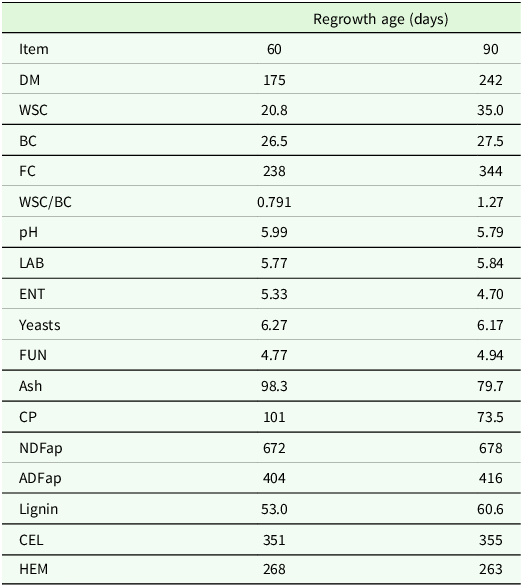
The contents of DM and WSC increased with increased regrowth age. The BC remained unchanged; however, there was an increase in the FC and the WSC/BC ratio, from 238 and 0.79 at 60 days to 344 and 1.27 at 90 days of regrowth, respectively. The populations of LAB, yeasts and FUN were similar, while the population of ENT decreased with the regrowth age. The contents of NDFap and ADFap were similar across the regrowth ages (Table 1).
Fermentability coefficient, microbial population (log CFU/g FM) and chemical composition (g/kg DM) of BRS Zuri at two regrowth ages before ensiling

DM, dry matter (g/kg FM); WSC, water-soluble carbohydrates; BC, buffering capacity; FC, fermentability coefficient; WSC/BC, water-soluble carbohydrates: buffering capacity ratio; LAB, lactic acid bacteria; ENT, enterobacteria; FUN, filamentous fungi; CP, crude protein; NDFap, neutral detergent fibre corrected for residual ash and protein; ADFap, acid detergent fibre corrected for residual ash and protein; CEL, cellulose; HEM, hemicellulose.
Fermentation profile and microbial population
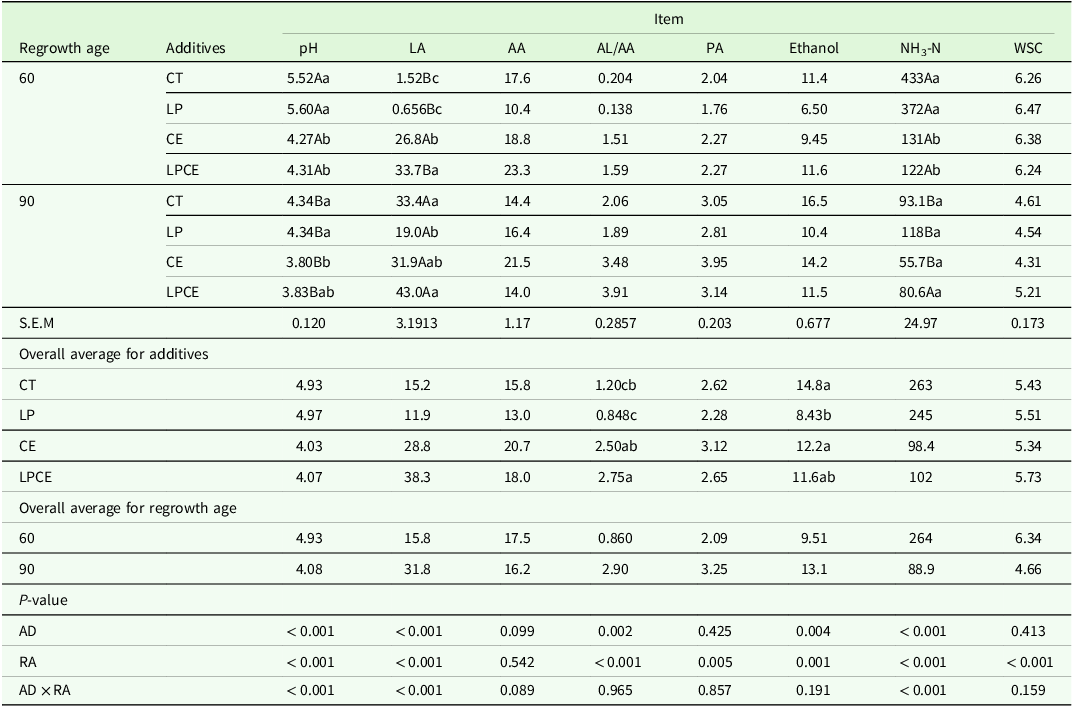
The pH, LA and ammonia was affected by the AD × RA interaction (P < 0.001; Table 2). The pH was lower in CE and LPCE silages at 60 days of regrowth. At 90 days, CE silage had a lower pH compared to CT and LP silages but did not differ from LPCE silage. Lactic acid content was higher in LPCE silage at 60 days of regrowth and lower in CT and LP silages. At 90 days, lactic acid content was lower in LP silage but not different from CE. All silages harvested at 90 days of regrowth had higher lactic acid content compared to those harvested at 60 days, except for CE silage. Ammonia concentration was higher in CT and LP silages with 60 days of regrowth. At 90 days, there was no effect of additives (Table 2).
Fermentative profile (g/kg DM) of BRS Zuri silages harvested at two regrowth ages and treated with different additives

CT, control; LP, L. pentosus AV 14.17; CE, cellulase; LPCE, L. pentosus AV 14.17 + cellulase. LA, lactic acid; AA, acetic acid; LA/AA, lactic acid: acetic acid ratio; PA, propionic acid; NH3-N, ammonia in g/kg total nitrogen; WSC, water-soluble carbohydrates; S.E.M, standard error of the mean; AD, additives effect; RA, regrowth age effect; AD × RA, interaction between AD and RA.
Means followed by different lowercase letters differ (P < 0.05) among additives within each regrowth age according to the Tukey test, while uppercase letters indicate difference (P < 0.05) between regrowth ages within the same additive according to the F test.
The ratio of lactic acid to acetic acid (LA/AA; P = 0.002) was higher in LPCE and CE silages, although CE did not differ from CT silage, and lower in silage from 60 days of regrowth (P < 0.001; Table 2). The propionic acid was higher at 90 days of regrowth (P = 0.005). Ethanol concentration was affected by additives (P = 0.004) and regrowth age (P = 0.001), with the lowest values for LP, which did not differ from LPCE, whereas the 90-day silage had the highest values. Butyric acid was detected only in CT (11.5 g/kg DM) and LP (6.6 g/kg DM) silages with 60 days of regrowth. The WSC residual content (P < 0.001) was higher in silages harvested at 60 days of regrowth (Table 2).
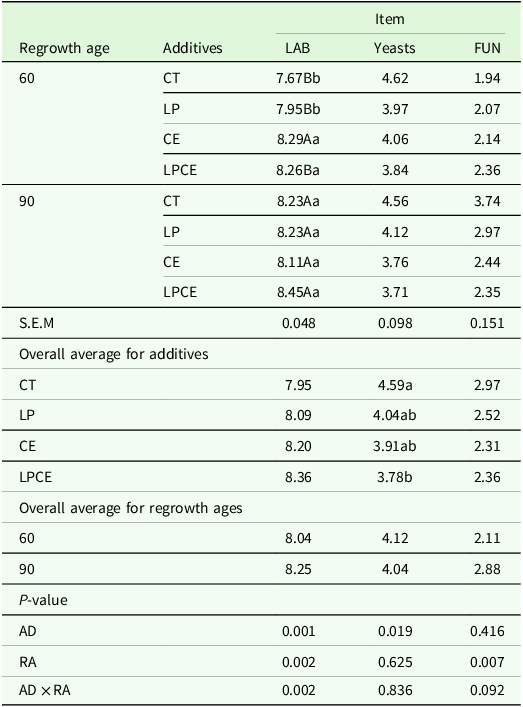
The LAB population was affected by the AD × RA interaction (P = 0.002; Table 3), being higher in CE and LPCE silages at 60 days. At 90 days, there was no difference between additives. The yeast population was higher at CT silage compared to LPCE silage (P = 0.019). The population of FUN was affected only by regrowth age (P = 0.007), with higher populations in the 90-day silages (Table 3).
Microbial populations (log CFU/g FM) of BRS Zuri silage harvested at two regrowth ages and treated with different additives

CT, control; LP, L. pentosus AV 14.17; CE, cellulase; LPCE, L. pentosus AV 14.17 + cellulase. LAB, lactic acid bacteria; FUN, filamentous fungi; S.E.M, standard error of the mean; AD, additives effect; RA, regrowth age effect; AD × RA, interaction between AD and RA.
Means followed by different lowercase letters differ (P < 0.05) among additives within each regrowth age according to the Tukey test, while uppercase letters indicate difference (P < 0.05) between regrowth ages within the same additive according to the F test.
Chemical composition
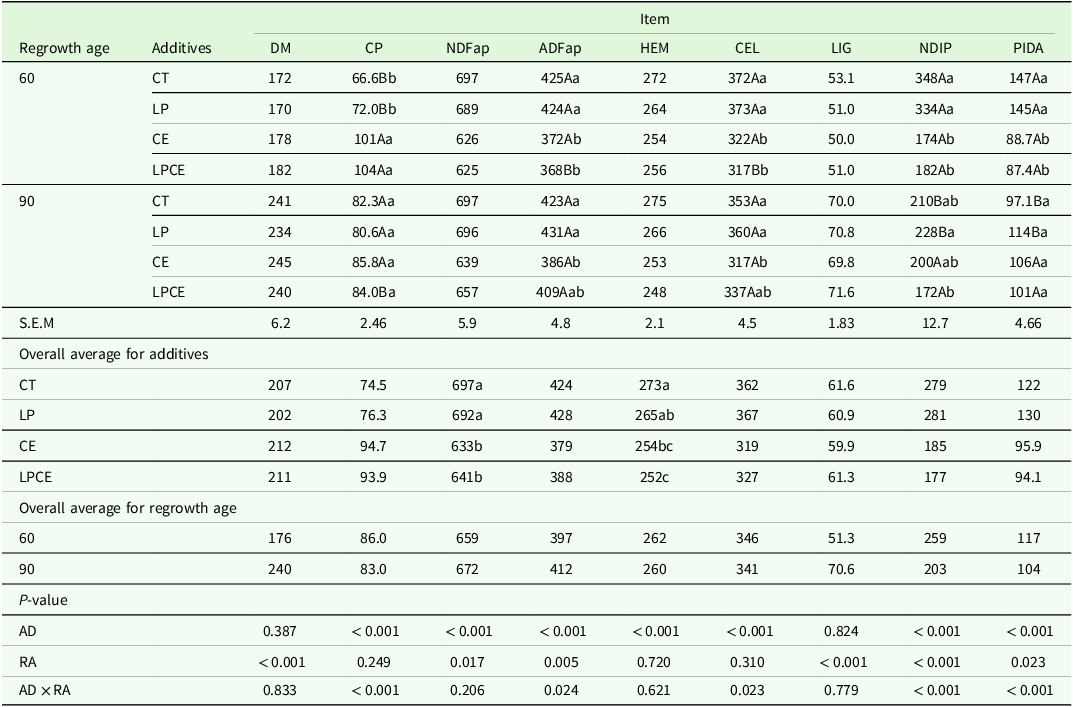
The chemical composition results of the silage are presented in Table 4. The DM content of silage was higher in Zuri grass silage harvested at 90 days (P < 0.001). The content of CP was higher in the CE and LPCE silages at 60 days. At 90 days, all silages had similar CP contents (P < 0.001). When comparing each treatment within regrowth ages, CP content was lower for CT and LP silages at 60 days, whereas LPCE silage showed the opposite (Table 4).
Chemical composition (g/kg DM) of BRS Zuri silage harvested at two regrowth ages and treated with different additives

CT, control; LP, L. pentosus AV 14.17; CE, cellulase; LPCE, L. pentosus AV 14.17 + cellulase; DM, dry matter (g/kg FM); CP, crude protein; NDFap, neutral detergent fibre corrected for residual ash and protein; ADFap, acid detergent fibre corrected for residual ash and protein; HEM, hemicellulose; CEL, cellulose; LIG, lignin; NDIP, neutral detergent insoluble protein (g/kg CP); ADIP, acid detergent insoluble protein (g/kg CP); S.E.M, standard error of the mean; AD, additives effect; RA, regrowth age effect; AD × RA, interaction between AD and RA.
Means followed by different lowercase letters differ (P < 0.05) among additives within each regrowth age according to the Tukey test, while uppercase letters indicate difference (P < 0.05) between regrowth ages within the same additive according to the F test.
The content of NDFap was influenced by RA (P < 0.001) and by AD (P = 0.017), being higher in silages from 90 days. Among the additives, the silages treated with CE and LPCE had the lowest NDFap values (Table 4). The contents of ADFap (P = 0.024) and cellulose (P = 0.023) were affected by the AD × RA interaction. Both ADFap and cellulose contents were lower in the CE and LPCE silages at 60 days of regrowth. At 90 days, the ADFap content was lower in the CE silage compared to CT and LP silages (Table 4).
The HEM content was affected by AD (P < 0.001), with lower values in LPCE silage compared to CT and LP silages. CE silage had similar HEM values to LP and LPCE silages. The lignin content was higher in silage harvested at 90 days of regrowth (P < 0.001; Table 4).
The contents of NDIP and ADIP were affected by the AD × RA interaction (P < 0.001). The content of NDIP and ADIP were higher in CT and LP silages at 60 days of regrowth. At 90 days, NDIP was higher in LP silage compared to LPCE silage; CT and CE silages had intermediate values. The ADIP content at 90 days there was no difference between treatments. With increasing regrowth age, NDIP and ADIP contents decreased in CT and LP silages (Table 4).
In vitro degradability assay
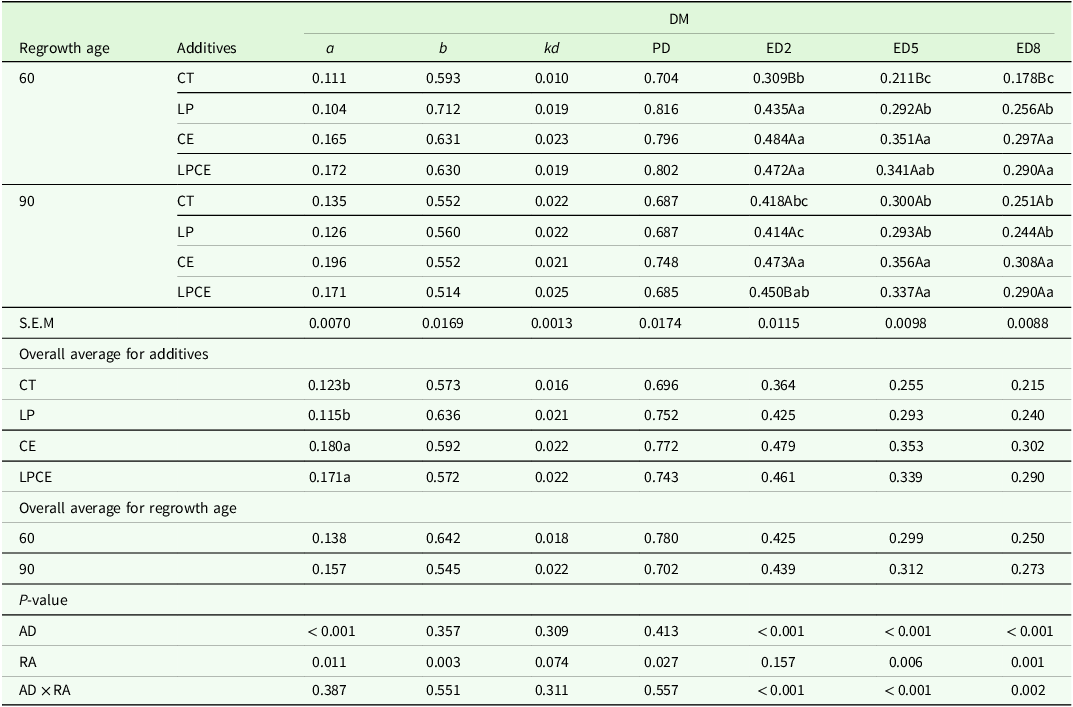
The soluble fraction a of DM was higher at CE and LPCE silage (P < 0.001) and silages with 90 days of regrowth had a higher fraction a value (P = 0.011). The potentially degradable fraction b and PD were higher in silages with 60 days of regrowth (P ≤ 0.027). The ED of DM was affected by the AD × RA interaction (P ≤ 0.002) for all passage rates evaluated (Table 5). At 60 days of regrowth, ED2 was higher in LP, CE and LPCE silages compared to CT silage at. At 90 days, CE silage had the highest ED2 compared to CT and LP silages. At a passage rate of 0.05%/h, ED5 was higher in CE silage at 60 and 90 days of regrowth compared to CT and LP silages but did not differ from that for LPCE silage. However, at a passage rate of 0.08%/h, ED8 was higher in CE and LPCE silages compared to CT and LP silages at both regrowth ages (Table 5).
In vitro degradability parameters of dry matter of Zuri silage treated with different additives at two regrowth ages

CT, control; LP, L. pentosus AV 14.17; CE, cellulase; LPCE, L. pentosus AV 14.17 + cellulase; DM, dry matter; a, readily soluble fraction; b, potentially degradable fraction in the rumen; kd, rate constant for degradation of ” b ” (per h); PD, potential degradation; ED, effective degradability at 0.02 (ED2), 0.05 (ED5) and 0.08/h (ED8) passage rates; S.E.M, standard error of the mean; AD, additives effect; RA, regrowth age effect; AD × RA, interaction between AD and RA.
Means followed by different lowercase letters differ (P < 0.05) among additives within each regrowth age according to the Tukey test, while uppercase letters indicate difference (P < 0.05) between regrowth ages within the same additive according to the F test.
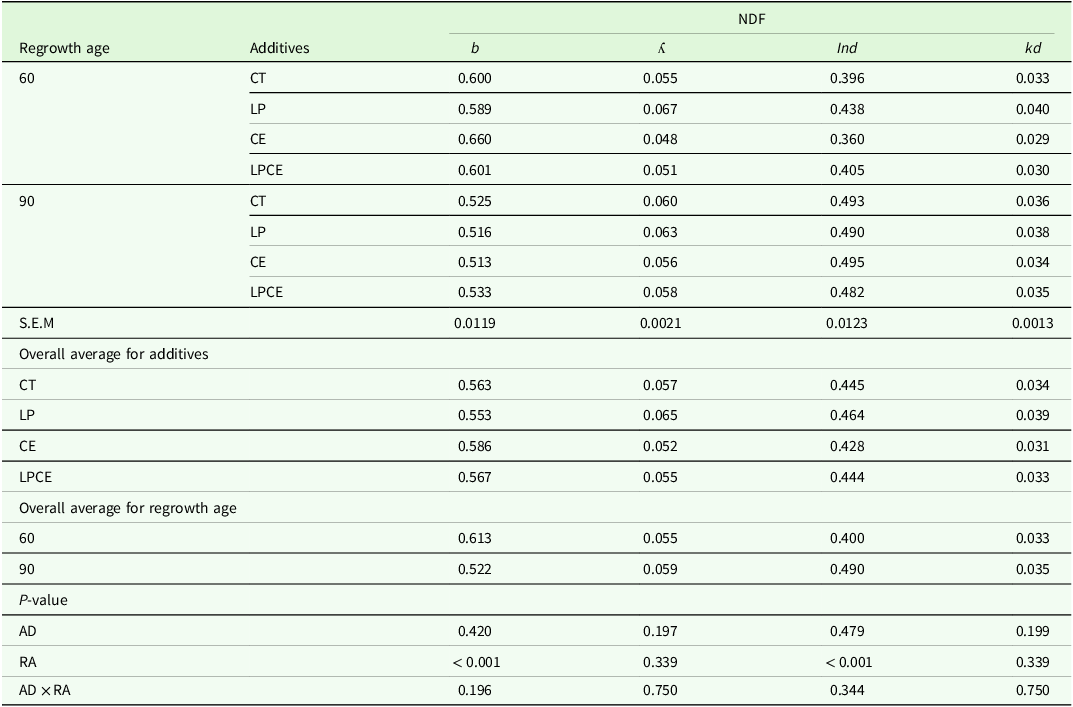
The potentially degradable fraction b of NDF and the Ind fraction were affected only by RA (P < 0.001), being higher in silages harvested with 90 days of regrowth. (Table 6).
In vitro degradability parameters of neutral detergent fibre of Zuri silage treated with different additives at two regrowth ages

CT, control; LP, L. pentosus AV 14.17; CE, cellulase; LPCE, L. pentosus AV 14.17 + cellulase; NDF, neutral detergent fibre; b, potentially degradable fraction in the rumen (g/kg); λ, joint fractional rate of latency and degradation (per h); Ind, indigestible fraction of NDF (g/kg); kd, rate constant for degradation of ” b ” (per h); S.E.M, standard error of the mean; AD, additives effect; RA, regrowth age effect; AD × RA, interaction between AD and RA.
Discussion
Fresh forage composition
The FC increased with the regrowth age of Zuri grass due to higher DM and WSC contents. At 90 days of regrowth, the FC approached 350, indicating moderate ensilability (Carvalho et al., Reference Carvalho, Bragatto, Buttow, Silva, Silva, Silva, Auerbach, Nussio and Daniel2024). In fact, the FC of 340 in plants with 90 days of regrowth was sufficient to inhibit clostridial fermentation, as evidenced by low ammonia levels and the absence of butyric acid, unlike the silage harvested at 60 days, which had an FC of 238. Additionally, the WSC/BC ratio increased with the regrowth age, indicating that a higher proportion of fermentable carbohydrates was available for fermentation, leading to a reduction of the pH in these silages (Alves et al., Reference Alves, Cruz, Freitas, Silveira, Coutinho, Roseira, Teixeira, Rigueira, Pereira and Ribeiro2025).
There was no increase in NDFap and ADFap contents with increasing regrowth age; however, there was a greater deposition of lignin. Lignin is an indigestible phenolic compound that, when binding to cellulose and hemicellulose, reduces the digestibility of fibre constituents (Adesogan et al., Reference Adesogan, Arriola, Jiang, Oyebade, Paula, Pech-Cervantes, Romero, Ferraretto and Vyas2019). In addition, Moraes et al. (Reference Moraes, Auerbach, Bragatto, Piran Filho, Silva, Nussio, Jobim and Daniel2023) emphasised that lignin has a more pronounced negative effect on the digestibility of tropical grass fibre compared to temperate grasses, and that harvesting tropical grasses at more advanced maturity should be analysed with caution.
The low FC of Zuri grass necessitates the addition of additives during ensiling to inhibit clostridial fermentation and reduce DM losses, especially when harvested at shorter regrowth intervals (Alves et al., Reference Alves, Cruz, Freitas, Silveira, Coutinho, Roseira, Teixeira, Rigueira, Pereira and Ribeiro2025). The addition of cellulase can make fermentable sugars available by hydrolysing fibre, thereby improving the fermentation profile (Muck et al., Reference Muck, Nadeau, McAllister, Contreras-Govea, Santos and Kung2018). Additionally, the combination of cellulase with a bacterial inoculant containing either homolactic or facultative heterofermentative LAB would enhance the efficiency of WSC utilisation (Zhang et al., Reference Zhang, Xu, Wang and Kong2019; Du et al., Reference Du, Xu, Jiang and Xiao2025).
Fermentation profile and microbial population
The effect of cellulase on the fermentation profile was more pronounced in the silage of plants harvested at 60 days, as observed by the interaction of important variables such as pH, lactic acid and ammonia. At 90 days of regrowth, the increase in the FC reduced the response to cellulase compared to the control silage, as the improved fermentation conditions allowed the naturally occurring LAB in the plant, along with greater availability of WSC, to adequately ferment the ensiled material. Inoculation, on the other hand, showed minimal effects, even when combined with cellulase, rejecting the hypothesis of a synergistic effect.
The L. pentosus strain AV 14.17 has shown promising results as an inoculant in legume silages, as demonstrated by Silva et al. (Reference Silva, Pereira, Leandro, Paula, Agarussi and Ribeiro2020) and Macedo et al. (Reference Macêdo, Pereira, Leite, Santos, Coutinho, Leite, da Silva, Valadares Filho and Ribeiro2023), and inhibiting the growth of pathogenic bacteria (Silva et al., Reference Silva, Pereira, Leandro, Paula, Agarussi and Ribeiro2020). In addition, its presence has been associated with the suppression of Clostridium spp., even under conditions of low WSC availability (Zheng et al., Reference Zheng, Li, Mao, Tian, Guo and Meng2024), similar to those found during the fermentation of tropical grasses. However, in the present study, no beneficial effects of this strain were observed, particularly in silage with 60 d of regrowth, as intense activity by enterobacteria and clostridia increased the concentrations of ammonia and butyric acid in the LP-treated silage. This suggests a species-dependent relationship, as the strain’s performance appears to vary according to the forage type (Carvalho et al., Reference Carvalho, Sales, Schwan and Ávila2021; Ke et al., Reference Ke, Wang, Rinne, Franco, Li, Lin, Zhang, Cai and Zhang2023), highlighting the importance of evaluating a strain across different forage types intended for silage production. An inappropriately selected strain used as an inoculant may worsen the fermentation profile and increase DM losses (Carvalho et al., Reference Carvalho, Sales, Schwan and Ávila2021; Ke et al., Reference Ke, Wang, Rinne, Franco, Li, Lin, Zhang, Cai and Zhang2023).
The addition of cellulase in the CE and LPCE treatments allowed the pH to decrease to levels within the acceptable range for grass silage, according to Kung et al. (Reference Kung, Shaver, Grant and Schmidt2018). However, in CT and LP silages with 60 days of regrowth, the pH stabilised at a high level. The reduction of pH in CE and LPCE silages occurred due to the availability of WSC, owing to cellulose hydrolysis by cellulase, which released glucose and cellooligosaccharides (Zhang et al., Reference Zhang, Xu, Wang and Kong2019; Du et al., Reference Du, Xu, Jiang and Xiao2025). These cellooligosaccharides, according to Zhang et al. (Reference Zhang, Xu, Wang and Kong2019), are fermented only by homolactic or facultatively heterofermentative LAB exclusively to lactic acid, favouring rapid acidification.
Indeed, the addition of cellulase increased lactic acid concentration in the silages, especially when associated with L. pentosus. This indicates that inoculation combined with cellulase improves the utilisation of available WSC (Du et al., Reference Du, Xu, Jiang and Xiao2025). This effect was more pronounced when the grass was harvested at 60 days, due to the greater challenge in fermenting this ensiled material. Consequently, there was a higher LA/AA ratio in these silages, indicating increased lactic acid formation by homolactic LAB fermentation (Kung et al., Reference Kung, Shaver, Grant and Schmidt2018). In contrast, CT and LP silages had a lower LA/AA ratio, suggesting that the inhibition of enterobacteria was inefficient or occurred slowly, allowing some of the WSC to be fermented by this group of bacteria (Pahlow et al., Reference Pahlow, Muck, Driehuis, Elfrink, Oude Elferink, Spoelstra, Buxton, Muck and Harrison2003; Macedo et al., Reference Macêdo, Pereira, Leite, Santos, Coutinho, Leite, da Silva, Valadares Filho and Ribeiro2023). Enterobacteria ferment WSC into different end products, such as acetic acid and CO2, increasing DM losses during fermentation (Pahlow et al., Reference Pahlow, Muck, Driehuis, Elfrink, Oude Elferink, Spoelstra, Buxton, Muck and Harrison2003). This competition between LAB and enterobacteria for substrate (WSC) resulted in a lower LAB count in CT and LP silages at 60 d. However, this effect was not evident at 90 days, likely due to the improved fermentation conditions that favoured the proliferation of LAB (Gusmão et al., Reference Gusmão, Danés, Casagrande and Bernardes2018).
The presence of enterobacteria in CT and LP silages with 60 days of regrowth resulted in high degradation of the protein fraction in the silage, as observed by the elevated ammonia levels in these treatments. The values found in these silages exceed the 120 g/kg of total nitrogen recommended by Kung et al. (Reference Kung, Shaver, Grant and Schmidt2018) as suitable for grass silages. Clostridia are the main microorganisms involved in the formation of ammonia and butyric acid (Pahlow et al., Reference Pahlow, Muck, Driehuis, Elfrink, Oude Elferink, Spoelstra, Buxton, Muck and Harrison2003). However, the high ammonia levels in these silages can also be attributed to the presence of enterobacteria (Li et al., Reference Li, Zheng, Zheng, Cai, Cui, Wang, Jiang and Xu2022). According to Li et al. (Reference Li, Zheng, Zheng, Cai, Cui, Wang, Jiang and Xu2022), a high presence of genes coding for proteolytic enzymes was found in alfalfa silage, and these genes were primarily attributed to the Enterobacteriaceae family.
Chemical composition
Intense proteolysis commented above in CT and LP silage with 60 days of regrowth, resulted in a significant reduction in CP content, with this reduction being more pronounced than the reduction in CP caused by increased regrowth age. However, the use of cellulase, whether or not combined with strain AV 14.17, was effective at preserving the CP of the silage. This demonstrates that harvesting grasses with better nutritional value, without adopting technologies to prevent losses during the process, can result in silages of lower quality compared to silages from grasses harvested at more increased regrowth age. Additionally, the lack of effects of cellulase on CP and ammonia levels in silages with 90 days of regrowth indicates that its addition has greater potential under conditions of lower ensilability (Cruz et al., Reference Cruz, Pereira, Alves, Freitas, Santos, Daniel, Diepersloot, Ferraretto and Ribeiro2025a,b). Furthermore, the contents of NDIP and ADIP were lower in cellulase-treated silages, indicating that proteolysis occurs in more labile proteins, resulting in an increase in protein that is considered to be of slow digestibility or indigestible (Alves et al., Reference Alves, Cruz, Freitas, Silveira, Coutinho, Roseira, Teixeira, Rigueira, Pereira and Ribeiro2025).
The addition of cellulase reduced the NDFap and ADFap contents in CE and LPCE silages as expected, due to hydrolysis of the fibrous components in the silage (Cruz et al., Reference Cruz, Pereira, Alves, Freitas, Santos, Daniel, Diepersloot, Ferraretto and Ribeiro2025a,b). In this study, this reduction occurred primarily due to the solubilisation of cellulose, which decreased by 11.3% in silages containing cellulase (CE and LPCE) compared to CT and LP silages. Hemicellulose decreased by only 5.94%, which can be attributed both to the activity of cellulase and to acid hydrolysis, due to greater acidification in these treatments (Rooke and Hatfield, Reference Rooke, Hatfield, Buxton, Muck and Harrison2003; Desta et al., Reference Desta, Yuan, Li and Shao2016). The CE and LPCE silages had lower pH, and under these conditions, hemicellulose can be solubilised, unlike CT and LP silages, which had elevated pH (Rooke and Hatfield, Reference Rooke, Hatfield, Buxton, Muck and Harrison2003).
In vitro degradability assay
In CE and LPCE treatments, the action of cellulase on the fibre increased the availability of readily soluble NFC, and the better preservation of the protein fraction resulted in an increased fraction a of DM compared to CT and LP silages. The higher fraction a in the 90-day silage is a result of the better fermentation profile compared to silages at 60 days, demonstrating that inadequate fermentation, with high DM losses and proteolysis, directly impacts the degradation parameters (Alves et al., Reference Alves, Cruz, Freitas, Silveira, Coutinho, Roseira, Teixeira, Rigueira, Pereira and Ribeiro2025). Conversely, the potentially degradable fraction in the rumen (fraction b) and the PD were higher at 60 days of regrowth. This fraction is primarily influenced by the chemical composition of the forage, where the higher lignin deposition in grass harvested at 90 days reduced the digestibility of the silage (Adesogan et al., Reference Adesogan, Arriola, Jiang, Oyebade, Paula, Pech-Cervantes, Romero, Ferraretto and Vyas2019). The same effect was observed for fraction b of NDF, where we also saw an increase in the indigestible fibre fraction. This demonstrates that additives, even though they alter the fibre structure via cellulase hydrolysis, are not capable of increasing the potential digestibility of the silage and only affect the degradation pattern (Yang et al., Reference Yang, Beauchemin and Rode2000).
When evaluating the ED of the silages, we observed that treatments containing cellulase (CE and LPCE) had higher ED, regardless of the passage rate assessed. It is likely that the enzyme’s action on the fibrous fraction provides greater disorganisation of the fibre, improving the action of rumen microorganisms (Ma et al., Reference Ma, Fan, Wu, Zhou, Huang, Qiu, Xing, Zhao, Yin and Gan2023). The effect of cellulase is more pronounced with higher passage rates, as observed in the present study. Increasing the ED is beneficial, especially for high-production animals such as lactating cows, because it reduces ruminal fill and enhances nutrient utilisation (Álvarez et al., Reference Álvarez, Nielsen, Weisbjerg, Volden, Eknæs and Prestløkken2022).
Furthermore, LP silage showed similar ED values at 60 and 90 days of regrowth, despite displaying an inadequate fermentation profile at 60 days. This suggests that strain AV 14.17, although not effective in improving fermentation, contributed to better nutrient preservation compared to CT silage. In contrast, CT silage benefited from being harvested at 90 days, as it showed higher ED than CT silage at 60 days, indicating that lignin accumulation at 90 days had a lesser impact on digestibility than the effects of poor fermentation, high proteolysis and DM losses.
Conclusion
Inoculation with L. pentosus AV 14.17 alone is not effective in improving the fermentation profile of the silage, regardless of the regrowth age. However, the addition of cellulase improves the fermentation profile, particularly when BRS Zuri grass is harvested at 60 days. No synergistic effect was observed that would justify the combination of additives.
Harvesting BRS Zuri grass at 90 days reduces its nutritional value but also improves the fermentation profile of silage.
Both additives improve the effective degradability of silages dry matter, mainly in cellulase-treated silages at faster passage rates.
Acknowledgements
We thank the National Institute of Science and Technology Animal Science (INCT-CA) (Grant Number 465377/2014-9), the Coordination of Improvement of Higher Education Personnel (CAPES) (88887.844747/2023-00) and the National Council for Scientific and Technological Development (CNPq) (310110/2022-0).
Author contributions
W.S. A., K. G. R., O. G. P. and J. P. S. Ri. conceived and designed the study. R. L. F., G. D. O. L., G. F. L. C., A. J. S. M., J. P. S. Ro. and H. R. O. S. conducted data gathering formal analysis. W. S. A. and J. P. S. Ro. performed statistical analyses. W.S. A., K. G. R. and O. G. P. wrote the article.
Funding statement
The authors are grateful for institutional support from Foundation for Research Support of Minas Gerais (FAPEMIG-APQ-01527-21).
Competing interests
The authors declare there are no conflicts of interest.
Ethical standards
The procedures for the use and management of the animals in this study were previously approved by the Animal Experimentation Ethics Committee of the UFV (Protocol 019/2021).