


Introduction
In March 2022, protests in the UK took place in response to an incident that occurred in 2020 where a child who identifies as black and is now known as child Q to protect her identity, was strip-searched at school by female police officers. No appropriate adult was present during the search and the child was reported to be menstruating at the time whilst her private body parts were exposed to the police. A safeguarding investigation and review took place and a report that was completed in response to this incident identified that the child suffered significant psychological distress and trauma (City & Hackney Safeguarding Children Partnership, 2022). The findings from the report state,
‘Having considered the context of the incident, the views of those engaged in the review and the impact felt by child Q and her family, racism (whether deliberate or not) was likely to have been an influencing factor in the decision to undertake a strip search’ (p. 6).
This single incident highlights an important point: the impact of racism and racist experiences can lead to mental health problems (Beck et al., Reference Beck, Naz, Brooks and Jankowska2019; Beck and Brooks-Ucheaga, Reference Beck, Brooks-Ucheaga, Todd and Branch2022). In addition, there is a lack of data that examine the impact on therapists working with racism within a therapeutic context, especially for therapists who have experienced racism themselves and identify as black British, black African or black Caribbean. The term ‘black’ is used in line with national guidance (GOV.UK, 2023; p. 6).
Race, inequality and racial disparity
The impact of inequality, racism and racial disparity on the individual and communites can be devastating (Byrne et al., Reference Byrne, Alexander, Khan, Nazroo and Shankley2020). Black people’s needs in the UK are often unmet in mainstream mental health services (Beck and Naz, Reference Beck and Naz2019; Lawton et al., Reference Lawton, McRae and Gordon2021). Black people and in particular Afro-Caribbeans are four times more likely than white people to be detained under the Mental Health Act (GOV.UK, 2021a). Black women are four times more likely to die in childbirth and post-birth than white women (Knight et al., Reference Knight, Bunch, Tuffnell, Patel, Shakespeare, Kotnis, Kenyon and Kurinczuk2021). Black students are less likely to be awarded a first or 2:1 in higher education (Office for Students, 2021); in addition, black children (in particular Afro-Caribbean pupils) are excluded from school three times more than white British children (GOV.UK, 2021b).
Despite making up just 14% of the population, black men and women make up 25% of prisoners, whilst over 40% of young people in custody are from racially minoritised backgrounds (Lammy, Reference Lammy2017); the reasons for this are still unclear. The mortality rate for black men who died from COVID-19 was significantly higher in comparison with white men (Aldridge et al., Reference Aldridge, Lewer, Katikireddi, Mathur, Pathak, Burns, Fragaszy, Johnson, Devakumar, Abubakar and Hayward2020; Office for National Statistics, 2022). Black people are more likely to experience disciplinary outcomes at work as a result of racism and discrimination (Kline, Reference Kline2014; NHS England, 2020). Such consistent disparity in various spheres of society such as health, mental health, education, criminal justice and employment highlights the perpetual inequalities that exist, and the detrimental impact on black people socially and psychologically.
Research aims
Understanding the extensive empirical data in relation to race and inequality is important as it highlights the potential impact on individuals and groups. Existing literature on racism and why people of colour in the UK (in particular black people) have poorer and disproportionate outcomes is arguably subjective and not always attributed to racism, because of the researchers’ school of thought, personal or social bias or perspective. However, the correlation between race, racial disparities and inequalities should not be ignored. This study seeks to extrapolate qualitative data from black cognitive behavioural therapists in order to explore black therapists’ personal experiences of racism and its impact on the therapist, as well as to explore if such experiences impact their clinical practice when working with clients who have also experienced racism.
Whilst there are studies that exist regarding same-race therapeutic dyads (Cimbolic, Reference Cimbolic1972; Goode-Cross, Reference Goode-Cross2011; Goode-Cross and Grim, Reference Goode-Cross and Grim2016), however, very little research currently exists regarding black therapists’ personal experience of racism and how this might impact their clinical practice when working with clients who have also experienced racism.
Method
Interpretive phenomenological analysis
Interpretive phenomenological analysis (IPA) has become an increasingly popular qualitative research approach in psychology (Smith et al., Reference Smith, Flower and Larkin2009). Its theoretical underpinnings are grounded in phenomenology, hermeneutics and idiography (Archer et al., Reference Archer, Montague and Bali2014; Smith et al., Reference Smith, Flower and Larkin2009; Smith and Shinebourne, Reference Smith and Shinebourne2012). IPA is concerned with the in-depth examination of how individuals make sense of their life experiences and subsequently develop meaning to such life experiences (Kacprzak, Reference Kacprzak2017; Pietkiewicz and Smith, Reference Pietkiewicz and Smith2014).
Double hermeneutics of IPA
Double hermeneutics is a process that the IPA researcher is engaged in as the researcher attempts to make sense of the individual, who is attempting to make sense of what is happening to them during an experience. Consequently, the researcher has a dual role as they are attempting to make sense of the participant’s experience through the participant’s account of their experience (Peat et al., Reference Peat, Rodriguez and Smith2019). Therefore, IPA as an approach was chosen for this research study because of its explicit nature of exploring a particular experience, in this case black psychotherapists.
What is lived experience?
Experience and ‘an experience’ are arguably subtly different in the sense that lived experience or ‘an experience’ takes place once an individual or group becomes aware of what is happening to them. However, experience (in this context) often involves being mindlessly, unselfconsciously absorbed in an experience such as driving, eating or cleaning, for example (Langeveld, Reference Langeveld1983; Shinebourne, Reference Shinebourne2011). IPA’s focus is to engage with the participant’s reflection of ‘an experience’ and its meaning to the person experiencing it. Therefore, IPA is interpretive in its approach which is informed by hermeneutics which is understood by some researchers to be the ‘theory of interpretation’ (Smith et al., Reference Smith, Flower and Larkin2009; p. 3).
Recruitment and eligibility
In line with the idiographic methodology of IPA, ‘purposive’ methods were employed to recruit participants and a homogenous sample of therapists who identified as being black were used to represent a specific phenomenon in a specific context (black therapists who provide therapy to clients who have also experienced racism) (Smith et al., Reference Smith, Flower and Larkin2009).
Participants were selected based on their self-identification and disclosure that they identify as being black, have experienced racism or have knowledge of what racism is. Participants are also required to practise psychotherapy including cognitive behavioural therapy, clinical or counselling psychology and have worked with clients who have experienced racism. There were no restrictions on gender to include male, female or any other assumed gender identity.
IPA study sample sizes are often small due to the extremely detailed process of data analysis to enable the researcher to explore each of the individual participant’s experiences and to then identify divergences and convergences between each individual experience as well as the group experience (Smith et al., Reference Smith, Flower and Larkin2009). Therefore, a sample of two in a pilot study is appropriate.
Participant data
In line with the University’s guidance on confidentiality and requirements for ethical approval (University of Derby, 2020), the two participants were assigned pseudonyms and have been labelled as participant X and participant Y. These are random alphabet letters and do not correspond to participant name or any other identifiable features. One participant was a qualified cognitive behavioural therapist (CBT) the other participant was a trainee CBT therapist.
IPA data collection process
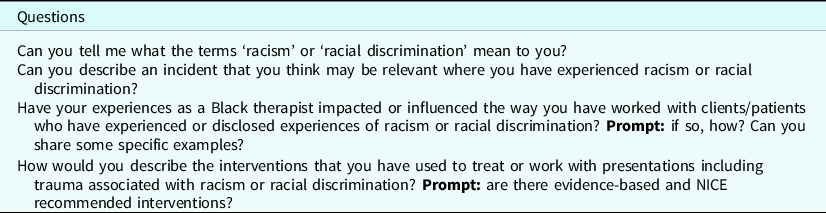
Semi-structured interviews are an acceptable and appropriate method to collect data for IPA studies (Smith et al., Reference Smith, Flower and Larkin2009). Due to the global pandemic, semi-structured interviews were carried out using Microsoft Teams and University GDPR and confidentiality processes were in place throughout the duration of the study from recruitment of participants, the data collection phase to the debriefing and post-interview process. Both interviews were carried out separately with only the interviewer and one participant present. Both interviews lasted approximately between 65 and 70 minutes. Questions used within the semi-structured interview were also part of the ethics application and approval process (see Table 1 for a sample of the interview questions). Microsoft Teams video recordings were transcribed verbatim, and participants’ identifiable and personal details were then anonymised during the transcription process.
Sample of questions used within the structured interviews

Analysis
Transcripts were analysed in line with the guidelines of Smith et al. (Reference Smith, Flower and Larkin2009). This included the detailed re-reading of the data obtained from the transcripts for each individual participant. Emergent themes were identified, and this process was refined to establish recurrent superordinate themes from the individual participant data. After this process, superordinate themes were then established across both cases.
Theoretical perspectives such as Jaeger and Rosnow (Reference Jaeger and Rosnow1988) and Peat et al. (Reference Peat, Rodriguez and Smith2019) argue that it is impossible for the researcher not to have some level of bias when analysing data, as such analytical skills are embedded in the researcher’s personal, present and past experiences; therefore, the researcher intrinsically becomes part of the research itself. The researcher identifies as being black and is also a therapist and whilst no evidence to suggest bias is present within this research, to minimise researcher bias the researcher utilised a reflective diary throughout the analysis process to identify emotive incidents and to explore how they have impacted the researcher. In such instances, the researcher frequently returned to the raw data opposed to the identified themes to ensure that the researcher remained constant and connected to the participants’ data as opposed to the researchers’ emotions, thoughts or past experiences. This reflective and reflexive approach is consistent with IPA’s approach of being interpretive due to its detailed analytical process (Pietkiewicz and Smith, Reference Pietkiewicz and Smith2014; Smith et al., Reference Smith, Flower and Larkin2009).
Results
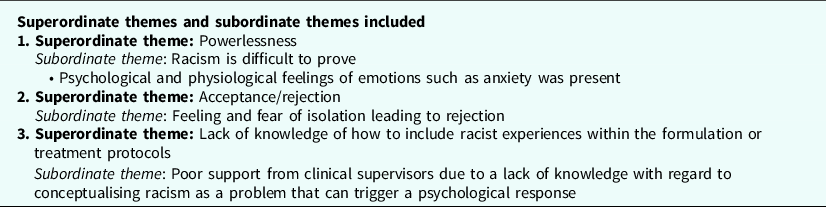
There were three superordinate themes that emerged after detailed analysis of the data (see Table 2). The themes were experienced by both participants.
Superordinate themes
Superordinate theme 1: Powerlessness
Powerlessness was a theme that emerged from both participants. The subordinate themes were: (i) racism is difficult to prove and (ii) psychological and physiological feelings of emotions such as anxiety were present as a result of feeling powerless when therapists personally experienced racism as well as when working with clients who shared their experiences of racism or racial injustice in a therapy context. For example, participant X shared:
‘Remembering my past experiences of racism always evokes anxiety within me because it makes me feel unsafe. And I think that if racism is going to happen, it’s going to be quite a violent experience, whether it’s verbal or being physical, either way I am being attacked because I am black. Being treated differently, it’s really traumatic when it’s racism. It really does bring up some level of anxiety, even just talking about racism.’
Participant X, for example, highlights that the sense of powerlessness evokes both physiological and psychological experiences which include anxiety. Such emotions appear to be evoked automatically without conscious creation, and such emotions appear not just in remembering past experiences which rightly may evoke strong responsive emotions. For participant X, even discussing the topic of racism can also create feelings of anxiety.
Participant Y reflected similar experiences of racism in a work context and identified emotions and thoughts which evoke feeling powerless and feeling ‘unsafe’. Participant Y states:
‘I fear reporting racist situations at work because I think something bad is going to happen and no one is going to believe me that racism has happened. I am genuinely concerned that I’m not going to be able to do anything about it in that moment or afterwards when it does happen. That’s what goes through my mind when I think someone has been racist to myself, a colleague or if they are speaking negatively about a client. Therefore, it’s easier to pretend racism did not exist if it is going to be unsafe for me. So, I think that’s what makes it particularly unsafe because it’s really hard to prove, especially to people that haven’t experienced racism.’
As participant Y suggests, there is a fear that negative consequences may happen and that something ‘bad will happen’ if they report racist behaviour in a work context. It is unclear if such beliefs are a result of catastrophic thinking or if this statement is rooted in previous experiences where the participant was not believed or listened to, and as a result experienced a negative consequence.
Superordinate theme 2: Acceptance/rejection
The subordinate theme includes feeling and fear of isolation which leads to rejection. Acceptance or rejection because of a racist experience appears to be a complex concept, in the sense that experiences of racism appear to leave both participants feeling part of their team (accepted) or feeling unsupported which lead to experiences of rejection or feeling isolated. Participant Y states:
‘Rejection to me is when people treat you differently because of your racial identity. This also includes being oppressed in many different ways because of your racial identity.’
Such experiences appear to evoke a sense of ‘otherness’ and ‘them and us’, specifically as a result of one’s race, a character or feature which cannot change. Therefore, because race or skin colour is a permanent feature, such feelings of rejection appear to go deeper than the superficial experience of not being liked because someone is new; for example, the rejection is actually about them, their skin and fundamentally who they are. Participant Y shares:
‘I think sometimes when you experience things like racism and discrimination, it just kind of forces you to change, to find a way to be accepted and somehow you know that you must deal with the shame that comes with conforming for the purpose of acceptance. If I am being honest that makes me feel uncomfortable even saying it now.’
Participant X shared an experience of microaggression at work which caused her to feel rejection and isolation when a racist word was used at work and no-one in the team came to that participant’s defence in a public context, but was willing to share their dissatisfaction about the experience in private only, reinforcing feelings of rejection and isolation when racist experiences happen especially in a public setting or work environment:
‘I was working on an in-patient ward and one of the nurses called me over and he was reading one of Malorie Blackman books. He had that book and then he said specifically to me only, “what do you think about that Nigger in the book?”. He was white and he said that to me, a black female. And then I was like, “what did you just say?”. And then he said, “oh, the boy in the book”. And then I said, “that’s not what you just said”. At that time there were other people in the office, some looked at me and I looked at them, but no-one said anything. I then just walked away because I felt like I was in shock and that not one of my colleagues interjected to say “hey that’s not appropriate”. I felt so hurt, alone and angry as the only black person in the team. I went outside and started to engage in mindfulness breathing, trying to calm myself down and someone came to me and said “you know how you’re acting is inappropriate? He didn’t say anything racist. You just need to go and tell him that he didn’t do anything bad”. It was almost like they wanted me to act like it didn’t happen. There was just one staff member who was white and he was married to a dual heritage black woman and he said “I just want you to know that what happened was wrong”. He waited until much later to say that to me privately when nobody was there but did not say it when everyone else was present. I was absolutely shocked and realised I was not supported in this team or accepted all because of my race.’
Such an experience of microaggressions highlight the loneliness and isolation which can take place in environments where the person of colour is the minority, and the lack of support is interpreted as a feeling of rejection because those who witnessed the experience did not vocally express support in that moment. This is a point also supported by participant Y:
‘When in clinical or academic situations, when someone has been racist or constantly engages in microaggressions, I’ve never had anyone say, “hang on, you know, what you’re doing to that person is wrong” or anyone look shocked. If anything, they kind of they react like they’re OK with what’s happening.’
Such experiences appear to heighten the sense of rejection or isolation which appears to add another layer of distress upon the event or experience which was racially motivated. From both participants X and Y, experiences of rejection and acceptance appear not to be limited to a colleague or management interaction but also between the black therapist and the black patient. Participant Y shared:
‘I always try to disclose my ethnicity to my client (if my client appears to share the same nationality, accent or culture as me) if and when it is appropriate so that they do not feel forced to work with me just because I am black and it also gives them the choice if they feel comforted knowing that we might both share some similarities because of our culture – either way I want them to feel informed, comfortable and safe.’
Participant X shared:
‘If I work with someone in therapy who shares the same nationality as me, I always disclose my nationality to them to see if they’re ok with us, continuing therapy. Sometimes people from the same African background as me find comfort and acceptance in working with someone who looks like them and speaks the same language and shares some of the same culture, whilst some patients can find it the opposite and want to stay far away from anyone who belongs to their culture. I suppose issues around their privacy maybe a concern even though I reinforce the service confidentiality policy.’
‘I have to say, working with people from the same part of Africa that I am from it’s something that does feel very emotive for me because the experiences are too familiar and I feel like I understand them too much to not be affected emotionally, if that makes sense.’
Such experiences of ensuring that the client feels supported and has choice of therapist appear to be an important factor that was highlighted in the development and maintenance of the therapeutic relationship with both participants X and Y.
Superordinate theme 3: Lack of knowledge of how to include racist experiences within the formulation or treatment protocols
Theme 3 highlighted a lack of knowledge of how to include racism or relevant racist experiences within the formulation or treatment protocols. The subordinate theme was poor support from clinical supervisors due to their lack of knowledge with regard to conceptualising racism as a problem that can trigger psychological distress that requires support within therapy.
Lack of knowledge of how to include racist experiences within the formulation or treatment protocols appear to be a clear issue for both participants which also included the academic training on their University postgraduate course. This was also emphasised by participant Y that the Eurocentric role of conceptualising distress may not appear exactly the same in other cultures; despite suffering being a universal experience, its presentation has the potential to appear differently in different cultures, a point suggested by participant Y:
‘Diagnosis, psychotherapy and psychology present a western perspective of distress, a western perspective of how to overcome that distress, and therefore the DSMV or ICD11 for example doesn’t quite fit in with my experiences and the experiences of some of the people of colour I have worked with in therapy that are not white or from a western background. I think it makes it really tricky that I’m trying to fit particular models with the clients’ racist experiences, even though it was not designed to do this. Clinically it means that some of the presentations are then perceived as complex just because they don’t fit into the identity of being western and being white.’
Both participants highlighted their genuine challenge that they struggle to incorporate racism or racial trauma within the clients’ formulation, as the primary presenting problem as racism appeared not to be taught on their postgraduate training programme and was not supported to conceptualise racism as a factor that can develop issues such as depression, anxiety or trauma. This was highlighted by participant X:
‘I still don’t know how to effectively clinically support someone in therapy where racism is the primary issue, because I don’t know what the therapy goal is. At least with depression, I want that person to not be depressed or be as depressed and get back to doing what they used to do, at least with social anxiety, you want that person to know that it is safe to be around other people and they can cope in those situations. But with racism and racial trauma, they are possibly going to continue to experience it again because that is an assigned part of their identity. So, I feel really powerless that I don’t know what the end goal or therapy goal is when someone has racial trauma and there’s nothing that I can do. So then sometimes I have to skirt around and pick anything that fits into the CBT model to work on instead. I think we need more models that have looked into racial trauma.’
Participant X suggests the lack of knowledge and support by the clinical supervisor in the formulation and treatment planning for clients who are attending therapy because of a racist incident hinders their ability to work with racism confidently and successfully. This, therefore, makes it difficult to work effectively with such clients and presentations:
‘If your supervisor doesn’t have the cultural competence to even have the conversation about race in supervision this is a problem. Sometimes it is my supervisor that says to me “oh, well, what do you think we should do about it?”. Or I have been told not to work with the clients’ experiences of racism or include it in the formulation even though it could be racial trauma, but there’s not actually a model for dealing with racial trauma so the supervisor has used this to justify why I cannot work with the clients’ distress of racism in a therapeutic context.’
Discussion
This study sought to explore black therapists’ personal experiences of racism and its impact on the therapist as well as to explore if such experiences impact their clinical practice when working with clients who have also experienced racism. Analysis of the data identified three superordinate themes as well as four subordinate themes. The findings from superordinate theme 1 highlight the negative impact that the experience of racism has had on therapists personally. This is constant with the perspective of Beck (Reference Beck2019) and Beck et al. (Reference Beck, Naz, Brooks and Jankowska2019), that experiences of racism can increase the risk of an individual developing mental health problems. Such mental health problems can include anxiety, but are not limited to anxiety alone. The findings highlight that such emotions in response to a racist experience were not only cognitive but present as bodily symptoms including increased heart rate and mild sweating.
The findings from superordinate theme 2 highlight the concept of ‘othering’ or ‘them and us’ which is discussed in depth in the literature (Gökay and Hamourtziadou, Reference Gökay and Hamourtziadou2016; Prasad and Prasad, Reference Prasad and Prasad2003). The participants highlight that as long as race causes them or causes others to see them as different, this creates a distinction for difference and feeling as if they are ‘others’ which is arguably synonymous with being an outsider (Graycar, Reference Graycar2008). Such discussions of feeling like an outsider can create a sense of rejection rather than acceptance and belonging. The participants’ experiences highlight that the sense of belonging and acceptance or otherness and rejection are not limited to societal or even community level (Morrison, Reference Morrison2017) but such experiences highlighted by participants X and Y demonstrate its presence in smaller dynamics such as among colleagues at work and even within small groups of people. Feelings or fear of isolation as a result of feeling rejected by those who surround them is also supported by literature specifically concerning race (Ingram, Reference Ingram2013; Lajevardi and Oskooii, Reference Lajevardi and Oskooii2018).
Both participants commented on the importance of developing a strong therapeutic relationship so that the client feels safe, and trust is nurtured. The building of trust plays an essential role in the maintenance and development of the therapeutic relationship with the therapist and client (Rogers, Reference Rogers1992). Both participants highlighted the importance of disclosing to the client if they are from the same culture to allow clients to choose if they would like to remain in treatment with the therapist or if the familiarity of belonging to the same culture is something that the client would like to refuse.
Correspondingly, both participants highlighted that providing the client with choice is essential to allow the therapeutic relationship to flourish. Equipping clients with information and choice by disclosing if the therapist is from the same culture, country or community is a practice that is frequently used when pairing interpreters to clients (Beck et al., Reference Beck, Naz, Brooks and Jankowska2019; Cecchet and Calabrese, Reference Cecchet and Calabrese2011; Farooq and Fear, Reference Farooq and Fear2003) for the same purposes of transparency for the client and to assist in the development of trust within the therapeutic relationship.
Regarding the findings from superordinate theme 3, both participants highlighted caution in relation to the limited perspective in psychotherapy, psychology and diagnostic literature of treating distress only through a western lens. Arguably the language that psychology and psychotherapy utilise in relation to mental health or psychological distress works within a western framework and ideals (Tribe and Thompson, Reference Tribe and Thompson2008). Therefore, it can be argued that the utility of diagnostic criteria with different cultures is not always adaptive, as not all cultures will present distress in the same way; therefore in a western context, alternative presentations can be interpreted as complex or difficult to work with. Consequently, the utility of western concepts in cross-cultural context is not always effective.
Participants highlighted the lack of training in the area of cultural competence or cultural humility for both themselves in their university training, as well as for their clinical supervisor who appeared to lack knowledge of how to work effectively with factors of racial trauma or racial injustice in the therapy room. Both participants argued the need for the development of evidence-based treatment models to work with clients in therapy who have experienced racism and especially if it contributed to their current distress which led them to seek support in therapy.
Arguably, early research studies on the conceptualisation and treatment of trauma were initially carried out with participants who had experienced rape or were war veterans (Buhmann et al., Reference Buhmann, Andersen, Mortensen, Ryberg, Nordentoft and Ekstrøm2015; Breslau, Reference Breslau2009); debatably factors such as racial trauma were not initially researched. Whilst there are existing frameworks and different approaches of working with racial trauma (Chioneso et al., Reference Chioneso, Hunter, Gobin, McNeil Smith, Mendenhall and Neville2020; Comas-Díaz et al., Reference Comas-Díaz, Hall and Neville2019; Mosley et al., Reference Mosley, Hargons, Meiller, Angyal, Wheeler, Davis and Stevens-Watkins2021; Williams et al., Reference Williams, Printz and DeLapp2018; Williams et al., Reference Williams, Osman, Gran-Ruaz and Lopez2021), there still remains no nationally recommended evidence-based models by NICE or other clinical bodies to assist in the treatment of racial trauma. Discussions on racism can evoke feelings of discomfort (Williams et al., Reference Williams, Faber and Duniya2022), not only for the therapist but also the client. Therefore, both participants highlighted the absence of evidence-based models can make the therapeutic process potentially maladaptive and there appears to be the need to increase therapist understanding of how to not only conceptualise racial trauma (Nadal et al., Reference Nadal, Corpus and Hufana2022) but also develop skills to effectively work with such presentations in a therapeutic context.
The analysis of this study adds to existing literature as it assists the reader to understand some of the complexities of experiencing racism and it explored the impact of racism, microaggressions and racial trauma on the individual, in this case the black therapist. The study also highlighted the lack of evidence-based guidance of working with clients who have experienced racism, and racism is a contributing factor to their current distress and presenting problem in therapy.
Limitations
Limitations should be acknowledged that although a homogeneous and small sample size is appropriate for an IPA study (Smith et al., Reference Smith, Flower and Larkin2009), it is unclear if such a small sample of two provides a fair representation of a specific group (black therapists) experience, therefore generalisability cannot be assumed. The gender of both participant was identified as female, and it is unclear if including a black male’s perspective may have created different data. Whilst both participants shared that they have many years working in mental health with regard to CBT, one of the participants was a trainee and it is unclear if the lack of knowledge about the interventions used in therapy is reflective of the trainee’s level of training and experience. This may not be the case but could be a potential limitation.
Although safeguards were put in place, it could be argued that the researcher knowingly or unknowingly may have some level of bias in the data analysis process as the researcher is a therapist and identifies as black. Other researchers who have used IPA as their methodology have utilised reflective diaries to identify strong emotions and process such emotions within the context of an external diary to minimise researcher bias during the analytical process (Bell et al., Reference Bell, Montague, Elander and Gilbert2020). To mitigate or minimise researcher bias, a diary was maintained throughout the process.
Key practice points
-
(1) Black therapists who have experienced racism in their personal life and work with such issues in therapy may need added support in supervision sessions or peer support groups.
-
(2) A better understanding and an appropriate conceptualisation of racism and racial trauma needs to be developed for the use of therapy.
-
(3) The development of an evidence-based model or guidance to treat and work specifically with discrimination that relieves emotional and psychological distress for the client is needed. Such guidance will need endorsement from psychology or psychotherapy clinical bodies.
-
(4) Improved training in the area of working with disclosures of racism and racial trauma within a therapeutic context was considered as important to the therapists of this pilot study.
-
(5) More training on cultural competence or cultural humility and working with racism in therapy needs to be included in postgraduate University CBT courses and was considered as important to the therapists of this pilot study.
Data availability statement
The authors confirm that the data supporting the findings of this study are available within the article.
Acknowledgements
None.
Author contributions
Michelle Brooks-Ucheaga: Conceptualization (equal), Data curation (equal), Formal analysis (equal), Investigation (equal), Methodology (equal), Resources (equal), Software (equal), Writing – original draft (equal), Writing – review & editing (equal).
Financial support
No financial support was received.
Competing interest
The author declares none.
Ethical standards
The author has abided by the Ethical Principles of Psychologists and Code of Conduct as set out by the BABCP and BPS. Ethical approval was obtained from the University of Derby Ethics Committee (application ETH2021-1900) prior to the start of the research. Consent to be part of this research and publish the data gained from interviews was given by the participants at the recruitment stage and discussed at the interview and debrief stage. The two participants for the study completed a risk assessment and received patient information forms and debriefing forms which was also submitted as part of the ethics application, informing them that the pilot study has received ethical approval from the University of Derby Ethics committee and is in line with the University of Derby ethics policy and guidance (University of Derby, 2020). Both participants were provided with the opportunity to opt out of their data being used for research purposes in line with the University of Derby Ethics guidance. Neither participant refused being part of this research.



Comments
No Comments have been published for this article.