Introduction
Ambulances are clinical environments in which patient care is initiated or maintained, but this setting poses safety risks for paramedics during transport. It has been suggested that there is a “hidden crisis” in the emergency medical industry, with US paramedics 2.5-times more likely to die on the job as compared to the US national average.Reference Maguire, Hunting, Smith and Levick1 A 20-year review by the United States National Highway Traffic Safety Administration (NHTSA; Washington, DC USA) identified that, on average, 4,500 ambulances are involved in crashes annually, with 34% resulting in injuries to paramedics.Reference Smith2 Moreover, 84% of paramedics in the crashes were unrestrained within the patient compartment of the ambulance.Reference Smith2 Emergency Medical Services have seatbelt policies for the patient compartment, with paramedics mandated to wear seatbelts at all times.3 However, it is standard policy to permit the removal of any restraint when the restraint either delays or prevents clinical care.3
Cardiopulmonary resuscitation (CPR) is one key example of a clinical intervention frequently performed by paramedics during ambulance transport in which the use of a seatbelt may negatively impact patient care. Effective chest compressions are a key feature of high-quality CPR,Reference Wik, Kramer-Johansen and Myklebust4–Reference Cheskes, Byers and Zhan6 and in an ambulance, they may be delivered in either a standing or sitting position. Effective chest compressions are characterized by compressions to the correct depth, rate, and full recoil.Reference Perkins, Smith and Augre7 However, despite the importance of delivering effective chest compressions, there are relatively few studies that have examined the impact of the body position of the individual delivering CPR on the quality of chest compressions. Paramedics are trained to give chest compressions as specified by the Basic Life Support (BLS) guidelines within standardized CPR courses, from a kneeling position on the floor. Although this position is standardized and meets current guidelines for effective compressions, there is no formal standard to address the delivery of compressions in a moving ambulance.
In prehospital simulated environments, no significant difference has been found in the quality of chest compressions delivered based on an operator that is either standing or kneeling.Reference Yasuda, Kato and Sugimoto8, Reference Havel, Schreiber and Trimmel9 However, there is a dearth of research that directly compares the quality of chest compressions delivered in an ambulance setting between a standing and unsecured position and a seated and secured position. These data are important for considering how to deliver optimum care to patients in an ambulance while preserving the safety of the paramedic.
The effectiveness of chest compressions from two conditions will be compared during simulated resuscitation in a stationary ambulance: from a standing unsecured position, or from a seated and secured position. The participants’ preference for body position when delivering chest compressions in an ambulance will also be assessed. The implications for paramedic training, ambulance design, and the use of technologies such as mechanical CPR devices and real-time CPR feedback will be discussed.
Methods
This study was conducted and reported in accordance with the reporting guidelines for health care simulation research reporting.Reference Cheng, Kessler and Mackinnon10
Design
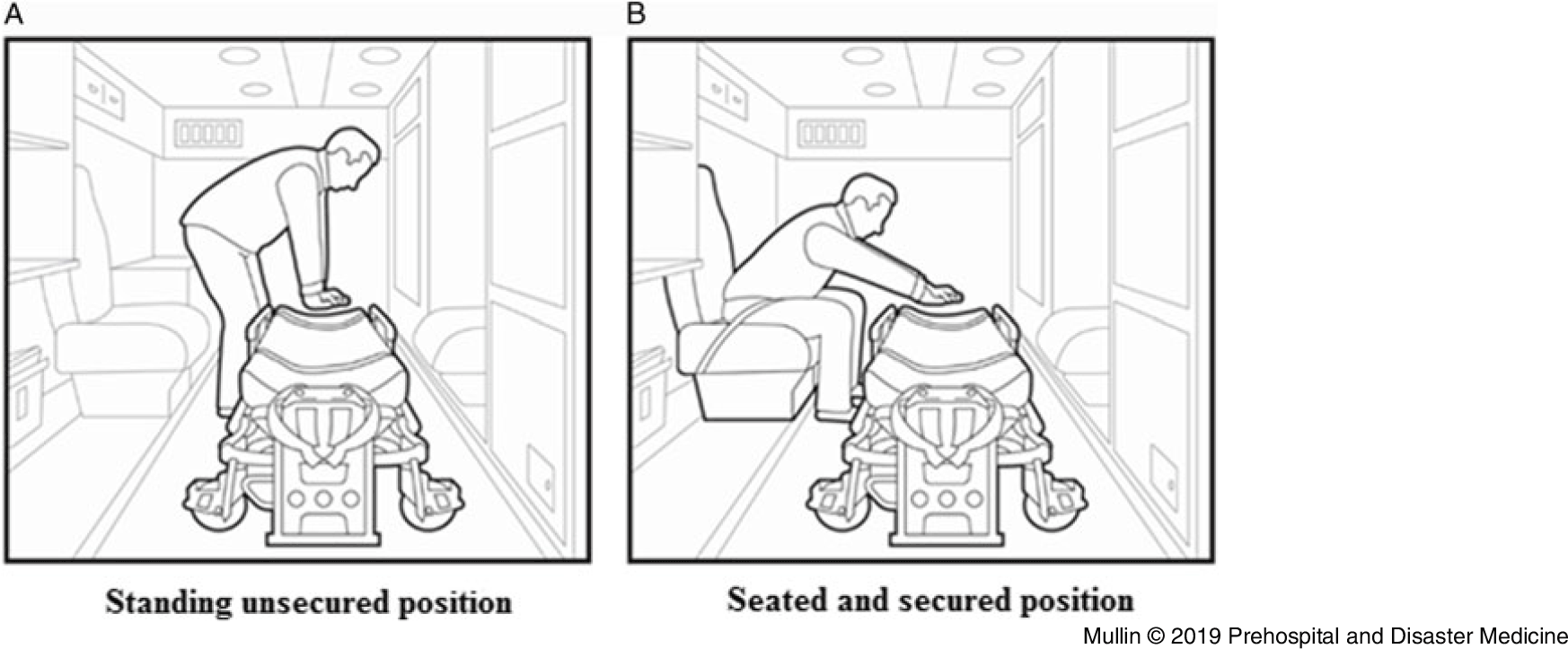
The study utilized a randomized, counterbalanced design. The conditions for this study consisted of: (A) a standing unsecured position, and (B) a seated and secured position (Figure 1). In Condition A, the paramedic is standing with knees slightly bent with straight arms on the chest of the patient, and uses their body weight to help deliver the compressions. In Condition B, the paramedic is seated and must lean out over the patient in order to deliver the compressions.
Condition A - Standing Unsecured Position; Condition B - Seated and Secured Position.

Setting
The study was carried out at the simulation center of Medicine Hat College (Medicine Hat, Alberta, Canada). The population of participants was 60 students across the first-year and second-year cohorts of the college’s paramedic program. Participants were excluded if they were not first-year or second-year students in the college’s paramedic program.
First-year students have approximately eight hours of experience performing CPR on high- and low-fidelity mannequins, and second year students have approximately 20 hours of experience. To be eligible for inclusion, the participants were required to be a student on the program and to hold a current certificate in BLS. The data collection was carried out from January through March 2018.
Ethical Approval
This study was reviewed and approved by the Medicine Hat College Ethics Review Board.
Sample Size Calculation
No previous published papers were available specifically comparing the quality of chest compressions given from seated and standing positions. Therefore, the effect size from Sebbane, et alReference Sebbane, Hayter and Romero11 (which compared kneeling and standing chest compressions) was used to estimate the sample size required to adequately power the current study using GPower. Specifying an effect size of Cohen’s d = 0.8, a two-tailed matched-pairs t-test, alpha of .05, and power of 0.95, it was determined that it was necessary to recruit a minimum of 23 participants in order for the study to be sufficiently powered.
Equipment
Chest compressions were performed on a QCPR manikin (Laerdal Medical; Ontario, Canada) placed on an MX-PRO R3 Stryker ambulance cot (Stryker EMS; Portage, Michigan USA). The manikin has been used in a number of other studies of the quality of chest compressions.Reference Perkins, Smith and Augre7, Reference Sebbane, Hayter and Romero11, Reference Cason, Trowbridge, Baxley and Ricard12 The Stryker stretcher was used as it is the current cot used within most ambulances in Alberta, Canada. The simulation manikin and ambulance cot were placed and secured within a stationary simulated ambulance patient compartment (SimLeader; Quebec, Canada). This simulation compartment is consistent with the specifications and functionality of the Alberta ambulance currently in service.
Measures
Chest compression data were captured for each participant on a Laerdal SimPad Plus SkillReporter (Laerdal Medical; Ontario, Canada). The participants performed compressions on a Resusci Anne QCPR manikin (Laerdal Medical; Ontario, Canada). All data were downloaded onto a laptop and saved into the Session Viewer software provided by Laerdal. Each participant was assigned a random code to blind the research team as to which condition the participant had completed first. The data collected were: the total number of compressions; the number of correct compressions (compressions performed at the correct rate, depth, with hands in the correct position, and with full release of pressure at the end of compression); and mean compression depth and average rate.
Preference and perception data by participants were assessed by using a 5-point Likert scale from one (“strongly disagree”) to five (“strongly agree”) via an online survey in Google Forms (Google; Mountain View, California USA). Participants responded to the following statements:
The chest compressions I performed when seated and secured were effective;
The chest compressions I performed when standing unsecured were effective;
I prefer the seated and secured body position when performing chest compressions; and
I prefer the standing unsecured body position when performing chest compressions.
Procedure
Students in the first-year and second-year cohorts in a paramedic program at Medicine Hat College were invited to participate in January 2018. The students received written information about the study via email, and were given the opportunity to ask questions. The first 24 students who agreed to participate were recruited into the study. All participants provided written informed consent.
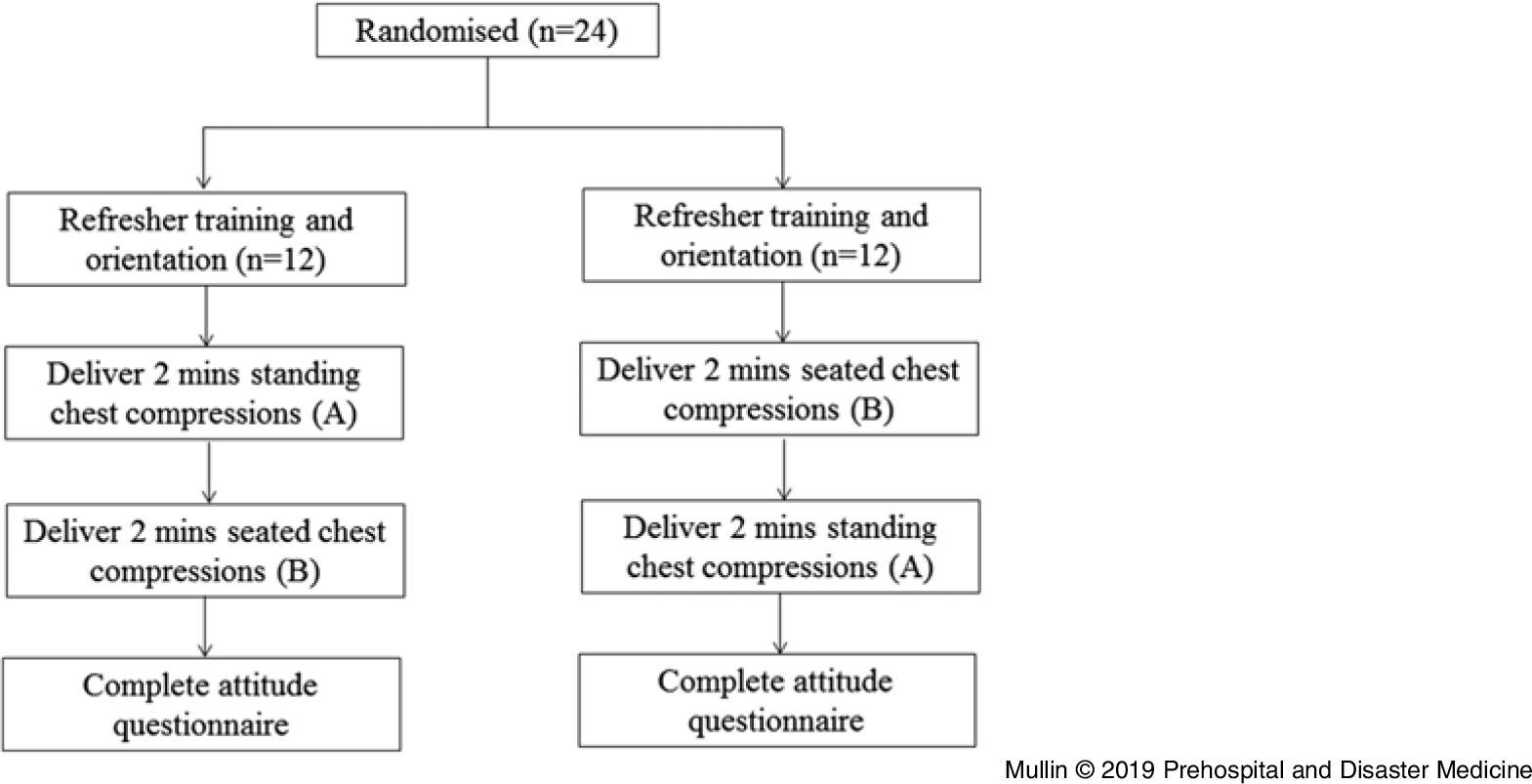
The participant flow diagram in Figure 2 provides an overview of the stages of the study. Participants were randomized into the two groups by using an online random number generator. The research team was blinded to the randomization. As the research team only had access to one ambulance simulator, the two groups started at alternative times on the same day. All participants completed a 30-minute refresher activity to ensure adequate knowledge of the Canadian Heart and Stroke Foundation (Ottawa, Ontario, Canada) BLS CPR before data collection. Each participant subsequently performed a two-minute chest compression routine on the Resusci Anne QCPR manikin, with visual feedback, to practice prior to the data collection.
Participant Flow Diagram.

Following orientation, individual participants entered the ambulance simulator and were asked to perform continuous chest compressions for two minutes followed by a 10-minute break between conditions. Participants were in a standing unsecured position beside an ambulance cot/stretcher (Condition A; Figure 1), and alternatively were seated in the seated and secured position (Condition B; Figure 1). Participants did not receive visual or audio feedback on the quality of the chest compressions in either condition.
Following completion of testing in both conditions, participants were asked to complete an anonymous online survey indicating their agreement to four questions relating to their preference for delivering chest compressions, as outlined in the methods section.
Statistical Analysis
IBM SPSS (version 23; IBM Corp.; Armonk, New York USA) was used to complete the statistical analyses. Comparisons between the two CPR positions were performed by using the dependent t-test or the Wilcoxon Signed Rank test when data were not normally distributed. Comparisons were made across the following dimensions: percent of correct compressions, the average rate of compressions per minute, the average depth of compressions, and number of total compressions. A Bonferroni correction was applied to control for the impact of multiple comparisons and a significance level of .012 was adopted. Effect size was calculated using Cohen’s d.
Results
Participants
Twenty-four participants were recruited (11 first-year and 13 second-year students). Twelve participants were randomized to Condition A, and 12 participants to Condition B (Figure 2). Fourteen participants were male and 10 were female.
Evaluation of Operator Position on Chest Compressions
There was no significant difference in the total number of compressions, or in the mean rate of compressions, between the standing and seated positions (Table 1). However, mean compression depth was significantly higher in the standing position as compared to the seated position, with a large effect size of the difference (Table 1). There was also a significant difference, and large effect size of the difference, in the percentage of correct compressions between the two positions (Table 1). The standing position resulted in a significantly higher percentage of correct compressions (total number of compressions; compressions performed at the correct rate, depth, with hands in the correct position; and with full release of pressure at the end of compression) than the seated position (Table 1).
Chest Compression Parameters According to Operator Position

Attitudes to Operator Position
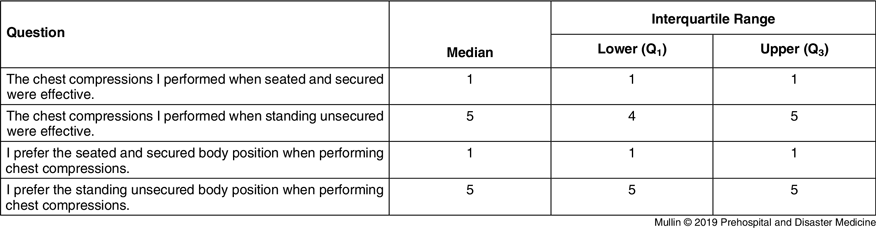
The participants perceived that the effectiveness of the chest compressions they delivered was higher when standing as compared to seated, and preferred to give chest compressions from a standing position (Table 2).
Likert-Scale Preference and Perception Questions

Note: 1 = “strong disagree” to 5 = “strongly agree;” (n = 24).
Discussion
Delivering effective chest compressions during a cardiopulmonary arrest is crucial.Reference Wik, Kramer-Johansen and Myklebust4–Reference Cheskes, Byers and Zhan6 However, this is a task that can be challenging to both effectively and safely perform in an ambulance. The study reported in this paper is one of a few studies that have specifically examined the impact of body position of the paramedic on the quality of chest compressions, and was the only study of which the authors are aware of that compares standing versus seated positions. The data indicate that delivering chest compressions from a seated and secured position, although safer for the paramedic, compromises the quality of the chest compressions given to the patient. Therefore, to optimize patient care, the paramedic must compromise their own safety by standing unsecured in the moving ambulance. These findings have implications for the training of paramedics to deliver chest compressions, ambulance design, and the use of technologies such as mechanical CPR devices and real-time feedback.
It is encouraging to see that, when standing, the mean depth of the compressions given by the participants in this study exceeded the American Heart Association (AHA; Dallas, Texas USA) guidelines of 50 mm,13 and the percentage of correct compressions was greater than 80%. Moreover, the total number of compressions and the mean rate of compressions were not significantly different between the standing and seated positions. Other studies have also found that rate of compression is not affected by the position from which the chest compressions are delivered.Reference Perkins, Smith and Augre7, Reference Sebbane, Hayter and Romero11, Reference Lewinsohn, Sherren and Wijayatilake14, Reference Mygind-Klausen, Jaeger and Hansen15 This finding suggests that the chest compression rate learned during practice generalizes to different delivery positions. However, there would appear to be a trade-off in which the depth of the compression is compromised in order for the paramedic to achieve an effective rate in all positions.
Chest compressions delivered from a seated position were significantly shallower, and had a significantly lower percentage of correct compressions, as compared to chest compressions delivered from a standing position. The participants’ seated and secured mean compression depth of 26 mm was comparable to the 27 mm depth reported by Sebbane, et alReference Sebbane, Hayter and Romero11 in the evaluation of the effect of delivering kneeling chest compressions to a patient on a stretcher. However, in both cases, the depth is considerably less than the AHA guidelines.13 Similarly, the percentage of correct compressions of less than 10% in the seated position is of great concern.
It is possible to speculate that this low number of correct compressions can be attributed to a lack of training and practice in delivering chest compressions from a seated position. A study that compared CPR training given with a mannequin on the floor, as compared to in a bed, found that the depth of compressions was too low in both cases. It was concluded that participants who optimized their working position (eg, by lowering the height of the bed) performed deeper chest compressions.Reference Mygind-Klausen, Jaeger and Hansen15 However, there are limited options in an ambulance to change the environment in order to improve the quality of the chest compressions, other than standing in an unsecured position. Moreover, a bigger issue than training and practice is that the delivery of effective chest compressions from a seated position has a number of biomechanical challenges. When standing in an ambulance, chest compressions are carried out through movement of the elbow and shoulder joints, and when kneeling, through flexion and extension of the hip joint.Reference Yasuda, Kato and Sugimoto8 When seated, all of the movement will have to come from the shoulder joints. Therefore, this will likely lead to provider fatigue.
Even in the absence of any feedback, the participants were aware that chest compressions delivered while standing were more effective than when seated. Therefore, unsurprisingly, the participants preferred to give chest compressions from a standing position. Although this can only be inferred, these attitudes suggest that the participants are likely to deliver chest compressions from a standing position in an ambulance. A qualitative study carried out with Swedish paramedics found that they have an attitude of “patient first, safety second” and prioritize the care of critically ill patients over their own safety in a moving ambulance.Reference Suserud, Jonsson, Johansson and Petzall16 This suggests that paramedics are willing to compromise their own safety in order to deliver more effective patients care.
The findings from the study reported in this paper have a number of implications for future research directions. Devices that provide real-time feedback on the quality of chest compressions are becoming more commonplace. Feedback can be given by a metronome, voice prompts, visual displays, or digital timers.Reference Brinkrolf, Lukas and Harding17 It has been found that verbal and visual feedback improves CPR quality in flying helicopters and moving ambulance vehicles.Reference Havel, Schreiber and Trimmel9 However, even with training, practice, and feedback, it is unlikely that it is possible to deliver good quality chest compressions from a seated and secured position. Therefore, future research should consider other solutions to the safe delivery of chest compressions in an ambulance.
When transporting patients, where high-quality chest compressions cannot be delivered safely, the use of mechanical CPR may be a potential solution.Reference Poole, Couper, Smyth, Yeung and Perkins18 Mechanical chest compression devices are designed to perform chest compressions at a specified rate and depth. Current research suggests that there is no significant difference in patient outcomes between mechanical and manual compressions when used in the prehospital environment.Reference Poole, Couper, Smyth, Yeung and Perkins18 Therefore, assessing the use of mechanical CPR devices in ambulance transportation is warranted. However, this research should not only consider the outcome for patients, but also the impact of the use of mechanical CPR devices on the safety of the paramedic.
Research on CPR in hospital environments has found that providers can improve quality of chest compressions by making changes to the environment, such as lowering the bed.Reference Mygind-Klausen, Jaeger and Hansen15 Current configurations of ambulances provide limited opportunity to make changes to optimize the delivery of chest compressions. However, consideration should be given to changes that could be made (eg, the ability to raise the seat) in order to allow the paramedic to optimizing their position for delivering chest compressions. A greater focus on paramedic safety during transport is long overdue. Understanding how paramedics work within an ambulance may address inefficiencies in design and functionality that contribute to the potential for injury to the paramedic and compromise patient care.Reference Du, Boileau, Wierts, Hignett, Fischer and Yazdani19
Limitations
This study has a number of limitations. First, the participants were paramedic students rather than experienced and qualified paramedics. Nevertheless, from an experimental perspective, a student group is desirable as all participants have a similar level of experience and training. Second, the participants performed chest compressions for two minutes, which is short and not representative of a full resuscitation. It is known that the quality of chest compressions decreases over time.Reference Hightower, Thomas, Stone, Dunn and March20 However, the data reported in this paper do represent one cycle of CPR, and the time is consistent with other studies that have examined the impact of operator position on quality of chest compressions.Reference Sebbane, Hayter and Romero11 Third, the number of participants in the study was relatively low. However, in spite of the low number of participants, the study was adequately powered, and the quantity of participants was larger than other similar studies.Reference Perkins, Smith and Augre7–Reference Havel, Schreiber and Trimmel9 Finally, the study used a manikin and a simulated stationary ambulance. Participants were not challenged by acceleration, deceleration, and G-forces inherent with a moving ambulance.Reference Slattery and Silver21
Conclusion
The quality of chest compressions delivered from a seated and secured position is inferior to those delivered from an unsecured standing position. This demonstrates that paramedics must compromise their own safety in order to deliver effective chest compressions in an ambulance. There is a need to consider how training, technologies, and the design of the patient compartment of ambulances can impact not only patient care, but also paramedic safety in ambulance transfers. Paramedics should not be placed in a situation in which they must compromise their own safety for patient care.
Acknowledgements
The authors would like to acknowledge A. Woods (Medicine Hat College; Medicine Hat, Alberta, Canada) for drawing the two illustrations in Figure 1.
Conflicts of interest/funding
The authors have not declared a specific grant for this research from any funding agency in the public, commercial, or not-for-profit sectors. The authors declare no conflicts of interest.
Contributors
SM, SL, and POC designed the study. SM collected the data. SM, SL, and POC analyzed and interpreted the data and drafted the manuscript. All authors approved the draft manuscript prior to submission.