Introduction
What are the social representations of older adults in Dakar? That is, to what extent do individuals share perceptions of older adults in their society as positive, neutral or negative? And, to what extent are these social perceptions linked to modernisation? To our knowledge, no previous research has explored these questions. In addressing these questions, the present research sought to provide new information about the cross-cultural scope of old-age representations, as well as offer new insights about the theoretical underpinnings of these shared social views. Since the seminal work of Cowgill and Holmes (Reference Cowgill and Holmes1972) and Bengtson et al. (Reference Bengtson, Dowd, Smith and Inkeles1975), research on ageing has long recognised that modernisation or modernity can result in negative age attitudes. However, although the modernity hypothesis has been routinely used to explain age attitudes, it has also been acknowledged that modernity entails a constellation of factors which co-exist with historically rooted social and cultural traditions to shape age-related social views in unique ways in societies (e.g. Makoni and Stroeken Reference Makoni and Stroeken2002; Thane Reference Thane2005). In order to understand more fully how these components interact, it is necessary to examine societies where one might see their unique interplay – such as in the case of Dakar. As a first step in understanding how older adults are represented in this contemporary urban African context, we surveyed a representative cross-section of the Dakar population aged 20 years and over using a methodology that is both quantitative and qualitative. We elaborate on this methodology following a description of the conceptual framework which guided the study and a review of the literature on representations of older adults in Western societies and in sub-Saharan Africa. Our results are discussed in the context of Dakar modernity and in comparison to Western modernity.
Epistemological framework and bases for social representations
This study explored ageing adults in Dakar within the epistemological framework developed by Marcel Mauss (Reference Mauss and Mauss1950a [1924] p.285) where anthropology is defined as ‘the sum-total of the sciences that consider man as a living, conscious and sociable being’.Footnote 1 Ageing can therefore be defined as the experience of a physiological process within a particular social context, which entails the macroscopic consequences of senescence (e.g. chronic diseases) as well the modes of social construction of ageing. In this paper, we focus on this social aspect of ageing by considering social representations of older adults in the Senegalese capital.
Social representations can be defined as universes of opinion related to various aspects of our environment (Moscovici Reference Moscovici1961). They depend on the context in which they are developed and correspond to a form of knowledge, socially elaborated and shared, contributing to the building of a common reality (Jodelet Reference Jodelet1989). Individuals comprehend reality through social representations in line with their interests and position within society. Thus, social representations consist as much of knowledge and opinions as of beliefs that legitimise behaviour and practice. In other words, social representations form a consistent and stable system of categorisation behind behaviours and authorise them according to social norms (Mannoni Reference Mannoni1998). Social norms operating within a society both shape social representations and are shaped by them.
Social representations have most often been investigated by social psychologists using etic approaches to study Western populations.Footnote 2 As such, there are few quantitative studies carried out south of the Sahara, the choice area of study for social and cultural anthropologists who often prefer emic approaches. However, while anthropologists rarely mention representations of older adults directly (e.g. Antoine Reference Antoine and Antoine2007a; Makoni and Stroeken Reference Makoni and Stroeken2002), such representations are often implicit in their writings. This literature will thus be discussed.
Representations of older adults in Western societies
Assessments of social representations of older adults have been framed in a variety of ways, ranging from questions which ask individuals about specific characteristics they associate with older adults to more general questions about their perceptions of how older adults are viewed in their society (Löckenhoff et al. Reference Löckenhoff, De Fruyt, Terracciano, McCrae, De Bolle, Costa, Aguilar-Vafaie, Ahn, Ahn, Alcalay, Allik, Avdeyeva, Barbaranelli, Benet-Martinez, Blatny, Bratko, Cain, Crawford, Lima, Fickova, Gheorghiu, Halberstadt, Hrebickova, Jussim, Klinkosz, Knezevic, de Figueroa, Martin, Marusic, Mastor, Miramontez, Nakazato, Nansubuga, Pramila, Realo, Rolland, Rossier, Schmidt, Sekowski, Shakespeare-Finch, Shimonaka, Simonetti, Siuta, Smith, Szmigielska, Wang, Yamaguchi and Yik2009). Across these methods, there is now a general consensus concerning representations of older adults in Western societies. After 60 years of research beginning with Tuckman and Lorge (Reference Tuckman and Lorge1953), researchers concur that age attitudes show a persistent negativity (e.g. Kite and Johnson Reference Kite and Johnson1988; Kite et al. Reference Kite, Stockdale, Whitley and Johnson2005; Levy and Banaji Reference Levy, Banaji and Nelson2002; Macia et al. Reference Macia, Lahmam, Baali, Boëtsch and Chapuis-Lucciani2009; Minichiello, Browne and Kendig Reference Minichiello, Browne and Kendig2000; Nelson Reference Nelson2002; Rupp, Vodanovich, and Credé Reference Rupp, Vodanovich and Credé2005). For example, in 1975, only 2 per cent of Americans perceived being 60 years of age as the ‘best years in life’ (Harris and Associates, Inc. Reference Harris1975), and in 2002, 91 per cent of Canadians aged over 60 reported that they had directly experienced age-related discrimination (Palmore Reference Palmore2002). In Western societies, age-related attributes such as slowness or clumsiness are perceived to increase from age 50 upwards, while adaptability and perseverance are perceived to decrease from age 60 (Heckhausen, Dixon and Baltes Reference Heckhausen, Dixon and Baltes1989). Research conducted on intergenerational communication follows a similar trend. In particular, research has repeatedly observed that when speaking to older adults, younger people systematically adopted a condescending, patronising style of speech (Hummert Reference Hummert, Hess and Blanchard-Fields1999; Ryan et al. Reference Ryan, Giles, Bartolucci and Henwood1986).
Research has also revealed that social representations can be highly complex and multidimensional (e.g. Brewer, Dull and Lui Reference Brewer, Dull and Lui1981; Caradec Reference Caradec2001; Lutsky Reference Lutsky1980; Macia, Chapuis-Lucciani and Boëtsch Reference Macia, Chapuis-Lucciani and Boëtsch2007). Brewer, Dull and Lui (Reference Brewer, Dull and Lui1981) showed that older adults were not perceived as a homogenous social group, but rather as a heterogeneous group divided into sub-categories: the grandmother (obliging and old fashioned), the elder statesman (conservative and dignified) and the senior citizen (weak and isolated). Recent work has confirmed these heterogeneous images (e.g. Boduroglu et al. Reference Boduroglu, Yoon, Luo and Park2006; Gluth, Ebner and Schmiedek Reference Gluth, Ebner and Schmiedek2010; Hummert Reference Hummert1993; Hummert, Garstka and Shaner Reference Hummert, Garstka and Shaner1997). Kornadt and Rothermund (Reference Kornadt and Rothermund2011) further showed that representations of older adults were mainly negative in the domains of ‘physical and mental fitness, health and appearance’, ‘friends and acquaintances' and ‘financial situation and dealing with money-related issues’. More positive evaluations were evidenced for ‘family and partnership’, ‘religion and spirituality’ and ‘work and employment’.
In short, the Western picture which has emerged from research is that although representations of older adults are increasingly heterogeneous in Western societies, they are predominantly negative. Indeed, the negative stigma attached to ageing has been offered as one reason why older adults in Western societies routinely refuse to be categorised on the basis of age (Quéniart and Charpentier Reference Quéniart and Charpentier2012).
Representations of older adults in sub-Saharan Africa
What are the social representations of older adults in societies south of the Sahara? To our knowledge, only one quantitative study has examined these perceptions. Löckenhoff et al. (Reference Löckenhoff, De Fruyt, Terracciano, McCrae, De Bolle, Costa, Aguilar-Vafaie, Ahn, Ahn, Alcalay, Allik, Avdeyeva, Barbaranelli, Benet-Martinez, Blatny, Bratko, Cain, Crawford, Lima, Fickova, Gheorghiu, Halberstadt, Hrebickova, Jussim, Klinkosz, Knezevic, de Figueroa, Martin, Marusic, Mastor, Miramontez, Nakazato, Nansubuga, Pramila, Realo, Rolland, Rossier, Schmidt, Sekowski, Shakespeare-Finch, Shimonaka, Simonetti, Siuta, Smith, Szmigielska, Wang, Yamaguchi and Yik2009) conducted a comparative study of university students across 26 countries from six continents, including one sub-Saharan African country: Uganda. Like their Western counterparts, Ugandan students perceived older adults along multiple dimensions, most of which were negative in valence: physical attractiveness (viewed negatively), performance of everyday tasks (viewed negatively), ability to learn new information (viewed negatively), general knowledge and wisdom (viewed positively). However, Ugandan students also saw older adults as likely to receive respect in their society and evaluated the subjective wellbeing of this age category most positively. Thus, representations of older adults are mainly negative in Uganda, even if older adults seem to benefit from a certain respect due to their age.
While the work of Löckenhoff et al. (Reference Löckenhoff, De Fruyt, Terracciano, McCrae, De Bolle, Costa, Aguilar-Vafaie, Ahn, Ahn, Alcalay, Allik, Avdeyeva, Barbaranelli, Benet-Martinez, Blatny, Bratko, Cain, Crawford, Lima, Fickova, Gheorghiu, Halberstadt, Hrebickova, Jussim, Klinkosz, Knezevic, de Figueroa, Martin, Marusic, Mastor, Miramontez, Nakazato, Nansubuga, Pramila, Realo, Rolland, Rossier, Schmidt, Sekowski, Shakespeare-Finch, Shimonaka, Simonetti, Siuta, Smith, Szmigielska, Wang, Yamaguchi and Yik2009) remains an important reference for cross-cultural representations of older adults, it has limitations. Firstly, university students' perceptions cannot be considered representative of the perceptions of a country's more general population. More importantly, Uganda should not to be considered archetypical of sub-Saharan Africa, and the views of this population therefore cannot be transposed to other countries across the continent. In addition, this work was an etic study that relied on closed questionnaires, which do not allow respondents to express themselves spontaneously with respect to social representations of older adults.
The constructivist methodologies favoured by social and cultural anthropologists offer a means of overcoming the last limitation. In an epistemological framework, the age-related notions are not predefined but instead emerge through interviews directly with the social perceivers. Within this framework, what have contemporary studies of African gerontology taught us? Some of these studies criticise the ‘romanticising’ (van der Geest Reference van der Geest2004) of representations formerly attributed to older adults in sub-Saharan Africa. Without taking a completely opposite stance from the pioneering studies that emphasised African gerontocracy and defined older adults as the pillars of societal and family organisation (e.g. Balandier Reference Balandier1974; Evans-Pritchard Reference Evans-Pritchard1940), it is precisely these analyses that some current studies tend to counterbalance. For example, among Bwa populations from the south-east of Mali, Hertrich and Lesclingand (Reference Hertrich, Lesclingand and Antoine2007) have shown that older adults have become less involved in the marriage of their offspring, and that the more simplified marital procedures espoused by younger generations serve to avoid older adults' authority. In the same way, the loneliness of some older adults (van der Geest Reference van der Geest2004) in rural Ghana, as well as the lack of care given to very ill people in the same area (van der Geest Reference van der Geest2002) and in South Africa (Sagner Reference Sagner, Makoni and Stroeken2002), could also be interpreted as proof of less positive social representations of older adults.
However, if the social position of older adults seems to decrease in sub-Saharan Africa according to some empirical prisms (Bologo Reference Bologo and Antoine2007; Golaz Reference Golaz and Antoine2007), other research indicates that the status and social representations of older adults are still largely positive in Africa south of the Sahara (Antoine Reference Antoine and Antoine2007b; Attané Reference Attané and Antoine2007; Demonsant Reference Demonsant and Antoine2007; Vandermeersch and Kouevidjin Reference Vandermeersch, Kouevidjin and Antoine2007). For example, in rural Senegal, as in rural Ivory Coast, more than 90 per cent of adults aged 55 and older are heads of households, a privileged status giving them the control of the land (Vandermeersch and Kouevidjin Reference Vandermeersch, Kouevidjin and Antoine2007). According to Demonsant (Reference Demonsant and Antoine2007), among the Peul of the north-east of Senegal, to be old is a necessary condition (but not sufficient) to acquire a dominant position in the village. Of course, the question of the status of older adults arises differently in Dakar than in rural areas, but it seems that this specific African urban context leads to the upholding of the high status of older adults (Antoine Reference Antoine and Antoine2007b).
Objectives of the study and the specific context of Dakar
Despite some sense of the social position of older adults in Dakar provided by previous investigations, no research has examined in systematic detail the specific nature of social representations of older adults held by members of this society. Moreover, the emic notions of these representations on the continent remain largely unknown. Given gaps in this age literature, the objectives of this study were twofold: to determine whether the representations of older adults are mainly positive, neutral or negative in the Senegalese capital; and to analyse the emic notions on which these age representations are based.
To situate our research fully, some major characteristics of Dakar society should be noted. With barely 5 per cent of the population aged 60 and over (Ndiaye and Ayad Reference Ndiaye and Ayad2006), the population of the Senegalese capital remains young, as in sub-Saharan Africa in general. From an economic point of view, Dakar society can be qualified as post-industrial, with 42.2 per cent of its jobs being in the service sector (Agence Nationale de la Statistique et de la Démographie (ANSD) 2004). The people of Dakar spend on average 1,224 FCFA per day (≈US $2.5), almost twice as much as inhabitants of other towns and almost three times as much as inhabitants of rural areas (ANSD 2007). In Dakar, the infrastructures are also incommensurable with the rest of the country: 81 per cent of households have electricity, while this is the case of only 47 per cent of the country as a whole, and over half of Senegal's hospitals are located in the area. On a more societal level, only 35 per cent of the capital population is illiterate (compared to 60.7 per cent in the whole of Senegal) and the average household comprises 7.5 people, the lowest in the country (Ndiaye and Ayad Reference Ndiaye and Ayad2006). Taken together, these indicators logically lead us to characterise Dakar society as a modern societyFootnote 3 (Werner Reference Werner and Marie1997).
Despite the low demographic weight of older adults in Dakar, they constitute an important portion of heads of households (32 per cent), and 40 per cent of the Senegalese capital inhabitants live in a household directed by an older adult (Antoine Reference Antoine and Antoine2007b). Among all the West Africa capitals, Dakar is the one where older adults are most often heads of households, and the one where adults achieve this privileged status at an older age. Moreover, 60 per cent of households where the head is aged 55 or above contain at least one adult child given the high rents in the city and the difficulties of finding an income-producing job for young generations (Antoine Reference Antoine and Antoine2007b). Finally, a large majority of older heads of households still work in the Senegalese capital, and 79 per cent of these households live, partly or totally, on their income. These factors suggest that older adults still maintain authority as the heads of households who hold responsibility in major decisions. In the Senegalese capital, this high social status given to older adults could also be reinforced by religion. Indeed, 94 per cent of the Senegalese population is Muslim (Ndiaye and Ayad Reference Ndiaye and Ayad2006), and one essential principle learned in Koranic schools is the respect of parents. The sanction for not recognising the higher status of older adults, and not acting appropriately, could thus lead to purgatory, a prospect that believers wish to avoid at all cost (Demonsant Reference Demonsant and Antoine2007). It is in this particular African, urban, contemporary context that the present study examined how individuals in Dakar view older adults in their society.
Method
Respondent sample
The study was conducted from January to June 2009 with a sample of 600 individuals. The sample was constructed using the quota methodFootnote 4 in order to obtain representativeness of the population aged 20 and over living in the department of Dakar. The data are from the National Agency of Statistics and Demography dating from the last census (2002). The quota variables included age (20–29, 30–39, 40–49, 50 and over), gender and town of residence. The towns were grouped by the four arrondissements making up the department of Dakar: Plateau-Gorée (five towns), Grand Dakar (six towns), Parcelles Assainies (four towns) and Almadies (four towns). Practically, this method requires constructing a sample that reflects the proportions observed in the general population. For example, according to the last census, men aged 20–29 living in the town of Medina (arrondissement of Plateau-Gorée) represented 2 per cent of the population aged 20 and over living in the department of Dakar. The sample was constructed to reflect this proportion and it included 12 men aged 20–29 living in this town. For each town, four doctoral-level investigators started out from different points each day to measure and interview individuals in Wolof or French in every third home. Investigators had a given number of individuals to interview (women aged 20–29, men aged 20–29, women aged 30–39, men aged 30–39, etc., in each town) to meet the quotas. Only one person was selected as a respondent in each home.
The data were collected through directed, individual interviews carried out face-to-face using a questionnaire. The questionnaire included items on socio-economic characteristics, health and health-related quality of life, nutrition and physical activity, life satisfaction, material wellbeing, as well as representations associated with certain population categories (older adults and migrants). The present study focuses on the questions relating to social representations of older adults.
Two successive questions were asked to assess how respondents viewed older adults. The first was a closed question similar to the one used by Löckenhoff et al. (Reference Löckenhoff, De Fruyt, Terracciano, McCrae, De Bolle, Costa, Aguilar-Vafaie, Ahn, Ahn, Alcalay, Allik, Avdeyeva, Barbaranelli, Benet-Martinez, Blatny, Bratko, Cain, Crawford, Lima, Fickova, Gheorghiu, Halberstadt, Hrebickova, Jussim, Klinkosz, Knezevic, de Figueroa, Martin, Marusic, Mastor, Miramontez, Nakazato, Nansubuga, Pramila, Realo, Rolland, Rossier, Schmidt, Sekowski, Shakespeare-Finch, Shimonaka, Simonetti, Siuta, Smith, Szmigielska, Wang, Yamaguchi and Yik2009): ‘In your opinion, how are older adults [magget in Wolof] perceived in Dakar?’ and had three possible answers: ‘rather positively, rather negatively or neutrally’. The second question was open-ended to explore the emic notions of these representations. Specifically, respondents were asked to justify their previous answer in response to the question: ‘Why?’ The interviewers immediately recorded respondents' answers. Responses were sometimes very short (e.g. ‘we have a lot of respect for older adults in Senegal’, a woman aged 22) or sometimes much longer and more complex (e.g. ‘we have a lot of respect for them. We go to them for advice, they are our guides. And even during ceremonies, the girls let them manage everything. They look after the young children because we trust them’, a man aged 44). When explanations did not seem to agree with answers to the first question, respondents were asked if they wished to revise their first evaluation or to elaborate on their justification. Thus, no incoherence between the first and second questions appeared during the analyses.
Analysis
We used the thematic qualitative analysis method described by Mason (Reference Mason1997). The first stage serves to identify themes by reading and rereading the interview notes. Agreement on how to label the themes was achieved via negotiation between the first and second researchers. Quotations illustrating the themes were then chosen by the same researchers. The second stage was a more detailed conceptual analysis aimed at interpreting the themes. To this end, the researchers worked through the themes which were extracted and systematically examined specific responses to elucidate the underlying conceptual elements. This method has been used successfully in a wide variety of interpretive settings (e.g. Nicolson and Anderson Reference Nicolson and Anderson2003).
Results
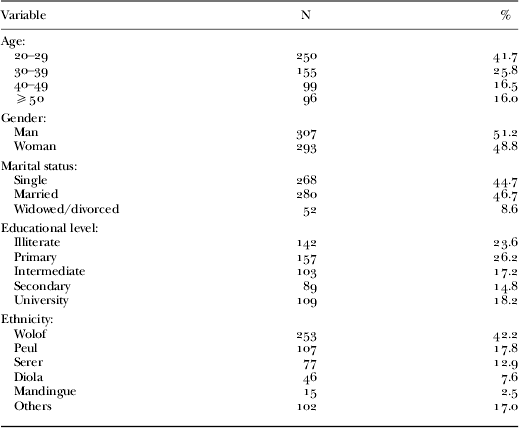
Descriptive characteristics of the sample respondents are shown in Table 1. The mean age of respondents was 36.0 (±13.7). Most were young, married, with low educational level and belonged to the Wolof ethnic group.
Socio-demographic characteristics of the sample
Note: N=600.
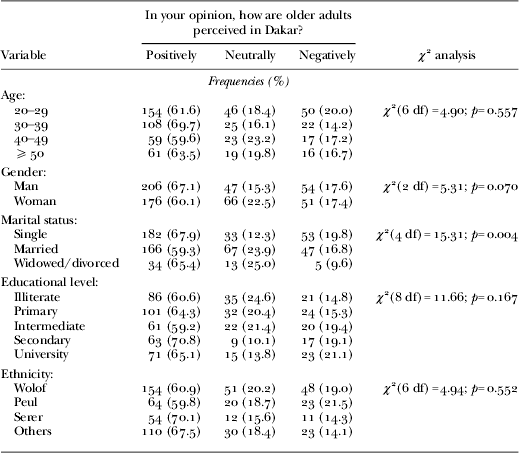
The majority of individuals (382 respondents, 63.7 per cent) felt that social representations of older adults were positive. Conversely, only 105 people (17.5 per cent) believed that older adults were perceived negatively by Dakar society. Lastly, 113 respondents (18.8 per cent) reported they did not perceive positive or negative stereotypes towards older adults. Moreover, as shown in Table 2, none of the socio-demographic factors were significantly associated with the observed social representations, except for marital status.
Perception of social representations of older adults according to socio-demographic characteristics

Notes: N=600. df: degrees of freedom.
These results are clearly different from observations seen in Western societies where views of older adults are predominantly negative (e.g. Kite and Johnson Reference Kite and Johnson1988; Kite et al. Reference Kite, Stockdale, Whitley and Johnson2005; Levy and Banaji Reference Levy, Banaji and Nelson2002; Macia et al. Reference Macia, Lahmam, Baali, Boëtsch and Chapuis-Lucciani2009; Minichiello, Browne and Kendig Reference Minichiello, Browne and Kendig2000; Nelson Reference Nelson2002; Rupp, Vodanovich, and Credé Reference Rupp, Vodanovich and Credé2005). They also contrast with the report of Löckenhoff et al. (Reference Löckenhoff, De Fruyt, Terracciano, McCrae, De Bolle, Costa, Aguilar-Vafaie, Ahn, Ahn, Alcalay, Allik, Avdeyeva, Barbaranelli, Benet-Martinez, Blatny, Bratko, Cain, Crawford, Lima, Fickova, Gheorghiu, Halberstadt, Hrebickova, Jussim, Klinkosz, Knezevic, de Figueroa, Martin, Marusic, Mastor, Miramontez, Nakazato, Nansubuga, Pramila, Realo, Rolland, Rossier, Schmidt, Sekowski, Shakespeare-Finch, Shimonaka, Simonetti, Siuta, Smith, Szmigielska, Wang, Yamaguchi and Yik2009) of Ugandan university students who characterised older adults as being perceived negatively by members of their society. According to the people of Dakar, social representations held about older adults are still largely positive in the Senegalese capital. At the same time, some representations were negative as well as neutral, suggesting that age representations in Dakar are also heterogeneous, as they are in Western societies (e.g. Boduroglu et al. Reference Boduroglu, Yoon, Luo and Park2006; Brewer, Dull and Lui Reference Brewer, Dull and Lui1981; Caradec Reference Caradec2001; Macia, Chapuis-Lucciani and Boëtsch Reference Macia, Chapuis-Lucciani and Boëtsch2007). To examine these age representations more closely, the emic notions were determined.
Emic notions of age representations
Respect and value of age
The notion of respect was omnipresent in the open answers. For a large majority of respondents, representations of older adults were identified as positive in Dakar because older adults were well respected. In the words of a 34-year-old woman: ‘In Senegal, the older you get, the more people respect you.’ The respect reserved for the ageing population should be viewed, as we will see, in connection with their roles in Dakar society and the notion of ‘parents’. However, for many respondents the reasoning need not be stretched so far, exemplifying how social representations can be fuelled by social norms and edicts: if older adults are respected in Dakar, it is simply because ‘it's our culture, we respect older adults in Senegal’ (man, 30), ‘we are taught to respect the elders in our families’ (woman, 20), ‘it's African tradition to respect our elders' (man, 41).
In short, as many respondents reported, older adults are perceived positively and respected simply because they are older: ‘the elderly are highly respected because of their age’ (man, 24), ‘the Senegalese are disciplined and very respectful of those who are older than they are’ (woman, 51). This reasoning is not truly tautological insofar as growing old is in itself a value in Dakar society. It is also consistent with the analyses of Devisch, Makoni and Stroeken (Reference Devisch, Makoni, Stroeken, Makoni and Stroeken2002) who showed that in certain African societies, ageing gives everyone, even the poorest people, the opportunity to enjoy a privileged social status that in Western societies is limited to its most ‘deserving’ members (such as judges or politicians, according to the authors).
While a majority of people from Dakar feel that older adults are respected in their society, a minority notes the contrary, which is observed in a comparative, temporal and/or geographic perspective. Thus, for some people it is not so much that older adults are not respected, it is more that they are no longer respected: ‘they [old people] are no longer shown any respect’ (man, 25), ‘there is no longer any respect or consideration for the elderly’ (woman, 41). Observations such as these have already been made in France and in Morocco (Macia et al. Reference Macia, Lahmam, Baali, Boëtsch and Chapuis-Lucciani2009), and it could be attributed to the effect of collective memory giving older adults a status which they never had. In any event, this diachronic change of attitudes toward older adults is usually condemned by middle-aged adults, who stress the poor upbringing of young generations: ‘this new generation does not respect older adults’ (woman, 44), ‘young people today are no longer well brought up and no longer respect older adults’ (woman, 37), ‘young people today no longer respect older adults, parents no longer teach their children as they should. I am a teacher but it's hard to train children at school!’ (woman, 35). In a similar way, comparisons with rural areas are often made to the detriment of representations constructed and circulated in the capital: ‘they [older adults] are not respected compared to in Casamance [where the participant comes from]’ (man, 25), ‘they [older adults] are respected in the provinces but not here’ (man, 33, born in Dakar but whose family comes from Kaolack).
The observed lack of respect toward older adults – compared to a timeless ‘before’, or to the ‘provinces’ as a homogenous entity – can be compared with views accusing the modernity/Westernisation/individualism amalgamation of being the cause of profound transformations of Dakar society. Thus, older adults are reportedly less respected in Dakar than in the provinces, and more so today than before, because the modernisation process, the assumed consequence of Westernisation and favoured individualism, is a recent phenomenon that is particularly visible in the capital:
Times have changed, older adults are no longer respected. That is modernity. (man, 31)
The people of Dakar have lost the values that our ancestors had left us, this is due to the influence of the Western media. (woman, 70)
Upbringing today is really mediocre. Consideration for older adults and disabled people has largely decreased, I think the people of Dakar copy the Westerners. But in rural areas respect is still there. (man, 28)
[Old people are no longer respected as] it is every man for himself, individualism is very developed. (man, 24)
These social perceptions tend to confirm those of modernisation theory (Cowgill and Holmes Reference Cowgill and Holmes1972) that links the decline of the privileged status of older adults in post-industrial societies with the rise of individualism and the fact that older people are gradually becoming negligible sources of information (Uotinen Reference Uotinen2005). However, such arguments remain very much the minority in modern Dakar society, which is already post-industrial (ANSD 2006). Thus, modernisation does not appear to have the same consequences in Dakar as in Western societies on representations of older adults. Modernisation theory, already criticised by various gerontologists who specialise in Africa (e.g. Ferreira Reference Ferreira1999; Makoni and Stroeken Reference Makoni and Stroeken2002), may therefore be less relevant to the Senegalese capital.
The roles of older adults
Many respondents mentioned the social roles of older adults to justify the respect they are shown in Dakar society. What are these roles, and how are they specific to older adults? For many people in Dakar, older adults play an important role in society and in Dakar families. For example, people turn to their elders to resolve intra- or inter-family conflicts, as the following remarks show: ‘they are sought out for their advice, to manage disputes’ (man, 34), ‘they resolve family problems, they help us’ (man, 60), ‘in our society, older adults are very much in demand to resolve relationship problems’ (woman, 35). Thus, older adults are considered mediators whose role is indispensable to ‘peace’ [jamm in Wolof], social peace representing harmony between the members of the group:
They [older adults] are highly esteemed because they are conciliators. (woman, 30)
It is them [older adults] who stabilise the family. (woman, 48)
In our culture, old people are social mediators. (man, 30)
Thanks to them, families live peacefully. (woman, 36)
In addition to resolving conflicts and ensuring social peace, older adults are also the guarantors of tradition for a great many Senegalese people: ‘in African culture, old people are highly esteemed, they are the guardians of tradition’ (woman, 26), ‘it is they [older adults] who try to pass on ancestral values to our generations. This is why we must respect them’ (man, 39). Ageing women are, for example, proud to lead official ceremonies: ‘people respect us highly. Even in ceremonies the girls let us organise everything’ (woman, 69). Older men are also considered religious guides, a particularly valued role in Dakar society, which is very devout: ‘they are religious guides, they teach the Qur'an to children, they are loved and respected’ (man, 57). These discourses are consistent with the analyses of Demonsant (Reference Demonsant and Antoine2007) in the north-east of Senegal.
The valued roles of older adults are based on the inherent qualities of growing older: accumulation of experience and wisdom that older people are obliged to hand down to younger people: ‘they are more mature, more experienced’ (woman, 24), ‘they are people who have lived for longer than us, know more than me and are better equipped’ (man, 25), ‘they know things that we don't and they must pass them on to us’ (man, 26), ‘they are people who teach us a lot if we are close to them’ (woman, 28). This experience and wisdom makes the older population ‘guides’, ‘counsellors’, ‘examples’, ‘markers’, ‘reference points’ or even ‘wise men and women’. Here are several examples of these views:
They [older adults] are our guides, our counsellors, they deserve total respect. (man, 29)
They [older adults] are points of reference for us, examples for our society. (man, 25)
Older adults are generally guides, wise people who put children on the right track. This is why young people respect us a lot in all areas. (man, 60)
Older adults have wisdom that they try to pass on to us, that is why they are appreciated. In our culture, an older person is always consulted during the major traditional ceremonies. (woman, 30)
From what I can see they [older adults] are respected for their wisdom. They are incredible. (woman, 22)
Although it is true that for most Dakar inhabitants, older adults have accumulated experience and knowledge well-suited to their role in upholding social stability, a minority of respondents view older people as useless because they no longer work: ‘[if older adults are badly considered] it's because of their age: they do not work, they do nothing’ (man, 39), and as they no longer bring home any money, they become ‘burdens for the family’ (man, 44). Nevertheless, as Antoine (Reference Antoine and Antoine2007b) notes, most older adults bring money into the household in Dakar. At the same time, their activity of appeasing conflict, which sometimes calls for long periods of discussion among older adults, can be ridiculed: ‘they [older adults] talk a lot and do nothing. They spend their time engaging in sterile chitchat’ (man, 38). But above all else, it is their role as guardians of traditional values that seems to be associated with negative representations. Indeed, for a number of young adults, older adults do not merely give advice but also give orders and exercise coercion that leads to intergenerational conflict. The adjective used to describe this is that older people are ‘complicated’ [lakelé in Wolof]. This euphemism can be interpreted to mean that older adults, by doing what they can to maintain the community habitus (Marie Reference Marie and Marie1997) that aims precisely at framing the younger generation's freedom of action, sometimes draw their wrath:
They like to control everything the young people do, that's what I don't like about them. (man, 26)
They control everything that goes on in people's homes, sometimes it's difficult to live with them. (man, 21)
They always look at things from one side without understanding and wrongly blame us. (man, 21)
They prevent us from doing many things. (woman, 22)
Nowadays, older adults are very complicated and generally judge other people's children when they don't bring up their own children in their own homes. (woman, 20)
However, these views remain a minority. The devaluation of older adults' experiential knowledge observed in Western societies and backed by modernisation theory (Cowgill and Holmes Reference Cowgill and Holmes1972) does not seem to correspond to Senegalese modernity and its current social norms. The persistence of oral culture certainly plays a part in this, since the common language of Dakar – Wolof – is not a written language. Vernacular knowledge is therefore once again subject to oral transmission, in which older adults obviously play an important role. At the same time, the difficult economic situation in the country – in permanent economic crisis – encourages people to uphold strong family and community ties to be able to live as well as possible. Even today most young people value the upholding of this family solidarity (Macia, Duboz and Gueye Reference Macia, Duboz and Gueye2010). The task of older adults is precisely to cement the community habitus through repressive means (Marie Reference Marie and Marie1997) and this role, although controversial as we have seen, seems to be set to last as long as a durable rise in the population's general standard of living does not occur. These characteristics of modernity in Dakar (i.e. mainly oral transmission of knowledge and need for family solidarity) explain in part why modernisation does not have the same consequences for representations of older adults in Dakar as for older adults in Western societies.
Parents and the ‘debt of life’
Many respondents also mentioned the notion of ‘parents'Footnote 5 [wajur in Wolof] to explain the respect shown to older adults. What does this notion of parents reflect? First, it should be noted that in Dakar society a mother's sisters are called ‘mama’, just like the person's biological mother. The same is true for a father's brothers, who are all called ‘papa’. These language practices can extend outside the lineage: for instance, calling one's parent's friends ‘mama’ and ‘papa’ is common and moreover appreciated. Likewise, a salesperson the same age as one's mother can be addressed as ‘mama’. Thus, names that in Western society are limited to the nuclear family extend well beyond this restricted circle in Dakar. Correlatively, in Senegalese society, biological parents are not the only ones responsible for bringing up their children, who are raised within the extended family – in Dakar a home consists of 7.5 people on average (Ndiaye and Ayad Reference Ndiaye and Ayad2006) – and it is not unusual for children with any sort of problem (discipline, assimilation of gender roles, etc.) to be sent to live with their uncles and aunts for a period of time. The children are raised by a group of parents, who are all referred to as ‘mama’ and ‘papa’ according to their age.
In this semantic framework, several respondents justified their positive representations in very simple terms: ‘they are our parents above all else, it's only normal that we respect them’ (man, 29), ‘we view older adults as if they were our parents, we must cherish and love them’ (woman, 32). Underlying this notion of parents is the children's debt to them. It is both a ‘life debt’: ‘they gave birth to us so we can only thank them and love them’ (woman, 35), as well as an ‘educational debt’: ‘they participated in our upbringing so we must respect them’ (woman, 26). Along with the frequent need for young adults to stay in their parents' household because of the high cost of rents in Dakar and their difficulties obtaining an income-producing job (Antoine Reference Antoine and Antoine2007b), it is also often an ‘economic debt’. Parents – in the broad sense, therefore – raise children despite the problems encountered in a developing country that is among the world's poorest. The reciprocal gift exchanges (Mauss Reference Mauss and Mauss1950b [1924]) are situated at different levels, and underpinned by the principles of the Qur'an (Demonsant Reference Demonsant and Antoine2007) in a society where Islam is the predominant religion (Ndiaye and Ayad Reference Ndiaye and Ayad2006). First, children who earn money are expected to give a large part of their earnings to the household they come from, whether they still live there or have already left (Macia, Duboz and Gueye Reference Macia, Duboz and Gueye2010). Second, one must respect and listen to one's parents: ‘older adults looked after us so it is normal that we respect them and turn to them when we have a problem’ (man, 40), ‘they brought us up, looked after us when we were very young, we all make an effort to respect them’ (man, 31). In short, children must look after their parents: ‘they helped us when we were small so we have to pay tribute to them’ (woman, 38), ‘they are our grandparents, they looked after us, which is why we look after them, so they don't feel abandoned like white people [toubab in Wolof] who put their parents in old people's homes’ (man, 29). These last remarks further highlight the influence of social norms on elders in Dakar society, and may be interpreted in terms of resistance to Westernisation and modernity values, a resistance partly determined by the necessity to maintain intergenerational solidarities – and African values – in a context of permanent economic crisis.
We now focus on the idea of reciprocity mentioned in the interviews. This can be seen in the way that older adults were accorded respect and given help, but within the context of reciprocal relationships such as van der Geest (Reference van der Geest2004) has identified in Ghanaian rural areas. For van der Geest, older adults who receive considerable support are those who, when they were younger, truly looked after their children (i.e. often worked very hard to meet their children's needs as best they could). van der Geest's analysis reflects many of the respondents' discourses where a neutral perception of the social representations of older adults was given. Indeed, for most people in this response category,Footnote 6 representations of older adults are neither positive nor negative, as ‘that depends on the person’, ‘it depends on the upbringing’, but especially: ‘it depends on the behaviour of the old people’, ‘old people are different so it depends’. In other words, ‘respect is earned’ (woman, 39). In Dakar, reciprocity in family relationships is therefore not limited to old age: parents must continue to help their children. They must, as we have seen, offer advice, transmit knowledge, accommodate and nourish them, but also, in as much as it is physically possible for them, look after their grandchildren: ‘we respect them and in general they look after our children when the women work. They are our mothers, our fathers, we love them’ (woman, 42), ‘the elders oversee our children's upbringing, that's why we always have a positive view of them’ (man, 46), ‘they [older adults] take part in young children's upbringing and above all they give good advice’ (woman, 20). Thus, the notion of ‘parents’ appears to be associated with permanent reciprocal relationships. Upholding the extended family can, and should, be considered an integral part of this reciprocity. When they live in the same household, all generations must take part in its organisation. In modernisation theory (Cowgill and Holmes Reference Cowgill and Holmes1972), the demise of the extended family, having been replaced by the nuclear family, is considered an element favouring older adults' loss of power. In Dakar, the modernisation process has not led to the rise of the nuclear family, and this may explain why social representations of older adults remain predominantly positive in this society.
Conclusion
The present research investigated age representation in Dakar society by asking members to appraise their society's views of older adults. It revealed that representations of older adults are heterogeneous and primarily positive in Dakar. These age representations clearly contrast Dakar society with Western societies, in which images of older adults are predominantly negative. These findings therefore raise several questions. While our observations indicate that older adults are typically reported to be highly valued in Dakar, one must question the extent to which these views are consistent with the conditions of older people in Senegalese society. Do older adults retain power and influence, or have they lost status in the context of Dakar modernity? In short, is there is a mismatch between how members of Dakar society perceive older adults and how older people actually experience relations in this social world? Available data on the modes of becoming head of household in Dakar, as well as macro-economic data on the functioning of households (Antoine Reference Antoine and Antoine2007b), tend to indicate that older adults still retain power and influence in their society, a power reinforced by religion (Demonsant Reference Demonsant and Antoine2007) and the permanent economic crisis the country is experiencing. However, it is also possible that other indicators might reveal incongruencies. Research is warranted to explore in more detail such indicators.
One may also question the extent to which social representations reflected in views of how older adults are perceived in Dakar society parallel more personal representations of older adults held by individuals. Social perception research which has addressed the issue of generalised stereotypic versus individualised beliefs has indicated that generalised views tend to be more negative than individuals ones, owing to less differentiation afforded stereotyped others (Braithewaite Reference Braithewaite1986; Zebrowitz, Montepare and Lee Reference Zebrowitz, Montepare and Lee1993). Given the more positive social views reported in the present study in comparison to social representations found in other cultural contexts, one might speculate that personal views may be even more positive, contrasting the present social views to others to an even greater extent. However, we would also argue that because respondents were prompted to justify and articulate their views, the observed social representations are reliable indicators of implicit personal views.
Another question concerns the extent to which individual differences are prevalent in the social representations of older adults in Dakar. The social representations observed in the present study were certainly not unidirectional in the Senegalese capital. As in other societies, a heterogeneity of representations prevails. Some note a decline in respect shown for older adults, whereas others point to their lack of participation in productive activities. Some young people feel oppressed by the coercive power of older adults, judging them ‘complicated’. These views echo a recent constructivist study that condemn the ‘romanticising’ (van der Geest Reference van der Geest2004) of representations of older adults in sub-Saharan Africa. However, the combination of quantitative and qualitative approaches has enabled us to show that negative representations of older adults remain very much a minority in Dakar. It is as if the modernisation process was currently occurring in Dakar, bringing, on the one hand, a resistance towards depreciation of older adults and, on the other hand, a contradiction; some of the Dakarites admit that the images associated with older adults are positive, and at the same time, they suggest that this norm is being transformed. However, more could be done to examine the nuanced ways in which views of older adults, and ageing more generally, may differ across age, gender, rural and related socio-economic groups in Senegal. Having documented the nature of general social representations of older adults in Dakar society, future research which considers group differences should provide additional insights.
Finally, the present findings call into question the extent to which modernisation theory offers an adequate framework to account for attitudes toward older adults across cultural contexts. Modernisation theory views the loss of power of older adults in Western societies as the consequence of industrialisation, which itself led to the devaluation of experiential wisdom of older adults, the advent of the nuclear family at the expense of the extended family (through urbanisation) and, of course, the shift from production methods controlled by older adults to production methods managed by industrial entities. Dakar society appears to depart from this basic theoretical premise, as the characteristics of its modernity are different from those observed in Western societies. In Dakar, the experiential wisdom of older adults is still valued (mainly through the importance of oral tradition) and the extended family is upheld (given the permanent economic crisis the country is experiencing). Representations of older adults remain positive overall and are based on three principal notions: the value of advanced age in itself, social usefulness of older adults and family ties. Thus, one can conclude that modernisation theory is limited in its application, with the study of age representations requiring a more fine-grained analysis of a constellation of cultural components.
In summary, two main conclusions can be drawn from this study. First, modernisation theory is narrow in its explanatory power and should be expanded to take into account the complexities of socio-cultural contexts. Secondly, the resistance of the Dakar inhabitants to a negative social representation of older adults, as seen in Western societies, could reflect a resistance towards Western modernity, i.e. an individualist and capitalist one. One could surmise that this resistance is fuelled by the difficult economic context touching on Senegal, and Africa in general. It is also possible that the modernity model of Western societies is rejected by Dakar inhabitants. In either case, sub-Saharan Africa is a unique research laboratory for gerontologists to observe different rationales at work in these societies, as well as to better understand those of Western societies and to refine broader theoretical perspectives assumed to drive attitudes toward age and older adults across cultures.
Ethical approval: No formal permission was obtained for this research as no standing ethics review committee was in place in Senegal at the time of this study. However, care was taken to respect customary ethical guidelines for research of this type and insure participants' comfort and confidentiality during the interview process.