Anomalous origin of one pulmonary artery branch from the ascending aorta (APA) is a rare congenital cardiovascular anomaly accounting for less than 0.1% of CHDs. Reference Kutsche and Van Mierop1 The term “Hemitruncus” used previously for this condition is seldom used now because of the presence of two separate semilunar valves. APA is classified based on the site of origin as those arising proximally from the posterior aspect of the ascending aorta near the aortic valve as the proximal type and those originating from the ascending aorta just proximal to the innominate artery as the distal type. Reference Dong, Yan, Xu, Duan and Liu3
Pathophysiologically, APA is characterised by early development of pulmonary vascular disease in both lungs. The lung connected to the normally arising pulmonary artery receives the entire cardiac output from the right ventricle, while the other lung supplied by APA is exposed to both volume and pressure overload due to unrestricted shunting from the aorta. This leads to early development of pulmonary vascular occlusive disease, the mechanisms of which include circulating vasoconstrictor substances, neurogenic crossover from the unprotected lung to the protected one, and development of pulmonary hypertension secondary to left ventricular failure. Reference Johnson, Watson, Strauss and Spray5 In this study, we evaluated the outcome of patients with this condition and the challenges in the peri-operative management.
Material and methods
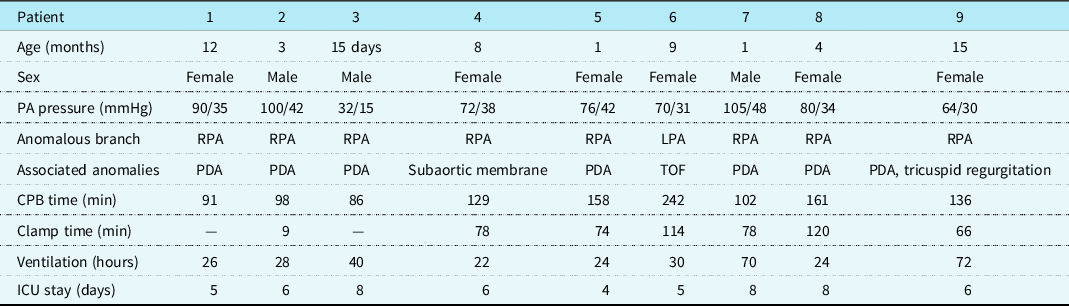
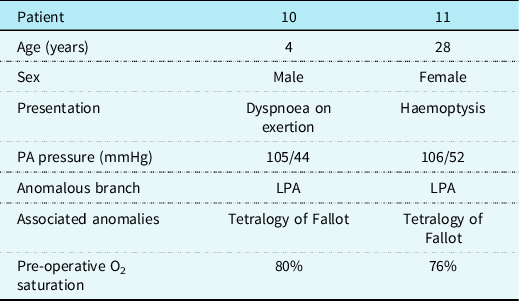
A retrospective analysis of all patients who were diagnosed with APA was performed after getting approval from our institutional ethical committee. Between January 2000 and December 2019, 11 patients were diagnosed to have APA of which 9 children underwent surgical correction. Detailed information of these patients is shown in Tables 1 and 2.
Operated Patients

CPB = cardiopulmonary bypass; LPA = left pulmonary artery; PA = pulmonary artery; PDA = patent ductus arteriosus; RPA = right pulmonary artery.
Unoperated Patients

LPA = left pulmonary artery
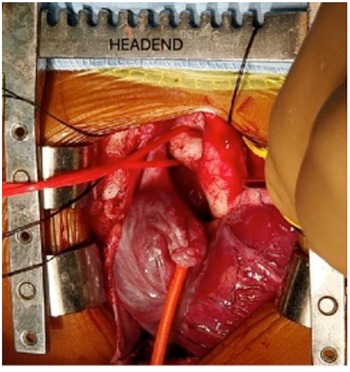
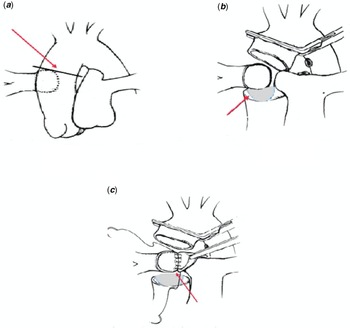
All the patients presented with features of congestive heart failure except two who presented late after infancy (one at 4 years and other at 28 years). Eight patients had anomalous origin of right pulmonary artery (Fig 1) and three had left pulmonary artery. Associated anomalies include patent ductus arteriosus (seven children), tetralogy of Fallot (three children), and subaortic membrane in one patient. Diagnosis was established according to the echocardiographic, CT, and operative findings. The surgical approach in all cases was via median sternotomy. The ascending aorta, anomalous pulmonary artery, main pulmonary artery, and its branch were carefully mobilised upto the hilum. Cardiopulmonary bypass was initiated with aortobicaval cannulation after snugging the anomalous pulmonary artery. Patent ductus arteriosus was ligated and divided in all cases. Mild hypothermic antegrade cardioplegic arrest was used in seven patients. Ascending aorta was transected above the APA (Fig 2A), and the pulmonary artery branch was harvested with a cuff of posterior wall from the aorta (Fig 2B). The defect in the aorta was closed with bovine pericardial patch. The anomalous pulmonary artery was then anastomosed end to side by making an adequate vertical incision along the lateral aspect of the main pulmonary artery (Fig 2C). Two patients underwent re-implantation without cardioplegic arrest. In these patients, a side-biting clamp was applied on the ascending aorta and the anomalous pulmonary artery was harvested.
Anomalous Rt Pulmonary artery from ascending Aorta.

Surgical illustration.

Associated procedures include biventricular repair with conduit for one patient with tetralogy of Fallot, subaortic membrane excision in one patient, and De vega’s tricuspid annuloplasty in one patient with severe tricuspid regurgitation. The patient with tetralogy of fallot also had left anterior descending coronary artery arising from right coronary artery which was crossing the right ventricular outflow tract and required the use of a homograft for complete correction.
Results
There was one in-hospital mortality (11.2%) in our series (patient no. 9). The child who underwent De Vega’s repair succumbed in the post-operative period due to severe right ventricular dysfunction refractory to all medications. This child presented with features of heart failure, got intubated and had severe tricuspid regurgitation with severe right ventricular dysfunction preoperatively. Child was taken up for surgical repair after medical stabilisation. However, child had a stormy post-operative period with severe right ventricular dysfunction and expired.
All patients received elective inotropic support in the post-operative period. Oral sildenafil was administered to all the children in the immediate post-operative period. Two children developed pulmonary arterial hypertensive crisis on the first post-operative day which was managed successfully with intravenous sildenafil infusion and inhalational nitric oxide and were extubated after 48 hours. One patient had superficial surgical site infection which was managed with sensitive antibiotics.
One of the two patients who were not operated had irreversible pulmonary vascular disease (patient 11). This patient was diagnosed to have APA in infancy and was advised surgery but was lost to follow-up and presented in adulthood with haemoptysis and succumbed to death at an age of 28 years. Other child (patient 10) underwent cardiac catheterisation at the age of 4 years which showed irreversible pulmonary arterial hypertension in the left lung and hence was not offered surgical correction as decided in our joint cardiac meet.
All patients underwent post-operative echocardiography in hospital and mean pulmonary artery pressure decreased significantly and were discharged in good condition with clinical symptoms relieved.
Follow-up for all the eight patients ranges from 60 to 84 months. All children are alive, asymptomatic, and in stable clinical condition at the most recent follow-up. Ross modified score Reference Dimopoulos, Diller and Opotowsky17 was used to assess cardiac function, and all patients who underwent surgical correction had scores less than 3. Systemic saturation of 100% was measured in all patients. In the recent follow-up echocardiography, all patients had normal biventricular function with no significant tricuspid regurgitation with right ventricle systolic pressure of less than 20 in all the patients. Since there was no cardiac catheterisation done in the follow-up period, the exact pulmonary artery pressures could not be assessed, which is the main limitation of this study.
The Doppler flow velocity at the anastomotic site of anomalous pulmonary artery and main pulmonary artery showed no significant gradients except for one patient (No. 8) who had mild pulmonary stenosis with a peak gradient of 32 mmHg. Child with subaortic membrane developed recurrent left ventricular outflow tract obstruction and is awaiting surgery.
Discussion
APA from the aorta remains an investigational field in paediatric cardiac surgery due to the low incidence of this congenital malformation. Reference Kutsche and Van Mierop1,Reference Patel, Zakir and Sethi2 The largest reported series includes 52 patients who underwent surgery for this anomaly over a 19-year period. Reference Dong, Yan, Xu, Duan and Liu3 In our study, the most commonly associated anomaly was patent ductus arteriosus, as consistent with a previous report. Reference Kajihara, Imoto and Sakamoto4 Though APA is different from aortopulmonary window, a combination of APA, aortopulmonary window, coarctation of aorta, and interrupted aortic arch is referred as Berry syndrome. Reference Johnson, Watson, Strauss and Spray5
It has been reported that histological features of pulmonary vascular disease can be seen as early as the first month of life with this condition. Reference Peng, Shanmugam, Macarthur and Pollock14 One-year survival of children with APA is around 30% without surgical treatment. Reference Benatar, Kinsley, Milner, Dansky, Hummel and Levin6 To avoid developing irreversible pulmonary vascular disease and improve the outcome, APA must be repaired in early infancy. All our surviving patients were operated during infancy. Reference Benatar, Kinsley, Milner, Dansky, Hummel and Levin6
The first successful surgical correction of APA was reported by Armer in 1961 Reference Armer, Shumacker and Klatte9 in which he used a dacron graft to anastomose the APA. Various surgical techniques have been described later that include implantation using an autologous pericardial patch, homograft, and direct implantation of the anomalous branch to main pulmonary artery. Reference Fucci, di Carlo, Di Donato, Marino, Calcaterra and Marcelletti10–Reference Salaymeh, Kimball and Manning12 Direct re-implantation of right pulmonary artery was first described by Kirkpatrick et al, Reference Kirkpatrick, Girod, Caplan and King13 the advantage of which is the growth potential of the native pulmonary artery and less chances of anastomotic obstruction, provided the anastomosis is achieved without tension. Reference Nakamura, Yasui, Kado, Yonenaga, Shiokawa and Tokunaga11,Reference Fong, Anderson, Siewers, Trento and Park15 The disadvantage of other techniques is that it almost always requires a second surgery.
Direct re-implantation after excision of the anomalous pulmonary artery as a button akin to coronary button in an arterial switch operation is our technique of choice now. Mobilisation of main pulmonary artery and both branches upto the hilum helps to reduce the tension in the anastomosis. Reconstruction of ascending aorta after the re-implantation (in case of right pulmonary artery) provides excellent exposure to avoid any inadvertent twists. Reconstruction of harvest site with a pericardial patch reduces the tension in the aortic suture line, thus preventing any posterior displacement leading to compression of translocated right pulmonary artery.
Patients with APA who underwent surgical treatment early in infancy have excellent short- and long-term outcomes. Reference Liu, Cheng and Qian16 However, the most common late complication after surgical treatment is the anastomotic site stenosis. Significant stenosis requiring further intervention is considered as an important cause of morbidity. Reference Fong, Anderson, Siewers, Trento and Park15,Reference Liu, Cheng and Qian16 There was no anastomotic site stenosis seen in any of our patients.
The calculation of pulmonary vascular resistance could be fallacious in APA. The source of pulmonary blood flow to both lungs are separate, and the pulmonary vascular resistance in each lung could also be different. Hence, the net Qp (pulmonary blood flow) in this situation would be difficult to estimate and saturation alone cannot be relied for pulmonary vascular resistance estimation. The ideal scenario, in this situation, would be to do a functional MRI to calculate the pulmonary venous return of individual left and right pulmonary veins to calculate the true Qp (pulmonary blood flow). This would help in calculating the true PVRI in each lung. Hence, in this situation, if the PVRI is calculated by assuming the Qp, this may result in fallaciously high value. Reference Dimopoulos, Diller and Opotowsky17 In this series, presence of sub-systemic pulmonary artery pressures in the APA with clinical X-ray and echocardiographic evidence of operability has been considered for surgical repair. The cut-off for operability based on calculated PVRI is still unknown.
Conclusion
APA is a potentially treatable lesion with an acceptable long-term outcome and near-normal quality of life if operated before infancy. Early direct pulmonary re-implantation is the preferred surgical strategy for this condition as proven by our results. However, large number of patients are needed to compare with other surgical techniques to statistically prove it.
Acknowledgements
None.
Financial support
This research received no specific grant from any funding agency, commercial, or not-for-profit sectors.
Conflicts of interest
None.
Ethical standards
Obtained.
Informed consent
Not applicable.