In late May of 1910, seventeen-year-old Elizaveta Nilovna Shniukova travelled from her home village Ilenskoe, a larger settlement (selo) in the Asian part of Perm΄ province to the regional center of Ekaterinburg to take part in a month-long choir course.Footnote 1 We don't know how Shniukova, who came from a comparably well-off peasant family, reached Ekaterinburg, but judging by maps from the time, the shortest journey would have taken the young woman by foot or in a horse-drawn cart along mud roads, through the settlement of Sapegina to the village of Cheremukhova, where she would have arrived after twenty-five versts (26.7 km).Footnote 2 Shniukova would have travelled this distance in a day, and she probably stayed overnight at Cheremukhova before continuing her journey the next day on the same road which, after another twenty versts, reached the railway station of Poklevskaia. By the time she arrived at the station, the sun would have been setting on her second day of travel, and Shniukova would have spent the night at Poklevskaia, a stopping point on the line that connected Ekaterinburg and Tiumen΄. The next morning, she would have taken one of the two daily trains to Ekaterinburg, which covered the remaining distance of 200 versts in just under nine hours.Footnote 3
When Shniukova finally reached Ekaterinburg after at least three days of travel, she joined a group of 101 enthusiastic singers, many of whom had made equally long journeys. All of them had come to the city to rehearse choral music for a month. From eight in the morning until nine at night during weekdays, they sang scales, studied music theory, and learned secular and sacred choral pieces. On Saturdays and Sundays, rehearsal time was restricted to two hours. As part of the course, however, the singers also performed at liturgies, and on June 26, 1910, they gave a concert in the wooden theater building of Ekaterinburg's industrial neighborhood, Verkh Isetsk.Footnote 4
Forty years later, Elizaveta Shniukova, then a retired music teacher, described the summer course of 1910 as a pivotal moment in her life: “I couldn't read music [when I first arrived]. I sang only by ear and without any sense of purpose.” Yet after a month of structured rehearsals, “I could sing simple songs from musical notation. I understood how to construct major and minor scales, I learned how to give F major, D minor, and other simple chords. I learned to conduct a choir for simple songs, and I became acquainted with the keyboard of a harmonium.”Footnote 5
Despite the long journey from Ilenskoe to Ekaterinburg, Shniukova evidently found the course worthwhile, as she participated in three further singing camps over the next few years. In the summer of 1911, she travelled to the provincial capital of Perm΄ on the other, western, side of the Ural Mountains, where that year's classes were held. The trip to Perm΄ added another 355 versts or fourteen hours on the train to her journey.Footnote 6 Instead of three days, then, Shniukova spent at least four to reach the course in 1911. In 1912, Shniukova did not have to travel quite as far, returning to Ekaterinburg to sing. That year she graduated from the singing course with a handsome certificate that boasted flowers, musical notes, the imperial double-headed eagle, and three signatures confirming that “the peasant girl (krest΄ianskaia devitsa) Elizaveta Nilovna Shniukova of the village of Ilenskoe in Irbit district” demonstrated “very good” achievements in elementary music theory, musical notation, and singing; and “good” abilities on the harmonium.Footnote 7 Three years later, in 1915, Shniukova attended her last month-long singing course, which again took place in Perm΄, and received another certificate that praised her “very good” abilities in singing and musical notation.Footnote 8
More important than these certificates, however, was the significant work of Russian classical music that Shniukova learned in 1912 and 1915: a version of Mikhail Glinka's opera A Life for the Tsar (Zhizn΄ za tsaria), which the musical director of the annual singing camps, Aleksandr Dmitrievich Gorodtsov (1857–1918), had—with financial support of local authorities—especially adapted for choir.Footnote 9 In 1915, Shniukova directed and performed this opera with local singers in the village of Krutikhinskoe, located forty versts from her native Ilenskoe, an achievement that filled her with pride for the rest of her life.
Shniukova's work as rural opera impresario offers important insights into early twentieth-century Russian musical culture and provincial life. As her long journey to Ekaterinburg illustrates, Shniukova's most notable musical accomplishment occurred far from the provincial, let alone the imperial, center. Her identity as a peasant woman further distinguished her from the refined urban men whose sophisticated artistic creations stood in the limelight of contemporary discussions about culture. Yet the classical music that Shniukova performed was at the heart of the cultural canon championed by the intelligentsia; and the monarchical message of A Life for the Tsar together with the backing that the opera's choral version received from local and imperial officials (more about this below) brought her into proximity with tsarist political rule. Shniukova's story thus allows us to study centers and peripheries in relation to geography, identity, music, and power.
The relationships formed between centers and peripheries have, of course, been studied before, albeit not always explicitly. Musicological research has tacitly privileged the geographical and artistic center, focusing on high-profile performances in St. Petersburg and Moscow, on famous male composers, eminent institutions, treatises about the nature of Russian music, and the fraught relationship between artists and autocracy.Footnote 10 Even though singing was the most democratic form of pre-revolutionary music-making, academic studies of choral culture have remained faithful to this larger musicological approach.Footnote 11
There are only careful exceptions to this general trend. Cultural historian Lynn Sargeant's work has been path-breaking in venturing into the provinces and analyzing the musical intelligentsia in cities throughout the empire, as well as the formation and fate of the Russian Musical Society.Footnote 12 Like her musicologist peers, however, Sargeant's analysis remains focused on the cultural, albeit regional, elites. This perspective leads her to discern familiar antagonistic dynamics. State-sponsored cultural programs, Sargeant argues, competed with the intelligentsia-driven Russian Musical Society. Importantly, she introduces a third antagonized group: the people.Footnote 13 Sargeant concludes that attempts by the state to reach out to ordinary people ended in failure because “participants tended to be schoolchildren rather than adults” who turned resentful when lectured on morality.Footnote 14 The people, she writes, were equally alienated from the musical intelligentsia, who adopted a “patronizing cultural logic [that] functioned both to infantilize peasants and workers and to retain for the intelligentsia the leadership role in cultural life.”Footnote 15
Shniukova's reminiscences prompt us to question the alleged preeminence of the cultural center and challenge the neat antagonistic picture painted by Sargeant. Shniukova and her fellow kursisty from comparably modest backgrounds did not feel antagonized by the local musical intelligentsia or the blunt monarchism of A Life for the Tsar. Instead, they responded enthusiastically to the choir program.
Other historical studies of Russia's regions have, like Sargeant, privileged social groups.Footnote 16 One strand in this scholarship has addressed problems of empire and ethnic minorities, another questions of civil society through a focus on the bourgeoisie.Footnote 17 Culture generally, and music in particular, have not been of particular interest in this research. An exception are literary circles, which have been analyzed through the idea of “cultural nests,” a concept developed by the Soviet regional scholar N.K. Piksanov.Footnote 18 This model, in which individual figures feature prominently, implies that isolated hubs of cultural activity existed within an extensive cultural wilderness.
Catherine Evtuhov has taken up the term “cultural nest” in her wonderful study of nineteenth-century economy, cultural life, and regional identity in Nizhnyi Novgorod guberniia.Footnote 19 In this pioneering work, she describes a multi-faceted regional culture, and argues emphatically that a comprehensive analysis of provincial life forces historians to revise our understanding of social and economic relations, governance, and identity in nineteenth-century Russia.Footnote 20 My analysis builds on Evtuhov's pioneering work, but departs from it in one important aspect. While Evtuhov foregrounds the activities of (almost exclusively) male provincial intellectuals who were acutely aware of their remote position vis-à-vis the capitals, my reading of Shniukova's account illustrates how this vibrant regional culture penetrated into rural areas, and describes village artists, numerous of whom were women, who proudly situated their settlements as the center of their creativity.Footnote 21 Instead of turning my attention to choirmaster Gorodtsov, then, I attempt to recover the experiences of his summer course students.
Shniukova's story not only underlines the profound commitment of provincial inhabitants, non-elites, loyal monarchists, and women to turn-of-the-century choral culture. Its examination reintegrates peasants and women into the study of the province, and the province and women in our analysis of Russian music. The shift in perspective that this repositioning engenders ultimately leads me to argue that the key movers of late imperial musical culture were—the glorification of artistic genius and the fetishization of the cultural center notwithstanding—otherwise unknown individuals who found themselves on the social and geographical peripheries.
In the early twentieth century, Glinka's opera A Life for the Tsar was one of the most popular works on Russian stages. First performed in 1836 and regarded by both contemporaries and later audiences as the most “Russian” of operas, it tells the myth of the peasant Ivan Susanin, who in 1613 allegedly saved the first Romanov tsar, the young Mikhail Fedorovich, by leading invading Polish troops into a swamp.Footnote 22 Opera houses throughout the empire regularly opened their seasons with Glinka's masterpiece.Footnote 23 The opera was a personal favorite of Perm΄ choirmaster Gorodtsov, who—himself an operatic bass—had performed the role of Susanin on numerous stages.
Adapting A Life for amateur choir forced Gorodtsov to subject the admired work to dramatic editorial changes.Footnote 24 Gorodtsov reduced Glinka's score to the four voices of his choirs: soprano, alto, tenor, and bass. Without an orchestra or even piano accompaniment, the overture had to be deleted, and the same fate befell all other instrumental sections. Gorodtsov radically removed all “Polish” scenes and severely abbreviated the opera's arias. Of the more than 500 bars in the introduction in Glinka's score, for example, only eighty-nine remained in Gorodtsov's rendering. Gorodtsov also aimed to make the music singable for amateur choristers, erasing difficult coloratura, transposing some sections to eliminate awkward high or low notes, and even replacing difficult polyphonic sections with spoken dialogue.Footnote 25 Yet despite these simplifications, the important musical and narrative themes of the work remained in place.
Shniukova and her fellow singers performed the first and last act of Glinka's opera—in Gorodtsov's rendering—at the Verkh-Isesk Theater in June, 1912. When, after the end of the course, the singers returned to their villages, they took the music with them. At home, they recruited new musicians: on November 21, 1912, Glinka's opera was performed in its a capella version by peasants for a local audience in the village of Aramil΄, twenty-five versts south of Ekaterinburg.Footnote 26 Eventually, amateur groups in more than thirty settlements followed suit in 1913 and 1914.Footnote 27
Shniukova did not immediately attempt to stage the opera when she returned home from Ekaterinburg in 1912. We do not know how she used the skills she learned at the music camps over the next few years; she did not attend the singing courses in 1913 or 1914. Most probably, this was because she had—aged eighteen—taken up a job as a parish choir director (regent) in Krutikhinskoe and was busy adapting to her new role.Footnote 28 Two years into her job, Shniukova directed and performed A Life with local singers in Krutikhinskoe in January 1915. The following summer, she attended the summer course for the last time.
Shniukova's production of Glinka's A Life was a resounding success. According to the regional newspaper Irbitskaia zhizn΄ (Irbit Life), January 4, 1915 was “a significant and unforgettable” day in the history of Krutikhinskoe, for which Elizaveta Shniukova “deserves recognition and thanks.”Footnote 29 Four decades later, she remembered: “We received requests to perform in other villages and even in the town of Irbit. All in all, we staged the show (spektakl΄) five times.”Footnote 30 Until the 1960s, Shniukova kept crumbling newspaper clippings from a local broadsheet about these performances, which reported that for “the first time, not only in our province, but in Russia, a village choir was invited to perform in a town.”Footnote 31 She also treasured “badly damaged” photographs that showed her troupe in their operatic costumes.Footnote 32 The success of their 1915 performance was so great that Shniukova decided to direct another operatic show in 1918, this time in the village of Kharlovskoe, located half-way between her native Ilenskoe and Krutikhinskoe, where she seems to have taken up another position.Footnote 33 This time, Shniukova directed Bogаtyr΄ Il΄ia Muromets (Knight Il΄ia Muromets), a collection of traditional songs and ballads (byliny) that Gorodtsov had arranged into an opera, and which participants in the 1915 summer courses had rehearsed in Perm΄.Footnote 34 Shniukova remembered that it was bitterly cold on the opening night of Bogаtyr΄ Muromets, “but our show at the school was packed. The byliny…and Russian songs touched the hearts of the simple people and said: ‘we've never had such a show here before.’”Footnote 35 Shniukova concluded her account with the proud observation that “popular singing was very advanced indeed in our province.”Footnote 36
Elizaveta Shniukova's pride in the choral culture of Perm΄ province was very much warranted. An exceptional program of musical education had run since 1896 under the auspices of the “Perm΄ Provincial Committee of the Guardianship of Popular Sobriety” (Permskii gubernskii komitet popechitel΄stva o narodnoi trezvosti), which had put the region firmly on the map of Russian musical culture. The Petersburg-based Russkaia muzykal΄naia gazeta (The Russian Music Gazette), for example, reported about the Perm΄ choral program on at least fifty-nine occasions between 1895 and 1918.Footnote 37 These articles, some of which covered initiatives in the province at great length, informed readers throughout the Russian empire about the various musical activities that the Perm΄ Guardianship organized.Footnote 38 These included the annual summer “courses of singing literacy” (kursy pevcheskoi gramoty), four of which Shniukova attended. To recruit the most talented singers, the Guardianship quickly abolished its initial policy that restricted participation to clerics and male teachers, and instead invited all enthusiasts, including women. Importantly, the Guardianship also paid up to 160 stipends that covered participants’ living expenses during the courses, and it reimbursed travel expenses.Footnote 39 The committee furthermore financially supported choirs throughout the province. In the province's two cities, Perm΄ and Ekaterinburg, choirs open to ordinary residents and financed by the Guardianship rehearsed three to four times a week from September to May. The Guardianship also organized concerts, liturgical music, and public readings. In addition to this impressive list of activities, the association published music that was especially arranged for popular choirs, and ran a lending library that rented out sheet music and instruments.
It was the Guardianship's explicit aim to reach ordinary inhabitants throughout the province, a region whose territory was slightly larger than present-day Poland. Thanks to the Guardianship's generous budget, thousands of the province's modest inhabitants received a musical education. According to Shniukova, “many [participants at the summer courses] were peasants, artisans and workers. There were also teachers.”Footnote 40 The annual report of the Guardianship provided the following detailed information about Shniukova and her fellow singers at the Perm΄ summer course in 1911: That year, 103 participants took part, fifty of whom received stipends. Seventy-one of the choristers were natives of the province's villages or factory settlements, fourteen were students at zemstvo or ministerial schools, thirteen were clerics, and five were seminarians. Twenty-two were inhabitants of the provincial capital of Perm΄ or the Motovilikhinskii factory settlement in its immediate vicinity, which means that they escaped Shniukova's arduous journey. A further sixty-six came from areas of Perm΄ province that were located to the west of the Ural mountains, while twelve participants—of which Shniukova was one—came from the Asian part of the province, and three came from neighboring gubernii.Footnote 41
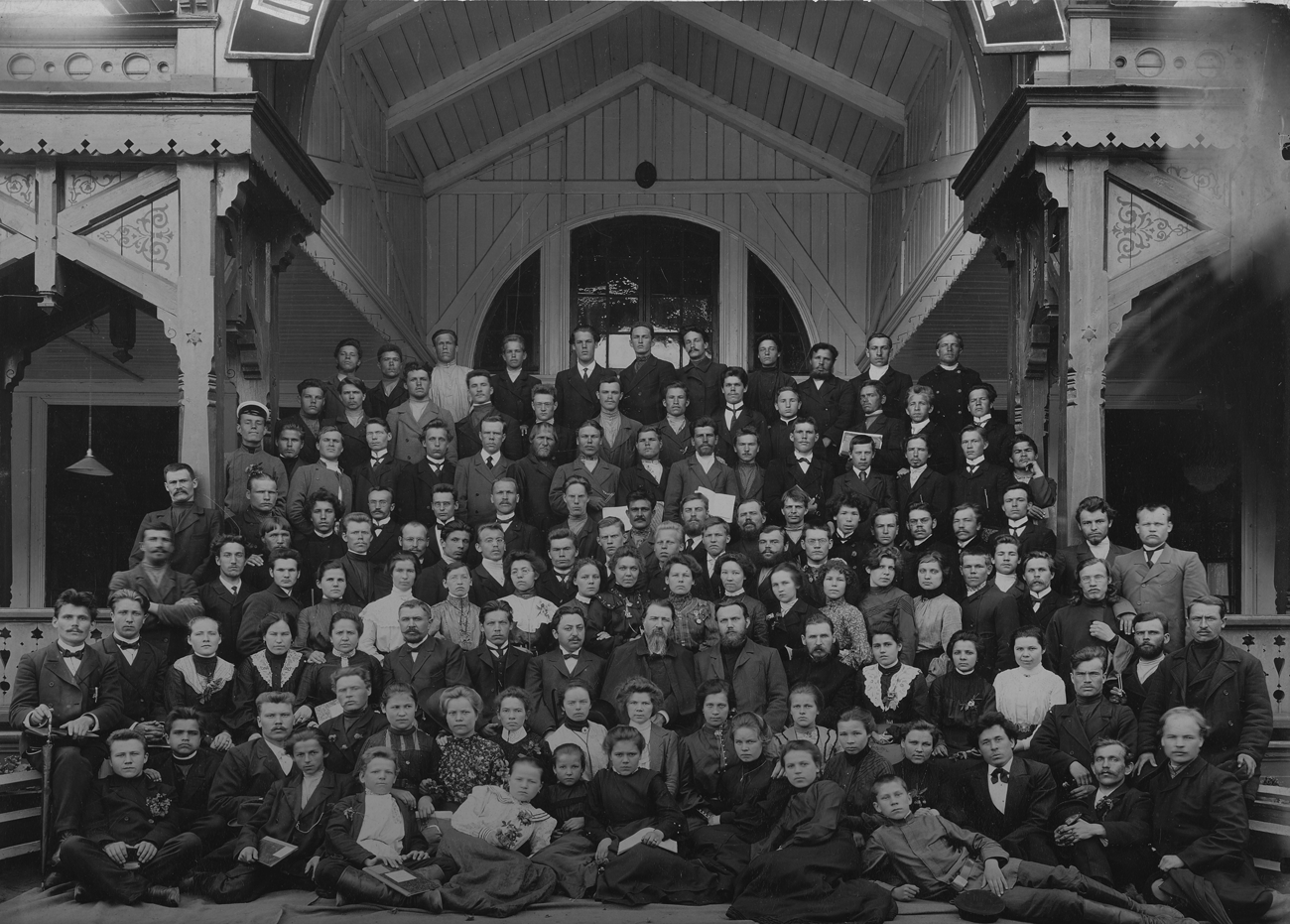
The social diversity is clearly visible in group photographs of summer course participants (see Figure 1). Workers in worn-out coats, peasants with sun-burnt faces in traditionally embroidered linen shirts, and young women in simple shirts and skirts look out at the observer, as do young men in school uniforms and women in well-tailored dresses holding decorated hats. They are seated next to priests in cassocks, intelligenty with glasses, and fashionable men with walking sticks.Footnote 42
Participants of the singing courses. Perm’, June 1905. Courtesy of Gosudarstvennyi arkhiv permskogo kraia (GAPK), F. 690, op. 1, del. 51.

The summer courses, with their demanding schedule, rigorous program of music theory, and ambitious repertoire, were intended to train future choir directors who could conduct singers in parish and school choirs throughout the province. As Shniukova's career illustrates, this program proved successful. She was not the only graduate of the summer courses who went on to pursue a career in music. A decade before her, Maksim Stepanovich Osinovskikh from the village of Kultaevo, located twenty-four versts to the southwest of Perm΄, returned from the 1901 summer courses to become the conductor of his local church choir.Footnote 43 At the same time that Shniukova took up her employment in Krutikhinskoe, her friend and fellow summer course participant Evlampiia Gashkova (later Shtanfel΄) worked as a singing teacher in the neighboring village of Gorskoe, and “the much respected Fedor Spiridonovich Uzkikh, [who] came to the courses as simple village bloke, rose to the position of singing teacher at the women's grammar school” in Ekaterinburg.Footnote 44
The number of active choirs in the province equally demonstrates the success of the program: according to the statistics of the Guardianship, these increased from 191 in 1897 to 321 in 1911.Footnote 45 For its ability to reach thousands of provincial singers and to inspire their enthusiasm, the Perm΄ Guardianship received effusive acclaim. Reportedly, even Minister of Finance Sergei Witte and Tsar Nicholas II took note of the program and endorsed it.Footnote 46
As Witte's and the tsar's approval indicate, Perm΄’s singing program fulfilled a political function. Indeed, it was the Ministry of Finance that set up and funded Guardianships for Popular Sobriety from 1895.Footnote 47 Regional branches of the Guardianship were headed by provincial governors and staffed by local dignitaries. Their aim was to offer ordinary Russians healthy forms of entertainment that, it was hoped, reduced instances of disorderly behavior that the consumption of alcohol frequently engendered. In Perm΄, this meant that successive governors headed the Guardianship, managed its budget, and were responsible for employing choir director Gorodtsov. Additionally, bishops of Perm΄ and Ekaterinburg dioceses, Duma representatives from the region, and other notables supported the scheme, attended opening and closing ceremonies at the summer courses, and addressed participants.Footnote 48
The educational program of the Perm΄ singing initiatives reflected the conservative and monarchic commitments which these figures of authority stood for. Participants in the summer courses sang the national anthem “God Save the Tsar” at opening and closing ceremonies, and they began and ended every day of rehearsals with a prayer.Footnote 49 The repertoire chosen for these courses equally underlined their conservative-patriotic spirit. As guardian Blagonravov explained to Shniukova in 1911, future choir directors should focus on two categories of music: traditional sacred and national secular music.Footnote 50 The first included orthodox chant composed by prominent Russian composers; the second comprised Russian folk song and secular pieces by Russian composers, including A Life for the Tsar.Footnote 51 According to the Guardianship's report for 1913, Glinka's opera was particularly capable of “strengthening a feeling of healthy patriotism and devotion to the Tsar and the Fatherland among the people.”Footnote 52
The overtly political agenda of the Guardianship's activities has raised challenges for later scholarship. Local historians have been aware of the program's impressive contributions to musical culture in the Urals, yet acknowledging the achievements of an explicitly tsarist endeavor was problematic in the Soviet Union. In the 1950s and 60s, Gorodtsov's former student Anatolii Aleksandrovich Lukanin, then a successful music pedagogue in Moscow, first began working on a biography of his former teacher. Lukanin approached other former students, and conducted what we would now describe as oral history interviews, because Gorodtsov's own papers and most documents pertaining to the Guardianship had perished in the civil war.Footnote 53 Among others, Lukanin approached Shniukova and it was for him that she wrote her recollections of the summer courses. She repeatedly encouraged the Moscow-based musician to complete his “important work.”Footnote 54 When Lukanin excused his lack of progress with ill health, Shniukova gave recommendations on how to regain strength. In January 1964, she sent Lukanin New Year's wishes that included the stern injunction, “this year, you definitely have to write the monograph on Aleksandr Dmitrievich [Gorodtsov]!”Footnote 55 However, Lukanin never concluded his work.Footnote 56 Shniukova's letters suggest that Lukanin had lost enthusiasm for this project. Maybe, he saw no way of faithfully portraying the deeply religious and conservative Gorodtsov while also meeting the expectations of Soviet ideology. I. V. Efremov, who eventually published a biography of Gorodtsov, had no such qualms. His 1983 study brazenly turned the choirmaster into a secret atheist and Bolshevik supporter.Footnote 57 Three decades later, V. L. Semenov painstakingly advanced facts from the archives to unmask Efremov's shameless approach.Footnote 58 In contrast to Efremov, Semenov's biography, written in the post-Soviet context of religious revival, makes much of Gorodtsov's childhood as the son of a village priest, his training as a seminarist, and his brothers’ careers as bishops and theologians.Footnote 59
Yet despite their opposing attitudes towards Gorodtsov's politics, Efremov and Semenov, like the musicologists discussed earlier, share a view of historical developments that extolls inspirational individuals and celebrates high culture. Their accounts of the Perm΄ singing program therefore concentrate exclusively on its musical director Gorodtsov and his faultless musical taste. Other supporters, from successive governors to district administrators, zemstvo officials, the church, and a large number of local activists such as music teachers receive no attention at all in these descriptions.Footnote 60 Participants like Shniukova appear in this scholarship as a faceless mass whose homogenous experience was restricted to the passive reception of great art.
Professionalism and Emotionality
For Shniukova and her fellow choristers, the personal artistic development they attained was the most valued accomplishment of the summer courses. “To develop our voices, we practiced scales with one or two voices every day before the singing classes [proper]. We also sang broken chords after Komarov's method. We then split into two groups and practiced for up to eight hours.”Footnote 61
Apart from training their voices, Gorodtsov aimed to give his students an overview of the classical musical repertoire: “In the evenings, we visited concerts to acquaint ourselves with the music.”Footnote 62 As noted above, the Guardianship also ran a lending music library, thereby ensuring that singers retained access to a rich musical tradition, no matter where they were in Perm΄ province. “I constantly used the music from the Guardianship's library,” Shniukova remembered. “At my request, Gorodtsov posted the music to me, and I returned it when the loan period was up.”Footnote 63
Shniukova and her fellow kursisty took great pride in the musical training they acquired at the summer courses. In group photographs, participants hold sheet music, tuning forks, and flowers, underscoring their professionalism of performance artists.Footnote 64 They treasured the diplomas which they received at the courses, and which, although they “did not award any privileges (nikakikh prav)” were nonetheless “meaningful at the provincial school board and the dioceses of Perm΄ and Ekaterinburg”—they mattered for anyone wishing to gain employment as a singing teacher or as the director of a parish choir.Footnote 65
Vocal technique and an understanding of the choral repertoire ultimately served the cultivation of a rich choral sound and tasteful interpretation of the music. At the summer courses, rehearsals with the complete choir “were our absolutely favorite lessons,” Shniukova remembered.Footnote 66 Simultaneously being engulfed by, and contributing to the sound of a one hundred voices-strong ensemble in the large hall of the Bogoroditsa school, where the courses took place, can only have been a memorable experience. The impression of such singing must have been most pronounced during a rehearsal of one of the meditative polyphonous compositions that was part of the curriculum.
But it was not the monumental sound of a large and well-trained choir that mattered most to Shniukova. Instead, she particularly valued expressiveness and musical truthfulness. She was deeply touched when she heard a choir of blind children in Perm΄, also conducted by Gorodtsov. “They loved and revered him so. And how beautifully they sang!…with such expressiveness!”Footnote 67 Shniukova also praised her sister's performance of Antonida in their 1915 rural production of A Life. “My sister Vassa Nilovna was a simple, barely educated (malogramotnaia) village girl, [who] said that she just performed her role as if she herself were Antonida.” At the point in the opera “when the Poles led away her father and she sang [her aria], we could hear sobbing in the audience.”Footnote 68
In Gorodtsov's rendering, which stripped Glinka's aria of the orchestral accompaniment and the solo part of all dramatic coloratura elements, Antonida's “Song” was a simple G-minor melody of lament, a few times interrupted by pulsating thirds or octaves from a small female choir.Footnote 69 Because Vassa—unlike most professional opera singers—would not have employed any vibrato, nor would she have had to ensure that her voice was heard over woodwinds and strings, or that it filled a large opera house, her performance reduced Glinka's lament to its most intimate element. This allowed the village ensemble to communicate the musical and sentimental authenticity that Shniukova valued so greatly. In the words of the journalist writing for Irbitskaia zhizn΄, Shniukova's troupe gave the audience “moments of great spiritual and aesthetic pleasure.”Footnote 70
Other accounts equally described the singing in Perm΄ choirs as inherently spiritual experiences. In a detailed discussion of Gorodtsov's pedagogy, V. Lebedev noted in 1909 that the focus on musical theory ultimately served the education of “a harmonious, comprehensive development of man's inner life (duzhevnaia zhizn΄)” and led “into the world of ideal feelings [where] the highest needs of the soul” could be met.Footnote 71
It is noteworthy that no report about choral performances in Perm΄ province ever mentioned any musical shortcomings. We learn nothing of the numerous pitfalls that normally plague ensembles: imperfect intonation, awkward phrasing, the absence of nuanced dynamics, inappropriate tempi, and thin vocal timbres, as well as others. Privileging intensity of feeling above technique as the true essence of music allowed genuine art to be located within an individual performer or audience member wherever they found themselves.
A Community of Singers
While the meaning of music was personal and thus independent of place, networks of singers situated musical experience within the Perm΄ region. After all, the personal aesthetic development that Shniukova and other singers valued so highly was only possible within a collaborative social context. To successfully perform a piece of choral music, Perm΄’s singers had to listen closely to one another and adjust their voices, in volume and pitch, to each other. In addition to this harmonic and dynamic collaboration, they had to coordinate rhythmically. During performances, moreover, singers needed to establish rapport with audiences or they would fail to express the emotional truthfulness that Shniukova was striving to communicate. It is not surprising that a month away from home with intensive daily rehearsals also gave rise to strong social ties anchored in local and provincial spaces.
The most immediate community which Perm΄’s musical program engendered was that of the course participants themselves. “For a month, we kursanty lived like one family,” Shniukova remembered.Footnote 72 Indeed, group photographs of participants resemble pre-revolutionary family portraits. They show men and women of different generations in affectionate poses. In the picture of 1905, for example, a number of singers have laid their hands on their neighbors’ shoulders, and some of those seated in the front row lean their bodies against those behind them.Footnote 73 Gorodtsov, seated in the center, was the undisputed father figure in this extended musical family. “All participants revered and loved our director Aleksandr Dmitirevich [Gorodtsov],” Shniukova remembered. “I have to say that we loved Gorodtsov like a father, after all he gave us so much that was new to us then.”Footnote 74 The sense of kinship among participants was reinforced by the presence of relatives: Elizaveta's elder sister Vassa also travelled to Perm΄’ in 1915, where Gorodtsov was joined in his pedagogical efforts by his son Andrei.Footnote 75 This community of singers, like their music-making, engendered heartfelt emotions. “When saying farewell, we gave speeches expressing our gratitude [and] we promised to apply our newly-acquired abilities back home. The participants often even cried when saying good-bye. Frequently, Al[exander] Dim[trievich Gorodtsov] also shed tears.”Footnote 76
That a large group of people from diverse regional and social backgrounds should be able to form a family built on mutual respect is noteworthy, given that historians commonly describe social relationships in this period as antagonistic. Mutual respect also manifested itself in non-musical areas. Gorodtsov, Shniukova recalled, never talked over the heads of ordinary people, but instead took them seriously. He “conducted his lessons…very clearly and with simple language…He stood next to the blackboard, chalk in hand, explained and wrote. We saw intellect and deep thought.”Footnote 77
Living up to the ideal of the stern bourgeois father—and indeed mirroring the image of the good tsar on a smaller, choral scale—Gorodtsov was a demanding teacher, who expected hard work from his singers, excluded lazy participants from the classes, and withdrew their stipends. Yet he expressed respect for those who shared his commitment to music. “He always came to the lessons on time, even though he was so busy…and he was neatly dressed, I remember, in a black suit with starched collar and cuffs with cufflinks. He was always polite, attentive and kind.”Footnote 78
Gorodtsov's commitment to his students helped sustain networks throughout the province. Every year—in a manner once more resembling the good ruler surveying his lands—he travelled many hundreds of versts to visit regenty in their villages, helping with rehearsals, distributing music and instruments, and giving advice. In 1915, for example, he called on forty local ensembles in seven different districts of Perm΄ province.Footnote 79 Two of these trips entailed meetings with Shniukova. “At the [summer] courses he said ‘If anyone needs my help with the production [of A Life], let me know, I will come,” and he agreed to star as Susanin in two of her performances.Footnote 80 When the singers in Krutikhinskoe heard the good news, they were exuberant. Gorodtsov's promise “inspired the whole collective and everyone worked with even greater energy towards the performance.”Footnote 81 When their maestro finally arrived in Krutikhinskoe, the singers were deeply touched. “He was no longer young at that time (being over 60)….We were literally in tears from happiness when we saw him.”Footnote 82 The former professional opera singer thus performed his favorite role twice on the village stages of Irbit district in 1915: at the premiere in Krutikhinskoe on January 4, and, four months later and twelve versts to the north, at a repeat performance in Belosludskoe.Footnote 83
Gorodtsov was not the only force keeping the family of singers together. Kursanty themselves also maintained their networks. Sacristan P. I. Bashkirov, who sang the role of Sobinin in Shniukova's production, rode seventy versts on horseback from the village of Kostinskoe in northwestern Irbit district to rehearse and perform in Krutikhinskoe; Vassa Shniukova travelled forty-four versts from Ilenskoe; and Nikolai Akesandrovich Zadorkin, who was in charge of costumes and scenery, came from Perm΄, where he studied at the theological seminary.Footnote 84 Shniukova's close friend Gashkova, who sang the role of Vania, walked ten versts from the neighboring village of Gorskoe to attend rehearsals and performances.
These networks were strongest in the participants’ home districts: three of Shniukova's soloists came from other villages in Irbit district, only one was from another part of Perm΄ province. With time, however, this network also included former fellow-choristers Uzkikh and Lukanin, thus extending participation to Ekaterinburg and even to Moscow.
Rehearsals and performances in their home villages, moreover, ensured that the network of kursanty extended into local village societies. In Krutikhinskoe, Shniukova rehearsed the choir sections of A Life with enthusiastic villagers, and she “very successfully taught” N. Trofimov and S. Spirin, two local inhabitants, their solo parts as commanders of the Polish and Russian detachments, respectively.Footnote 85 Shniukova was also grateful for the practical support that she received from village teacher Anna Nikanorovna Tikhonova, who opened the school for rehearsals and sang in the choir herself.Footnote 86
The performance of A Life in Krutikhinskoe took place in the “narrow wooden barn of the local fire brigade.”Footnote 87 “Fire engines and other equipment stood in the barn. There was an elevation at one side of the barn, which served us as the stage.”Footnote 88 Although the dressing room was so small that the singers had to change into their costumes at home, the setting also had its advantages: “The timbered walls were perfectly appropriate for Susanin's peasant hut,” Shniukova remembered. Other decorations required more work. “For the scenes in the forest we cut fir trees,…the snow was cotton wool,” and the Kremlin walls were cut out of plywood.Footnote 89 The ensemble produced a “bill written on a typewriter. This bill was amended with a pen” for subsequent performances.Footnote 90 Tickets cost between ten kopecks and 1.3 roubles, and all performances were sold out.
Shniukova and her troupe not only treated her audience to the operatic narrative of Susanin's patriotic sacrifice. They also served tea and refreshments during the interval, and arranged dances after the show.Footnote 91 We can assume that performers and members of the audience mingled during the interval and danced together after the end of the opera. The village institutions at which singers rehearsed and performed, the typewriters that Shniukova's troupe borrowed, and fir trees that they received integrated the show into village life. The merrymaking after the show blended the celebrated performance with rural customs in yet another way: these activities fell within the sviatki traditions of the Russian peasantry, that is, social gatherings between Christmas and Epiphany.
Learning and performing an ambitious piece of music engendered a sense of camaraderie which connected local inhabitants for decades to come. Shniukova's close friendship with Gashkova lasted until at least 1961, when the two women jointly signed letters to Lukanin.Footnote 92 At the same time, Shniukova borrowed photographs of the performance from former village artists and lent them to Lukanin for his planned study about Gorodtsov. When the Moscow scholar was slow to return one photograph in particular, she reproached him, explaining “the citizen (grazhdanin) who sent [the picture] to me asked me to return it as quickly as possible, and I gave him my word.”Footnote 93
While village productions of Glinka's opera fostered local bonds, the Guardianship's music program also opened avenues through which singers partook in national culture. Photographs of Shniukova's troupe show Bashkirov and Gorodtsov proudly holding the score of Glinka's canonical opera.Footnote 94 Singers in Perm΄ and Ekaterinburg celebrated national culture by marking significant events in Russia's history with public performances. In 1911 they gave concerts in memory of the composer Nikolai Rimskii-Korsakov, and commemorated the fiftieth anniversary of the liberation of the serfs.Footnote 95 Indeed, various dynastic and cultural jubilees provided the impetus for Gorodtsov's adaptation of A Life. In 1896, to celebrate the coronation of Nicholas II, Gorodtsov arranged the first two arias “V buriu, v grozu” (In storm and gale) and “Slav΄sia” (Be Glorious) for choir. More followed in 1904, when the country celebrated Glinka's centennial birthday, and in 1907, the fiftieth anniversary of the composer's death.Footnote 96
The Perm΄ Guardianship of Popular Sobriety published Gorodtsov's complete adaptation of A Life on the occasion of the 300th anniversary of the Romanov dynasty. The date was aptly chosen for an opera that oozed monarchism. The cover of Gorodtsov's score prominently displayed portraits of the first Romanov tsar alongside the current Emperor Nicholas II. How important the monarchic message was to Gorodtsov can be gauged by the fact that he offered two versions of Susanin's aria “Vysok i sviat nash tsarskii dom” (Elevated and Sacred is our Ruling Dynasty): one in C major, the other a fourth higher, thereby providing basses who struggled with the low notes with a more comfortable arrangement.Footnote 97
With the outbreak of war in the summer of 1914, Glinka's opera acquired yet another layer of significance. Antonida's yearning to be reunited with her fiancé and her lament for her father would have resonated with audiences’ worries for the lives of husbands, sons, and brothers at the front. The Great War affected the lives of Perm΄’s singers in dramatic ways. Choirs found it difficult to carry on because their male members or conductors had been conscripted, some of whom fell at the front.Footnote 98 It was only appropriate, then, that Shniukova and her ensemble chose to donate part of the proceeds from their operatic performance to “wounded and injured soldiers.”Footnote 99 Later in the year, she and her fellow choristers sang the national anthem and a few arias from A Life for convalescing soldiers in Perm΄, once more underscoring the strong link between their musical activities and the war effort.Footnote 100
Commemorations of national composers, historic events, and contributions to the war effort illustrate that singers in Perm΄ saw themselves as a self-evident part of the Russian nation. That membership, however, did not mean that musicians in the provinces merely joined in with festivities established elsewhere. They also shaped early-twentieth century Russian culture in their own right. Location mattered greatly in this respect. The size and remoteness of Perm΄ guberniia gave Gorodtsov, Shniukova, and their fellow choristers artistic space and agency that they would have lacked elsewhere. Moscow and Petersburg were musically crowded: imperial operas, the Court kapella, the Synodal School, the country's leading conservatories, and private companies competed for the best musicians of the Russian empire and Europe, and for the attention of audiences. In the busy capitals, Gorodtsov would not have had the visibility, official backing, and loyal audience necessary to become the towering figure of musical life that he came to be in the Urals.
Remoteness was equally decisive for Shniukova's musical and directorial success. According to Andrei Gorodtsov's instructions on how to successfully stage A Life, it was vital that singers “unquestionably subordinated themselves to the person directing the show.”Footnote 101 In the capitals, a 22-year-old unmarried peasant women would not have had the authority to command an ensemble consisting of, among others, older men. Yet Shniukova was not the only female opera impresario working in remote locations across Perm΄ province at the time. In Dobrianka factory settlement, sixty-five versts upstream from Perm΄ on the Kama river, parish school teacher A. M. Dubrovina directed a particularly successful church choir that had developed a wide-ranging repertoire with which she performed A Life in 1915.Footnote 102 Shniukova and Dubrovina could point to at least eight more fellow women choir directors in remote settlements of Perm΄ province. One of them was М. Vl. Ignat΄eva, wife of the priest of Sugoiak. “Sugoiak is a real god-forsaken place (medvezhii ugol) on the border of Bashkiriia,” Gorodtsov wrote in his 1915 report, and a 1902 directory of local settlements noted that Sugoiak's location in a swamp meant that villagers lacked basic access to pure drinking water.Footnote 103 Remoteness and putrid water notwithstanding, Ignat΄eva organized and conducted thirteen concerts in the village and a neighboring settlement.Footnote 104
These energetic but forgotten female conductors shed light on the role of women in Russian choirs.Footnote 105 Scholars of Russian choral singing have paid significant attention to the early-twentieth century debate among conductors of whether to include female voices in parish choirs. They concluded that women were only “gradually” included in ensembles “over the first two decades of the twentieth century.”Footnote 106 Choral practice in the Urals, however, indicates that we need to differentiate between what contemporaries considered important and appropriate in Moscow and St. Petersburg and musical practices elsewhere. The inclusion of women in the Perm΄ Guardianship's training program for choir directors in 1898, while a shift in policy, does not seem to have raised local tempers. Indeed, female singers were commonplace in parish choirs by 1900, and probably had been so before.Footnote 107 If a mixed choir, or even more so one directed by a female professional, was a revolutionary sight, this was only the case in St. Petersburg and Moscow, where both the Court kapella and the Synodal Choir remained single-sex until 1917.Footnote 108
Shniukova's and Dubrovina's directing of parish singers and opera productions also forces us to reconsider the relationship between secular and religious choirs. When judged from the writings of St. Petersburg and Moscow commentators, these appear to have been separate entities.Footnote 109 The Perm΄ summer courses, however, were supported by state and church figures; at them, participants learned religious and secular music, performed during liturgies and in theaters, and ultimately found employment as teachers and parish choir conductors. Even once they were employed either by the church or state school boards, graduates continued moving between religious and secular genres and venues.
Crossing over secular and religious musical traditions was pragmatic in that it prepared graduates for church and school posts, and was simultaneously in line with empire-wide developments of choral reform. Gorodtsov's educational program was inspired by the reformed curriculum of the Court kapella and the syllabus of the Synodal Choir school.Footnote 110 Musical reformers in Moscow and St. Petersburg also expanded the choral repertoire by performing both secular and religious compositions, bringing religious music into secular venues and blurring the boundary between lay and professional musicians. Gorodtsov and his colleagues in the capitals moreover stressed “musical literacy,” a solid grounding in music theory, and instrumental training.Footnote 111
When it came to the widening of music's social reach, provincial choirs were at the forefront of developments, and the Perm΄ program soon became the empire's beacon of success. Even though singing camps for local residents had taken place in Kiev in 1884, in Novocherkassk in 1890, in Lipetsk in 1895, and in Ekaterinodar in 1896, none of these programs were as long-lived or as far-reaching as the one in the Urals.Footnote 112 As mentioned above, music journalists described the Perm΄ program at length and recommended it for adaptation throughout the country. Other provincial authorities turned to the Perm΄ Guardianship for advice. The Perm΄ committee responded by printing a brochure about its initiatives and distributing it generously to other provincial administrations.Footnote 113 Gorodtsov even travelled to other provinces and advised local bureaucrats.Footnote 114
In the summer of 1905, S. V. Smolenskii, often regarded as the empire's most famous choir reformer, wrote from Petersburg asking Gorodtsov for his advice on popular choirs. “You know very well that I constantly follow your excellent activities with great affection and admiration,” Smolenskii wrote, before explaining that he intended to organize choral summer courses for primary school teachers in the capital and hoped to benefit from Gorodtsov's experience.Footnote 115 The courses for choir directors that Smolenskii established in 1907, then, were not pioneering endeavors as described by previous scholarship, but owed their conception to the educational programs established a decade earlier in provincial Perm΄.Footnote 116 Ten years after his correspondence with Smolenskii, and after the latter's untimely death, Gorodtsov attended the First All-Russian Congress of Popular Theater Activists in Moscow between December 27, 1915 and January 5, 1916, where he informed a large audience about the Perm΄ scheme.Footnote 117 The Perm΄ experience thus shaped what Soviet musicologist V. Il΄in describes as the democratizing trend to bring choral music to the people in the 1900s and which continued into the Soviet period.Footnote 118
The Perm΄ program also affected the repertoire of Russian choral culture, although the religious and royalist music that predominated the Guardianship's courses meant that this influence was less long-lived. The first 1000 copies of Gorodtsov's adaptation of A Life, published in 1912, had been sold or distributed to students within eleven months, and were followed by a second edition of 1200 copies in 1913.Footnote 119 While most of these scores probably stayed in the Urals, some left Perm΄ province. On March 17, 1913, amateurs in St. Petersburg performed “A Life for the Tsar in the redaction of the famous Perm΄ activist A. D. Gorodtsov.” According to Russkaia muzykal΄naia gazeta, the show went “quite well” and the work was enthusiastically recommended for other ensembles.Footnote 120 And indeed, in 1914, workers in Kostroma on the Volga “dazzled the audience” with a production of A Life under the direction of singing teacher M. Ia. Egorova.Footnote 121 Two years later, the same Petersburg ensemble performed Gorodtsov's next operatic adaptation, Bogatyr Il΄ia Muromets.Footnote 122 Bogatyr Il'ia Muromets was favorably reviewed in Zhurnal ministerstva narodnogo prosveshcheniia (Journal of the Ministry of Education) and recommended by the Ministry for use in schools.Footnote 123
Elizaveta Shniukova's story of a young peasant women who trained as a musician in the provincial capital of Perm΄ before directing rural performances in one of the region's Asian districts seems at first glance extraordinary. However, what is most unusual about her narrative is that she wrote it down. Her roughly 2000 fellow-kursanty in Perm΄ province and many more committed choristers throughout the empire did not leave detailed accounts of their lives in music.Footnote 124 Rather than treating Shniukova's experience as a merely colorful but otherwise inconsequential episode, it is worthwhile contemplating its historical significance.
Shniukova's music making demonstrates, first, that musicians of modest background, many of them women, played a key role in spreading cultural values and shaping musical life, a contribution that musicology, with its focus on artistic genius, has thus far not appropriately acknowledged. Women's historians, by focusing on eloquent intelligentsia women and the obstacles they faced in making professional use of their education have also overlooked the success of lower-class women in the arts.Footnote 125
Second, Shniukova's account illustrates that singers in early twentieth-century Russia were part of a remarkably broad artistic collaboration between peasants, workers, the regional intelligentsia, and state officials. Through the Guardianships of Popular Sobriety, local government responded to the cultural needs of peasants, workers, and townspeople, and established patterns of state support for popular participation in the high arts that would endure throughout the twentieth century.Footnote 126
It is not straightforward to assess, however, how ordinary singers in early twentieth-century Russia related to the political conservatism that underpinned the Guardianship's educational program. Rural opera troupes clearly valued the praise they received for their efforts from village audiences, regional journalists, local dignitaries, and impressed commentators in St. Petersburg and Moscow. What is more, Gorodtsov's adaptation of A Life for the Tsar might—inadvertently—have toned down the opera's bombastic monarchism. Without an orchestra, without powerful operatic voices, and bereft of hundreds of bars of Glinka's music, the village version of A Life was musically far more intimate than the original. Moreover, the barn of the village fire brigade provided a considerably more modest setting than an opera house, which would have boasted classical external architecture, a richly-decorated foyer, and a palatial performance space. Rather than entering the opulent world of the opera, villagers in Krutikhinskoe stayed in Susanin's peasant hut. However, Shniukova's approval of Gorodtsov's dapper appearance and the presents with which choristers thanked their conductor for his commitment—icons, portraits of composer Balakirev, a writing set, twelve silver spoons or a golden tuning fork—suggest that kursanty shared his high regard for the national cultural canon, for domesticity, and for Orthodox Christianity; values which also underpinned autocratic ideology.Footnote 127
Third, Shniukova's story shows that the widespread enthusiasm for choral music linked performances in villages with cultural life in regional towns and musical developments in the capitals by the turn of the century. Yet differences between provincial tastes and those in the capitals also come to the fore in an analysis of Shniukova's work. The enthusiasm for A Life in the provinces diverges from Marina Frolova-Walker's observation that the opera's popularity declined from the 1860s, when the progressive intelligentsia felt increasingly embarrassed by Susanin's monarchism.Footnote 128 While the Romanovs were viewed critically by the refined intelligentsia in the empire's cultural centers, Glinka's opera engendered heartfelt enthusiasm among the country's provincial music-loving majority.
A further difference between musicians in St. Petersburg and singers in the Urals was their relationship to national culture. Unlike the eminent musical intelligentsia or later scholars, ordinary singers in the Urals felt no need to define Russia musically, but saw themselves and their own music-making as self-evidently Russian. From the provincial perspective then, the relevance of debates about the Russianness of Russian music has been severely overstated.Footnote 129 Instead, it was the musical skill, aesthetic education, and professional friendships that mattered most deeply to provincial singers, and became an important part of how they defined themselves. This was the reason why Shniukova—in a very different political climate—wholeheartedly defended Gorodtsov's integrity, even if tactfully passing over the more “inappropriate” aspects of his activities.Footnote 130
Finally, Shniukova and her fellow kursanty rejected the peripheral position that their location and social position might otherwise suggest. For them, musical skills and professional identities were formed in regional centers and collegiate networks anchored in home districts. The national canon was not a privilege reserved exclusively for urban music lovers–complex operatic works were also accessible in some form and brought enjoyment in villages. Even more importantly, meaningful aesthetic experience was not restricted to refined audiences in Moscow and St. Petersburg. It also occurred in Perm΄, where a former opera singer, clerics, workers, and teachers cried when they took farewell; or in the village of Krutikhinskoe, where villagers were moved to tears by Antonida's aria.Footnote 131