

“Knowledge is power. Information is liberating. Education is the premise of progress, in every society, in every family.” (Kofi Annan, Reference Annan1997)
Recent policy trends have focused on tapping into the potential power of the informed consumer to make decisions that control costs and improve individual and societal outcomes. As a result, data are increasingly available to the public in medicine, finances, the environment and elsewhere. In medicine, for example, informed decision making (defined as a process in which patients receive sufficient information about risks, benefits, limitations, alternatives and uncertainties in order to make a value-concordant decision and participate in decision making at a desired level; Braddock et al., Reference Braddock, Fihn, Levinson, Jonsen and Pearlman1997, Reference Braddock III, Edwards, Hasenberg, Laidley and Levinson1999) allows patients to take charge of their health by making good choices about consumer-directed health plans, surgical and other treatment risks and evidence-based medicine. Research in fact demonstrates that these activated patients have better health outcomes and lower costs (Ward et al., Reference Ward, Sundaramurthy, Lotstein, Bush, Neuwelt and Street2003; Greene & Hibbard, Reference Greene and Hibbard2012; Greene et al., Reference Greene, Hibbard, Sacks, Overton and Parrotta2015). Patient engagement in medical decisions is critical because, in the end, it is the patient who has to take the medication once prescribed, who has to show up ready for surgery once it has been scheduled and who has to make lifestyle changes to eating, exercise and smoking once recommended. Patients, however, do not always follow medical advice on prescription medications; about 20–30% are never filled, and about half of ongoing chronic disease medications are not taken as prescribed (Osterberg & Blaschke, Reference Osterberg and Blaschke2005; Bosworth et al., Reference Bosworth, Oddone and Weinberger2006; Bosworth, Reference Bosworth2012; Zullig et al., Reference Zullig, Shaw, Bosworth, Marsch, Lord and Dallery2014). And of course, it is well known that large proportions of people do not follow eating, exercise and smoking advice (Wilfley & Brownell, Reference Wilfley, Brownell and Dishman1994; Brownell & Cohen, Reference Brownell and Cohen1995; Abraham et al., Reference Abraham, Norman and Conner2000). This non-adherence is costly in terms of increased healthcare utilisation and poorer outcomes. These are all good reasons to promote better informed and more activated patients. Similarly, in financial domains, consumers must protect themselves against payday loans and phishing schemes and prepare for their future through retirement savings. In environmental domains, public stakeholders are involved in protecting and ensuring appropriate uses of public goods such as parks, water, clean air and climate.
A problem exists, however, in that not all individuals understand presented information either because the information is not presented in a comprehensible format and/or because the consumer's skills to make decisions in the domain are lower than preferred. In the present paper, I examine two broad ways of educating consumers in order to encourage better choices. An analogy exists with running hurdles on a track (hurdling is the act of running and jumping over an obstacle at speed). Hurdling is difficult, but it can be made easier in either of two ways: you can make the hurdles shorter or you can make the runner stronger. Either method will lead to greater success. The same thing is true of educating decisions: you can make the information easier to comprehend and use or you can improve the individual's decision-making competencies.
In the first part of the present paper, I consider knowledge-based educational interventions in decision making (e.g. decision aids), which promote deeper knowledge and/or make critical information more salient. These interventions are often used in medicine and elsewhere in order to promote informed decision making. When individuals access, understand and use this information, they can increase control over their experiences and outcomes. However, the data are often confusing and overwhelming for lay people; therefore, I briefly review evidence-based strategies for how to present information in order to facilitate informed decision making. When information is presented strategically, decision makers can understand it better, use it more and make more informed and value-concordant choices. Then, the second part of this paper questions whether knowledge is adequate on its own. Educating good decisions may also require the identification and teaching of competencies that are critical to effective decision making. In particular, I consider evidence for formal schooling (years of education) and specific numeracy training as long-term foundations for good decision making.
Decision aids and other educational efforts to increase knowledge
To improve decisions across a multitude of domains, researchers and policy makers have often considered short-term educational interventions in order to increase knowledge and improve particular decisions. For example, educational efforts have aimed to teach older adults how to prevent falls (Chang et al., Reference Chang, Morton, Rubenstein, Mojica, Maglione, Suttorp, Roth and Shekelle2004) and improve nutrition (Sahyoun et al., Reference Sahyoun, Pratt and Anderson2004). The medical decision-making literature abounds with decision aids intended to improve knowledge in areas as diverse as prostate and colon cancer screening, hormone-replacement therapy, male new-born circumcision and rheumatoid arthritis (e.g. O'Connor et al., Reference O'Connor, Stacey, Entwistle, Llewellyn-Thomas, Rovner, Holmes-Rovner, Tait, Tetroe, Fiset, Barry and Jones2003; Fraenkel et al., Reference Fraenkel, Peters, Charpentier, Olson, Errante, Schoen and Reyna2012, Reference Fraenkel, Matzko, Webb, Oppermann, Charpentier, Peters, Reyna and Newman2015). Schroy et al. (Reference Schroy, Emmons, Peters, Glick, Robinson, Lydotes, Mylvanaman, Evans, Chaisson, Pignone, Prout, Davidson and Heeren2011), for example, developed a decision aid for colorectal cancer screening guided by constructs of the Ottawa Decision Support Framework (O'Connor et al., Reference O'Connor, Drake, Fiset, Graham, Laupacis and Tugwell1998, Reference O'Connor, Tugwell, Wells, Elmslie, Jolly, Hollingworth, McPherson, Bunn, Graham and Drake1999). Colorectal cancer is the second leading cause of cancer-related death in the USA and the third most commonly diagnosed cancer, but 50% of eligible Americans do not get appropriate screening (Shapiro et al., Reference Shapiro, Seeff, Thompson, Nadel, Klabunde and Vernon2008). The decision aid was designed with an audiovisual and touchscreen format to simplify its use for individuals with limited literacy or computer skills and was composed of a series of modules in which diverse, professional actors played roles and conveyed relevant information via onscreen video, animation and/or graphics. One module, for example, was composed of brief descriptions of five recommended screening methods, whereas another included audio and visual (i.e. traffic light graphic) comparisons of each screening method with respect to individual test features (e.g. test accuracy, inconvenience and possible complications). The comparisons were intended to allow patients to more easily understand the differences between screening options (e.g. for test accuracy). We also explicitly included a no-screening option to educate patients on the difference in risk between getting versus not getting screened (regardless of what screening method they chose). With exposure to the decision aid compared to no exposure, knowledge, satisfaction with choice and intentions to get screened were all higher. In other words, informing choices helped. Indeed, exposure to decision aids generally increases knowledge and decreases decisional conflict in medical choices (O'Connor et al., Reference O'Connor, Stacey, Entwistle, Llewellyn-Thomas, Rovner, Holmes-Rovner, Tait, Tetroe, Fiset, Barry and Jones2003).
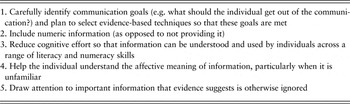
Policy makers, however, need to be aware that how options and information are presented matters to consumer comprehension and use of that information. Providing the right facts is not enough; information providers also need to provide those facts in a comprehensible and easy-to-evaluate manner so that complex content can be understood and used by decision makers. In particular, five evidence-based communication strategies have been shown to facilitate the comprehension and use of appropriate information (see Table 1 and, for a more detailed explanation, Peters et al., Reference Peters, Meilleur and Tompkins2014).
Five recommendations to facilitate communication.

Graphic warning labels increase knowledge
The use of graphic warning labels on cigarette packages can be seen as an exemplar of a communication that uses many of these evidence-based practices in an attempt to combat a worldwide smoking habit. According to the US Centers for Disease Control (2016), smoking harms nearly every organ of the body, and it is the leading cause of preventable death in the USA, with more than 480,000 smoking-related deaths per year. The average smoker dies 10 years earlier than the average non-smoker. In addition, more than 16 million Americans live with smoking-related disease. This means that, for every person who dies because of smoking, at least 30 people live with a serious smoking-related illness, such as cancer, heart disease, stroke, lung disease, diabetes and chronic obstructive pulmonary disease, which includes emphysema and chronic bronchitis, tuberculosis, certain eye diseases, problems of the immune system (including rheumatoid arthritis) and erectile dysfunction in males. In addition, if smoking rates do not change, 1 in 13 young Americans (aged ≤17 years) alive today are expected to die from smoking-related disease. However, quitting can have marked benefits. Adults who quit smoking at 25–34, 35–44 or 45–54 years of age are expected to gain about 10, 9 and 6 years of life, respectively, as compared to those who continue to smoke (Jha et al., Reference Jha, Ramasundarahettige, Landsman, Rostron, Thun, Anderson, McAfee and Peto2013).
Smokers have some knowledge of these major health risks (Kenkel & Chen, Reference Kenkel, Chen, Jha and Chaloupka2000; Kennedy et al., Reference Kennedy, Spafford, Parkinson and Fong2011), but in-depth knowledge of tobacco's health risks is low (Smith et al., Reference Smith, Bansal-Travers, O'Connor, Brown, Banthin, Guardino-Colket and Cummings2011). Research shows that most people can name only one to two of the many diseases caused by smoking (Weinstein et al., Reference Weinstein, Slovic, Waters and Gibson2004). Little knowledge exists about the numeric likelihoods of smoking-related disease, and most adults and adolescents overestimate the likelihood that lung cancer is curable (Weinstein et al., Reference Weinstein, Marcus and Moser2005). Adolescents’ risk understanding and perceptions appear to be lower than those of adults (US Department of Health & Human Services, 1994; Kenkel & Chen, Reference Kenkel, Chen, Jha and Chaloupka2000; Slovic, Reference Slovic2001). Tobacco users also minimise personal risk and demonstrate an ‘optimistic bias’ (Weinstein, Reference Weinstein1998; Weinstein et al., Reference Weinstein, Marcus and Moser2005; but see Viscusi, Reference Viscusi2000; Dillard et al., Reference Dillard, McCaul and Klein2006).
Graphic warning labels on cigarette packs are one educational intervention being used in at least 100 countries worldwide (Canadian Cancer Society, 2016). Their use takes advantage of four of the five evidence-based strategies in Table 1. First, they have identified a communication goal to increase knowledge and decrease smoking. Second, the use of graphic images to supplement more complicated text may reduce cognitive effort in understanding smoking-related disease, perhaps helping less educated populations the most (Niederdeppe et al., Reference Niederdeppe, Fiore, Baker and Smith2008). Third, the graphic warnings provide affective meaning to smoking-related diseases that are otherwise potentially abstract and meaningless to smokers (Peters et al., Reference Peters, Romer, Slovic, Jamieson, Wharfield, Mertz and Carpenter2007; Kees et al., Reference Kees, Burton, Andrews and Kozup2010). This affective meaning may promote a series of cognitive and behavioural responses that influence smoking knowledge, perceptions and behaviours (Peters, Reference Peters, Lichtenstein and Slovic2006). Finally, the graphic warnings draw more attention than text-only warnings (Strasser et al., Reference Strasser, Tang, Romer, Jepson and Cappella2012). However, until recently, graphic warnings had been studied only in surveys and small experimental studies with limited exposures to the warning labels.
In the first randomised clinical trial of smokers in a naturalistic setting, Evans et al. (Reference Evans, Peters, Strasser, Emery, Sheerin and Romer2015) found that, compared to text-only warnings, placing graphic warnings on smokers’ cigarette packages each week for 4 weeks: (1) increased negative affect to smoking; (2) heightened scrutiny of smoking's risks; (3) improved the perceived credibility of the warnings; and (4) increased label memory. The increased knowledge mediated the effects of the graphic warnings on increased risk scrutiny and perceived credibility. Additional indirect-only effects ensued on heightened risk perceptions, quit intentions and risk knowledge. Overall, emotional reactions to the warnings helped smokers to understand the risks of their habit better and encouraged them to quit. A later, larger clinical trial demonstrated that graphic warnings indeed increased quitting (Brewer et al., Reference Brewer, Hall, Noar, Parada, Stein-Seroussi, Bach, Hanley and Ribisl2016).
These results have implications for graphic warning policy and also for how behavioural scientists can work with law makers so that research into the effectiveness of educational interventions does not get ‘lost in translation’ in the legal process (Peters et al., Reference Peters, Evans, Hemmerich and Berman2016). In the case of graphic warnings, the US courts reasoned that graphic warnings cued emotional responses, and therefore could not be considered ‘factual’. They did not consider, however, the warnings’ multiple psychological effects on risk education. Emotional influences on cognition, although not always appreciated by law and policy makers, are deeply rooted in human evolutionary history (Blanchette et al., Reference Blanchette, Marzouki, Claidière, Gullstrand and Fagot2016). Behavioural scientists can work with attorneys and others in order to interpret and apply behavioural research effectively.
Formal schooling and numeracy interventions
The interventions discussed thus far assume that more knowledge leads inevitably to better decisions and outcomes. However, knowledge may not always be enough, because decision makers need to think and reason about facts, be motivated by their meaning and be able to quell short-term desires and overcome mindless habits. For example, knowing that smoking is bad and exercise is good often does not affect change. One can also know that purchasing $40 a day of lottery tickets is unlikely to yield the big winner, but hope that it might (and continue to buy tickets). As a result, in my laboratory, we have recently become interested in the role of education – formal schooling (the number of years spent in school) and more specific numeracy training with adults – and their potential effects on decision-making competencies as a back door to improving decision making. Education interventions that build adult capacity may better allow decision makers to bring knowledge to bear on decisions, think probabilistically, use heuristic processing less and consider alternative scenarios.
Formal education and improvements to health and wealth
Formal education is widely acknowledged to have ‘silver bullet’ properties on health and wealth. But why and how does education have these positive effects? To start to examine this question, we went to rural areas in sub-Saharan Africa in the eastern side of Ghana and to the highlands of Peru where the Quechua peoples live. We chose these places in order to study the decision-making and health effects of greater schooling in populations with fewer issues of selection bias and endogeneity than what we can find in more developed countries (for obvious reasons, we cannot randomly assign children to years of education). Individuals in these areas varied widely in terms of their years of formal education, but shared similar histories in terms of parental educational levels and post-schooling employment; their reasons for continuing or discontinuing schooling also appeared to be non-academic (e.g. individuals indicated the need to quit schooling because a family injury occurred and they were needed on the farm or in the home).
We were particularly interested in education's potential effects on the problem of HIV/AIDS in these two countries. Numerous international non-governmental organisations, particularly in sub-Saharan Africa, have developed and distributed HIV/AIDS prevention education curricula; they have tried to build knowledge, although the facts have not always been interpreted correctly. For example, during our pilot data collection in Ghana, when an unschooled, middle-aged, rural man was asked whether blood transfusions could infect him with HIV, he responded, “Yes, but not if I wear a condom.” The quotation illustrates a gap in basic understanding of and reasoning with the facts associated with HIV transmission, despite attempts to increase knowledge.
We proposed and tested a schooling-decision-making model, positing that formal education would foster intellectual abilities and, in turn, provide individuals with enduring cognitive and decision-making competencies to support better health-related behaviours (Peters et al., Reference Peters, Baker, Dieckmann, Leon and Collins2010). In a field study with 181 adults in rural Ghana, we examined health-protective behaviours related to HIV/AIDS infection, one of Ghana's critical health issues. As expected, individuals with more years of formal education practiced more protective health behaviours (e.g. “Have you ever been tested for HIV/AIDS; used a condom; spoken with your spouse or partner about HIV/AIDS?”). More years of schooling were also correlated, as expected, with greater wealth and HIV/AIDS knowledge, as well as greater cognitive, numeracy and decision-making abilities. However, structural equation modelling analysis demonstrated that it was the education-enhanced abilities (and not HIV/AIDS knowledge or wealth) that mediated the effects of education on taking health-protective behaviours. Schooling appeared to matter, at least in part, because it built decision-making capacity.
A later study of 247 individuals living in rural areas of the Peruvian Highlands focused on objective numeracy (ability with numbers) and one HIV/AIDS-related protective behaviour: condom use (Dieckmann et al., Reference Dieckmann, Peters, Leon, Benavides, Baker and Norris2015). Similar to our results from Ghana, these results again supported the schooling decision-making model, and also showed a potential unique protective effect of objective numeracy (defined as the ability to comprehend and use probabilistic and other mathematical concepts) on this health-protective behaviour, even after accounting for other measures of fluid intelligence and potential confounding factors. Schooling appears to enhance cognitive and decision-making competencies that are then brought to bear on better decisions. Identifying the causal mechanisms that underlie these effects (beyond increases to years of formal education) would help us translate this knowledge into effective health interventions that could be used with adults. Based on Dieckmann et al.’s results, numeracy in particular may be important to taking protective action against future potential risks, perhaps through more numerate people's ability to recall and understand the meaning of risk likelihoods better (Peters, Reference Peters2012). These abilities may allow them to forecast better into the future and balance risks and benefits more appropriately.
Numeracy interventions improve judgements and decision outcomes
In our formal education field studies in Ghana and Peru, more schooling was associated with greater objective numeracy, which was linked with better decision-making abilities in the Ghana study and with reports of more health-protective behaviours in both studies. In developed countries, greater objective numeracy has been linked with a wide variety of better health outcomes, including superior control of stroke risk and diabetes and lower body mass index (Estrada et al., Reference Estrada, Martin-Hryniewicz, Collins, Byrd and Peek2004; Peters et al., Reference Peters, Västfjäll, Slovic, Mertz, Mazzocco and Dickert2006; Cavanaugh et al., Reference Cavanaugh, Huizinga, Wallston, Gebretsadik, Shintani, Davis, Gregory, Fuchs, Malone, Cherrington and Pignone2008; Huizinga et al., Reference Huizinga, Beech, Cavanaugh, Elasy and Rothman2008; Reyna et al., Reference Reyna, Nelson, Han and Dieckmann2009; Ghazal et al., Reference Ghazal, Cokely and Garcia-Retamero2014). More numerate individuals also do better financially by having more adequate retirement savings, avoiding predatory loans and paying credit cards in full (Banks & Oldfield, Reference Banks and Oldfield2007; Lusardi & Mitchell, Reference Lusardi and Mitchell2014; Sinayev & Peters, Reference Sinayev and Peters2015). In addition, more objectively numerate individuals appear to use better decision processes such that, compared to the less numerate, the more numerate comprehend numbers better in decisions, use them more and use non-numeric information less. The more numerate also attend more to numeric information and derive greater affective meaning from numeric information (they report stronger positive and negative affect to numeric information, and this affective meaning appears to underlie their greater use of numbers; Peters et al., Reference Peters, Västfjäll, Slovic, Mertz, Mazzocco and Dickert2006; Petrova et al., Reference Petrova, van der Pligt and Garcia-Retamero2014). Because numbers are present, implicitly or explicitly, in many of the judgements we form and decisions we make, people who are more successful at solving numeracy problems make better decisions and enjoy better outcomes, presumably as a result of their superior decision-making abilities.
Numeracy's causal effects on decision quality had not been tested until recently, but the combination of results reviewed in the present paper suggests that training objective numeric ability in adults could improve decision competencies as well as outcomes. Numeracy may also be one of the more modifiable cognitive abilities, at least as compared to components of fluid intelligence such as working memory (Shipstead et al., Reference Shipstead, Redick and Engle2012; Redick et al., Reference Redick, Shipstead, Harrison, Hicks, Fried, Hambrick, Kane and Engle2013). We recently examined two methods for experimentally altering numeracy in order to test the causal effects of numeracy for improving decision making.
Approximate arithmetic practice
Dieckmann et al. (Reference Dieckmann, Peters, Leon, Benavides, Baker and Norris2015) found that objective numeracy in particular was associated with greater condom usage, a health behaviour that is protective against HIV/AIDS risk. Numeracy may be associated with such protective behaviours because greater numeracy is linked with superior risk understanding (Petrova et al., Reference Petrova, van der Pligt and Garcia-Retamero2014; Sinayev & Peters, Reference Sinayev and Peters2015). Chesney and Peters (Reference Chesney and Petersin review) tested this relation causally by improving adult numeracy and testing whether such improvements led to greater consistency in risk perceptions. Participants were randomly assigned to practice either arithmetic or working memory problems in six sessions over a 2-week period. Arithmetic participants were asked to quickly estimate the sum of or difference between presented numeric stimuli, using symbolic numbers (i.e. Arabic numbers) or non-symbolic numeric stimuli (i.e. dot arrays). The training was dynamic, becoming more difficult when participants answered correctly and less difficult when participants answered incorrectly. Compared to the working memory training condition, both symbolic and non-symbolic approximate arithmetic practice improved objective numeracy and caused greater consistency in risk perceptions, as hypothesised (e.g. they perceived their 5-year mortality risk as greater than or equal to their 1-year risk, rather than the reverse). The benefits of non-symbolic training were similar to those of the more familiar symbolic training, but non-symbolic training yielded greater numeracy benefits among individuals who believed that they had lower numeric skills (based on subjective numeracy scores; Fagerlin et al., Reference Fagerlin, Zikmund-Fisher, Ubel, Jankovic, Derry and Smith2007), whereas symbolic training resulted in greater numeracy improvements among those who believed that they had higher numeric skills.
Improving numeracy through values affirmation
In Chesney and Peters (Reference Chesney and Petersin review), we attempted to improve objective numeracy skills directly through training sessions in which participants practiced arithmetic. In a second study, we instead attempted to manipulate numeracy indirectly (Peters et al., Reference Peters, Shoots-Reinhard, Tompkins, Schley, Meilleur, Sinayev, Tusler, Wagner and Crockerin review). In particular, our participants were students in a psychology statistics course in which we conducted a values-affirmation intervention intended to improve subjective numeracy (beliefs in one's numeric abilities) and, through this, enhance objective numeracy and, ultimately, decision outcomes. In prior research, taking a statistics course improved one aspect of decision making (use of the law of large numbers; Fong et al., Reference Fong, Krantz and Nisbett1986). However, taking mathematics courses, including the present statistics course, involves difficult concepts and negative feedback, which can pressure students considerably (depending on how well student learning is supported), reduce their self-efficacy and interfere with learning (Hackett & Betz, Reference Hackett and Betz1981; Betz & Hackett, Reference Betz and Hackett1983). A theoretically motivated psychological intervention called values affirmation (Cohen et al., Reference Cohen, Garcia, Apfel and Master2006; Miyake et al., Reference Miyake, Kost-Smith, Finkelstein, Pollock, Cohen and Ito2010), in which people reflect on core values, can focus people on long-term goals over immediate pressures (Schmeichel & Vohs, Reference Schmeichel and Vohs2009; Logel & Cohen, Reference Logel and Cohen2012) and increase acceptance of counter-attitudinal thoughts (Sherman & Cohen, Reference Sherman and Cohen2006), including perhaps beliefs in numeric ability (Hall et al., Reference Hall, Zhao and Shafir2014). Our primary hypothesis concerned the intervention's possible snowball effects; we expected the intervention to increase subjective and objective numeracy and, through them, improve the quality of financial literacy, as well as financial and health outcomes (e.g. having a savings account or emergency fund; [not] having sex in a non-committed relationship without using a condom). Such a result would support the importance of learning abstract numeric skills. In a 9-week longitudinal study (Peters et al., Reference Chesney and Petersin review), undergraduate students taking a psychology statistics course were randomly assigned to a control condition or a values-affirmation manipulation intended to improve numeracy. By the final week of the course, the numeracy intervention had enhanced objective numeracy, subjective numeracy and two decision-related outcomes (financial literacy and health outcomes). It also showed positive indirect-only effects on financial outcomes and a series of mathematics course-related outcomes (course grades, intentions to take more mathematics-intensive courses and later mathematics-intensive courses taken based on academic transcripts). All decision and mathematics course-related outcome effects were mediated by the changes in objective and/or subjective numeracy and demonstrated similar and robust enhancements. Consistent with our hypotheses, improvements to abstract numeric reasoning improved decision outcomes.
Conclusions
Educational interventions can focus either on increasing knowledge (e.g. through a decision aid) or improving abstract decision-related competencies (e.g. through more years of formal schooling or numeracy training). We know that we can improve informed decision making using decision aids and similar means that are focused on improving knowledge. We also know that information providers, including policy makers, will inevitably influence consumer decisions (and not just increase knowledge) through how and what they choose to present. These presentation choices can be made intuitively or in an evidence-based manner with the best interests of the decision maker in mind. The choices involve ethical considerations and, therefore, require careful attention.
We also know that educational interventions tend to work better in children and particularly in pre-schoolers, where educational policies have the biggest ‘bang for the buck’ (Heckman, Reference Heckman2007). However, the numeracy-training interventions reviewed here showed early promise in adults. They had small effects, but effects that may be long lasting. In Peters et al. (Reference Chesney and Petersin review), an affirmation intervention conducted within a statistics course required two 10–15-minute writing exercises, and this intervention improved health outcomes and financial literacy 8 weeks later. In Chesney and Peters (Reference Chesney and Petersin review), a more involving numeracy intervention (six sessions of 20–30 minutes each) resulted in more individuals being consistent in their risk perceptions 2 weeks after the initial training.
Other types of educational interventions exist as well. For example, Reyna et al. (Reference Reyna, Weldon and McCormick2015) reviewed evidence that teaching adolescents to automatically associate particular contextual cues with appropriate actions resulted in decreased sexual risk taking and increased medication adherence. Decision making as a set of core skills may be teachable as well (Baron & Brown, Reference Baron and Brown1991). Training decision making itself, either directly or indirectly (e.g. through formal schooling or numeracy training), may improve quality of life across multiple domains.
Schooling (as opposed to knowledge interventions such as decision aids) is not a low-touch intervention, but it is important. Education in mathematics may be particularly important. The 2010 ACT College and Career Readiness report found that only 29% of the tested 2010 graduates are considered college-ready in science and 43% are considered college-ready in mathematics. The heart of science, technology, engineering and mathematics (STEM) education is better jobs, workforce development and innovation, an improved economy for our nation and better global leadership. But this way of thinking about STEM education leaves out a lot of people who perhaps do not see how they fit into these large concepts and, therefore, why they or their children would benefit from more STEM education. The educational research presented here, however, suggests that STEM education concerns everyone. It is about everyday people, the quality of their numeric and decision competencies and the health, wealth and other outcomes they experience.
Acknowledgements
The writing of this paper was supported by funding from the National Science Foundation (SES-1155924 and -1558230) and the National Cancer Institute and FDA Center for Tobacco Products (CTP) (grant number P50CA180908). The content is solely the responsibility of the author and does not necessarily represent the official views of any funder. Table 1 was modified with permission from ‘Numeracy and the Affordable Care Act: Opportunities and Challenges’, Appendix A, Health Literacy and Numeracy: Workshop Summary, 2014, by the National Academy of Sciences, Courtesy of the National Academies Press, Washington, DC.