

INTRODUCTION
The central phenomenon for this article is the way in which some episodes of “small talk” – gossip, chat, or “time out” verbal exchanges that are “minor, informal, unimportant and non-serious” (Coupland Reference Coupland and Coupland2000:1) – can propose to disattend to an instrumental action that has been or is currently underway in the doctor–patient encounter and, more generally, in other work or institutional settings. By suggesting disattentiveness, we do not mean that the parties are inattentive to their work. Rather, in distinctive ways, they manage small talk so as to push instrumental tasks of various kinds to the background of that talk.
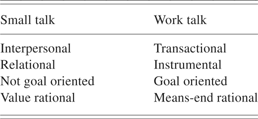
Investigators make distinctions in interactional dynamics between “small talk” and “work talk” (and other such labels – see Table 1), arraying conversational interaction on a continuum between these opposites (Holmes Reference Holmes and Coupland2000:37–43), and proposing that various settings foreground one or the other of them (Coupland, Coupland & Robinson Reference Coupland, Coupland and Robinson1992:213; Coupland Reference Coupland and Coupland2000:3). Moreover, there is recognition of the intimate connections between small talk and work talk in the sense that the former can help constitute social relationships that facilitate instrumental tasks: Small talk “oils the social wheels” of work-related embodied discourse (Holmes Reference Holmes and Coupland2000:57). However, another connection between small talk and work talk, and one not yet fully investigated, is that interpersonal inquiries and revelations can suppress the visibility of, and sometimes avoid, actions related to instrumental pursuits and mask such suppression and avoidance through otherwise affiliative conversational moves.
Distinctions in interaction.

In this article, we examine small talk in two kinds of medical clinics. Our investigation began with data from a clinic for orthopedic surgery, where we first noticed the phenomenon of small talk disattention. These data were audio-recorded. These episodes were selected from a larger data set in part because they included consideration of an invasive procedure.Footnote 1 For comparative purposes – to see whether the phenomenon was also present in a primary care clinic and how it may be contoured in the nonvocal conduct of doctor and patient – we then examined small talk in a collection of videotaped encounters in an internal medicine clinic. We reviewed the entire corpus of 15 primary care visits that the first author collected over a two-week period in an internal medicine clinic at a medical school in the U.S. Midwest. Together, the clinics exhibit different forms of the phenomenon of disattentiveness. One form is disattentiveness-in-simultaneity, where small talk occurs at the same time as work-oriented tasks. The other form is disattentiveness-in-sequence, where doctor or patient may propose to shift the talk from instrumental issues as a way of responding to an action the other has initiated. A distributional feature of our data is that the sequential form of disattentiveness is more frequent in episodes from the surgery clinic than in those from internal medicine. Accordingly, small talk episodes in these surgeon–patient interactions display a prominent feature: Visits about surgery or other procedures are narrower in their instrumental focus and may have, as a consequence, a higher frequency of sensitive, delicate, or contentious interactional issues, which participants may handle by small talk.
SMALL TALK IN SIMULTANEITY WITH WORK PRACTICES
Drawing on Malinowski's (Reference Malinowski, Odgen and Richards1923:312–15) discussion of “phatic” communication, which refers to occurrences “when the object of talk is not to achieve some aim but the exchange of words almost as an end in itself,” Laver Reference Laver, Kendon, Harris and Key1975 has observed the use of small talk at the “boundaries” of interaction – its opening and closing phases. He makes only cursory remarks about small talk in the middle or “medial” part of social encounters. From our doctor–patient data, we examine each of these three phases in order: opening, medial, and closing.
A structural definition of small talk
At the beginning of contact between participants, in Laver's (Reference Laver, Kendon, Harris and Key1975) view, there are three functions of small talk. As “propitiatory,” small talk can defuse the potential hostility that silence might engender; as “exploratory,” it can move participants toward a working consensus regarding their visit; and as “initiatory,” it means comfortably and cooperatively getting the interaction underway. Following Laver Reference Laver, Kendon, Harris and Key1975, Coupland (Reference Coupland and Coupland2000:5), among others, has discussed these functions as well, which Holmes (Reference Holmes and Coupland2000:48) summarizes as “doing collegiality” and “paying attention to the face needs” of participants. The functional approach, however, glosses actual social actions and conversational sequences; remedying functional glosses is a matter that Coupland et al. (Reference Coupland, Coupland and Robinson1992:215) suggest to be critically important in understanding how participants use small talk. Accordingly, as we examine the initial part of a medical interview, we will incorporate a structural definition to supplement the functional one: Small talk consists of concrete conversational sequences not necessary to the instrumental task itself – whether primarily embodied or done through talk – that form distinctly affirmative or what we call “prosocial” actions recognizable as such to the participants.
The beginning of the medical interview
Extract 1Footnote 2 occurs just as the doctor has entered the room where the patient has been awaiting his arrival. There are five distinct sequencesFootnote 3 and “small talk” social actions that doctor and patient produce collaboratively. These are (1) apology–acceptance, (2) appreciation–acknowledgment, (3) “in-group,” ethnic joking–self-deprecating receipt, (4) pursuit of self-deprecation as joking compliment–“modesty-display” as receipt, and (5) how are you–reply. However, something would be missing from the analysis if we did not notice, in their nonvocal conduct, what else is going on between doctor and patient. Indeed, to incorporate an analysis of nonvocal conduct is consistent with Laver's (Reference Laver, Kendon, Harris and Key1975:232) statement that small talk consists of linguistic behavior as well as “nonlinguistic aspects of speech … non-vocal behavior such as posture, body orientation, gesture, facial expression and eye contacts.” With the use of audio recordings, however, the literature of small talk has missed the embodied accompaniments to small talk.
In extract (1), while engaging in small talk, doctor and patient display an orientation to an instrumental task – the doctor's obtaining the patient's record from outside of the room. The set of frames at the right of the transcript in (1) shows the participants' embodied behavior. First, as the doctor enters the room, and as the patient tracks his movement with his head and gaze, he apologizes for keeping the patient waiting (line 1). The preferred response to an apology usually takes the form of that's okay, a denial of the need to have apologized, or an oh-prefaced utterance that also challenges the need for an apology (Robinson Reference Robinson2004:301–8). Here, there is considerable silence (line 2), and the patient's utterance has a well-preface, more silence, and then an idiomatic account, which are all suggestive of a dispreferred response. The doctor possibly orients to dispreferredness, insofar as, during the silence and the patient's accounting, he is gazing at his pen and rather fumbling at putting it in his pocket, thereby focusing his gaze away from the patient.
(1)


As the doctor finishes with the pen, and as he starts moving toward the door of the room, he states appreciation for the patient's consent to the video recording (lines 6–7), after which the patient produces a surprised oh that is accompanied by laughter (line 8) and suggests, as oh-prefaced utterances do when responding to inquiries (Heritage Reference Heritage1998), that the action to which they respond is in some degree inapposite. Here, with oh plus laughter, the patient can be putting forward, in a light manner, that the appreciation was not necessary.
In a third sequence, the doctor produces a joke about their shared ethnicity and pats the patient on the shoulder as he says Do you and leaves the room (lines 9–10, 12). The patient responds with a self-deprecating return joke and laughter invitation (lines 13–14). At this point, the doctor has left the room and is off camera, and in the frame grab at line 15, we can see the patient gazing after him. In a fourth sequence that initiates repair, the patient repeats the self-deprecation (which is also complimentary to the doctor) with appended laughter that can suggest a continued non-serious and possibly teasing aspect to the utterance (lines 16–17). As he closes the door and re-enters the room with file in hand, the doctor proposes to close the joking series in a display of modesty with a “finalizer” (lines 19, 21), and the patient offers rather lax laughter tokens (lines 20, 22). At this point (during line 22), the doctor is moving into his chair at the desk, and the patient shifts his head and gaze as he continues to track the doctor's movement. In a fifth sequence, and at the precise moment when he has met the chair with his buttocks and leans back into it, the doctor proposes to open up discussion of the reason for the visit (line 23) by asking a how-are-you question.
Doctor and patient are now in a kind of canonical posture in which each displays recipiency toward the other and thereby a readiness for the interview at hand – “a state of mutual engagement concerned with the patient's reason for the visit” (Heath Reference Heath1986:31–41, Reference Heath, Heritage and Maynard2006). In the medical context, however, a how-are-you question can be ambiguous as to whether it is a standard and socially oriented how-are-you inquiry or one that is solicitous of the patient's medical concern (Frankel Reference Frankel, Morris and Chenail1995). The patient gives an equivocal reply: After feelin, he pauses and then proposes that he is as good as can be, but then adds a qualifier (lines 24–25). Now the small talk is more definitively brought to a close, as the physician challenges the patient's report with really? (line 26), and this occasions the patient's complaint about the tongue trouble he has been experiencing (not in the extract).
Heretofore (until the Really query at line 26), talk has been “small” in Laver's (Reference Laver, Kendon, Harris and Key1975) sense of filling what otherwise might have been silence, in establishing a cooperative relationship, and in allowing for joint attention to the forthcoming business. Yet both parties interactionally also have maintained a work-oriented course of action – obtaining the patient's chart – the doctor embodying this action and the patient attending to it with his head shifts and gaze. After the chart is retrieved, the patient aligns to the doctor's proposal for a closing to the joke sequences and for opening discussion of how the patient is, suggesting that both are ready for the talk to become occupied with the business of the visit. This interview is typical of others in which doctor and patient engage in small talk at the beginning of the interview while the doctor may be engaged in entering the room, positioning himself at the desk, positioning files, adjusting his stethoscope, or other actions related to the transactional goals of the visit, as the patient attends visually to these actions or may also be finding a place to sit for the exam.
The phenomenon in which we are interested is how this instrumental course of action and the practices comprising it are not something entering the talk. Although doctor and patient are oriented in an embodied way to the work task, the small talk recognizes the work task only in an apologetic mode and in playful relation to their being on camera while the anticipated tasks will be occurring. Otherwise the talk consists of social actions in sequences that are not necessary to the work and that are disconnected from the simultaneous actions of retrieving and placing the patient's chart in readiness for the interview as such. At the beginning of this interview, the initiation of small talk actively disattends to the work-oriented activity that is simultaneously underway in and through the bodies of participants. In a Goffmanian (Reference Goffman1963) sense, the participants constitute the work-oriented activity as a side involvement and tacitly accomplish it while the main or overt and official matters in which they engage are a series of small-talk sequences.
The medial and closing phases of the visit
A similar statement regarding small talk's disattention to instrumental goals can be made about other episodes of small talk in medical encounters, whether it is in what Laver (Reference Laver, Kendon, Harris and Key1975:217) would call the medial phase or at the close of the interview. Laver gives only passing attention to the medial phase of social encounters, although other students of small talk and interaction have expanded the attention (Frankel Reference Frankel, Fisher and Todd1983; ten Have Reference ten Have, Boden and Zimmerman1991, Reference ten Have1999), and the literature on doctor–patient interaction subdivides the medial section of the primary-care medical interview into problem presentation, history taking, physical examination, diagnosis, and treatment recommendations (Byrne & Long Reference Byrne and Long1976, Heritage & Maynard Reference Heritage, Maynard, Heritage and Maynard2006). Again, however, because of the use of audio recordings and a concomitant lack of attention to nonvocal activities (Ragan Reference Ragan1990:73), there is much to be said about how small talk, or small talk initiations, may coordinate with transactional goals of an encounter during this phase. Participants can orient to their instrumental tasks with embodied conduct even while their talk is occupied differently: the talk can disattend to this embodied conduct.
The physical exam
One way in which such disattention occurs is during the physical exam, when the doctor is making intrusions on the patient's body and, as a result, the patient may experience discomfort, pain, or embarrassment at the violation of privacy (Ragan Reference Ragan1990:68–9). That doctor and patient initiate and/or engage in small talk during the physical exam is consistent with, while adding a dimension to, the research of Heath (Reference Heath1986:100–1, Reference Heath, Heritage and Maynard2006), who has demonstrated how, when the exam is underway, both doctor and patient must manage their activities so as to conduct the exam with a requisite amount of detachment and decorum. The patient's pose, adopted across a varied range of physical exams, involves turning the gaze to one side (with eyelids partially lowered) and into the “middle distance” rather than at any object, the doctor, or the site of the exam (Heath Reference Heath1986:107–8). Doctors are also circumspect with their viewing of the patient's body, turning away their own gaze at precise moments (Heath Reference Heath1986:103–4,113). These practices for gazing are a form of disattention in their own right, and Heath (Reference Heath1986:101) remarks that an additional enactment of disattention involves suspending talk for the duration of the examination, whereas we find that small talk can be regularly although not always present. Here, partly for reasons of space, we explore an audio-recorded instance of small talk during a physical exam in the surgery clinic, recognizing (along with Ragan Reference Ragan1990) the drawbacks resulting from lacking video.Footnote 4 However, the features we wish to highlight are captured in the audio very well.
At the beginning of the interview from which extract (2) is taken, the patient, Ms. M, states that she has pain in both knees but that the right knee is worse. Dr. F then discusses “revision” for the knee, which would involve replacing a previously implanted artificial joint with a new prosthesis. In discussing the risks of this surgery, the patient reports that she recently fell again, because her knees give out. At line 1 below, the physician asks about which knee is the most affected. The patient answers both of them (line 2), at which point Dr. F seems to initiate physical examination of the knee (see the silence at line 3). Because we have only audio data for this interview, it is not possible to situate precisely the initiation of this exam, but the continual silences (lines 7, 9, 11, 13, 15, 17), the directive (line 10), and the inquiry and its answer (lines 14, 16) all give evidence that manipulation of the knee or knees is occurring. There may be some writing also occurring in the midst of the exam.
(2)

After the sore over there? question (line 14), the patient's answer (line 16), and a long silence (line 17), Ms. M compliments Dr. F (line 18) by reporting what she has heard about him (line 18). Then, following a slight hesitation and his start of an utterance (lines 19–20), she produces a subsequent version (line 21) of the compliment: an assessment of his reputation. A facet of these compliments is that, without formulating the compliments as relevant to his status as a surgeon, they are hearable in that way by virtue of their placement within the medical interview. Moreover, in assessing his competence, they touch on the instrumental aspects of their encounter, so that while personally oriented and not necessary to the assessment of just this patient's disorder, they are generically relevant to what the doctor and patient are addressing as her medical problem. Consequently, these compliments may have a dual character – they are personal and professional both – and, in another way than the simultaneity we are suggesting exists between embodied work practices and small talk, they may demonstrate that the separation between relational and transactional orientations is rarely, if ever, very rigid.
Dr. F, at line 22, receives the compliment with a display of surprise and a downgrading response (Pomerantz Reference Pomerantz and Schenkein1978), which is in overlap with Ms. M's laughing or nonserious treatment (line 23) of his surprise. Following this she produces direct reported speech (Coulmas Reference Coulmas1986, Holt Reference Holt1996), quoting an assessment of her fellow choir member, identifying her occupationally in a way that may be relevant to her compliment recipient (lines 24–25), and finalizing her turn with a categorical attribution of the quote (lines 24–26, 28). Participants prototypically use reported speech to provide evidence for assessments. They do so, as Ms. M does here with her initial direct reported speech, using turn initials, such as the “change of state” tokens (“o:h o:h, line 26; see Heritage Reference Heritage, Atkinson and Heritage1984) that can suggest a cognitive state (such as “recognition”) on the part of the quoted person, and alterations of prosody, like the quieting and downtone of °he's goo:d° that can indicate an affirmative statement. Just after the categorical attribution (lines 26, 28), Dr. F accepts the compliment (line 29), and as he apparently continues the examination of her knees (lines 31–36) he produces a further and ironic formulation of acceptance (line 32). The patient laughs (at line 33), and after the doctor's question (line 36), her agreement (line 37) is intoned in a way that may indicate some “hurt” to which the question had been directed. More to the point is that the patient, introducing small talk by way of complimenting the physician, can be exhibiting something akin to what Jefferson Reference Jefferson, Atkinson and Heritage1984b has called “troubles resistance.” The patient can, by the use of small talk, be displaying manipulation and/or pain resistance. So small talk may disattend to both mild and more severe incursions on the body. Our data contain many examples from internal medicine and orthopedic surgery, suggesting that this form of disattentiveness to a nonvocal facet of the medical interview happens in varied clinical environments.
Transitions and record-keeping
Small talk during the physical exam is within a particular phase of the interview, but doctors and patients both use small talk also at transition points between phases, and at its close. Although we have many instances, we will not show closing-phase small talk in favor of illustrating how it co-occurs with such activities as moving from one phase to another and with potentially competitive instrumental actions. Our illustration involves Mrs. V, who has come to Dr. G for a regular checkup and who suffers from diabetes and carpal tunnel syndrome. The doctor also attends to Mr. V, the woman's husband, as a patient (Mr. V sees the doctor just after his wife's visit). In a prototypical example of doctor-initiatedFootnote 5 small talk during the physical, when Dr. G has Mrs. V on the examination table to listen to her breathing and heart, he compliments Mr. V: Your husband's been lookin’ good, I think retirement agrees with ‘im. Mrs. V agrees, replying, Yes, he's more relaxed, um I think his color is a little better too. After completing the exam, Dr. G in extract (3), line 1, invites Mrs. V to return to the seat she had occupied by his desk. As Mrs. V is sitting down (frame grab at line 4), Dr. G has already lowered himself into the desk chair, pulled it forward, and positioned himself with respect to the patient files at the desk.
(3)

Mrs. V, using a referral form (he) that ties back to the previous husband-oriented talk during the physical, produces a kind of pre-punchline (lines 2–4) about her husband's good time tellin' people about a comment the doctor had made to them in a previous consultation. The doctor's go-ahead (line 5) asks laughingly about what he had said, and, although he is looking at a document on the desk (frame grab at line 4), he shifts his head and gaze to her (frame grab at line 5). This movement is related to what Raymond & Lerner Reference Raymond and Lerner2007 discuss as an “interjected” action: It holds in abeyance a course of action (reading and writing in the medical records) that the doctor had been pursuing. In overlap with Mrs. V's utterance, he draws an inbreath (line 6), starts an explanation regarding the comment, and then yields to Mrs. V's quoting of it (line 7). She appends laughter (line 8) as Dr. G registers the punchline with Oh: and by laughing with her (line 9) and beyond (line 10). The punchline is an interesting object in its own right: Insofar as it follows a pre-punchline that claims the doctor's talk from an earlier occasion to have been already repeated to others by the husband (Mr. V has been tellin' people), it shows a prior appreciation for the joke, and now in new retelling of the doctor's joke, it represents another form of appreciation, even while delivering it again to the original teller for his appreciation. That is, this is a double-complimentary repeat of the joke.Footnote 6 Moreover, the delivery and reception of the reported joke not only allow for a display of affiliation; they also weave together doctor, patient, and husband into a joking type relationship – not exactly the kind that Radcliffe-Brown Reference Radcliffe-Brown1940 delineated for kinship societies, but one that is similar. Joking relationships simultaneously express both detachment and attachment (Radcliffe-Brown Reference Radcliffe-Brown1949); here such duality is embedded in a professional and appropriately friendly association between the two participants. In the extract, the doctor, while continuing his post-joke laughter, and while the patient has leaned slightly forward, turns away from her (Radcliffe-Brown Reference Radcliffe-Brown1949) to look at the file and his writing hand, thereby returning to the course of action in which he was engaged just prior to the joking episode.
The patient's next utterance (lines 11–12, 14, 16), overlapped with further laughter tokens from the doctor, offers an account for Mr. V's having consulted with Dr. G about their upcoming travel, and it is produced while Dr. G simultaneously writes in Mrs. V's file. Suggesting that the husband felt better by checkin' in with the doctor, the utterance is also complimentary, and Dr. G receives the compliment with an oh change-of-state token (line 18) that handles it in such a way as to modestly accept it. That is, it acknowledges the compliment while avoiding the possible taint of self-praise that a stronger form of acceptance would do (Pomerantz Reference Pomerantz and Schenkein1978). During this talk (lines 11–18), she turns to gaze at his writing and then, at line 19, she brings up another medical concern.
Accordingly, in their physical movements the participants separate interpersonal “small” talk from the instrumental tasks being pursued, including the patient's movement from the examining table to chair, the doctor's transition from standing at the table to sitting at the desk such that the task of writing in the patient's file can commence (at about line 10), and the actual record-writing in which he engages. They do this separation in simultaneity – that is, small talk and instrumental tasks can run parallel with one another – and the participants also do it through practices of interjection. In both ways, small talk is the main involvement as it disattends to medical goals through parallel engagement or through momentarily holding aside instrumental actions.Footnote 7 While Holmes (Reference Holmes and Coupland2000:42) has suggested that any “firm boundary between business talk and social talk” is artificial, our video data suggest that boundaries are not so much artificial as they are fluid. Participants organize these boundaries through their concrete practices of embodiment, talk, and social interaction.
In clinics, doctors and patients initiate small talk through a set of related devices: joking, self-deprecation, laughter, complimenting, displaying modesty, and using reported speech, all of which display affiliative stances and social ties among doctor, patient, and others. Some of these devices may be dually oriented, as when compliments are generic while at least indirectly relating to the task at hand. The relatedness among these devices is that, however initiated and answered, small-talk utterances involve what Goffman (Reference Goffman1971:62–63), following Durkheim on positive and negative rituals, calls “supportive interchanges” that in various ways propose, affirm, or ratify “civility and good will” between participants (Pomerantz Reference Pomerantz and Schenkein1978:106). It is in this sense that we refer to these social actions as “prosocial.”
Small talk in simultaneity with embodied instrumental actions, it turns out, involves just one way that there can be disattention to the task at hand. Another way that small talk is disattentive is in sequential relationship to the pursuit of instrumental actions also done through the talk.
SMALL TALK IN SEQUENCE WITH WORK PRACTICES
In the surgery clinic, and as we adumbrated in the introduction to this paper, both physician and patient may use small talk to avoid responding to actions the other has initiated. Doctors may use small talk to disattend to potential medical problems the patient raises other than those connected to specific orthopedic concerns, and patients may use small talk to disattend to therapeutic or other recommendations of the physician. In a complication of these patterns, a patient's small-talk initiation may be complicit with a doctor's instrumentally oriented disattention.
Physician's disattentiveness to patient's potential or actual complaining
Extract (4) involves a patient with back pain, who had had an operation ten years earlier and has had a recurrence of pain in the last three years. More recently, he has been taking Celebrex and has had an injection to curb the pain. The interview begins with boundary-type small talk. There is an exchange of how you doin and how are ya sequences (at lines 1–4), and then the doctor produces a question related to what Robinson has called a “follow up” (lines 7, 10). He is apparently asking about either the injection or the Celebrex. After reporting on the matter (lines 9, 11) the patient offers a more global self-assessment at lines 14–15, one that is at least partially equivocal: he's not great but he does think it's stabili:zed, and his symptoms might be even improving a little bit. The physician literally latches to this assessment with an approving evaluation (line 16, Good) that is emphasized and that prefaces an aphoristic formulation (lines 16, 18), which ties to the patient's assessment but with the equivocation removed. This turn overlaps apparent continuation and rather minimal acknowledgment from the patient, who also produces a very quiet acknowledgment (line 19). Then the physician initiates a small talk sequence with an avocational category question (lines 20), again in very quick or latched succession to the patient's acknowledgment. This kind of question indicates prior knowledge between doctor and patient – related to Button & Casey's (Reference Button, Casey, Atkinson and Heritage1984) “itemized news inquiry” or Jefferson's “pending biographical” (Reference Jefferson, Atkinson and Heritage1984a:193) – and invites topical talk. In this environment it is also disjunctive with respect to the ongoing medical talk.
(4)
Footnote 8

The patient at first is silent (line 21) and then treats the doctor's inquiry as a kind of laughable remark (line 22), possibly in a self-mocking way, repeating the category – which also (along with the silence at line 21) may indicate resistance to the question – before providing a standardized response at lines 24–25 (not bad), to which is added a detail about a kid or some other person or object. Next, he starts an utterance that is interrupted by the doctor doing physical examination (lines 27–33), but the doctor eventually initiates repair (line 34) to retrieve the interrupted utterance of the patient, who issues an invitation that the doctor accepts (lines 36–43), and this precedes an extended version of what we (Hudak & Maynard Reference Hudak and Maynard2007) call “topicalized small talk.” The patient and doctor seem to know one another very well.
With respect to disattentiveness, the possibility we raise is that, unlike the doctor in extract (1) who treats a patient's equivocal answer to a how-are-you question with a challenging query, and thereby elicits his elaborated medical concern, this doctor upgrades his patient's equivocating self-assessment to an unequivocal positive evaluation. The equivocation also displays troubles resistance, a display the doctor can use as a resource for disattentiveness. Insofar as the patient's equivocation can indicate a relevant medical concern,Footnote 9 however, the upgrade is disattentive, and the latched small talk initiation appears to extend the disattentiveness.
Notably, the mechanisms for such disattentiveness are not in violation of the interaction order of the talk. When the patient produces his equivocating reply to the doctor's follow-up question, it is a three-part list that goes from negative to neutral to positive.Footnote 10 While such lists can have their own logic apart from what it is that speakers use them to describe, they also provide for close monitoring (Jefferson Reference Jefferson and Psathas1990:68–74). From a recipient's position, the third part of the list is most strongly sequentially implicative and can be closure-relevant, so that when the doctor responds with his approving, positive assessment, it is ostensibly to complete a move toward closure, even if, in its utter immediacy and increased pitch, this move has a rushed and hasty quality. Finally, although the small talk initiation pursues disattentiveness to the patient's back condition, by asking about the patient's avocation – something about the patient that the doctor knows – it is officially “other attentive” (Jefferson Reference Jefferson, Atkinson and Heritage1984a:194). A possibility to explore is that small talk masks its instrumental disattentiveness in a cover of prosocial talk.Footnote 11
Such masking is strongly evident in an interview with a patient who has severe pain in her right shoulder:
(5a)

After this extract, the doctor starts to examine the patient by asking her to stand and stretch her left and right arms, palpating around her shoulder, and querying about where it hurts. Then he asks her to grab a seat, and informs her about what the X-rays have shown, what is happening in the shoulder's ball and socket joint, and whether the tendons for her rotator cuff are swollen and irritated, partially torn, or torn all the way through (he doesn't know). Then, in extract (5b), the doctor advances what the choices are with a proposal to rule out doing nothing (lines 1–2). Following a silence (line 3), he starts to provide an account for this proposal. As he starts to project what will happen if she tries to get normal (lines 4–5), the patient interrupts to state that that's what she wants to go back to (line 6). This occasions a rather gendered inference (one that invokes stereotypical womanly activities), an attempt at empathy from the doctor (lines 9–10, 13). The patient produces a disaffiliative Nwe:::ll in overlap at line 11, and in lines 14–16, a contrast version of her pain – it's not the gettin up into that zone when she's doing her hair, but rather the coming down while at work that is bothersome. Now this complaint is an activity formulation that is inferentially category-bound. That is, hearing the activity formulation, the doctor proposes relevant membership categories (teacher, librarian, line 17) for her in a way that, although roughly on topic, addresses a matter that is “ancillary” (Jefferson Reference Jefferson, Atkinson and Heritage1984a) to her pain, insofar as her turn was a complaint about pain occurring in the context of her work and not about her occupation as such.Footnote 12 The patient self-identifies as a textbook librarian (line 18).
(5b)

The doctor uses this identification not to occasion further information about the patient, including her pain experiences. Rather, in another move that focuses on an ancillary matter (line 20), he forms a complaint about a category of persons related to school, the kids. In this manner, he may be offering a kind of affiliation based on their potentially relevant comembership in the category of “adults.” Thus, he focuses off her pain complaint, and, while she laughingly agrees but in a downgraded fashion (N(h)o(h) not much), she also reinvokes her own complaint about the heavy textbooks, although in a troubles-resistant fashion, with laughter tokens infusing the utterance (lines 21, 23). Once again, now at line 24, he focuses off her complaint as such to report his own third-hand experience with heavy textbooks, and this occasions agreement (line 25) and a story from the patient (lines 27–29).
In this interview, there is turn-by-turn competitiveness in the context of the patient's complaining about pain that derives from her working environment. Each time the patient pursues a complaining action, the doctor proposes to “focus off” that action and “focus on” an ancillary matter (Schegloff & Sacks Reference Schegloff and Sacks1973). These are proposals of stepwise topic shifts, and, as one suggests an empathy with grooming tasks and the other an affiliation as adults vis-à-vis kids, they display themselves as other-attentive. The patient does not relate to them that way, but eventually she lifts her resistance to the doctor's refocusing attempts as the latter of these (involving a mention of backpacks) touches off a story she has to tell about her granddaughter carrying a heavy backpack. Eventually the doctor is able to return to discussion of treatment recommendations, which include a cortisone injection and physical therapy, with an MRI (magnetic resonance image) later if there is no improvement, or an MRI more immediately. (They decide on physical therapy.)
Small talk and physicians' disattentiveness to patients' complaining
Doctors' initiation of small talk can be part of a pattern whereby delicate topics such as patients' medically relevant complaints are closed and new or shifted topics are opened. That is, by fitting with procedures for handling the exit from topical talk, small-talk initiations (how's your woodworking career, most kids don't use books) are not overtly disruptive to the flow of talk and take place in an interactionally orderly fashion. Furthermore, these initiations and the emergence of small talk in specific environments work within the overall structure of the interview on behalf of medical treatment recommendations – in the first case a recommendation against immediate surgery for the patient as that arises in the further course of the interview, and in the second case for physical therapy. We might be reminded here of online commentary whereby such commentary during physical examination can project treatment or no-treatment options at the end of the interview (ten Have Reference ten Have, Boden and Zimmerman1991:152, Heritage & Stivers Reference Heritage and Stivers1999). Small talk, in its sequentially disattentive mode, is a resource to be used on behalf of, and is embedded within, an overall transactional course of action rather than being a separate genre of talk. And because of the prosocial aspect of small talk (the ways in which it is other-attentive and proposes to align with talk the patient has introduced), it can mask physicians' resistance to particular patient complaints (as a kind of work talk) and physicians' competitive but tacit pursuit of instrumental orientations such as treatment recommendations.
Patients' disattentiveness to physicians' recommendations
That small talk can be sequentially disattentive to potentially relevant work talk in the form of patient complaints would fit with the usual picture of physicians' enactment of a medical agenda and insensitivity to the “lifeworld” of the patient (Mishler Reference Mishler1984). However, with small talk there are two counterbalancing notes. One is that the development of small talk, if not its initiation, takes collaboration. That is, in each of the above examples, the patient either sooner (after a first small-talk proposal) or later (after several such proposals) engages in and/or contributes to the topical trajectory. It is not imposed in any strict fashion. The second note is that, just as doctors can resist patients' possible or actual complaining actions, patients can resist doctors' recommendations, and one mechanism for this involves the patient's own disattentive small-talk initiations.
A patient's resistance to a physician's recommendation is strongly evident in extract (6), and her use of small talk as part of this pattern is occasioned by the surgeon's own device for exiting from a series of recommending actions that the patient avoids endorsing. At the beginning of the interview, it is revealed that she has arthritis on each patella (kneecap), and it is the left knee that is giving her more pain. She had taken a cortisone shot recently, but its effects have worn off and the doctor does not want to have her take further cortisone, in part because the relief was so temporary. As the review of her history takes place, and after he examines both her knees, doctor and patient discuss how she is unable to take anti-inflammatories like Vioxx and Celebrex because they upset her stomach. She also cannot take Aleve because it bothers her ulcer. When they discuss the possibility of a knee operation, the surgeon proposes holding off for a while, and she states that she is not real fond of surgery. After they discuss how bad the pain is (e.g., it does not interfere with her sleep at night), he suggests that they may eventually want to do a knee replacement but not yet, and recommends and prescribes Darvocet to see if that might relieve the pain. The extract takes up just after he has electronically sent the prescription for Darvocet to the pharmacy, Walgreens.
The doctor seems still to be working on the computer as he confirms the next appointment for her (lines 1–2). At line 5, he asks about another kind of therapy with glucosamine, an over-the-counter amino sugar that is often used to treat arthritis. The patient replies that she's never tried it (line 7). He goes on (lines 9–11) to recommend talking to the pharmacist and getting a good sample of the medication. Such a recommendation, like advice, makes relevant some form of acceptance or rejection (Heritage & Sefi Reference Heritage, Sefi, Drew and Heritage1992, Kinnell & Maynard Reference Kinnell and Maynard1996), but this one meets with silence (line 12), after which Dr. L produces an account that suggests its potential for helpfulness. The patient then produces a delayed and minimal acknowledgment (lines 15–16), and Dr. L pursues his recommendation with a further account about the effectiveness of glucosamine in dogs and ends the utterance with an upshot-implicating so (lines 18–19), to which Carol responds with a very quiet and again-delayed okay, to which is appended a laughter token (line 21). However, Dr. L's next utterance is built, with its tone and and-prefacing (En, line 22) to extend his previous turn, ignore the laughter, and suggest seriously that the medication may work on humans too. This turn also ends with an upshot-implicating so. Now, at line 24, there is a substantial silence, during and after which someone, presumably Dr. L, is apparently shuffling papers.
(6)

Dr. L next (lines 25–56) pursues a response to his recommendation with candidate interpretations or inferences (Pomerantz Reference Pomerantz, Atkinson and Heritage1984) regarding Carol's resistance to the recommendation. One inference suggests a concern about the harmfulness of the medication, which he discounts, and the other acknowledges the expense of the drug. After yet another silence (line 27), Dr. L proffers an aphoristic, bland remedy (line 28) related to his inference about the bothersome cost, which may offer an acknowledgment on behalf of his patient that this may be her concern. Clearly, while the doctor continues to solicit alignment to his recommendation, the patient is showing disalignment through the practices associated with dispreferred responses (using silences and minimal acknowledgments rather than rejection forms). After a very long silence (6 seconds at line 29), during which the physician may be writing in her chart, the patient (line 30) engages another device associated with dispreferred responses, which is offering an account for a rejection instead of a rejection form itself. She asks about insurance coverage; her question is built with negative polarity – pessimistically proposing an answer to her question, and asking for confirmation, which Dr. L produces at line 32.
Following the silence at line 33, Dr. L suggests a context-sensitive political remedy. Robbie Mainland (pseudonym) was a member of the U.S. House of Representatives from the patient's district at the time, while George W. Bush was U.S. president. The implication is that they could change things so that insurance would support a glucosamine purchase. As the doctor is apparently working on the computer during this turn (the clicks at line 35 and 36 have the sound of a keyboard), his talk (lines 34, 37) has a kind of musing quality but is spoken in a serious tone. That is, the proposal does not have ironic features to it (Clift Reference Clift1999). As it pursues the issue of expense and remedying that expense, it does, however, represent a kind of stepwise move toward exiting the series of recommendations about taking glucosamine. At this point, rather than retaining a focus on the medication, the patient, at lines 38–39, produces an announcement that focuses on Robbie Mainland and a social relationship. This topic is stabilized through Dr. L's question (line 40) and the further turns at lines 41–45, after which the interview is brought to a close (lines 46–48).
When patients introduce small talk in the environment of physicians' therapeutic recommending, it is often part of a pattern in which they resist the recommendations. As the physician's talk moves away from the recommending, but while it still contains recommendation-relevant talk, the patient may propose a further stepwise topic shift by focusing on an ancillary matter. If that stepwise shift is stabilized with a topicalizer – here, a were you query – they may move into a short or sometimes extended spate of small talk, and the recommendations of the physician are then bereft of patient alignment.
We have other such instances. For reasons of space, we summarize just one. Later in the interview containing extract (4), in which reference is made to the patient's woodworking career, and during which the medical issue is the patient's back pain, the doctor asks, Are you doin' the flexion exercises …. The patient answers that he has wanted to walk but that it has been too cold. The doctor then says, Well ya oughta do those flexion exercises, you can do those in the house, you know, in the living room in front of the fire, to which the patient responds, Okay sure, arright, in a way that acknowledges rather than accepts the recommendation. The doctor next proposes a summary recommendation (that oughta do well), and the patient delays and then offers another of his ambivalent condition reports, this time as a kind of excuse (Well I dunno it seems to me at least it's stabilizing it's not getting worse). Similarly to how he latched to the patient's ambivalent report in extract (4), the doctor quickly aligns with Good, well that's a good sign, I'll take that all day long. Then there is laughter, a joke from the doctor, and more laughter from the patient, at the end of which the patient disjunctively asks, How's your son? (recall that doctor and patient are “friends” or at least are “friendly” and well-acquainted). This occasions extended topicalized small talk regarding the physician's children. Overall, the patient avoids endorsing the doctor's recommendations about exercise, and the initiation of other-attentive small talk is a culminating move that disattentively exits the series of recommending sequences.
A mixed case
We have one case of disattentiveness that does not fit either of the sequential forms of disattentiveness so far discussed. In the first pattern, a doctor uses small talk as part of a topic-changing or stepwise topical move to avoid the patient's complaining, as explored in extracts (4) and (5b), and depicted like this:

The second pattern involves the patient's using small talk in a topically coherent way to avoid the physician's recommendation, as analyzed in extract (6), summarized for another case, and depicted here:

Rather, in a kind of mixed pattern, something more complex and subtle happens: It is the patient who engages in small talk in an environment of her own complaining. This small talk occurs just after a physician's disattentive treatment recommendation, as in this abstraction:

The patient in extract (7) is a 75-year-old woman who requires knee surgery. At the beginning of the interview, the doctor says, it's been awhile since you and I have chatted. The patient says, Yeah six and a half months since Fred passed away. From there, the doctor reviews her orthopedic history, which is that her right knee has already been scoped, and now she has been referred from her regular doctor because her left knee has become painful with a torn meniscus and bursitis, among other conditions. After doing an exam, the doctor says, I wish I had a simpler answer for you but I don't. You need to have it scoped, which is an outpatient surgery.
As the transcript takes up, they have just talked about scheduling the surgery. When the doctor asks if the patient has any questions and proposes (line 1) that she remembers what it's like, she agrees, raises a concern about her living alone, and then projects, through continuing the utterance, a wonderin (line 3). Given that, at the beginning of the interview, she reminds the doctor of her husband's death, even in its own right this is a possible “psychosocial” medical complaint or at least the beginning of one.Footnote 13 However, when subsequently she takes an inbreath, the doctor at line 4 preempts her completion of the utterance to suggest that she can walk immediately after the surgery, appending an upshot-inviting so, implicating as a recommendation a no problem stance with regard to the possible complaint. So the physician here may be disattentive to a medically relevant social action, not with small talk but with another type of instrumental action. There is a brief silence (line 5) after his suggestion. The patient starts another utterance (line 6), and this is also interrupted, now with a recommendation for having a friend around. Rather than retrieve her utterance for completion, the patient at line 10 seems to acknowledge this recommendation as the doctor goes on with a proposal of assurance (line 9). This proposal meets with a brief silence (line 11), after which the patient initiates small talk with a pre-announcement (line 12) about her brother-in-law that shifts topic. The doctor receives the pre-announcement with a display of recognition (↑OH YEAUH) and acknowledgment (Yeah) that provides a go-ahead for the patient's announcement at line 15. This announcement is an assessment of the brother-in-law's post-surgery state; given that it is this doctor who “did” him, the assessment is complimentary.
(7)

The doctor receives the compliment with a downgraded questioning check (line 16), which is confirmed at line 17, and small talk about the patient's brother-in-law continues from there until the doctor initiates closure of the interview at lines 33–34.
In extract (7), to reiterate, the physician successfully competes with the patient for turn space to produce recommendations for how to handle her post-surgery circumstances and to offer reassurance in a way that minimizes or deletes the reports of potential troubles the patient works haltingly to produce. While yielding to the doctor's incursions on her turns, the patient is subtly resistive (with silence after the doctor's turns)Footnote 14 but, after the offer of reassurance about being able to do okay, she introduces a topic-shifting initiation of small talk, an utterance that leads to complimenting the physician and extended small talk. It can be noticed that there is a tie between this compliment and the physician's reassurance. Where he has suggested that she will be okay (after he has operated on her), the patient's comment about her brother-in-law can be endorsing that view with the assessment that, after the surgeon did (operated on) him, he is doing great. The doctor's receipt of this compliment, while displaying modesty through its downgrade, also reinvokes the doin' okay assessment.
If the patient's compliment is an endorsement, it is not disattentive to the physician's instrumental course of action and is ratifying of it instead. Nevertheless, because the doctor's recommendations were, in the first instance, disattentive to her recent widowhood (living alone) and what she was apparently wonderin as a consequence, and to a further “need” statement that she started but cut off, it is as if the patient's complimenting small talk is complicit in that disattentiveness. It helps to mask, in guise of prosociality, the way in which her own medically relevant talk was left wanting.
Of course, this is an orthopedic visit and not an interview in an internal medicine or other more generalist clinic. Accordingly, for the doctor to pay attention to psychosocial concerns of a patient rather than just those aspects of her medical condition relevant to his specialty may not be normatively required. If so, then we can make sense of another pattern in our two sets of data. We find the frequency of sequential disattentiveness to be much higher in the orthopedic surgery clinic than in the internal medicine clinic. Of course, this data set involves episodes that were selected for the presence of patient and doctor discussing an invasive procedure. Accordingly, the physicians involved are more concerned with a narrow band of the patient's health and predisposed to ignore potential medical complaints that are outside the band. Furthermore, these data can be expected to have a greater frequency of treatment recommendations that patients may disfavor. Comparatively, these visits about surgery contain more sensitive, contentious, or delicate interactional issues that are only rarely present in primary care medicine. In short, the larger amount of sequential disattentiveness reflects instrumentally intense focus in the orthopedic surgery clinic. We can hypothesize that specialized clinics with such focus, particularly regarding potentially invasive medical procedures, will have a greater frequency of sequentially disattentive small talk than more generalist clinics.
CONCLUSION
As mentioned, Holmes Reference Holmes and Coupland2000 arrays conversational interaction on a continuum between work talk and social talk as opposites. However, the literature on small talk has not fully described the structures of small talk – the sequences for producing social actions such as apology and acceptance, appreciation and acknowledgment, joking and laughing, and others – or the intimacy between small talk and work talk, between sociality and instrumentality, and the dense social organization that binds small talk and work talk together.
We propose that the picture of a continuum needs replacement or supplementation with two other pictures. One would suggest small talk as a parallel endeavor that can actively disattend to instrumentally oriented and especially embodied practices that are necessary to the work of the setting. These instrumental tasks consist of beginnings to, completions of, and transitions between phases and subphases of the medical interview, as well as physical examinations, record keeping, and other jobs. Such parallelism is small talk in simultaneity with work practices. The other picture would suggest that small talk can actively disattend to instrumentally oriented practices, including those done through talk, in a sequential manner, when there are underway such actions as complaining or recommending that are relevant to the work of the setting, but from which the recipients of such actions wish to withdraw. This is small talk in sequential relationship with work practices. With these latter two pictures – of simultaneity and sequentiality – we can appreciate that small talk, because of its prosocial quality, can mask the resistance and disattention that it helps to accomplish. Finally, especially in its sequential mode, small talk can be involved in ignoring or effacing certain kinds of agonistic relations in which participants are otherwise engaged. In medical settings, this ignoring or effacing involves contestations over whether complaints are to be heard or recommendations are to be followed. In disparate institutional settings, with different instrumental activities, the uses of small talk may be the same.