Introduction
Most field crops worldwide are produced using ‘conventional’ agricultural practices, characterized by highly simplified agrosystems and repeated use of chemical inputs such as glyphosate-based herbicides (Benbrook, Reference Benbrook2016). This model has proved its effectiveness as evidenced by the important productivity gains observed since the early 1990s (Duke, Reference Yesuf and Bluffstone2015). However, these increased yields have led to local and global environmental drawbacks such as a gradual loss of soil functions, biodiversity loss, diseases of cultivated plants, herbicide resistance in some weed species and contamination of surface and underground water networks (Van Bruggen et al., Reference Van Bruggen, He, Shin, Mai, Jeong, Finckh and Morris2018). Furthermore, conventional practices continue to accentuate agricultural producers' dependence on fossil energies (Malézieux, Reference Yesuf and Bluffstone2012). While it is advocated that large field crops production must increase to meet the global demand for food (FAO, 2009), an ecological transition of agricultural practices is also imperative (IPCC, 2019). Ecological transition in the agricultural context, sometimes called agroecological transition, refers to the implementation of sustainability transition frameworks. It relies on system analysis, both socio-ecological and socio-technical, to propose avenues in order to change agricultural production from an economic paradigm to one of sustainability, where the economic aspects are combined with broader environmental and social considerations (Ollivier et al., Reference Ollivier, Magda, Mazé, Plumecocq and Lamine2018).
The adoption of standardized conventional field cropping systems is attractive to producers throughout the world as variables to be optimized are easily defined, namely production yields, short-term profits and earnings per unit of invested capital (Weiner, Reference Yesuf and Bluffstone2003). In contrast, alternative practices may be more complex, relying on chemical inputs reduction, an extension and diversification of crop rotations, the adoption of direct seeding mulch-based cropping systems and increased connectivity between ecological communities (Ferguson and Lovell, Reference Yesuf and Bluffstone2014; Vincent-Caboud et al., Reference Vincent-Caboud, Peigné, Casagrande and Silva2017). Besides, alternative practices must be economically and socially acceptable in order to be largely adopted by producers. Indeed, alternative practices can result in similar or even higher incomes when compared to conventional agricultural exploitations (Clark et al., Reference Clark, Klonsky, Livingston and Temple1999; Cavigelli et al., Reference Cavigelli, Hima, Hanson, Teasdale, Conklin and Lu2009; Delbridge et al., Reference Delbridge, Coulter, King, Sheaffer and Wyse2011). Nevertheless, the ecological transition has evolved slowly, as it is a complex innovation requiring significant strategic and systemic changes. Some economic factors act as barriers to transition, including the cost of materials and equipment, increased labor demands, the redefinition of agricultural policies, the acceptance of profitability uncertainty, increased risk and yield loss (Rodriguez et al., Reference Rodriguez, Molnar, Fazio, Sydnor and Lowe2009). It is critical to consider the determinants of transitions to understand and promote the adoption of ecological practices (Horrigan et al., Reference Horrigan, Lawrence and Walker2002).
In the present study, we focus on three determinants of ecological transition: profitability prospects, risk attitude and time preferences, which have been shown to play an important role in the adoption of agricultural practices (Ghadim et al., Reference Ghadim, Pannell and Burton2005; Duquette et al., Reference Duquette, Higgins and Horowitz2013; Galor and Özak, Reference Galor and Özak2016; Liu et al., Reference Liu, Bruins and Heberling2018). These determinants are more likely to foster some transition avenues than others. Hence the present study adopts a more specific definition of ecological transition as ‘changes in agricultural practices that improve input use efficiency and reduce environmental impacts’ (Duru et al., Reference Duru, Therond and Fares2015).
Profitability prospects are key to decision-making processes of producers. A large body of literature has shown that ecological practices, even if they reduce production costs, fail to reach the yields of conventional agriculture (Langley et al., Reference Langley, Heady and Olson1983; Acs et al., Reference Acs, Berentsen and Huirne2007; Seufert et al., Reference Seufert, Ramankutty and Foley2012), particularly so for soybean production (De Ponti et al., Reference Yesuf and Bluffstone2012). These studies have associated lower harvests in organic soybean production to losses due to weeds and phosphorus deficiencies, which are often found in organic farming systems. Thus, when discussing their profitability prospects, producers who are likely to undertake ecological transition process should consider reducing their production costs rather than increasing yields per hectare.
The degree to which producers tolerate risk, their risk attitude is central in the adoption of new agricultural practices, as they are fundamentally uncertain to their adopters. In this study, the risk is defined as uncertain consequences, specifically, exposure to adverse consequences (Hardaker et al., Reference Yesuf and Bluffstone2015). Practices that may prove more profitable on average may not be adopted if they present greater variability in yearly profits. For example, a meta-study (Knapp and van der Heijden, Reference Knapp and van der Heijden2018) has found that organic agriculture tends to offer more variable yields than conventional practices. Indeed, a producer's degree of risk aversion can significantly impact his/her decision to consider an ecological transition of his/her agricultural practices (Acs et al., Reference Acs, Berentsen, Huirne and Van Asseldonk2009). More specifically, profitable transitions for a risk-neutral producer may not be profitable for another sufficiently risk-averse producer. Since many studies have shown that farmers are generally risk-averse (Moscardi and De Janvry, Reference Moscardi and De Janvry1977; Grisley and Kellog, Reference Grisley and Kellog1987; Barr Reference Barr2003; Miyata, Reference Miyata2003; Wik et al., Reference Wik, Aragie Kebede, Bergland and Holden2004; Yesuf and Bluffstone, Reference Yesuf and Bluffstone2009; Harrison et al., Reference Harrison, Humphrey and Verschoor2010; Tanaka et al., Reference Tanaka, Camerer and Nguyen2010), an ecological transition of agricultural practices may be limited if it exposes producers to increased risk.
It is also relevant to inquire into producers' time preferences, because in any ecological transition period, profits may be delayed for several years. Producers need to be patient before seeing their business become profitable again (Dabbert and Madden, Reference Dabbert and Madden1986). Rodriguez et al. (Reference Rodriguez, Molnar, Fazio, Sydnor and Lowe2009) found that producers are reluctant to adopt farming practices that are compatible with an ecological model given that gains are not immediate. Consequently, the degree of patience of agricultural producers, more generally referred to as time preferences, should be measured to assess their potential to begin an ecological transition of their practices.
Despite their importance, risk attitude and time preferences have rarely been measured among agricultural producers, especially in middle-income countries. This study is the first to measure risk attitudes and time preferences of field crop producers in the Brazilian Amazon. An established experimental method (Andersen et al., Reference Andersen, Harrison, Lau and Rutström2008), usually applied to university students in laboratory settings, was used to elicit time preferences and risk attitudes in soybean/maize producers from the region of Santarém (State of Pará). This study contributes to the literature on ecological transitions by analyzing how the measured characteristics, in conjunction with profitability prospects, influence the susceptibility of producers to undertake a transition.
The region sampled is currently at the frontline of the soybean cultivation expansion in the Amazon. Field crops have expanded rapidly in the Brazilian Amazon over the past years, contributing to the massive clearing of the tropical rain forest (INPE, 2019). This soybean ‘boom’ can be explained by a combination of factors: noticeable technological improvement of seeds in the 1970s; the introduction of subsidies and credit in the 1980s; market deregulation and tariff reduction in the 1990s; rising soybean prices coupled with favorable exchange rates between the Real and the US Dollar in the late 1990s and early 2000s (Garrett et al., Reference Garrett, Lambin and Naylor2013). The rapid development of the agricultural sector in the region remains controversial as it puts pressure on the tropical forest, which represents an invaluable ecological asset (Walker et al., Reference Walker, Defries, del Carmen Vera-Diaz, Shimabukuro and Venturieri2009). Producers have massively adopted the conventional agricultural system, with the widespread use of pesticides and chemical fertilizers as well as frequent plowings. Very few of those newly installed producers in the region seem inclined to adopt alternative practices.
Material and methods
Study area
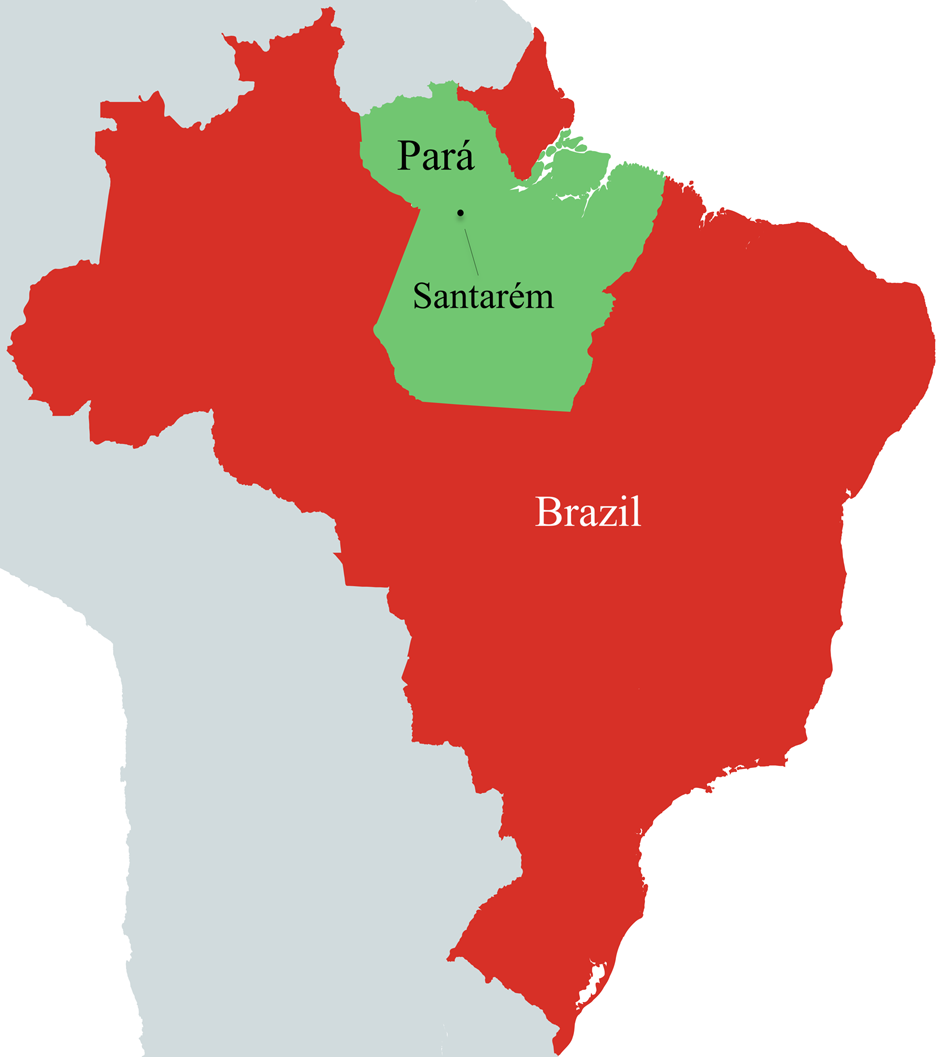
Santarém is a city located in the State of Pará, in the Brazilian Amazon (see Fig. 1). It is located at the confluence of the Tapajós River and the Amazon River. Over the last 15 years, the region has been at the heart of a rapid economic development driven by the growth of its agricultural sector. Since the opening of the Cargill port in 2003, a facility owned by an American company of the same name, soybean growing areas have expanded significantly. In the State of Pará alone, fields cultivated with this oilseed barely occupied 1200 hectares in 2001 (IPEADATA, Reference Yesuf and Bluffstone2010). In 2015, this area was multiplied by nearly 300, reaching 337,000 hectares. During the same period, annual production volumes increased by nearly 400, rising from 2600 to more than a million tons (IBGE, 2016).
Map of the study area.

Sampling procedure
Based on the information provided by the Rural Union of Santarém (SIRSAN), the estimated number of producers in the Santarém area was 45. Among them, 35 producers were asked to participate in the study. Their contact information was provided by the Union as well as by the Santarém office of the Brazilian Agricultural Research Corporation (EMBRAPA). Other producers were met directly during an on-farm visit. A total of 27 producers agreed to participate and signed a consent form approved by UQAM's Research Ethics Board (CERPE). It should be noted that our research design did not require participants to be of any gender. However, all producers in the region were men, hence all the study participants are males.
Data
The two data collection tools used in this study to gather information from the producers were a semi-structured questionnaire and economic tests. Both quantitative and qualitative data were obtained in late 2016. Open and semi-directed questions were asked to producers in order to let them answer freely, without being forced to choose from a set of defined answers. The interviews were conducted by three Brazilian students from the Federal University of Pará (UFOPA) in the presence of the first author of this study.
The questionnaire was used to collect socio-demographic data as well as data relating to the agricultural practices of the participants (such as costs and volumes of production) and their profitability prospects. The economic tests were used to collect data on risk attitude and time preferences, following the methodological framework of Andersen et al. (Reference Andersen, Harrison, Lau and Rutström2006, Reference Andersen, Harrison, Lau and Rutström2008). To the best of our knowledge, this is the first application of this methodology to agricultural producers.
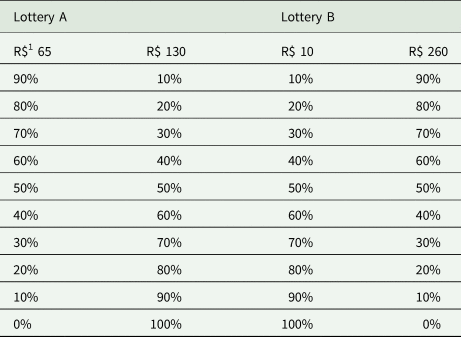
In order to measure risk attitudes, participants were asked to choose from repeated lottery pairs. For each lottery, the participant had a chance to win two different amounts of money each associated with a specific probability of winning, expressed in percentages. Table 1 illustrates one of the 10 pairs from which participants had to choose.
Example of choices between two lotteries.

1 Real, the Brazilian currency. Exchange rate as of January 2018: R$ 1 = US$ 0.31.
In the first alternative presented, if the participant chooses lottery A, he/she has a 90% chance of winning R$ 65 and a 10% chance of winning R$ 130. If he/she chooses lottery B, he/she has a 90% chance of winning R$ 260 and a 10% chance of winning R$ 10. Each participant was challenged with similar lotteries ten times: the same amounts were repeated throughout the test, but the probabilities of winning varied. Another test with different amounts was also administered.
Variation in probabilities is structured to prompt participants with low-risk aversion to keep choosing lottery B over lottery A, even when the probability of winning the higher amount (R$ 260) decreases significantly. Participants with high-risk aversion are expected to choose lottery A throughout the test or to switch from lottery B to lottery A sooner than participants with low-risk aversion. All participants are expected to choose lottery A for the last row, as it guarantees a higher amount than lottery B. The row in which a transition occurs from lottery B to lottery A, or the fact that only lottery A is chosen throughout, is informative of the risk attitude of the participant.
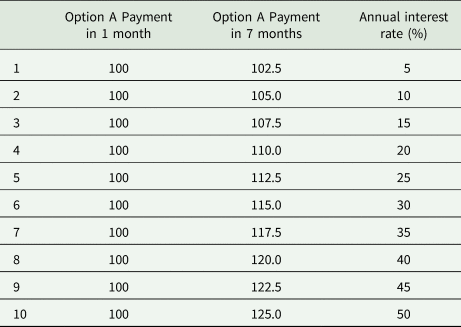
To assess time preferences, participants were asked to choose amounts in multi-horizon payment tests. During the first test, participants were given the possibility to receive an amount of money in 1 or 7 months. In the second test, they were given the possibility to receive the amount in 1 or 13 months. As shown in Table 2 for the 3-month interval, participants were asked to choose ten times between option A (R$ 100) or option B (R$ 100 plus an annual interest rate increasing by 5% for each option) as previously done in Andersen et al. (Reference Andersen, Harrison, Lau and Rutström2008).
Test payment to multiple horizons on a 6-month time horizon.

Theoretical framework
Participants' choices were modelled using the expected utility model. When faced with to lottery i ∈ {A, B}, participants evaluate its relative desirability as if they were using the following utility function:

where ω represents the participant's income, r is the coefficient of relative risk aversion (CRRA) and p ij and M ij are, respectively, the probability and the amount of option j ∈ {1, 2} for lottery i. According to this representation of the utility function, r = 0 corresponds to risk neutrality; r > 0 to risk aversion; and r < 0 to risk tolerance.
When participants choose lottery B over lottery A, it was interpreted it as if their expected utility of lottery B were superior to that of lottery A (EU B > EU A). Hence, parameter r was estimated using maximum likelihood performed on a slightly modified measure of the difference between expected utilities of lotteries:

where μ is a noise parameter allowing for randomness in participants decisions. A detailed description of the estimation method can be found in Andersen et al. (Reference Andersen, Harrison, Lau and Rutström2008).
The relation between the level of risk aversion of the participants and some economic and socio-demographic variables was also assessed. Variables such as age, income, size of the exploitation and production costs may influence the attitude adopted by an agricultural producer in a risky situation (Binswanger, Reference Binswanger1980; Kurosaki and Fafchamps, Reference Kurosaki and Fafchamps2002; Wik et al., Reference Wik, Aragie Kebede, Bergland and Holden2004; Yesuf and Bluffstone, Reference Yesuf and Bluffstone2009; Harrison et al., Reference Harrison, Humphrey and Verschoor2010). The influence of these variables on the risk attitude of producers was estimated. The exploitation financing was also considered, namely whether the producer had access to credit for his/her entire production, part of his/her production or none of his/her production. In the case of the Santarem producers, credit is often provided by the crop buyer, generally Cargill. Inputs are provided through implicit loans, which are repaid when crops are purchased.
The time preferences of the participants were calculated using the tipping point for both tests, namely when a transition was observed from option A to option B. Presenting the amounts as two deferred income payments allowed participants to choose an amount based strictly on time-related reasons, without being tempted by instant financial gain. Data were processed using version 15 of the Stata software.
Results
Participants (all males) had a mean age of 45 years (Table 3). Eleven producers indicated that they had completed their higher education, with eight having completed it in a field related to agriculture. All producers were pursuing a family tradition; they were all sons of producers. None of them was from the region of Santarém. They previously grew soybeans in the State of Mato Grosso (64%) or in southern states, such as Santa Catarina, Paraná or Rio Grande do Sul (36%). Producers generally arrived in the region in 2003, which corresponds to the opening year of the Cargill port. Nearly 90% of the producers interviewed indicated that they were alternating between corn and soybean crops. Most of them (81%) cultivated rice upon arrival in Santarém before converting their plots to soybeans. In 2015, approximately 10% of them were still growing rice.
Profile of the producers.

The average profits were estimated using the difference between the annual costs and revenues disclosed by the producers for the year 2015. Average profits, farm size, yield and production costs are for soybean cultivation only. N = 27.
The decision to relocate production in the Santarém region was generally justified by the construction of the Cargill port or the opening of a new agricultural frontier. These motivations were mentioned by 58% of the participants. Biophysical reasons, such as favorable climatic conditions and a good soil fertility were mentioned by 38% of producers. Finally, less than a quarter (23%) of producers were motivated by the low cost of land and, incidentally, the acquisition of larger landholdings.
The producers sampled represented 43% of the soybean cultivated area in the region of Santarém in 2015. Their average productivity of 3.06 tons ha−1 is almost identical to the region average of 3 tons ha−1 (IBGE, 2017a).Footnote 1 In the State of Pará, agricultural producers are on average 49 years old and are 80% men, making the sample slightly younger (45) and more masculine (100%) than the state average (IBGE, 2017b) Although self-selection into sampling bias based on unobservable characteristics cannot be ruled out, participants in this study appeared like typical soybean producers of the region and, to a lesser extent, typical of the State of Pará.
Profitability prospects
Of all participants, 81% agreed to disclose their production costs and revenues from soybean production. The unit of measure used to quantify the costs and revenues of soybean production was ‘bag per hectare’, which is a unit of yield.
The average annual benefits of the exploitations studied ranged between US$ 100,000 and 125,000 for soybean cultivation alone, with a mean growing area of 645 hectares (Table 3). It can therefore be estimated that 1 ha of soybeans generates US$ 175 annually on average, which is similar to the returns observed in the USA (Schnitkey, Reference Schnitkey2019). The average profits, shown in Table 3, were estimated by calculating the difference between the annual costs and revenues disclosed by the producers for the year 2015. Revenues were calculated by multiplying the average yield by the total number of hectares owned by the producers. In 2015, productions were generally sold between May and August when the average price of a soybean bag (60 kg) was R$ 58.36 (CONAB, 2017). Estimates take into account the exchange rate between the Real and US Dollar for two crop outflows in 2015 (May: 0.32 and August: 0.25) (XE, Reference Yesuf and Bluffstone2017).
Moreover, 81% of participants said they wanted to increase the profitability of their business by improving the productivity of their land using soil tillage, anticipated new technologies and better adapted soy cultivars. Only two producers planned to reduce their production costs to improve profitability (they also disclosed their costs and revenues in Reals, rather than in ‘bags per hectare’, and kept the details on paper).
Most participants (72%) were hoping to access currently ‘unused’ degraded areas or areas consisting of secondary forests and abandoned pastures in the State of Pará in order to acquire new lands on which to grow soybean. During interviews, they expressed this wish by presenting it as an economic opportunity offered in the Amazon region. It should be noted that the Brazilian government adopted a series of measures between 2004 and 2008 to slow the progression of deforestation, which had been on the rise since 1977 in the Amazon. It has significantly slowed down starting in 2005 but has slightly rebounded since 2015. Producers in the region of Santarém operate since 2006 under the Soy Moratorium, where traders voluntarily avoid purchasing soybean grown on lands deforested after July 2006 (Gibbs et al., Reference Gibbs, Rausch, Munger, Schelly, Morton, Noojipady, Soares-Filho, Barreto, Micol, Walker and Walker2015 and CAR, Reference Yesuf and Bluffstone2016).
Soybean producers in the region of Santarém evolve in the peculiar economic context of monopsony where there is only one buyer. In fact, the multinational company Cargill virtually controls the soybean buying market. Another buyer, Avispará, also operates in the region, but sales to this company remain limited. Only a little over half our sample did business with Avispará for sales between 1 and 5% of their production.
Risk attitude tests
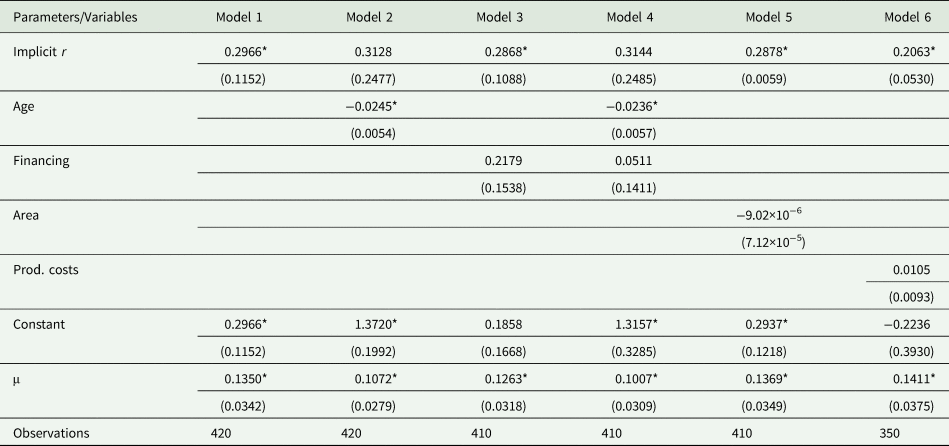
The maximum likelihood estimates for risk preferences under six different specifications are presented in Table 4. Model 1 estimates a CRRA of 0.3, without any other covariates, suggesting a low-risk aversion among soybean producers in the region of Santarém.Footnote 2 Models 2–6 add different covariates to the estimation, including the age of the producer, the financing status of the production, the area cultivated and the production costs.
Maximum likelihood estimates of risk aversion models.

For each parameter/coefficient, estimates are presented on the first line and standard errors (clustered at the participant level) are below in parentheses. *Statistically different from zero at the 5% significance level.
For each specification, the first line presents the implicit value of the CRRA (r) that can be calculated from the parameter values in rows two to six and the mean values of the relevant covariates. The next-to-last line of the table shows the estimate of the noise parameter μ. As μ tends toward 0, the model determines the choices made by participants more accurately. Thus, our estimates indicate μ < 0.15 whether we use ω = 0 or the reported value of the income of participants (Table 4 only reports value for ω = 0). These low values for the noise parameter indicate the model successfully explains the participants' decisions in all specifications. It should be noted that each participant could answer a maximum of 20 questions on risk preferences, hence the number of observations is higher than the number of participants. Standard errors were clustered at the participant level to account for within-participant correlation of errors.
A specification with all covariates is not presented, as the sample size was too limited to identify all their effects simultaneously.
Model 1 is the baseline specification. No covariates are included. It provides a CRRA estimate of 0.3, which is statistically different from zero at the 5% significance level.
Model 2 includes the age of the participant as a potential variable to explain differences in levels of risk aversion. It has a statistically significant negative sign, which means that older participants have a lower level of risk aversion of 2.5 percentage points per additional year of age. The average level of risk aversion remains similar to the estimated of Model 1 (r = 0.31), although it is less precisely estimated and not statistically different from zero.
Model 3 includes the financing status of the participant production as a covariate. It is a dummy variable that takes the value 1, when the entire production of a participant benefited from access to credit and takes the value 0 when part or none of the production benefited from credit. The first group (full financing) comprises 56% of our sample, while the latter accounts for 44%. Despite its magnitude, the financing status coefficient is not precisely estimated and it cannot be ruled out that it is different from zero. The average CRRA level remains nearly identical to the estimated value of Model 1 (r = 0.29) and is statistically different from zero at the 5% significance level.
Model 4 combines the two previous covariates, age and financing status, in the same estimation. While the age coefficient remains almost identical (2.4 percentage points) and statistically different from zero at the 5% level, that on financing status is greatly reduced and remains imprecisely estimated. The average CRRA level is similar to the previous models' estimates (r = 0.31) but is not statistically different from zero as in Model 2.
Model 5 uses the area cultivated by each participant as a covariate. The covariate's coefficient is very close to zero and is precisely estimated. It seems that risk aversion does not vary across participants based on cultivated area. The average CRRA level remains in the same range as with previous models (r = 0.29) and is statistically different from zero at the 5% significance level.
Model 6 estimates the CRRA using the participant's production costs as a covariate. The production costs coefficient is not statistically different from zero at the 5% significance level. The average CRRA level in this specification is lower than in previous models (r = 0.21) but remains statistically significant at the 5% level.
Overall, our estimations of risk aversion are consistent across models. The average CRRA varies between 0.21 and 0.31 and is statistically different from zero at the 5% significance level in models 1, 3, 5 and 6. Age is the only covariate that appears to be significantly influencing risk aversion, as older participants tend to have a lower CRRA. Finally, the area cultivated does not appear to influence the risk aversion level among participants, as its coefficient was precisely estimated zero.
Time preference tests
Results for the time preference tests are shown in Table 5. Soybean producers of the Santarém region generally chose the delayed option when the annual interest rate averaged 29%. In other words, if the annual interest rate was not higher than 29%, producers chose to receive the proposed amount within 1 month.
Results of the time preference tests: average annual interest rates.

P. T1 < T2 refers to the results when the participants (P) have lower annual interest rate values in the first test (T1) than in the second test (T2). P. T1 > T2 refers to the opposite situation, whereas P. T1 = T2 refers to the results when participants had equivalent values in both tests.
In the first test (1 and 7-month horizons), producers chose on average the second option (receiving the amount in 7 months) when the annual interest rate averaged 28.37%. In the second test (1 and 13-month horizons), the second option was chosen when the annual interest rate was 28.93%.
Nearly half (48%) of the producers showed a greater level of patience in the first test (or when the amounts were to be received after 6 months). The annual interest rate had to be 10.3 percentage points higher on average for them to choose the second option in the test (with a 12-month interval between payments). Just under a third (29%) of the producers showed a greater level of patience when there was a 12-month interval between payments, accepting a reduction of 11.3 percentage points in the annual interest rate in comparison with the first test. Still, in the first test, the annual interest rate had to be inferior to 37% in order for them to prefer receiving the amount within a month. The remaining participants (24%) had the same level of patience in both tests, preferring the second amount when the annual interest rates averaged 29%.
Discussion
The propensity of producers in the region of Santarém to begin the ecological transition of their agricultural practices was assessed using the collected data.
Profitability prospects
When asked how they wished to increase the profitability of their business, the producers in the region of Santarém explicitly mentioned improving production yields per hectare and expanding their exploitation. They indicated that improved yields could be achieved through increased tillage and the use of new agricultural technologies such as seed varieties that are genetically optimized for the region. The questionnaires revealed that they wished EMBRAPA would increase its research for the development of soybean varieties better-adapted to the climatic and soil specificities of the region. In addition, questionnaires revealed that all producers except two were not able to itemize their incomes and costs. They only knew the total amounts (total revenues and total costs). For example, they were unable to quantify the cost of various inputs but could sometimes estimate, with some accuracy, that the fuel for the machinery ‘is expensive’. Moreover, the two producers who rigorously maintained accounts of their expenses were the only one to mention that access to higher incomes had to go through a reduction in production costs. One of them wanted to use fewer herbicides to improve effectiveness.
The vast majority of producers disclosed their costs and revenues in ‘bags per hectare’. Rather than using a monetary unit (real or dollar), they said to use the cost in bags per hectare and multiply this number by the area of their land. Revenues and costs were thus disclosed by using a unit of output, which reinforces the idea that increased yields are central to the evaluation of their business success.
The goal to increase production yields is reflected in the statistical data of IPEADATA (2010) and IBGE (2016) on soybean production in the State of Pará. It can be observed that production volumes increase more rapidly than cultivated areas, reflecting a steady increase in productivity per hectare of land since 2000. The improvement of soil quality by previous rice crops as well as technological progress, supported by the biotechnology law of 2005 which authorized the use of Roundup Ready® transgenic seeds in the Brazilian territory, can explain this increase in yields. Agricultural practices in the region of Santarém are based on only a few genetically optimized soybean varieties as well as the abundant use of chemical inputs (such as glyphosate-based herbicides and synthetic fertilizers).
The widespread objective to increase yields among producers does not make them spontaneous candidates likely to undergo an ecological transition. Selling the idea that more sustainable practices could reduce production costs and thus increase profits, may be ineffective for initiating the ecological transition process. Amazonian soybean producer should also consider changing their accounting methods.
Another element to consider when studying ecological transitions is the commercial situation of soybean cultivation in the State of Pará. Cargill's monopsony influences the economic circumstances under which soy is grown in the region of Santarém. It has been reported to us that this multinational offers a single price for soy, regardless of whether the production is transgenic (Roundup Ready®) or not (Identity Preserved). Therefore, producers selling non-transgenic soybean do not receive a price premium. It is a major factor that could make these crops more profitable than transgenic crops, even though the associated yields per hectare may be lower (Hepperly et al., Reference Hepperly, Douds and Seidel2006).
The current situation creates a strong incentive for producers to choose agricultural practices which are compatible with transgenic seeds. In addition, the company offers producers who subscribe to specific credit programs, free technical assistance such as soil analysis or agronomic advice on the choice of inputs as well as free synthetic fertilizers. By doing so, the company acts as a service provider and can pressure producers through a second channel. This is a significant factor to consider since 56% of the producers subscribed to the credit programs for their whole production, while about half of the remaining producers subscribed for part of their production. Indeed, in this commercial environment where a price premium for alternative practices is lacking and where credit is provided to purchase inputs for conventional practices, the potential of soybean producers in the region to undergo an ecological transition is limited.
Risk attitude and influence variables
An analysis of the results showed that producers in the region of Santarém have low-risk aversion (r = 0.30). This result is consistent across specifications, although it was not always possible to produce precise estimates due to the small size of the sample. Nevertheless, it is clear that this value is lower than most estimates found in the literature. For example, Rosenzweig and Wolpin (Reference Rosenzweig and Wolpin1993) found a CRRA coefficient of 0.96 for their sample. Kurosaki and Fafchamps (Reference Kurosaki and Fafchamps2002) estimated a mean CRRA coefficient of 1.83 (between 1.34 and 4.12), which reflects a clear risk aversion. However, these studies were conducted with small producers whose characteristics and realities were quite different from those in this study.
In this regard, producers in this study are potential candidates for an ecological transition since they are willing to take risks. However, despite current Brazilian laws, the idea of increasing production areas remains prevalent among producers in the region of Santarém. This low-risk aversion could, for example, lead to the acquisition of new lands even though it is illegal (Garrett et al., Reference Garrett, Lambin and Naylor2013; Soares-Filho et al., Reference Soares-Filho, Rajão, Merry, Rodrigues, Davis, Lima, Macedo, Coe, Carneiro and Santiago2016).
The low-risk aversion estimates for the participants of this study may reflect self-selection specific to the region. Data collected using the questionnaires have shed a light on this selection. Some producers mentioned that the resistance of social and environmental groups to the soybean cultivation in the Amazon region, led by organizations such as Greenpeace, shows how vulnerable the development of this culture is. Although popular pressures partly contributed to the adoption of the Soy Moratorium in 2006, production volumes and cultivated areas continued to increase, which suggests that producers in the Santarém area tolerate enough risk to continue, or even intensify, soybean cultivations, despite this institutional risk.
Low-risk aversion could also reflect the fact that producers in the region of Santarém do not have insurance plans to protect their harvests. They bear the risk of a poor harvest, due in part to rainfall dependency, which suggests that this business requires a certain level of risk tolerance. In addition, many producers have reported biophysical attributes such as climate or soil fertility as strengths of the region. This suggests that they trust the productivity of the land on which they grow crops, which may influence their attitude towards risk.
The obtained value (r = 0.30) could also result from a methodological weakness. Indeed, the larger the amounts in lotteries, the greater the evidence of increased risk aversion among individuals (Wik et al., Reference Wik, Aragie Kebede, Bergland and Holden2004; Yesuf and Bluffstone, Reference Yesuf and Bluffstone2009). Thus, the amounts presented in the lottery tests were perhaps too low compared with the producers' income. A higher risk aversion could otherwise have been revealed.
Our results show that risk attitudes can depend on producer characteristics such as age. Producers may not respond to risky choices in the same manner. As a matter of fact, we found that older producers were less risk-averse than younger ones. This effect is both statistically and economically significant as an average 40-year-old producer would have a CRRA more than twice superior as an average 50-year-old producer. The fact that older producers will tolerate more risk is consistent with the literature (Harrison et al., Reference Harrison, Humphrey and Verschoor2010).
On the other hand, no correlation was found between the characteristics of the exploitations and the degree of risk aversion of the participants. Regarding the exploitation area, the large heterogeneity in the size of sampled farms helps to estimate precisely this absence of effect. Since there was a high correlation between exploitation area and production volumes in our sample, we can also interpret this result as pertaining to the size of the production. It is possible that this absence of effect is hiding some unobserved heterogeneity among our participants, as there is conflicting evidence in the literature on the relationship between production size and risk aversion. Yesuf and Bluffstone (Reference Yesuf and Bluffstone2009) found that larger producers are generally more risk-averse while Kurosaki and Fafchamps (Reference Kurosaki and Fafchamps2002) and Wik et al. (Reference Wik, Aragie Kebede, Bergland and Holden2004) suggested the opposite.
Finally, although the coefficient signs may suggest that the use of credit and production costs are positively correlated with risk aversion among participants, these effects were too imprecisely estimated to be statistically significant. Larger sample sizes could improve the precision of these estimates.
Time preferences
Our results indicate that soybean producers in the region of Santarém are rather impatient, with an average discount rate of 29%. In other words, they would rather wait for 12 months before receiving an amount only if it is more than 29% higher than the amount they could receive immediately. For a 6-month time horizon, the amount must be 14.5% higher, hence half of the annual rate of 29%. Except for the producers with equivalent estimates for both tests, most producers (in 63% of cases) required a higher interest rate when the time horizon between the receipt of both amounts increased from 6 to 12 months.
This indicates that producers are usually more impatient when payment is delayed. In comparison, Andersen et al. (Reference Andersen, Harrison, Lau and Rutström2008) showed that the Danish population prefers to wait for a larger amount if the latter is at least 10.2% higher (average between a 6-month and a 12-month wait). However, the qualitative difference between both samples was considered, as the sample in Andersen et al. (Reference Andersen, Harrison, Lau and Rutström2008) was composed of individuals from disparate backgrounds. In addition, the average inflation in the consumer price index over the last 10 years in Brazil was around 6%, whereas it was 1.44% in Denmark over the same period (Trading Economics 2020a, b).
Knowing that the ecological transition causes some delay in the receipt of profits (Dabbert and Madden, Reference Dabbert and Madden1986), it seems that soybean producers in the region of Santarém are not likely to massively undergo this process. In fact, measures should be adopted to mitigate the depreciation of investments or to offer soybean price premiums in order to encourage producers to begin the transition process.
Conclusion
This study has analyzed three determinants of agricultural practices adoption for soybean producers in the region of Santarém, namely their profitability prospects, their risk attitude and their time preferences. These determinants were assessed to discuss the extent to which they may favor or impede the ecological transition of these producers production practices.
The results show that producers have a low level of risk aversion, which could make them potential candidates for the transition. On the other hand, their general inclination towards increasing production volumes to improve profitability as well as their time preferences, oriented towards short-term gain, suggest that they do not display a propensity to begin the ecological transition of their practices.
This study raises additional questions that will require further research to better understand the profile of profitability prospects, risk aversion and time preferences across regions and production types. Because of the small size of our sample, the results of this study should not be readily transposed to all contexts of conventional agriculture in low- and middle-income countries.
Finally, the extent to which individual characteristics interplay with the broader socio-economic framework should be studied to determine how it affects the potential for ecological transition. For example, this study suggests that the characteristics of the market can impair the development of more environmentally friendly agricultural practices, as the virtual monopsony of a single buyer in the region of Santarém reduced the potential for stimulating the adoption of alternative practices with price premiums.
Acknowledgements
This study was financed in part by the Coordenação de Aperfeiçoamento de Pessoal de Nível Superior - Brasil (CAPES) and the Department of Foreign Affairs, Trade and Development Canada (DFATD) Joint Research Project Canada-Brazil. We thank the Rural Union of Santarém and soybean producers for their participation and collaboration in the accomplishment of this work, We thank Lucieta Guerreiro Martorano (EMBRAPA-Santarém) for early producer contacts and four anonymous reviewers for pertinent comments. We acknowledge Alailson Rego and Keely Meireles as field assistants. All errors and omissions are our own.