Introduction
Place of origin is one of the attributes most commonly used to differentiate and enhance the competitiveness of agri-food products, as it is considered a proxy variable for quality and ease of consumer identification (Van Der Lans et al., Reference Van Der Lans, Van Ittersum, De Cicco and Loseby2001; Acharya and Rahman, Reference Acharya and Rahman2016; Vergamini et al., Reference Vergamini, Bartolini, Prosperi and Brunori2019). Studies such as those by Mørkbak et al. (Reference Mørkbak, Christensen and Gyrd-Hansen2010) and Kim (Reference Kim2008) have also shown that in the case of a number of agri-food products, the place of production is a cue that consumers take as a guarantee of food safety, reducing their perception of risk involved in consuming the product. Nonetheless, products whose quality label is linked to their place of production often have to compete with other products that attempt to emulate the name or region of origin (van Ittersum et al., Reference Van Ittersum, Meulenberg, Van Trijp and Candel2007). To guarantee the protection of the producers and consumers of such products, geographical indications (GIs) were developed as an attribute that reconciles and upholds the interests of both parties.
According to the definition of the World Intellectual Property Organization (WIPO) (2020): ‘A geographical indication (GI) is a sign used on products that have a specific geographical origin and possess qualities or a reputation that are due to that origin. In order to function as a GI, a sign must identify a product as originating in a given place’. The European Union (EU), through Council Regulation (EEC) No. 2081/92 of July 14, 1992, has especially fostered the development of two signs: the protected designation of origin (PDO) and the protected geographical indication (PGI). The aim of these labels is to enable consumers to trust and distinguish quality products, while helping producers better market their products (EC, 2020a). Given their condition and relation to food production, GI labels serve to revitalize rural environments, increasing the income of farmers, who can use these labels to differentiate their products, thus increasing their added value (Sanz Cañada and Macías Vázquez, Reference Sanz Cañada and Macías Vázquez2005; Tregear et al., Reference Tregear, Arfini, Belletti and Marescotti2007).
Consumers generally tend to attribute higher quality to products with certification of origin (van Ittersum et al., Reference Van Ittersum, Meulenberg, Van Trijp and Candel2007; Veale, Reference Veale2008). In their study on willingness to pay for olive oil, Menapace et al. (Reference Menapace, Colson, Grebitus and Facendola2011) found that consumers are prepared to pay more for GI products compared to non-GI products from a given region. Similar studies have evidenced the importance of GIs in other products, such as wine (Fait, Reference Fait2010) and cheese (Monjardino de Souza Monteiro and Raquel Ventura Lucas, Reference Monjardino De Souza Monteiro and Raquel Ventura Lucas2001). The importance of GIs is, however, country-specific, and varies for products with different places of origin (Chryssochoidis et al., Reference Chryssochoidis, Krystallis and Perreas2007; Aranda et al., Reference Aranda, Gómez and Molina2015; Atkin et al., Reference Atkin, Wilson, Thach and Olsen2017), as this concept of higher quality is associated with the culture, image and reputation of the production of a concrete product in a certain country or region (Marcoz et al., Reference Marcoz, Melewar and Dennis2016).
European consumers give greater importance to GIs than consumers in countries such as Australia, New Zealand or the United States (Santeramo and Lamonaca, Reference Santeramo and Lamonaca2019). Even so, various studies have shown that the value different consumer segments attach to these certificates varies within a given country (Van Der Lans et al., Reference Van Der Lans, Van Ittersum, De Cicco and Loseby2001; Cicia et al., Reference Cicia, Cembalo and Del Giudice2012; Marcoz et al., Reference Marcoz, Melewar and Dennis2016; Bernabéu et al., Reference Bernabéu, Rabadán, El Orche and Díaz2018). The study by Marcoz et al. (Reference Marcoz, Melewar and Dennis2016), for example, found that consumer preference for products marketed under the Fontina PDO increased further they lived from the region where the PDO is located (Marcoz et al., Reference Marcoz, Melewar and Dennis2016). The preference for these quality labels is, then, variable across populations and territories, with it being necessary to specifically study the different certifications to determine the structure of consumer preferences towards them.
Of the GIs in the EU, more than 450 are registered under the category of ‘fruits, vegetables and cereals’, and, with 73 indications, Spain is one of the countries with the largest number of certified products in this category (EC, 2020b). The use of quality labels related to production area has been specifically identified as a good strategy for marketing fruit (Groot and Albisu, Reference Groot and Albisu2015). In this sense, in a study on German consumers, price was found not to be an important attribute for consumers with a clear preference for fruit of a specific origin (Cicia et al., Reference Cicia, Cembalo and Del Giudice2012). These GI labels for fresh fruit, as well as being a guarantee of quality (van Ittersum et al., Reference Van Ittersum, Meulenberg, Van Trijp and Candel2007), also serve to identify the place of production. The closer the fruit is produced, the fresher it reaches the consumer, as time elapsed from harvesting to consumption is a key parameter to guarantee optimal eating quality (Cañete et al., Reference Cañete, Hueso, Pinillos and Cuevas2015).
Both sweet cherries (Prunus avium L.) and loquats (Eriobotrya japónica L.) are spring fruits that are highly appreciated by consumers for both their organoleptic characteristics and their nutritional qualities (Faienza et al., Reference Faienza, Corbo, Carocci, Catalano, Clodoveo, Grano, Wang, D'amato, Muraglia, Franchini, Brunetti and Portincasa2020). The primary drawback limiting the consumption of these products is that they are highly perishable with a very short useful service life, even when cold-stored (Looney et al., Reference Looney, Webster, Kupperman, Webster and Looney1996; Hadjipieri et al., Reference Hadjipieri, Gavriel, Sismanidis and Manganaris2019), making them a luxury fruit in some countries (Blando and Oomah, Reference Blando and Oomah2019). Hence, marketing these fruits both inside and outside the producer country is complex and appears to be focused on nearby locations, where the arrival of these fruits with maximum conditions of quality is guaranteed (Soler et al., Reference Soler, Martínez-Calvo, Llácer and Badenes2007; Cañete et al., Reference Cañete, Hueso, Pinillos and Cuevas2015). In Spain, the annual production of cherries reached 107,000 tonnes in 2018 (MAPA, 2019) while the total consumption was 49,300 tons with a per capita intake of 1.1 kg (Mercasa, 2020). In the case of loquats, both production and consumption are small. Loquat production reached 29,000 tons in 2018 (MAPA, 2019) with per capita consumption below 1 kg and up to 75% of the national loquat production under the PDO being exported each year (Mercasa, 2020).
Consumer preferences in purchasing fruit have mainly been analyzed with reference to the origin of the products (Ingrassia et al., Reference Ingrassia, Sgroi, Tudisca and Chironi2017; Chiang et al., Reference Chiang, Schnettler, Mora and Aguilera2018) and their sensory attributes (Crisosto et al., Reference Crisosto, Crisosto and Neri2006). However, attributes such as flavor, sweetness or sourness can only be evaluated once the fruit has been eaten, and hence these attributes cannot be considered at the time of purchase. Given this situation, the quality certification provided by GIs can be an effective tool for consumers as they combine the advantages of a certified place of production and greater control in production and marketing, which together ensure higher quality (Monjardino de Souza Monteiro and Raquel Ventura Lucas, Reference Monjardino De Souza Monteiro and Raquel Ventura Lucas2001; Dimara and Skuras, Reference Dimara and Skuras2005; Sanz Cañada and Macías Vázquez, Reference Sanz Cañada and Macías Vázquez2005; van Ittersum et al., Reference Van Ittersum, Meulenberg, Van Trijp and Candel2007)
In light of the above, the aim of this work was to analyze the associations between the consumers' preference for GI foods and the preference for other attributes of the product. We also proposed to segment consumers according to their place of residence in order to determine whether the association of the attributes with these GIs varies depending on whether the consumers live or not in the area of influence of the GIs.
Materials and methods
The data used in this study were gathered in towns in the provinces of Alicante, Murcia and Valencia (Spain) in May 2019.Footnote 1 The target population comprised all the fresh fruit consumers of these provinces, accounting for 3.7 million people (INE, 2019; Sanidad, Reference Sanidad2019). As a result, the target population was considered infinite. The paper-based questionnaire was administered on weekdays to consumers about to buy food for home consumption in supermarkets and hypermarkets. A total of 582 surveys were collected. The margin of error was below 4.14%, for a 95.5% confidence level (k = 2)Footnote 2, under the principle of maximum uncertainty (p = q = 0.5)Footnote 3. Before the fieldwork, a prior questionnaire was administered to 25 consumers to check whether the questions were properly understood and would not cause confusion.
The first aim of the paper was to evaluate the associations between the preference for fruits produced under a GI label and other factors that consumers consider when purchasing spring fruits. For both fruits, the objective variable was the importance attributed to the GI label when purchasing the fruit. For cherries, we used the PGI for Mountain Cherries from Alicante (Spain) and, for loquats, the PDO for Loquats from Callosa d'En Sarriá. The objective variable was measured as the importance given to the specific GI label when purchasing cherries and loquats. The importance was measured using a 5-point Likert-type scale ranging from very unimportant (1) to very important (5).
The explanatory variables used in this work were selected among the attributes that consumers most value when buying cherries and loquats. In order to identify these attributes, we used the existing bibliography and in-depth interviews with experts on fruticulture (Cañete et al., Reference Cañete, Pinillos, Cuevas and Hueso2007; Cicia et al., Reference Cicia, Cembalo and Del Giudice2012; Blando and Oomah, Reference Blando and Oomah2019). The explanatory variables for the case of both cherries and loquats were as follows: color, size, price, variety, firmness, organic production certification and place of origin. All the variables were assessed using a 5-point Likert-type scale where the consumers rated the importance they attached to each attribute at the time of purchase, from very unimportant (1) to very important (5).
Finally, to measure demographics and socioeconomics, respondents included information about their gender, age (in five established age groups), highest level of education completed (in three groups), monthly net family income (in five groups) and the postal code of their normal residence. The information about the socioeconomic characteristics of the sample is included in Table 1.
Socioeconomic characteristics of the sample

Our data analysis was conducted using multivariate analysis techniques, which allow consumer preference formation to be studied. To this end, this variable that included the information about the importance of the GI label when purchasing, was converted into a dichotomous variable identifying two levels, differentiating between consumers that attached little importance to these quality seals (values below the average mean of the sample) or great importance (values above the mean), respectively. It was considered that using the sample mean, the two distinct groups associated with the two dichotomous levels of the target variable in the logistic regression were more balanced.
In logistic regression, variable Y is modelled as a binomial distribution taking a value of 1 with probability p and a value of 0 with probability 1–p. This regression predicts the likelihood of Y taking the value of 1, conditional on the values taken by the predictor variables, P(Y = 1|X = x); that is, given consumers' scores on the rest of the cherry and loquat attributes, the likelihood of their giving a high score to the GI label. This probability is modelled as follows:

In addition, to identify the effect of the consumers' place of residence on their perception of GIs, consumers were segmented according to whether their normal residence was located inside or outside the area of influence of the GI label. In the case of both fruits, we established the area of influence of the GI as the province of Alicante (Spain). As a result, consumers were segmented between those living in the province of Alicante (consumers living inside the GI area of influence) and consumers from Valencia and Murcia (consumers living outside the GI area of influence). After the consumer segmentation, individual logistic regressions were again performed in each segment to determine whether differences existed in the attributes associated with the GI labels inside and outside their area of influence of the GI.
The statistical analyses were performed using SPSS, release 23.0 for Windows.
Results and discussion
Attributes associated with GIs
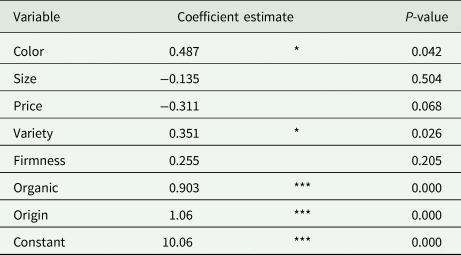
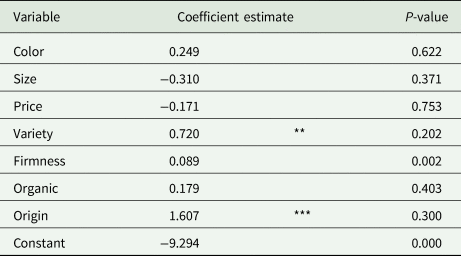
The regression used in the case of cherries correctly predicted 80.8% of the data for the dichotomous variables (Table 2); this percentage rose to 84.7% in the case of the loquats (Table 3). These are high percentages of prediction, being similar to those obtained in other studies using the same methodology (Rabadán and Sáez-Martínez, Reference Rabadán and Sáez-Martínez2017; Bernabéu et al., Reference Bernabéu, Rabadán, El Orche and Díaz2018). Nagelkerke's R2 revealed that the models explain 51.3% of the total variance observed for the consumer preferences for PGI cherries and 54.7% of the total variance on the case of the PDO loquats.
Model of estimated parameters for certified cherries consumers

−2 Log likelihood: 297.634; Nagelkerke: 0.513; correctly predicted: 80.8%.
***, ** and * correspond to 1‰, 1% and 5% maximum error levels, respectively.
Model of estimated parameters for certified loquats consumers

−2 Log likelihood: 232.259; Nagelkerke: 0.547; Correctly predicted: 84.7%.
***, ** and * correspond to 1‰, 1% and 5% maximum error levels, respectively.
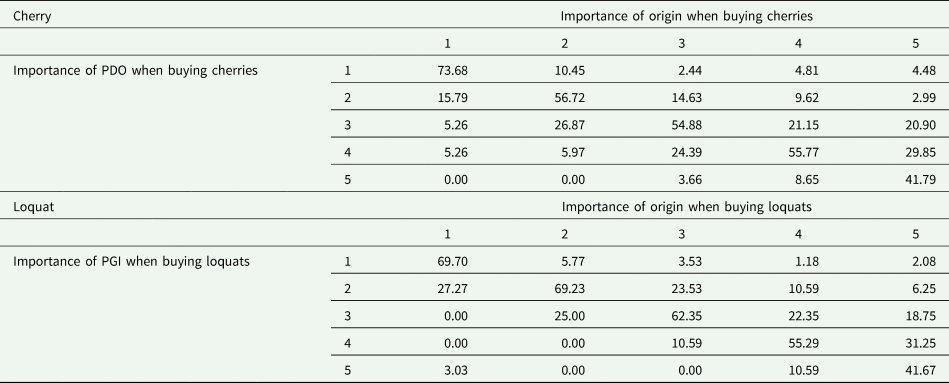
For both products, origin is the attribute most associated with the GIs. Table 4 shows the distribution of the values that consumers give to the importance of the origin and the GI labels when buying cherries and loquats. Those consumers that report higher importance to the GIs are also those that consider the origin as an important quality attribute. This association had been reported previously for other products, such as lamb meat (Sepúlveda et al., Reference Sepúlveda, Maza and Mantecón2010).
Cross-table including the importance that consumers give to the origin and the GI labels (PDO and PGI) when buying cherries and loquats

Numbers in the table are percentages. Figures in the same column of each product (cherries and loquats) show the distribution of the total percentage of consumers reporting that value (5-point Likert-type scale).
In the case of cherries, the results suggest that a greater preference for cherries with PGI may be explained by the more substantial importance given to origin (P < 0.001) and organic production (P < 0.001). Previous studies have shown that origin is an attribute that significantly affects cherry consumers' preferences (Chiang et al., Reference Chiang, Schnettler, Mora and Aguilera2018) and, given the direct relationship with GI (Van Der Lans et al., Reference Van Der Lans, Van Ittersum, De Cicco and Loseby2001), this association between the two attributes was not unexpected. Like a GI, organic certification is a quality label that distinguishes a product (Magnusson et al., Reference Magnusson, Arvola, Hursti, Åberg and Sjödén2003), with both types of labels being related in the case of the cherries. The importance for fruit consumers of both origin and the presence of different quality labels was previously reported in the study by Cicia et al. (Reference Cicia, Cembalo and Del Giudice2012), who analyzed peach consumers' preferences. Albeit to a lesser degree, the greater preference for PGI cherries is also associated with a greater importance given to the fruit's intrinsic characteristics, such as variety and color (P < 0.05). The skin color of cherries, given its link to the fruit's ripeness, has typically been identified as one of the attributes with the largest impact on consumer preferences (Crisosto et al., Reference Crisosto, Crisosto and Metheney2003; Chauvin et al., Reference Chauvin, Whiting and Ross2009) (Table 2).
In the case of the loquat, a greater preference for this PDO fruit is significantly associated with greater importance given to the origin of production (P < 0.001) and to variety (P < 0.01). Both the origin of the fruit and the varieties that may be grown within the area of the PDO are attributes included in the regulations established to grant a GI (EEC, 1991). Thus, the PDO acts as a simple quality indicator with information of various attributes positively valued by consumers (Table 3).
Segmentation of consumers according to whether they live inside or outside the area of influence of the GI label
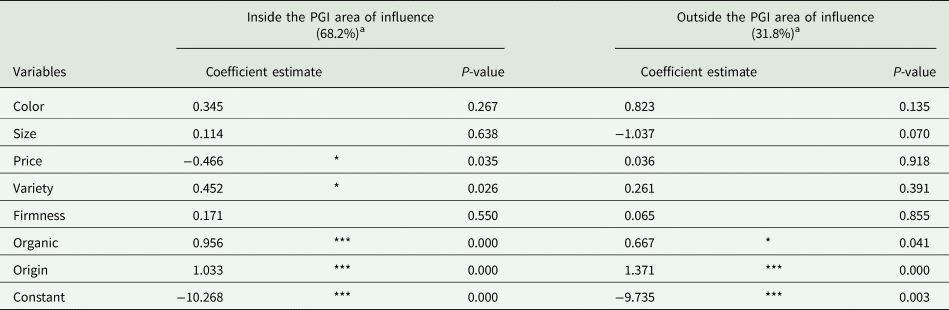
When the cherry consumers are segmented according to whether their place of residence is inside or outside the area of influence of the GI, significant differences can be observed in the factors most appreciated by those who prefer cherries with PGI (Table 5).
Model of estimated parameters for cherry consumers living inside and outside the area of influence of the PGI for Mountain Cherries from Alicante

IN Area PGI: −2 log likelihood: 191.044; Nagelkerke: 0.499; correctly predicted: 80.5%.
OUT Area PGI: −2 log likelihood: 75.659; Nagelkerke: 0.543; correctly predicted: 82.3%.
a Size of the segment.
***, ** and * correspond to 1‰, 1% and 5% maximum error levels, respectively.
The consumers who live within the area of influence of the PGI show an association between the GI and a larger number of attributes, with the most important being origin and the organic production label (P < 0.001). These consumers also attach the greatest importance to variety, arguably due to their greater knowledge of this attribute as they live nearer the production area (Galmarini et al., Reference Galmarini, Symoneaux, Chollet and Zamora2013). Cherry consumers living within the area of influence of the PGI attached less importance to price, presumably because they are aware that production under differentiated quality certification increases production costs (Angood et al., Reference Angood, Wood, Nute, Whittington, Hughes and Sheard2008). Accordingly, they would be willing to pay more for cherries with PGI as they would likely regard them to be of higher quality, which would compensate for paying a higher price. This finding coincides with the study by Cicia et al. (Reference Cicia, Cembalo and Del Giudice2012), who found that the segment of German consumers with a stronger preference for PDO peaches also reported price as an unimportant attribute when buying this product.
Similarly to the findings of Marcoz et al. (Reference Marcoz, Melewar and Dennis2016), the consumers that most value the origin of the cherries are those living outside the area of influence of the PGI. Our results suggest that within the area of influence of the PGI, this quality label is associated with a large number of attributes, while outside the area of influence, the PGI is primarily associated with the origin of the product.
Table 6 shows the segmentation of loquat consumers according to whether they live inside or outside the area of influence of the PDO. The fit is adequate in both segments, being better in the case of consumers residing outside the area of influence, for whom Nagelkerke's R2 is 71.2%. This may be because outside the area of influence, both the product and the GI are less well known, and so the attributes associated with these factors tend more to be the generic ones proposed in our study (Cañete et al., Reference Cañete, Pinillos, Cuevas and Hueso2007; Cicia et al., Reference Cicia, Cembalo and Del Giudice2012; Blando and Oomah, Reference Blando and Oomah2019).
Model of estimated parameters for loquat consumers living inside and outside the area of influence of the PDO for Loquats from Callosa d'En Sarriá

IN Area PGI: −2 log likelihood: 150.527; Nagelkerke: 0.521; correctly predicted: 83.2%.
OUT Area PGI: −2 log likelihood: 47.873; Nagelkerke: 0.712; correctly predicted: 88.8%.
a Size of the segment.
***, ** and * correspond to 1‰, 1% and 5% maximum error levels, respectively.
In the case of loquats, the greater importance given to the place of origin is notably the attribute that most robustly explains the preference for loquats with PDO (P < 0.001). As in the case of the cherries with PGI, this tendency is much stronger in consumers living outside the area of influence of the PDO (Marcoz et al., Reference Marcoz, Melewar and Dennis2016).
Conclusions
The use of GI labels is considered an effective strategy to enhance the competitiveness of agri-food products, increasing farmers' income and revitalizing rural environments. The significant commitment to this initiative made by a number of countries, especially in the EU, has given rise to a considerable number of quality labels, whose effectiveness is difficult to verify given their specificity to each country and product.
The present study analyzed the attributes that consumers of spring fruits (cherries and loquats) associate with a GI. Our findings reveal the crucial association that consumers make between the GI label and the origin of the fruit as a synonym of differentiated quality. Creating this robust association in consumers' minds has been one of the foremost aims of GI labels since their inception. However, the preference for GIs is increasingly related to organic certification in the case of cherries. This suggests these labels serve not only to guarantee the specific origin of a food product, but also to bolster their differentiated quality based on traditional production methods as a safeguard for the sustainability of the environment. Such production is often grounded in traditional working methods and underpinned by regional exchange systems, with less reliance on globalized commerce, thus helping to preserve local and regional natural resources.
In addition, we found differences between consumers of food products with quality designations who live inside and outside the particular food's production area. GI labels are more commonly viewed as a guarantee of origin outside the area of production, while inside the area, likely due to their greater knowledge of the crops and production methods, consumers associate these labels with other attributes beyond the origin, such as the variety of the fruit.
The results show that an increase in the knowledge of GI labels beyond their area of influence could bolster the demand for these products, as consumers would be aware of all the different quality attributes that are guaranteed with a single label. In this regard, the administrations and institutions involved need to conduct more effective information campaigns to increase the information consumers receive about these labels. This will serve to increase the quality of food produced in rural environments and will enhance the value added that producers receive for their products. The development of the demand for GIs products has the potential to generate greater income and employment in the production areas, which, in turn, will help settle population in those regions.
This work also has some limitations. The first refers to the main weakness of market research, namely that consumers' responses may not actually be reflected in what they finally do when shopping. The second is the complexity involved in geographically segmenting consumers. Consumers may live in one place (city or province) but work or spend their weekends in another, and may also have been raised in a third location. All this can affect their current food preferences. In this regard, the authors decided to use the consumers' place of residence (province), as, to our understanding, it would be the most simple and effective way to include a reference to their geographical reality. Future research should address this issue and consider different variables and their usefulness in geographically segmenting consumers.
Financial support
This study has been partially funded by the University of Castilla-La Mancha and the European Regional Development Fund (2018/11744).
Conflict of interest
The authors declare none.