Today, as they have been for a long time, Western European (WE) and Central and Eastern European (CEE) party systems are widely regarded as two different worlds. Prior to the fall of the Berlin Wall, their respective democratic and authoritarian natures accounted for the difference. After 1989, they continued to remain separate entities, with most of the literature pointing to a major difference between the two areas: one expressed as the traditional stability of Western European party systems vs. the instability of the post-communist party systems due to their weak processes of institutionalization (Lewis Reference Lewis2006; Mair Reference Mair2013). Even in more recent times, the party systems in the two regions have been conceived as very distinct, with most of those in WE featuring stable patterns of interparty competition and those in CEE continuing to be characterized by important voting shifts among established parties, coupled with the very frequent entry of new parties and/or exits of old parties (Casal Bértoa Reference Casal Bértoa2013; Powell and Tucker Reference Powell and Tucker2014).
Yet this article calls into question the conventional wisdom that WE and CEE party systems are worlds apart, at least in terms of their stability/instability, as measured by the well-known Pedersen (Reference Pedersen1979) index of electoral volatility. We argue that this conventional wisdom is heavily influenced by three sources of bias – related to case selection, time and measurement – that systematically occur when scholars compare electoral instability in the two regions. With regard to case selection, most studies on post-communist countries include polities that are not fully democratic according to standard indexes, thus making cross-national comparisons problematic. As for time, most studies do not take into account the most recent electoral trends in Western Europe, characterized by unprecedented levels of volatility and the successful emergence of new political parties. Finally, scholars of the two regions usually apply different criteria for the calculation of volatility (e.g. dealing with cases of splits and mergers), with a systematic overestimation of electoral instability in CEE in comparison to WE standards. By correcting these biases, this article aims to assess the persistence of the division between WE and CEE party systems and to verify the existence of a process of convergence in electoral volatility between the two regions.
Until now, a convergence in terms of electoral (in)stability between WE and CEE party systems has never been empirically proven. Some scholars have hypothesized that, over time, a convergence might occur (Casal Bértoa Reference Casal Bértoa2013; Haughton and Deegan-Krause Reference Haughton and Deegan-Krause2015; Lane and Ersson Reference Lane and Ersson2007; Van Biezen Reference Van Biezen2003), but they have not found any substantial evidence of such a process occurring.Footnote 1 Our analysis finds that a process of convergence has been taking place and has gone so far as to blur the traditional distinction between WE and CEE party politics. Moreover, it shows that this convergence is due more to WE party systems moving towards CEE standards (i.e. increasing electoral instability) than the other way around. As a matter of fact, Europe as a whole is facing turbulent times to an extent never seen before.
The article proceeds as follows. The first section discusses the literature on party system change in both WE and CEE and introduces our hypotheses. The second section addresses in detail the methodological issues related to the three possible sources of bias in the comparative analysis of electoral volatility. The third and fourth sections present the empirical analysis and test the hypotheses. A concluding section discusses the implications of our findings.
Party system change between East and West: two different worlds?
WE party systems have traditionally been characterized by stable and predictable patterns of interactions among parties, stemming from the presence and persistence of deep social cleavages (Lipset and Rokkan Reference Lipset and Rokkan1967). Their consolidation has been taken for granted for a long time, even after the 1970s, when signs of instability began to emerge (Dalton et al. Reference Dalton, Flanagan and Beck1984; Franklin et al. Reference Franklin, Mackie and Valen1992). Even then, a ‘fundamental bias towards stability’ (Bartolini and Mair Reference Bartolini and Mair1990: 68) still prevailed. Only more recently, following the de-freezing of political alignments, the weakening of ideological conflict after 1989 and the economic crisis of 2008, WE party systems have appeared to be changing to a significantly greater extent than before (Emanuele and Chiaramonte Reference Emanuele and Chiaramonte2016; Hernández and Kriesi Reference Hernández and Kriesi2016), in some cases leading to an outcome of de-institutionalization (Chiaramonte and Emanuele Reference Chiaramonte and Emanuele2017), under which the interactions between parties tend to become progressively irregular and unpredictable (Casal Bértoa Reference Casal Bértoa2014; Mainwaring Reference Mainwaring2016; Mainwaring and Scully Reference Mainwaring and Scully1995).
Conversely, since the beginning of the democratization process, and for over a quarter of century, party systems in post-communist countries have been depicted as highly fluid (Bakke and Sitter Reference Bakke and Sitter2005; Epperly Reference Epperly2011; Haughton and Deegan-Krause Reference Haughton and Deegan-Krause2015; Mair Reference Mair1997; McAllister and White Reference McAllister and White2007; Pop-Elecheș Reference Pop-Elecheş2010; Pridham and Lewis Reference Pridham and Lewis1996; Rose and Munro Reference Rose and Munro2009; Sitter Reference Sitter2002; Tavits Reference Tavits2008), challenging the very existence of structured forms of competition in some cases. For a while, Hungary, the Czech Republic, Slovenia and even Slovakia appeared to show increasing patterns of stabilization (Agh Reference Agh1998; Casal Bértoa and Mair Reference Casal Bértoa and Mair2012; Lewis Reference Lewis2006; Sitter Reference Sitter2002; Van Biezen Reference Van Biezen2003). However, this optimistic diagnosis has rapidly been put into question by the multiplication of electoral ‘hurricanes’, not only in the more fragile democracies but also in the consolidated ones (Hanley and Sikk Reference Hanley and Sikk2016; Haughton and Deegan-Krause Reference Haughton and Deegan-Krause2015; Pop-Eleches Reference Pop-Elecheş2010). Over the last decade, post-communist politics have faced the challenge of a wide group of new parties with an agenda combining moderate social and economic policies with anti-establishment appeal (Hanley and Sikk Reference Hanley and Sikk2016). Across the region, the empirical evidence seems to reinforce Peter Mair’s (Reference Mair1997) forecast of long-term instability and unpredictability.
Thus it is no surprise that scholars comparing WE and CEE party systems over the past 20 years have emphasized two contrasting images: the stability of Western party systems against the instability of the post-communist ones. Most of them have drawn their conclusions on Mogens Pedersen’s index (Reference Pedersen1979) of electoral volatility, which detects the net aggregate electoral changes over successive elections (Bielasiak Reference Bielasiak2002; Casal Bertoa Reference Casal Bértoa2013; Tòka Reference Tòka1997) and has been widely used as a proxy for party system change. Some others have employed more sophisticated measures, aiming to fine-tune the inner dynamics of party competition (Birch Reference Birch2003; Mainwaring et al. Reference Mainwaring, Gervasoni and España-Najera2016; Powell and Tucker Reference Powell and Tucker2014; Rose and Munro Reference Rose and Munro2009).Footnote 2 In particular, Eleanor Powell and Joshua Tucker (Reference Powell and Tucker2014) disentangle total volatility (TV) into two components, calling the vote shifts caused by the entry and exit of parties from the political system ‘Type A Volatility’ and the vote shifts occurring when voters switch their votes between existing parties ‘Type B Volatility’. They find not only higher levels of volatility in CEE than in WE, but also that most of the volatility in post-communist countries is Type A Volatility, whereas in Western Europe it is Type B Volatility. In other words, according to this literature, WE and CEE party systems are still worlds apart.
However, we argue that this conclusion needs to be reconsidered because it is based on empirical evidence that may suffer from a number of possible biases. First, the analyses of party system change in the post-communist region have produced remarkably different results, depending on the countries selected. Therefore, when using the term ‘post-communist countries’ or ‘Central and Eastern Europe’ – and indeed ‘Western Europe’ – a common definition is required. Second, there may be a case of time selection bias, and the empirical evidence that has emerged so far should thus be tested against the recent developments in both WE and CEE party systems. Third, as shown by Fernando Casal Bértoa et al. (Reference Casal Bértoa, Deegan-Krause and Haughton2017), data on electoral volatility (and on its internal components) may vary considerably from author to author, particularly if dealing with CEE countries, due to the different criteria and assumptions used for the measurement. This is of course a problem per se, but of even greater relevance when comparing two regions that have often been studied independently from each other. These three sources of possible bias are discussed in more depth in the following section.
By properly addressing these methodological issues, and by taking into account the recent season of hurricane elections in WE party systems, we may even go so far as to hypothesize that a process of convergence between the party systems of the two regions is taking place. More specifically, the first hypothesis we want to test here is:
Hypothesis 1: Over the course of the period 1990–2016, a process of convergence in the levels of electoral volatility has taken place between WE and CEE party systems.
As a corollary to this hypothesis, we also want to test: (a) whether the process of convergence, if present, is symmetrical – that is, characterized by a growth of volatility in the West and a decline of similar extent in the East – or asymmetrical – that is, characterized by other patterns (for example, different trends of growth in both regions); and (b) whether it is driven by Type A or Type B Volatility, the two measures developed by Powell and Tucker (Reference Powell and Tucker2014) for which, in this article, following Alessandro Chiaramonte and Vincenzo Emanuele (Reference Chiaramonte and Emanuele2017), we will use the terms ‘Volatility by Regeneration’ (RegV) and ‘Volatility by Alteration’ (AltV) respectively and we will calculate accordingly.Footnote 3 These two components of total volatility (TV) capture two distinct types of party system change. While AltV simply witnesses a change in the balance of power among established parties, RegV reflects a change in the essence of parties competing in the system, either because previously established parties have disappeared or because new parties have emerged.
As for point (b), we expect the process of convergence to be driven primarily by RegV. More specifically, we expect the (slow) institutionalization in CEE party systems to be mainly a result of the reduction of RegV, while we expect the (initial) de-institutionalization in WE party systems to be affected by an increase in RegV due to the entry of successful new parties.
The confirmation of Hypothesis 1 would show that the difference in the levels of TV between WE and CEE party systems has been diminishing over time. It would also show the size such a difference was some time ago and, possibly, still is now. However, unless we find a full overlap in the levels of TV in the two regions, it would not be possible to demonstrate whether such a difference still makes the difference between East and West. Indeed, we want to assess whether the regional distinction is still a significant predictor of electoral volatility in Europe. For this purpose, our expectation is the following:
Hypothesis 2: The convergence in the levels of TV between WE and CEE party systems has gone so far that the region to which a given party system belongs is no longer a statistically significant predictor of TV.
Comparing electoral volatility and its internal components between East and West: three sources of bias
As introduced in the previous section, we believe that the conventional wisdom, according to which WE and CEE are still considered two different worlds regarding party system stability, results from three sources of bias: case selection, time coverage and, last but not least, measurement.
The case selection bias concerns the number of cases under scrutiny. While there is a consensus in studies focusing on WE regarding which countries belong to the region and should therefore be included in cross-national comparisons, the ‘meaning’ of CEE is less defined, and consequently there is a large variation in both the number and the identity of the cases covered by the literature.Footnote 4 Specifically, the bias arises from the choice of several authors to include not only the post-communist EU member states, but also other countries, whose levels of democratization are questionable, to say the least, and whose party systems are far from being even minimally institutionalized, thus making cross-national comparisons problematic. Here, we refer to former Soviet Union countries such as Moldova, Russia and Ukraine (Bielasiak Reference Bielasiak2002; Birch Reference Birch2003; Mainwaring and Zoco Reference Mainwaring and Zoco2007), Armenia and Georgia (Epperly Reference Epperly2011) or Balkan states, such as Albania, Bosnia-Herzegovina, Macedonia, Montenegro and Serbia (Powell and Tucker Reference Powell and Tucker2014), or even Turkey (Lane and Ersson Reference Lane and Ersson2007).Footnote 5 To compare these countries with fully democratic polities and EU member states such as the Czech Republic or Slovenia is to compare apples and pears.
In relation to the timespan, most of the literature on CEE focuses on a relatively limited period of time, beginning with the first post-communist elections and ending in the late 1990s (Bielasiak Reference Bielasiak2002; Tòka Reference Tòka1997) or the early 2000s (Birch Reference Birch2003; Epperly Reference Epperly2011; Lane and Ersson Reference Lane and Ersson2007; Sikk Reference Sikk2005; Tavits Reference Tavits2005). Slightly longer periods are included in the analyses by Ruth Dassonneville and Marc Hooghe (Reference Dassonneville and Hooghe2011), Andreas Bågenholm and Andreas Heinö (Reference Bågenholm and Heinö2013) and Powell and Tucker (Reference Powell and Tucker2014). None of these studies covers the post-2009 elections, apart from Casal Bértoa’s (Reference Casal Bértoa2013), whose data extend up to 2011. Similarly, only a few studies in WE focus on the elections that occurred after the beginning of the economic crisis (Chiaramonte and Emanuele Reference Chiaramonte and Emanuele2017; Hernández and Kriesi Reference Hernández and Kriesi2016). This time bias has two consequences. On the one hand, there is an emphasis on the first post-communist elections, which occurred in the early stages of the process of democratic institutionalization and were generally characterized by an increased level of fluidity. On the other hand, the dynamics of the most recent elections in WE – where the impact of the post-2008 economic crisis has produced ‘a general shift towards instability’ (Chiaramonte and Emanuele Reference Chiaramonte and Emanuele2017: 381, original emphasis) – are neglected in the current scientific debate.
The last potential bias refers to the decisions about measurement and classification. This element has been regularly underlined by the literature (Casal Bértoa et al. Reference Casal Bértoa, Deegan-Krause and Haughton2017; Mainwaring et al. Reference Mainwaring, Gervasoni and España-Najera2016; Powell and Tucker Reference Powell and Tucker2014). On this point, Casal Bértoa et al. (Reference Casal Bértoa, Deegan-Krause and Haughton2017) demonstrate that the lack of shared rules for the calculation of electoral volatility leads scholars in the two regions to produce divergent estimates. The most important source of variation is the crucial decision concerning when to consider a party as ‘new’: relabelling, splits, mergers or birth from scratch? As noted by Casal Bértoa et al. (Reference Casal Bértoa, Deegan-Krause and Haughton2017), the impact of these strategic decisions increases when applied to more sophisticated indexes of volatility, as in the case of Sarah Birch (Reference Birch2003), Richard Rose and Neil Munro (Reference Rose and Munro2009), Powell and Tucker (Reference Powell and Tucker2014) or Scott Mainwaring et al. (Reference Mainwaring, Gervasoni and España-Najera2016). These authors operationalize the ‘newness’ of a party in a less conservative way than scholars focusing exclusively on WE, who usually follow the example of Pedersen (Reference Pedersen1979) and Stefano Bartolini and Peter Mair (Reference Bartolini and Mair1990). For the sake of the calculation of the index of electoral volatility, the latter consider a party as new only when it does not derive from the structure of an existing party, while splits and mergers are always treated as continuations of their predecessors.Footnote 6 This asymmetry between scholars dealing with CEE and WE creates a substantial overestimation in electoral volatility scores (and, more specifically, in the ‘regeneration’ component) in CEE compared with WE. Additional sources of bias linked to the measurement dimension are the use (and the size) of a threshold of inclusion for parties to be considered as part of the party system and the treatment reserved for parties below this threshold, the so-called ‘others’.Footnote 7
Given these potential biases, and in line with the aim of assessing the extent to which an ‘Iron Curtain’ still divides the two regions into two distinct and hardly comparable environments, we propose three corrective measures. In reaction to case selection and time biases, we have built a data set covering 31 countries and 209 parliamentary elections held between 1990 and 2016.Footnote 8 We have applied the disentangled index of electoral volatility previously developed by Chiaramonte and Emanuele (Reference Chiaramonte and Emanuele2017) to 20 Western European countries, supplemented by 11 post-communist countries.Footnote 9 Within these countries, we have excluded all the volatility scores based on a calculation where at least one election was in a year that was not considered ‘free’ by Freedom House (2017).Footnote 10 This sampling is characterized by higher internal homogeneity in relation to both political and economic criteria compared with other recently published studies (Lane and Ersson Reference Lane and Ersson2007; Mainwaring et al. Reference Mainwaring, Gervasoni and España-Najera2016; Powell and Tucker Reference Powell and Tucker2014). Furthermore, the 1990–2016 timespan has a double advantage. First, it increases the statistical robustness of the computations by increasing the number of elections covered. Second, it makes it possible to test the potential synchronization between the persistent instability in CEE and the WE party systems’ de-institutionalization in light of the recent electoral earthquakes that occurred in various countries, including Greece, Iceland, Italy and Spain. By applying the same criteria of calculation, this analysis aims to build a comprehensive database of electoral volatility and its internal components (volatility by regeneration and volatility by alteration) in both WE and CEE. More specifically, the data set is compliant with the traditional criteria detailed by Bartolini and Mair (Reference Bartolini and Mair1990) regarding mergers and splits, and with Emanuele (Reference Emanuele2015) regarding other technical choices (i.e. the threshold for parties to be included in the calculation of regeneration and alteration, and the treatment of volatility derived by parties below this threshold).Footnote 11 Bartolini and Mair’s criteria have been later used, among others, by Allan Sikk (Reference Sikk2005), Jan-Erik Lane and Svante Ersson (Reference Lane and Ersson2007), Dassonneville and Hooghe (Reference Dassonneville and Hooghe2017) and Chiaramonte and Emanuele (Reference Chiaramonte and Emanuele2017). We are conscious that each method of calculation has its own advantages and limits.Footnote 12 However, we consider the aggregation method as preferable to the other two methods for two main reasons: first, its criteria are those originally set by the group of scholars that first approached the study of electoral volatility (Pedersen, Bartolini, Mair, Ersson) and still remains the most used one in the literature, thus demonstrating that alternatives have not succeeded in becoming standard; second, it provides more conservative choices compared to the other two methods and this is useful as it avoids overestimation in the level of electoral change: with such a method, whenever an election results in a volatility index it means that a real change in voters’ preferences has occurred without being inflated by changes in the electoral supply (as in the cases of splits and mergers). Table A1 in the online Appendix reports the results of the Pearson’s r correlations between our data and three other available data sets measuring electoral volatility in both WE and CEE.Footnote 13
Towards a convergence in the levels of volatility? Evidence
Having outlined the three types of bias concerning the measurement of volatility and having presented our corrections, it is now time to pin down the numbers of the European variation and to test the two rival hypotheses of convergence vs. the persistence of an Iron Curtain between the two regions (Hypothesis 1).
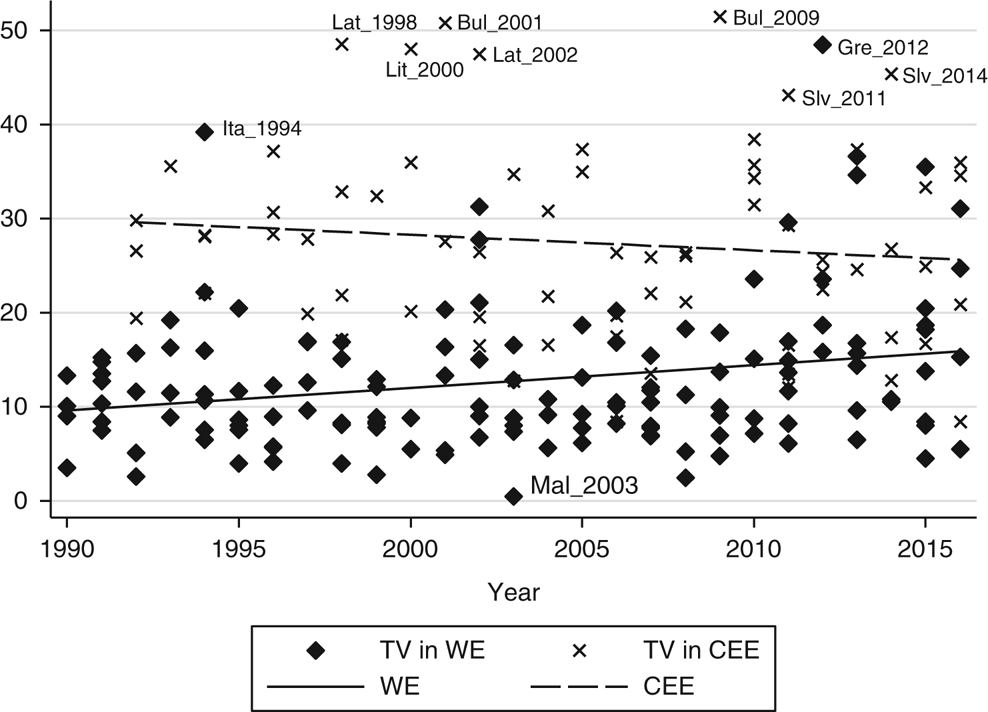
Figure 1 plots the distribution of electoral volatility scores over time in WE and CEE elections. The two fitted regression lines show a clear process of convergence in the volatility scores between the two regions: at the beginning of the period under consideration, the average difference between WE and CEE was around 20 points (TVs of about 10 and 30, respectively), while at the end of the period this has halved. Indeed, a process of convergence in the electoral volatility scores has occurred in Europe over the last 25 years, and this confirms our first hypothesis.Footnote 14 Generally speaking, a process of convergence can be the result of two different processes: a parallel approach between the two trend lines (symmetric convergence) or an uneven change, with one line that gradually approaches the other (asymmetric convergence). This latter, in turn, may follow two opposite directions, depending on whether the convergence is characterized by an upward or a downward trend. Here the process depicted in Figure 1 clearly belongs to the upward asymmetric convergence. As shown by Table A2 in the online Appendix, which reports the averages of TV, RegV and AltV by country, region and period, the convergence is mainly due to the sharp increase in electoral volatility that occurred in WE during the 2010s, and only to a lesser extent to the decrease in volatility in CEE. The average TV in WE increases from 11.2 to 17.3 when one moves from the first two decades, jointly considered (there are no significant differences between the 1990s and the 2000s), to the 2010s. In other words, an election with a TV of 17, which was considered an outlier in the period before 1990 (see Bartolini and Mair Reference Bartolini and Mair1990: 72), is a common event in the current decade. Conversely, only a slight decline is observable in CEE, where TV decreases from 27.9 to 26.6, and therefore remains very high.
Total Volatility in Europe, 1990–2016

Over the whole timespan under study (1990–2016), the equations resulting from the regression of time (operationalized as the number of years elapsed since 1 January 1990) on volatility are the following:
For Western Europe: TV=9.49 + 0.24(year)
For Central and Eastern Europe: TV=30.02 − 0.16(year)
Based on these predicted trends, in terms of total volatility, Western Europe is expected to reach and overtake Central and Eastern Europe in the year 2041, when TV will be on average 21.8 in WE and 21.7 in CEE. This would suggest that the convergence is still far from occurring. Yet, if we consider the predicted trends based on the last decade, the 2010s, the scenario changes significantly, as the equations are the following:
For Western Europe: TV=14.74 + 0.11(year)
For Central and Eastern Europe: TV=44.33 − 0.75(year)
In this case, the process of convergence will be completed much earlier, in the year 2025. This means that, if the current trends are maintained over the next few years, Western Europe will approach the levels of volatility of Central and Eastern Europe, and the whole region will face party system instability and unpredictability.
Indeed, in considering Europe as a whole, the first signals of such an outcome are already visible, as the continent has shifted towards instability in the last few years. As reported in Table A2, the average level of TV has increased from 16.2 before 2010 to 21.1 afterwards. Therefore, the ‘average election’ in Europe today is an event featuring a substantial level of party system change. Moreover, almost half of elections since 2010 display a TV higher than 20, against only 18% reporting low volatility scores. Once again, in the previous two decades, the situation was reversed, as low-volatility elections outnumbered those with high volatility.
Overall, the data show conclusive evidence that an asymmetric convergence towards greater instability is currently occurring in Europe. This trend was anticipated a decade ago by Lane and Ersson (Reference Lane and Ersson2007) and some years later by Casal Bértoa (Reference Casal Bértoa2013), but at that time their data showed that the two regions were still worlds apart.
This finding brings a new question to be addressed. What drives this convergence? Is this result symmetrically driven by the two internal components of TV? Or is only one of the two components responsible for it? Addressing these questions allows us to disentangle the patterns of interparty competition going on in the two regions and to provide a comprehensive understanding of what drives electoral instability in WE and CEE.
Furthermore, by looking at the internal components of regeneration and alteration, we can verify whether some consolidated and largely accepted assumptions emphasized by previous literature hold when we apply our rules of counting, thus allowing for a consistent comparison between the two regions. A look at the data reported in Table A2 tells us that there are at least two assumptions or, using a different formulation, two ‘myths’ to dispel. The first is that ‘electoral volatility in post-communist countries to date is almost entirely driven by volatility due to new party entry and old party exit’ (Powell and Tucker Reference Powell and Tucker2014: 125). Yet, Powell and Tucker’s calculations are based on the ‘maximum difference method’ (Casal Bértoa et al. Reference Casal Bértoa, Deegan-Krause and Haughton2015: 14), which considers most parties resulting from splits and mergers as new entities. This method ‘is prone to seeing change where little is actually present’ (Casal Bértoa et al. Reference Casal Bértoa, Deegan-Krause and Haughton2015: 25), given that splits and mergers are typical cases where ‘the faithful [voters] have no other place to go’ (Sikk Reference Sikk2005: 394). If we consider parties that clearly result from splits or mergers as being in continuity with their predecessors, consistent with the rules established long ago by Bartolini and Mair (Reference Bartolini and Mair1990), the picture radically changes, and we are faced with a substantially different story. Indeed, volatility by regeneration is on average 8.8 in CEE during the period 1990–2016, while volatility by alteration is about twice as large (16.5). Therefore, while for Powell and Tucker (Reference Powell and Tucker2014: 131) ‘over 70 per cent of the Total Volatility in post-communist countries in this time period is Type A Volatility’, RegV (roughly corresponding to Type A Volatility) represents ‘only’ 32% of TV.
The second myth to dispel concerns the trend over time of the two components. Powell and Tucker find that ‘Type A Volatility and Total Volatility decrease over time, Type B Volatility is stable or increases slightly’ (2014: 132). While a decrease in TV is confirmed by our analysis, it is not RegV, which actually increases over time (from 7.8 in the period 1990–2009 to 10.6 since 2010), that is responsible for this trend, but rather AltV, which declined from 17.8 to 14.2 between the first two decades and the last one.
From this striking evidence, it follows that the interpretation of the patterns of electoral instability in CEE should be radically revised. Although the role played by the entry of new players and the demise of old ones is a distinctive feature of the region and should not be underestimated (Sikk Reference Sikk2005; Tavits Reference Tavits2008), TV in CEE today is still mainly driven by vote shifts among established parties, similar to what occurs in Western Europe.
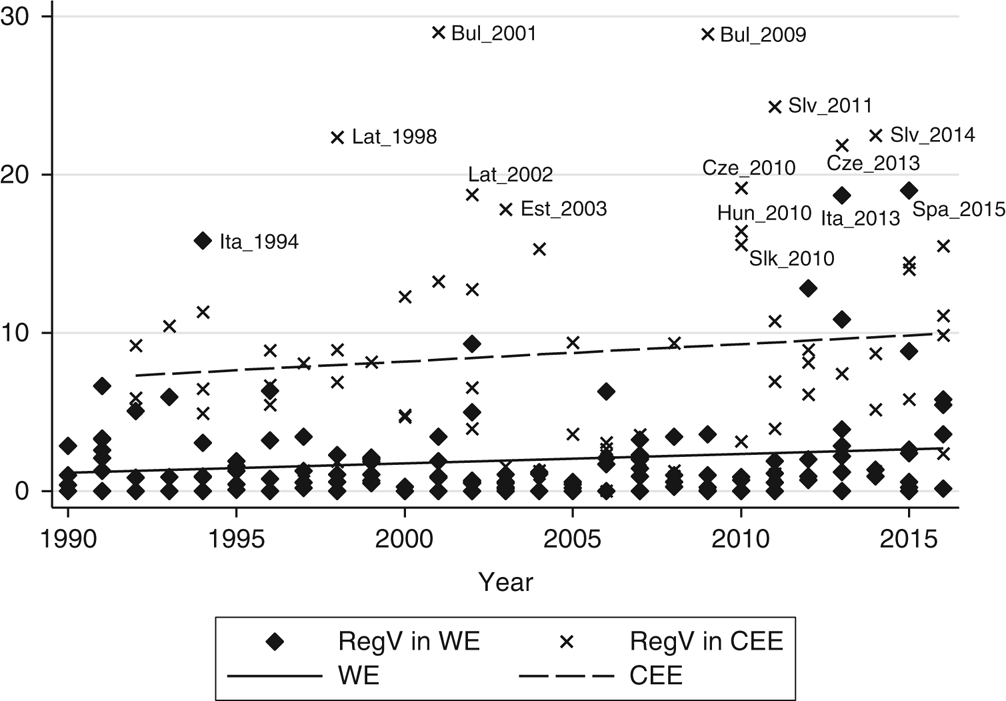
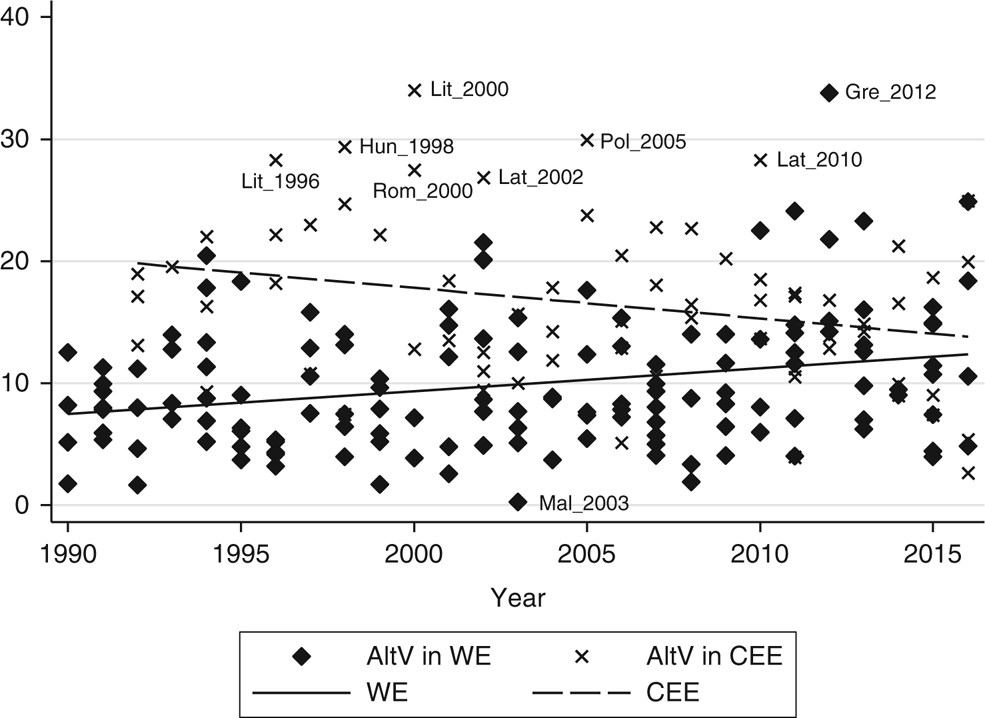
These considerations bring us to address the above-mentioned question of which component of TV drives the process of convergence detected so far. Figures 2 and 3 plot all the scores of, respectively, regeneration and alteration over time for the two regions, thus providing a clear answer. Contrary to what might be expected (see above), the convergence in TV levels is entirely due to growing similarity of the two regions in the level of alteration (where in the 2010s WE and CEE are separated by just one point, 13.1 to 14.2 respectively), while, notwithstanding a notable increase in Western Europe (where RegV in the 2010s is more than twice as high as in the 1990–2009 period), the two regions still remain two different worlds as regards regeneration. Therefore, while WE countries are becoming both more unstable (higher AltV) and unpredictable (higher salience of RegV, considered as the ratio between RegV and TV) (Chiaramonte and Emanuele Reference Chiaramonte and Emanuele2017), CEE countries are stabilizing slightly, but their unpredictability is still very high and has indeed increased over time.
Volatility by Regeneration in Europe, 1990–2016

Volatility by Alteration in Europe, 1990–2016

The decrease in AltV in CEE during the last decade is a finding that should not be underrated: it means that vote shifts among established parties are less pronounced than in the past. In other words, this may bear witness to the fact that the ‘core’ parties of the system have finally succeeded in creating (more) stable and enduring loyalties with their voters. As a result, it is possible that the number of ‘faithful’ voters who repeatedly vote for the same parties is on the rise, which may help established parties to survive for a larger number of consecutive elections. This process, in turn, would increase the likelihood of these parties being able to strengthen ties with their own voters, thus completing a virtuous circle of stabilization. Therefore, notwithstanding the presence of increasing patterns of regeneration – mainly due to the continuous rise of new parties that, in many cases, are in turn replaced by even newer parties (Haughton and Deegan-Krause Reference Haughton and Deegan-Krause2015) – the stable presence of a certain number of ‘core’ parties may be of benefit to the overall stabilization of the party system in the region.
Is the East–West divide still the key difference?
So far, this analysis has shown that a convergence in the levels of electoral volatility is taking place between WE and CEE. Yet we still need to verify to what extent the two regions are becoming increasingly similar. Is the regional distinction still a significant predictor of electoral volatility in Europe? Or has the convergence come to the point that makes the difference between the two regions statistically irrelevant?
The most straightforward way to address these questions is to build a pooled explanatory model of electoral volatility and verify whether a dichotomous variable marking the regional subgroup (0 for WE and 1 for CEE) maintains its statistical significance across the decades. The underlying assumption (Hypothesis 2) is that – all else being equal – the effect of this dichotomous variable decreases over time and, in moving from the 1990s to the 2010s, the difference between the two regions gradually becomes statistically irrelevant.
Since Pedersen’s original proposal (Reference Pedersen1979) of the index of electoral volatility as a proxy to gauge party system change, there has been a growth of studies analysing its determinants, both in WE (Bartolini and Mair Reference Bartolini and Mair1990; Dassonneville and Hooghe Reference Dassonneville and Hooghe2017) and in CEE (Birch Reference Birch2003; Powell and Tucker Reference Powell and Tucker2014; Tavits Reference Tavits2005), as well as comparing the patterns in the two regions (Lane and Ersson Reference Lane and Ersson2007) or pooling together countries from all regions of the world (Mainwaring and Zoco Reference Mainwaring and Zoco2007; Mainwaring et al. Reference Mainwaring, Gervasoni and España-Najera2016). By relying on this consolidated literature, we control for the effect of four different sets of factors: the cleavage structure of the society, the economic context, the political-institutional framework and the timing of democracy.
For the first set of factors, we control for the effect of social cleavages,Footnote 15 specifically the class cleavage and the cultural ones, through, respectively, trade union density (TUD), which is the ratio between trade union membership and the total dependent labour force in a country,Footnote 16 and the fractionalization index (Alesina et al. Reference Alesina, Devleeschauwer, Easterly, Kurlat and Wacziarg2003). To gauge the state of the economy, we use the GDP growth rate at constant prices (i.e. adjusted for inflation), measured one year before the election.Footnote 17 As regards the political-institutional framework, we control for turnout change (measured as the absolute difference between two consecutive elections),Footnote 18 number of parties (measured by the effective number of electoral parties – ENEP)Footnote 19 and features of the electoral system, through the natural log of the average district magnitude (ADM).Footnote 20 Finally, we add in the explanatory model ‘birth year of democracy’, measured as the logged number of years between the inauguration of democracy and 2016,Footnote 21 and the time elapsed since the previous election.
By adding all these variables to the previously mentioned dichotomous variable for CEE, the model to be estimated is the following:
 $$\eqalignno{ {\rm Total}\,{\rm volatility} {\equals} \alpha \,{\plus}\,\beta \left( {{\rm TUD}} \right)\,{\plus}\,\beta \left( {{\rm Cultural \hskip4pt fractionalization}} \right)\,{\plus}\,\beta \left( {{\rm GDP}\,{\rm growth}} \right) \cr {\plus}\beta \left( {{\rm Turnout}\,{\rm change}} \right)\,{\plus}\,\beta \left( {{\rm ENEP}} \right)\,{\plus}\,\beta \left( {{\rm ADM}} \right)\,{\plus}\,\beta \left( {{\rm Birth}\,{\rm Year}\,{\rm of}\,{\rm democracy}} \right) \cr {\plus}\beta \left( {{\rm Time}\,{\rm between}\,{\rm elections}} \right)\,{\plus}\,\beta \left( {{\rm CEE}} \right)\,{\plus}\,{\rm e}. $$
Table A3 in the online Appendix reports the descriptive statistics of the dependent and (unlogged) independent variables.
Dealing with a time-series–cross-section (TSCS) data set, and specifically with a so-called ‘cross-sectional dominant’ pool, where cross-section units are more numerous than temporal units (N>T),Footnote 22 problems of heteroscedasticity and autocorrelation may arise (Stimson Reference Stimson1985). In particular, errors may not be independent and identically distributed, given that each panel (i.e. each country) has its own variance; moreover, errors may be serially correlated – that is, the errors for a given country are correlated with previous errors for that country. Diagnostic tests confirmed the presence of heteroscedasticity in our data, while the assumption of non-serially correlated errors is not violated.Footnote 23 In order to tackle heteroscedasticity problems, we have estimated the models by using an OLS with Huber/White/sandwich robust standard errors within the country clusters.Footnote 24
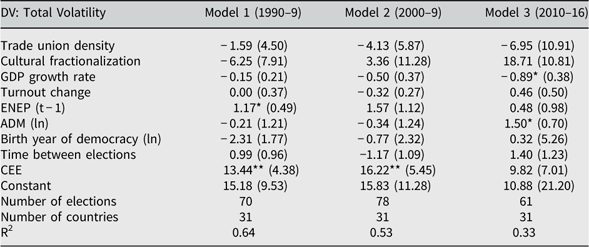
Table 1 reports the results of the regression of total volatility on the various social, economic and institutional determinants introduced above. We estimated three different models, one for each decade. The analysis of the determinants of electoral volatility goes beyond the scope of this article, while our interest focuses on the hypothesis of convergence formulated at the beginning of this section.Footnote 25 Evidence shows that Hypothesis 2 is empirically confirmed. Indeed, by taking into account a set of potential determinants of electoral volatility, the effect of the dichotomous variable related to the dichotomy WE vs. CEE was the most important factor fostering TV during both the 1990s and the 2000s. Conversely, this variable is no longer significant in the 2010s, and this represents a robust confirmation of the hypothesis of convergence between the two regions. The same result is achieved by regressing, respectively, the two internal components of volatility, RegV and AltV, on the same determinants: in both cases, the statistical significance of the dichotomous variable disappears during the 2010s (see Tables A4 and A5 in the online Appendix).Footnote 26 As a result, the regional distinction between WE and CEE no longer makes a difference for predicting electoral volatility scores.
OLS Regression for Electoral Volatility in Europe (1990–2016), by decade

Note: OLS regression with robust standard errors clustered by country; robust standard errors (se) in parentheses. *p< 0.05; **p< 0.01, ***p< 0.001.
Conclusion: the vanishing of the Iron Curtain
Almost three decades after the first free elections in post-communist Europe, this article has asked whether the dividing line between Eastern and Western democracies is still valid with regard to patterns of electoral volatility. The symbolic Iron Curtain has been invoked as a frontier dividing the stable and predictable Western party systems from the Eastern party systems characterized by irregular patterns of interparty competition coupled with the inability to develop expectations for the foreseeable future. So far, the index of electoral volatility measured by the extremely rich literature on party system change has produced highly different results for Eastern and Western countries. In our understanding, however, this diversity is directly connected to three potential biases related to case selection, time coverage and measurement. By controlling for these biases, our analysis provides three main contributions from both the methodological and the substantive viewpoint.
First, we have presented a new data set of electoral volatility, covering both Western and Central and Eastern Europe between 1990 and 2016. This data set has provided up-to-date information about volatility and its internal components of regeneration and alteration with regard to a broad range of countries over a much longer timespan than the previous data sets. This chronological extension has had the advantage of including in the comparison the most recent Western European elections, during which new parties have become increasingly successful. More importantly, to the best of our knowledge, this data set is also the most comprehensive and homogeneous in Europe, in that it covers 31 countries and follows the same rules and assumptions for calculating volatility in both regions.
Second, contrary to previous assessments, our analysis has shown evidence of an asymmetric convergence in the levels of volatility between the two areas of reference. More specifically, within a trend of growing overall instability in Europe between 1990 and 2016, our data detect an increasing electoral volatility in the Western European countries and, to a lesser extent, a diminishing electoral volatility in the Eastern European countries. Furthermore, by looking at the internal components of regeneration and alteration, and again contrary to what was previously stated by the literature, our analysis has proven that the process of convergence is less an issue of regeneration volatility – which is growing both in the East and in the West – and more, if not exclusively, of alteration volatility – which is significantly diminishing in Eastern Europe (meaning that the ‘core’ parties at least have reinforced the loyalty of their voters) and increasing in Western Europe.
Third, and finally, we have found that the regional distinction between Western and Central and Eastern Europe, which was the most important predictor of electoral volatility during both the 1990s and the 2000s, is no longer significant in the 2010s. This evidence represents not only further confirmation of the hypothesis of convergence but also shows that the process of convergence has gone so far as to make the difference between East and West statistically irrelevant in predicting the levels of volatility. In other words, so far as party system stability is concerned, Eastern and Western Europe are no longer two different worlds.
There is a lot at stake in the vanishing of this symbolic Iron Curtain. Although additional information is required, we consider that our conclusions are particularly important for future research on the implications of party system change for the functioning and the quality of democracy (Casal Bértoa Reference Casal Bértoa2017). Our analysis confirms that Central and Eastern European party systems offer a laboratory for understanding trends in party system volatility that are emerging in Western Europe and across the globe (Haughton and Deegan-Krause Reference Haughton and Deegan-Krause2015: 61). As has so far been the case in the East – and perhaps, in the future, in the West – ‘instability breeds instability’ (Bågenholm and Heinö Reference Bågenholm and Heinö2013: 22), and thus unstable party systems – characterized by the fragility of the linkages between parties and voters – become increasingly vulnerable to party switching, short-term coalition-building and the challenge of frequently emerging new parties, which are often held together by charismatic leaders and are erratic in the stances they adopt. This, in turn, undermines electoral and policy coordination, compromises the capacity of voters to attribute responsibility to parties and politicians for what they do, and frustrates citizens’ participation. In weakly or under-institutionalized party systems, in other words, electoral accountability – which is the core of democracy – tends to be hampered.
Our analysis is a first step in providing a more accurate understanding of the changes in party competition and voting patterns in the European democracies. As such, a state of enduring instability might become the point of arrival for several democracies, and, contrary to earlier expectations, this might be a credible scenario for a Western European party politics increasingly synchronized with Eastern dynamics.
Supplementary material
To view supplementary material for this article, please visit https://doi.org/10.1017/gov.2018.25
Acknowledgements
A previous version of this article was presented at the 75th annual conference of the Midwest Political Science Association, Chicago, 6–9 April 2017; and the 11th ECPR General Conference, Oslo, 6–9 September 2017. We warmly thank Scott Mainwaring and his colleagues for providing us with their full data set on electoral volatility. The research received grants from the University of Florence and from LUISS Guido Carli in Rome.