Neonates born with dextro-transposition of the great arteries are reliant on adequate mixing of oxygenated and deoxygenated blood, primarily at the level of the atrial septum, in order to maintain life. Approximately 30% of dextro-transposition of the great arteries patients require a balloon atrial septostomy to augment mixing before definitive repair via the arterial switch operation.Reference Vigneswaran, Zidere, Miller, Simpson and Sharland 1 Balloon atrial septostomy improves cerebral oxygenation and reduces oxygen requirements,Reference Vigneswaran, Zidere, Miller, Simpson and Sharland 1 , Reference Zellers, Dixon, Moake, Wright and Ramaciotti 2 and it lowers in-hospital mortality relative to patients who do not undergo atrial septostomy.Reference Hiremath, Natarajan, Math and Aggarwal 3 Balloon atrial septostomy can be performed in the cardiac catheterisation laboratory using fluoroscopy, with or without ultrasound assistance, or at the patient’s bedside using echocardiographic guidance alone.Reference Van der Laan, Verhagen, Bos, Berger and Kooi 4 – Reference Steeg, Bierman, Hordof, Hayes, Krongrad and Barst 7 The decision regarding where to perform the septostomy is often based on physician or institutional preference, with safety concerns or desire to visualise coronary artery anatomy often cited when the catheterisation laboratory is preferred. Prior studies have supported the safety and efficacy of both procedure locations.Reference Zellers, Dixon, Moake, Wright and Ramaciotti 2
Review of procedure billing for a bedside septostomy at the study institution revealed coding for cardiology professional fees, echocardiography technical and professional fees, and catheter equipment. Standard billing for these elements resulted in charges of ~$9200. Patient sedation for bedside septostomy is incorporated into daily hospital charges from the neonatal ICU. Coding for balloon atrial septostomy performed in the catheterisation laboratory included the same charges as the bedside septostomy, plus anaesthesia professional fees (~$2000) and catheterisation laboratory facility fees (~$18,000), resulting in a total billing of ~$29,000.
This study evaluates the effectiveness and safety of balloon atrial septostomy performed in the catheterisation laboratory compared with those performed at the bedside at a single institution. In an era where healthcare cost is an increasingly important discussion, consideration of strategies to provide equal quality of care with decreased resource utilisation is an important focus.
Methods
We retrospectively reviewed all patients with dextro-transposition of the great arteries who underwent balloon atrial septostomy at Riley Hospital for Children from October, 2000 to January, 2014. Medical records including echocardiograms, cardiac catheterisation, and operative reports were reviewed. Patients were excluded if they did not have a diagnosis of dextro-transposition of the great arteries, or if they had an additional diagnosis of coarctation of the aorta or double-outlet right ventricle. The following data were compared: gestational age, age at balloon atrial septostomy, age at arterial switch operation, presence of a prenatal diagnosis, and peri-procedural use of ventilator support or inotropes. Pre-procedure and post-procedure oxygen saturations were recorded; the value was determined by pulse oximetry as the final recording before initiation of the procedure for pre-procedure and the first recorded value at the conclusion of the procedure for post-procedure. Complications related to balloon atrial septostomy were documented, including arrhythmia, haemodynamic compromise necessitating inotropes, bleeding, and stroke. Discrepancies from the echocardiography-defined coronary anatomy and operative report were identified.
Statistical analysis was performed to compare patient characteristics for each procedural location. The two locations were compared using t-tests for most continuous variables and Fisher’s exact tests for all categorical variables. Wilcoxon rank sum was used to compare age at procedure, age at surgery, and days between balloon atrial septostomy and surgery. An analysis of covariance model was used to compare the two locations on the change in oxygen saturation levels after adjusting for the pre-procedure level.
Results
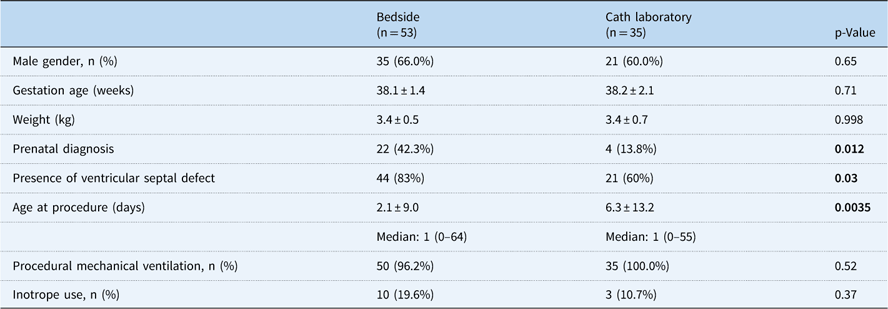
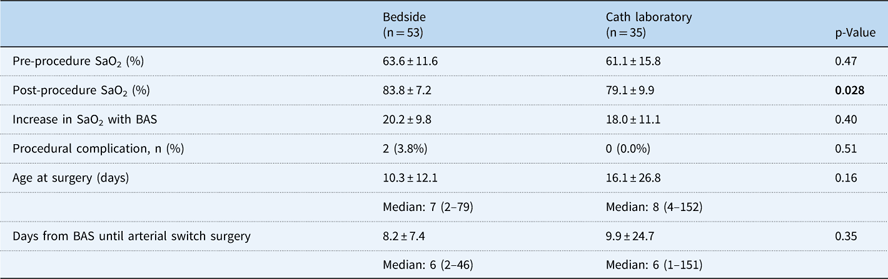
A total of 88 patients had a balloon atrial septostomy performed for dextro-transposition of the great arteries and met inclusion criteria. Among them, 65 (74%) had a ventricular septal defect. In all, 53 patients (60.2%) had balloon atrial septostomy performed at the bedside and 35 patients (39.8%) had a balloon atrial septostomy in the catheterisation laboratory. Table 1 compares patient characteristics between the two groups. There was no difference in gender, gestational age, weight, or use of inotropes between the two locations. Catheterisation laboratory patients were 4 days older than those who underwent bedside septostomy (catheterisation laboratory: 6.3±13.2 days; bedside: 2.1±9.0 days; p=0.004). More bedside septostomy patients had a prenatal diagnosis of dextro-transposition of the great arteries than those performed in the catheterisation laboratory (42 versus 14%; p=0.012). Patients who underwent bedside septostomy more frequently had a ventricular septal defect (83 versus 60%; p=0.03). There was no difference in pre-procedure oxygen saturation between the groups (Table 2). Patients who had a balloon atrial septostomy performed at the bedside had a higher post-procedure oxygen saturation than those performed in the catheterisation laboratory (83.8 versus 79.1%; p=0.028). However, there was no difference in the pre- and post-procedure oxygen saturation change between bedside and catheterisation laboratory (20.2 versus 18.0%; p=0.40). There was no difference in age at arterial switch surgery (10.3 versus 16.1 days; p=0.16) or the number of days from balloon atrial septostomy until surgery (8.2 versus 9.9 days; p=0.35) between bedside and catheterisation laboratory groups.
Demographic comparison of procedure location in balloon atrial septostomy.

Data reported as mean±SD, or median (range)
The bold numbers are for the values that reached statistical significance
Efficacy and safety of balloon atrial septostomy by location performed.

BAS = balloon atrial septostomy; SaO2 = oxygen saturation
Data reported as mean±SD, or median (range)
The bold numbers are for the values that reached statistical significance
There was no difference in complication rates between the two locations. In all, two complications occurred during bedside balloon atrial septostomy. One patient developed supraventricular tachycardia during the procedure that resolved with catheter manipulation, followed by successful septostomy. Another patient had a large coronary sinus resulting in difficulty with procedural imaging. Thus, the procedure was aborted and the patient was referred to the catheterisation laboratory for balloon atrial septostomy. No adverse clinical sequelae occurred owing to either complication. There were no complications for balloon atrial septostomy performed in the catheterisation laboratory.
A total of 24 patients were identified with a coronary artery variant. The most common coronary anomaly was a circumflex branch arising from the right coronary artery, which was found in 16 of 24 (67%) patients. Of the 24 coronary anomaly patients, 14 (58%) had the anomaly correctly identified by echocardiography before the procedure; one patient was diagnosed with a coronary variant by echocardiography but was found to have normal coronary arteries in the operating room; and five patients who had bedside septostomy had a cardiac catheterisation afterwards to define coronary anatomy. Of these five patients, one had a coronary variant. In all, 22 of 53 (41%) bedside septostomy patients did not have coronary anatomy clearly defined by echocardiography; six of these patients had coronary artery variants identified at surgery. These six patients did not have a cardiac catheterisation before surgery. There were no operative complications related to coronary anatomy.
Discussion
Balloon atrial septostomy is an important, life-saving procedure that promotes haemodynamic stability in anticipation of corrective surgery. Balloon atrial septostomy can be successfully performed in the catheterisation laboratory or under echocardiographic guidance at the bedside.Reference D’Orsogna, Lam, Sandor and Patterson 8 , Reference Lin, Di Sessa and Williams 9 The choice of modality is usually determined by institutional, or practitioner, preference. Clinical discussions regarding the ideal choice largely focus on safety. This study compares balloon atrial septostomy outcomes based on the procedural locations of the catheterisation laboratory versus the bedside. This is the largest study to compare balloon atrial septostomy outcomes based on the procedural location, demonstrating that either venue yields safe and efficacious results.
The two groups had similar characteristics including gestational age, weight, sex, use of inotropes, and pre-procedure oxygen saturation. Bedside septostomy was performed earlier than in the catheterisation laboratory, which may be owing to the ease of organising the procedure at bedside relative to coordinating the catheterisation laboratory that is dependent on a schedule of competing, scheduled procedures. Why more patients with prenatal diagnoses underwent bedside procedures is unknown. Whether earlier atrial septostomy held clinical benefit was not evaluated in this study.
There were two complications in our patient cohort, both of which were in the bedside septostomy group. One was supraventricular tachycardia that resolved with catheter manipulation and the other was the inability to complete the procedure with solely ultrasound guidance. Supraventricular tachycardia or other atrial arrhythmias are well-described complications caused by the presence of catheters introduced into the right atrium, whether they are procedural equipment or central venous lines. Moving the inciting object or, less commonly, performing chemical or electrical cardioversion often achieves successful treatment.Reference Martin, Rigby, Penny and Redington 10 – Reference Green and Yohannan 12 Neither patient had long-term sequelae attributed to the bedside procedure, particularly as one simply required a change of venue to the catheterisation laboratory. Our study did not demonstrate a difference in safety outcomes between procedure locations, consistent with prior studies.Reference Steeg, Bierman, Hordof, Hayes, Krongrad and Barst 7 , Reference Mukherjee, Lindsay and Zhang 13 In addition, bedside septostomy in the ICU has the advantages of not introducing risks of patient manipulation and transport, and does not expose the patient to radiation.
Coronary anatomy remains a concern for patients with dextro-transposition of the great arteries owing to the re-implantation of the coronary arteries during the arterial switch operation. There were coronary variants in 27% of the patients in our study, the most common being a circumflex artery originating from the right coronary artery. In our study, 22 patients who had a pre-procedure echocardiogram that did not clearly delineate coronary anatomy and then underwent a bedside balloon atrial septostomy did not undergo catheterisation to identify coronary anatomy before the arterial switch operation. Of these patients, six were found to have coronary anomalies at the time of the arterial switch, but there were no surgical complications related to the coronary anatomy. While Pasquali et al found that patients with transposition of the great arteries and single coronary or intramural coronary anatomy had a higher mortality compared with other types of coronary anatomy, more recent studies have not shown a correlation between coronary anatomy and mortality in patients with dextro-transposition of the great arteries.Reference Polito, Ricci, Fragasso and Cogo 14 – Reference Sarris, Chatzis and Giannopoulos 17 In 2001, Brown et alReference Brown, Park and Turrentine 18 suggested that modern coronary reimplantation techniques have minimised coronary anomalies as a significant risk factor for mortality in patients undergoing the arterial switch operation. This suggests that having a cardiac catheterisation to identify coronary anatomy before the arterial switch operation may not be necessary. As such, the key advantage of the catheterisation laboratory may be superfluous to the operative management of these patients.
A focus on healthcare costs is of increased demand and is broadly discussed in medicine and medical training. Nevertheless, specific discussion on how to reduce costs is not often realised. Concerns are raised that patient safety and outcomes should outweigh any cost advantage of one specific therapy over another. Discussions with hospital and physician practice billing departments revealed a large difference between what is billed in a catheterisation laboratory procedure and a bedside procedure in the ICU. Resource utilisation during bedside balloon atrial septostomy is more efficient because sedation administration and ventilator management are provided by the attending ICU physician, rather than an anaesthesiologist. Their fees are related to their daily service commitment, and the need for additional services, resulting in manpower and billing, is absent. The catheterisation laboratory utilises an additional team of nurses and technicians, and includes standard fees associated with the service. Therefore, the technical fees associated with septostomy performed in the catheterisation laboratory are not assessed for the bedside procedure. Some institutions do not use echocardiographic assistance for septostomy performed in the catheterisation laboratory, which would reduce the overall cost for procedures performed in this venue, yet costs of a procedure performed in the catheterisation laboratory would remain markedly higher owing primarily to facility fees. An additional factor is that bedside balloon atrial septostomy may be performed at referral hospitals to stabilise patients with dextro-transposition of the great arteries and allow them to remain at the referral hospital before transfer to tertiary care centres.Reference Brown, Park and Turrentine 18 Although this study demonstrates safety and efficacy in either venue, future studies should focus on the cost-effectiveness of procedure location on healthcare utilisation. Importantly, the argument of care over cost is lost in light of the findings that the outcomes at both locations were equivalent.
This study has important limitations. As a single-centre investigation, it is unclear whether similar results would be reproduced in other centres, and provider comfort with performing septostomy in one location versus another may have safety and efficacy repercussions. In addition, while we utilised institutional billing data, it is unclear how costs vary between institutions. Similarly, we did not evaluate actual overall hospital costs to compare cost-effectiveness by location. An additional limitation is the heterogeneity of the patient cohort. There were patients with a ventricular septal defect and those with an intact ventricular septum. Owing to the inherent differences in mixing of these two subgroups, the timing of septostomy can be affected, and thereby location, depending on operator choice. Interestingly, the bedside procedure patients were more likely to have a ventricular septal defect, and thus additional mixing, yet were younger than the catheterisation laboratory patients at the time of the procedure. Given the retrospective nature of the study, we are unable to clearly define the rationale for the decision to perform septostomy in one venue over the other, although historically this has been decided based on logistical factors at our institution. Although no neurologic complications were reported, no routine neurologic studies were performed post-procedurally. Head ultrasound was routinely performed as a preoperative assessment, but it was not timed relative to the balloon atrial septostomy procedure.
This is the largest study evaluating the safety and efficacy of balloon atrial septostomy performed at the bedside compared with the catheterisation laboratory. We found that balloon atrial septostomy performed at either location had similar safety outcomes and efficacy. Bedside balloon atrial septostomy has the advantages of decreased patient transport, reduced radiation exposure, and decreased resource utilisation and cost compared with atrial septostomy performed in the catheterisation laboratory. Although septostomy in the cardiac catheterisation laboratory has the advantage of characterising coronary anatomy, some studies suggestReference Hong, Choi, Kim, Hyun, Lee and Cho 19 that coronary anomalies are not a significant risk factor in the arterial switch operation. In the current era of a focus on quality improvement, while encouraging cost containment, we advocate that bedside balloon atrial septostomy offers equivalent safety and clinical outcome with the benefit of considerable cost savings compared with the catheterisation laboratory.
Acknowledgements
None
Financial Support
This research received no specific grant from any funding agency or from commercial or not-for-profit sectors.
Conflicts of Interest
None
Ethical Standards
The authors assert that all procedures contributing to this work comply with the Ethical Standards of the Helsinki Declaration of 1975, as revised in 2008, and has been approved by the Institutional Review Board of Riley Children’s Hospital.