





Introduction
Human immunodeficiency virus (HIV) is a chronic infectious disease that impacts millions of people worldwide (World Health Organization 2025). Advancements in antiretroviral therapy have transitioned HIV from a terminal disease into a treatable condition, leading to improved life expectancy of HIV-positive individuals. People living with HIV who are adherent to therapy and have high CD4 T-cell counts have a near-normal life expectancy (Trickey et al. Reference Trickey, Sabin and Burkholder2023). Consequently, with the growing population of older adults with HIV, there is a growing need to ensure that the care received by this group aligns with their values and preferences. Thus, advance care planning plays a crucial role in their care as it allows adults to communicate their values and preferences regarding future medical care to ensure that delivery of care aligns with their wishes (Sudore et al. Reference Sudore, Lum and You2017).
Advanced care planning is a process that enables individuals to articulate their preferences for future medical care, often during times when they are unable to communicate their wishes. For people living with HIV, advanced care planning is especially important due to their unique medical and social needs. Lower rates of advanced care planning are seen in persons living with HIV when compared to the general population, 26.6% compared to 60% (Nguyen et al. Reference Nguyen, Perez and Thayer2023). People living with HIV face unique barriers to advanced care planning, including stigma, fragmented social support, and historical experiences of discrimination within the health-care system, all of which may contribute to low rates of goals of care documentation (Emlet Reference Emlet2006). Open and effective communication between persons living with HIV and health-care providers is essential due to these challenges.
Engaging in advanced care planning offers numerous benefits for persons living with HIV. For instance, by fostering informed decision-making, these discussions provide an opportunity for patient-centered care, prepare patients and providers for potential medical complications, and ensure that treatment aligns with individual values and preferences. Additionally, these discussions reduce anxiety about future health-care decisions and improve overall care quality by equipping both health-care providers and patients to navigate complex medical scenarios (Reich et al. Reference Reich, Perez and Gazarian2022; Vashisht et al. Reference Vashisht, Gutman and Mackey2024).
To ensure equitable and patient-centered care, targeted interventions are needed to address existing barriers to advanced care planning such as a lack of health-care provider training and insufficient time for such discussions. As the population of persons living with HIV ages, we must optimize care delivery and align it with the values and preferences of this vulnerable group by understanding and addressing factors that influence advanced care planning uptake, such as age, sex, access to primary care, and health-care utilization.
There is a greater need for effective communication between health-care providers and persons living with HIV than the general population due to often weak social support networks and greater reliance on health-care providers for support and guidance (Cruz-oliver et al. Reference Cruz-oliver, Tseng and Mitchell2019). Engaging in advanced care planning discussions allows health-care providers to deliver patient-centered care while educating persons living with HIV on their expected prognosis, potential complications, and comorbidities to facilitate informed decision-making and develop a treatment plan aligned with individual values. Furthermore, advanced care planning prepares health-care providers and persons living with HIV for situations when they cannot communicate their wishes.
Study aims
Primary objective. Determine the proportion of adults ≥18 years who are receiving care at the Southern Alberta HIV Clinic who have a goal of care designation recorded in their electronic health record.
Secondary objectives. Determine whether there are differences in the proportion of patients who have a goal of care designation recorded in their electronic health record, by the following factors:
(a) Age
(b) Sex
(c) Presence or absence of a family physician/primary care provider
(d) Presence or absence of an emergency department (ED) visit in the prior year
(e) Presence or absence of a hospital admission in the prior year
Methods
Study design. This was a cross-sectional observational study.
Setting. The Southern Alberta HIV Clinic is the sole provider of HIV care to all persons living with HIV in Southern Alberta, a province in Canada.
Participants. Adult patients ≥18 years of age who were engaged in care at the Southern Alberta Clinic during the study period (January 1, 2022–December 31, 2023).
Inclusion criteria. Persons living with HIV ≥18 years of age and receiving HIV care at the Southern Alberta Clinic during the study period.
Exclusion criteria. Not a person living with HIV, aged <18 years, and/or not receiving care at the Southern Alberta HIV Clinic during the study period.
Southern Alberta Clinic uses the Connect Care electronic health record to record patient data, including goals of care designation, family physician information, ED visits, and hospital admissions. We extracted the following data from the Connect Care record for each active patient ≥18 years of age during the study period: age (continuous value in years), age category (18–49, 50–64, and 65 years and above), sex (male/female), goal of care designation (yes/no), goal of care designation category (Resuscitative, R; Medical, M; Comfort, M), presence or absence of a family physician/primary care provider (yes/no), presence or absence of an ED visit in the prior year (yes/no), and presence or absence of a hospital admission within the prior year (yes/no).
Data analysis. We performed descriptive statistics to describe the sample population, including means and standard deviations. We used chi-square tests to compare the proportion of patients with and without a recorded goal of care designation based on age, age category, sex, family physician status, and history of ED visits or hospital admissions within the prior 1 year. All statistical tests were conducted on SAS 9.4.
This study adheres to the Strengthening the Reporting of Observational Studies in Epidemiology (STROBE) statement guidelines for reporting observational studies (Von Elm et al. Reference Von Elm, Altman and Egger2007) (Supplementary material 1: STROBE Checklist).
Results
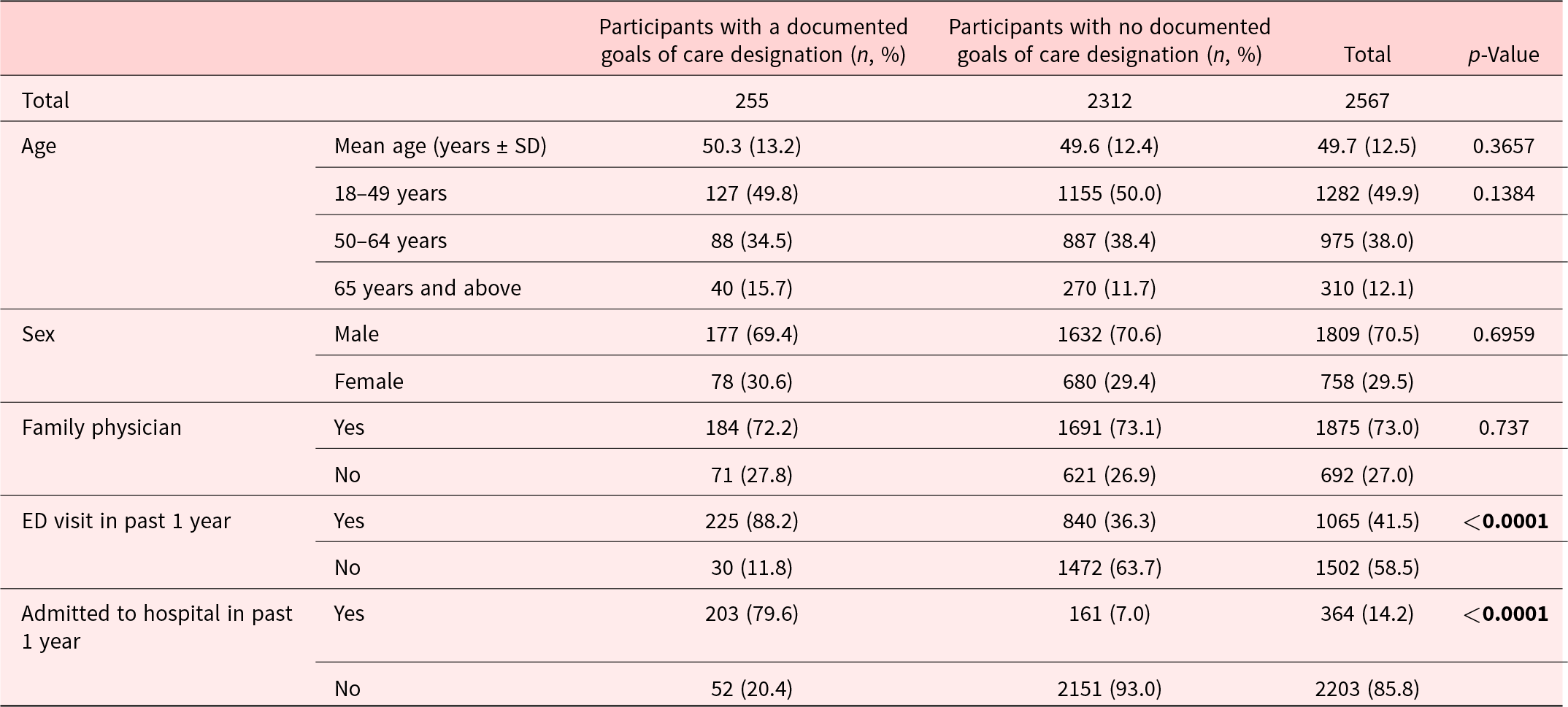
As demonstrated in Table 1, 10% of adults aged 18 years and above (n = 255/2567) had a goal of care designation documented in the electronic medical record between January 1, 2022, and December 31, 2023. Ninety percent (n = 2312/2567) did not have a goal of care designation documented in the medical record during the study period.
Demographic characteristics of participants aged ≥18 years and receiving HIV care at the Southern Alberta Clinic in Alberta, Canada, between January 1, 2022, and December 31, 2023

Table 1 Long description
Participant characteristics are compared between those with a documented goals-of-care designation (255 people) and those without one (2312 people), with totals and p-values shown. Recent health care use differs strongly: 88.2% with a designation had an emergency department visit in the past year versus 36.3% without, and 79.6% were admitted to hospital versus 7.0% without; both differences are statistically significant with p-values below 0.0001. Average age is similar between groups (about 50 years) and the age distribution is broadly comparable, though the documented group has a higher share aged 65 and above (15.7% vs 11.7%). Sex distribution is similar (male about 70% in both groups; female about 30%), with no statistically significant difference. Having a family physician is also similar (about 72 to 73% yes), with no statistically significant difference. P-values indicate association only and do not establish causation; the documented group may differ in underlying health status or care needs.
The bolded p-values were statistically significant results.
There was no difference in age between those with and without a goal of care designation in the electronic medical record. The mean age of those with a goal of care designation was 50.3 years (±13.2), while the mean age of those without a goal of care designation was 49.6 years (±12.4) (p = 0.37).
There was no difference in goal of care documentation by age category. Among 18–49-year-olds, 9.9% had goal of care documentation, among 50–64-year-olds, 9.0% had goal of care documentation, and among those aged 65 years and above, 12.9% had goal of care documentation (p = 0.1384).
Thirty percent of the sample was female (n = 758/2567). Ten percent of females (n = 78/758, 10.3%) and 10% of males (n = 177/1809, 9.8%) had a goal of care documentation. There was no difference by sex in goal of care documentation (p = 0.70).
Most of the sample had a family physician (n = 1875/2567, 73%). Ten percent of those with a family physician (n = 184/1875, 9.8%) and 10% of those without a family physician (n = 71/692, 10.3%) had a goal of care documentation. There was no difference by the presence or absence of a family physician in documentation (p = 0.74).
Nearly 42% of patients visited an ED in the prior year (1065/2567, 41.5%). Among those who had visited an ED in the prior year, 21% (n = 225/1065) had a goal of care documentation, compared to 2.0% of those who had not visited an ED in the prior year (n = 30/1502). There was a significant difference in the proportion of those who visited an ED in the prior year in goals of care documentation (p < 0.0001). In contrast, 98% of those who had not visited an ED in the prior year (n = 1472/1502, 98.0%) and 79% of those who had visited an ED in the prior year (n = 840/1065, 78.9%) did not have goal of care documentation.
Fourteen percent of patients (n = 364/2567, 14.2%) were admitted to the hospital in the prior year. Among those, 55.8% (n = 203/364) had a goal of care documentation, compared to 2.4% of those who were not admitted to hospital in the prior year (n = 52/2203, 2.4%). There was a significant difference in the proportion of those who were and were not hospitalized in the prior year in the goals of care documentation (p < 0.0001). In contrast, 98% of those who were not hospitalized in the prior year (n = 2151/2203, 97.6%) and 44% of those who were hospitalized in the prior year (n = 161/364, 44.2%) did not have a goal of care documentation.
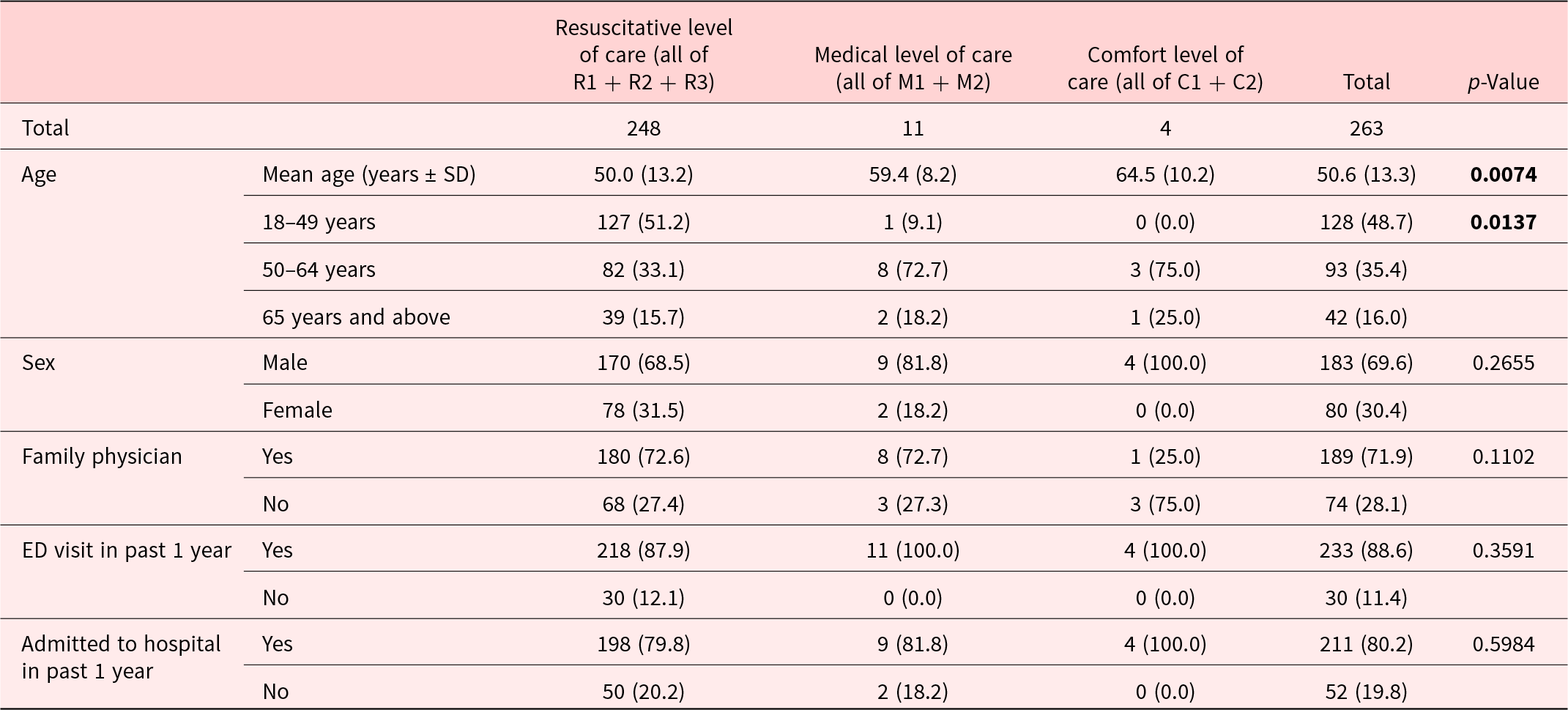
In Table 2, goals of care designations were evaluated by category (i.e. resuscitative [R] level of care, medical [M] level of care, and comfort [C] level of care). The mean age of patients within each category was significantly different (Table 2). The mean age of those with a documentation of R (resuscitative) level of care was 50.0 years (±13.2), the mean age of those with a documentation of M (medical) level of care was 59.4 years (±8.2), and the mean age of those with a documented C (comfort) level of care was 64.5 years (±10.2) (p = 0.007).
Comparison of documented goal of care designation by category (i.e. resuscitative level of care, R, medical level of care, M, and comfort level of care, C) among participants aged ≥18 years and receiving HIV care at the Southern Alberta Clinic in Alberta, Canada, between January 1, 2022, and December 31, 2023

Table 2 Long description
Goal-of-care designation is compared across resuscitative, medical, and comfort categories for 263 adult HIV-care participants, with counts and percentages shown for each subgroup. Most participants were in the resuscitative category (248), with far fewer in medical (11) and comfort (4). Mean age increased across categories: about 50 years in resuscitative, 59 in medical, and 65 in comfort, and the age difference by category was statistically significant (p 0.0074). Age-group distribution also differed (p 0.0137): about half of the resuscitative group was 18 to 49 years, while most of the medical and comfort groups were 50 to 64 years. Sex distribution did not differ significantly by category (p 0.2655); males were the majority overall and in each category, including all comfort cases. Having a family physician was similar for resuscitative and medical groups but lower in the comfort group; this difference was not statistically significant (p 0.1102). Emergency department visits and hospital admissions in the past year were common across all categories and showed no statistically significant differences (p 0.3591 and p 0.5984). Interpretation should be cautious because the medical and comfort groups are very small, making percentages unstable.
The bolded p-values were statistically significant results.
There was also a difference by age categories in the goal of care categories. Among those with documented resuscitative goals of care, 51% were aged 18–49 years, 33% were aged 50–64 years, and 16% were aged 65 years and above. Among those with documented medical goals of care, 9% were 18–49 years, 73% were 50–64 years, and 18% were 65 years and above. Among those with documented comfort goals of care, zero were 18–49 years, 75% were 50–64 years, and 25% were 65 years and above (p = 0.01).
There was no difference by sex (p = 0.27), presence or absence of a family physician (p = 0.11), presence or absence of an ED visit in the prior year (p = 0.36), or presence or absence of a hospitalization in the prior year (p = 0.60) in the goal of care designation by category (i.e. resuscitative, medical, and comfort levels of care).
Discussion
The aim of the present study was to determine the proportion of persons living with HIV ≥18 years of age who had a goal of care documentation in their electronic health record. We also sought to determine whether there were differences in the proportion of patients with a goal of care documentation by age, age category, sex, presence or absence of a family physician/primary care provider, ED visit in the prior year, and hospitalization in the prior year.
This study underscores the significant gap that persons living with HIV face in the documentation of their goals of care designations, as only 10% of adults receiving HIV care at the Southern Alberta Clinic had a documented goals of care designation in the electronic medical record. Despite the substantial advancements in antiretroviral therapy that have transformed HIV from a terminal disease into a chronic treatable condition, the low rate of goals of care documentation points to a missed opportunity to integrate advance care planning into routine HIV care. An urgent need for targeted interventions to enhance advanced care planning in this population is highlighted by these findings.
The lack of documentation across most demographic and clinical variables suggests systemic barriers to advanced care planning engagement and not individual-level factors. Despite nearly three-quarters of the sample reporting having a family physician, the presence of one did not result in a higher proportion of goals of care documentation in this group, with only 10% of those with a family physician having a goal of care documentation. These findings align with prior research indicating that despite being well-positioned, primary care providers often underutilize opportunities to facilitate advanced care planning discussions due to time constraints, lack of training, or competing priorities (Vashisht et al. Reference Vashisht, Gutman and Mackey2024). The lack of significant differences across age or sex further reinforces the need for systematic strategies to embed advanced care planning into routine care for all patients, regardless of demographic characteristics.
The study revealed that patients with either an ED visit or hospitalization within the prior year were significantly more likely to have a goal of care designation, with 21% of ED visitors and 55% of hospitalized patients having documented their care preferences compared to 2% of those who had not visited either in the prior year. Surprisingly, despite being hospitalized in the prior year, 44% still did not have a goal of care designation in the electronic health record. While these acute care encounters represent critical touchpoints for advanced care planning discussions, reliance on such reactive settings is suboptimal. The high-paced nature of hospitals often limits the time available for meaningful advanced care planning conversations, which are better suited to outpatient or primary care settings (Vashisht et al. Reference Vashisht, Gutman and Mackey2024). Nevertheless, the significant association between acute care utilization and goals of care documentation highlights an opportunity to integrate advanced care planning protocols into the hospital setting. Interventions such as prompts within electronic health records and standardized documentation templates may help leverage these critical health-care encounters to promote advanced care planning. However, the goal should be to shift the initiation of such discussions to primary care settings where patients and health-care providers can engage in meaningful discussion (Vashisht et al. Reference Vashisht, Gutman and Mackey2024).
Understandably, the desire for intensive and invasive health care decreases with age, with 25% of patients aged ≥65 years opting for comfort care compared to 51% of the younger cohort (18–49 years) choosing resuscitative care. This age-related trend reflects broader societal patterns, where older adults are more likely to prioritize quality of life over life-prolonging interventions as their health status changes (Lewis et al. Reference Lewis, Harrison and Hanly2019). These differences emphasize the importance of revisiting advanced care planning discussions periodically to align evolving values and health conditions with documented preferences.
When compared to individuals with cancer, the rates of advanced care planning and goals of care documentation among people living with HIV are notably lower. Studies consistently show that patients with cancer are more likely to engage in advanced care planning discussions and have documented care preferences, with rates ranging from 30% to 70% depending on the disease stage and health-care setting (Johnson et al. Reference Johnson, Butow and Kerridge2016; Nouri et al. Reference Nouri, Barnes and Shi2021). HIV is perceived as a manageable condition, which may deprioritize communicating and documenting goals of care for both patients and providers, focusing on disease management instead of future planning. Differences in how these conditions are perceived may lead to this disparity, as cancer is often viewed as a life-threatening illness that necessitates future planning; however, advancements in antiretroviral therapy have transformed HIV into a chronic and manageable condition. Advanced care planning in the context of HIV care may inadvertently be deprioritized due to this shift in perception as both patients and providers focus on managing the disease rather than planning for potential complications or end-of-life scenarios. The importance of reframing advanced care planning as relevant and beneficial for all individuals with chronic diseases, regardless of perceived disease severity, increases as HIV becomes recognized as a manageable condition. It is essential to integrating these discussions and documentation into routine HIV care to ensure that care remains patient-centered and aligned with individual values, particularly as the population of persons living with HIV continues to age.
To improve engagement among people living with HIV, health-care systems must implement proactive and scalable strategies. Primary care physicians, often serving as trusted sources of guidance for patients, should be equipped with tools and training to initiate advanced care planning conversations early and revisit them regularly. Incorporating prompts into electronic health records and structured templates for goals of care documentation can streamline these discussions and ensure consistency. Community-based initiatives, such as peer-led education programs and culturally sensitive materials, should empower patients to articulate their care preferences, leaving acute care settings as advanced care planning checkpoints. For example, standardized protocols for initiating discussions during hospital admissions or ED visits could help address gaps in outpatient care. However, the optimal long-term goal should be to shift advanced care planning discussions to outpatient and community-based settings, where patients can reflect on their values and preferences without the time constraints and emotional pressures of acute care environments.
Limitations
These results reflect the experience of adult patients living with HIV who were engaged with care and may not represent people living with HIV who are not engaged in care and who may experience greater barriers to accessing health care. There may be misclassification of some individuals as not having (or having) a goal of care designation because this documentation is not accurately reflected in the electronic health record. However, we expect this potential misclassification to be similar for those with (and without) such documentation. While the data were subgrouped based on sex (male/female) as recorded in the electronic medical record, gender identity data were unavailable; therefore, these were not considered in the analysis. As a result, we could not evaluate potential differences in goals of care documentation among diverse gender identities, including transgender and nonbinary individuals. Differences in experiences with the health-care system, stigma, and advanced care planning engagement may exist across gender identities, and future studies should explore these factors to ensure more inclusive and equitable care planning for all people living with HIV. Lastly, the results herein represent the experiences of one geographically defined population and may not represent the broader population of persons living with HIV.
Conclusion
This study demonstrates that despite opportunities for integration into both outpatient and acute care settings, advanced care planning remains underutilized among adults living with HIV. While acute care encounters provide a valuable safety net for such discussions, they cannot replace the need for proactive and ongoing conversations in outpatient settings. To ensure that care aligns with the values and preferences of people living with HIV, we must address the barriers to advanced care planning conversations for this vulnerable population through clinician training, system-level interventions (including the use of electronic health record prompts), and patient-centered approaches. As the population of persons living with HIV ages, incorporating advanced care planning conversations into routine care will be essential for delivering equitable, high-quality, and patient-centered health care.
Supplementary material
The supplementary material for this article can be found at 10.1017/S1478951526103435.
Acknowledgments
The authors wish to thank the patients and staff at the Southern Alberta Clinic in Calgary, Alberta, without whom this work would not have been possible.
Author contributions
All authors contributed to the study concept and design. The first draft of the manuscript was written by A.V., and all authors commented on previous versions of the manuscript. All authors read and approved the final manuscript.
Funding
This research received no specific grant from any funding agency, commercial or not-for-profit sectors.
Competing interests
The authors have no conflicts of interest to declare.
Ethical approval
This study was approved by the University of Calgary Conjoint Health Research Ethics Board (CHREB 23-0997) on August 17, 2023, and renewed in 2024 and 2025. The Research Ethics Board approved a waiver of informed consent for the study. All procedures performed in this study were in accordance with the ethical standards of the University of Calgary Conjoint Health Research Ethics Board (CHREB) (REB23-0997) and with the 1964 Helsinki Declaration and its later amendments.
Ethics and consents
The requirement for informed consent was waived by the University of Calgary Conjoint Health Research Ethics Board.


 Open access

