Adolescents spend more time with their peers than in any other social context (Myers, Doran, & Brown, Reference Myers, Doran and Brown2007), and peer relations are critical to positive adaptive development (Erdley & Nangle, Reference Erdley and Nangle2001). Susceptibility to peer influence peaks during middle adolescence (Monahan, Steinberg, & Cauffman, Reference Monahan, Steinberg and Cauffman2009; Steinberg & Monahan, Reference Steinberg and Monahan2007), and adolescence is marked by heightened desire for affiliation as well as sensitivity to social evaluation (Somerville, Reference Somerville2013). Negative peer interactions, such as rejection, victimization, and bullying by peers, are associated with poor outcomes such as externalizing and internalizing psychopathology, as well as academic and social difficulties (Hawker & Boulton, Reference Hawker and Boulton2000; Parker & Asher, Reference Parker and Asher1987). In contrast, positive peer interactions, such as the provision of social support or acceptance by peers, can either promote adaptive development and psychological well-being or exacerbate problem behaviors. For example, adolescents are more likely to engage in risky and antisocial behavior in peer groups than alone (Bauman & Ennett, Reference Bauman and Ennett1996; Kotchick, Shaffer, Miller, & Forehand, Reference Kotchick, Shaffer, Miller and Forehand2001), and peer reinforcement of delinquent behaviors seems to produce escalations in those behaviors (Dishion & Tipsord, Reference Dishion and Tipsord2011). In contrast, adolescents who are accepted by their peers are at lower risk for internalizing symptoms and exhibit more adaptive emotion regulation (Kim & Cicchetti, Reference Kim and Cicchetti2010). Thus, identifying the mechanisms by which positive and negative peer interactions influence adolescents’ adaptation and psychopathology is critical.
One emerging body of research has suggested that interactions with peers may alter children and adolescent's self-regulatory abilities (Baumeister, DeWall, Ciarocco, & Twenge, Reference Baumeister, DeWall, Ciarocco and Twenge2005). Self-regulation, which can be broadly conceptualized as the ability to control and redirect emotions and behavior in service of adaptive goals (Posner & Rothbart, Reference Posner and Rothbart2000), is a multidimensional construct that has been shown to be associated with both positive and negative adaptation during adolescence. Self-regulation has been used to refer to constructs such as impulsivity, effortful control, cognitive control, emotion regulation, executive function, self-control, and decision making, and has been assessed using both self-report measures of temperament and personality and behavioral assessments (King, Patock-Peckham, Dager, Thimm, & Gates, Reference King, Patock-Peckham, Dager, Thimm and Gates2014; Sharma, Markon, & Clark, Reference Sharma, Markon and Clark2014). Higher self-regulation across these domains is generally associated with better academic and social functioning (Duckworth & Kern, Reference Duckworth and Kern2011; Moffitt et al., Reference Moffitt, Arseneault, Belsky, Dickson, Hancox, Harrington and Caspi2011), while low self-regulation is associated with alcohol use and problems (Coskunpinar, Dir, & Cyders, Reference Coskunpinar, Dir and Cyders2013), risky sexual behaviors, binge eating (Smith et al., Reference Smith, Fischer, Cyders, Annus, Spillane and McCarthy2007), a broad range of externalizing behavior problems (Krueger et al., Reference Krueger, Hicks, Patrick, Carlson, Iacono and McGue2002), and anxiety and depression symptoms (Smith, Guller, & Zapolski, Reference Smith, Guller and Zapolski2013). The neural systems that underlie self-regulation undergo meaningful changes during adolescence (Albert, Chein, & Steinberg, Reference Albert, Chein and Steinberg2013; Somerville, Hare, & Casey, Reference Somerville, Hare and Casey2011; Somerville, Jones, & Casey, Reference Somerville, Jones and Casey2010) that may make them particularly sensitive to environmental influences. At the same time, peer relationships become particularly important and occupy increasing amounts of time (Barnes, Hoffman, Welte, Farrell, & Dintcheff, Reference Barnes, Hoffman, Welte, Farrell and Dintcheff2007; Larson, Reference Larson2001). Sensitivity to social feedback also increases during adolescence (Somerville, Reference Somerville2013), while peer relationships not only become more important and occupy more time but also are less stable (Cairns, Leung, Buchanan, & Cairns, Reference Cairns, Leung, Buchanan and Cairns1995), resulting in greater opportunities to experience acceptance and rejection by peers. For these reasons, it is particularly critical to examine how peer rejection and acceptance influence self-regulation during adolescence. Some prior research has examined the naturalistic sequelae of peer rejection on processes involved in self-regulation (such as social information processing deficits or emotion regulation difficulties; Dodge et al., Reference Dodge, Lansford, Burks, Bates, Pettit, Fontaine and Price2003; Fabes et al., Reference Fabes, Eisenberg, Jones, Smith, Guthrie, Poulin and Friedman1999); however, these associations may be confounded by other individual difference characteristics that make certain children more or less likely to experience rejection. Thus, the main goal of the current study was to test the effects of experimentally induced peer acceptance and rejection on self-regulation in adolescents.
The need to belong theory posits that a fundamental psychological need is to avoid rejection and to be accepted by others, and that social rejection and exclusion impair self-regulatory abilities (Baumeister et al., Reference Baumeister, DeWall, Ciarocco and Twenge2005). Experimental tests of this theory, largely conducted among young adults, suggest that rejection by unfamiliar peers reduces self-regulation behaviors such as attention and persistence, while increasing reward orientation (Baumeister et al., Reference Baumeister, DeWall, Ciarocco and Twenge2005; DeWall, Baumeister, & Vohs, Reference DeWall, Baumeister and Vohs2008). A recent longitudinal study with young children demonstrated that social exclusion was associated with reduced inhibitory control and attention, and higher impulsivity 2 years later (Stenseng, Belsky, Skalicka, & Wichstrøm, Reference Stenseng, Belsky, Skalicka and Wichstrøm2015). Other evidence suggests that peer rejection may increase risk taking because rejected youth try to repair their social standing through risk taking. In one study, imagining peer rejection, relative to imagining acceptance, produced increased risk taking among older children, but imagining acceptance produced reduced risk taking in younger children (Nesdale & Lambert, Reference Nesdale and Lambert2008).
In contrast, the effects of peer acceptance on self-regulation are relatively unknown. Only one study that we are aware of examined the effects of acceptance versus rejection on self-regulatory behaviors (Nesdale & Lambert, Reference Nesdale and Lambert2008). Peer contagion theory argues that peers who model maladaptive behaviors promote those maladaptive behaviors in their peers (Dishion & Tipsord, Reference Dishion and Tipsord2011). Among adolescents, the mere presence of peers (relative to being alone) influences sensitivity to reward, which in turn seems to heighten the likelihood of risky behaviors (Albert et al., Reference Albert, Chein and Steinberg2013; Chein, Albert, O'Brien, Uckert, & Steinberg, Reference Chein, Albert, O'Brien, Uckert and Steinberg2011; O'Brien, Albert, Chein, & Steinberg, Reference O'Brien, Albert, Chein and Steinberg2011). When in the presence of peers, adolescents are more likely to make risky decisions, display preferences for immediate versus delayed rewards, and exhibit heightened activity in neural systems associated with reward (Chein et al., Reference Chein, Albert, O'Brien, Uckert and Steinberg2011; Gardner & Steinberg, Reference Gardner and Steinberg2005; Geier, Terwilliger, Teslovich, Velanova, & Luna, Reference Geier, Terwilliger, Teslovich, Velanova and Luna2010; O'Brien et al., Reference O'Brien, Albert, Chein and Steinberg2011). However, none of this research has focused specifically on the impact of interpersonal behaviors such as acceptance on self-regulatory processes, so it is unclear whether the effects of acceptance on self-regulation are driven by mere exposure to peers or by the positive nature of peer interactions.
Although multiple studies suggest that rejection by peers alters self-regulation in youth, this literature is clouded by widely varying operationalizations of self-regulation. Because there is such diversity in the specific processes that are subsumed within the construct of self-regulation, and because the majority of prior studies have used only one or two behavioral self-regulation measures, it is not clear which aspects of self-regulation are influenced by peer exposure, acceptance, or rejection. As described above, prior studies have reported effects of peer exposure on inhibition, attention, persistence, reward orientation and sensitivity, and risk taking, all of which have been considered to be indicators of the broad construct of self-regulation (Cyders & Coskunpinar, Reference Cyders and Coskunpinar2012). Thus, we utilized multiple indicators of self-regulation in the current study to examine multiple constructs classically referred to as reflecting self-regulation.
Behavioral self-regulation measures can be categorized as being either “cold” (i.e., emotion free) or “hot” (i.e., emotion laden; Zelazo & Carlson, Reference Zelazo and Carlson2012). Self-regulation has also been variably operationalized as the ability to suppress a dominant response in favor of a nondominant one, to switch tasks flexibly, to persist toward a goal, or to make decisions about potential rewards (such as balancing potential risks vs. reward, or balancing temporal delays vs. the amount of a reward; Cyders & Coskunpinar, Reference Cyders and Coskunpinar2012; King et al., Reference King, Patock-Peckham, Dager, Thimm and Gates2014). Thus, for the current study, we used multiple measures of self-regulation that covered a variety of domains of regulation in hot and cold settings. In terms of cold self-regulation, we used a measure of inhibitory control and cognitive flexibility, and a measure of delay discounting. For hot self-regulation, we measured cognitive control in emotional situations and decision making in the face of information about reward and loss. Finally, we used a measure of distress tolerance that assessed participants ability to persist in the face of difficulty and frustration, because some prior research has suggested that the effects of peer rejection may influence both persistence (Baumeister et al., Reference Baumeister, DeWall, Ciarocco and Twenge2005) and emotion regulation (Eisenberg et al., Reference Eisenberg, Sadovsky, Spinrad, Fabes, Losoya, Valiente and Shepard2005).
By using multiple indicators of self-regulation, we hoped to gain insight into the specific processes that are affected by peer experiences. Because the literature has produced few consistent effects across studies and has largely focused on peer exposure rather than specific types of peer experiences (i.e., acceptance vs. rejection), we did not have strong hypotheses about which specific aspects of self-regulation would be influenced by rejection or acceptance. Understanding how peers influence specific self-regulatory processes can provide insight into the mechanisms by which the peer context influences decisions about risk and, ultimately, inform prevention and intervention efforts aimed at reducing problem behaviors and psychopathology during adolescence.
Method
Participants
Participants in the present study were 16- and 17-year-old adolescents (N = 291; M age = 16.5, SD = 0.50; 54.5% female) recruited from the community in Seattle, Washington (n = 112), Pittsburgh, Pennsylvania (n = 74), and Boston, Massachusetts (n = 91). Youth were recruited through community presentations, online advertisements, and fliers in community locations and neighborhoods. Community-based fliers were used to achieve diversity from across each city in region, socioeconomic status, and race/ethnicity. The sample was diverse with respect to race/ethnicity: 41.9% White, 21.1% Black, 16.3% Asian, 11.9% biracial, 5.9% Hispanic, and 3.1% reporting another racial/ethnic background. On average, adolescents reported their parents as having “some college,” although 1 SD of this mean encompassed a range from “high school graduate” to “graduate professional school.” The sample reported primarily heterosexual orientation (83.4%).
The design of the current study represents a within-person experimental design. Participants completed behavioral measures of self-regulation during two sessions across 2 weeks, with an experimental exposure prior to the self-regulation measures at the second session (see details below). This allowed participants’ baseline performance to serve as a within-person control for experimental effects. At the second session, participants were randomized to one of three conditions. Two represented different forms of peer exposure: peer acceptance (n = 107, 40%) and peer rejection (n = 114, 43%). A third, neutral condition had no peer exposure (n = 44, 16%). Sample size was decided on a priori power analyses that determined that the current study would have the power to detect medium to small differences between acceptance and rejection groups in regression (minimum detectable effect size f 2 = 0.04 where power, 1 – β = 0.80 at α = 0.05), and small to medium effect size effects between the neutral and the accept and reject conditions (as small as f 2 = 0.05; with 1 – β = 0.80 and α = 0.05). No data analyses were conducted until the full sample was collected. There were no differences by sex, χ2 (2) = 2.98, p = .23, race, χ2 (12) = 11.90, p = .45, or study site, χ2 (4) = 0.34, p = .99, in assignment. Fewer individuals were randomized to the neutral condition as primary analyses were focused on the comparison of peer acceptance and rejection. Eighteen participants failed to return for their second session, resulting in a final analytic sample of N = 273. There were no differences in terms of sex or race, χ2 max (1) = 0.828, p = .36, or performance on the behavioral self-regulation tasks at Time 1, t max (287) = 1.36, p = .17, between those who did not complete the second interview and those who did. There was also data missing at Time 2 due to multiple sources, such as participant dropout from Time 1 to Time 2 (n = 18), data loss or corruption on specific tasks (n = 4–6 depending on task), or to participants performing below an acceptable performance threshold (on the arrows task, n = 34). Because this produced a varying sample size across each outcome (n = 221–251), we reestimated the current models, accounting for missing data assuming ignorable missing at random, using multiple imputation with 20 imputations (Graham, Reference Graham2009; Schafer & Graham, Reference Schafer and Graham2002) in Mplus 6.0 (Muthén & Muthén, Reference Muthén and Muthén2010). The findings from these analyses largely replicated the main effects reported below, both in terms of significance and in terms of effect size, suggesting that missing data did not have a significant impact on the current findings. Thus, we report findings from the nonimputed data below.
Procedure
In Session 1, adolescents provided demographic information and completed survey measures and all self-regulation tasks in randomized order, to serve as a control for the experimental effects at Time 2. Those randomized to experience peer acceptance and rejection completed the preliminary steps of the chatroom interact task (Silk et al., Reference Silk, Stroud, Siegle, Dahl, Lee and Nelson2012), which has been shown to produce activation in regions of the brain associated with the identification of social and emotional states as well as the production of emotions (Silk et al., Reference Silk, Siegle, Lee, Nelson, Stroud and Dahl2014). Specifically, participants selected from 10 pictures of same-age, same-sex peers who they were most interested in interacting with at the next session. The pictures used in these virtual profiles were of child actors and/or youth living in a different state who consented to be photographed for the task (see Silk et al., Reference Silk, Stroud, Siegle, Dahl, Lee and Nelson2012). After selecting their top 5 pictures, participants then were shown five profiles describing interests of the selected peer (such as movies or sports) that were purportedly matched to their 5 picture selections; the same profiles were presented to each participant, but varied for males and females accordingly (i.e., names and profiles were gender specific). Participants ranked the profiles, had their picture taken, and provided their own profile information, ostensibly so that the other adolescents (whose profiles they rated) could view and rate their profile. Individuals who were randomized to the neutral condition did not complete any of these steps.
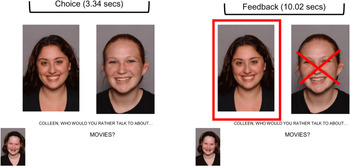
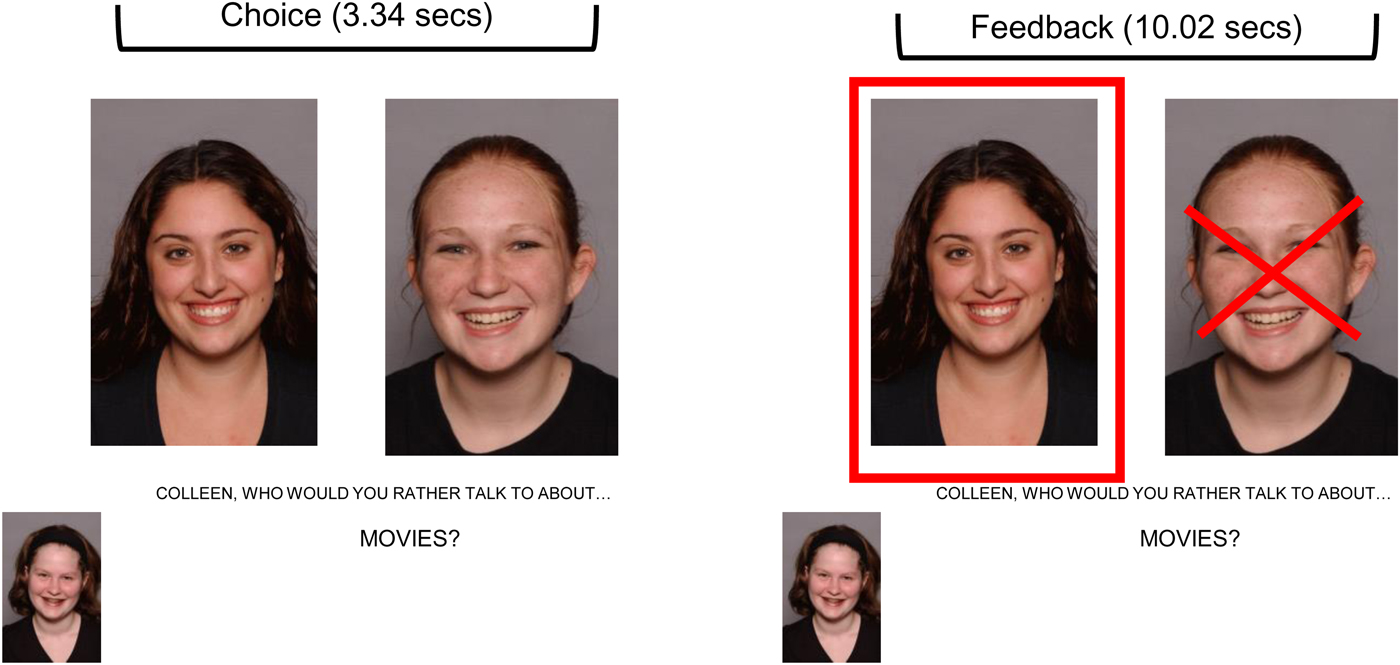
In Session 2, participants randomized to peer acceptance or rejection were told that they had been matched to the two adolescents they had ranked most highly in the first visit and that they were going to participate in a “chat choose” game using a remote connection. The game proceeded in two 6-min blocks. After each of the blocks, participants completed two or three of the self-regulation tasks (presented in a randomized order) and completed an affect rating. The first 2 min of each block of the game consisted of participants selecting the adolescents they wanted to chat with about each of 15 topics (e.g., friends and shopping), and the next 4 min included 30 trials in which the participant was either chosen or not as the preferred person to discuss each of the 15 topics by the two virtual peers. Topics were presented in a randomized order. A photograph of the person making selections was projected in the bottom left corner of the screen, and pictures of two other players were shown next to one another in the middle of the screen. For each round, the question “Who would you rather talk to about …” was posed with the chosen topic for that trial (e.g., “family?”). After each selection, the photograph of the person who was chosen was highlighted around the border with red, and the person not chosen was superimposed with a red X. When not participating, the participant was asked to indicate whether the adolescent on the left or right was chosen with the press of a button to ensure he or she was paying attention throughout the task. Figure 1 illustrates the task. The participant was selected by a virtual peer in two-thirds of the trials in the acceptance condition and in one-third of the trials in the rejection condition.
(Color online) The chat–choose task.
During debriefing, 9 participants reported clear knowledge that the peers were fake or that the choices were not real. These participants were excluded from all further analyses. After the initial debriefing, another 28 participants reported that they had had some suspicion about the manipulation. We conducted sensitivity analyses to test whether excluding these suspicious individuals from analyses altered the findings. In no case did the results change; we therefore present analyses including those 28 participants.
Measures
Self-regulation
We administered five behavioral self-regulation tasks that assessed hot and cold cognitive control, reward sensitivity, distress tolerance, and risky decision making.
Cognitive control (cold)
Cold cognitive control was assessed with the arrows task, a visual (nonverbal) Stroop task that assesses inhibition and switching (Davidson, Amso, Anderson, & Diamond, Reference Davidson, Amso, Anderson and Diamond2006; Korkman, Kirk, & Kemp, Reference Korkman, Kirk and Kemp2007). A research assistant presented participants with an array of arrows pointing up or down (50% white, 50% black). Participants were asked to identify the direction each arrow was pointing (congruent trial). Then, participants were asked to report the opposite direction of each arrow (opposite trial). Finally, participants were asked to state the direction the arrow was pointing for arrows of one color and to state the opposite direction for arrows of the other color (different trial). Responses were recorded by a research assistant (blind to condition assignment), who timed participants with a stopwatch. Cognitive control is assessed as the reaction time in the opposite and difference trial compared to the congruent trial: inhibition (opposite minus congruent) and switching (different minus congruent).
In addition to measuring cognitive control (inhibition and switching based on reaction time), we also calculated the errors in each of the trials. While these errors are not an index of cognitive control per se, they allow a test of whether changes in cognitive control based on experimental condition were due to increase in errors. The errors in inhibition and switching were operationalized in the same way and are used in supplemental analyses (errors in the opposite condition minus errors in the congruent decision and errors in the different condition minus the congruent condition, respectively).
Cognitive control (hot)
Cognitive control in the context of emotional stimuli was assessed via the emotional Stroop task (Etkin, Egner, Peraza, Kandel, & Hirsch, Reference Etkin, Egner, Peraza, Kandel and Hirsch2006). In the emotional Stroop, participants were presented with 148 trials run in E-Prime 2.0 (Psychology Software Tools, 2012). Participants were presented with a series of faces exhibiting either happiness or fear. The word “happy” or “fear” was written across each face. Participants were asked to push the number “1” if the face was happy and “3” if the face was fearful. Hot cognitive control is operationalized as the reaction time differences between trials where the word and facial expression were congruent and incongruent, separately for happy and fear trials, providing a measure of inhibition in an emotional context.
As in the measure of cold cognitive control, we assess errors during the emotional Stroop task. Supplemental analyses test if any changes in reaction time due to experimental condition are the product of changes in errors in the hot cognitive control task.
Reward sensitivity
The delay discounting task (Kirby & Marakovic, Reference Kirby and Marakovic1996) was used to assess preference for immediate versus delayed monetary reward. In E-Prime 2.0, participants were asked to choose between an immediate reward of a given amount and a delayed reward of $1,000, delivered at varying time intervals. The length of time the reward was delayed was varied across six blocks (1 week, 1 month, 6 months, 1 year, 5 years, and 15 years). If a delayed reward was preferred, the subsequent trial presented an immediate reward value midway between the prior trial and the $1,000 (i.e., a higher amount). If the immediate reward was preferred, the next trial presented an immediate reward midway between the prior one and $1. Participants responded until their preference for the immediate and delayed reward were equal, a value reflecting the “discounted” value of the delayed reward for the given time period. Across all trials, we calculated the average indifference point (i.e., the average of the discounted value of the reward across all six blocks). We also calculated the discount rate, which is the nonlinear rate of the discounted value across the six blocks.
Distress tolerance
We used the Paced Auditory Serial Addition Task, a performance-based measure of attention and working memory, to measure distress tolerance (Tombaugh, Reference Tombaugh2006). The task presented numbers on a computer screen, and participants were asked to sequentially add each number to the number presented previously, before the subsequent number appears on the screen. Responses were recorded by the research assistant. The task consists of three blocks. The latency between trials is 3 s in Block 1 (60 trials), 2 s in Block 2 (72 trials), and 1 s in Block 3 (92 trials). At the beginning of the third block, participants were told that they could terminate the task at any time by informing the experimenter. Because the third block is very challenging and has been shown to increase negative affect and stress in participants, latency in seconds to task termination in the third block has been used as a measure of ability to tolerate distress across multiple prior studies (Leyro, Zvolensky, & Bernstein, Reference Leyro, Zvolensky and Bernstein2010).
Risky decision making
Risky decision making was measured with the hot version of the Columbia card task (CCT; Figner, Mackinlay, Wilkening, & Weber, Reference Figner, Mackinlay, Wilkening and Weber2009), administered as a stand-alone computer program. The CCT assesses decision making when participants are presented with real-time responses on the positive or negative consequences of their actions. Participants were presented with 32 cards that provide either a gain or loss of points. For each trial, three factors were varied: number of loss cards (either 1 or 3), value of reward cards (either 10 or 30 points), and value of loss cards (either –250 or –750 points). Participants turn over 1 card at a time accruing points until they either decide to stop and bank their points or encounter a loss card and the trial ends. Decision making is assessed as a function of number of loss cards, loss amount, and gain amount (representing sensitivity to probability of loss, to actual loss, and to gain; Figner et al., Reference Figner, Mackinlay, Wilkening and Weber2009; Schonberg, Fox, & Poldrack, Reference Schonberg, Fox and Poldrack2011).
Affect
Using a computerized survey, we administered the Positive and Negative Affect Scale (PANAS; Watson, Clark, & Tellegen, Reference Watson, Clark and Tellegen1988) both prior to the task and after each block to test whether it was eliciting emotion. The PANAS is a 20-item measure assessing positive and negative affect. The state form of the PANAS was used. Participants endorsed the extent to which they felt each of 10 positive and negative emotions on a 5-point Likert scale ranging from 1 (very slightly or not at all) to 5 (extremely). The PANAS has excellent psychometric properties (Waikar & Craske, Reference Waikar and Craske1997; Watson & Walker, Reference Watson and Walker1996). The positive affect (α = 0.90–0.91) and negative affect (α = 0.83–0.86) scales demonstrated good reliability in this study.
Analytic strategy
We used ordinary least squares regression to test if the experimental manipulation altered positive and negative affect. To examine whether peer acceptance or rejection altered self-regulation, we tested a series of ordinary least squares regression models for each outcome separately: cold cognitive control, hot cognitive control, reward sensitivity, and distress tolerance. For risky decision making, we tested effects of experimental condition using multilevel modeling as this fits the nested structure of the CCT best. However, the same basic sequence of model testing occurred in both the regression models and the multilevel models.
For each outcome, we tested three models. We compared the overall effects of being in either the peer acceptance or peer rejection condition (coded as 0.5) relative to the neutral condition (coded as –1), which tested for the average effects of peer exposure. Next, we tested a similar model but with two dummy-coded variables, testing the effects of peer acceptance compared to the neutral condition and peer rejection compared to the neutral condition. Finally, in a subset analysis excluding the subjects in the neutral condition, we compared the effects of peer rejection (coded as 1) to peer acceptance (coded as zero).
We controlled for sex, race/ethnicity, IQ, and performance on the behavioral task from Session 1 (i.e., self-regulation in the absence of the peer manipulation) in all analyses. Sex was dummy coded with males as the reference group. Race was modeled with five dummy codes with White youth as the reference group (Black, Hispanic, Asian, biracial, and other race or ethnicity). IQ was controlled using standardized scores from second edition of the Wechsler Abbreviated Scale of Intelligence vocabulary and matrix reasoning subscales. Although the age range of the current sample was highly restricted (0.5 SD around the mean), we tested whether including age as a covariate altered the current findings. Age was neither a significant predictor in the current models nor did including it alter the effects of the predictors; thus, we dropped it from further consideration. There were no differences in task performance at Session 1 across conditions, t max (286) = –1.14, p = .254.
For all models, we examined residual statistics and measures of influence (such as Cook D, Mahalanobis distance, or standardized residuals >3 SD) to assess model fit.
For risky decision making on the CCT, we estimated three multilevel models, with each of 24 trials nested within two time points (Session 1 or 2) nested within 273 participants, providing 12,648 observations to analyze at Level 1. We estimated a random intercept at Level 1 (trials) and Level 2 (session) and random variances and covariances for trial conditions at Level 1 (number of loss cards, loss amount, and gain amount) to allow for individual differences in the effects of trial conditions on the number of cards chosen. For the final models, we used a factor analytic covariance matrix to estimate the variance–covariance matrix of the remaining random effects as a freely estimated matrix did not converge. We tested for the main effect of study condition and also if the experimental condition moderated the association between three task parameters (the value of the win card, the value of the loss card, and the probability of a negative outcome) and the number of cards chosen.
Results
Affect
Adolescents randomized to the peer acceptance condition reported increases in positive affect relative to the neutral condition after each block of the chatroom interact task (β = 0.08–0.13, p = .081–.032), and those randomized to the peer rejection condition reported decreases in positive affect compared to the neutral condition after each block of the chatroom interact task (β = –0.07–0.08, p = .040–.048). There were no changes in negative affect.
Effects of any virtual peer exposure on self-regulation
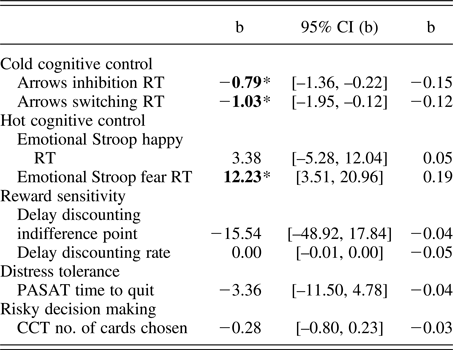
Then, we tested how any virtual peer exposure affected performance on self-regulation tasks. All effects are summarized in Table 1. We found three influential outliers who altered the effects of condition on performance on the arrows in switching response times. All three subjects were in the acceptance condition, and had among the largest scores on the outcome. The exclusion of these cases caused the effects of chatroom task exposure to increase dramatically while the standard error of the coefficient decreased, suggesting that the estimate became more precise. One of those same participants was identified as an influential outlier in terms of errors; this participant committed seven errors, which was 5.15 SD beyond the mean. These outliers were excluded from all further analyses of the switching task data. We found no influential outliers in any of the other tasks.
The effects of exposure to peers on self-regulation, relative to the neutral condition

Note: RT, reaction time; PASAT, paced auditory serial addition task; CCT, Columbia card task. The Columbia card task also controlled the main effects and interactions among each condition of the experiment. All analyses were controlled for sex, ethnicity, intelligence, and Time 1 task performance.
*p < .05.
Peer exposure affected both cold and hot cognitive control. Peer exposure produced improvements in inhibition (average improvement of 790-ms difference between inhibited and congruent trials) and switching (average improvement of 1030-ms difference between switched and congruent trials) in the arrows task. Peer exposure was not associated with changes in errors, suggesting that these improvements in reaction time did not come at the expense of accuracy: inhibition errors, b = –0.07, 95% confidence interval (CI) [–0.23, 0.08], p = .33; switching errors, b = –0.25, 95% CI [–0.52, 0.01], p = .06. In contrast, peer exposure led to slower reaction times (average slowing of 12.20 ms) on the emotional Stroop in response to incongruent relative to congruent fearful faces (but not happy faces). Subsequent analyses found that these slowed reaction times were not accompanied by an increase in errors: errors in fearful condition, b = –0.01, 95% CI [–0.01, 0.04], p = .23. There were no effects of peer exposure on other measures of self-regulation.
Effects of peer acceptance and peer rejection on self-regulation compared to the neutral condition
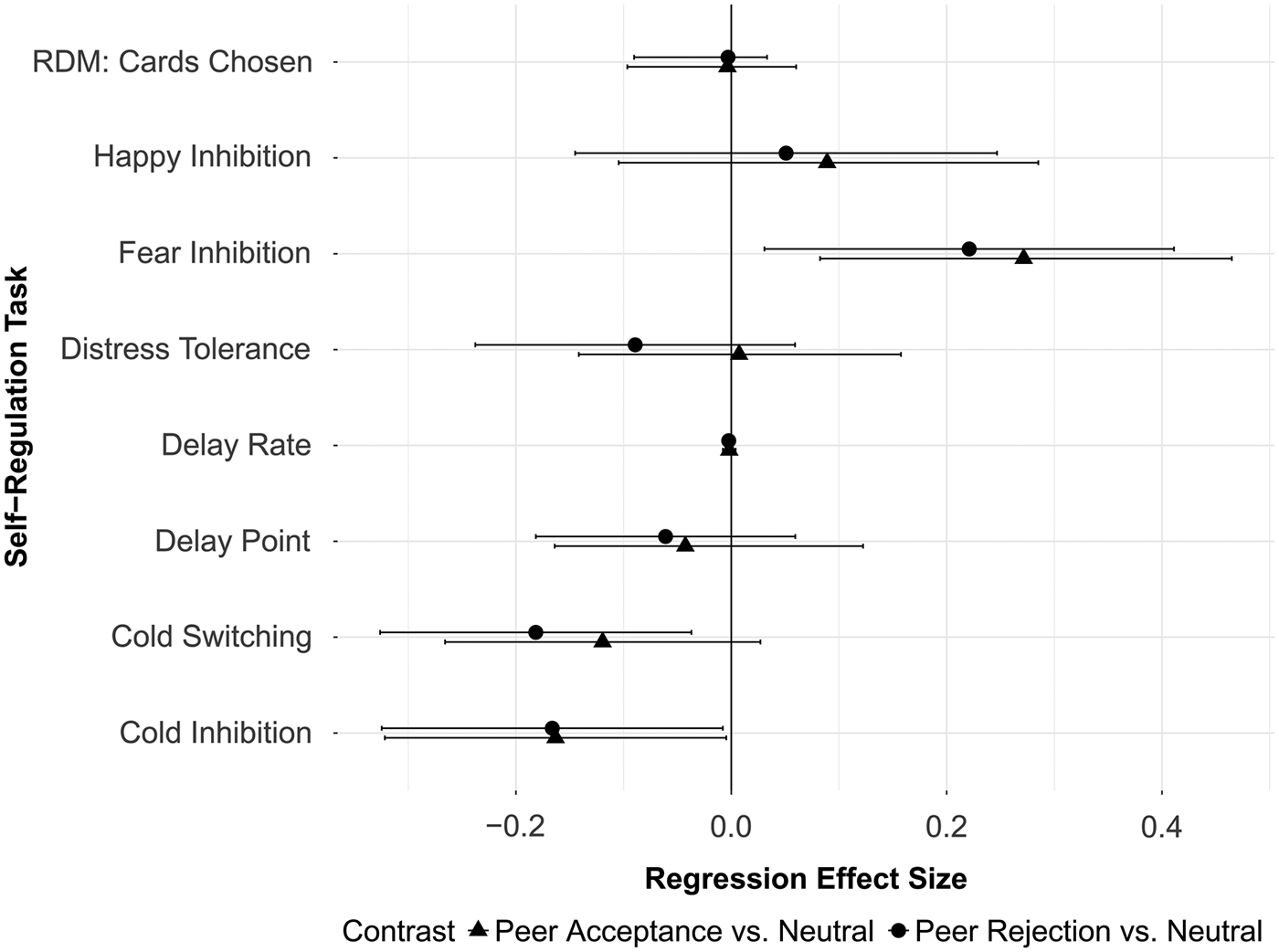
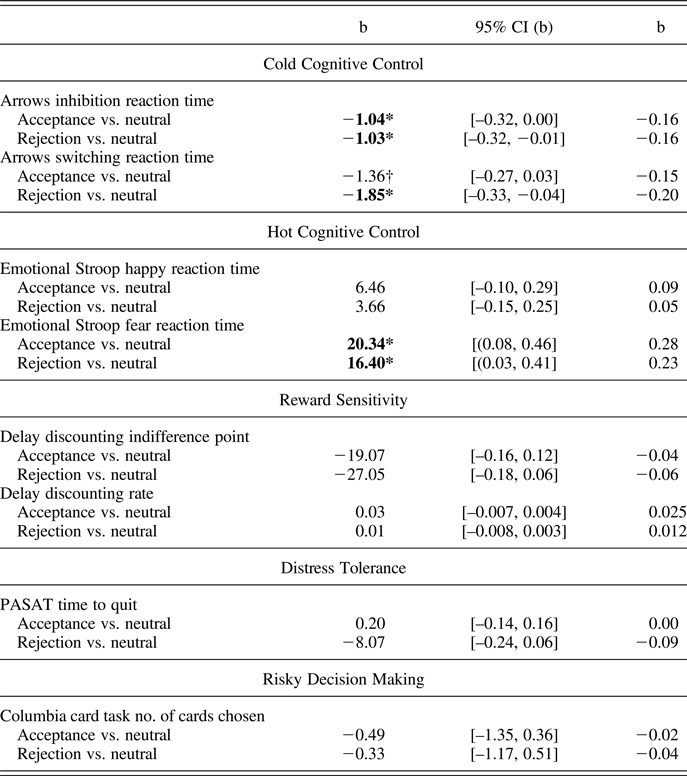
Next, we tested whether the effects of the chatroom task were specific to acceptance or rejection. The relative standardized effects for all outcomes are illustrated in Figure 2, and all effects are summarized in Table 2. In general, the effects of acceptance and rejection were similar as compared to the neutral condition involving no peer exposure. Both peer acceptance and rejection produced similar improvements in cold cognitive control relative to the neutral condition. Specifically, exposure to the peer task produced improvements in inhibition and switching in both the acceptance (average 1004 ms difference in the inhibition trials and 1360 ms in the switching trials relative to congruent trials) and rejection conditions (average improvement of 1003 ms in inhibition and 1850 ms in switching trials relative to congruent trials). This effect was not due to inhibition errors: acceptance, b = –0.16, 95% CI [–0.46, 0.24], p = .95; rejection, b = –0.16, 95% CI [–0.50, 0.24], p = .91, and both the acceptance and rejection conditions produced fewer errors relative to neutral during switching: acceptance, b = –0.49, 95% CI [–0.90, –0.07], p = .03; rejection, b = –0.40, 95% CI [–0.80, –0.01], p = .04, suggesting that the gain in cognitive control assessed by reaction time did not come at the cost of increased errors.
Relative effect sizes (β) and 95% confidence intervals of the peer acceptance and rejection compared the neutral condition on self-regulation; RDM, risky decision making.

The specific effects of peer acceptance and peer rejection on self-regulation compared to the neutral condition
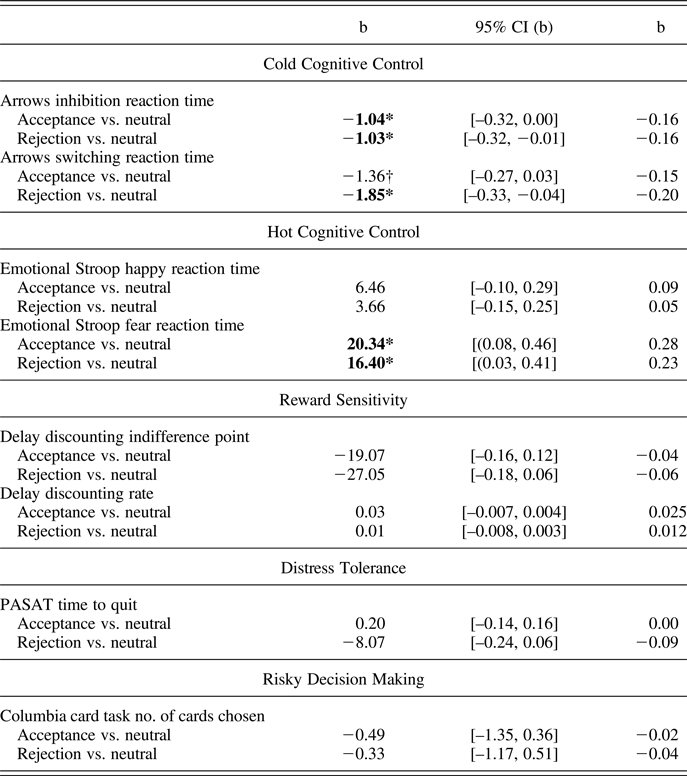
Note: All analysis controlled for sex, ethnicity, intelligence, and Time 1 task performance; the Columbia card task also controlled the main effects and interactions among each condition of the experiment; PASAT, paced auditory serial addition task.
†p < .10. *p < .05.
Participants exhibited greater emotional interference on fearful trials in the emotional Stroop task in both the acceptance and rejection condition. Compared to the neutral condition, participants in both the acceptance (20.34 ms) and rejection (16.40 ms) conditions were slower to respond to incongruent (relative to congruent) fearful faces. Peer acceptance (but not rejection) also produced more errors: errors in response to fearful faces, b = 0.04, 95% CI [0.001, 0.080], p = .036, suggesting that peer exposure reduced accuracy. There were no differences in response to happy faces in terms of inhibition or errors. When we controlled for the effects of errors in response to fearful faces on the association between experimental condition and reaction time in the emotional Stroop, the effects of peer acceptance compared to neutral were not substantively altered: b = 19.52, 95% CI [5.41, 33.88]. As in previous models, there were no effects of acceptance or rejection on the other self-regulation tasks.
Differential effects of peer rejection and peer acceptance on self-regulation
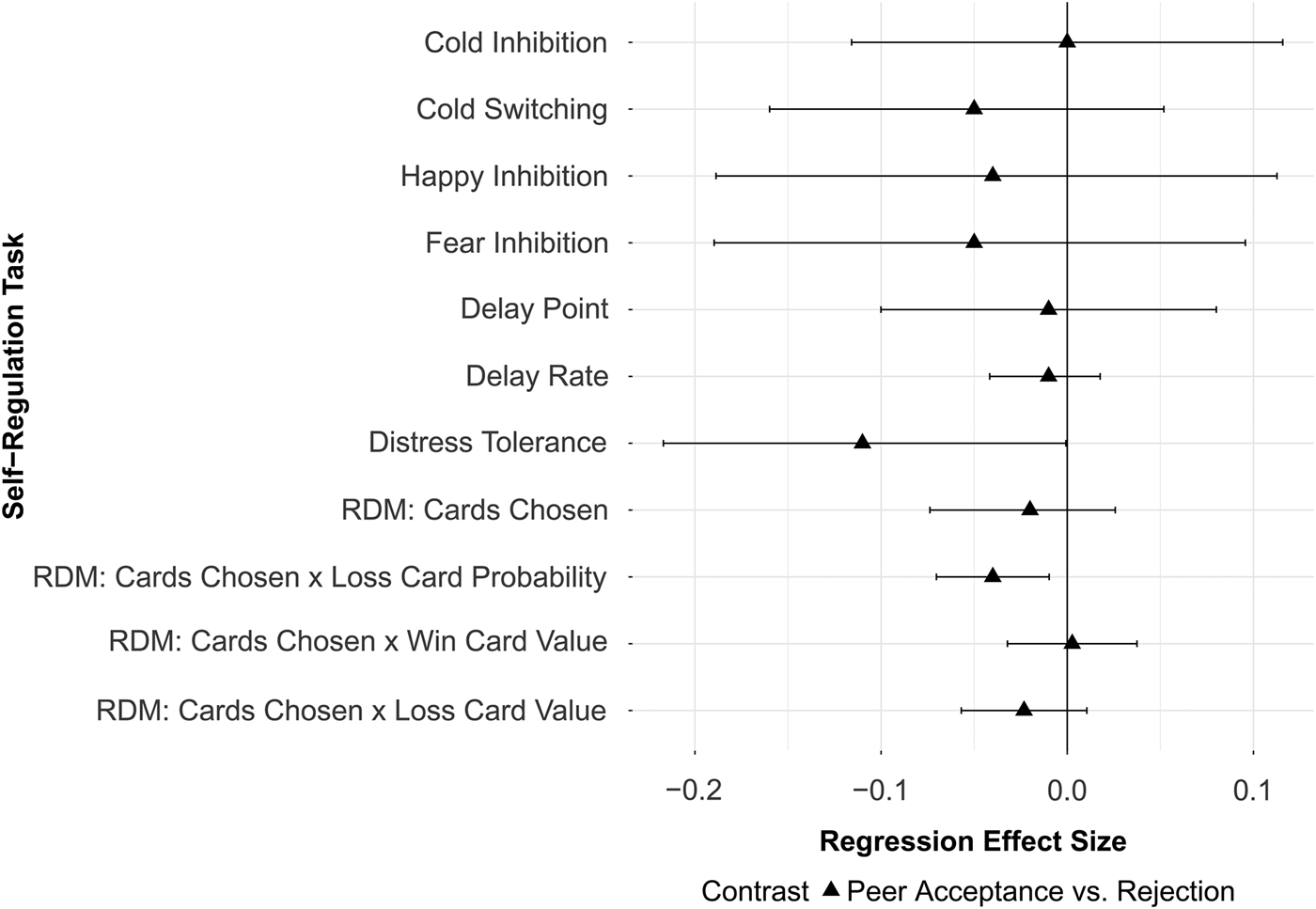
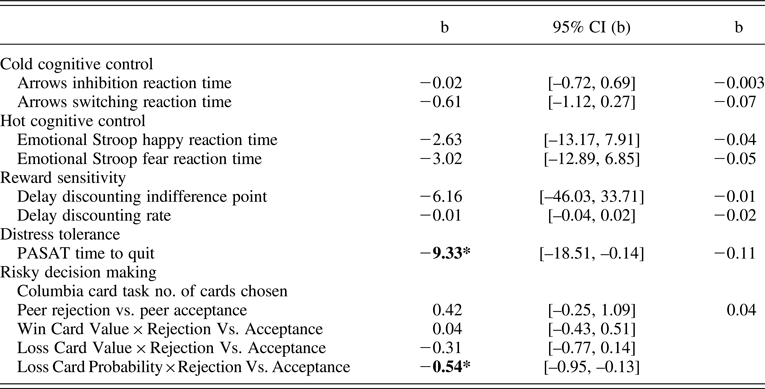
Finally, we compared the relative effects of peer rejection compared to peer acceptance on self-regulation. Figure 3 illustrates relative standardized effects across outcomes, and Table 3 summarizes these effects. There were no differences between rejection and acceptance in cold cognitive control reaction time or errors. Similarly, there were no differences in hot cognitive control, but youth in the rejection condition made fewer errors in response to fearful (but not happy) faces relative to those in the acceptance condition: b = –0.04, 95% CI [–0.07, –0.01], p = .01. There were no effects of condition on reward sensitivity (average discount point or rate of discount).
Relative effect sizes (β) of peer rejection compared to peer acceptance; RDM, risky decision making.

The relative effects of peer rejection compared to peer acceptance on self-regulation

Note: Rejection was coded 1, and acceptance was coded 0. All analyses were controlled for sex, ethnicity, intelligence, and Time 1 task performance; PASAT, paced auditory serial addition task. The Columbia card task analysis included main effects and interactions between experimental conditions; effects are not displayed for parsimony. We did not compute standardized coefficients for Columbia card task interactions because interpreting standardized interaction coefficients does not provide readily interpretable information.
*p < .05.
With respect to distress tolerance, the results indicate that participants in the rejection condition gave up an average of 9.33 s more quickly than adolescents who experienced peer acceptance. In addition, we observed an effect on risky decision making. Performance in the CCT was influenced by the task parameters, such that participants chose fewer cards when the value of the loss cards was 750 points versus 250 points, b = –1.44, 95% CI [–1.81, –1.08], or the probability of choosing a loss card was higher (3 cards vs. 1 card), b = –5.85, 95% CI [–6.20, –5.50], but the value of the winning cards had no effect. These effects were also synergistic: participants chose the fewest cards in trials when there were three loss cards that were each worth 750 points: b = 0.84, 95% CI [0.43, 1.24]. The influence of loss card probability differed across experimental conditions. Being faced with more loss cards had a stronger effect on the number of cards chosen for adolescents in the rejection (5.99 fewer cards) versus the acceptance condition (5.45 fewer cards).
Discussion
Mere exposure to peers has been shown to influence risk taking and decision making among adolescents. Yet remarkably little research has examined how specific types of peer interactions influence self-regulation processes during adolescence. Findings from the current study confirm that peers affect self-regulation during adolescence, but the effects depend on the nature and quality of peer exposure. A very brief exposure to peers online altered multiple domains of self-regulation, even though peers were not present in the room or directly observing behavior, and the participant had no existing relationship with the peer. Specifically, relative to a neutral condition, exposure to either acceptance or rejection by peers (i.e., mere interaction) produced improvements in cold cognitive control (both inhibition and switching) but impairments in hot cognitive control. In contrast, exposure to rejection, relative to acceptance, produced decreases in distress tolerance and increased sensitivity to losses.
Different neural networks underlie “hot” and “cold” aspects of self-regulation (Zelazo & Carlson, Reference Zelazo and Carlson2012), and our findings suggest that exposure to peers had opposite effects on these networks. Virtual peer exposure unexpectedly produced improvements in cognitive control in affectively neutral tasks, but diminished cognitive control during tasks involving the exertion of control in an emotionally salient context. The effects were similar in magnitude (~0.15 SD), but opposite in direction, and we observed greater/lesser interference without a concomitant increase in errors on the tasks. This is broadly consistent with findings that being observed by peers produces increased activity in regions of the brain associations with emotional arousal and self-reflection (Peake, Dishion, Stormshak, Moore, & Pfeifer, Reference Peake, Dishion, Stormshak, Moore and Pfeifer2013; Somerville, Reference Somerville2013). It may be that exposure to peers heightens attention due to the perceptual salience of peers during adolescence, and this increased attentional focus produces improvements in cognitive control for tasks involving neutral stimuli where distracting emotional information is absent. In contrast, this increased attentional focus could impede cognitive control in the presence of social and emotional distractors (such as emotional faces) because attention is either more readily captured by this information or because it is more difficult to disengage from that material in order to perform the task following exposure to peers. Experimental induction of positive and negative mood states produces mood-congruent performance differences on an emotional inhibition task, such that positive mood produces greater interference for positive cues and negative mood produces greater interference for negative cues (Richards, French, Johnson, Naparstek, & Williams, Reference Richards, French, Johnson, Naparstek and Williams1992). This may have also contributed to worse performance on the emotional inhibition task following exposure to peers. However, it is also importance to note that our experimental effects contrasted peer acceptance/rejection with a neutral condition. Future research should explore the degree to which other interpersonal contexts (such as different forms of peer interactions, like the provision of social support or neutral peer interactions, or exposure to nonpeers) may influence the expression and measurement of self-regulatory behavior.
Relative to acceptance, rejection reduced persistence in the face of a cognitively demanding and stressful task, a widely used indicator of distress tolerance (Leyro et al., Reference Leyro, Zvolensky and Bernstein2010). These findings suggest that peer rejection reduces willingness to persist in the face of frustration. Rejection experiences typically elicit negative affect, and this negative affect, when coupled with a frustrating and challenging task, may make it harder to persist with the task. Alternatively, rejection experiences may make it more difficult for adolescents to effectively manage the feelings of frustration and negative affect elicited by a difficult task. Longitudinal research indicates that peer rejection is associated with disruptions in emotion regulation at a later point in time among adolescents, including poor emotional awareness, maladaptive emotion expression, and increases in rumination (McLaughlin, Hatzenbuehler, & Hilt, Reference McLaughlin, Hatzenbuehler and Hilt2009). Prior research indicates that peer rejection reduces persistence in the face of frustration (Baumeister et al., Reference Baumeister, DeWall, Ciarocco and Twenge2005; DeWall et al., Reference DeWall, Baumeister and Vohs2008; Nesdale & Lambert, Reference Nesdale and Lambert2008); our findings suggest that this reduced persistence may reflect impaired distress tolerance. Overall, these findings suggest that negative peer interactions, and rejection in particular, may reduce the degree to which adolescents persist at difficult and frustrating tasks. This has implications for understanding the effects of peer rejection and bullying on school performance.
Moreover, peer rejection, relative to acceptance, enhanced the effect of potential losses on risky decision making. Information about risk (in terms of the number of chances to lose) had a stronger influence on decision making after adolescents had been rejected compared to accepted by peers. This pattern suggests that adolescents became more risk averse after being rejected. The negative experience of peer rejection may make adolescents particularly attuned to information about risk and increase motivation to avoid negative outcomes associated with those risks. This finding contrasts with a prior study using a similar paradigm in 8- and 10-year-olds where rejection increased risky choices (Nesdale & Lambert, Reference Nesdale and Lambert2008). It may be that the increased cognitive maturity of the adolescents in our study (age 16–17) allowed them to pursue strategies aimed at mitigating losses following the negative experience of peer rejection, whereas these strategies are difficult or impossible for younger children to implement. Regions of the prefrontal cortex and ventral striatum that are maturing during adolescence have been associated with individual differences in loss aversion during tasks that involve balancing potential rewards and losses (Barkley-Levenson, Van Leijenhorst, & Galván, Reference Barkley-Levenson, Van Leijenhorst and Galván2013; Tom, Fox, Trepel, & Poldrack, Reference Tom, Fox, Trepel and Poldrack2007). Information about risk (in terms of the number of chances to lose) had a stronger influence on decision making after adolescents had been rejected compared to accepted by peers.
In contrast to prior work, we found no differences by experimental condition in reward sensitivity, or preference for immediate versus delayed rewards (O'Brien et al., Reference O'Brien, Albert, Chein and Steinberg2011). This may be because our delay discounting task was affectively neutral; youth indicated their relative preference for a monetary amount sooner or later, but did not actually receive any amount. Alternatively, our experimental manipulation may have been too modest to produce an effect. In prior studies (O'Brien et al., Reference O'Brien, Albert, Chein and Steinberg2011) young adults brought two peers (likely real-world friends) to observe them complete the tasks, while we used virtual “online” peers who did not observe task completion. Moreover, those studies focused on more affectively positive or neutral interactions with real peers, with peers either present in the room during task performance or peers watching task performance from a separate room (Weigard, Chein, Albert, Smith, & Steinberg, Reference Weigard, Chein, Albert, Smith and Steinberg2014). It may be that the key component to peer exposure in prior research is not the “presence” of peers, but something about peer observation. Future research is needed to unpack how variations in how peer exposure is experimentally manipulated affect study outcomes.
Several limitations of the current study should be considered. Some prior work has suggested that many cognitive tasks such as those used in the current study have high test–retest reliability (Weafer, Baggott, & de Wit, Reference Weafer, Baggott and de Wit2013; Wöstmann et al., Reference Wöstmann, Aichert, Costa, Rubia, Möller and Ettinger2013), and may be subject to practice effects (Salthouse, Reference Salthouse2014). While the within-person design allowed us to estimate change in task performance from subjects’ baseline, it may also have reduced our obtained effect sizes relative to a simpler, between-person design. In addition, although very few participants reported that they were suspicious of the manipulation, and removing their data did not alter the findings, it may be that utilizing a more powerful peer acceptance or rejection condition, such as with live confederates or even with confederates on web cams, may produce larger effects on both affect and self-regulation. However, given that such a modest exposure to peer rejection or acceptance elicits significant within-person change, peer-based experiences in the real world may have an incredibly powerful effect on adolescent self-regulation, including effects on within-person variation in self-regulation ability across contexts. In addition, because we did not include a non–peer-based mood induction condition, we could not determine whether the effects we observed were due to peer exposure or simply the result of changes in affect (although covarying self-reported affect did not influence the current findings). Future research should work to disentangle these effects. Moreover, although using behavioral indicators of self-regulation may provide a deeper understanding of how peer exposure affects more specific dimensions of regulation (Sharma et al., Reference Sharma, Markon and Clark2014), the use of multiple behavioral measures in the same study may have fatigued participants. However, the order of task administration was randomized across both sessions, limiting the effect of potential fatigue on study outcomes. Relatedly, the psychometric properties of most behavioral self-regulation tasks are poorly established beyond indicators of test–retest reliability and predictive validity (see Cyders & Coskunpinar, Reference Cyders and Coskunpinar2011; King et al., Reference King, Patock-Peckham, Dager, Thimm and Gates2014, for reviews). Finally, most behavioral self-regulation tasks were designed to measure self-regulation as a trait, and consequently often have high test–retest reliability (Weafer et al., Reference Weafer, Baggott and de Wit2013; Wöstmann et al., Reference Wöstmann, Aichert, Costa, Rubia, Möller and Ettinger2013). This high reliability may impede the ability of experimental studies to find within-person effects. As such, it is likely that effects we document in the current study are conservative estimates of any real-world effects that may exist. Given that real-world peer interactions are extensive, longitudinal, and likely more salient than a brief virtual peer interaction, we suspect that real-world peer interactions may generate larger effects on self-regulation. Future research should focus on developing measures of self-regulation that are both psychometrically valid and sensitive to state-level variation in self-regulatory capacity.
Good self-regulation is key to positive adaptation during adolescence. Given that adolescents’ spend more time with peers than with any other socialization group, there are real concerns that peers may increase risk of psychopathology and risk-taking behaviors through diminished self-regulation. However, self-regulation is not a unitary construct, and different behavioral indicators of regulation seem to reflect multiple independent constructs (King et al., Reference King, Patock-Peckham, Dager, Thimm and Gates2014). Reflecting this complexity, we find that the mere presence of peers enhances cold cognitive control, but impairs cognitive control in the face of emotionally arousing information. In contrast, rejection by a peer did not impair hot or cold cognitive control, but reduced distress tolerance and made adolescents more sensitive to losses, relative to being accepted by a peer. Understanding how aspects of self-regulation differentially interact with an adolescent's social environment across the course of development is crucial toward building a more precise model of the development of psychopathology.