INTRODUCTION
Historically, the grey seal, Halichoerus grypus (Fabricius, Reference Fabricius1791), occurred throughout most of coastal Europe and the species was possibly the most abundant pinniped species in the Wadden Sea – a shallow water area in the south-eastern part of the North Sea – until around 1000 AD (Reijnders et al., Reference Reijnders, van Dijk and Kuiper1995). With the expanding human settlement in the area, the hunting of seals increased significantly and was assumed to have caused the grey seal population to decline and eventually to disappear from the Wadden Sea in the 16th Century (Reijnders et al., Reference Reijnders, van Dijk and Kuiper1995; Härkönen et al., Reference Härkönen, Brasseur, Teilmann, Vincent, Dietz, Abt and Reijnders2007). In the 1950s, single individuals, most likely originating from the British Isles, started appearing in the German and Dutch part of the Wadden Sea and by the 1980s a few breeding colonies were established (Scheibel & Weidel, Reference Scheibel and Weidel1988; Reijnders et al., Reference Reijnders, van Dijk and Kuiper1995). Since then, the grey seal population in the Dutch and German Wadden Sea has increased, reaching a total population size of more than 4000 individuals in 2014 (Brasseur et al., Reference Brasseur, Czeck, Diederichs, Galatius, Jensen, Körber, Siebert, Teilmann and Klöpper2014). The high growth rates in population size, averaging around 15% annually since 2008, are unlikely to be a result of local pup production alone. Population growth rates, in closed populations of grey seals, are generally not expected to exceed 11% (Härkönen et al., Reference Härkönen, Harding and Heide-Jørgensen2002). Based on satellite telemetry, the additional immigration of grey seals from the British Isles seems to account for a significant portion of population growth in the Dutch Wadden Sea (Brasseur et al., Reference Brasseur, Borchardt, Czeck, Jensen, Galatius, Ramdohr, Siebert and Teilmann2012, Reference Brasseur, Diederichs, Czeck, Jensen, Galatius, Ramdohr, Siebert, Teilmann, Körber and Klöpper2013, Reference Brasseur, van Polanen Petel, Gerrodette, Meesters, Reijnders and Aarts2015). Still, the number of pups born in the Dutch and German Wadden Sea and on the German island of Helgoland has increased significantly from 196 pups in 2008 to 609 newborn pups in 2014, of which the majority are born in the Netherlands (Brasseur et al., Reference Brasseur, Czeck, Diederichs, Galatius, Jensen, Körber, Siebert, Teilmann and Klöpper2014).
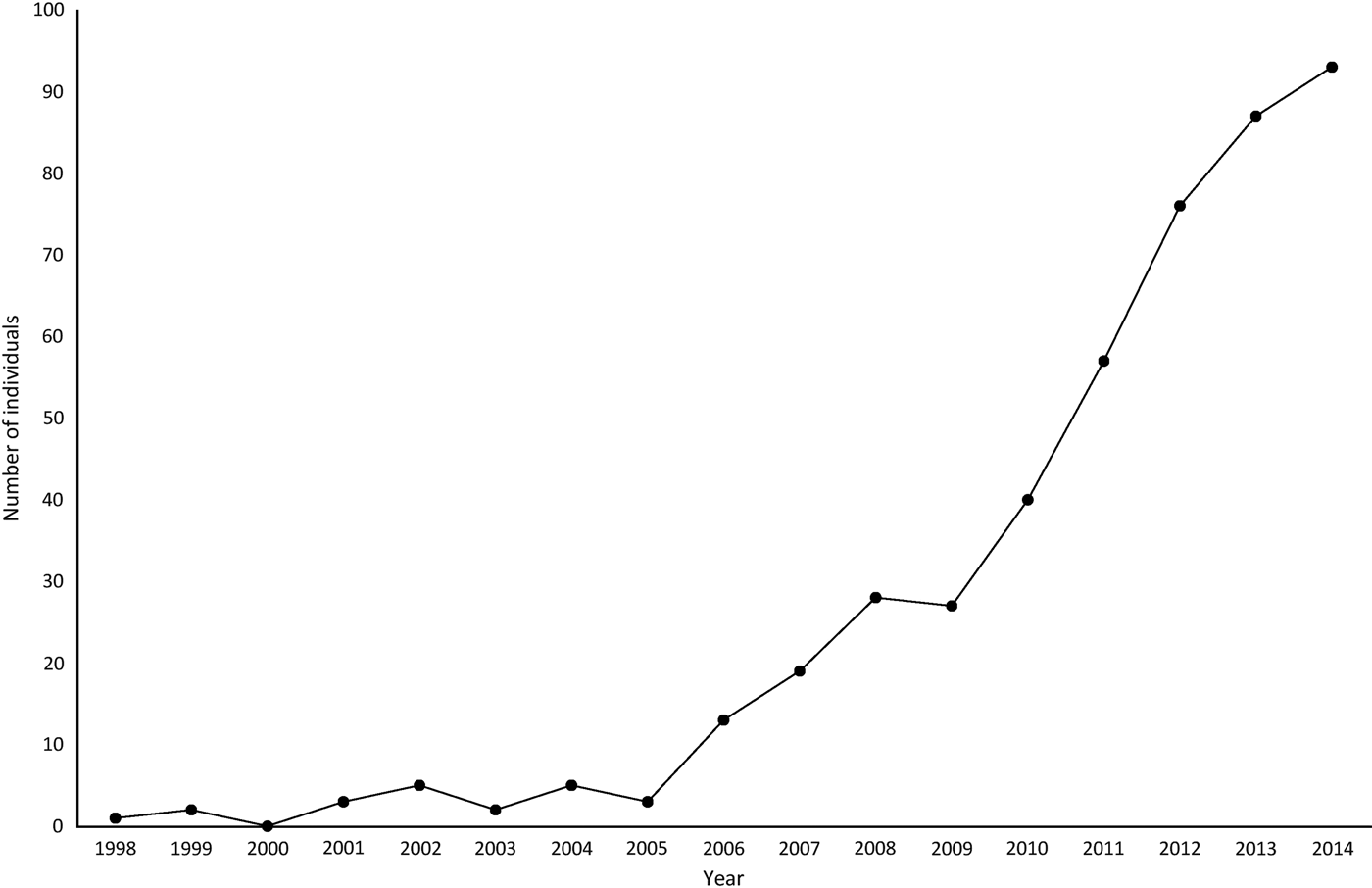
Despite population growth in the Netherlands and Germany, grey seals have, to date, only appeared in low numbers in the Danish Wadden Sea and breeding had not been observed since the species disappeared. However, counts conducted during aerial surveys of harbour seals in June, July and August, show that grey seal numbers have recently grown in the area (Brasseur et al., Reference Brasseur, Reijnders, Borchardt, Siebert, Ramdohr, Stede, Jensen and Teilmann2009, Reference Brasseur, Reijnders, Borchardt, Siebert, Ramdohr, Czeck, Körber, Jensen and Teilmann2010, Reference Brasseur, Borchardt, Czeck, Jensen, Galatius, Ramdohr, Siebert and Teilmann2011, Reference Brasseur, Borchardt, Czeck, Jensen, Galatius, Ramdohr, Siebert and Teilmann2012, Reference Brasseur, Diederichs, Czeck, Jensen, Galatius, Ramdohr, Siebert, Teilmann, Körber and Klöpper2013). While only single individuals were occasionally observed in the early 2000s, a total of 93 adult grey seals were observed during a survey in August 2014. These summer counts are not ideal for grey seal monitoring, as only a small fraction of the population is observed on land in this period (Abt et al., Reference Abt, Hoyer, Koch and Adelung2002; Brasseur et al., Reference Brasseur, van Polanen Petel, Gerrodette, Meesters, Reijnders and Aarts2015). Counts obtained then are not directly comparable with the numbers obtained during the moulting period of grey seals, in March and April, when 912 seals were counted in Germany and 3364 in the Netherlands (Brasseur et al., Reference Brasseur, Czeck, Diederichs, Galatius, Jensen, Körber, Siebert, Teilmann and Klöpper2014, Reference Brasseur, van Polanen Petel, Gerrodette, Meesters, Reijnders and Aarts2015).
Based on the increasing occurrence of grey seals in the Danish Wadden Sea, a dedicated survey programme was launched in December 2014 within the EU Marine Strategy Directive. The survey programme comprised five surveys, which were conducted during pupping (three surveys in December) and moulting (two surveys in March and April) seasons, consistent with the standard that has been previously established for the other Wadden Sea areas.
RESULTS AND DISCUSSION
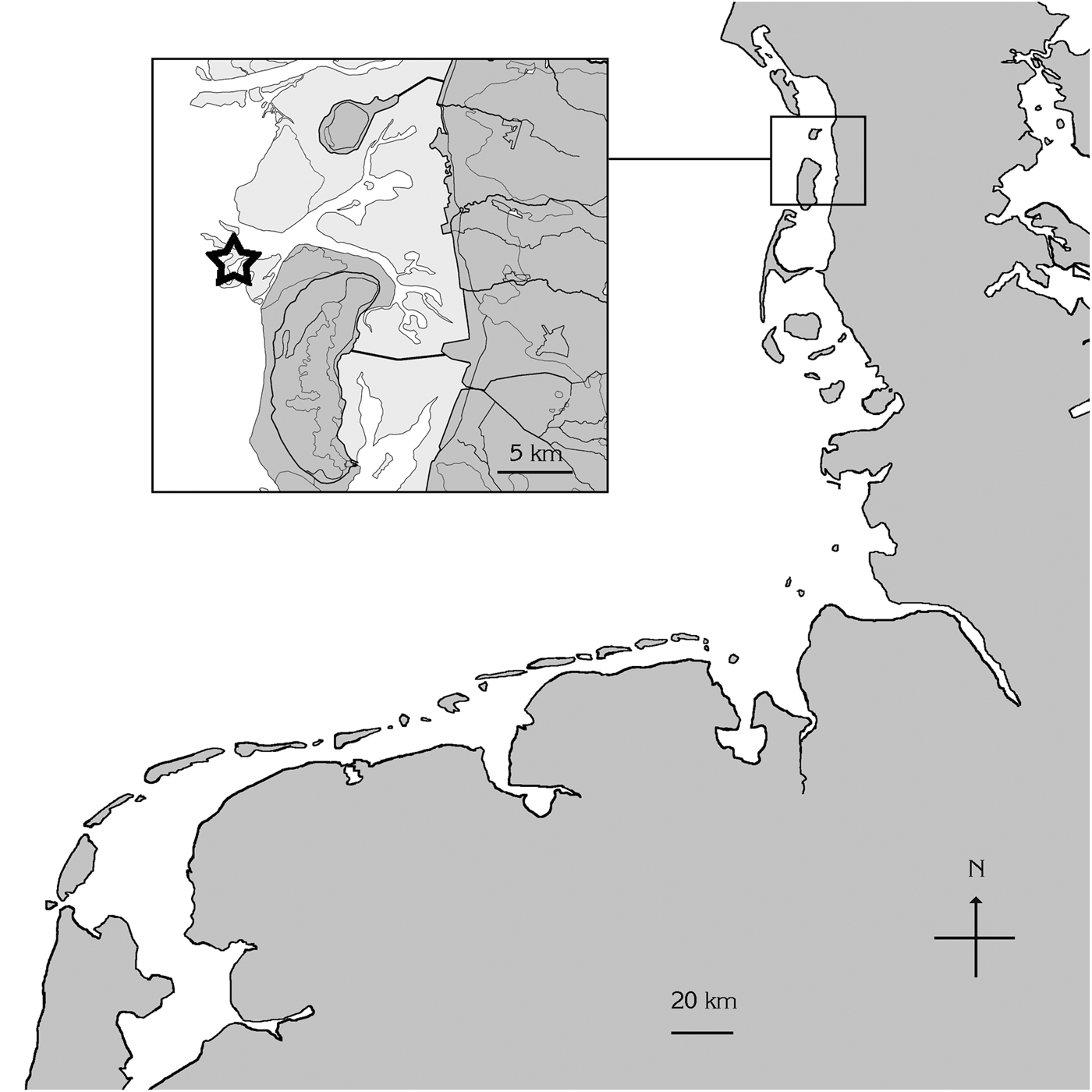
During an aerial survey conducted on 30 December 2014 in the Danish Wadden Sea, a newborn grey seal pup was observed with its mother on a remote sandbank located north of the island Rømø (Figure 1; coordinates: 55°12′27.57″N 8°26′49.64″E). The pup had a white lanugo coat and remains of the umbilical cord, funiculus umbilicalis, were visible. These characteristics, together with the pup being relatively thin, indicated that the pup was born within no more than a few days prior to the observation (Radford et al., Reference Radford, Summers and Young1978). Furthermore, from the size of the mother, showing extensive blubber reserves, it was assumed unlikely that the pup had been suckling for very long. The observation was documented at a height of 1000 feet above ground by digital photography using a Nikon D7000 SLR camera with a AF-S Nikkor 70–300 mm 1:4.5–5.6 G lens at 300 mm (Figure 2).
Star represents the location of the observed newborn grey seal pup; sandbank north of Rømø, Denmark.

Newborn grey seal pup alongside its mother.

This is the first report on a breeding grey seal in the Danish Wadden Sea since the species disappeared from the area in the 16th Century. On previous occasions, a few pups without their mothers have been observed. In January 2007, three juvenile grey seals with remaining patches of white natal fur, indicative of older or weaned pups, were found in the Danish west coast and the Wadden Sea, and during a survey on 16 December 2014, a moulting pup was observed in the Wadden Sea. However, as grey seal pups have been observed to migrate at a very young age (McConnell et al., Reference McConnell, Beaton, Bryant, Hunter, Lovell and Hall2004), these pups may also have been born in the German/Dutch Wadden Sea, or in one of the large colonies of the British Isles. In 2007 and 2014, winter storms (low pressure system Kyrill, 17–19 January 2007 and Alexandra, 11–12 December 2014) had swept across northern Europe prior to the recorded observations of the moulting grey seal pups. Thus, the occurrence of the pups is likely a result of these storms.
In recent years, the grey seal population in the Dutch and German Wadden Sea has been growing, as has the number of breeding colonies (Czeck & Paul, Reference Czeck and Paul2008; Abt & Engler, Reference Abt and Engler2009). Additionally, grey seals seem to have become increasingly abundant in the Danish Wadden Sea (Figure 3). The observation of a newborn grey seal pup in the Danish Wadden Sea indicates that the species is expanding northwards and that actual breeding colonies might be established in the future, if suitable breeding sites are available. The Danish Wadden Sea is characterized by three barrier islands (Fanø, Mandø and Rømø) sheltering the Wadden Sea from the exposed North Sea. The islands are, however, all populated and receive many visitors throughout the year. Thus, very few beaches are undisturbed. Due to a tidal range of 1.4–1.9 m, numerous isolated sandbanks are exposed at each low tide, but are flooded at high tide. Only a few sandbanks remain above water level during high tides and even the highest sandbanks are occasionally flooded during storms. These sites would be expected to be the most appropriate for a future grey seal breeding colony in the Danish Wadden Sea. The sandbank where the newborn pup and its mother were observed is relatively high, though still flooded at high tide. However, the sandbank is in close vicinity to a seal reserve situated at a higher sandbank that only gets flooded during severe storms.
Maximum number of adult grey seals observed in the Danish Wadden Sea during aerial surveys in June, July and August.

In the Netherlands and Germany, fewer pups are observed during surveys conducted immediately after extreme high tides due to storms. Similarly, seal rehabilitation centres seem to receive more pups after the first winter storms (Brasseur et al., Reference Brasseur, van Polanen Petel, Gerrodette, Meesters, Reijnders and Aarts2015). Thus, the breeding success of grey seals in the Wadden Sea might be reduced in years with December storms.
Grey seals are known to show site fidelity to breeding sites and in Scotland females have even been observed to return to the same site within the breeding colony year after year (Pomeroy et al., Reference Pomeroy, Anderson, Twiss and McConnell1994, Reference Pomeroy, Redman, Ruddell, Duck and Twiss2005; Twiss et al., Reference Twiss, Pomeroy and Anderson1994). As a consequence, colonizations of new breeding sites seem most likely in younger primiparous animals (Brasseur et al., Reference Brasseur, van Polanen Petel, Gerrodette, Meesters, Reijnders and Aarts2015). Thus, the pup observed in the Danish Wadden Sea is likely to be the females’ first pup.
With the observation of breeding grey seals in the Danish Wadden Sea, the species has potentially returned to the area from which it was displaced several hundred years ago. Whether the species will manage to establish actual breeding colonies in the area will become evident in the years to come. Most critical for the reproductive success of grey seals in the Danish Wadden Sea is expected to be the availability of undisturbed sandbanks and beaches that are protected from high tides.
ACKNOWLEDGEMENTS
The authors thank two anonymous reviewers for comments on a previous version of the manuscript and the Danish Nature Agency for financing the survey programme.