In the late afternoon of 26 July 2005, two workers went to the trade union office of Company T. Calmly but firmly, they uttered words that stunned the union chairman: “We are going to strike!” A few hours later, machines stopped running, and the next day 577 workers did not turn up for work. What was unexpected, however, was that the workers' action at Company T triggered a wave of strikes that swept the entire Dalian Development Area (DLDA) in the next two months: 18 enterprises, all Japanese except for one Korean, saw similar labour action that involved more than 20,000 workers. This is a significant episode in China's labour history, not only because of the number of enterprises and workers involved but also because of its impact: all enterprises hit by strikes raised workers' salaries and abolished some practices that the workers thought unreasonable.
Chinese workers' collective action during market reform has caught scholarly attention in recent years. This has led to the emergence of a small amount of impressive literature that explains the causes, claims, forms, discourse and organization of workers' action. The literature has predominantly focused on workers' behaviour, seeking to understand a variety of factors that shaped their responses to the market economy, such as institutional locations,Footnote 1 legal procedures,Footnote 2 communal space and identity,Footnote 3 the socialist legacy, and collective memory.Footnote 4 However, what has not been explored is how the workers' collective action, like the action in Dalian, was resolved, under what conditions and with what outcomes. A close examination of these issues is important in order to understand the main functions of the industrial relations institutions, which are still in the making as China experiences a sweeping economic transformation. Strike settlements have also posed a profound challenge to the government amid a surge of labour unrest in foreign and privately owned enterprises during the recent global financial crisis.
Using the Dalian case, this article examines the process that led to the settlement of labour strikes in China. It can be defined as a non-judicial process, in contrast to legal proceedings for labour dispute settlements.Footnote 5 The article argues that although the Chinese government has claimed to be pursuing tripartism for labour relations, the non-judicial process of industrial conflict resolution in China is largely a process of quadripartite interaction. In addition to the government and employers, the trade unions and workers are two separate players: workers' collective action in China is always launched by unorganized workers rather than by trade unions, whose task is to defuse the situation. Such a quadripartite process is dominated by the government, with the trade union playing a mediating role, not only between workers and the government but also between workers and employers. The process involves certain explicit and implicit rules, as well as distinct dynamics. By analysing its institutional and social basis, this study will explain why the non-judicial process of industrial conflict resolution is a quadripartite interaction and demonstrate how it works: namely, how parties involved in strikes interacted with each other in formal and informal institutional settings, their respective concerns and goals, and the factors that contributed to the way the strikes were brought to an end. The central focus will be on the role of the trade union, because the trade union is located in an institutional position that allows it to connect the other three parties and drive the quadripartite interaction.
The findings of this study are based on both group and individual interviews that were held in 2006 with representatives from twelve union cadres in the DLDA, including the chairman of the DLDA union and union heads from eleven strike-affected enterprises. All of them were personally involved in the settlement of strikes at that time. Background information is also derived from media reports and union documents. The focus of the article is a close investigation of three major enterprises (C, N and T) in the DLDA; there is only a cursory examination of other enterprises.
The Institutional and Social Basis of Quadripartite Interactions
A “strike” refers to work stoppage caused by collective refusal of employees to perform work in order to redress their grievances.Footnote 6 The freedom to strike was written into China's 1975 and 1978 constitutions, but revoked in 1982.Footnote 7 Illegal though they are, strikes have become one of the major forms of collective action by workers in China's burgeoning capitalist economy. Although the official statistics of “worker group incidents” (gongren qunti shijian 工人群体事件) do not differentiate strikes from other forms of action, such as collective petitions, road blockage, demonstrations or the occupation of factories, media reports and scholarly research indicate that there has been a frequent occurrence of strike incidents in recent years, especially in foreign and privately owned enterprises. As in other societies, a strike is usually caused by interest disputes that involve wage levels and conditions of employment. Unlike rights disputes, which involve the interpretation or application of existing standardsFootnote 8 and are reliant on legal procedures for their settlement,Footnote 9 interest disputes have to be resolved through a non-judicial process such as conciliation and mediation.Footnote 10 Although China has established a legal framework for coping with rights disputes, it lacks institutionalized mechanisms to handle interest-based disputes,Footnote 11 which have risen dramatically in recent years.
In many Western market economies, the non-judicial process for the resolution of interest disputes is often framed in an institutional setting called “tripartism,” a system of industrial relations composed of three actors: management organization, organized labour and government agencies.Footnote 12 The tripartite industrial system institutionalizes “social dialogue” among the three actors and allows them to interact with each other, negotiate, and use economic and political power or influence in the process of determining the rules that constitute the output of the industrial relations system and settling conflicts that arise in workplaces. This long and viable institutional practice in Western industrialized nations has been promoted by the International Labour Organization as a method for member states to handle industrial relations.Footnote 13 To adapt to changing industrial relations and to improve its international image,Footnote 14 China has begun to pursue tripartism. In 1990, the National People's Congress approved the International Labour Organization's No. 144 Convention calling for “tripartite consultation” between representatives of the government, employers and workers. The tripartite meeting system was formally set up at the national level in 2001, composed of representatives from the Ministry of Labour and Social Security, the All China Federation of Trade Unions, and the National Association of Entrepreneurs.Footnote 15 Its permanent office was created in Beijing in 2006. The same arrangement has subsequently been extended to the provincial, municipal and county levels. It is reported that by 2006, 2,452 tripartite bodies above the county level had been established.Footnote 16 Building “tripartite mechanisms” (sanfang jizhi 三方机制) has become a key target of government labour policy. Within such a macro framework, tripartite mechanisms have been encouraged at the micro-level, that is, in enterprises to resolve labour disputes and also to promote “collective consultation” on wages.Footnote 17
However, China's tripartism bears little resemblance to the Western institutions. As some commentators have criticized, China lacks a precondition of “true social dialogue”: political pluralism.Footnote 18 The state's firm control over both union and employer organizations at national and regional levels has rendered tripartite consultation only a formality. In the process of conflict resolution at the micro level, tripartism also fails to reflect the true configuration of labour relations. While government and employers of the private and foreign sector are two distinct parties,Footnote 19 the trade union's ambiguous position in labour relations makes tripartism problematic. This is because of the trade union's dual institutional identity.Footnote 20 The trade union is part of the government apparatus, and it is thus hard for it to represent workers as it also has to serve the goals of the government, some of which may be opposed to workers' interests as the government pursues capitalist-sponsored development. The union's governmental status prevents it from acting like a genuine representative of workers. Indeed, it is the union's failure to represent workers in interest disputes that has often forced workers to take action on their own. Workers' collective action in China underscores two issues: first, their grievances could not be resolved through institutionalized means while unions were largely unresponsive to their complaints; and second, their actions were initiated by themselves and not authorized by unions.Footnote 21 In other words, unions are not open to collective actions and their task, ironically, is to prevent and defuse them. The instance in which workers took spontaneous action highlights the separation between workers and trade unions as two different parties in industrial conflict.
On the other hand, the trade unions' governmental status does not mean that they will never be at odds with the government. After all, they are also labour organizations and in fact their union identity has been enhanced with the drastic change in labour relations and their own organizational development.Footnote 22 Thus, on some specific issues, unions might take an attitude that leans towards the workers. They sometimes can be viewed, because of their efforts to balance dual functions, as a separate party from the government, and hence a party between the government and labour. This leads to a quadripartite interaction that characterizes non-judicial processes of the settlement of interest disputes in China.Footnote 23
Quadripartite Interactions in Strike Settlement
The government
The government is central to the non-judicial process of conflict resolution. In fact, the very existence of quadripartite interaction is the government's making. After all, it is government policy that has created exclusive representation of the All China Federation of Trade Unions, which makes independent unionism impossible. It is the government's restraint on the unions' role that has led to a separation between unions and workers into two parties in industrial relations. The government also defines the rules for quadripartite interactions, with a predominant goal of political stability and social peace. That goal makes the government both inherently antagonistic to all forms of uncontrolled worker action and particularly sensitive to political or external connections. It is also concerned with the potential adverse effect of strikes on the local investment environment, because foreign direct investment (FDI) has become a driving force for China's economic growth. In the event of a major strike, local governments are always in full charge, setting the tone and principles for settlement, based on a thorough assessment of the nature, scope and background of the strike. They encourage negotiations but do not rule out coercion when necessary.Footnote 24
Quadripartite Interactions

The trade union
The key player that drives the non-judicial process, as the Dalian case and other media reports show, is the trade union. Trade unions in this case refer only to those above the workplace level, or what I call “union bureaucracies.”Footnote 25 Unions in the workplace are unable to play such a role. The unique role of unions in conflict resolution is typically shaped by their double institutional identity. On the one hand, as article 27 of the Trade Union Law stipulates:
In case of work-stoppage or slow-down strike in an enterprise or institution, the trade union shall, on behalf of the workers and staff members, hold consultation with the enterprise or institution or the parties concerned, present the opinions and demands of the workers and staff members, and put forth proposals for solutions. With respect to the reasonable demands made by the workers and staff members, the enterprise or institution shall try to satisfy them. The trade union shall assist the enterprise or institution in properly dealing with the matter so as to help restore the normal order of production and other work as soon as possible.
On the other hand, unions have a governmental status, which has two implications for their role in conflict resolution. First, they have to act more like a mediator between workers and employers than as a representative of the workers. Second, their capacity to mediate derives from their governmental status (workplace unions cannot negotiate with employers on an equal footing because of their structural subordination to management).Footnote 26 In short, the dual institutional identity of the unions places them in a unique position to manoeuvre between the government and labour,Footnote 27 which enables them to communicate with and influence all the other parties involved. As this case study will show, the governmental status of the DLDA union enabled it to act as the proxy of the municipal government to carry out mediation. This status also gave the union the necessary authority and resources not only for settlement of the dispute but also to exert pressure on both employers and workers. In the meantime, as the labour organization was incorporated into the government structure, the DLDA union could directly access government authorities, while at the same time being able to present and even argue for the workers' views and demands in formal government meetings that discussed crisis management.
Employers
When considering employers as a party, it is necessary to remember an important aspect that differs in many other market economies. As this case study will show, while the DLDA union was able officially to represent all the strikers from different enterprises, employers from these enterprises lacked a unified body to represent them. There was a loosely organized “Association of Foreign-Owned Enterprises” in the DLDA. But like most of its counterparts in other places in China, this organization was designed to provide a platform for foreign management to discuss common concerns, exchange information and network, rather than to play a substantial role in collective bargaining; in other words, it was not an officially sanctioned bargaining unit. This indicates that, so far, employers in China have not been well organized. As a party in conflict, their power is essentially company-based. However, as some scholars point out, capitalists do not require a collective organization to enable them to display their power,Footnote 28 because their power is based on their control over production and the jobs in their enterprises.
Besides their company-based economic power, foreign enterprises in the DLDA, as well as in other parts of China and the world, enjoy an additional advantage that further strengthens their bargaining position in labour disputes: the local government's enthusiasm for attracting foreign capital. It was quite common for foreign enterprises to take a hard-line attitude towards strikes initially by refusing to respond to workers' demands and even threatening to fire those involved. This attitude also derives from their understanding that strikes in China are illegal and that the country's oversupply of labour makes it easy to find replacements for workers who are fired. Their eventual concession, as this case will demonstrate, resulted not so much from the pressure of workers as from that of the government, which was exerted through union bureaucracies.
Workers
Compared with the other three parties, workers are weak in that they lack economic and organizational resources, and bargaining power. Institutionally and legally, they are not even a legitimate “party” in labour relations, for they are supposed to be represented by official trade unions. Yet their distinct interest, which unions often fail to take care of, as well as their ability to use disruptive action, makes them a “party” in collective conflicts. Such a contradiction became particularly noticeable in worker strikes. As this case will show, on the one hand, the strikes were, to some degree, co-ordinated and organized through micro-mobilization in groups and via mobile phones among individual workers. In a few enterprises, workers' demands were even well presented in written form. On the other hand, there was no identifiable leadership that openly claimed to represent the workers during the strikes. Organizing collective action remains a taboo in China that prevents the emergence of worker leaders. Thus the “workers” in the quadripartite interaction are a “party” able to take disruptive action to express their grievances and demands but unable to negotiate effectively with employers because of their lack of leadership and organization. So it was the DLDA union, when asked to mediate, that brought workers' demands to the negotiating table and pressed employers to concede. But since the union also had to accommodate the government's concern about the investment environment, it was unlikely that it could fully pursue workers' demands.
Contextualizing Strikes in the DLDA
Located in Dalian, Liaoning province, the DLDA was the first state-level economic and technological development area, having been approved by the State Council in 1984. In two decades or so, the DLDA has achieved an impressive growth, with a GDP of 53.6 billion yuan in 2006. The growth has been a result of the government's preferential policies for coastal development first and the “Revitalizing the North-east China Programme” later. The driving force for the successful story is FDI, which accounts for 96 per cent of enterprises in the area. As one official acknowledges, FDI is the “absolute pillar of the DLDA.”Footnote 29 Up to 2004, one year prior to the outbreak of strikes, DLDA had attracted 1,840 foreign enterprises, including 40 of the Fortune Global enterprises. Perhaps from geographical as well as historical reasons, the DLDA has been a favourite site for Japanese investment. There were 521 Japanese-owned enterprises in 2004, with a total investment of US$3.92 billion. That accounted for 40 per cent of the FDI in the area.Footnote 30 Japanese FDI has mainly focused on manufacturing, such as electronics, machinery, construction materials and automotive parts.
In sharp contrast with the remarkable economic growth, however, are the dire conditions of the workers, especially those called laowugong 劳务工.Footnote 31 A survey found that in the DLDA, laowugong's monthly salary in 2004 was only 632 yuanFootnote 32 and operating workers' monthly salary was 710 yuan (see Table 1). These salaries are exceedingly low, compared with those of shop floor workers in southern cities which were 150–300 yuan higher, as well as with the average monthly salary in the DLDA, which was 1,570 yuan.Footnote 33
Average Monthly Salary in the DLDA

Note:
Operating workers are skilled workers, with a longer contract, though many of them are also not local residents.
Source:
A report of the DLDA trade union.
Many laowugong involved in strikes complained that their salary had stagnated for years even though they worked very hard. Even worse, laowugong were least protected. For instance, Company C, with 30 per cent of its labour force laowugong, only offered them short-term contracts that were renewed every six months and would be terminated after their 22nd birthday. Laowugong were also unequally treated in insurance, benefits and salary, compared with regular contracted workers. Moreover, some enterprises maintained intensive labour processes in order to increase productivity. Company T, for example, increased the speed of its assembly lines by reducing the time from 20 to 14 seconds. Forced overtime was widespread and 12 hours' work per day was routine in many enterprises.
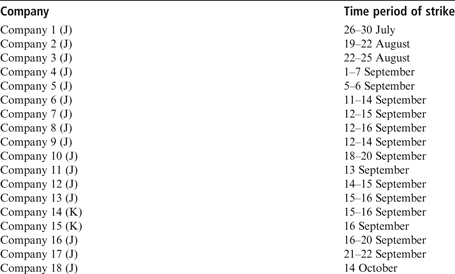
Accumulated grievances led to the outbreak of strikes, with salary increases as the principal demand. In a small geographical area that had a high density of foreign companies, workers shared common concerns and the strike was highly contagious: when the first action in Company T successfully led to an increase in salary, it quickly spread to other enterprises (see Table 2). It is notable that, of 17 Japanese companies hit by strikes, eleven were among the top 100 in terms of output value in the DLDA in 2005, a fact that highlights the tension between economic success and labour discontent. One background factor needs to be mentioned. Beginning with the strike in Company T in July, a wave of worker action occurred around the anniversary of 18 September 1931, the day the Japanese invaded north-east China. Speculation at the time said that workers seized the opportunity to ride the wave of the nation's anti-Japanese sentiment (which happened to be at its peak at that time because of Japanese Prime Minister Junichiro Koizumi's uncompromising stance toward the Yasukuni Shrine), though one investigation shows that, for the majority of workers, the driving force behind their actions was their strong feeling that “our salary was too low.”Footnote 34
Strikes in the DLDA between 26 July and 14 October 2005

Note:
This is based on information in a report of the DLDA Trade Union, in which the names of all these companies are identified. It is not necessary to disclose their names here.
Strikes were spontaneous in the sense that they were not initiated and organized by trade unions within the enterprises. In fact, unions were kept in the dark until a few hours before the strikes were set to happen. In Company T, the union was simply notified by two workers of the strike four hours before it occurred. In Company N, a note was slipped under the door of the union office in the morning, which declared the intended strike action that took place four hours later. The fact that unions were ignored indicates that workers did not view them as their representatives.
How micro-mobilization was carried out remains to be explored. Our fieldwork and media reports were unable to identify any visible leadership or tangible organizational format behind the strikes because many workers insisted “this is spontaneous.” But for such concerted action to happen, some co-ordination must exist.Footnote 35 In Company C, slips of paper with the word “strike” were privately circulated among workers. The slogan “Act Now and It's Time to Strike” appeared on the walls of dormitories and bathrooms.Footnote 36 Worker action was also co-ordinated through mobile phone messaging. As a union cadre from Company C recalled, they visited dormitories to persuade workers to stay away from the strike, only to find that all of the dormitories were empty; it turned out that a mobile phone message about the visit of the union cadre had already been disseminated among the workers and they had been asked to “disappear.”Footnote 37 In several enterprises, sites for worker gatherings were transmitted in the same way. The way workers presented their demands also reveals a certain degree of co-ordination. In Company T, workers raised 15 demands, including salary increases, the reduction of labour intensity, payment for overtime and an elimination of unreasonable regulations (such as permission to go to the lavatory). In Company C, a letter in the name of all the workers was presented to the union and management to state the reasons for the strikes, including low salary, poor benefits and low overtime payments. Clearly, the strikes represented conflict between employers and workers, while the trade unions in enterprises are not involved. But, as was common practice in China, the DLDA union was held responsible for settling the strikes. Its capability to access and interact with each party, shaped by its special status, placed it at the centre of the settlement process.
The Union as the Mediator in the Strike Settlement
This section examines how the DLDA union interacted with each party to seek the settlement as well as the parameters that defined its efforts.
The trade union and workers
Worker strikes in the DLDA circumvented enterprise trade unions. As union cadres frankly admitted, the workers simply did not trust the trade unions and knew that they would not support strikes anyway. To a large extent, the workers' spontaneous action in itself testified to the unions' failure to channel workers' grievances into formal managerial structures. Although workers were less organized, the impact of their action is not dissimilar to that of strikes organized by trade unions in other market economies: it interrupted production and forced the parties concerned to respond and find a solution. On the other hand, the lack of leadership deprived workers of the ability to negotiate effectively with employers. In Company C, when government officials called workers to send representatives to negotiate, nobody stepped forward. “They were afraid that to be worker representatives would be identified by the government as well as the enterprise as the organizers of the strike ….”Footnote 38 Representatives were finally picked by the government and were promised that they would not be held responsible for the strike. Likewise, striking workers from Company T refused to send representatives for the same reason, though their action was indeed co-ordinated by some activists. Management had to hold a meeting with all the strikers in a big hall, which accomplished nothing.Footnote 39 In short, without the role of enterprise unions, striking workers were an unorganized “party” in the conflict, unable to communicate and negotiate with the employers effectively.
The DLDA union's direct intervention in the strike settlements was premised on its recognition that the enterprise unions could do little on their own to resolve the conflict. In fact, in March 2005, the DLDA union issued a circular stipulating that in the event of strikes, “the superior trade union can directly guide, co-ordinate, represent and act on behalf of enterprise unions and workers to properly handle incidents.” It is worth mentioning that the DLDA was one of the first unions in the country to experiment with this “superior-trade-unions-representing-inferior-trade-unions” (shangji gonghui daibiao xiaji gonghui 上级工会代表下级工会) model aimed to redress the weakness of enterprise unions without a change in the existing trade union structure.
When they were called upon to settle the conflict, the DLDA union and its branches were uneasy about deciding how to stand up for the workers who were on strike. The difficulties were mainly political. No legal statute allowed workers to strike under any circumstances. The government detested any type of worker collective action, and was particularly fearful of large-scale and concerted protests that might have a considerable social impact or have been influenced by external forces. Thus, union cadres had to balance speaking for workers' concerns on the one hand and being seen to be leading the strike on the other, so they were very cautious about their relationship with worker representatives and tried to distance themselves by playing the role of a third party. For example, in some enterprises, union cadres chaired negotiations between worker representatives and management. When the head of the union from Company N was included in the DLDA team, he was asked by workers to represent them in negotiations, and he refused by stating “I cannot be your representative.” As he commented later in an interview, “if I admit that the union represents workers, that will amount to saying that I am the organizer of the strike.” He admitted that he did not dare to do so, because he was afraid of retaliation by the government. So during the negotiations, as he described,
I was just a mediator between two parties (worker representatives and employers). I was just assisting worker representatives in negotiations. That was my role. We had been indoctrinated with the government's view that strikes were unlawful in China, so I did not want to be involved in anything illegal. To be honest, I had personal considerations. I had to be worried about my job and my head (naodai 脑袋) as well.Footnote 40
But the union did try to provide assistance for strikers. For example, workers from both Company C and Company T raised a number of demands, ranging from wage increases and the elimination of short-term contracts to the improvement of working conditions. The DLDA union helped reorganize these demands and presented them to employers. On the other hand, to prevent worker action from turning nasty, the union also tried to control worker representatives by holding study sessions for them, in which they were warned away from “sabotaging production” or they would face serious consequences. The union's main concern, consistent with that of the government, was to end the strikes as soon as possible and before they could affect social stability and the investment climate. The union was sympathetic to the workers' economic claim, but did not support their use of a strike as the way to express it. For the DLDA, the strike was not a legitimate way to pressurize the employers and was a bomb that must be defused before it was too late. Thus, while negotiating with employers around the table, the DLDA union, together with enterprise unions, spared no effort to reach the shop floor, and even dormitories, in order to prevent the escalation of the strikes and end them without delay. When workers from Company N refused to go back to work because they found that the company's concession did not meet their demands, Mr M, the head of DLDA union, personally addressed a rally of 9,000 workers, urging them to accept the employer's offer and end the strike. He told the workers that the enterprise had made concessions, with which the government had been satisfied, and reiterated that, in the light of social stability and the long-term interests of economic development, the union did not agree with or advocate the workers' current action.Footnote 41
After the strike incidents in Dalian, the union cadres who were involved in conflict settlement reflected on the unions' relationship with workers. Some of them were deeply unsatisfied with their awkward and uneasy role and argued that legalizing strikes was necessary. As one union cadre pointed out: “If we [unions] are not given the right to strike, we will be weak forever. I was once hesitant about whether strikes should be legalized. But after that [the strikes in Dalian], I firmly believe that without strike legislation, we will never make any progress.” On the other hand, some union cadres remained reserved about the right to strike. They were worried about a potential runaway situation and political consequences if strikes were legalized. “What should the union do if workers want to strike? What if somebody shouts ‘Down with the Communist Party’ during strike? That will change the nature of the strike, making it a political or criminal issue. Could union heads bear such a responsibility? So I'd rather not have the right to strike.”Footnote 42
The trade union and the government
When large-scale worker collective actions take place in China, local governments are often more concerned about the impact than the employers. First of all, they are worried about the political implications and consequences. Under the pressure of the central government's stability-overrides-everything stance, they must take labour action seriously so that it does not disturb the social and political order. Local governments are also very concerned about the potential adverse impact of strikes on the investment environment, because attracting FDI is crucial for local economic development, as well as being an indicator of the local officials' performance. On the other hand, the government tried to direct strikes into institutionalized channels. As early as 1994, the DLDA authorities issued “Provisional Regulations on the Settlement of Labour Disputes in the DLDA.” According to this document:
When workers intend to organize stoppage and slowdown [note the word “strike” is not used] due to the infringement of their legitimate rights, they must nominate their representatives who are supposed to notify in writing the trade unions and enterprise administration 72 hours before they take action. At the same time, worker representatives also should present a written report in person to the DLDA union, with their identification cards shown and their names registered.
However, strikes in the DLDA were a surprise. It is unclear if this regulation was deliberately ignored or simply unknown to workers when they took action. It is likely that striking workers had never heard of this document that was dated more than ten years earlier. Workers were disorganized and highly mobile and it would be very difficult for them to have any access to official documents. But even if some of them knew about the document, the requirement for worker representatives to provide names and identification cards could be intimidating enough to prevent them from making an earlier announcement about their intended action. Of course, we could also reasonably ask whether they could ever get prior approval for a strike, even if they had sought it.
When workers stopped working, the chief municipal leaders of Dalian city immediately held a meeting to discuss what to do. First, they made sure that no political or external forces were involved. But even though they found that strikes were merely economically motivated, some of them still suggested a crackdown and detention of those who were thought to be “stirring up” the workers on the grounds of maintaining social and economic order.
The head of the DLDA trade union, Mr M, was invited to a meeting of top municipal Party and governmental officials to brief them about the situation. He tried to persuade them that the workers' action was motivated by no more than a demand for salary increases. He also demonstrated that the salaries of the enterprises concerned were indeed very low, compared with those of southern China, and insisted that the workers' demands were reasonable. The details of the municipal leaders' discussion remain unknown, but Mr M recalled in an interview, “the atmosphere of the meeting is very tense,”Footnote 43 implying that some officials maintained their hard-line attitude towards strikes. In the end, the Municipal Party Secretary ruled in favour of Mr M and endorsed the DLDA union to negotiate with the employers for salary increases. Mr M and some Chinese labour scholars later acknowledged that it was the Party secretary's final words about the “nature” of strikes that paved the way for conciliation and mediation.
However, the municipal government's reconciliatory approach to the strikes in July and August was almost overturned when workers in Company C took action in mid-September. The government called the strike unlawful and rejected the workers' demand for salary increases. As some workers recalled, the government's attitude became very hard, claiming that “no single cent will be increased” and those who refused to go back to work would be fired. Two organizers were detained.Footnote 44
Several factors might have contributed to the government's initial reaction. First, Company C's threat to withdraw investment if the strike continued caused anxiety within the government. There was also a fear among officials that a chain of labour actions demanding salary increases would increase labour costs in the DLDA and hence undermine its comparative advantage. Their fear was justified because they saw the spread of strikes to more enterprises in September. Some officials believed that the government could not afford to scare foreign investors away from the city and thus the strikes must be stopped. As one official remarked:
A strike is not a good thing to the DLDA. If foreign investors come here, only to discover that the quality of workers is so bad, the government does nothing about it, and the investment environment is so poor, they will be scared and leave.Footnote 45
Second, strike action in Company C appeared more militant than the strikes that had previously occurred in other enterprises. For example, when workers planned to march on the municipal government building to present their petition, government officials became very nervous and worried about the impact of the action on society at large.
Third, September 2005 was a sensitive period. That year was the 60th anniversary of the end of the Anti-Japanese War and 18 September was the anniversary of the Japanese invasion. Nationalist sentiment was particularly intense that year, and was aroused by Japanese Prime Minister Junichiro Koizumi's staunch position on the Yasukuni Shrine. The municipal government had to be cautious about the possible escalation of worker action amid national anti-Japanese fever. In the ten days after the strike in Company C, at least ten more enterprises saw similar actions that paralysed production. Perhaps it was this collective challenge that compelled the municipal government to drop the idea of coercion in favour of mediation. The DLDA union was mandated again to do the job.
In mediation processes, the DLDA union's capacity to settle the conflict depended on the municipal authorities' endorsement as well as its own government status. Mr M, the head of the DLDA union, enjoyed authority far beyond that of a union head, which enabled him to exercise influence in dispute settlements. As a member of the DLDA Party committee, he was able to access the municipal Party leadership and the government by attending their meetings and had direct communication with the city's top leaders. He was also authorized to summon the heads of the Bureau of Labour, the Bureau of Public Security, the Bureau of Trade Development and the Association of Entrepreneurs in the DLDA and co-ordinate their mediation efforts. At the same time, the DLDA union reached out to the worker organizations, as well as the trade unions, in the enterprises affected by strikes, advising them to “stabilize” angry workers through “thought work.” For example, within four hours of the start of the strike in Company N, the DLDA union had summoned all 300 cadres who headed shop floors and asked them to soothe the disgruntled workers. Many of the union heads in these enterprises concurrently held posts as deputy Party secretaries. To them, Mr M was their Party boss as well as the head of their trade union. Apparently, Mr M acted not as a union head at that time but as a member of the DLDA Party committee and was charged with full responsibility for crisis management. As one union cadre from an enterprise states, “Chairman M actually represents the government these days.”Footnote 46 Mr M himself remarks that in those days he felt as if he were an “imperial envoy” (qinchai dacheng 钦差天臣),Footnote 47 meaning that he had enjoyed a mandate given by the municipal government.
However, while the DLDA union was perceived as acting on behalf of the government, its position on certain issues was not always consistent with that of the government. The union felt that sometimes it must act like a union. At the municipal meeting mentioned earlier, Mr M spoke for workers' concerns and expressed his sympathy for their strikes, in contrast with some officials. While taking a conciliatory attitude towards the strikes, some government officials still suggested that worker activists should be fired. But Mr M and his colleagues insisted on opposing any punishment. One episode also shows the friction between the union and the government. During the process of settlement, the union's chief goal was to set 700 yuan as a baseline monthly salary for the DLDA, which was initially endorsed by the government. After negotiations, many enterprises raised salaries to that level or above. However, the government later announced a new minimum wage of 650 yuan for the DLDA, to be effective on 1 August 2006. The decision caused confusion among union cadres in some enterprises. The DLDA union officials openly expressed their disappointment at this decision, pointing out that it might undermine what workers had achieved. Unable to reverse the government's policy, the union appealed to enterprises to maintain salaries that had been adjusted after the strikes and emphasized that the official minimum salary did not amount to a “satisfactory salary.”Footnote 48
The trade union and employers
In the face of strikes, employers were initially adamant in expressing no intention to concede. A number of factors accounted for their strong response. As some union cadres remarked, employers often tended to believe that the government was behind them. They knew that the local government could not afford to be unfriendly to FDI. They also generally assumed that the government would not tolerate strikes for political as well as economic reasons. Some employers, as one union cadre pointed out, were misled by government officials into believing that “[Chinese] workers would not strike, for strikes would lead to arrests.”Footnote 49 So when strikes did occur, employers expected government intervention in their favour.
One specific factor that heightened employers' initial uncompromising attitude was the 1994 document that required prior notification of a strike 72 hours before the action takes place. Referring to this regulation, some Japanese employers argued that the strike was unlawful because none of them had been informed of it before the event and even the unions had known nothing about it in advance. The employers' toughness also stemmed from their belief in an almost unlimited supply of labour. Our interviews as well as media reports indicate that during the height of strikes, some employers were actually thinking about firing all the workers who participated, if they continued to “stir up trouble.” They never doubted that they could easily find replacements.
Bypassed by the workers, the enterprise unions played no role in representing them at the beginning of the strikes. Nor were they in a position to mediate and negotiate, because they were not fully independent of the management. It was the intervention of the DLDA union that made negotiations between conflicting parties possible. During the mediation, the DLDA union performed two important roles. First, it acted as a proxy for the government. For instance, in his first meeting with the manager of Company N, Mr M made it clear that the municipal government had agreed that a salary increase should be considered. Speaking much like a government official, he also blamed the company for failing to comply fully with governmental regulations on wages and employment. Even if the company could refuse workers' demands, it could not afford to ignore the wishes of the government. Company N dispatched a representative from its Japanese headquarters to negotiate with Mr M and his team. It can be reasonably assumed that Company N took Mr M seriously, primarily because he was perceived as a representative of the government. At other strike sites, the DLDA union also pressured employers by notifying them of the government's endorsement of salary increases. This was crucial for bringing adamant employers to the negotiating table.
Second, the DLDA union mediated between workers and employers over the range of wage increases. Without cross-enterprise co-ordination, the amount of wage increase demanded by workers varied from enterprise to enterprise. For example, workers from Company T demanded an addition of 380 yuan to their basic monthly wage, while their counterparts from Company C and Company N asked for 200 yuan more. The employers and the government considered these demands to be too high. Bearing in mind the government's aim to maintain a favourable investment environment, the union also reckoned that this increase was unrealistic. Thus, it mediated by scaling down what the workers asked for and reached deals that were acceptable to both sides. The union's proposal for a 100 yuan increase as a minimum was initially rejected by workers. However, because the workers were largely unorganized they could barely sustain their demands, and after several rounds of negotiation, three major Japanese enterprises raised wages by 100, 103 and 120 yuan respectively.
At least one case shows that an enterprise union pre-empted an imminent strike by initiating negotiations with the employer before the workers acted. When strikes spread in the area in September, workers from this enterprise were ready to follow suit. The enterprise union took the initiative, collected workers' complaints and presented them to the employer. Several rounds of negotiations between the union and employer led to the latter accepting some minor improvements (such as lump-sum cash for the Mid-Autumn Festival and an increase in meal subsidies) but failed to reach an agreement on wage increases. As the news that Company C had raised wages became widely known, the union seized the opportunity to increase the pressure on their employer to do the same to prevent a strike. The employer finally agreed to a 100 yuan increase in monthly salaries. He later acknowledged the union's timely role in defusing a possible strike in a very intense environment.Footnote 50
One problem surrounding union–employer interaction during the Dalian strike was the lack of an effective employers' organization at the DLDA level. This meant that the DLDA union had to negotiate with every individual strike-affected enterprise over the same issues. This apparently raised the cost of the non-judicial process. The lack of an organization with authorization to negotiate at the level of the DLDA might have also reduced the bargaining power of employers.
Conclusion
As the Chinese economy becomes increasingly market dominated, labour strikes have increased. Caused by interest conflicts, strikes cannot be addressed within the existing judicial framework. A non-judicial process of disputes settlement, such as conciliation and mediation, must be applied. Following the practice that is prevalent in Western market economies and also recognized by the International Labour Organization, China has promoted tripartism to resolve interest disputes. Nevertheless, China's labour relations have never been truly tripartite in the way seen in Western market economies. Rather, they are quadripartite, as a result of the unions' double institutional identity. This characteristic was particularly evident during open conflicts, where workers took action on their own and trade unions had to balance their dual functions by manoeuvring between the government and the workers.
The non-judicial process of industrial conflict resolution that involves a quadripartite interaction reflects a low degree of institutionalization of industrial relations in China. Unlike Western market economies, strikes in China are not a lawful means that unions can use to break an impasse in collective bargaining on behalf of their members. Rather, they are a discursive expression of grievance and demand by largely unorganized workers. Spontaneous strikes indicate that workers have not been well channelled into the established labour institutions and hence lack the institutional avenues to press for their demands. Without organization and rules to follow for strikes, the behavioural pattern of worker action can be volatile, undisciplined and unpredictable. Strikes usually come as a surprise because there is no prior communication between workers and the trade unions which should be representing them. Strikes signify not only the unions' failure to represent workers, but also their inability to control them: the quadripartite interaction occurred when, through their disruptive action, the workers became a party in their own right and the unions were bypassed.
Unlike legal disputes settlements that have laws to follow, rules on the handling of interest-based conflicts remain general, vague and in principle only. In several major laws, such as the Labour Law, the Trade Union Law and the Labour Contract Law, the principles of settlement are mentioned but are not specific enough to guide the process. Thus settlement processes are often arbitrary, improvised solutions and are not institutionalized. The priority of the settlement process is to control and defuse worker actions that are perceived by local governments as a threat to social stability. For them, the strike settlement is as much a political as an economic issue. Their fear of instability accounts for their willingness to concede as well as their use of coercion.
The quadripartite process of non-judicial resolution may be credited for its effectiveness in settling strikes. The similar process in Western market economies can be lengthy and protracted.Footnote 51 As this case shows, all the strikes in the DLDA ended in a few days, with one settled in only 24 hours. The government's direct intervention was evidently crucial for a quick settlement. Government officials have all the necessary incentives – political, economic and even personalFootnote 52 – to bring strikes to an end as soon as possible. The active role of the trade union in the process must first be understood as reflecting the government's will to control labour unrest and prevent its escalation. The union's authority to mediate also comes from the delegation of this role from the government. It is clear that without the pressure from the government, applied through the trade unions, the employers would not have made concessions so quickly.
It is also worth pointing out that non-judicial industrial conflict resolution has enhanced the trade unions' role. Although unions still remained subordinate to the government, many of them leaned towards the workers' demands when handling industrial conflict. They seemed to have been increasingly aware of their role in the protection of labour interests and attempted to make efforts on behalf of workers. The non-judicial process provides opportunities for union cadres to play a proactive role. From the perspective of the government, the priority is to defuse workers' collective action quickly, regardless of political or economic considerations. But “defusing” is a rather open process in which various proposals and measures are discussed, considered and tried, and the union's view is expressed and heard. As a goal, “defusing” can be accomplished by either dissipating workers or pushing employers to a compromise. As shown in this study, the DLDA union apparently opted for measures in favour of workers. Its insistence on the necessity of wage increases as a solution influenced the government's decision. For union cadres who harboured stronger union awareness, the non-judicial process was an arena to contest the employers' interests in favour of the workers' interests. Mr M, the head of the DLDA union, for example, enjoyed a good reputation for his pro-worker attitude long before the strikes. In handling the strikes, he seized the opportunity to support the workers' demands. With the government's endorsement, he aggressively pressed employers to concede. The involvement of the DLDA and Mr M's personal character also emboldened the enterprise unions, which had been silent when the strikes took place. As Mr M himself claimed, the successful handling of the strikes somewhat empowered the trade unions,Footnote 53 and his view was shared by other union cadres interviewed.
Nevertheless, the visible role of the unions in conflict resolution does not mean that they can fully and independently represent the workers. Nor does the unions' influence in a non-judicial process of dispute settlements reflect the emergence of “associational power.”Footnote 54 The unions' power to mediate derives from their government status and they are more of a “third party” than a representative of the workers. Until the unions become genuine representatives of the workers, we can continue to expect more spontaneous strikes launched by workers on their own, followed by a quadripartite process of conflict resolution with trade unions serving as a mediator. Installing genuine tripartism remains a profound challenge for China.