Introduction
The excess mucus secreted in chronic rhinosinusitis accumulates in the paranasal sinuses, where electrolytes and water are absorbed. The resulting hyperviscous mucus is difficult to clear and may promote infection.Reference Quraishi, Jones and Mason1 Nasal lavage increases the clearance of retained secretions, and there is a large body of evidence that it improves symptom control in patients with chronic rhinosinusitis.Reference Harvey, Hannan, Badia and Scadding2
The optimal composition of nasal lavage fluid has not been determined. Lavage with markedly hypo-osmolar solutions is uncomfortable and for this reason some salt is usually added to the lavage fluid. Although hyper-osmolar saline nasal lavage has shown superior results for symptom control compared with no treatment, there is conflicting evidence on whether or not hyper-osmolar saline is more effective than iso-osmolar saline.Reference Rabago, Zgierska, Mundt, Barret, Bobula and Maberry3–Reference Talbot, Herr and Parsons5
There is currently no consensus on the ideal composition of nasal lavage fluid, and whether or not nasal pH is altered by lavage solutions.Reference Washington, Steele, Jackson, Bush, Mason and Gill6, Reference Homer, England, Wilde, Harwood and Stafford7 The pH of the anterior nasal passage mucosa is 6.4.Reference Washington, Steele, Jackson, Bush, Mason and Gill6 Addition of surfactant to nasal lavage fluid may inhibit biofilm formation, but the clinical relevance of this has not been determined and its efficacy has not been compared to saline lavage alone.Reference Chiu, Palmer, Woodworth, Doghramji, Cohen and Prince8 Studies have not yet been performed to determine the most effective and best-tolerated nasal lavage solution.
Human nasal fluid is comprised of water (making up 95 per cent by biochemical proportion), proteins, glycoproteins, lipids and DNA.Reference Quraishi, Jones and Mason1 An ionic composition study using X-ray microanalysis found approximate ion concentrations of 127 mmol/l for sodium, 27 mmol/l for potassium and 140 mmol/l for chloride, giving an approximate osmolarity of 300 mmol/l.Reference Vanthanouvong and Roomans9
A number of commercial nasal lavage fluids are available, in addition to a myriad of home-made recipes. The osmolarity values and other physical characteristics such as pH are usually not specified for the commercial products. The home-made recipes are significantly cheaper for patients to prepare, but, again, the resultant osmolarity and pH are rarely stated.
The primary aim of this study was to determine whether the major physical characteristics of commercial and home-made nasal lavage products differ. Our primary measurements were pH and osmolarity.
Despite patients receiving standardised recipes for solution preparation, it has been reported they show variable adherence to these instructions.Reference Sowerby and Wright10 Although patients may receive an identical recipe for a solution, once prepared the solution's composition may be variable. The secondary aim of our study was to determine the reproducibility of patient-prepared lavage fluid composition.
Materials and methods
Primary measurement: pH and osmolarity
A number of home-made recipes used in clinical practice were identified by internet searching and through personal communication. Four representative recipes were selected and tested (Table I). Two commercially available products were also tested: Neilmed Sinus Rinse (isotonic) (Neilmed, Santa Rosa, California, USA) and FESS Sinu-Cleanse (ENT Technologies (now Care Pharmaceuticals), Sydney, New South Wales, Australia). These two products were chosen as they were the most commonly available commercial preparations in New Zealand.
Home-made recipes tested

*N Jones, personal communication. UOI = University of Iowa; AAAI = American Academy of Allergy, Asthma and Immunology; ORL dept = otorhinolaryngology department; ACH = Auckland City Hospital
The home-made solutions were prepared as per their recipes, with distilled water at room temperature. The commercial products were prepared according to the instructions on the packaging, using the manufacturer-provided container with distilled water at room temperature.
The salt used for making the solutions was non-iodised table salt. The baking soda and sugar used were also commonly available brands with no additives. Upon addition of water to the ingredients, each mixture was shaken vigorously for 10 seconds. The ingredients were all used before their manufacturers' recommended expiry date. To standardise volume measurements, we used 250 ml as a standard definition of a cup.
We measured the pH of each solution using the Mettler Toledo Seven Easy pH-meter (Mettler, Columbus, Ohio, USA) and the osmolarity using a Vapro 5520 vapour pressure osmometer (Vapro, South Logan, Utah, USA).
Each home-made recipe was prepared in triplicate with ingredients measured out using a commonly available metal teaspoon. Osmolarity and pH measurements were repeated in triplicate for each batch of solutions made.
The solutions were then prepared with a measuring teaspoon and the same testing protocol was applied. The two commercial products were each made up in triplicate, and each batch was tested three times.
Secondary measurement: inter-patient variance
Eleven consecutive patients were asked to prepare the Auckland City Hospital solution at home and to supply a 10 ml sample. The samples were collected over three weeks and frozen at −20°C. A total of 11 samples were collected.
The samples were allowed to thaw to room temperature before analysis was carried out. The samples were vigorously shaken for 10 seconds to decrease settling of ingredients. The samples were then analysed using the same equipment used in the primary measurement.
In addition, eight consecutive patients were asked to prepare the Neilmed Sinus Rinse solution at home and to supply a 10 ml sample. The specimens were stored and analysed as above.
Results and analysis
Primary measurement: pH and osmolarity
Table II shows the mean pH and osmolarity of the home-made recipes, prepared using either a commonly available teaspoon or a measuring teaspoon. The value shown for each solution's physical characteristic represents the mean of three measurements from each batch, for a total of three batches.
Mean pH and osmolarity of home-made recipes by teaspoon type

Mean values were calculated using three batches and three measurements for each batch. UOI = University of Iowa; AAAI = American Academy of Allergy, Asthma and Immunology; ORL dept = otorhinolaryngology department; ACH = Auckland City Hospital
All solutions were alkaline. The most alkaline solution was the University of Iowa solution, with a mean pH of 8.50 when made up using a commonly available metal teaspoon. The American Academy of Allergy, Asthma and Immunology solution had the highest osmolarity, with mean values of 795 mmol/l when prepared with a measuring teaspoon and 630 mmol/l when prepared with a commonly available metal teaspoon. Nick Jones' solution had the lowest osmolarity, with mean values of 163 mmol/l using a measuring teaspoon and 140 mmol/l using a commonly available metal teaspoon. The mean pH and osmolarity for the FESS Sinu-Cleanse solution were respectively 8.05 and 778 mmol/l, while the same parameters for the Neilmed Sinus Rinse were respectively 8.08 and 284 mmol/l (see Table III).
Mean pH and osmolarity of commercial products

Mean values were calculated using three batches and three measurements for each batch.
Secondary measurement: inter-patient variance
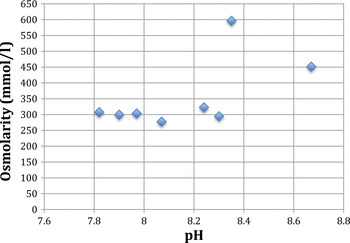
The mean values for pH and osmolarity of the Neilmed Sinus Rinse solution prepared by consecutive clinic patients were 8.17 and 357 mmol/l, respectively. Figure 1 shows a scatter plot of solution pH and osmolarity of Neilmed Sinus Rinse solutions prepared by consecutive clinic patients. Six points cluster around an osmolarity of 300 mmol/l, with a pH range 7.82 to 8.3. There are two points with higher pH and osmolarity values.
Scatter plot of pH and osmolarity for Neilmed Sinus Rinse solutions prepared by consecutive clinic patients.

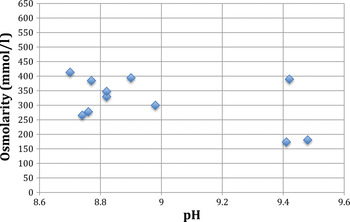
The mean values for pH and osmolarity of the Auckland City Hospital solutions prepared by consecutive clinic patients were 8.98 and 315 mmol/l, respectively. Figure 2 shows a scatter plot of solution pH and osmolarity of Auckland City Hospital solutions prepared by consecutive clinic patients. Eight points are closely clustered together, with an osmolarity range of 266 to 414 mmol/l and a pH range of 8.70 to 8.98. There are three points with a higher pH.
Scatter plot of pH and osmolarity for Auckland City Hospital recipe solutions prepared by consecutive clinic patients.

Discussion
We observed a range of osmolarity and pH values in sinus lavage solutions prepared according to home-made recipes or from commercially prepared sachets. Further variability was introduced by inaccuracies in the measurement of components by patients. This level of variability was little affected by the use of premeasured commercial sachets.
The Auckland City Hospital and University of Iowa solutions had similar physical characteristics to the Neilmed Sinus Rinse solution. The FESS Sinu-Cleanse solution was hyper-osmolar; the home-made recipe that best matched it was the American Academy of Allergy, Asthma and Immunology solution.
The data gathered from nasal lavage solutions prepared by consecutive clinic patients showed variability in these solutions' physical characteristics. The amount of variability did not appear to be greater in home-made solutions than in commercial solutions: each displayed a moderate amount of variability with outliers. This probably reflects errors in measurement of ingredients, in addition to variability in interpreting recipe instructions. The home-made recipes were substantially less expensive.
The pH of some sinus lavage solutions was as high as 9.5; in contrast, nasal mucosa has a pH of 6.4 at baseline.Reference Washington, Steele, Jackson, Bush, Mason and Gill6 There is no evidence to suggest that the pH of nasal lavage solutions is associated with different patient tolerability. However, given the large pH variation observed we would like to study the tolerability of the various nasal lavage solutions. The short and long term effects of nasal lavage with highly alkaline solutions are not known.
• Nasal lavage aids clearance of retained sinus secretions and decreases symptoms in patients with chronic rhinosinusitis
• Various commercial products and home-made recipes are available
• In this study, home-made recipes had similar physical characteristics and reproducibility to commercial preparations
Another shortcoming of the study was the use of distilled water to prepare the solutions, rather than the cooled boiled tap water suggested in the recipes. This could potentially alter the pH and osmolarity measured, and may not be representative of the ingredients used by patients preparing the solutions at home. We used distilled water in the laboratory-prepared samples because we believed that using distilled water rather than cooled boiled tap water would have a negligible effect on osmolarity and pH. At the time of the study, Auckland City tap water had a maximum osmolarity of less than 2 mmol/l and a pH varying between 6.9 and 7.9; therefore, there might have been some effect on pH measurement but we did not quantify this.14 Distilled water by definition has a pH of 7 and an osmolarity of 0 mmol/l. Distilled water is also more readily available in the laboratory.
Conclusion
This study found that home-made nasal lavage recipes had similar physical characteristics to commercial preparations. The reproducibility of home-made preparations was comparable to that of commercial preparations. The ideal physical characteristics for nasal saline lavage are yet to be defined. It is our suspicion that a wide range of pH values and osmolarities are tolerated by the nasal mucosa, and that all of the above solutions are likely to be equally effective. However, clinical studies comparing the clinical efficacy and tolerability of saline solutions are required to define the optimal preparation.
Acknowledgement
The authors wish to acknowledge and thank Nicholas Jones, who kindly communicated his own nasal rinse recipe via email (2 February 2012).